


Erhalten Sie Zugang zu diesem und mehr als 300000 Büchern ab EUR 5,99 monatlich.
- Herausgeber: The Poetry Business
- Kategorie: Sachliteratur, Reportagen, Biografien
- Sprache: Englisch
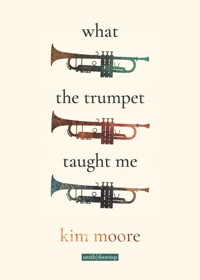
Award-winning poet Kim Moore studied music and was a trumpet teacher for several years. What the Trumpet Taught Me is a collection of vivid and immediate snapshots, from first lessons to music college, and from teaching the trumpet in schools and conducting a brass band, through to playing in working men's clubs in a ten-piece soul band. Meditative and often funny, these short prose pieces are always open to experience and clear-eyed about the vagaries of class-prejudice and the intricacies of gender in a predominantly male world. The trumpet is the central character that we always return to as we are asked to consider the pivotal role of music in both an individual and social history.
Sie lesen das E-Book in den Legimi-Apps auf:
Seitenzahl: 85
Veröffentlichungsjahr: 2022
Das E-Book (TTS) können Sie hören im Abo „Legimi Premium” in Legimi-Apps auf:
Ähnliche















What the Trumpet Taught Me
Published by The Poetry Business
Campo House,
54 Campo Lane,
Sheffield S1 2EG
www.poetrybusiness.co.uk
Text copyright © Kim Moore 2022Cover artwork and illustration copyright © Emma Burleigh 2022
The moral rights of the author have been asserted.
All rights reserved.
Without limiting the rights under copyright reserved above, no part of this publication may be reproduced, stored in or introduced into a retrieval system, or transmitted, in any form or by any means (electronic, mechanical, photocopying, recording or otherwise), without the prior written permission of both the copyright owner and the above publisher of this book.
Designed & typeset by The Poetry Business.
Cover Image by Emma Burleigh.
British Library Cataloguing-in-Publication Data.
A catalogue record for this book is available from the British Library.
Smith|Doorstop is a member of Inpress
www.inpressbooks.co.uk.
Distributed by IPS UK, 1 Deltic Avenue,
Rooksley, Milton Keynes MK13 8LD.
ISBN 978-1-914914-14-0
eBook ISBN 978-1-914914-15-7
The Poetry Business gratefully acknowledges the support of Arts Council England.
I get along without you very well
Of course I do
Except perhaps in spring
But I should never think of spring
For that would surely break my heart in two
‘I Get Along Without You Very Well’,
Hoagy Carmichael
O trumpeter, methinks I am myself the instrument thou playest,
Thou melt’st my heart, my brain – thou movest, drawest, changest them at will …
‘The Mystic Trumpeter’, Walt Whitman
For my twin sister, Jody
I’MTENYEARSOLD when my teacher asks the class who would like to play a brass instrument. Because I’m the sort of child who volunteers for everything, my hand shoots into the air. And though I believe I’m never chosen, this time my teacher picks me, along with my twin sister and two other children in the class. I don’t even know what a brass instrument is, but I know I want to be chosen.
In our school, everyone knows what recorders and violins are. We have a school orchestra, led by a teacher called Mrs M. If you show promise on the recorder, eventually Mrs M invites you to change to the violin. Mrs M writes letters above the musical notes for the recorders, but the violin players have to learn to read music. When she offers me the violin, I refuse. I know the violin sounds terrible. I blame the instrument rather than the children wielding the bow.
Mrs M has short dark hair and huge spectacles. She writes out parts so we can accompany the whole school in hymn practice. Every morning we line up in front of the piano to practise together. Mrs M’s voice is harsh and nasal. She can cut through twenty squeaking recorders and out-of-tune violins without even standing up from her piano stool. We play as the rest of the school sing along, using books held together with tape along the spines. Hymns like ‘When A Knight Won His Spurs’ – my favourite because the words feel like a poem, or ‘He’s Got The Whole World In His Hands’, which I hated because it was repetitive and dull.
THERE’SAPHOTOGRAPH of me and my twin sister, taken the first day we brought a brass instrument home. I’m standing and holding a euphonium that’s clearly too big for me. I think this must have belonged to our school – probably an instrument found in the back of a cupboard and forgotten about.
I’m balancing on one leg, with my other foot on the sofa and supporting the euphonium with my knee. My sister is sitting down, looking grumpy, her leg stretched out and her foot about to kick me, or perhaps push me away. She was probably angry at having to share, having to wait, something that as twins we were always forced to do, and resented deeply. I look happy and pleased with myself – I’m smiling around the large mouthpiece, peering from behind the bell, although I can’t remember any of this. If it wasn’t for the photo, I wouldn’t even know I’d ever taken a euphonium home, that any of this happened.
Although writing this now, I suddenly start to doubt whether it was me holding the instrument at all. Maybe it was my sister, and I was the one doing the kicking, disgruntled and irritated by her happiness. I haven’t seen the photo for years – I don’t even know if it exists in its physical form so I can’t check the truth, and my sister doesn’t remember anything about the moment it was taken.
MYPARENTSTAKE us to a brass band, recommended by my new brass teacher, Mr P, as a place we can get an instrument for free. I ask for a cornet, after watching a young girl playing one with a pearl-like sheen. My sister is given a tenor horn. The conductor, who says we can call him by his first name, W, tells us to join in with the rehearsal, though we cannot read music. I’m told to sit next to a girl with a fox-like face.
I don’t understand why the music in front of me has numbers above each note, rather than letters. I don’t understand that the numbers correspond to the valves I should be pressing down. I don’t even know they are called valves. I’m happily playing along, pressing the valves whenever I feel like it. I don’t know a conductor can hear one person playing a wrong note, even when there are thirty other people playing. Eventually, when I find this out, it seems as if it’s a superpower, and one I’ll never possess.
W is an elderly man with bone-white hair. He waves his arms, urging us onward. Although it doesn’t seem as if anybody is looking at him, or noticing what he’s doing, I understand he is important, that the weather of the room starts and finishes with him.
I STAYBEHIND after junior band rehearsal to listen to the senior band. They play the theme tune to Rocky. I don’t know it’s the theme tune to Rocky. I think it’s the most profound and beautiful thing I’ve ever heard. I have goosebumps on my arms, although it’s not the staccato fanfare of the cornets at the beginning, but the entrance of the lower brass that makes my heart lurch. At some point in the piece, it feels like the music ‘turns’. It’s at this point I understand what yearning means, although I don’t have a name for it, this feeling, this longing. Later, I understand this was a key change. But this is 1992. I’m eleven years old and falling in love.
THEOLDESTTRUMPETS in the world were discovered in King Tutankhamun’s tomb in 1922 by British archaeologist Howard Carter. One of the trumpets was made of silver, the other of bronze. When they were found, they’d not been played for 3000 years.
I imagine picking the silver trumpet up, how light it would be, like a hollow branch. I imagine balancing the weight of it in my hand, of the journey towards the mouth, of filling it with breath for the first time in centuries.
I’MTHIRTEENYEARSOLD. We’re being forced to march up and down in the local park by our new band conductor, R, who is wearing a bass drum, pounding it louder and louder to try and keep us all in time. Our left feet must hit the floor on the first and third beat of the bar.
R tells us to mime, says he doesn’t trust us not to fall over. Even the percussionist is only allowed to carry his drumsticks. I imagine someone from school seeing this and wonder if it’s possible to die of embarrassment.
SOMEPEOPLEMISS W, the old conductor, who waited patiently for us to finish chatting between each piece we played. With W, we didn’t really rehearse, just played through piece after piece from beginning to end. W used to give us a break halfway through rehearsal, and we would go outside and play British bulldog in the car park.
One evening R came in to listen to our rehearsal. He was the senior band conductor and had never shown any interest in the junior band before. That night it was raining, so at breaktime we stayed inside, running around the hall, leaping over our instruments, shoving chairs around and yelling at each other. R stood and watched silently from a corner of the band room, his arms crossed. At the end of the break, we all took our seats, giddy and sweaty from running around. R came to the conductor’s stand and began to shout at us for our recklessness. We’d left our instruments on the floor, not even putting them away in their cases.
W walked out halfway through our telling-off and never returned. I liked W, but I don’t remember asking where he went or whether he was coming back. R took over and began conducting, dissecting what we were playing, asking each section to play certain parts by themselves, every now and then picking out individual players for praise. Nobody said a word for the rest of that rehearsal, apart from R. Even our parents sat around the edge of the room in shame-faced silence.
INREHEARSALS, R jumps up and down in frustration if we miss a key change. He throws the baton across the room if we make the same mistake repeatedly, shouts at people if they haven’t practised, yells if we don’t observe the dynamics and roars wordlessly if we slow down or speed up without being directed. I think he’s wonderful. He never shouts at me, but then I practise for an hour every day, sitting at the dining table with my twin sister, propping our music on our cases because we don’t have our own music stands.




