


11,99 €
Mehr erfahren.
- Herausgeber: Anima Edizioni
- Kategorie: Ratgeber
- Sprache: Englisch
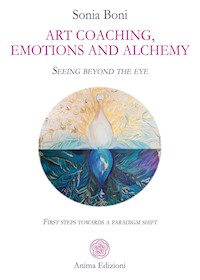
Art for looking within, art for the soul. Consciousness sees no separation; science and art are companions, united by a single truth, guiding us towards a paradigm shift, towards an encounter with the secret language of art.
Have you ever thought that art and art history could be an alchemic tool for the evolution of consciousness? Have you ever wondered what value art could have beyond being purely aesthetic? What if seven small steps were enough to change those assumptions about art that limit its true expression and prevent us from making full use of it to get closer to our souls and listen to and understand what it whispers in our ears? This book is intended to stimulate a change of perspective in order to return art to its true emotional language that is able to touch deep chords and reach inside to “heal” the soul. The intention is to take you on a fascinating journey between art and science where the disciplines converse and complement each other, and to induce you to explore a concept of art therapy that stems from listening to a work of art. Through the exercises I propose, you will learn to “feel” what the work of art arouses in you.
Das E-Book können Sie in Legimi-Apps oder einer beliebigen App lesen, die das folgende Format unterstützen:
Veröffentlichungsjahr: 2023
Ähnliche









BOOK SERIES
DISCOURSES FOR THE SOUL
SONIA BONI
ART COACHING, EMOTIONS AND ALCHEMY
Seeing beyond the eye. First steps towards a paradigm shift.
Anima Edizioni
3
© Anima Edizioni, 2022
© Sonia Boni, 2022
On the cover: Sonia Boni, Trilogy. Story of alchemic transmutation (no. 2)
acrylic on canvas, 50 × 100 cm
All translation, electronic storage, reproduction and adaptation rights, either entirely or in part, by any means (including microfilm and photostatic copies) are reserved in any country. For rights of use, please contact the publisher.
Editor: Jonathan Falcone
Drafting: Camilla Ripani
Administration: Loredana Brondin
Layout: Emanuele Bellisario
Editing: Federica Pizza
ANIMA s.r.l.
C.so Magenta, 83 – 20123 Milan
e-mail: [email protected]
www.animaedizioni.it
Anima 1st edition, January 2022
ISBN: 9788863656763
To mamma Nadia and papa Giancarlo,
my first teachers along the path of existence.
Tireless workers devoted purely to the family.
So different from me and yet, for that very reason, fundamental to my growth.
Thanks to you, I have understood the value of my emotions and my “uniqueness”, of being a voice out of the chorus;
I have learnt to listen to myself and bring to light aptitudes and talents long left in the shadows.
Thank you for encouraging me to be who I am.
INDEX
Preface by Giuseppina Tazzioli
Foreword
Introduction
Chapter 1First steps towards a new paradigm on art
1.1. Art and well-being
1.2. Art, culture, care and well-being
1.3. Art, neuroscience and neuroaesthetics
1.4. Seeing beyond the eye
1.5. Creativity between science and experience
1.6. The road to alchemy: art and physics combined
Chapter 2Beyond appearances
2.1. The wisdom of art
2.2. Art is free and liberating
2.3. The magic of the artist’s studio
2.4. Art, work of art and artist
Chapter 3Be like water. The importance of emotions
Chapter 4Art coaching with an integrated emotional focus. The fundamentals of the method
4.1. Listening to a work of art and instrumentalising the process
4.2. Defining intent
4.3. Bridge between conscious and unconscious and the co-creation of reality: emotions
4.4. Quantum physics and soul
4.5. The value of culture
4.6. The role of the observer
Exercise
Chapter 5The alchemic artist
5.1. Introduction
5.2. Cristina Silletti, the person and the artist
5.3. Interpretation of the works
Chapter 6Art and business
Chapter 7Notions of the history of deep art. The transformative fire
Exercise
Work of art index
Further reading
Acknowledgements
PREFACE
by Giuseppina Tazzioli
In Sonia Boni’s book, the reader is taken on a seven-step journey to discover the secret language of art.
Seven, that quintessential magic number. Seven as in the number of chakras, the days of the week, the branches of the cosmic tree and also the number that acts as a bridge between the known and the unknown.
The book fits precisely into this latter connotation, offering itself as a tool for a reader who intends to embark on a path of self-awareness and of understanding the world through contact with art.
Art is undoubtedly one of the most meaningful expressions of beauty and the experience of beauty has a therapeutic dimension in healing and liberating our original energy, the energy we refer to when we speak of the soul.
It is said that, from the very beginning, we are imprinted with the image of a distinct and individual character and a precise soul project. This implies that there is a specific reason why my person, which is unique and unrepeatable, is in the world and that there are things, beyond everyday life, to which I must devote myself and which give everyday life a reason ...
In short, before birth, the soul of each of us chooses an image or design that we will then experience on Earth and receives a companion who will guide us down here, a unique daemon all to ourselves.
This is an extremely ancient idea: each person comes into the world because he or she has been summoned.
The idea comes from Plato’s Myth of Er.
We have a responsibility towards this original image in the sense that we should endeavour to be responsible for our own soul project.
The search for beauty and its custodianship is the highway to experiencing the profound meaning that our life contains and that can unfold before the seekers’ eyes.
Beauty then, not as the mere result of an aesthetic taste or the attraction of pleasure, but as the source of a deep aesthetic experience, which induces a person to move, change and transform his or her life in order to progressively reach their own authenticity.
It represents that source of wisdom that, over the course of time, has been, and still is, guarded, not only by the great spiritual and religious traditions, but also by philosophy, poetry and art.
And it is precisely in the relationship with art that the author leads the observers towards achieving true harmony with themselves and the world through beauty as it reveals itself and vividly resonates within them.
A necessary step is to nurture our gaze by placing harmony before it.
Since everything is the result of vibration, the experience with art can also be described, at its fundamental level, as the result of syntony between the constitutive vibration of the object and the constitutive vibration of the observer. The vibration of the art work connects with the vibration of the observer and the resonance created between these two vibrations represents the heart of the aesthetic experience. The author therefore invites us to give in to the emotions and sensations that the work arouses in us at that precise moment, because it is precisely from that very vibration that we can open the inner doors that lead us to an ever-deeper relationship with ourselves and allow us to connect to our memories and the mystery we each hold within. By being aware that the ability to enter into our mystery is a way of connecting with our soul, we can teach ourselves to socialise with that characterising mystery by developing the perception of being in front of something immense, which must, above all, be respected, as immense things should be, but which must also be inhabited.
The soul is always with us, but if we are not aware of it and do not perceive it, it is as if it were not there at all. To live, through aesthetic experience, in contact with our soul, requires a person’s total participation. To be recognised, it requires emotional involvement.
The relationship with the art work as an instrument of self-awareness often also causes some extent of pain. The attraction that it arouses, in fact, confuses the self, which feels it is no longer enough and that it needs something else, and therefore must come out of itself. It is precisely this something else, the unknown and irreducible mystery that every human being carries within, that the work prompts us to welcome because it is exactly here where something that resists any kind of interpretation and yet must be exclusively experienced, resides.
This is what the book invites the reader to do. It is an invitation to question ourselves and bring out emotional experience. And the questions that the author puts to the reader lead him or her to make an emotional and vibrational connection with what the art work triggers within them.
Foreword
To you
who are far removed from the world of art; to you who
everyone always said were useless at art; to you who believe
that art is not for you; to you who no longer know how to listen
to your creative and emotional side;
to you who place your interest in profit and think that art is
so distant from it that it does not deserve your attention;
to you for whom reason
is far more important than emotion
and to you
who is rediscovering your creative side; to you who are an artist;
to you who are transforming; to you who are the other, the one
with whom I compare and relate,
the one thanks to whom and for whom I am here today
writing this book…
To You.
Thank you.
This book had been biting at my heels for years. I knew it was calling me but, unlike now, I did not have that irrepressible urge within me to write it.
Basically, if I am writing it today, it is thanks to the path of personal growth that I embarked upon some thirty years ago and which has allowed me to know and strengthen myself, to sink deep roots into the heart of the earth and to extend my branches to touch the sky.
It was time to bear fruit.
The road I had to travel started from overcoming certain fears that had hitherto hindered and limited my evolution.
What a great resource fears are!
We can imagine them as that door beyond which, if we have the courage, we can find unknown aspects of ourselves. After all, the more fears we overcome, the more we will discover who we are and what we can do: our power. We may be surprised at how many resources we have!
I call fears doors, not limits, which is how we were taught to consider them and that term has enshrined in us the impossibility of ever overcoming them.
The etymology of the word ‘limit’ indicates two different Latin nouns limes, limitis and limen, liminis. The former originally meant a path or road that formed the boundary between two plots of land and was later expanded to include fortifications. Eventually it became a defence work that, in the Augustan age, took on the meaning of a line of attack.
Hence, limes for us, is something that divides, separates or can even can become offensive. It is therefore a form of “imprisonment” and can be a danger. The term limen, on the other hand, relates to the threshold and - figuratively speaking - to the beginning, the start. The threshold is a point of passage and can therefore become a place of encounter, exchange and communication. However, in the collective unconscious, it is the first meaning that determines our conception of threshold. This is where thinking of fears as doors - which invokes the lost concept of threshold - allows us to imagine a possible communication with what lies beyond, with a treasure that is waiting for us alone, our El Dorado, a new beginning.
And so, the perspective changes: who would not want to go in search of that treasure?
Only after taking this new point of view into consideration, after freeing myself from that “prison”, did I begin to open those doors and allow myself to communicate with that part of me that lay beyond the threshold, waiting to be seen, recognised, loved.
My story, after all, is no different from that of many of you.
I feel that I belong to that group of “black sheep” who come into families to create havoc because they think, feel, act and live without conforming to the convictions and customs shared by other members of the household. It is no surprise, therefore, that the underlying theme of my existence, the one I had to confront repeatedly, was recognition. A creative, sensitive and “alternative” dreamer, immersed in a pragmatic, utilitarian and highly judgmental reality, I spent most of my existence walking a tightrope, seeking balance without ever allowing myself to step off the tightrope, gripped by the terror of falling and hurting myself too badly. I felt my solitude tearing me apart, so much so that, when I came to that threshold, I would close the door and retrace my steps, seeking safety in a condition that, albeit painful, I was familiar with and had learnt to juggle. My task was to be a voice out of the chorus, but I did not have the strength to totally emerge. Life was a gym where I was both “trainer” and “athlete”. The trainer was often unable to show me the most effective exercises and, just as often, the athlete forgot to train, thus thwarting the previous efforts and results. This is how I managed to destroy credibility and trust in myself!
Until I had sufficient strength at last to cross that threshold beyond which I realised that the judgement, the non-recognition, the feeling of not being seen, did not come from the outside, but were, instead, within me. The people I loved the most had encouraged me to walk that impervious path that would lead me to recognise myself, to see myself and to withhold the judgement that I constantly came up against. That is how, after pursuing a traditional academic path and gaining work and research experiences in institutional settings, I have now come to write about what I have “felt” about art since I was a child, how I see art history and how, through art, I have re-taken possession of my power. And how every person can use it to this end and the innovative method that originated from these foundations that I intend to disseminate.
INTRODUCTION
In these pages you will discover with me a different way of understanding art and art history. We will delve into the mystery of art’s secret language and you will realise how compelling its narrative can be and how powerful its message is.
I only ask you to put aside and forget everything you know or that is commonly said on the subject and allow yourself to re-accustom your eye to real seeing, which is based on a profound connection to your emotions and sensations. A way of seeing that passes through the eye but reaches directly inside you, transforming itself into feeling.
I will talk to you about what I call “listening” to the art work as a fundamental approach to be developed in order to fully enjoy its language until it actually touches our “essence”.
If you allow it to do so, it will enter “within” you through the emotions with which it has a privileged bond and it will take care of you, revealing its incredible, and often underestimated, maieutic dimension.
Then we will talk about emotions and how they can transform our lives.




