


9,99 €
Mehr erfahren.
- Herausgeber: Parkstone International
- Kategorie: Geisteswissenschaft
- Sprache: Englisch
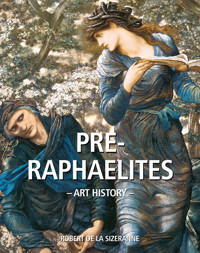
In Victorian England, with the country swept up in the Industrial Revolution, the Pre-Raphaelites, close to William Morris' Arts and Crafts movement, yearned for a return to bygone values. Wishing to revive the pure and noble forms of the Italian Renaissance, the major painters of the circle such as John Everett Millais, Dante Gabriel Rossetti and William Holman Hunt, in opposition to the academicism of the time, favoured realism and biblical themes over the affected canons of the 19th-century. This work, with its captivating text and rich illustrations, describes with enthusiasm this singular movement which notably inspired Art Nouveau and Symbolism.
Das E-Book können Sie in Legimi-Apps oder einer beliebigen App lesen, die das folgende Format unterstützen:
Seitenzahl: 61
Veröffentlichungsjahr: 2024
Ähnliche
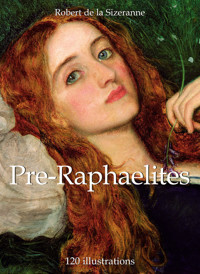
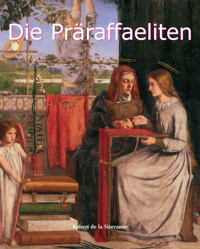















Robert de la Sizeranne
PRE-RAPHAELITES
– ART HISTORY –
© 2024, Confidential Concepts, Worldwide, USA
© 2024, Parkstone Press USA, New York
© Image-Barwww.image-bar.com
All rights reserved. No part of this may be reproduced or adapted without the permission of the copyright holder, throughout the world.
Unless otherwise specified, copyright on the works reproduced lies with the respective photographers. Despite intensive research, it has not always been possible to establish copyright ownership. Where this is the case, we would appreciate notification.
ISBN: 979-8-89405-014-0
Contents
English Art In 1844
The Pre-Raphaelite Battle
Major Artists
William Holman Hunt
Sir John Everett Millais
Dante Gabriel Rossetti
Ford Madox Brown
Sir Edward Burne-Jones
William Morris
List Of Illustrations
John Everett Millais, Mariana, 1851. Oil on mahogany, 59.7 x 49.5 cm. Tate Britain, London.
ENGLISH ART IN 1844
Until 1848, one could admire art in England, but would not be surprised by it. Reynolds and Gainsborough were great masters, but they were eighteenth-century painters rather than eighteenth-century English painters. It was their models, their ladies and young girls, rather than brushwork, which gave an English character to their creations. Walking through the halls of London museums, one could see different paintings, but no difference in manner of the painting, drawing, or even in the conception or composition of a subject. Only the landscape painters, led by Turner and Constable, sounded a new and powerful note at the beginning of the century. As for the others, they painted, with more or less skill, in the same way as artists of other nationalities. Their dogs, horses, village politicians, forming little kitchen, interior and genre scenes were only interesting for a minute, and even then, the artists did not handle them as well as the Dutch. Thus, no one anticipated that out of all this something new and great would emerge. Everything was sleepy and calm; average people, average stories, average painting. Weak, muddy colors layered over bitumen, false and lacking in vitality, the shadows too dark and the highlights too intense. Soft, hesitating outlines that were vague and generalizing. And as the date of 1850 approached, Constable’s words of 1821 resonated; “In thirty years English art will have ceased to exist.”
And yet, if we look closely, two characteristics were there, lying dormant. First, the intellectuality of the subject. The English had always chosen scenes that were interesting, where the mind had as much to experience as the eye, where curiosity was stimulated and laughter or tears provoked by a silent story.
It was rapidly becoming an established idea that the paintbrush was made for writing, storytelling and teaching, not simply for showing. However, prior to 1850 it merely spoke of the pettiness of daily life; it expressed faults, errors or rigid conventional feelings. The other quality was intensity of expression. It is not just “accuracy” that we mean, for this is not a distinctive characteristic of English art. Our wildlife artists of the eighteenth and nineteenth centuries also captured expressions accurately and yet what a difference there is between Oudry’s or Desportes’ dogs in the Louvre and Landseer’s in the National Gallery in London! But intensity of expression was only persistently sought and successfully attained in the representation of animal figures. Most human figures had a banal attitude, showing neither expressiveness, nor accuracy, nor picturesque precision, and were placed on backgrounds imagined in the studio. They were prepared using academic formulas, according to general principles that were poorly understood and lazily applied, fading away with the dimming memory of the old days of Reynolds and Gainsborough.
Such was English art until Ford Madox Brown came back from Antwerp and Paris, bringing an aesthetic revolution along with him. But one must consider that in 1844, when William the Conqueror was exhibited for the first time, no trace of these new things had yet appeared. Rossetti was sixteen years old, Hunt seventeen, Millais fifteen, Watts twenty-six, Leighton fourteen, and Burne-Jones eleven, and consequently not one of these future masters had finished his training. If one considers that the style of composition, outline and painting ushered in by Madox Brown can be found fifty years after his first works in the paintings of Burne-Jones, having appeared in those of Burne-Jones’ master Rossetti, one must acknowledge that the exhibitor of 1844 played the decisive role of the sower, whereas others only tilled the soil in preparation or harvested once the crop had arrived.
What, then, was in the hand of this sower? In his head was the idea that art was clearly perishing because of the systematic generalization of forms. In his heart was the indistinct but burning desire to see art play a great social role in England, that of bread rather than sweets reserved for the tables of the rich. Finally, in his hand were a certain elegant awkwardness and a meticulous attention to detail. That he had learned partly from direct observation of the Primitives. All of this was quite revolutionary and it was also anti-French, anti-continental, absolutely original and autonomous, so it must have appealed to their patriotism for these reasons.
Dante Gabriel Rossetti,Mariana, 1870. Oil on canvas, 109.8 x 90.5 cm. Aberdeen Art Gallery & Museums, Aberdeen.
Charles Allston Collins, Convent Thoughts, 1850-1851. Oil on canvas, 84 x 59 cm. The Ashmolean Museum of Art and Archaeology, University of Oxford, Oxford.
John Everett Millais, Ferdinand Lured by Ariel, 1849-1850. Oil on panel, 64.8 x 50.8 cm. The Makins Collection, Washington, D.C.
When Madox Brown arrived in London, the great competition begun in 1843 for the decoration of the new Palace of Westminster was underway and had produced no less than one hundred and forty works signed by the best artists of the day. This aesthetic tournament is an important date in English art history, because it helped then unknown leaders to stand out from the crowd. Watts, a young artist who had learned independently, had just been noticed there. Madox Brown had sent five large compositions. The principal one was an episode from the Norman Conquest: The Body of Harold brought to William the Conqueror. These were his first forays down a new path, his protest against old and official art.




