


26,99 €
Mehr erfahren.
- Herausgeber: John Wiley & Sons
- Kategorie: Geisteswissenschaft
- Serie: Blackwell Public Philosophy Series
- Sprache: Englisch
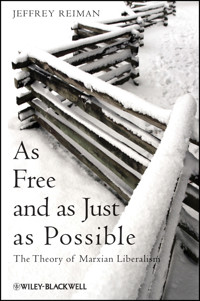
Grafting the Marxian idea that private property is coercive onto the liberal imperative of individual liberty, this new thesis from one of America's foremost intellectuals conceives a revised definition of justice that recognizes the harm inflicted by capitalism's hidden coercive structures.
- Maps a new frontier in moral philosophy and political theory
- Distills a new concept of justice that recognizes the iniquities of capitalism
- Synthesis of elements of Marxism and Liberalism will interest readers in both camps
- Direct and jargon-free style opens these complex ideas to a wide readership
Sie lesen das E-Book in den Legimi-Apps auf:
Seitenzahl: 423
Veröffentlichungsjahr: 2012
Ähnliche




















Table of Contents
Cover
Blackwell Public Philosophy
Title page
Copyright page
Dedication
List of Abbreviations
Preface
1 Overview of the Argument for Marxian Liberalism
2 Marx and Rawls and Justice
2.1 Marx’s Theory of Capitalism and Its Ideology
2.2 Rawls’s Theory of Justice as Fairness
2.3 Rawls on Marx
2.4 Marx and Justice
2.5 Marxian Liberalism’s Historical Conception of Justice
3 The Natural Right to Liberty and the Need for a Social Contract
3.1 A Lockean Argument for the Right to Liberty
3.2 Our Rational Moral Competence
3.3 From Liberty to Lockean Contractarianism
4 The Ambivalence of Property
4.1 Locke, Nozick, and the Ambivalence of Property
4.2 Kant, Narveson, and the Ambivalence of Property
4.3 Marx and the Structural Coerciveness of Property
5 The Labor Theory of the Difference Principle
5.1 The Moral Version of the Labor Theory of Value
5.2 The Labor Theory of the Difference Principle
5.3 Finding a Just Distribution
5.4 Is the Difference Principle Biased?
5.5 Answering Narveson and Cohen on Incentives
6 The Marxian-Liberal Original Position
6.1 Property and Subjugation
6.2 The Limits of Property
6.3 The Marxian Theory of the Conditions of Liberty
6.4 Inside the Marxian-Liberal Original Position
6.5 The Difference Principle as a Historical Principle of Justice
7 As Free and as Just as Possible
7.1 The Just State
7.2 Capitalism for Marxists
7.3 The Marxian-Liberal Ideal: Property-Owning Democracy
7.4 Communism for Liberals
Conclusion
Index
Blackwell Public Philosophy
Edited by Michael Boylan, Marymount University
In a world of 24-hour news cycles and increasingly specialized knowledge, the Blackwell Public Philosophy series takes seriously the idea that there is a need and demand for engaging and thoughtful discussion of topics of broad public importance. Philosophy itself is historically grounded in the public square, bringing people together to try to understand the various issues that shape their lives and give them meaning. This “love of wisdom” – the essence of philosophy – lies at the heart of the series. Written in an accessible, jargon-free manner by internationally renowned authors, each book is an invitation to the world beyond newsflashes and soundbites and into public wisdom.
Permission to Steal: Revealing the Roots of Corporate Scandal by Lisa H. Newton
Doubting Darwin? Creationist Designs on Evolution by Sahotra Sarkar
The Extinction of Desire: A Tale of Enlightenment by Michael Boylan
Torture and the Ticking Bomb by Bob Brecher
In Defense of Dolphins: The New Moral Frontier by Thomas I. White
Terrorism and Counter-Terrorism: Ethics and Liberal Democracy by Seumas Miller
Who Owns You? The Corporate Gold Rush to Patent Your Genes by David Koepsell
Animalkind: What We Owe to Animals by Jean Kazez
In the Name of God: The Evolutionary Origins of Religious Ethics and Violence by John Teehan
The Secular Outlook: In Defense of Moral and Political Secularism by Paul Cliteur
Freedom of Religion and the Secular State by Russell Blackford
As Free and as Just as Possible: The Theory of Marxian Liberalism by Jeffrey Reiman
This edition first published 2012
© 2012 Jeffrey Reiman
Wiley-Blackwell is an imprint of John Wiley & Sons, formed by the merger of Wiley’s global Scientific, Technical and Medical business with Blackwell Publishing.
Registered Office
John Wiley & Sons Ltd, The Atrium, Southern Gate, Chichester, West Sussex, PO19 8SQ, UK
Editorial Offices
350 Main Street, Malden, MA 02148-5020, USA
9600 Garsington Road, Oxford, OX4 2DQ, UK
The Atrium, Southern Gate, Chichester, West Sussex, PO19 8SQ, UK
For details of our global editorial offices, for customer services, and for information about how to apply for permission to reuse the copyright material in this book please see our website at www.wiley.com/wiley-blackwell.
The right of Jeffrey Reiman to be identified as the author of this work has been asserted in accordance with the UK Copyright, Designs and Patents Act 1988.
All rights reserved. No part of this publication may be reproduced, stored in a retrieval system, or transmitted, in any form or by any means, electronic, mechanical, photocopying, recording or otherwise, except as permitted by the UK Copyright, Designs and Patents Act 1988, without the prior permission of the publisher.
Wiley also publishes its books in a variety of electronic formats. Some content that appears in print may not be available in electronic books.
Designations used by companies to distinguish their products are often claimed as trademarks. All brand names and product names used in this book are trade names, service marks, trademarks or registered trademarks of their respective owners. The publisher is not associated with any product or vendor mentioned in this book. This publication is designed to provide accurate and authoritative information in regard to the subject matter covered. It is sold on the understanding that the publisher is not engaged in rendering professional services. If professional advice or other expert assistance is required, the services of a competent professional should be sought.
Library of Congress Cataloging-in-Publication Data
Reiman, Jeffrey H.
As free and as just as possible : the theory of Marxian liberalism / Jeffrey Reiman.
p. cm. – (Blackwell public philosophy; 12)
Includes bibliographical references and index.
ISBN 978-0-470-67412-3 (hardback : alk. paper)
ISBN 978-1-118-23194-4 (mobi)
ISBN 978-1-118-23205-7 (epdf)
ISBN 978-1-118-23206-4 (epub)
1. Liberalism–Philosophy. 2. Philosophy, Marxist. 3. Rawls, John, 1921-2002. I. Title.
JC574.R445 2012
335.401–dc23
2011044951
A catalogue record for this book is available from the British Library.
For Sue
List of Abbreviations
Preface
It was from Karl Marx that I learned to admire capitalism and to fear socialism. In both the Communist Manifesto and in Capital, Marx wrote about the enormous productivity unleashed by capitalism, as well as of capitalism’s power to liberate people from older more repressive social systems. For Marx, capitalism’s productivity would provide the means for freeing human beings from unwanted toil, which he thought would be achieved in communism. Capitalism’s dissolution of the bonds of feudalism, and its promotion of individual liberty, paved the way for freeing human beings from domination by other human beings, which Marx believed communism would also bring. At the same time, Marx thought that capitalism was an unfair and brutal system. For Marx, capitalists’ ownership of the means of production (factories, machines, natural resources) gave them power over the rest of society, because it gave them control over the opportunities for earning a living. And this power was exercised for profit rather than for satisfying human needs. No one who has seen the news recently will find this hard to believe.
Marx thought that the remedy for capitalism was socialism: replacing private ownership of means of production with public ownership. But, as I said, I also learned from Marx to fear socialism. States are already dangerously powerful, with their police forces and armies. If ownership of the means of production is as potent a mechanism of power over people as Marx thought, then it is simply too great – too easy to misuse, too tempting to abuse, too likely to corrupt the powerful – to place it in the control of the state. And in Russia, Eastern Europe and China, history has shown that the danger is real. Whatever good they have done, socialist states have not been hospitable to freedom.
But, not only does Marx’s belief that ownership of means of production is a mechanism of power over people suggest that socialism will be dangerous to freedom, it suggests as well that capitalism’s relatively decentralized ownership of means of production supports the individual freedom that has generally characterized capitalist societies. This might work in the way that James Madison thought that the large number of independent religious sects in America worked to protect religious freedom.
What, then, is to be done? I think that the time is ripe for a philosophical theory of justice that combines Marx’s insights – about capitalism, and about the conditions of freedom and the mechanisms of coercion – with the liberalism that socialist states have lacked. Marxian Liberalism is such a theory of justice. It aims to satisfy the lovers of individual freedom, and the fans of free enterprise, while realizing some of the egalitarian values dear to socialists – but in a form less likely to lead to tyranny. The liberal ideas that Marxian Liberalism combines with Marx’s insights are drawn from the classic work of John Locke, and the recent work of John Rawls, said by some to be the John Stuart Mill of the twentieth century. Marxian Liberalism starts by bringing together the Lockean idea that people have a natural right not to be coerced, with the Marxian idea that private ownership is coercive. From there, it develops a theory of justice that calls for a highly egalitarian form of capitalism combined with a strictly liberal state, and holds that this combination makes for a society that is as free and as just as possible.
Because As Free and as Just as Possible: The Theory of Marxian Liberalism is published in a series on public philosophy, I have written it for the educated layperson, though I hope that professional philosophers find it interesting as well. I have tried to put forth my ideas and arguments in widely accessible non-technical language. Where technical terms are necessary, I define them in plain English. Though some background in philosophy will help in reading this book, I have tried to write it so that such a background is not necessary.
While working on the book, I encountered the late G. A. Cohen’s Rescuing Justice and Equality, a profound full-scale critique of Rawls’s theory of justice. Since Cohen is a philosopher with Marxist sympathies who objects to some of the very features of Rawls’s theory that are crucial to Marxian Liberalism, I had to respond to his objections. Consequently, I engage with Cohen’s views at many points throughout As Free and as Just as Possible. I think that I am able to defend the features of Rawls’s theory that play a role in Marxian Liberalism against Cohen’s objections. And I think that Marxian Liberalism is a better theory as a result. I am grateful to Cohen for this, and feel all the more deeply the great loss his untimely death is for philosophy.
I believed some combination of liberal and Marxian beliefs long before I thought of them as a doctrine with a name of its own. For this reason, I have occasionally been able to make use of previous articles of mine here. Parts of Section 2.1 are from my “The Marxian Critique of Criminal Justice,” Criminal Justice Ethics 6, no. 1 (Winter/Spring 1987), pp. 30–50 (copyrighted material reprinted by permission of The Institute for Criminal Justice Ethics). Section 2.2 draws on my “Is Racial Profiling Just? Making Criminal Justice Policy in the Original Position,” The Journal of Ethics 15, no. 1–2 (Winter 2011), pp. 3–19. Section 4.3 uses material from my “Exploitation, Force, and the Moral Assessment of Capitalism: Thoughts on Roemer and Cohen,” Philosophy & Public Affairs 16, no. 1 (Winter 1987), pp. 3–41. Material from my “The Labor Theory of the Difference Principle,” Philosophy & Public Affairs 12, no. 2 (Spring 1983), pp. 133–159, turns up in Sections 5.1 through 5.4, and Section 6.5. Finally, some of what I say in Sections 2.4, 2.5, and 7.4 is derived from my entry “Marx, Karl,” in Hugh Lafollette, ed., The International Encyclopedia of Ethics (Boston, MA: Wiley-Blackwell, forthcoming). I thank these publications for supporting my work, and for permitting the use of these writings in the present book.
Other thanks are due as well. Though he will surely disagree with Marxian Liberalism, Jan Narveson (whose work is dealt with at a number of points in this book) deserves thanks for being a perfect philosophical pen pal: always ready to argue about the issues and always in a friendly manner. I am grateful to my old friend, Arthur Lothstein, for inviting me to speak at C.W. Post University and give the core ideas in this book their first public airing. I thank Joe Rees, an excellent former undergraduate philosophy student of mine (now pursuing his doctorate at Georgetown University), who read a draft of this book and gave me lots of helpful and challenging comments. Joe also tried to convey to me the questions that his generation of young philosophers might have about my project, and I have tried to respond to those questions in my text. I am grateful to two graduate students: John Fantuzzo, who did most of the historical and legal research reported in Section 6.2; and Brian Brinker, who filled in some of the rest.
I thank Michael Boylan, Marymount University philosopher, and editor of the Blackwell Public Philosophy Series, for inviting me to contribute to that series, for warmly encouraging me along the way, and for reading and commenting extensively on an early draft of the book. I thank Jeff Dean, my editor at Wiley-Blackwell, for his candid advice and friendly support of my project. I am grateful to Jack Messenger for ably copyediting the manuscript, and to Joanna Pyke for skillfully guiding my project from manuscript to book. I thank both of them for accommodating my unpredictable work schedule. And I thank (once again) American University, where I have taught for more than forty years, for providing me with a tolerant and welcoming intellectual environment in which I have been free to follow my philosophical impulses where they led. I am especially grateful to my colleagues in the Department of Philosophy and Religion at American for their warmth and interest and their deep commitment to philosophical inquiry.
Finally, I have had the great good fortune to spend my life with a wonderful, brainy, funny, passionate woman, a professor and an author in her own right, with three books to her name. She stimulates my mind and brightens my days. She is part of everything I do. For this reason, this book is dedicated to her, the other Marxian Liberal, my wife and partner, Sue Headlee.
1
Overview of the Argument for Marxian Liberalism
Marxian Liberalism is a theory of social justice that results from combining certain liberal beliefs, most importantly, that people have a natural right to liberty understood as a right to be free from unwanted coercion, with some Marxian beliefs, most importantly, that private property is coercive. Because Marxian Liberalism aims to protect people from both the normal forms of coercion and the subtler structural coercion of private property, it calls for a society that is as free as possible. Because it defines justice historically, as what can be required of people in light of their changing human nature, it calls for a society that is as just as possible.
A crucial result of combining the right to liberty with the belief that private property is coercive is that on liberal grounds, to be justified, a right to private property must be consented to by all affected by it, which means by all present and future humans. Consequently, consent must be theoretical, not a matter of asking actual people to sign on the dotted line, and I shall explain why theoretical consent is satisfactory in this context (see Section 3.3). To seek theoretical consent is to appeal to what, in the philosophical tradition, is called a social contract. To determine what sort of right to private property would receive this theoretical consent, I deploy an imaginary contracting situation modeled on John Rawls’s original position and veil of ignorance, but with a special difference: The knowledge that the parties in this original position possess includes certain liberal and certain Marxian beliefs. I contend that the parties in this Marxian-Liberal original position will agree to a right to property limited by a strongly egalitarian requirement, namely, Rawls’s . (I lay out Rawls’s theory of justice in Section 2.2.)
Lesen Sie weiter in der vollständigen Ausgabe!
Lesen Sie weiter in der vollständigen Ausgabe!
Lesen Sie weiter in der vollständigen Ausgabe!
Lesen Sie weiter in der vollständigen Ausgabe!
Lesen Sie weiter in der vollständigen Ausgabe!
Lesen Sie weiter in der vollständigen Ausgabe!
Lesen Sie weiter in der vollständigen Ausgabe!
Lesen Sie weiter in der vollständigen Ausgabe!




