


Erhalten Sie Zugang zu diesem und mehr als 300000 Büchern ab EUR 5,99 monatlich.
- Herausgeber: The History Press
- Kategorie: Geisteswissenschaft
- Sprache: Englisch
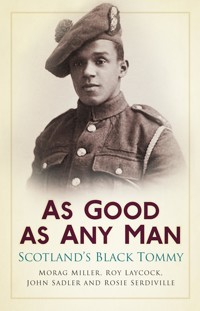
When the harrowing Great War diaries of one of Britain's first black soldiers were unearthed in a dusty Scottish attic nearly 100 years after they were written, they posed a bit of a mystery. The diary entries – ranging from May 1917 to March 1918 – were written by one Arthur Roberts while he served initially with the King's Own Scottish Borderers before being transferred to Royal Scots Fusiliers in 1917. He details what life was like for him during the First World War, how he survived the Battle of Passchendaele, and how he escaped unscathed when a German shell killed a dozen men round him. Yet Arthur was an otherwise unknown man – what was the rest of his life like? Now, Morag Miller and Roy Laycock have painstakingly researched Roberts' life history, filling in the gaps. From his birth in Bristol, to his life in Glasgow and time at the front, they provide here much more than just a war memoir. This is a unique history of one man's remarkable life. Beautifully illustrated with Roberts' own accomplished photographs and artwork, As Good As Any Man is the remarkable biography of one of Britain's black Tommies.
Sie lesen das E-Book in den Legimi-Apps auf:
Seitenzahl: 248
Veröffentlichungsjahr: 2014
Das E-Book (TTS) können Sie hören im Abo „Legimi Premium” in Legimi-Apps auf:
Ähnliche




















To Ian Martin, Archivist, King’s Own Scottish Borderers. Without whose enthusiasm and support this work would never have been published.
No black no white, No good no bad, There stood glory, There fell fate …
Arthur William David Roberts (1897–1982)
One hundred years have passed,
Still the blame goes on,
No black no white,
No good no bad,
There stood glory,
There fell fate,
Where was sense,
Where was shame,
But never forget,
Those who gave,
Their todays,
For our tomorrows,
Nor those who lived,
And bore the scars for life.
Roy Laycock: 1914 (2012)
CONTENTS
Title Page
Dedication
Epigraph
Acknowledgements
Introduction: The Forgotten
1 The Boy
2 The Recruit
3 The Soldier
4 The Veteran
5 The Survivor
6 The Old Sweat
7 The Native
8 As Good As Any Man
Map 1: Third Battle of Ypres 1917
Map 2: Western Front 1914–18
Bibliography
Copyright
ACKNOWLEDGEMENTS
This book could never have been written without the detailed research and background work undertaken by Morag Thomson Miller and Roy Laycock. It is their dedication and diligence that has steadily built up Arthur’s story from the time of its chance discovery. Thanks are also due to Chloe Rodham for the maps, Ian Martin, curator of the King’s Own Scottish Borderers Museum in Berwick, Murray Miller, Laura Smith, the owners of Arthur’s memorabilia, Doreen Thomas, Darryl Gwynne and family, Lauren Crooks, Ian McCracken, Rita Thomas, Craig Fleming, Tony Sharkey, Steve Wallwork, Marc Rath, James Beal, Sarah Taylor, Janet Hiscocks, the Bristol Archivists, Karen Greenshields, Ruth Alexander, Izzy Charman from Media, Allison O’Neill, Jim and Isa Wilson, personal acquaintances of Arthur, Alan Bullas, for photographs, Glasgow Registry Office, The Mitchell Library, Glasgow, Thos Robertson, Wendy L.T. Miller, Christine Hughes, Jane Rafferty, Sandy Leishman, Bob Steele, Pat Docherty, Frank Leonard, Gus McPherson and Jean Mackenzie, staff at the Glasgow City Archives, Jim Fleming, and, finally, to Mark Beynon and the editorial staff at The History Press for another successful collaboration.
***
I should like it to be clearly understood that in writing this miniature book of sketches, I lay no claim whatever to possess any literary abilities (Arthur Roberts).
Likewise, any errors or omissions are entirely the responsibility of the joint authors.
Rosie Serdiville, John Sadler, Morag Thomson Miller and Roy Laycock
October 2013
INTRODUCTION: THE FORGOTTEN
In the autumn of 2004, two young people purchased a house in Mount Vernon, a residential suburb of Glasgow. They had no expectation of undiscovered treasure but there, in the uncleared attic, they found it. Behind a Dansette turntable they discovered a cardboard box. And in that box was Arthur. Arthur William David Roberts, who had died over twenty years previously and whose life story, like a time capsule, had lain forgotten ever since. Here, in his diaries, pictures and memorabilia, was the record of his life. At the core of Arthur lay his war experience; the record of a man who had lived through the cauldron of Flanders during the Third Battle of Ypres in 1917:
For so short an army career, I think I may safely say, my life during that period was as varied, and eventful, as most private soldiers of a similar length of service. A soldier during war time if capable is pushed into many breaches whether fit for the front line or base. I have been fit for both; consequently I have filled many breaches. The last sentence will perhaps lead the reader to think I am possessed of great capabilities, and this belief may be strengthened when I say that I have been company-runner, batman, guide, dining-hall attendant, bugler, cycle-orderly, dispatch clerk, bomber, motor mechanic, telephone orderly, aircraft-gunner, hut-builder, stretcher-bearer, and one or two other things. Now it has been unintentional, if I have seemingly blown my own horn about my military accomplishments, but I think this book, written as frankly as I could write it will exonerate me from any imputation of self-aggrandisement.
The strange thing about it is, that according to my discharge, my military qualifications are ‘Nil’. At that rate, I think nothing short of being a Commander-in-Chief, allows me to have a military qualification.
There is yet another very strange thing, but this also puzzles me. I have volunteered for detachments, sniping jobs etc., but when the orderly sergeant was looking for volunteers for church parade, Pte. Roberts was talking scandal in the latrine, or was attacked with a generous fit, and was carrying water for the cooks.
Should the parade be compulsory, the same Pte. fell in the extreme rear, trusting to luck that the church hut or tent, would not hold the lot.
The story is a remarkable one. Arthur Roberts was born in Bristol in 1897 of mixed-race parents. David Roberts (Jenkins), his father, a ship’s steward, hailed from the Caribbean. His mother, Laura Dann, was a West Country lass. By the time of Arthur’s birth, the family had dropped the surname Jenkins. At some point in the early twentieth century it appears Arthur and his father moved to Glasgow, where the young boy was educated. Remaining at school well beyond the normal leaving age of 14, it is clear from the quality of his prose that he was a highly intelligent and articulate young man. The photographs show us a bit of a dandy: he looks directly and confidently out at the world, a young man of style, who invites our interest – traits that would be apparent all his life.
The adult Arthur was a marine engineer who worked for some of Glasgow’s largest and most important engineering firms: Harland & Wolff and Duncan Stewart (later Davy United). He volunteered in February 1917, first with the King’s Own Scottish Borderers, then, in June of that year, with 2nd Battalion Royal Scots Fusiliers.
Arthur’s story is not just another set of Great War memoirs, adding to the considerable volume that already exists, but a unique record from the viewpoint of a mixed-race soldier. Relatively few black soldiers served in a front-line role with Scottish regiments in the First World War. The conflict consumed many lives in Scotland and her proud regiments garnered many laurels – won at a very high price. Arthur Roberts does not dwell on his race or cultural identity – he is very much an individual, both participant and wry observer, slightly detached, while clearly not, in any way, excluded.
Accounts by black soldiers are very rare in Scottish literature. And yet Arthur’s narrative is very much a Scottish experience, regardless of the writer’s origin. It is extremely well written and beautifully illustrated; the writer was an accomplished artist. It is more than just a war memoir, it is a fully rounded account that has been ably illuminated by Morag Thomson Miller and Roy Laycock, who have painstakingly researched the subject’s life history. They know Glasgow intimately as natives and a great part of Arthur’s story is his life as an adopted Glaswegian:
I first actually entered the trenches on the dawn of 9th June, 1917. I can tell you, after our gruelling march [described in the diary], I was a physical wreck. That night as I plumped down in a dugout, I was so tired that without taking off my equipment, I almost immediately fell into a trance. All the Kaiser’s horses and all the Kaiser’s men could not have put the wind up me that night. No, I was too far beyond the stage of self-preservation. Sleep and welcome oblivion was wanted. I believe I should not have cared if I had been told I should never wake up again.
Every year, Remembrance Day on 11 November becomes a more self-conscious event – now almost ‘Disneyfied’ in the contemporary slush of sentimentality. No future generation will have the privilege of hearing, in person, the voices of those who served, as the last known survivors have died. This marks a watershed, when the conflict passes beyond immediate consciousness, past a memory of fathers and grandfathers, and grows increasingly remote.
There is a duty and a compulsion to keep these voices alive. Whether Tommy Atkins was a ‘lion’ led by ‘donkeys’ or whether the generals were thwarted by advances in technology that rendered a well-held trench line unbreakable is not the subject of this book. Arthur Roberts was not just a military figure: his life is a window on the twentieth century. He was of mixed race, yet he remained in education till the age of 18 – an achievement in itself. His grasp of language and grammar were exemplary and he was as skilled with the brush as the pen. His war memoir is fluent and accomplished, delivered with humour and panache, yet this is but part of a wholly remarkable story.
Arthur suffered recurring foot problems and may not have seen further active service after 1917. He was demobbed on 5 December 1919.
By now Glasgow was his home city and that was where he would finish his apprenticeship. He returned to sketching, was confirmed into the Anglican faith and resumed his interest in music, particularly the banjo. He met his future wife in the 1930s, though they did not actually marry until many years later. He continued to live and work in Glasgow during the Second World War, though whether he ever joined the Home Guard or Civil Defence Corps remains unclear. His post-war photos show him as still very much the dandy, even on the beach! His wife Jessie died young, aged only 63. His next relationship, with Jessie’s cousin Jean McDonald, lasted until she too died in 1977. Arthur’s health declined and his later years were spent in care, where he died at the age of 84.
The house in Mount Vernon had been the property of an elderly widower who never got round to clearing the attic: it lay undisturbed for decades. The new buyers knew nothing of Arthur William David Roberts until the day they came across that large cardboard box with its wealth of memorabilia. Twenty years had passed since Arthur’s death. Gazing on the life story laid out on the attic floor, it seemed as though Arthur had prepared his hoard and left its discovery to chance.
His Great War diary and collected memoirs had been boxed up with his satchel, official documents placed separately. Photos, postcards and drawings together with three albums, various Christmas cards and other, unrelated items, all lay waiting for their audience. The young woman, Laura, who, with her partner Murray, had bought the house, used some of the Great War material in her academic work. It was her course tutor who advised her to consult a military expert. That was when the full significance of the diary emerged. Morag and Roy, who had agreed to take on the research task, consulted Ian Martin at the KOSB Museum in Berwick-upon-Tweed. Thanks to Ian’s experience and diligence a clearer record of Arthur’s Great War service came to light. Morag and Roy were now fully possessed by historical fever – they had to know more.
How had the box ended up in this particular attic? Arthur appeared to have had no connection with the address. A series of clues emerged from the cache of personal records. Tellingly, his death certificate (dated 15 January 1982) listed his executor as a Mr J. Walker. He was the elderly widower who had owned the property – the link was now established.
Ian Martin, at the KOSB Museum, put Morag and Roy in touch with two historians who were researching Great War material. Like Morag and Roy, Rosie Serdiville and John Sadler were hooked as soon as they read Arthur’s diary – this book had to be written.
The diary, reminiscences and memoirs provoked considerable media interest worldwide in 2011. Press coverage prompted TV features and the story of Arthur Roberts jumped from obscurity to near celebrity. People began to get in touch. Doreen Thomas was a distant cousin of Arthur’s and still lived in Bristol. Another cousin, Darryl Gwynne, made contact from Georgetown, Canada. Two important local witnesses – James Wilson, who’d been Arthur’s apprentice in Duncan Stewart & Co. and Allison O’Neill, latterly his key care worker, in Crookston Care Home – were inspired to come forward. This book represents a distillation of the available evidence from the above sources, and we are deeply grateful to all of them for enhancing our knowledge and understanding of this remarkable man.
This, then, is the story of a man’s life, a man who was at once both extraordinary and commonplace. Arthur Roberts comes alive through his own words: erudite, confident and witty. He gives himself to us as a man of his times, an adopted Glaswegian, his life a window on the life of this great city through much of the twentieth century. Those who seek evidence of racism and discrimination will be disappointed. Arthur’s ethnicity is never of concern to him, and his only reference to it is in terms of his army service. To Arthur, Glasgow appeared a cosmopolitan and tolerant place. That he does not report any tensions may come as a surprise to some readers. Arthur is the medium, Glasgow and the unfolding of the twentieth century is his canvas.
1
THE BOY
Life can be hard for incomers. Later in this book we refer to the Race Riots of 1919 when Glasgow, like so many other cities, erupted into violence. Fuelled by economic desperation and community distrust, groups of white and black seamen clashed around the docks. On the surface it appeared there was scant welcome in this city for a man of colour.
The experience of Arthur William David Roberts proved different. He was not a native Glaswegian, having been born in Bristol on 28 April 1897. His father, David Roberts Jenkins, was Afro-Caribbean, his mother, Laura Roberts Jenkins (née Dann), was a West Country lass. David Roberts (he dropped ‘Jenkins’ before Arthur was born) worked as a ship’s steward (at one time on the SS Micmac). Arthur was still very young when he and his father moved 400 miles north to Glasgow, the ‘Second City of the Empire’. They would settle in the Anderston district:
The suburb adjoins the western extremity of Argyle Street and stood quite apart from Glasgow till about 1830. Later it communicated with Glasgow by an open thoroughfare, called Anderston Walk. [In Arthur’s time it was completely enveloped in the western extensions of Glasgow.] It stood amidst these extensions with old dingy features of its own, in strong contrast to the surrounding impressive Victorian architecture: impinging on the Clyde along what in the early 1900s was a dense and very busy part of the old docks, but what formerly lay far westward beyond the old dockland’s lower extremity: at its centre an old main street, Stobcross Street, deflecting at an acute angle from Argyle Street, leading on toward Finniston. Here there were a number of narrow old streets very densely peopled, and a number of newer or more airy ones, mostly going parallel with one another, at right angles to Stobcross Street, to the Clyde. This area is now unrecognisable due to the construction of the Kingston Bridge in the late 1960s.1
This rather dry portrait describes a period of profound change and rapid growth. From long centuries of semi-rural calm the area had sprung into industrialised life during the second half of the nineteenth century. The brash new industries of the great city, shipbuilding, iron-founding, engineering, their growth fuelled by proximity to the packed waterside, spurred a demand for mass housing. Tenements were thrown up to house the influx, densely packed with a slew of new churches to feed the spiritual needs of this burgeoning population. Two vast municipal-style bakeries provided further employment. Alongside these larger concerns many small backstreet workshops flourished.
Immigration was nothing new in Glasgow. During the late eighteenth and early nineteenth century a rush of Irish Protestants were drawn by opportunities in the booming textile trade, their Catholic countrymen attracted by a rising demand for unskilled labourers. These two communities had a history of enmity and carried their prejudices with them. About the time Arthur’s family shifted into Anderston, a fresh wave of immigrants, this time escaping from agricultural stagnation in Italy, began to arrive in Scotland with Glasgow as their main destination. The city became a vast cosmopolitan sprawl. New wealth and confidence fuelled a rash of major civic projects – the Loch Katrine Aqueduct, City Subway and Tramway, City Chambers, Mitchell Library and Kelvingrove Museum all owe their origin to this period. The population had long since surpassed that of Edinburgh – Glasgow became one of the first cities in Europe to house more than a million inhabitants. Major international exhibitions were staged at Kelvingrove in 1888, 1901 and 1911.
This urbane and confident facade hid a darker reality of slums and poverty, of hunger and disease, high infant mortality and reduced life expectancy due to squalor and want. Black immigrants faced an even darker time, as reported in the Scotsman in 2007 (200th anniversary of the abolition of the slave trade in the British Empire):
John Glassford was a hugely successful tobacco merchant who had a street named after him. It is near Buchanan Street, named after another tobacco merchant. Jamaica and Virginia Streets also attest to Glasgow’s connections with tobacco and slavery. These streets crisscross modern-day Glasgow like scars from a slave-master’s lash.
In Glasgow, the city’s slave history is only half-hidden. Massive signs announcing Merchant City adorn George Square, and the Glasgow Museum of Modern Art – one of the city’s most prominent structures – is now housed in what was once a tobacco merchant’s private residence. What is missing in these edifices are the appalling conditions that brought this splendour into being. The Barons that built Glasgow into what it is today made their money from trade with slave-worked plantations. This trade was vital to the plantations’ survival and so to slavery itself.2
A series of industries boomed in Glasgow as a result of the trade in sugar, tobacco and later cotton – rope and leather works, iron foundries, textile factories churning out clothes for slaves – the wealth spilled out through the region.
When the young Arthur Roberts and his father relocated to Glasgow they would know very little of this. Why they chose Glasgow is not recorded. The reason was probably family related. Throughout the course of his diary and reminiscences Arthur rarely refers to any form of bigotry or discrimination. This is not to say he was never on the receiving end of racism, but he certainly does not see himself cast in the role of victim. Throughout, he appears confident, even buoyant, at ease within his own frame. He never appears to have contemplated living anywhere other than Glasgow, which he clearly regarded throughout his life as home. His childhood was spent in the sprawling, smoke-laden labyrinth of Anderston, one working family among many. The dark, austere tenements resonated with the clamour of industry and trade – redolent with the fumes of leather, oil, steam, sweat and a hundred varieties of cooking and spilling ale houses. These crowded tenements housed commerce on the ground floor, split by narrow alleys or ‘closes’ giving access to an internal yard. Rear stairs led to individual households above. Each household – either a single room or a room and kitchen – typically housed an extended family. Arthur would do his growing up in this intensely communal setting, one that produced a fair measure of local pride and assurance, coupled with deprivation, chronic health problems, dank, dismal and perennially overcrowded. Arthur slept in a cubicle in a model lodging house called the Exhibition Hotel but presumably spent meal times and leisure hours in the single-end at 635 Argyle Street.
He began his education at Finniston Primary before moving to senior school at Kent Road. At this time the University of Glasgow was at the forefront of learning innovation, educating the rising bourgeoisie for careers in business and the professions. The school-leaving age had been raised to 14 in 1901. From the 1870s Scotland had begun moving toward a system of universal state-funded education, compulsory for all 5 to 13-year-olds. Larger urban school boards established ‘Higher Grade’ (Secondary) schools, such as that which Arthur would attend, as a cheaper alternative to the burgh schools. The Scottish Education Department introduced a Leaving Certificate Examination in 1888 to set national standards for secondary education and in 1890 school fees were abolished.
As he walked daily along crowded streets to school, Arthur would have witnessed the spectacle of small herds of bleating sheep and nervous cattle being driven through the streets. Granite setts ringing with the clopping of cloven hooves, pigs were hustled noisily towards their final destination at Sir Thomas Lipton’s original store at 101 Stobcross Street. These animals were moving adverts for the enterprising grocer, their fat necks slung with prominent notices proclaiming: ‘I’m on my way to Lipton’s, the best place in town for bacon!’
Harry Lauder was the doyen of innumerable variety theatres, but the suffragette leader Mrs Pankhurst was a more contentious visitor. Arthur’s higher grade school at Kent Road was scarcely 200yd from St Andrew’s Hall where, on the evening of 11 March 1914, a suffragette meeting degenerated into a brawl, with Glasgow’s finest being pelted with plant holders and a few blank rounds discharged. Undeterred by the heated reception, Mrs Pankhurst was duly dragged off into incarceration – prompting a march by some 4,000 protesters.
Arthur was a bright and studious boy. Lively but conscientious, he showed an early talent for drawing and his sketches soon became proficient. He was by nature sociable and gregarious, in many ways a born actor. Joining the Boy Scouts suited his orderly temperament and the crisp uniform was an obvious attraction for the emerging dandy. Music, particularly, at this time, the bugle, proved an added impulse. The need for practice must have been something of a strain for those round him in such densely crowded conditions!
1914 saw storm clouds gathering over Europe. Arthur and his emerging generation could have no idea of the Calvary that was awaiting them. On 28 June, in the Balkan city of Sarajevo, a teen assassin fired two fatal shots that would change the world forever. This storm had been brewing for over forty years, since Bismarck’s plans had first included the humiliation of France and ushered in an era of nervous yet aggressive superpowers divided into armed camps, poised to mobilise. Glasgow was one of the world’s greatest industrial centres and Scotland was about to be precipitated into the world’s first industrial war – conflict on a scale and of an intensity never before dreamed of. The optimistic shout at war’s outset ‘It will all be over by Christmas’ would ring as hollow as the claim, at war’s end, that veterans would return to ‘a land fit for heroes’.
It has been said, not without truth, that Britain fielded four armies during the Great War. First, the original regular army and reserves that formed the British Expeditionary Force (BEF) in 1914 (immortalised as ‘the Old Contemptibles’). Second, the Territorial Battalions, third Kitchener’s New Army Battalions and, finally, the conscript army of 1917–18. The core tactical unit throughout was the battalion (typically 750–1,000 men). This was headed by a colonel, essentially an honorary position, but actual day-to-day command was vested in the lieutenant-colonel. As a rough rule, some 10 per cent of battalion strength was kept in reserve, left out of the battle (‘LOOB’), as a core around which to rebuild if the unit was badly cut up. All too often this pragmatic prophecy would indeed come to pass. Below lieutenant-colonel was the major, who normally commanded the 250-strong HQ Company. Then ‘A’, ‘B’, ‘C’ and ‘D’ Companies were each commanded by captains, all at similar notional strength. Each company was then divided into four sub-units or platoons: an HQ platoon (commanded by a lieutenant with an NCO and four privates or ‘riflemen’ in a Rifle unit); then four other platoons, numbered 1–4, led usually by a second-lieutenant (subaltern), with four NCOs and thirty-two privates. The platoon itself was broken down into sections, the smallest tactical unit, each of eight men and an NCO. Crucially, the infantry battalion in 1914 possessed only two Vickers medium machine guns. From 1915 firepower was significantly enhanced by the introduction of lighter automatic weapons, such as the Lewis Gun. Latterly, the medium machine-gunners were transferred to the Machine Gun Corps and the number of Lewis guns available was increased from four per battalion to four times that number and double that again after the Somme. In 1914, four battalions, under a brigadier-general, formed a brigade and three brigades a division. This larger unit was commanded by a major-general and possessed its own signallers, medical staff, engineers and gunners. Some three, perhaps four, divisions would be formed into an army corps, led this time by a lieutenant-general. A number of corps, say four–six, would constitute an ‘army’. Britain would have five armies deployed on the Western Front with total ration strength of over a million men.
The young Arthur Roberts, like so many of his generation, had a taste for the pomp of war; his keenness for the plangent notes of the bugle would echo through his military service:
During my school days I was possessed of great military inclinations. Anything in the form of drill, or manoeuvres, interested me exceedingly. As a result when the church to which I belonged, got a troop of scouts, I worried my father so much for permission to join them, that at last, for relief he consented. To cut a long story short, I took this good opportunity of learning the bugle, and speaking frankly I became fairly efficient at the instrument. Some years later, the Great War broke out, and in the course of time I was with many thousands more engulfed in that titanic conflict. As will be seen in the diary, I was one time stationed at Le Havre, and it was here, that, the following incident took place.
The bugler of the camp in which I was, became very friendly with me, so me, fancying my prowess as a bugler, it was only natural I should ask him to let me blow a call. Oh how I have reason to regret that request, and if I could only have seen twelve short days ahead of me! Looking at it from another point, it just had to be, so there is no use worrying now. However, to return to the story, he complied and I blew that particular call in fine style, much to my satisfaction and his surprise. This, dear reader was the first move of fate in the game. Follow closely. Now, unless there are two or more buglers in a camp, the chap who has the job, is practically tied to his post. Imagine the joy of this bugler discovering me. Believe me; he made full use of his discovery. Any night he was other-wise engaged, I acted as his deputy with pleasure. Thus, fate made its second move.
It so happened, the bugler was sweating on the top line for leave, about this time, so I was not surprised when, 21st December 1917 to be exact, he informed me gleefully; he had been warned for leave. The orderly sergeant promptly told me off for bugler, for the ensuing fifteen days, being as he said (bunkum of course) the only man in the camp able for the job. This was move the third. How mysterious are the ways of fate. Watch how magnificently it works up to its final blow.
No doubt, it was a cushy job, for it entailed no such distasteful things as work or inspections, or guards and such like. To tell the truth, the job was too alluring, no wonder I was elated. I was looking forward to fifteen glorious days, so, as it was pay-day, why should I not find enjoyment suitable to my mood? No sooner thought than did. I had a glorious time (curtain). Isn’t fate playing well?
Curiously enough, the officer’s servants and cooks, amalgamated that same night. Their movements after leaving camp were unknown to any, but themselves, but fortune smiles on the Bacchanalians at times, so they successfully, like myself, evaded the maw, of the ever ready red-caps, and the wee small hours witnessed their straggling return. Of course, I’m only imagining that they straggled. Here we find fate has made its fifth move and is now ready, with all the heroes, and the super hero (me), lying drunk, incapable, and happy for the grand finale.
Oh dear reader! Have you ever tried to write, with truth and candour about one of your own personal disasters? If you would be advised – don’t. I took up this work before I knew, so it’s the hand on the plough business. I’m afraid I’m guilty of straying again, but here goes for the great smash. From a dreamless sleep, I was boisterously wakened to find myself half out of bed, and the orderly man yelling ‘Hi! Hi! It’s after six o’clock. Get Up! Get Up! Man, you’re the bugler, your late, come on! Get up!’
When I recovered some of my senses, I attempted to rise, but instead, I rolled out of bed. ‘What! What!’ says I, my mouth like a sewage pipe, ‘where’s the damn bugle, where’s my trousers and my boots? What time is it? Screw on the lights somebody. Oh hell, this is clink for me this time. Damn the rotten bugle. Where’s the mouth piece?’ I found the trousers, but no boots, although I discovered my socks. By this time, I was delaying myself by hurrying too fast. The time was flying, so I followed its example. With only my shirt and trousers and socks on, I dashed out into the December air, with my eyes half shut, and before I stopped, the bugle was up and I was blowing like a hero in action. It was now 6.20 a.m. but the call was over, so I came flopping back, imagine me flopping, to smarten myself up a bit. Dear reader, leave me to go on flopping and take a peep into the officer’s quarters.




