


21,99 €
Mehr erfahren.
- Herausgeber: John Wiley & Sons
- Kategorie: Geisteswissenschaft
- Sprache: Englisch
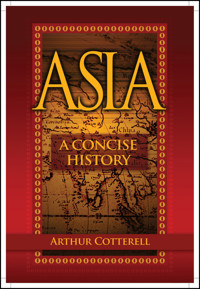
From one of the world's leading historians?a comprehensive narrative of the 3,000 years that have formed Asia's people, culture, and global destiny
Tracing its origins in Mesopotamia to its modern role on the global geopolitical stage, historian Arthur Cotterell offers a compelling, lively, and readable account of one of the most culturally diverse, and often misunderstood, parts of the world. Beginning with the emergence of the world's earliest civilization in 3000 BC, Asia: A Concise History provides a fascinating look at the global convulsions?like the rise and fall of Assyria and Persia, the medieval states that flourished after the advent of Islam, and the modern transformations triggered by the lightning conquests of imperial Japan?that have shaped the continent.
- Covers the great events and figures of Asian history, along with a look at the monumental remains that bear witness to those times: the ziggurats of Iraq, the Taj Mahal, the Great Wall of China, the temple of Angkor Wat
- Includes fascinating slices of history, including funeral arrangements for Qin Shi Huangdi in 210 BC; an extract from Lord Macartney's journal of his 1793 diplomatic mission to the Qing emperor Qian Long; and Toyotomi Hideyoshi's edict of 1587 banning firearms in Japan
- Features boxed inserts of special interest?like a Babylonian recipe for lamb stew circa 1500 BC
- Contains over 100 illustrations, maps, and photos
- Other books by Cotterell: The Minoan World, The First Emperor of China, The Encyclopedia of Mythology, and Chariot
Destined to become a reference staple for history buffs and students of Asian history, Asia: A Concise History offers readers a breathtaking narrative and wealth of detail that make the formative periods, key events, and personalities from this once remote part of the world come alive.
Sie lesen das E-Book in den Legimi-Apps auf:
Seitenzahl: 681
Veröffentlichungsjahr: 2011
Ähnliche



















Contents
Preface
Introduction
List of Maps
Photo Credits
Part 1: Ancient Asia
Chapter 1: Ancient West Asia
The First Civilisation: Sumer
The Great Empires: Babylon, Assyria and Persia
Understanding the World: Religion and Myth
Endgame: Greco-Roman Europe Versus Persian Asia
Chapter 2: Ancient South Asia
Asia’s Second Civilisation: The Indus Valley
Epic India: The Aryan Invasion
The Buddhist Revolution: The Mauryan Empire
The Age of Invasion: From the Bactrians to the Huns
Chapter 3: Ancient East Asia
The Cradle of the East: The Shang Dynasty
Classical China: The Zhou Dynasty
Imperial Unification: The Qin and Former Han Emperors
Imperial Crisis: The Failure of the Later Han
Chapter 4: Ancient Central Asia
The Steppe: An Intercontinental Highway
Nomads: The Scourge of the Sown
The Spread of Buddhism: The First Pan-Asian Faith
The Great Raid: Attila the Hun
Part 2: Medieval Asia
Chapter 5: Medieval West Asia
Islam: The Second Pan-Asian Faith
The Umayyad and Abbasid Caliphates
The Coming of the Seljuks
The Crusades
Safavid Persia
The Ottoman Empire
Chapter 6: Medieval South Asia
The Arrival of Islam
The Hindu and Buddhist Kingdoms
The Mughal Empire
European Rivalry
The British Triumph
Chapter 7: Medieval East Asia
Tang and Song China
Confucian Korea
Feudal Japan
The Ming Revival
Chapter 8: Medieval Central Asia
The Turks and the Qidans
The Tibetan Empire
The Mongol Empire
Tamerlane, the Sword of Islam
The Manchu Conquests
Chapter 9: Medieval Southeast Asia
Independent Vietnam
The Khmer Empire
The Kingdoms of Burma
The Island Powers: Srivijaya, Mataram and Majapahit
The Slow Spread of Islam
The Advent of European Power
The Rise of the Thai
Part 3: Modern Asia
Chapter 10: Modern West Asia
The Fall of the Ottoman Empire
Between World Wars
The Founding of Israel
Syria, Lebanon and Jordan
Iraq versus Iran
Saudi Arabia and the Gulf States
Modern Turkey
Chapter 11: Modern South Asia
The British Raj
The Indian Mutiny
The End of Company Rule
Gandhi and Indian Nationalism
Independence and Partition
Sri Lanka and Bangladesh
Chapter 12: Modern East Asia
China’s Humiliation
Japanese Imperialism
The People’s Republic of China
The Korean War
The Rise of the Pacific Rim
Chapter 13: Modern Central Asia
The Russian Advance
The Great Game
Afghanistan, the Land of Bones
Siberia and Mongolia
The Central Asian Republics
Chapter 14: Modern Southeast Asia
The Dutch East Indies
The British Possessions
French Indochina and Thailand
The Greater East Asia Co-Prosperity Sphere
Post-War Decolonisation
The Republic of Indonesia
The Tragedy of Vietnam
Filipino Democracy
Postscript: The Rise of Present-Day Asia
Glossary
Further Reading
Index
Copyright © 2011 John wiley & sons (Asia) Pte. Ltd.
Published in 2011 by John Wiley & Sons (Asia) Pte. Ltd.
1 Fusionopolis Walk, #07-01, Solaris South Tower, Singapore 138628.
All rights reserved.
No part of this publication may be reproduced, stored in a retrieval system, or transmitted in any form or by any means, electronic, mechanical, photocopying, recording, scanning, or otherwise, except as expressly permitted by law, without either the prior written permission of the Publisher, or authorization through payment of the appropriate photocopy fee to the Copyright Clearance Center. Requests for permission should be addressed to the Publisher, John Wiley & Sons (Asia) Pte. Ltd., 1 Fusionopolis Walk, #07-01, Solaris South Tower, Singapore 138628, tel: 65-6643-8000, fax: 65-6643-8008, e-mail: [email protected].
This publication is designed to provide accurate and authoritative information in regard to the subject matter covered. It is sold with the understanding that the publisher is not engaged in rendering professional services. If professional advice or other expert assistance is required, the services of a competent professional person should be sought.
Neither the authors nor the publisher are liable for any actions prompted or caused by the information presented in this book. Any views expressed herein are those of the authors and do not represent the views of the organizations they work for.
Other Wiley Editorial Offices
John Wiley & Sons, 111 River Street, Hoboken, NJ 07030, USA
John Wiley & Sons, The Atrium, Southern Gate, Chichester, West Sussex, P019 8SQ, United Kingdom
John Wiley & Sons (Canada) Ltd., 5353 Dundas Street West, Suite 400, Toronto, Ontario, M9B 6HB, Canada
John Wiley & Sons Australia Ltd., 42 McDougall Street, Milton, Queensland 4064, Australia
Wiley-VCH, Boschstrasse 12, D-69469 Weinheim, Germany
Library of Congress Cataloging-in-Publication Data
ISBN 978-0470-82504-4 (Hardcover)
ISBN 978-0470-82958-5 (ePDF)
ISBN 978-0470-82957-8 (e-Mobi)
ISBN 978-0470-82959-2 (ePub)
For the Class of 1968, V Arts, St. Thomas’ School, Kuching, Sarawak
Preface
“Impossible. I’ve spent my entire life thinking about classical Greece.” Thus George Forrest responded to a request for a 5,000-word article when telephoned one Friday evening in Oxford. Without hesitation, I told him to imagine that he was going to be shot by the junta next Tuesday and this was his last chance to leave behind a considered view. “I’ll do it,” he said to my relief as editor of the Penguin Encyclopedia of Ancient Civilizations. And I consider his contribution still unmatched as an introduction to the subject.
A not dissimilar feeling of impossibility assailed me when my publisher, Nick Wallwork, thought that a history of Asia was a good idea. Even though I have been allowed many more words, the subject is immense in terms of time as well as space. Only the conspicuous absence of any general treatment of a continent so important to the whole world persuaded me to undertake the task. Because Asia will have a great impact on the present century, we really do need to understand how events have shaped its peoples and polities.
Asia: A Concise History aims to provide this guide through a chronological survey of key areas: West Asia, South Asia, East Asia, Central Asia and Southeast Asia. While any book covering such an incredible range of human endeavour can never hope to be more than introductory, there is the possibility that the general reader will obtain a useful overview. At the very least, it is hoped that some bearings will be furnished for those who wish to explore the vast expanse of Asia’s past.
What this book signals are the very different experiences of Asian peoples, not only among themselves, but in comparison with the peoples of other continents as well. Just to list a few of the individuals who have contributed to their history is enough to reveal Asia’s significance in world affairs: Gilgamesh, Ashurbanipal, Zoroaster, Cyrus, the Buddha, Asoka, Jesus, St. Paul, Attila, Muhammad, Abd al-Malik, Confucius, Qin Shi Huangdi, Nagarjuna, Zhu Xi, Genghiz Khan, Yong Le, Hideyoshi, Shah Abbas, Akbar, Gandhi, Atatürk, Mao Zedong, Ho Chi Minh and Sukarno.
By tracing Asia’s development from ancient times, and especially through the amazing diversity of the medieval era, the enduring traits of its various cultures can be discerned as they adapt to globalism. The catalyst for this far-reaching transformation was Western colonialism, whose recent retreat from Asia has produced an entirely new political landscape. Yet the most striking feature of the continent’s history is the fact of its longevity, and not just the unusual length of Chinese civilisation, because Asian polities were the first to appear on Earth. What is new, however, is an awareness of how complex these earliest states were, thanks to the archaeological discoveries of the past 150 years.
In publishing this book I must acknowledge the invaluable contributions made by several people. First of all, my wife Yong Yap, through the translation of documents from Asian languages; second, an old friend Datuk Hj Harun Din, for advice on Islam; third, Graham Guest, another old friend whose extensive archive of pre-1900 illustrations, Imperial Images, has furnished material for the medieval and modern sections; and, last but not least, Ray Dunning, the creator of the maps and drawings spread throughout the book.
Perhaps the dedication needs a word of explanation. During the 1960s, I had the good fortune to teach in newly independent Sarawak, one of the states of Malaysia. Then I was struck by the communal harmony that existed among its more than forty distinct peoples, an undoubted legacy of the relaxed approach adopted by James Brooke, the first “white rajah”. Only six of Sarawak’s peoples were represented in the class mentioned in the dedication, but their different perspectives meant that our discussions were often a revelation. Besides making me aware of a wider range of possibilities, they planted an abiding interest in things Asian. I can only hope that this brief survey of Asia’s past encourages a similar appreciation of its remarkable achievements.
Introduction
Asia invented civilisation. The earliest cities in the world appeared in Sumer, present-day Iraq, during the fourth millennium BC. Egypt was not far behind this urban revolution, but it was the Sumerians who shaped the consciousness of ancient West Asia. Their seminal thought is known to us from the library belonging the Assyrian kings. Translation of one royal text in 1872 caused a sensation because it comprised the Babylonian account of the Flood, a story believed to have been biblical in origin. When scholars discovered that this myth went all the way back to Atrahasis, the Sumerian Noah, they realised that here were some of the oldest ideas to survive anywhere on the planet.
In chapter 1, the Sumerian heritage is viewed through the empires of Babylon, Assyria and Persia, its successor states in ancient West Asia. Persian rule, however, was interrupted by Alexander the Great, whose conquests stretched as far as northwestern India. His generals could not hold on to these vast territories, so a revived Persia confronted the Romans in the Mediterranean. The seesawing struggle between Europe and Asia lasted well into the medieval period, with the Crusades and the Ottoman occupation of the Balkans. In ancient times, this intercontinental struggle had already acquired religious overtones. Because the multiplicity of deities derived from the Sumerian pantheon were largely replaced by the monotheism of Jewish belief through its powerful offshoot, Christianity. What the Christians retained in Jesus though, much to the later consternation of Muhammad, was the Sumerian notion of a dying-and-rising god.
Chapter 2 begins with the civilisation that arose in the Indus river valley about 2200 BC. Even though an inability to decipher the Indus script renders our understanding of this second-oldest Asian civilisation incomplete, archaeological remains point to a religious tradition that had a profound impact on Indian belief. Ritual ablution, yoga and worship of a mother goddess were passed on to the Aryans, who overran the Indus valley between 1750 and 1500 BC. Their chariot-led invasion made this war machine central to Aryan culture: its effectiveness is celebrated in the epic duels that are described in the Mahabharata, the second longest poem ever composed. Only the La Galigo cycle, belonging to the Bugis on the Indonesian island of Sulawesi, is more extensive in its account of the hero Sawerigading’s exploits. Not so easily dealt with was Buddhism, the first pan-Asian faith. The Aryans had to come to terms with its singular concepts once the Buddha’s message became popular. The patronage of the Mauryan emperors, as well as the Kushana kings, spread Buddhism into Central Asia by means of monastic foundations, whence monks carried the religion farther east to China, Korea and Japan.
The Kushanas were just one of the Central Asian peoples who controlled northern India during ancient times. Under the native Gupta dynasty a degree of stability returned before the arrival of the Huns. As did Attila in contemporary Europe, the Hunnish king Mihirkula took delight in the intimidation of settled populations. Before Gupta strength was worn down, however, the dynasty had rejected Buddhism in favour of Hinduism: henceforth the dominant religion in South Asia, despite Islam’s penetration of the subcontinent during the seventh century AD.
The cradle of Asia’s third-oldest civilisation in East Asia is the subject of chapter 3. There the Shang and Zhou monarchs witnessed the formation of China’s uniquely continuous culture, which was to endure as an empire from 221 BC until 1911. Before imperial unification under Qin Shi Huangdi, the rival philosophies of Confucianism and Daoism had emerged, although the family-oriented system of Confucius would triumph under the emperors. Possibly the remoteness of China from other ancient centres of civilisation in South and West Asia explains its sense of being a world apart. Troublesome neighbours on the Central Asian steppe had led to the construction of the Great Wall, the boundary between the unsown land of the nomads and the intensive agriculture of the Chinese peasant farmers.
But the Great Wall was never enough to guarantee the safety of the Chinese empire once nomadic peoples were recruited as allies. In a parallel to the fate that befell the western provinces of the Roman empire, the whole of north China was conquered by Central Asian tribesmen in 316 AD. Yet the difference between the Germanic and Central Asian invasions could not have been more marked because, unlike Latin, Chinese survived intact and finally replaced the invaders’ tongues as the official language. Only the Persian language achieved a similar longevity in its struggle with Arabic, although it was greatly transformed as a result.
The Central Asians, who took over north China, and indeed other parts of Asia as well as Europe, are discussed in chapter 4. How the Eurasian steppe acted as an intercontinental highway for charioteers and horsemen has come to be appreciated in recent years. Despite the usual direction of movement being from east to west, as nomadic herders headed towards lusher pastures kept green by Atlantic rain, China received the chariot from the Tocharians, a people originally living on the Russian steppe. Their trek eastwards remains an exception to the rule that migration was westwards, particularly after the Great Wall reduced opportunities for raids in East Asia. The scourge of the sown was how Central Asian nomads were viewed. Not until the Turks and the Mughals established dynasties, in West and South Asia respectively, would this perception begin to fade. Even so, Tamerlane was a terrible reminder that nothing could ever be taken for granted in Central Asia.
Chapter 5 introduces the medieval period in West Asia, an era defined by the rise of Islam, the second pan-Asian faith. Prophet Muhammad’s mission was to have a far-reaching influence on the continent. Arab arms took his message to Central and South Asia, while Indian converts involved in trade carried the new religion to Malaya, Indonesia and the Philippines. A crucial decision was the replacement of Jerusalem as the Holy City with Mecca: it meant that the Arab custom of pilgrimage to the Ka’ba provided the means of unifying a community of believers spread right across Asia.
The Prophet’s death brought about a poor compromise over the leadership of Islam, with the assassination of three of the four men who were appointed to succeed him, including his son-in-law Ali ibn Abi Talib. Only with the establishment of the Umayyad and Abbasid caliphates were the fratricidal tendencies of the Arabs tamed, although in 750 the former were slaughtered in a delayed revenge for Ali’s murder. After the decline of the Abbasids, the Turkish Seljuks assumed the leadership of Islam, which was challenged by the Crusades between 1095 and 1229. Out of the mayhem of the Mongol onslaught, however, two major powers arose: Safavid Persia and the Ottoman empire. Today the splendid monuments that their leaders raised can be seen in Isfahan and Istanbul.
The coming of Islam to India is the starting point of chapter 6. Hindu and Buddhist kingdoms continued to flourish in southern India and Sri Lanka, but the medieval experience of South Asia was in the main foreign rule. From Central Asia came a series of Moslem i nvaders until in 1530 Zahir-ud-din Muhammad Babur founded the Mughal dynasty. The transformation of his semi-nomadic followers into the rulers of a great empire is one of the highlights of Asia’s medieval era. That his most famous successor, Akbar, tried to accommodate Indian beliefs and customs is still evident in the Indo-Islamic architecture at Fatehpur Sikri, the city he built near Agra.
Foreign interference was not restricted to overland invaders because Europeans arrived by sea. The Portuguese and the Dutch were the first competitors for Asia’s seaborne trade, but the contest for mastery pitted the French against the British. Arguably, it was their rivalry that turned the English East India Company into the dominant power, once Arthur Wellesley broke the Maratha confederacy in 1803. Well might a Mughal emperor still sit on a throne in Delhi, but real authority resided at Calcutta, the capital of British India.
Having recovered from the Central Asian occupation of north China, the Chinese empire enjoyed an impressive renaissance under the Tang and Song dynasties. In chapter 7 the splendour of their rule is reflected in the two main capitals they constructed: Chang’an and Kaifeng. The former Tang capital, with two million inhabitants, was then the largest and most populous city in the medieval world.
Such was the zenith reached by Chinese culture that its influence flowed strongly into Korea and Japan, shaping their own traditions in a lasting manner. Only feudalism prevented the Japanese from becoming as Confucian as the Koreans. Interminable civil wars ensured that no Japanese emperor ever acquired the authority of the Chinese throne. Despite the Mongol conquest of China between 1276 and 1368, the Chinese restored their empire under the Ming dynasty, strengthening the Great Wall and dispatching fleets under the eunuch admiral Zheng He into the southern oceans. Had the Chinese not turned away from the sea after 1433, Vasco da Gama would have found his tiny fleet sailing alongside a Chinese navy with vessels four times the size of his caravels. The emptiness of Asian waters gave the Portuguese, the Spaniards, the Dutch, the French and, finally, the English a false impression that they were the first explorers to sail there.
Central Asian arms were at their most irresistible during the medieval period. Not only did Genghiz Khan set the Mongols off on a series of conquests that made them masters of the largest empire ever to exist in Asia, its subject peoples living as far apart as Russia, Persia, Korea, China, Cambodia and Java, but the Tibetans and the Manchus also carved out for themselves impressive states. Both the Tibetans and the Manchus harried China, but it was the semi-nomadic Manchus who founded in 1644 China’s last imperial dynasty, the Qing.
In chapter 8 we note as well how Tamerlane’s short-lived triumph could never be forgotten: his liking for severed heads resulted in 90,000 of them being cemented into 120 towers in 1401, after the capture of Baghdad. Despite his title, “the Sword of Islam”, Tamerlane was by no means inclined to behead non-Moslems. In comparison with his Moslem enemies, Christians, Jews, Buddhists and Hindus escaped lightly. But on rare occasions, almost as though to appear even-handed, Tamerlane would unleash his fury against them too.
Chapter 9 is devoted to medieval Southeast Asia, whose various civilisations then came to the fore. First, Vietnam asserted its independence from China in 939, after a millennium of direct rule. Its r ulers never shook off Chinese ways: Confucian learning endured long enough for Ho Chi Minh to despair in the 1900s at its continued use to recruit Vietnamese officials. South of Vietnam, Indian influence prevailed in Champa, Cambodia as well as the Indonesian archipelago, where Hindu-style kingdoms developed. Burma, modern Myanmar, received Buddhism from Sri Lanka, while the Philippines remained isolated from outside ideas before the advent of Islam and Christianity.
Christianity was brought to the Philippines by the Spaniards in the sixteenth century. At first they shared the spice trade with the Portuguese, but the Dutch decision to establish a permanent base on the island of Java gave them the upper hand in Indonesia, soon known as the Dutch East Indies. Another late intruder were the Thai, who left what is now the Chinese province of Yunnan during the fourteenth century.
Modern times commenced with Asian polities in full retreat. Western encroachment either overland or by sea reduced the majority to the status of colonies, protectorates or client states. Political realities were to alter dramatically after the Second World War, but the technological edge then enjoyed by the Europeans and the Americans gave them unprecedented dominance over Asian affairs.
Nowhere was this clearer in West Asia than in the collapse of the Ottoman empire, whose terminal decline is revealed in chapter 10 as the prelude to the formation of the countries into which the area is now divided. Opposition to Israel comprises one of the few policies these new states share, because their differences create an atmosphere of suspicion and uncertainty. Iraq and Iran are locked in bitter antagonism; Syria and Lebanon coexist in uneasy tension; Jordan and Saudi Arabia pursue their own separate courses, whereas the programme of modernisation sponsored by Atatürk has transformed Turkey into a potential member of the European Union.
For South Asia the key modern event was the Indian Mutiny of 1857. After the uprising, the deposition of the last Mughal emperor meant that the only way to escape from colonialism was independence, something that Gandhi did so much to achieve. Chapter 11 follows this strenuous effort, whose admirable emphasis on non-violence still failed to prevent bloodshed. But this was to be completely overshadowed by the communal disorder associated with the partition of the subcontinent in 1947, when 700,000 people lost their lives. Its bitter legacy was three wars fought between newly independent Pakistan and India, before the final one in 1971 permitted the emergence of Bangladesh as a sovereign state. Independent Sri Lanka also inherited communal problems that are still unresolved, despite the defeat of the Tamil Tigers.
Although theirs was not as extreme as the fate suffered by the Ottoman Turks, the Chinese were hard pressed by modern predators. The British demonstrated the Chinese empire’s weakness during the notorious Opium War of 1840-42. Trafficking in opium resulted from the English East India Company’s shortage of silver to pay for tea. Force of arms prevented the Chinese authorities from blocking this lethal import, a circumstance that encouraged others to meddle in China’s internal affairs. Chapter 12 shows how the French, the Russians and the Japanese all pressed the tottering Qing dynasty for concessions before it was extinguished in 1911. The rise of Japan, the first Asian country to modernise its economy, altered the balance of power to such an extent that the imperial ambitions it ruthlessly pursued in Korea, China and, eventually, Southeast Asia fatally weakened colonialism everywhere.
The tribulations of modern Central Asia are treated in chapter 13. Rivalry with Britain in Afghanistan and Tibet was one reason for Russia’s subjugation of its nomadic peoples, another was a desire to exploit the area’s natural resources. At its worst under the Soviets, the Central Asian republics were converted into a vast cotton plantation that relied on cheap labour and the draining of the Aral Sea. Only now are its peoples becoming truly independent, notwithstanding a return of inter-tribal quarrels. Siberia and part of Manchuria remain under Russian control, while Afghanistan retains its capacity to frustrate foreign domination.
Chapter 14, the final chapter, brings this concise history of Asia to a close by reviewing the mixed fortunes of modern Southeast Asia. While the British conducted an orderly withdrawal from empire, after the historic decision to grant India early independence, the Dutch and the French endeavoured to retain their colonies in a totally changed world. For the Vietnamese, who led resistance to France on mainland Southeast Asia, the anti-colonial struggle proved devastating once the United States joined in. The Vietnam War is a salutary lesson of how misconceived were so many actions during the Cold War. Washington simply failed to grasp North Vietnam’s essential aim: the reunification of the Vietnamese homeland.
For the Filipinos, the Pacific dimension of the Second World War made no difference to the agreed date of their independence, 4 July 1946. But the wanton destruction of Manila cast a shadow over this event, since the city suffered as much damage as Warsaw and Budapest during their liberation. As did Thailand and Myanmar, the Philippines learned that democracy offered no ready solution to public unrest, although so far it has avoided a military coup. Malaysia and Singapore, on the other hand, have managed the post-colonial period rather well, even though the Malaysian federation needed help to deter Sukarno’s territorial ambitions during the 1960s. With the 1999 liberation of East Timor, another victim of the Republic of Indonesia’s expansionism, the last European colony reasserted its sovereignty. Because of the abundant sandalwood forests, the Portuguese had established a trading post there in 1642.
List of Maps
Ancient Mesopotamia
The Persian empire
The Gupta empire
The Han empire
The Eurasian Steppe
The Seljuk empire
The Mughal empire
The Song empire
The Mongol empire
Medieval Southeast Asia
The Ottoman empire
The British Raj
The Qing empire
Central Asian republics
Southeast Asia in 1941
All of the maps were drawn by Ray Dunning.
Photo Credits
Chapter 1
The ruins of the ziggurat, or stepped temple, at Ur.
Source: Getty Images
Chapter 2
The Mahabodhi temple which marks the spot where the Buddha’s enlightenment came to pass.
Source: Getty Images
An entrance to one of the Buddhist cave sanctuaries at Ajanta in central India.
Source: Corbis
Chapter 3
The Great Wall north of Beijing with its Ming dynasty stone facing.
Source: Arthur Cotterell
The mound raised above the tomb of Qin Shi Huangdi at Mount Li.
Source: Arthur Cotterell
Chapter 4
Rivers and streams from mountain ranges ensure the survival of nomads’ herds.
Source: Arthur Cotterell
The deserts of Central Asia meant that a variety of animals was needed.
Source: Arthur Cotterell
Sunset on the Mongolian steppe.
Source: Arthur Cotterell
The fortress at the western end of the Great Wall, whose rammed-earth construction is clearly visible.
Source: Arthur Cotterell
The great Buddha at Bingling Si in Gansu province, striking testimony to the Indian faith’s arrival in north China.
Source: Ray Dunning
Part of the vast Buddhist cave complex at Dunhuang, near the western end of the Great Wall.
Source: Ray Dunning
Chapter 5
The Dome of the Rock, Jerusalem.
Source: AFP
Suleyman the Magnificent’s mosque at Istanbul.
Source: Ray Dunning
Sultan Orhan’s tomb at Bursa.
Source: Ray Dunning
The Byzantine church of Saint Sergius and Saint Bacchus in Istanbul.
Source: Arthur Cotterell
Haghia Sophia, the former Church of the Divine Wisdom.
Source: Ray Dunning
Chapter 6
The Qutb Minar in Delhi, built by the Ghurids around 1199.
Source: RayDunning
One of the temples at Khajuraho, where Ibn Battuta found Moslems studying yoga.
Source: Arthur Cotterell
The Kailasanatha temple at Kanchipuram, the Pallava capital.
Source: Arthur Cotterell
The standing Buddha at the Gal Vihara rock temple, Polonnaruva.
Source: Ray Dunning
Indo-Islamic decoration at Fatehpur Sikri, Akbar’s new city 30 kilometres from Agra.
Source: Ray Dunning
Some of the monumental buildings at Fatehpur Sikri.
Source: RayDunning
Shah Jahan’s tribute to Mumtaz-Mahal, the famous Taj Mahal.
Source: Ray Dunning
The Taj Mahal viewed from the Agra Fortress, where Shah Jahan spent his final years as a prisoner.
Source: Arthur Cotterell
Chapter 7
The pilgrim Xuan Zhang persuaded Emperor Gao Zong to erect this pagoda at Chang’ an as a library for Buddhist scriptures.
Source: Arthur Cotterell
Xuan Zhang’s tomb at a monastery on the Silk Road.
Source: Arthur Cotterell
The cemetery of the Xi Xia kings at Yinchuan. Its tombs were robbed by Genghiz Khan.
Source: Arthur Cotterell
The gatehouse of the Nanzenji temple in Kyoto, Japan’s second imperial capital.
Source:Getty Images
Monumental sculptures lining the road leading to the Ming imperial tombs near Beijing.
Source: Arthur Cotterell
Part of the emperor’s private quarters in the Forbidden City, Beijing.
Source: Arthur Cotterell
An inner doorway at the Forbidden City, Beijing.
Source: Arthur Cotterell
Chapter 8
A collection of balbals, Turkish grave markers, dating from the sixth century in Kyrgyzstan.
Source: Ray Dunning
Ismael Samani’s tomb at Bukhara, constructed in the 890s.
Source: Ray Dunning
The remains of the observatory at Samarkand, where Tamerlane settled learned men from the countries he conquered.
Source: Ray Dunning
The Gur Amir, Tamerlane’s mausoleum at Samarkand.
Source: Ray Dunning
Inner part of the Forbidden City, Beijing.
Source: Arthur Cotterell
Forbidden City roofs.
Source: Arthur Cotterell
A dragon holding “the pearl of wisdom” in its claw.
Source: Ray Dunning
Chapter 9
Van Mieu, the Temple of Literature in Hanoi.
Source: Getty Images
Angkor Wat, Suryavarman II’s great contribution to the Khmer capital.
Source: Ray Dunning
An example of Indian-inspired decoration to be found on Khmer buildings.
Source: Ray Dunning
Another example of Khmer architectural decoration.
Source: Ray Dunning
The Ananda temple at Pagan, dedicated to the Buddha’s cousin and favourite follower, Ananda.
Source: Getty Images
Part of the vast Buddhist stupa of Borobudur in Java.
Source: Thinkstock
The Emerald Buddha’s Hall in the Grand Palace, Bangkok, shows the influence of Khmer traditions.
Source: Ray Dunning
More Khmer influence is evident in the architecture of the Regalia Hall at Bangkok.
Source: Ray Dunning
The enormous Buddha at Wat Po in Bangkok, where the Thai king is believed to possess the essence of this saviour.
Source: Ray Dunning
Chapter 10
The sultan’s harem at the Topkapi Palace in Istanbul.
Source: Arthur Cotterell
A 1917 military review. Lawrence of Arabia stands at the back wearing Arab clothes.
Source: Getty Images
The extravagant historical parade at Persepolis in October 1971.
Source: Getty Images
Ayatollah Ruhollah Khomeini returning home in 1979 after his exile in France.
Source: AFP
American missiles being fired in 2003 during the Second Gulf War.
Source: Getty Images
“Father Turk”, Mustafa Kemal, in his garden in 1923 with his wife and a friend.
Source: AFP
Chapter 11
The Red Fort in Delhi, the last stronghold of the Mughals.
Source: Ray Dunning
From this audience chamber in the Red Fort, the Mughal emperor Bahadur Shah Zafar II could exercise no control over the mutinous sepoys.
Source: Ray Dunning
The Curzons’ visit to Hyderabad in 1902.
Source: Corbis
The indomitable Gandhi as determined as ever in 1940 to end the British Raj.
Source: Getty Images
Chapter 12
Sun Yatsen in 1923.
Source: AFP
Guomindang troops skirmish in Shanghai with Japanese forces before the outbreak of the Second Sino-Japanese War.
Source: Getty Images
USS Arizona going down in flames at Pearl Harbor, 7 December 1941.
Source: Getty Images
On 1 October 1949 Mao Zedong proclaims the People’s Republic in Beijing.
Source: Getty Images
Chapter 13
Two views of Kashgar, a Moslem city that was pivotal in the Great Game (above).
Source: Ray Dunning
A towering minaret at Turfan, one of the Central Asian cities incorporated into the Chinese empire.
Source: Ray Dunning
High minarets such as this one at Bukhara have always fascinated visitors, including Genghiz Khan.
Source: Ray Dunning
Vladivostok, Russia’s port on the Sea of Japan, was an early acquisition
Source: Getty Images
The Ark fortress at Bukhara, where in 1918 a 20-strong delegation of Russian Bolsheviks was executed.
Source: Ray Dunning
Chapter 14
A Land Dayak longhouse in Sarawak.
Source: Arthur Cotterell
Part of the Royal Palace at Phnom Penh.
Source: Ray Dunning
British soldiers surrendering at Singapore on 15 February 1942.
Source: Getty Images
A second atomic bomb exploding above Nagasaki, 9 August 1945.
Source: Getty Images
Singapore’s Lee Kuan Yew with his Malaysian counterpart Tunku Abdul Rahman.
Source: AFP
President Sukarno rallies Indonesians against the return of the Dutch colonial authorities.
Source: AFP
Taman Ayun temple at Mengwi, a Hindu place of worship in Bali.
Source: PhotoLibrary
A typical Javanese village with its paddy fields.
Source: Alamy
“Uncle Ho”. The leader of Vietnamese resistance to the French and the Americans, Ho Chi Minh.
Source: Corbis
Despite this display of technology in 1967, the United States was heading for defeat in Vietnam.
Source: Getty Images
Mass opposition to President Marcos that led to his exile in 1986.
Source: Corbis
Special thanks to Imperial Images © and Ray Dunning for all the other illustrations featured in this book.
Part 1
Ancient Asia
Chapter 1
Ancient West Asia
Exhausted, Ninhursag yearned for a beer.
The great gods languished where she sat weeping.
Like sheep they could only bleat their distress.
Thirsty they were, their lips rimed with hunger.
For seven whole days and seven whole nights
The torrent, the storm, the flood still raged on.
Then Atrahasis put down his great boat
And sacrificed oxen and many goats.
Smelling the fragrance of the offering
Like big flies, the gods kept buzzing about.
From the Sumerian story of the Flood
The First Civilisation: Sumer
Appreciation of Asia’s antiquity is recent. Apart from China, whose uniquely continuous civilisation preserved a record of its own ancient origin, the rest of the Asian continent had to wait for modern archaeology to reveal the cultural achievements of the earliest city dwellers. Excavations over the past century and a half have uncovered lost civilisations in West Asia as well as India. Near Mosul in northern Iraq, exploration of a mound at the site of ancient Nineveh resulted in the recovery of the library belonging to the Assyrian kings, a treasure trove for understanding the world’s first civilisation. Surviving texts provide a means of approaching the Sumerians, who founded their cities more than two thousand years before Nineveh fell in 612 BC to a combined attack of the Babylonians and the Iranian Medes. The destruction of this last Assyrian city ushered in the final era of ancient West Asian history, that of Persian power.
Lesen Sie weiter in der vollständigen Ausgabe!
Lesen Sie weiter in der vollständigen Ausgabe!
Lesen Sie weiter in der vollständigen Ausgabe!
Lesen Sie weiter in der vollständigen Ausgabe!
Lesen Sie weiter in der vollständigen Ausgabe!
Lesen Sie weiter in der vollständigen Ausgabe!
Lesen Sie weiter in der vollständigen Ausgabe!
Lesen Sie weiter in der vollständigen Ausgabe!
Lesen Sie weiter in der vollständigen Ausgabe!
Lesen Sie weiter in der vollständigen Ausgabe!
Lesen Sie weiter in der vollständigen Ausgabe!
Lesen Sie weiter in der vollständigen Ausgabe!
Lesen Sie weiter in der vollständigen Ausgabe!
Lesen Sie weiter in der vollständigen Ausgabe!
Lesen Sie weiter in der vollständigen Ausgabe!
Lesen Sie weiter in der vollständigen Ausgabe!
Lesen Sie weiter in der vollständigen Ausgabe!
Lesen Sie weiter in der vollständigen Ausgabe!
Lesen Sie weiter in der vollständigen Ausgabe!




