


17,99 €
Mehr erfahren.
- Herausgeber: John Wiley & Sons
- Kategorie: Geisteswissenschaft
- Sprache: Englisch
For centuries, the major poweres of the West were seduced by the allure of the countries of "the Far East". Spices, textiles, silk and tea were the staples of East- West trade. But competition between Western traders eventually caused military intervention in Asian affairs and the establishment of colonial empires. These actions have shapred the history of mankind and left a legacy that still reverberates throughout Asia. Western Power in Asia is a unique contribution to the understanding of present- day Asia. Essential reading for anyone interested in world history, Arthur Cotterell offers fascinating insights into five hundred extraordinary years of power and influence by the West, which disappeared spectacularly after the Second World War. The author's ability to tell both sides of the story, with the aid of contemporary illustrations as well as quotations, makes this book a tremendous resource for students of Asian history. And because the entire colonial experience is covered for the first time within a single volume, Western Power in Asia also provides the general reader with an unusual and invaluable perspective on East- West relations. As countries such as China and India become key players on the world stage, Western Power in Asia provides a timely reminder of the path that led to their present positions, while allowing a poignant opportunity to reflect on how they might in future treat their Western trading partners.
Sie lesen das E-Book in den Legimi-Apps auf:
Seitenzahl: 751
Veröffentlichungsjahr: 2011
Ähnliche



















Contents
Preface
Introduction
Photo Credits
Part 1: The Slow Rise of Western Imperialism
Chapter 1: Iberian Expansion Overseas 1415–1647
Portuguese and Chinese Maritime Exploration Compared
The Sea Route to India Discovered
The Formation of the Portuguese Empire
Mixed Portuguese Success in Southeast Asia
China and Japan
Chapter 2: The Struggle for Supremacy 1647–1815
Early Dutch Power
New Rivals: the French and the English
The Battle for India
Britain’s Triumph
A Chinese Rebuff
Chapter 3: Imperial Heyday 1815–1905
The Opium Wars
The Indian Mutiny
France’s Colonial Revival
The American Colony of the Philippines
The Russo-Japanese War
Part 2: An Asian Challenge
Chapter 4: The Advent of Imperial Japan 1868–1941
The Meiji Restoration
A New Balance of Power
Revolution in China
Colonial Unrest
The Sino-Japanese War
Chapter 5: The Collapse of Western Power 1941–45
The Outbreak of the Pacific War
Catastrophe in Southeast Asia
Japan’s New Order in Asia
The Fall of the Japanese Empire
The Surrender of Japan
Part 3: Western Decolonisation
Chapter 6: The Beginnings of Withdrawal 1945–50
The Post-War Settlement
The End of the Indian Empire
Dutch Failure in Indonesia
The Communist Triumph in China
The Occupation of Japan
Chapter 7: Cold War Complications 1950–99
US Intervention
Independence in British Southeast Asia
The Tragedy of Vietnam
Accommodating China and Japan
Post-colonial Conflicts
Postscript: Last Post in Hong Kong 1997
Chronology
Bibliography
Index
Copyright © 2009 Arthur Cotterell.
Published in 2009 by John Wiley & Sons (Asia) Pte. Ltd.
2 Clementi Loop, #02-01, Singapore 129809
All rights reserved.
No part of this publication may be reproduced, stored in a retrieval system, or transmitted in any form or by any means, electronic, mechanical, photocopying, recording, scanning, or otherwise, except as expressly permitted by law, without either the prior written permission of the Publisher, or authorization through payment of the appropriate photocopy fee to the Copyright Clearance Center. Requests for permission should be addressed to the Publisher, John Wiley & Sons (Asia) Pte. Ltd., 2 Clementi Loop, #02-01, Singapore 129809, tel: 65-6463-2400, fax: 65-6463-4605, e-mail: [email protected].
This publication is designed to provide accurate and authoritative information in regard to the subject matter covered. It is sold with the understanding that the publisher is not engaged in rendering professional services. If professional advice or other expert assistance is required, the services of a competent professional person should be sought.
Neither the authors nor the publisher are liable for any actions prompted or caused by the information presented in this book. Any views expressed herein are those of the authors and do not represent the views of the organizations they work for.
Other Wiley Editorial Offices
John Wiley & Sons, 111 River Street, Hoboken, NJ 07030, USA
John Wiley & Sons, The Atrium, Southern Gate, Chichester, West Sussex, P019 8SQ, United Kingdom
John Wiley & Sons (Canada) Ltd., 5353 Dundas Street West, Suite 400, Toronto, Ontario, M9B 6HB, Canada
John Wiley & Sons Australia Ltd, 42 McDougall Street, Milton, Queensland 4064, Australia
Wiley-VCH, Boschstrasse 12, D-69469 Weinheim, Germany
Library of Congress Cataloging-in-Publication Data
ISBN 978-0-470-82489-4
In piam memoriam
Professoris Johannis Crookii
Magistri carissimi discipulisque benevolentis
Preface
The idea for Western Power in Asia arose from discovering an old account of a courtesy visit paid by an Austria-Hungarian warship to the Paris of the East, French Saigon. This late nineteenth-century event evoked a world that has completely vanished. Although Ho Chi Minh City still has its Catholic cathedral and opera house, and in its squares and avenues the look of a French provincial town, there is little else to recall more than a century of colonial rule. Neither Austria nor Hungary now possesses a coastline, let alone a navy capable of sailing in Asian waters. So altered is the face of present-day Asia that the length of Western dominion there is easily forgotten, from the arrival of the Portuguese at the close of the fifteenth century to the liberation of their last colony at the close of the twentieth. And overlooked, too, is the extent to which all Asian peoples were drawn into the colonial scheme of things. The Chinese and the Japanese played their very different parts in the rise and fall of Western power. This book endeavours to chart the whole course of European and American imperialism in Asia during the colonial era, from the perspective of both the rulers and the ruled.
In publishing this book I must acknowledge the invaluable contributions made by several people. First of all, my wife Yong Yap, through the translation of documents from both European and Asian languages; second, Graham Guest, an old friend whose amazingly extensive archive of pre-1900 illustrations, Imperial Images, furnished most of the fascinating material in the early chapters; third, my stalwart designer Ray Dunning, for the excellent maps as well as the work he has done once again on the illustrations; and last but not least, my publisher Nick Wallwork, a world history enthusiast. Without his timely support, Western Power in Asia would never have appeared in its present form.
Introduction
At the height of the Boxer rebellion, as an international relief force closed on Beijing, the great Qing minister Li Hongzhang pointed out how continued resistance was worse than useless until conditions changed in China. Having witnessed at first hand the military advantage enjoyed by a modernised Japan, he was under no illusion about the need for Asian states to match the technology of the Western colonial powers. The British, the Russians, the French, the Germans and even the Japanese had easily extracted concessions and territory from a tottering Chinese empire, because an unwillingness to embrace the modern world was the root cause of its weakness. There was nothing Li Hongzhang could do to stop Empress Ci Xi endorsing in 1900 the anti-Western sentiments of the Boxers, although he knew that their assault on the Legation Quarter would lead to Beijing’s second foreign occupation. His own efforts to introduce up-to-date methods in industry and the armed forces had met with a degree of success; but Li Hongzhang’s struggle to reconcile the adoption of foreign ways with traditional values—“Western learning for practical purposes” as opposed to “Chinese learning for fundamentals”—indicates the problem he encountered in strengthening China. This worldly man was still appalled by the looting of Beijing on its fall. Forty years earlier, Lord Elgin had authorised the plundering of the Summer Palace as a punishment for the deaths of captives: in 1900, there was an unauthorised free-for-all. Afterwards, Li Hongzhang suggested that the eighth commandment should be amended to: “Thou shalt not steal, but thou mayst loot.”
The vulnerability of China throughout the period of modernisation in Asia profoundly influenced the outlook of the Chinese people. They were acutely aware of the abyss into which their country sank as the imperial system declined, and the republic that followed its disintegration proved no match for either warlord politics or Japanese imperialism. It is something of a paradox, therefore, that Japan’s attempt to subdue China led to the downfall of Western power in Asia. No one could foresee in July 1937 how a skirmish between Chinese and Japanese soldiers at the Marco Polo bridge, southwest of Beijing, would start Japan along a path leading not only to the surprise attack on Pearl Harbor and the capture of Singapore, but also to unconditional surrender after the United States dropped atomic bombs on Hiroshima and Nagasaki. Few could have guessed that the nationalist aspirations stimulated by the short-lived but spectacular Japanese advance were to be beyond the capability of the returning colonial powers. Britain alone was spared the agony of a bloody retreat from empire because the Labour government of the day regarded decolonisation as an absolute necessity. The granting of independence to India, Pakistan and Burma in 1947 spelt the end of Western power in Asia. London had tacitly acknowledged how conditions there had changed in the half century since Li Hongzhang deplored the looting of Beijing. The resurgence of Asia remains the most significant historical event of our time.
Western Power in Asia narrates the recent liquidation of the colonial empires belonging to Europe and the United States, as well as their gradual accumulation of territory from the sixteenth century onwards. Quite remarkable is the fact that the last colony to gain its independence in Asia was founded by the very first colonial power, Portugal. The expulsion of the Indonesians in 1999 from East Timor represented a delayed liberation since Jakarta had taken advantage of the overthrow of a dictatorship in Lisbon to annex this Portuguese possession shortly after the colony’s own declaration of independence in 1975. Because of its abundant sandalwood forests, the Portuguese had established a trading post there in 1642.
Chapter 1 surveys Iberian expansion overseas after a brief comparison of Chinese and Portuguese maritime exploration. The decision of the Ming dynasty to turn away from the sea left a power vacuum in the Indian Ocean into which Vasco da Gama unwittingly sailed. Had the Portuguese explorer rounded the Cape of Good Hope 70 years earlier, he would have found his own vessels of 300 tonnes sailing alongside a Chinese fleet with ships of 1,500 tonnes. Da Gama arrived instead at Calicut in 1498 quite unaware of China’s naval reconnaissance of the Arabian, African and Indian coasts. Delighted to set foot safely on land, he and his men gave thanks inside a Hindu temple in the mistaken belief that it was a Christian shrine. While the legendary mission of St. Thomas in India probably explains the error, it was really the absence of any sign of Moslem worship that clinched the matter. Despite this first embassy to an Indian king going off without too much misunderstanding, the Portuguese soon tired of such diplomatic exchanges and looked for a permanent trading post of their own. This foothold they secured in the Moslem settlement of Goa, which was taken by force in 1510. The colony functioned as the headquarters of the Estado da India, the name given to the Portuguese empire in Asia. While Portugal’s maritime expansion was overshadowed by Spanish exploits in the New World, the speed with which the Portuguese travelled eastwards was staggering, their ships reaching China in 1517. The first Europeans to visit Japan were three Portuguese traders who made the voyage from Guangzhou on a Chinese junk. Within a few years of their arrival in 1542, Portugal dominated Japan’s international commerce.
From the outset, the Estado da India was determined to control the spice trade, the most lucrative of all European markets. By planting fortresses at strategic locations and conducting regular sweeps of the seas, the Portuguese were able to add customs duties to the profits derived from their own trading activities. Only in disunited Sri Lanka did they manage to hold a sizable territory; elsewhere, their tiny population discouraged any challenge to organised Asian states. The total number of Portuguese men in Asia at the height of the Estado da India’s power never topped 10,000. But it was the ripple effect of European conflicts that brought this privileged position to a close: the temporary union of Spain and Portugal between 1580 and 1640 meant that the Estado da India came under assault from Spain’s enemies, most notably the Dutch.
The arrival of European competitors in Asia is the subject of Chapter 2. After the ratification of the Treaty of Münster in 1647–48, by which Spain recognised Holland’s independence, the Dutch replaced the Portuguese. Except for Britain at the start of the nineteenth century, no power ever approached the reach of early Dutch trading ventures. Once the Vereenigde Oost-Indische Compagnie, or the United East-Indian Company, persuaded merchants in Amsterdam of the value of cooperation, a concerted effort was made to monopolise the import of spices to Europe. But setting up a fortified settlement on the island of Java was to have unexpected consequences for Holland, because the steady extension of its influence throughout the Indonesian archipelago laid the foundation of a land-based colonial empire. The advent of the English and the French converted commercial rivalry into outright warfare, especially in India, where the decline of Mughal power provided ample scope for the acquisition of territory. And the discovery that properly trained Indian recruits could perform as well on the battlefield as European soldiers increased the possibilities of colonialism overnight. Here was an almost inexhaustible reservoir of military manpower. As Field Marshal Slim noted in his memoirs, victory over the Imperial Japanese Army in Burma had been achieved by “an army that was largely Asian”.1 Other colonial peoples under his command in 1945 hailed from as far away as Africa. By this date some 200,000 West Africans had volunteered to fight for “King Georgi”, Biyi Bandele reminds us in his novel Burma Boy.
The English East India Company eventually won the contest for India. The Treaty of Paris between the United Kingdom and the United States, along with related treaties ending wars with France, Spain and Holland, left Britain in 1783 as the major European power in Asia. If anything, the loss of the North American colonies redirected British imperial interests eastwards, where India received most attention. Yet China was soon seen as an adjunct of growing dominion in the subcontinent through the expanding trade of the English East India Company. Lord Macartney’s mission to Emperor Qian Long in 1793 was intended to place Anglo-Chinese commerce on a regular footing. What London failed to understand was China’s indifference to international trade and the anxiety of the Qing dynasty about the adverse effect foreign influences might have on its Chinese subjects. That this mission was not a success can be explained perhaps in the darker side of the English East India Company’s trading activities. So that it could acquire sufficient silver to sustain an unfavourable balance of payments involved in the China trade, caused largely by massive purchases of tea, it had deliberately stimulated the production of opium in India. Except for a single year, 1782, when its own ships sold the drug in Guangzhou because of an acute shortage of bullion, the English East India Company was careful to leave opium distribution to private merchants. This policy did not fool Beijing and in 1839 a special commissioner was sent to southern China with orders to stamp out the whole business.
Chapter 3 begins with the Opium Wars fought between China and Britain, which led to the cession of the island of Hong Kong as a sovereign base and the lease of a large stretch of land opposite, on the mainland itself. That the Second Opium War concluded with the fall of Beijing reveals how vulnerable the Chinese empire had become: fewer than 20,000 British, Indian and French soldiers were needed to force its surrender in 1860. But in India, Britain was seriously challenged by the Indian Mutiny, an uprising in the north of the subcontinent, which delayed the attack on China for almost one year. Even though the British scraped through this unexpected crisis, things could never be the same again. After the last Mughal emperor was dethroned, attitudes hardened among the Indians and their colonial masters, and the utter dominance of British authority in the subcontinent left no escape route other than the pursuit of outright independence. Its architect, Mohandas Karamchand Gandhi, was born in 1869, seven years after the last of the Great Mughals died in exile at Rangoon. Not to be outdone by the British, the French pushed their way into mainland Southeast Asia, the last remaining colonial prize. Even the Americans were drawn into an imperial role through the annexation of the Philippines after a brief war with Spain. The Filipinos were baffled that “the Land of the Free” felt no sympathy for their desire for immediate freedom. Although it suited President William McKinley to portray the American colony of the Philippines as an incidental result of American intervention in the Spanish Caribbean, the truth is that he had already decided to advance the United States’ position in the Pacific by the acquisition of key islands. In his mind, the chief threat to American interests was Japan, whose rapid modernisation had introduced a new imperial player on the Asian stage. Prescient though this judgement proved to be on 7 December 1941, when Japanese aircraft caught most of the US Pacific Fleet at anchor in Pearl Harbor, Japan drew European blood first in its defeat of Russia in 1905.
The mediation of the United States brought the Russo-Japanese War to a close. By the Treaty of Portsmouth, Russia allowed Japan to occupy the Liaodong peninsula, assume railway rights in Manchuria, take over the southern half of the island of Sakhalin, and act as protector of Korea. Chapter 4 traces the Asian challenge that Japan’s rise as an imperial power represented for the Western colonial empires. It shows how different the Japanese experience of economic as well as constitutional change was to that of Europe. Even though the emperor, his court and leading reformers all dressed in Western-style clothes, the constitution they announced by imperial decree in 1889 was unnegotiable and an “immutable fundamental law”. Influenced by Germany rather than Britain or France, the new system of government was in effect an oligarchy of shared power between civilian politicians and military leaders, which in the 1920s and 1930s tilted in favour of the latter. Revolution in China and unrest in the colonies of the Western powers seemed to create an ideal moment for an increasingly militarised Japan to strike out on its own. The result was the Pacific dimension of the Second World War, a catastrophe for imperialism throughout Asia. Everywhere Japan’s opponents were taken by surprise. Western confidence and prestige plummeted with defeats as widespread as Hong Kong, the Philippines, Malaya, Singapore, Burma and Indonesia.
As Tsuji Masonobu, staff officer responsible for operations under Yamashita Tomoyuki during the Malayan campaign, commented well after the Japanese surrender:
In military operations we conquered splendidly, but in the war we were severely defeated. But, as if by magic, India, Pakistan, Ceylon, Burma, the Dutch East Indies, and the Philippine islands one after the other gained independence overnight. The reduction of Singapore was the hinge of fate for the peoples of Asia.2
Britain never really recovered from the surrender of the supposedly impregnable “fortress” of Singapore. Its fall heralded the end of the colonial era in Asia.
In Chapter 5, the rise and fall of the Greater East Asia Co-Prosperity Sphere provides the narrative focus. By using this name for its newly conquered empire, Japan hoped to enthuse the Asian peoples it had liberated from Western rule. They were encouraged to believe that a modernisation programme akin to Japan’s would be a reward for active participation in the Greater East Asia Co-Prosperity Sphere. No concessions were made to nationalist demands for independence until it became obvious that the tide of war had turned against the Japanese. As a Burmese nationalist remarked: “If the British sucked our blood, the Japanese ground our bones!” Because the Indonesians had such a pronounced hatred for Dutch rule, they tolerated the Japanese occupation for two years without complaint. Yet their anti-Western outlook was not proof against Japan’s inability to administer conquered territories with restraint. Forced labour, rice requisitions and the Japanese military police had undermined Indonesian acquiescence by 1945. In March that year, Tokyo virtually acknowledged that its authority was at an end by asking Sukarno and Mohammad Hatta, the leading nationalists, to devise a formula for political cooperation based on the so-called five principles of nationalism, internationalism, representative government, social justice and Islam. They were even allowed to draft a constitution for an independent republic, which was to incorporate under a strong presidency not only the territories of the Dutch East Indies but those belonging to Britain in Malaya and Borneo too. Because the Indonesian leaders did not want independence as a gift from the Japanese, on 17 August 1945, two days after the surrender of Japan, Sukarno proclaimed the Republic of Indonesia.
The abysmal failure of the Dutch to reassert themselves in Indonesia was a signal that the days of Western power were numbered. The French chose to ignore the warning, with dire consequences for the Vietnamese, who led the fight for independence in French Indochina. Defeat at Dien Bien Phu in 1954 confirmed France’s colonial bankruptcy, but the surprising success of Vo Nguyen Giap’s young communist soldiers caused panic in Washington, where Cold War fears got the better of common sense. Only the British succeeded in achieving a dignified retreat from empire, in large measure because of Clement Attlee’s determination to grant India early independence. Chapters 6 and 7 follow the tortuous process of decolonisation through the second half of the twentieth century. Also described are the two great transformations of this period: the recovery of Chinese strength through the founding of the People’s Republic, and the emergence of a defeated Japan as an economic superpower. That they were both entwined with Cold War rivalry was an inevitable result of US intervention in Asia, the salient feature of the final stage of Western withdrawal. The last section of this study deals with post-colonial conflicts in India, Pakistan, Sri Lanka, Indonesia, Malaysia, Burma, Vietnam, Cambodia and East Timor.
1. Slim, Defeat into Victory, p. 539. Orde Wingate had insisted that the Third West African Brigade should join the Chindits, his behind-enemy-lines force in Burma. Before the fall of France, a major African contribution to the war effort was not envisaged but, as the scale of the Second World War unfolded, Britain was obliged to recruit soldiers whenever it could do so. Bandale’s treatment of a Chindit expedition is based on his father’s reminiscences. A full account of the contribution made by colonial troops can be found in Jackson, The British Empire and The Second World War. According to George MacDonald Fraser, whose Quartered Safe Out There is one of the finest memoirs of the Second World War, “probably not even the legions of Rome embraced as many nationalities as the Fourteenth Army”, p. 94.
2. Tsuji Masanobu, Singapore 1941–1942, p. 281.
Photo Credits
Cover
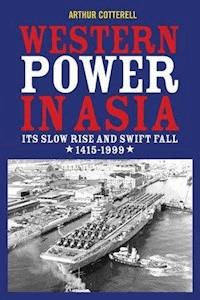
HMS Bulwark docking at Singapore naval base in 1961 © British Crown Copyright IMOD. Reproduced with the permission of the controller of Her Majesty’s Stationery office.
Chapter 5
The signing of the Tripartite Pact between Germany, Italy and Japan in 1940. Source: Getty Images
USS Arizona going down in flames at Pearl Harbour, Decemeber 1941. Source: Getty Images
HMS Prince of Wales sinking off the coast of Malaysia. Courtesy of the Trustee at the Imperial War Museum
A Japanese victory parade at Singapore in early 1942.Reproduced with permission from Robert Hunt library
At Cairo in 1943, Franklin D. Roosevelt, Winston Churchill and Chiang Kai-shek. Source: Getty Images
After a kamikaze attack, USS Bunker Hill retires from Okinawa. Source: Getty Images
The second atomic bomb exploding above Nagasaki, 9 August 1945. Source: Getty Images
Chapter 6
The Japanese arrive for the surrender ceremony aboard USS Missouri, 2 September 1945. Source: Getty Images
British internees leaving Stanley Camp on Hong Kong Island. Reproduced with permission from Imperial War Museum
Premier Attlee with Aung San in London, early 1947. Source: Getty Images
Manila after the American Liberation. Source: Corbis
The two political rivals, Nehru and Jinnah, at a 1946 conference. Source: Getty Images
Parachute regiment soldiers on patrol in Batavia. Courtesy of the Trustee at the Imperial War Museum
On 1 October 1949 Mao Zedong proclaims the People’s Republic in Beijing. Source: Getty Images
A less than comfortable Japanese Emperor with Douglas MacArthur. Source: Getty Images
Chapter 7
US troops were shocked by the Korean winter in 1950. Source: Getty Images
French soldiers take cover at Dien Bien Phu. Source: Getty Images
Tunku Abdul Rahman signs the agreement for Malayan independence. Source: Corbis
One-man air-raid shelters in Hanoi during the Second Vietnam War. Source: Getty Images
Richard Nixon is greeted at Beijing airport by Zhou Enlai in 1972. Source: Getty Images
Deng Xiaoping and Gerald Ford inspecting troops in 1976. Source: Getty Images
Australia meets Indonesia: Sir Robert Menzies and his wife with Sukarno. National Archives of Australia: Indonesia; AA1972/341; 322.
The Saviour of East Timor, Bishop Carlos Ximenes Belo. Source: Getty Images
Special thanks to Imperial Images © and Ray Dunning for all the older illustrations featured in the book.
Part 1
The Slow Rise of Western Imperialism
Chapter 1
Iberian Expansion Overseas 1415–1647
Then, we entered the land, and no one was spared, neither male, nor female, pregnant women and droves of infants. And this because this land. . . had always been an enemy of the Christian name, and above all of the Portuguese; and the land which was wholly put to sack and fire, is called Goa.
Piero Strozzi’s account of the Portuguese capture in November 1510
Portuguese and Chinese Maritime Exploration Compared
At the beginning of the fifteenth century, on the extreme ends of the Old World, two powers simultaneously were conducting a series of maritime expeditions. In 1415, King João of Portugal descended on the Moroccan port of Ceuta with a crusader fleet and siezed the city, a project long in the preparation. That same year, the Chinese admiral Zheng He sailed back to the imperial dockyards in Nanjing after his fourth voyage to the “western and southern oceans”, which included visits to Vietnam, Cambodia, Malacca, Java, Sumatra, Sri Lanka, India, east Africa, and Hormuz, near the mouth of the Persian Gulf. Neither of these two countries were at this time aware of their mutual interest in the sea, although a century later marauding Portuguese ships would be in virtually undefended Chinese coastal waters. So very different were the outcomes of the Portuguese and Chinese expeditions that there is no better place to begin an account of the Western power in Asia than a consideration of their motives, as well as their means of navigation.
The great fleet commanded by the Moslem eunuch Zheng He undertook between 1405 and 1433 seven major seaborne expeditions, which caused the authority and power of the Ming emperor to be acknowledged by more foreign rulers than ever before, with even Mamluk Egypt sending an ambassador. The renown of the restored Chinese empire, after the expulsion of the Mongols in 1368, was increased by these voyages, in which the foremost navy in the world paid friendly visits to foreign ports; and states that acknowledged the sovereignty of Beijing were guaranteed protection and gifts were bestowed on their kings. “Those who refused submission,” we are told
they were over-awed by a show of armed might. Every country became obedient to the imperial commands and, when Admiral Zheng He turned homewards, sent envoys with him to offer tribute. Emperor Yong Le was delighted and before very long ordered Zheng He to go overseas once more and scatter largesse among the different states. On the second expedition the number of ambassadors who presented themselves before the dragon throne grew ever greater.1
The maritime expeditions had another purpose besides the reassertion of Chinese authority in the southern and western seas after liberation from Mongol rule. They restarted a system of state-sponsored trading, first introduced to protect the precious metals of the empire. The import of luxury items such as ivory, drugs and pearls had been a severe drain on the limited supply of bullion available, and a regulation issued in 1219 specified the commodities to be used instead of coin to pay for foreign imports—silk, brocades and porcelain. The Southern Song Emperor Gao Zong had already remarked in about 1145 how “the profits from maritime commerce are enormous. If such trade is properly managed, the revenues earned amount to millions of strings of cash. Is this not better than taxing the people?” The loss of the northern provinces to the Jin, nomad precursors of the Mongol invaders, had made the Chinese sea-minded for the very first time. Though the immediate cause of this new interest was pressure from the warlike peoples of the northern steppelands, the economic and political centre of the Chinese empire had been shifting for many centuries from the north to the south, from the great plains of the Yellow River to the Yangzi delta.
By the Southern Song period, the southern coastal provinces were both the richest and most populous parts of China. A consequence of the southward movement of the imperial capital to Hangzhou and the unavailability of northern overland routes for trade was a remarkable increase in seaborne commerce, an expansion that was to impress Marco Polo when he visited Zaiton, modern Zhangzhou, in Fujian province. To this port he tells us, “come all the ships from India laden with costly wares and precious stones of great price and big pearls of fine quality. . . And for one ship that goes to Alexandria or elsewhere to pick up pepper for export to Christendom, Zaiton is visited by a hundred.”2 Southern Song officials had deliberately encouraged overseas contacts by sending out trade missions laden with gifts, which were gratefully received at foreign courts. So pleased was the sultan of Malindi with Zheng He’s presents that he sent an embassy to the Ming capital of Nanking in 1415 bearing exotic gifts of his own, among them a magnificent specimen of a giraffe for the Imperial Zoo. At the gate of the palace, the third Ming emperor Yong Le personally received the animal along with a “celestial horse” and a “celestial stag”; the giraffe was regarded as “a symbol of perfect virtue, perfect government and perfect harmony in the Empire and the universe”.3 To mark his appreciation, the ambassadors were taken all the way home to east Africa on Zheng He’s fifth voyage of 1417.
The Ming emperor Yong Le, who sent Zheng He to explore the “southern and western oceans” from the imperial dockyards in Nanjing
Exceptionally powerful though they were, Ming expeditions had a very different character from those of the Portuguese: instead of spreading terror, slaving and planting fortresses, the Chinese fleets engaged in an elaborate series of diplomatic missions, exchanging gifts with distant kings from whom they were content to accept merely formal recognition of the Ming emperor as the Son of Heaven. The intolerance of the crusader was entirely absent. Indeed, the arrival of the Portuguese in the Indian Ocean in 1498 abruptly ended the peaceful oceanic navigation that had been such a marked feature of Asian trade. Arab and Chinese sources speak of the hazards of the sea, of storms and shipwrecks, but they are silent about violence, other than brushes with pirates. What the Portuguese and their European successors brought with them was the notion of exclusive rights to maritime trade, something entirely alien to the tradition of long-distance commerce in Asia.4
No greater contrast could be drawn between the trading activities of Zheng He at Calicut, on the western coast of India, and the atrocities practised there in 1501 by Pedro Alvares Cabral and by Vasco da Gama on his second visit two years later. There was no Chinese equivalent of the Portuguese habit of sailing into port with corpses hanging from the yards. On only three occasions did Zheng He have to resort to force of arms. In 1406, he crossed swords with a pirate chief who attempted to surprise his camp at Palembang: the buccaneer was duly returned to China for punishment, since he hailed originally from Guangdong province. Eight years later, again on the island of Sumatra, Zheng He was ordered by Emperor Yong Le to restore a deposed sultan to the throne of Semudera. The third clash of arms occurred in 1411 near Colombo, where Zheng He’s troops were attacked by those of the Sinhalese ruler Alagakkonara. The Chinese won a complete victory, and the captured king, along with his family, went to China as hostages when the fleet set sail from Sri Lanka for Nanjing.
Archaeological evidence for the pacific tenor of Zheng He’s diplomacy ironically comes from Sri Lanka, where a stele, dated 15 February 1409, has been found at Galle with a trilingual inscription. The Chinese text explains how the voyages were intended to announce the mandate of the Ming to foreign powers, the inscription ending with a list of the presents offered to the Buddha: gold, silver, silk and so on. Here we have a Moslem ambassador from China dedicating at a Buddhist shrine in the Indian Ocean gifts from the Son of Heaven, the One Man of Confucian philosophy. More fascinating still is that the other two inscriptions do not exactly translate the Chinese one; the Tamil text praises Tenavari-nayanar, an incarnation of Vishnu, and the Persian one invokes Allah and the great saints of Islam. But while the texts are thus different, they all agree about the list of gifts.5 Hardly surprising then was the relaxed attitude taken by the Chinese over the conversion of the sultan of Malacca to the Moslem faith. The nodal position of Malacca, at the meeting point of several major Asian trade routes, was understood by Emperor Yong Le, who entertained its ruler and granted him a war junk, so that he could return to his capital and protect his country. Between this state visit to China in 1411 and Zheng He’s fourth voyage two years later, Malacca had adopted Islam, a faith then being spread throughout Southeast Asia by the permanent settlement of Indian traders. Ma Huan, an official interpreter on the voyage of 1413 and a Moslem himself, noted with sympathy how “the King of Malacca and all the people follow the new religion, fasting, making penance, and saying prayers”.
Such urbanity has nothing in common with the religious fanaticism of the Portuguese, whose own sense of identity had been largely shaped in a struggle against Islamic domination. “Whenever the treasure ships arrived from China,” Ma Huan goes on to tell us, “their crews at once erect a stockade, like a city wall, and set up towers for watch-drums at four gates. At night there are patrols of policemen carrying bells. Inside they erect a second stockade, like a small city wall within which are constructed warehouses and granaries. All the valuables and provisions are stored in them. Later the ships which have gone to other ports return with foreign goods and, when the south wind becomes favourable, the whole fleet puts to sea and returns home.”6 With the consent of the local ruler, Malacca obviously acted as a temporary naval base during each of Zheng He’s expeditions.
From the beginning of an empire overseas, Portuguese belligerence was legitimised by successive popes as a continuation of the crusades. In 1502, King Manuel demanded of the ruler of Calicut that all Moslems should be expelled from his kingdom, because they were enemies of Christ. The chronicler João de Barros puts the issue bluntly in his Décadas de Asia, written in 1539.
It is true that there does exist a common right for all to navigate the seas, and in Europe we acknowledge it fully. But this right does not extend beyond Europe, and so the Portuguese as lords of the sea by the strength of their fleets are justified in compelling all Moors and Gentiles to take out safe-conducts under pain of confiscation and death. For the Moors and Gentiles are outside the law of Jesus Christ, which is the true law that all must keep under pain of damanation to eternal fire. If then the soul be thus condemned, what possible right has the body to the privileges of our laws? It is true that the Gentiles are reasoning beings, and might if they lived be converted to the true faith, but as they have not revealed any desire to embrace it, we Christians have no duties towards them.7
Just how matter of fact this chilling statement is about the unlimited scope for violence enjoyed by the Portuguese may seem strange now, but Barros was simply stating the obvious to his Catholic contemporaries. Responsibility for relations with non-Christians was believed to rest solely with the Pope, and in return for bearing the costs of the work of their conversion, papal bulls granted to Portugal a monopoly of trade in Asia. The closeness of papal support can be judged from the very first venture overseas: King João’s surprise attack on Ceuta. This expedition received indulgences, although preachers did not mention that it was a crusade until after the fleet had left Portuguese waters, so as to keep secret its destination as long as possible.8
Perhaps an even greater contrast between the deep-sea navigation of the Chinese and the Portuguese, however, is to be found in the relative sizes of their fleets. Populous and powerful Ming China dispatched Zheng He abroad with a veritable armada. On his first voyage, in 1405, he took 317 ships to Java, Sumatra, Malacca, Sri Lanka and India: 27,870 men in all were under his command. Some of Zheng He’s vessels possessed as many as nine masts and his so-called treasure ships displaced 1,500 tonnes. Arguments over the tonnage of Chinese oceangoing junks were settled in favour of such a large figure by the discovery of an actual rudder post in 1962 at the site of one of the Ming shipyards in Nanjing. It once turned a rudder blade of at least 100 square metres, large enough to steer a vessel between 130 and 190 metres in length. Had Vasco da Gama rounded the Cape of Good Hope 70 years earlier, he would have found his own tiny squadron sailing alongside ships belonging to a Chinese fleet with an average displacement three or four times heavier than his own.
The advanced state of Ming nautical technology derived from a tradition of invention already over a millennium old. The steering oar, used in the West until the late Middle Ages, put a severe limitation on the size of ship that could safely be constructed, besides giving the steersman a hazardous task of control in rough weather. In China, it was replaced in the first century of the Christian era by the stern-post rudder, the prototype of Zheng He’s impressive oceangoing steering system. Other early Chinese advances in shipbuilding were the watertight compartment, which allowed junks to become large deep-sea craft, and the aerodynamically efficient mat-and-batten sail. These improvements fascinated Marco Polo, who felt it necessary to provide shipbuilding details for the benefit of his Venetian compatriots. The bulkhead-built hull, divided into separate watertight compartments, really caught his attention, since it permitted repairs to be carried out at sea. But it was the mat-and-batten rig that allowed junks to make headway to windward, something the square-sailed ships of Europe simply could not do.
For this reason Portuguese shipwrights had turned to Arab models when developing long-distance craft. The famous caravo or caravela (from the Arabic word karib) had a wide hull displacing little water, with three masts hoisting triangular sails, hung from very long spars. This permitted greater mobility in manoeuvring as well as better use of the wind. By the time Vasco da Gama left Lisbon for India with four vessels, the dhow-like caravels in his tiny fleet had still only increased their displacement from 50 to 300 tonnes. A Chinese invention of direct use to him was undoubtedly the magnetic compass, which had passed westwards through Arab hands. The magnetic compass, along with accurate star charts, allowed Zheng He’s fleet to reach southern Africa, touch the northern coast of Australia, and sail widely in the Pacific Ocean.
What Vasco da Gama found on rounding the Cape of Good Hope was an almost empty Indian Ocean, because after 1433, the Ming emperors discouraged maritime activities and ran down the imperial fleet, a policy of indifference to sea power that would eventually expose China to the unchecked depredations of European navies. Not all the causes are apparent for this crucial reversal of policy, which left a power vacuum in the southern and western oceans—into which the Portuguese, the Spaniards, the Dutch, the English and finally the French sailed. A combination of circumstances seems to have been responsible. Chinese scholar-officials, strongly against the ocean voyages from the beginning, were even more opposed to the prestige Zheng He and the eunuchs derived from their success. The grip that the eunuchs gained over state policy was to worry the imperial bureaucracy greatly as young or weak emperors were manipulated one after another. So influential did they become that the Manchus, who overthrew the Ming dynasty in 1644, regarded eunuch power as the chief reason for their victory. Under the Qing, their own dynasty, the management of the imperial household passed into the hands of the emperor’s own kinsmen. The eunuchs were once again restricted to duties in the imperial harem. But the despatch of fleets overseas was anyway becoming less profitable as trading ventures and the cost of mounting them pressed hard on the imperial exchequer.
Another consideration was the removal in the 1420s of the capital from Nanjing to Beijing, the site of the former Mongol seat of power. The laying out of a city and a palace there shifted the centre of imperial gravity northwards and concentrated attention on the Great Wall. This line of defence was bound to rank as the top priority, once strong leaders re-emerged among the nomadic peoples living to its north. Ming preoccupation with this new threat culminated within a hundred years of Zheng He’s death in 1433 in a series of anti-maritime edicts that made it a capital offence to own or build craft with two or more masts. Even the administrative records of the great voyages were destroyed in the 1470s on the grounds that they contained “deceitful exaggerations of bizarre things far removed from the testimony of people’s ears and eyes”.9 Yet this lack of interest in the rest of the world was part of a more general attitude in East Asia. The inward-looking societies of pre-modern China, Korea and Japan chose to concentrate on their own affairs, and as far as possible ignore the arrival of Western power and influence. Though the Japanese were initially fascinated by the Portuguese, and as many as 200 Catholic churches were built, in 1614 missionaries were summarily expelled. Even more commerce with Europe was soon ended, except for a very limited exchange with the Dutch, who had conveniently arrived to replace the zealous Portuguese. The Dutch managed to trade by eschewing all missionary activity, a calculated policy that was condemned by their European rivals as nothing more than a cynical accommodation with Japanese superstition.
No such compromise was ever countenanced by the Portuguese crown, the driving force behind the expansion overseas from Ceuta onwards. For it was from the aristocrats who actually attended court, or who were the monarch’s representatives outside the capital, that the impetus for overseas conquest and exploration nearly always came. War with Spain had sharpened interest in seapower—the city of Seville was attacked in 1369 by a fleet of 32 Portuguese ships—and so encouragement was given to shipbuilders in the form of tax-free timber from the royal forests, and to merchants by means of maritime insurance. Ships paid 2 per cent of the value of their cargoes into the royal treasury and received insurance against losses in war or against unexpected taxes. Anti-Spanish sentiment was behind the foundation of the Avis dynasty in 1385.
In alliance with the English duke John of Gaunt, whose daughter he married, King João managed to turn back a full-scale Spanish invasion at the battle of Aljubarrota. Learning from English experience in France, the outnumbered Portuguese army remained on the defensive behind a makeshift barricade of stakes and brushwood, which was intended to break Spanish cavalry charges. From the safety of this position, longbow shot could be directed against attackers either on horseback or on foot. Some 700 English soldiers were among the 7,000 men at Aljubarrota who fought for King João I. Their surprise victory prevented any permanent merger of Portugal with Spain, although during a temporary union under the Habsburgs from 1580 until 1640, the old alliance with England did not exempt it from attack by English forces.
The marriage on 14 February 1387 of King João and Lady Philippa symbolically united England and Portugal. Because Dona Filipa, the name given by the Portuguese to the Lancastrian bride, took delight in chivalry, she would have enjoyed the ten days of tournaments that were held after the wedding. And we are aware that she wholeheartedly approved of King João’s wish that their sons “should be knighted in splendid fashion”.10 According to the chronicler Gomes Eannes de Azurara, this was what the monarch wanted above all else. A great expedition was therefore secretly arranged: an attack on Ceuta, a city situated on the Moroccan side of the Straits of Gibraltar. King João found himself in much the same position as his Lancastrian relations in England. His possession of the throne was also due to a usurpation, and he had to find employment for a quarrelsome nobility now that Portugal was at peace with Spain.
The capture of Ceuta in 1415 actually coincided with Henry V’s invasion of Normandy and the resumption of the Hundred Years War. Rather like the youthful English monarch, João thought that young men must practise the arts of war or they would waste the best years of their lives, for it was only through fighting that knightly ambitions could ever be fulfilled. Honourable though this medieval notion was as a means of maintaining status, the Portuguese king could not quite disguise an obsession over plunder during the overseas expedition. Besides regular trading with Norway, Flanders and Genoa, his own ships are known to have participated in the piracy that customarily took place between Moslems and Christians. Arguably, it was this characteristic Mediterranean mixture of commerce and conflict that Portugal later transferred to the Indian Ocean. At a time when the value of rents steadily fell, ransoms were as useful a way of supplementing income as trading profits. Portugal was, as were many other European countries, very short of gold, and Moroccan coins were in general circulation as a result of Moslem purchases of fruit from the Algarve. Their high quality, plus knowledge that Ceuta handled a large proportion of the west African gold trade, was the economic spur behind the expedition, Portugal’s first overseas crusade. The large loans raised by King João from bankers in Portugal and elsewhere to finance it would not have been forthcoming without an expectation of their ready repayment.11 That it was the royal treasurer, João Alfonso, who acted as the chief advocate of the Ceuta attack can be taken to reflect the confidence felt about its prospects by the merchant community.
Six years were spent in making preparations for the expedition. The king of Granada, the last Moslem holding of any size on the Iberian peninsula, sent an embassy to inquire about its purpose. But the secret was so well kept that when the Portuguese fleet dropped anchor off Gibraltar, before turning south towards Morocco, in alarm the Moslem authorities there sent out to King João “the best and most precious things they could find, while asking him to assure them of peace. The Portuguese king, however, would make no promises and confined himself to accepting their presents.”12 An outbreak of plague in the expeditionary force failed to deflect King João’s purpose, and tactical surprise was achieved on its arrival at Ceuta. Recording the events in the 1450s, when fresh Moroccan expeditions were being planned, Azurara was at pains to present the capture of Ceuta as the logical first step in conquest overseas, and to elevate the role played by Henry the Navigator, third youngest of the Portuguese princes. Henry was always keen on a forward policy in Morocco, and to him fell the difficult task of holding Ceuta on behalf of the Portuguese crown. His extended governorship of the Algarve makes sense as the person officially responsible for the fate of this African city. Yet its possession was a drain on the royal treasury for the reason that, once the Moslems realised recapture was impossible, the trade they controlled across the Sahara was diverted to other cities.
For Azurara, there was no question about the correctness of King João’s actions. Celestial signs lent their support before the assault, in which the Moslems were shown no mercy at all. Fighting raged in the streets and in Moorish houses that made “our poor homes look like pigsties”. Ordinary Portuguese soldiers, Azurara had to admit, were less interested in glory than gain.
But theft was dangerous in houses with low and narrow doorways, like those of the Moors. Men who were carried away by covetousness entered without caution, which often led to their destruction, for many of the Moors had taken refuge in their houses and were defending them to the end, preferring to lose their lives rather than preserving them by flight. . . . Seized by grief, they hid themselves behind doors in order to kill their enemies when they crossed the threshold; but from this the Moors had little advantage, for behind the foremost were others, and they were all armed.13
The fall of Ceuta permitted King João to dedicate its great mosque to Christian worship, and under the newly consecrated dome make his three oldest sons into knights. For the dubbing ceremony, the king had brought along three special swords that Dona Filipa had provided. She died just before the expedition set off. Then, leaving behind a garrison of 2,700 men, the Portuguese sailed away after a stay of just 13 days.
Although the attack on Ceuta was the beginning of a century and a half of warfare in Morocco, the limited advantage gained through this initial foothold weakened for some years the alliance formed between Portuguese commercial interests and the Avis dynasty. Relations were hardly improved by the disastrous attack of 1437 on Tangier, under the command of Prince Henry. It was thought that occupation of the city would give support to Ceuta and facilitate progress inland, a move still effectively thwarted by Moslem arms. The expedition seems to have been poorly supported, so that the capture at Tangier of King João’s youngest son, Fernando, came as a considerable embarrassment. Henry found himself in the unenviable position of having to argue against the ransom of his captured brother, for whom the Moslems demanded the surrender of Ceuta. Whilst Prince Fernando died as a prisoner of war, hard-nosed Henry established himself at Sagres on the south-western tip of the Algarve and sponsored exploration along the African coast.
Once again it was the lure of wealth that motivated Henry as much as his hatred of Moslems: the ships he sent against them in the service of the Catholic faith were expected to seek plunder, slaves and ransoms as well. Although privateering had become increasingly the favoured economic activity of the Portuguese nobility, Henry’s captains were little different from the followers of the Lancastrian invaders of France. To maintain support, Henry V of England had from the start of the new campaign against the French made it his policy to share the profits of war.14 Finding employment and opportunities for young retainers to prove their skills and abilities was a constant problem for European rulers at the close of the Middle Ages, and Portuguese monarchs largely solved it by overseas adventures, although very few of them proved immediately profitable.
Chivalry might well be used by Azurara as a manifesto for the Avis dynasty’s foreign policy, but beneath the chivalric veneer of his narrative the reality of hit-and-run raiding is visible. In 1441, the first black slaves were brought back to the Algarve, and two years later, Henry obtained from the Pope a bull confirming his rights to their homeland in Guinea. The prince had every right to be pleased, according to Azurara, because “though their bodies were captive, this was small matter in comparison with their souls which would enjoy freedom for eternity”. It did not seem to worry anybody at Lagos, the Algarvian port at which African slaves were landed, how families were usually split up on purchase, with parents and children being sent to places far apart. In the Algarve itself, slaves came to make up 10 per cent of the population, in Lisbon the proportion was even higher. By the time Henry died in 1460, slaving had become a staple of Portuguese trade.
The Sea Route to India Discovered
Rivalry with Spain for control of the African coast stimulated the Portuguese to push their claims by making new discoveries. In 1474, Prince João, the future João II, was at the age of 19 charged with responsibility for overseas expansion. To him, rather than Henry the Navigator, credit should be given for the creation of a deliberate plan of discovery. Once on the throne, King João II tried to direct the financing and planning of an overseas empire himself, in contrast to Spanish monarchs who tended to restrict themselves to an indirect role through granting licences to conquistadors. It earned his equally energetic successor, Manuel, the title of “grocer king”. The expedition King João II sent southwards in 1482 was perhaps the most important of all, because its discovery of the eastward trend of the African coast to the north of the equator appeared to promise the chance of reaching India by sea. Intelligence gathered by Pero de Covilham a decade later revealed the existence of a maritime route to the east coast of Africa from India. Fluent in Arabic, Covilham had travelled in the guise of a Moorish merchant as far east as Calicut and Goa. His report to the Portuguese king contained details of the spice trade, including both its origins and routes of exchange. Covilham died in 1526 in Ethiopia, where he had gone to make contact with the legendary Christian ruler Prester John.
It was the voyage of Bartolomeu Dias to the Cape of Good Hope in 1487–88 that finally located the passage from the Atlantic to the Indian Ocean. In all probability a professional mariner rather than a member of the nobility, Dias had been sent southwards with three vessels to discover where the African continent ended. It took him a good seven months to sail back home after the discovery. Another explorer watched Dias’ return to Lisbon, for the Genoan Christopher Columbus was still trying to enlist the support of the Portuguese crown for a scheme of his own: basing his calculations on the work of Italian mapmakers, he argued for a westerly sea route to India.
It could well be the confusion caused by Columbus’ apparent success on behalf of Spain in 1492, which brought about a pause in Portuguese exploration. What news of his discovery of the “Indies” certainly did was to oblige the Holy See to redefine the spheres of influence belonging respectively to Spain and Portugal. A bull issued in 1493 placed the dividing line west of the Azores, or the Cape Verde Islands. With the exception of Brazil, which Portugal had yet to discover, it remained in force until Ferdinand Magellan, a Portuguese in Spanish service, arrived off the Philippines in 1521. By sailing there in a westerly direction via Cape Horn, he invalidated the papal bull and forced another revision in 1529, when the Spaniards gave up any claim to the Moluccas in exchange for a Portuguese undertaking to allow the Spanish conquest of the Philippines.
The resumption of Portuguese exploration in 1497 thus took place in the shadow of Spanish exploits. Even the size of Vasco da Gama’s expedition belied King Manuel’s claim to lordship over the Indian Ocean. Four vessels and fewer than 200 men hardly matched the expedition’s declared intentions: these were sailing direct to India, the establishment of Portuguese control over the spice trade by force of arms, and the making of alliances with Christian rulers who supposedly lived there.
Vasco da Gama was the first Portuguese commander to sail to India, reaching Calicut in 1498
While Lisbon could see the long-term financial gain of breaking the Venetian–Moslem monopoly over the supply of spices to Europe, King Manuel may not at this stage have been ready to stake a great deal of his personal prestige on the venture. Another possibility is that da Gama was not his own choice for the command, but had been forced upon him by nobles who feared the increased power that would gather to the crown from the diversion of Asian trade round Africa. Except for a few years in the 1460s, it had already exercised a monopoly on all imports of gold and slaves from West Africa. Royal licences were needed by well-born people who wished to take part in this profitable trade, and Azurara tells us they included noblemen, churchmen, high officials, as well as members of the military orders. The government even tried to set the price for imported pepper, but it was naturally forced down as supplies increased. By the last decade of the fifteenth century, however, increasing demand for spices in general pushed prices upwards and stimulated further Portuguese exploration.15
For Vasco da Gama’s epoch-making voyage, we are fortunate to possess a chronicle, most likely a personal diary kept by a certain Alvaro Velho on board the São Rafael. Little is known about the author, whose account of the expedition covers the period from July 1497 to June 1498, the month the tiny fleet of four ships left Calicut for the return voyage to Lisbon. Beforehand, Velho may well have spent some time in Guinea. Having travelled more than half the distance of the outward journey, da Gama’s ships came on 25 December 1497 to the farthest point reached by Bartolomeu Dias: it is still called Christmas, or Natal. Continuing up the coast of east Africa the condition of the crews became pitiful, as scurvy took its toll. “There were many with swollen hands and feet, the gums growing over their teeth to such an extent they could not eat.”16 After a month restoring their health and making repairs to their vessels, da Gama made for Mozambique, Mombasa and then Malindi, from which he eventually set sail for Calicut in late April.
Mozambique was the first direct contact made by the Potuguese with the Indian Ocean trading network. This is how Velho reports the encounter:
The people of this country are dark and well-built. They are Moslems, and their language is the same as the Moors. Their clothes are made of fine linen or cotton, with coloured stripes and rich embroidery. All of them wear caps decorated with silk tassels and gold thread. They are merchants, and trade with the White Moors, four of whose vessels were at the time in port, laden with gold, silver, cloves, pepper, ginger, and silver rings, as well as quantities of pearls, jewels and rubies, all of which articles are used by the people in this country. We understood them to say that all these things, with the exception of the gold, were brought here by the Moors.17
The distinction drawn between black Moslems and White Moors, in other words between “native Moslems” and “Moors from Mecca”, indicates that the Portuguese explorers saw the last as their principal adversaries. But they realised from the start how they lacked adequate manpower to engage in an all-out war against Islam. Unlike Ming China, with a population approaching 200 million, Portugal was inhabited by barely 1.5 milion people. The total number of Portuguese at any time in Asia is reckoned never to have topped 10,000 men.18
It was fortunate then for da Gama that at this time Egypt, Persia and Vijayanagar in southern India had no armed shipping in the Indian Ocean, if indeed they ever owned navies at all. And later this stroke of good luck continued with the foundation of the Mughal empire in India, a land-oriented power with little concern for the sea. Its third ruler, Akbar, responded with puzzlement when in 1586 he stood on a beach and first saw waves. In desperation, Venice had requested in 1502 that the Mamluk sultan of Egypt should take action over the Portuguese incursion into the spice trade, but he was in no position to stop the newcomers from blocking trade along the Red Sea. The sultan asked the Pope to intervene instead, on pain of Egyptian harassment of Christians and destruction of sacred sites in Jerusalem. Not until the Ottoman Turks had conquered Egypt, and extended their power into the Persian Gulf with the capture of Basra in 1546, would the Portuguese become really stretched at sea.




