


9,49 €
Mehr erfahren.
- Herausgeber: Sonicbond Publishing
- Kategorie: Geisteswissenschaft
- Serie: On Track
- Sprache: Englisch
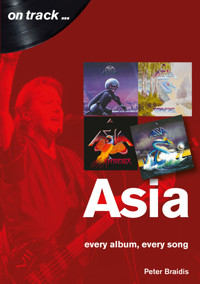
A progressive rock supergroup in the 1980s? Critics savaged Asia, but music fans disagreed. John Wetton, Geoff Downes, Steve Howe and Carl Palmer had played with the likes of King Crimson, Yes and ELP and they certainly lived up to the supergroup tag. Asia’s self-titled debut album went to number one on the US charts, hit the top twenty in the UK and sold over ten million copies worldwide. Asia were all over MTV; they had a sold-out world tour, enjoyed several hit singles and a Grammy nomination.
Line-up changes abounded over the band’s first few years with Howe departing and Wetton leaving and rejoining – their fans needed a scorecard to keep track of it all. And then the group itself split. Geoff Downes struggled to keep the flame alive with vocalist / bassist John Payne from 1991 to 2005 until the original line up reunited in 2006. They continued, basking in the newfound respect accorded them by both the media and fans, until Wetton’s sad passing in 2017.
This book covers every studio album in detail as well as key live albums, compilations and related projects, making it a comprehensive guide to the music of this enigmatic, undervalued and ever-changing band.
Peter Braidis is a graduate of Rutgers University in History and Journalism. He currently works in education at Rohrer Middle School in Haddon Township, New Jersey and for the Major League baseball team, The Philadelphia Phillies. Music is his passion, along with a nice plate of gnocchi. A very young Peter bought the debut album from Asia in 1982 and the love for the band has never ceased. He has written on sports and music for the Philadelphia Inquirer, several magazines and authored the book Unstrung Heroes: Fifty Guitar Greats You Should Know. He lives with his girlfriend, his kids, a cat and his birds.
Das E-Book können Sie in Legimi-Apps oder einer beliebigen App lesen, die das folgende Format unterstützen:
Seitenzahl: 294
Veröffentlichungsjahr: 2025
Ähnliche




















Asia
Peter Braidis
Contents
Introduction
1. Asia (1982)
2. Alpha (1983)
3. Astra (1985)
4. Aqua (1992)
5. Aria (1994)
Aria (1994)
6. Arena (1996)
Arena (1996)
7. Aura (2001)
Aura (2001)
8. Silent Nation (2004)
9. The Original Line Up Reforms
10. Phoenix (2008)
11. Omega (2010)
12. XXX (2012)
13. Gravitas (2014)
14. 2014 And Beyond
15. Asia Live Albums
16. Asia Odds And Ends
17. Asia Compilation Albums
18. Asia Video Releases
19. Asia Members In Spin-off Bands
20. Solo Albums
References And Bibliography
Thanks and Dedications
I want to thank Stephen Lambe at Sonicbond Publishing for allowing me the opportunity to write a book about the musical career of Asia. It was a fun challenge that became much more daunting almost immediately after we agreed on me writing the book.
The week I began writing this book, the world crumbled in March 2020. Everything shut down due to the COVID-19 pandemic (which is still very prevalent here in the US in February 2021 as I write this) and the school I teach at shut down and eventually went to online teaching (which was and still is a serious struggle) and all college and professional sports halted. Seeing as I also work for a Major League Baseball team (the Philadelphia Phillies) that meant two jobs I couldn’t do for quite some time.
To say the least, my writing this book as all this world strife was unfolding was tough, not to mention I had a hospital visit in April (and I am still far from ready to run a marathon) and a one-ton tree fell through our house during a brief, but violent storm in June. As a matter of fact, I was typing one of the last chapters in the book at the moment I heard the tree rip in half and hit the house which was a hideous, horrifying sound I cannot describe accurately. I couldn’t even get the front door open because the tree was now our front porch!
However, the book is obviously complete for all to enjoy, and my love for this band and their music will hopefully come through in these words you read.
I profusely thank the love of my life, Michelle (the sweetest, most caring and giving person in the world), and the kids: Emerson and Luke (we are Emerson, Luke & Peter, so it was my destiny to do a book on a progressive rock band); our 18-year-old cat Krimpet, who is still spry and doesn’t mind smacking me for no reason whenever I walk past her; our birds, and the mysterious squirrel that I feed every day outside our house who is waiting for me in a somewhat uncomfortable manner when I arrive home from work.
I must also give a shout-out to my co-workers and the kids at Rohrer Middle School. Somehow, we are back in school as a hybrid mix of online and in-person, and the kids are getting it done (as are we) under difficultcircumstances. Wearing masks and wiping down desks may be the new normal, but here’s to hoping that won’t be the case for too much longer. To Doug, Stacey and the kids Meredith, Morgan, Christian, Quentin, Jon, Destin, Obaid, Tatiana, Collin, Kelton, Santino and Alyson: We somehow got this far and you will now forever be mentioned in a book! I thank Brian McRory for his help with the photos and his overall charming demeanor.
I must thank John Wetton, Geoff Downes, Steve Howe and Carl Palmer for creating this fantastic band and changing my musical life forever. I also thank John Payne for keeping Asia going with Geoff during some rough years that may not have produced great sales, but did produce some great music. And I also must dedicate this book to the late Neil Peart, drummer extraordinaire of Rush, who sadly passed away in early 2020 and was one of the biggest positive influences in my life with both his drumming and his words.
My mother really liked the music of Asia, and they were one of the few bands she used to not tell me to turn off when I was playing the music loudly in my room. Hopefully, she knows I wrote a book about the band. I miss her every day since she passed away, and like my other books, I dedicate this to her.
Peter Braidis
March, 2021
Introduction
By 1981, progressive rock had become a dirty phrase. Most such acts, like Genesis, the Moody Blues, Jethro Tull, King Crimson and others, had shifted towards shorter, more compact songs, and steered away from the ten to twenty-minute epics of the 1970s.
When former Yes manager, Brian Lane, guided guitarist Steve Howe (who had played with Yes from 1970 to the band’s breakup in early 1981) towards bassist/vocalist, John Wetton (ex-Family, King Crimson, Roxy Music, Uriah Heep, UK and Wishbone Ash), it was with the thought of forming a new band that could adapt to the new musical climate of the 1980s whilst still maintaining the musicality and sophistication of the 1970s. Wetton. and Howe decided that a project together was worth pursuing, and under the guidance of legendary A&R man John Kalodner, it was time to form a proper band. Initially, the idea Lane had was for a lineup of Wetton, ex- Emerson, Lake & Palmer drummer Carl Palmer, and former Yes keyboard wizard, Rick Wakeman. They would combine with guitarist/vocalist Trevor Rabin, who had enjoyed success with the band, Rabbitt, in his homeland of South Africa, but left the country due to its Apartheid policy, relocating first to the UK and then the US. Wakeman later said, ‘Because the record company (Geffen Records) were happy to sign us without hearing us play or even talk about the style of music we wanted to do, I refused to sign the contract on a matter of principle’. Thus, Lane moved on to a combo of Wetton and Howe. Wetton stated the importance of Kalodner in the Dave Gallant book The Heat Goes On:
Kalodner was key to this whole thing. He groomed me for the job, starting in 1976 when I played with Roxy Music at Santa Monica Civic Center. He was working for Atlantic then as head of A&R/West Coast. I’d just come off stage; I was just getting changed out of my stage jeans into my regular jeans and this voice behind me said, ‘Would you have lunch with me tomorrow?’. I turned and saw John Kalodner standing in front of me. Then I saw the card he had in his hand… (it) said Atlantic Records. I said, “Why do you want to have lunch with me?” He said, ‘Just courtesy. You’re on Atlantic and I’m the Atlantic person’. When we sat down, he said, ‘What are you doing? Get something together because you’re worth a lot more than this. Playing backup to Bryan Ferry is not your destiny’. He gave me the best pep talk of all time. From then on, I would get calls every couple of days. He’d send me tapes to listen to. He kept grooming me towards this position. Eventually, in 1981, that was the time to do it. He’d moved to Geffen, and with this new-found position, he wanted to start up with a bang, and I was the guy he was going to do it with. That was it. I started writing songs that would become (the first Asia album). I could not believe how quickly it happened. From demo form, these songs went to Kalodner, and suddenly Brian Lane was there, Steve Howe was there, and everything fell into place so quickly.
Howe recalled in the same book:
Yes disbanded somewhere around January 1981. A few months went by, and then the phone rang one day and Brian Lane said he’d been speaking with John Wetton, who wasn’t doing anything. We met in a small and poky rehearsal room. and we spent a day in there, and John really blew me away completely, playing the most incredible bass stuff. I thought, ‘Well, forget (Chris) Squire and the rest’. As it happened, the group would go in a different direction, but I didn’t know that at the time. We started looking at some songs – maybe we spent a few days in there. They were the embryos of songs, like ‘Cutting It Fine’, ‘Without You’ and ‘Here Comes The Feeling.’ Basically, we were knocking around some songs and deciding whether we could play together, who would be in the band and what kind of music we would play.
An attempt to recruit ex-Jeff Beck drummer Simon Phillips into the band failed, but Simon was there for a bit. Phillips later said: ‘I bailed because I wasn’t totally into the music’. Carl Palmer then entered the picture and discussed how he came into the band in the Gallant book:
I got a phone call asking me if I would like to come and play in a band that had Steve Howe in it. Well, I’d known Steve for a long time, and I’d also known the manager (Lane) for a long time. I came and played; there was John Wetton, Steve Howe and myself – no keyboard player. I wasn’t too happy with that because I feel that with the amount of technology available today, not to have a keyboard player is a bad idea. So I suggested we have a keyboard player, and Steve Howe, having played with Geoff Downes in the last configuration of Yes, suggested we try him. It seemed good to me, so the four of us played and we decided to be a band after about a week, because it felt good.
Around this time, it was a decision whether to add another musician and become a quintet, which led to meetings with Trevor Rabin and ex-The Move/Electric Light Orchestra/Wizzard member, Roy Wood, as well as former Journey singer Robert Fleischmann. None would work out, but ironically enough, Rabin would replace Howe in Yes in the near future, and he did do some demo work with Asia before departing. Wetton told Gallant:
When we first started, we wanted two singers. I was after that Everly Brothers touch. But we tried so many people and we had about three or four songs, most of which were my songs. I’d teach the guy to sing it and then at the end of the day, we’d go to the pub and talk about what had happened that afternoon. Everyone would say, ‘Well, when you taught him the song, he didn’t sing it as well as you did.’ The problem was that we were never really going to find anybody.
Wetton elaborated on the subject of Rabin in the Gallant book:
Geoff and I knew all the time we didn’t want any more people in the band. That was it. We had the four; it didn’t need to be any more. We had the songwriting covered. We knew what the sound was going to be. But still, we got bombarded by people auditioning for the band. Trevor Rabin was one of the better ones. In fact, he was probably the best one.
A band name that was considered at the time was MI5 – after the branch of the British Secret Service – but with Rabin gone (he did actually rehearse with the band: ‘Here Comes The Feeling’, and ‘Starry Eyes’, which would later become ‘Only Time Will Tell’), they ditched the idea of MI5. Wetton credited the name to Lane in an interview with Kerrang! magazine: ‘We were sitting around the office with dictionaries, and Brian said, “Nobody has ever used the name Asia, have they?”. We said, “Go away, Brian”, and then the light bulbs went on! It’s a good, strong name. And a name is very important. If we had been called The Architects, it would’ve been taken in a completely different way, even if the music was the same’.
Asia was signed to Geffen Records with huge expectations and began working on the debut album, Asia, with producer Mike Stone, who had helmed hugely successful albums by Queen, Journey and April Wine. In fact, Stone had just produced Escape for Journey in 1981, which topped the US charts and sold over nine million copies, with four smash US singles coming from it. Palmer talked at the time to MTV about getting Stone involved: ‘We managed to get tied in with Geffen Records. David (Geffen) heard what we were trying to do. He loved the idea – the musical concept that we had – and he immediately said, “OK, let’s do something”. We decided to have an objective view within the group, i.e. a producer who was an English chap named Mike Stone’.
Kalodner was the one who brought Stone on board. In an interview with Dave Gallant, Kalodner stated: ‘I originally asked Jimmy Iovine to produce the record, which he did not want to do. He said, “Why don’t you use Mike Stone?”’.
Wetton was onboard with that decision: ‘Journey, Kiss, Queen – you name it, Mike was doing it. Mike and I got on like a house on fire. We had exactly the same vision for the sound of the band. It was the harmony vocals on the chorus, the way that the vocal would be presented, in your face. Lots of keyboard layers and stuff. It was just exactly right’. A key ingredient that Wetton brought up was this: ‘I figured that in order to survive in the 1980s, you have to stop being a band of the 1970s. You have to condense more and be more direct: cut the soloing. So you play for four minutes instead of the eight you used to play’.
What Mike Stone was able to do with the band was get the balance right from the combination of talent, and – as Wetton alluded to – bring in the accents on choruses and layer the instruments. The accent here was on the cohesive, collective sound, and not individual performances, which was more difficult to achieve than it sounds because these four musicians, legendary for their musicianship, were now being asked to rein that in. Stone did a masterful job in not only achieving that, but in creating an identifiable approach, which became the ‘Asia sound’. You can clearly hear Stone’s production of Escape – which was Journey’s boldest sounding album to date – an accent on a group feel and one identifiable sound. The choruses and arrangements were worked out and carefully coordinated in an approach that was very close to what Asia would do.
Palmer mentioned: ‘We have tried to create a sound collectively, rather than project as individuals. I was in a band where I could do nothing but project as an individual for eight or nine years, so I’ve had enough of that. I can go a different way now – and Asia is that for me’.
With a sterling cover and logo design by Roger Dean (of Yes and Uriah Heep fame), featuring a leviathan sea serpent rising out of the ocean, Asia also had an identifiable image to go with the sound, and the band members weren’t even on the cover.
As for his involvement with Asia, Dean remembered it this way in an interview for The Heat Goes On book:
Steve (Howe) did say he would like me to do the cover, but he felt that the rest of the band thought it made too much of a connection to Yes. They had other people do covers, including Hipgnosis, but they did not seem to get on with any of them. Late in the day, Steve said to me, ‘We need a cover; we don’t have one’. I said, “I have just the thing for you”. I went in with a finished painting of the dragon and the sea and a logo for them. It went down very well. It was done independently of the band. But the logo was sufficiently different to Yes, and the dragon sufficiently different to Yes, and it was powerful in its own right.
And so, with an album of fantastic songs from start to finish, an amazing album cover illustration and logo designed by Roger Dean, perfect production from Mike Stone, and striking music videos directed by Godley & Crème that were tailor-made for MTV, Asia was ready to take on the music world. And the music world was ready for Asia.
Asia (1982)
Personnel:
John Wetton: bass, lead vocals
Steve Howe: guitars, backing vocals
Geoff Downes: keyboards, backing vocals
Carl Palmer: drums, percussion
Released: 18 March 1982
Recorded: Marcus Recording (London, UK) and Town House (London, UK) June- November 1981
Producer: Mike Stone
Engineer: Mike Stone
Cover Illustration: Roger Dean
Highest chart position: UK: 11, US: 1 (9 weeks), Canada: 1, Japan: 15, Germany: 6, Switzerland: 4
Asia was a musical and commercial phenomenon. The album got off to a quick start: in fact, quicker than anyone could’ve imagined. The record debuted in the top ten of the US album chart. Asia were initially trying to build up a following modestly – having booked the start of their first tour in colleges and theatres in the US, beginning in late April of 1982 – but this would soon prove to be impossible due to the explosion of the album. The first date was played at the Clarkson Walker Arena in Potsdam, New York, on 22 April 1982. During this early leg, they played venues such as the legendary Tower Theater in Philadelphia, PA, and the Stanley Theater in Pittsburgh, selling out halls that held between 2,500 and 5,000 people.
This is how the band wanted to build things – slowly. But album sales went through the roof, and the record quickly hit number 1 on the US album charts by May. Indeed, the album went to number 1 on three separate occasions, for a total of nine weeks. Asia went quadruple platinum in America (four million copies), and worldwide sales eclipsed ten million. Although Asia was a sensation in the US, they weren’t quite as big in their native UK, though the album did well there, peaking at number 11 and charting for 38 weeks.
No wonder then that by June, despite having been playing theatres and colleges as recently as May, Asia were now filling 15,000-20,000 seat arenas every night and often returned to cities they had just played due to high ticket demand. Their stage design was impressive, and the band played impeccably, offering up the entire album as well as solo spotlights for Howe, Downes and Palmer. At the time, the band refused to play any material from their older bands, wanting Asia to stand on its own. However, this meant that they only had one album to choose from, even with the solo spotlights. Thus, two new songs were added – ‘Midnight Sun’ and ‘The Smile Has Left Your Eyes’ – both of which would be radically reworked for the Alpha album. Occasionally they also did the instrumental, ‘The Man With The Golden Arm’, from the 1955 film of the same name.
Asia also led to a Grammy nomination for Best New Artist Of The Year, though they would lose out to Australian band Men At Work. However, most critics despised the band Asia simply for existing, let alone for the actual music, and they hated the live performances as well. One doubts whether they even attended the gigs: and if they did, critics had poisoned darts out for Asia before a note was even played, and weren’t going to change their minds. But none of that mattered to the fans, radio programmers, record store owners or MTV: all of whom were thankful that this ‘supergroup’ lived up to the billing, but were unaware that the band had delivered an album that would still sound fresh nearly 40 years later.
When I interviewed Steve Howe in 2001 as Yes were touring for the Magnification album, we discussed many things dealing with Asia. When it came to this album, I asked him if they possibly had any clue how big it was going to be, and he told me:
Well, we certainly hoped it would be. We were very ambitious at the time. We were also very hopeful. We were hedging all our bets on that record and we did it in completely the right spirit. Mike Stone kind of said to us near the end, ‘You know I want to mix it’. And we kind of stated, “Well yeah, but we want to be there”. And he told us, ‘Well, give me a break. I’ve got to get in here and get it sorted out’. When we came back to it each day on the mixing days, he had already kicked its ass. (He had, for instance) brought those tympanis up on ‘Only Time Will Tell’. All it took then was for me to say, ‘Wait, you can’t hear that bit’, or ‘That’s a bit loud there’, or “Can you bring that guitar break in just one beat earlier where I started?”. These were tiny little things that the guitarist would notice more than anybody else, and there was wonderful continuity on that album. And what an album it was, with every single track standing on its own, even the one B-side. The album was that good.
‘Heat Of The Moment’ (Downes/Wetton)
The first song – on the first album – that was the first single and music video from the first supergroup of the 1980s, ‘Heat Of The Moment’ was to be the perfect way to usher in this new musical entity called Asia.
The song lets the listener know right off the bat that this was not going to be like the Yes, ELP or King Crimson of the 1970s. Steve Howe’s opening, chiming guitar chords are unusually simple for the guitar virtuoso, and it works like a charm. The warmth of the sound is immediate, and as soon as the rest of the instrumentation joins in and John Wetton’s vocal begins, listeners are hooked. The melodies and keyboard fills are perfectly placed and the chorus is instantly memorable. The verses build the emotion of the song, and the opening line – ‘I never meant to be so bad to you’ – was a shockingly honest and open way to start a lyric. The song was written by Wetton about his future wife Jill, although they would divorce after ten years.
While it seems like a simply written pop/rock song, it wasn’t quite that easy. The song was composed very late in the album sessions and was a combination of two separate ideas that Wetton and Downes had. There’s also the intriguing middle-eight section with subtle keyboard fills and Howe’s singular sliding guitar notes. Additionally, the song has unusual drumming throughout, particularly in the outro section.
And yet, it became a monster hit, soaring to number 4 on the US singles charts (and the same position in Canada), and number 1 on the US album rock charts for radio-play, for a total of six weeks straight. The single would stall at 46 in the UK. The music video was shot on film and was beautifully directed by the famed team of Godley & Crème. It used a series of sixteen grids, with the images constantly changing and telling the story, interspersed with shots of the band performing. The final shot shows a spinning globe landing on – where else? – the continent of Asia. The video would be played as many as four times a day on the then-nascent MTV.
When asked about the lyrical content of the song, Wetton stated on MTV:
It starts with an apology. You’ve never heard that in a rock song before, either. ‘I never meant to be so bad to you, One thing I said that I would never do.’ The whole song is just an apology. It’s just saying, ‘I fucked up. I hold my hand out and I got it wrong. I never meant it to be like that, and, so I’m sorry.’ That’s basically what ‘Heat Of The Moment’ is.
‘Heat of the Moment’ has become a rock classic. The song has been used in numerous TV shows and films, most notably The 40-Year-Old Virgin (2005) and Good Boys (2019). It has been used on an episode of South Park, with the character Cartman, passionately singing the tune in front of Congress, in the episode ‘Kenny Dies’. The song has even been used for the popular Guitar Hero video game. ‘Heat Of The Moment’ was all the evidence anyone needed that the members of Asia did what they set out to do, which was to make a streamlined song with mass appeal, that could still showcase their individual skills as top-notch musicians and at the same time shed the excess of the bloated progressive rock of the past.
Wetton described the creation of this song in an interview on his website:
The original Wetton chorus was written in a country vein in 6/8. It was only when the Downes verse was introduced that we realized we could be going somewhere different. In a lot of ways, ‘Heat Of The Moment’ is a conundrum. The last consideration would be the first, heard by millions of people. Its chorus was 6/8 which became 4/4. The metal guitar-friendly intro was written on a piano. The natural key for anyone to play this song in would be D. We chose C#… the verse is in 10/8 time, and the middle eight (or bridge) begins with the most outrageous jazz chord ever invented on a keyboard but translated to guitar. The chorus chords are, uncharacteristically for me, or Geoff for that matter, all majors – a fact that delighted our A&R man John Kalodner, who was convinced (erroneously) that there had never been a hit in a minor key.
Then came the lyrics: not exactly the boy/girl stuff of our teens, but again what most people can identify with. Essentially, it is not so much boy-meets-girl, as boy- loses-girl and is tossing the whole scenario over and over in his mind, wondering how he could have been so stupid, but somehow justifying his case by quoting the chorus. The lyric metamorphoses into his life (real and imagined) towards the end, but always with the same result. I guess that really could be the true story of true love. It is in my case. We never do seem to get it quite right, do we?
One other thing we don’t get right is the melody. Ask someone to hum the chorus and they will invariably get it wrong – they do every night when audience participation wades into our set. The vocal was recorded as a twelve voice block. There is NO lead vocal in the chorus. All the voices you hear are part of the harmony and all are mixed at the same level.
Downes offered his recollections of the song on his website:
My verse, John’s chorus – that was it. That was written around John’s piano. I think he had the original chorus, but it was a country song. We straightened that out into a 4/4, and it just seemed to knit together very well, as did ‘Only Time Will Tell’, except that I had the chorus for that. Steve didn’t really want to play the guitar intro in the way that John and I had perceived it. He started to play a very broken-up version. We asked him just to power-chord it. He said, ‘I don’t do power chords’. In the end, he did it on a smaller guitar which had a bit more sustain – I think it was a mini-Gibson. It sounded very bright and powerful. We opted for that. We had to bribe him, I think! Steve was not enamoured with the song. John would probably tell you that as well. He didn’t see it as being ‘Asia’. And when Kalodner heard it, he said that it was the one we were going with (for the single).
‘Only Time Will Tell’ (Downes/Wetton)
The second track on Asia would also be the second single. ‘Only Time Will Tell’ is a very symphonic-sounding pop tune, based largely on Downes’ insistent synthesizer flourishes. The main theme is carried by the lush keyboards, and Steve Howe adds beautifully-played accents on guitar, while Palmer plays tastefully and also gets to add timpani drum leading to the big choruses. Wetton delivers again on vocals in a sympathetic way that allows the song to connect emotionally without resorting to being saccharine or false.
The melodies and arrangements once again show how dedicated the band was to crafting songs and not just building epics like in the past. The scope of the song is evident right from the first note, the lyrics showing the pain of relationships and emotions, and some of the lines demonstrating excellent use of imagery. Here, the protagonist has been used and he is walking out not wanting to live a lie. He feels his partner will probably do just fine without him, but that only time will tell.
Listeners responded, sending the single to 17 in the US. In the UK it would reach number 54. The single edit chopped off a good amount of music but wasn’t too offensive. As for the video, Godley & Creme came up with a weird one, as a female gymnast is leaping over a bunch of televisions on which we see the band. Though it’s uncertain what that had to do with the song, it was constantly on MTV anyway.
Godley later stated that, ‘We just felt it would look interesting; it’s as simple as that. I don’t think we were driven by it having any meaning initially. It was just the memories that came to mind as a device that might look rather interesting, and it felt like the music felt to a degree’.
In the rehearsal stage, ‘Only Time Will Tell’ was initially called ‘Starry Eyes’, at a time when Trevor Rabin came close to joining the band in 1981. It was one of two songs he rehearsed with the group. Indeed, Wetton had started to compose this song during his time with Wishbone Ash in late 1980, as well as several other songs that were prepared for Asia.
Like ‘Heat Of The Moment’, ‘Only Time Will Tell’ still receives heavy FM airplay. It was used in a Family Guy episode, a video game, and an episode of the popular TV crime/drama Cold Case. It’s not clear if gymnasts around the world use the song to jump over televisions, but we can always hope someone attempts it at the next Olympics.
Downes recalled this about the composing of the song on his website:
It was just a melody that I had written with the chorus underneath it. Those two songs (‘Heat Of The Moment’ and ‘Only Time Will Tell’) were written in very similar ways. The intro came together when we started to arrange the song in rehearsals. We thought we would give the chorus a sort of pre-flavour as the intro. I took over the lead and played around the chorus chords with the fanfare. That was very much my signature tune.
Wetton commented on his website that:
(The song is) a lament regarding a lost romance: my first one. As lyrics in the second and third Asia record (Alpha and Astra) mellowed, the words on the first one were pretty nasty. I was castigated for that by (mainly) women – rightly so – it was a vitriolic lambaste, thinly disguised as a love poem. The fact was that it had a haunting melody and a killer chorus – augmented 5th on an A minor – in other words, the chord changes to F, but the bass remains on A. Invert it and you see the genius of Downes at work.
The lyrics to this and all Asia songs are universal. It is neither banal nor clever; it just IS. There is no obvious chorus like ‘Heat Of The Moment’, but it has the inevitable hooks.
‘Sole Survivor’ (Downes/Wetton)
This was more like it for progressive rock fans. ‘Sole Survivor’ packs an awful lot into its five-minute length. The opening is bombastic, heavy, and even somewhat gothic in tone, as it sets the listener up for a powerful ride. The song has serious drive, propelled by Palmer’s thunderous drumming, but the verses are relatively open, accenting Wetton’s vocals and bass-playing. Those vocals are incredibly strong, and Downes’ organ, synthesizer and piano flourishes are all key to the song’s progressive feel – each choice Downes makes has a deft touch.
The chorus is stirring and defiant, and Howe gets to add some wah-wah- heavy guitar lines coming out of each of those choruses. The middle-eight has a breakdown segment where only Downes is heard, playing a synth part that sounds like a creepy carnival. Palmer then hits the hi-hat, and Howe starts scaling up and down the guitar with more wah-wah, before a big drum fill leads back into the main musical theme, as Downes gives a brief synth solo leading into the final verse. The final section is a repeating chorus with Howe adding solos here and there, and Palmer building the tension with double-kick drumming and ride cymbal.
Wetton’s vocal performance may be his best on the entire album. To hit that crazy note in the ‘one time glory, back in their gaze’ section, is impressive. John was finally leading a band, and he was going to make sure he left his imprint. In some ways, ‘Sole Survivor’ could apply to his whole rock and roll story.
‘Sole Survivor’ has long been a favourite of Asia fans. It has always remained in the live set, and for good reason. The song hit number 10 at US Album Rock, but failed to chart as the third single and only hit 91 in the UK. The single edit is an absolute butchering of the song, as nearly 90 seconds are shorn off. It’s truly dreadful, but it is available to hear on the compilation album The Very Best of Asia: Heat of the Moment (1982-1990), that Geffen/Universal issued in 2000. A sloppy music video was slapped together, utilizing the single-edit- butchering, over a dimly-shot film of the band playing at Wembley Arena. MTV didn’t even accept it for broadcast.
It wouldn’t be far-fetched to say ‘Sole Survivor’ is the best track on Asia, because it combines all the elements the four band members brought to the table and is a bold mix of the new sound with a few nods to the past. An Asia show would be diminished without it. When it came to describing this masterpiece on his website, Wetton said:
(It is) just a positive statement regarding our place in the state of the recording industry at the time. Indignant, if you will, and defiant. In other words, ‘Sole Survivor’ was a statement of the struggle – I’m not trying to sound pompous here – to get where we were going. The tense changes in the three verses of the song were not coincidental: the past, present and future were totally conscious. It was never easy. Our representative, on hearing the masters and seeing the artwork, told me, ‘The logo is illegible, the cover is too dark, and frankly, I don’t hear a single’. Two weeks later, it was the fastest-selling record in the history of the planet. Essentially it is a song of hope in the face of adversity.
‘One Step Closer’ (Howe/Wetton)




