


9,49 €
Mehr erfahren.
- Herausgeber: Sonicbond Publishing
- Kategorie: Geisteswissenschaft
- Serie: On Track
- Sprache: Englisch
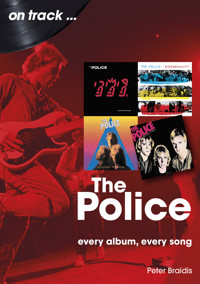
Forming when punk was starting to become a force, The Police – led by drummer Stuart Copeland and singer/bassist Sting - used this emerging new form of music to create a sound that was both fresh, energetic and sophisticated. An early incarnation with guitarist Henry Padovani ended when Andy Summers joined the band, and under the innovative management of Miles Copeland, The Police took on the world.
From 1978 to 1983, the band released five magnificent albums that took in rock, reggae, and world music. A succession of massive hit singles, including ‘Message In A Bottle’ and the classic and often misunderstood ‘Every Breath You Take’ also cemented their success. By 1983, they’d become arguably the biggest band in the world, but egos and arguments took their toll, and the group split in 1986. Sting would go on to massive solo success, but a reunion tour in the 2000s broke box office records and finally closed the door on the band.
This book details every song and album from the first single to the last, making it a comprehensive guide to the music of one of the greatest bands in music history, with sales of over 100 million worldwide.
Peter Braidis is a graduate of Rutgers University with a B.A. in History and Journalism. He currently works in education at Haddon Township High School in the state of New Jersey, USA. Music (especially Thin Lizzy) and helping children and animals are his passions, as well as pretty much any pasta dish. He has written on sports and music for the Philadelphia Inquirer, several magazines and authored the book Unstrung Heroes: Fifty Guitar Greats You Should Know. This is his second book for Sonicbond Publishing, having written Asia On Track in 2020.
Das E-Book können Sie in Legimi-Apps oder einer beliebigen App lesen, die das folgende Format unterstützen:
Seitenzahl: 290
Veröffentlichungsjahr: 2024
Ähnliche




















Foreword
Rock trios have always been something of a special breed. In the late 1960s, power trios such as Cream, The Jimi Hendrix Experience and the James Gang emerged. The 1970s had its own roster of trios and The Police were one that emerged in the decade, featuring three chaps named Sting, Stewart Copeland and Andy Summers (Summers replaced initial guitar player Henry Padovani, although the band were very briefly a four-piece with both guitarists). The Police covered an awful lot of ground with their musical scope, incorporating reggae, new wave, punk (in the early days of the band), world music, rock and pop. To me and many others, it was quite fascinating to hear the development from the scorching blast of ‘Fall Out’ in 1977 to the haunting soundscapes of ‘Tea in the Sahara’ in 1983. The Police never settled for the same sound and continued to experiment and diversify throughout each album and tour.
The consistency of the band’s initial existence from 1977-1986 was nothing short of amazing, all the more so because they truly loathed one another a lot of the time as the years went on, especially Sting and Copeland. By 1986, it was over.
Somehow, a glorious reunion tour finally happened in 2007-08 that is unlikely to occur ever again, most likely writing the final chapter on the band’s career. The demise of The Police saddened me greatly at the time, but looking back from a distance, I can now see that they may have packed it in at the right time, with five stellar albums in a career that was only for a total of nine years. This band’s music has lived on ever since the breakup and their songs have been used in countless films, television shows and commercials and have also been covered by a wide variety of artists.
The reason for this book is simple. It is to discuss each song from each album by The Police and how that music was crafted and created. All the numerous B-sides and rare non-album tracks will also be discussed.
A very special thanks goes out to Stephen Lambe for allowing me to write this book, as well as to Gordon, Stewart and Andy for the wonderful music through the years. I also want to mention Pete Sarubbi for his constant friendship, his similar obsession for music and the numerous concerts we have seen over the years. The same thanks go to Sue Tracey, Pat Dooley, Doug Johnson, Wendy Stokes and many others. And to Rachel – I’ve loved no one more than you and we’ve always shared a bond for the music of The Police, so now you’re a part of it.
Most importantly, as I finished writing this book, my best friend Craig Kline passed away after a valiant battle with cancer. I’ve seen over 450 concerts or so and at least half were with Craig, including The Police and a few Sting shows. This book is solely dedicated to Craig.
Peter Braidis
February 2024
Contents
Musical Careers Before The Police
The Early Days
Early Police Recordings
The Formation Of The Classic Lineup
Outlandos D’Amour (1978)
Reggatta De Blanc (1979)
Zenyatta Mondatta (1980)
Ghost In The Machine (1981)
Synchronicity (1983)
The Police Hiatus And The Guys Fly Solo
The 1986 Amnesty International Concerts And Failed Studio Album
The Reunion Era
Coda. Summers V Sting?
The Police Compilation Albums
The Police Live Albums
The Police Box Sets
Strontium 90 Albums
The Police Video Releases
The Police On The Road
References and Bibliography
Musical Careers Before The Police
Sting
Born Gordon Matthew Thomas Sumner on 2 October 1951 in Wallsend, Northumberland, England, Sting was the oldest of four children and grew up near the shipyards. Sting did begin college but left after one term and took jobs as a bus conductor, building labourer and tax collector.
After that, it was back to college at Northern Counties College of Education, where he received a qualifications to be a teacher. Sting began playing music on the weekends during this time and became a decent bassist. Among the acts he played with were the Phoenix Jazzmen, Newcastle Big Band and Last Exit. It was with Last Exit that Sting first made his mark musically, and they achieved significant local success from 1974-76 but found breaking out of the Newcastle scene difficult. They managed to release a single in 1975 called ‘Whispering Voices’ on a small indie label, but it went unnoticed. A cassette was also released in 1975 called First from Last Exit, but that too went nowhere. The material was very good, though and Carol Wilson, who was the head of Richard Branson’s publishing company, offered them a contract while Virgin Records put up the money for a demo recording. The demo was pitched to a variety of labels and some showed interest. However, no deal materialized because few knew how to market a band that mixed of jazz, pop and rock.
The band relocated to London in early 1977, but after only a few gigs, some of the band moved back to Newcastle, unable to adjust. Sting and keyboardist Gerry Richardson stayed in London. Richardson would become soul singer Billy Ocean’s musical director and enjoyed success whilst Sting hitched his wagon to a new punk rock act called The Police that Stewart Copeland was putting together, which he saw as his way to get some sort of musical career going before it was too late.
Stewart Copeland
The son of a CIA agent named Miles Copeland Jr., Stewart Copeland was born in Alexandria, Virginia in the US on 16 July 1952.During his early years, Stewart’s family moved several times around the middle east. It wasn’t until the age of twelve that Stewart started playing the drums and in the late 1960s, he moved to the UK to attend boarding school in Somerset.
Stewart attended college back in the US at Cal-Berkley University. However, Copeland eventually returned to the UK for a career in music and became a road manager for the progressive rock outfit Curved Air. He subsequently joined the band in late 1974 until their breakup in late 1976. He appeared on the albums Midnight Wire (1975) and Airborne (1976) and on the latter album, he also co-wrote a few songs. The albums sold poorly, but they marked Stewart’s recording debut. Curved Air disbanded in late 1976.
Of course, we know Stewart then formed what became The Police in 1977, but he also recorded under the pseudonym Klark Kent. Although this material was recorded at the same time as The Police were active, Copeland hit the charts before The Police ever did, with the single ‘Don’t Care’ reaching 48 on the UK singles charts in 1978 several months before The Police charted with ‘Can’t Stand Losing You’. A mini-LP called Klark Kent surfaced in 1980, with Stewart playing all the instruments. It was the same snappy and goofy new wave that the single had been but didn’t attract much attention.
In 1978, Stewart (as Klark Kent) appeared on the BBC’s Top of the Pops and Sting, Andy and a few others appeared on stage with him in masks playing ‘Don’t Care’. Sting was a gorilla and Andy was Leonid Brezhnev. Also on stage in masks were road manager Kim Turner and former Curved Air drummer Florian Pilkington-Miksa. So, rather bizarrely, the first TV appearance by The Police was wearing strange masks and miming to a Stewart solo song.
Andy Summers
Andy was considerably older than Sting and Stewart and was born on 31 December 1942 in Poulton-le-Fylde, Lancashire, England. Summers and his family relocated to Bournemouth and it was here where he began an interest in playing musical instruments, including piano and guitar. He excelled on the guitar by playing jazz and started playing clubs by age sixteen.
He played with Zoot Money’s Big Roll Band and appeared on the albums It Should’ve Been Me (1965) and Zoot! (1966) before the band evolved into a psychedelic-rock outfit called Dantalian’s Chariot, who issued an album called Chariot Rising to little interest. Andy would then join the experimental jazz rock/psychedelic/progressive rock outfit Soft Machine for a little while and toured the US with the band in the summer of 1968, including gigs opening for the Jimi Hendrix Experience, with whom they shared the same management. Within a few months, however, Summers would move on.
Later that same summer, Andy became a member of Eric Burdon and the New Animals. His old pal Zoot Money came along with him. This lineup didn’t last long, but did record the double album Love Is, which came out in December 1968. A highlight on the album was a nine-minute cover of the Traffic song ‘Coloured Rain’, which featured a scorching four-minute guitar solo from Summers. The album also produced a top 40 hit in the UK with a cover of Johnny Cash’s ‘Ring of Fire’.
A main reason this lineup dissolved so quickly was due to a frightening Japanese tour in the autumn of 1968, which had been delayed a few months. To recuperate money the promoters had lost due to the delay, they kidnapped the band’s manager and forced him to write a promissory note of £25,000 at gunpoint. Unbeknownst to the band, the promoters were members of the Yakuza (the Japanese mob). The yakuza did release the manager but told him and the Animals to flee the country by the next day or they’d be killed. The band, management and road crew promptly fled the country and left all their equipment behind.
Andy then moved to Los Angeles, studied classical guitar and graduated from Cal-Northridge University with a degree, returning to London in 1972. Summers then went into sessions and occasional touring with a wide variety of musical artists such as Kevin Coyne, David Essex, Neil Sedaka and Joan Armatrading. With Armatrading, he appeared on her 1975 album Back to the Night, playing lead guitar on her classic ‘Steppin’ Out’. Sessions continued, but it was that fateful time in 1977 when Mike Howlett of Gong asked Summers to stand in on guitar in Howlett’s new act Strontium 90, which would also include Sting and Stewart Copeland, that Andy’s career path would project upward.
The Early Days
In the year of 1976, punk rock was the talk of the music world amongst both fans and critics. And many critics trying to be hip, quickly latched on to this allegedly new form of music, declaring older acts like The Rolling Stones, Pink Floyd, Jethro Tull and the like as ‘Dinosaur Rock’. However, it was very exaggerated by the media as many of the ‘dinosaur’ acts were putting out hugely successful albums and filling concert venues even during the height of punk. While many punk acts couldn’t legitimately play a note and just screamed their way through poorly written songs, there is some truth in saying that quite a few of these bands acts could actually play, write and sing rather well. In many cases, these acts hid that fact behind a three-chord approach and didn’t want to be caught actually playing well or – god forbid – putting in a real guitar solo. But by the late 1970s, it was quite clear that the brief chaos of what punk started as had faded to a large degree.
In his Police Diaries, published in 2023, Copeland discussed the atmosphere in London in 1976 and how it affected him:
And this was soooo not dance music as hitherto known. The kids were electric but there was a similar voltage of outrage from all of our fancy friends. The prog cognoscenti were coughing, spluttering and sulking on the perimeter. There were no triplets! Only two chords! That’s not singing, it’s shouting! But Ian’s got a connection with the dance floor. Everybody in show business is searching for the Next Big Thing and we were looking at it right there. The suits and the short hair were like a nightmare version of The Man that hippies were congenitally opposed to. The revenge of straight people returned as electrified zombies high on glue rather than pot! Those kids were an insult to everything that my band stood for, but dang! I felt like I was on their side.
Copeland began to look for a band to reflect this new zeitgeist. He knew he would struggle to sing from behind his kit, so he began looking for a guitarist and bassist, on the bassist that one of them would have to sing.
So, around the autumn of 1976, Stewart Copeland met Gordon Sumner, who was playing with Last Exit. Sumner, who was nicknamed Sting due to a particularly hideous black and yellow striped sweater that he wore, was intrigued by Copeland’s musical knowledge and enthusiasm. Sting knew that the jazz rock format wasn’t exactly going to pay the bills, so he asked Copeland what he had in mind musically and became intrigued, deciding hitch his hopes on Stewart and his new band. Sting but did realize that it was a possible springboard towards getting noticed if they could pull it together. However, a guitarist was needed and Copeland remembered a fellow he had come across who was a native of Corsica named Henry Padovani.
Padovani wasn’t a brilliant, flashy player, but he knew the basic chords and attitude of punk, resulting in Copeland inviting him into the band. Stewart remembered to Hugh Fielder in La Historia Bandito:
He (Padovani) knew a few chords and he was really enthusiastic and when he’d had his hair cut and stuff, he really looked the part. I mean, he could play guitar better than I could and I could play guitar better than Joe Strummer ... well, in those days. So I reckoned he’d be OK, but I didn’t figure Sting would see it that way …
Sting agreed to accept Padovani into the band, but not without some reluctance. Padovani recalled in his book Secret Police Man that he and Stewart donned shades and leather, while Sting showed up to the first practice in jeans with his wife and baby:
When Sting arrived with his baby in a travel cot (Sting and his then-wife Frances had recently had their first child, Joe), we’d adopted the pose of dangerous rockers, silent and moody. Sting was wearing dungarees. He must have thought we looked like idiots.
Sting wasn’t a beneficiary of a particularly great childhood, living in a shipbuilding area of England known as Wallsend, but he did have aspirations of doing more than what he saw the grizzled, hard-working men doing each day just to survive. Sting attributed the beginning of music in his life to a four-stringed guitar that had been left behind by a family friend: ‘As soon as I saw that guitar, I realized I’d found my route out – my best friend’, adding ‘I didn’t speak for four years, I just played the guitar. I saved up for the other strings’. Being so used to playing four strings, it is no wonder that he became such a fantastic bassist.
Sting learned to like the songs that Stewart had come up with and he soon started offering up his own songs. However, according to Padovani in his book Secret Police Man:
Stewart stopped him each time. He said, ‘Sting, you still don’t get it. Write something like ‘my job is a heap of shit and I’m going to smash everything up!’THATwe can play’. I could see Sting seething inside and then he’d play at three times his normal speed and Stewart loved that.
This is how songs like ‘Landlord’, ‘Dead End Job’ and ‘Visions of the Night’ began to surface.
The Police had some songs, but they had no gigs and no money. It was Stewart’s brother Miles who came to the rescue, getting the band some shows supporting New York-based punk singer Cherry Vanilla. Cherry couldn’t afford to bring her band to the UK, so Miles offered The Police as backup. They received a whopping £15 a night. And the guys also got to open the gigs as The Police, with shows beginning on 1 March 1977 at Newport Stowaway in South Wales. The band played ten songs in seventeen minutes at their first show – now that’s punk rock!
The other influence on the band was reggae. Originating from the Caribbean, this musical form had grown in stature since the arrival of the first wave of immigrants in the late 1940s. By the 1970s, with the commercial success of Bob Marley and home-grown British acts like Steel Pulse, it had made its mark on British culture. Furthermore, unlike progressive or jazz rock, it had credibility. Sting told The Breakfast Club in 2018:
For me it was homage to something that I loved. I was brought up in England in the ‘50s and ‘60s, and we had a very influential West Indian community, so I grew up with calypso and ska music, and Blue Beat. And then when Bob Marley came to England it was very revolutionary to me because he turned rock music on its head. The importance of the bass —as a bass player, that was hugely influential to me — the way the drums are played is completely different. And then Marley’s philosophy, his spiritual message, his political message was very powerful. For me, it wasn’t cultural appropriation, it was homage to something that I loved and I still love.
In February 1977, The Police had entered the recording studio to cut their debut single and thus began, in an inauspicious way, the recording career of a band that would eventually have massive worldwide success.
Early Police Recordings
‘Fall Out’(Copeland)
Recorded on 12 February 1977 and issued on 1 May 1977, the debut single from The Police was a two-minute and three-second blast of rocking, catchy punk rock. The song was recorded before the band’s live debut and had cost a borrowed £150 to make. The track was written by Copeland and Stewart played the rhythm guitar parts in addition to his usual drum duties due to Padovani’s inability to stay in time. Padovani laid down the lead guitar and Sting handled the dual roles of bass and vocals. ‘Fall Out’ is a fun, energetic tune that does all it needs to do. The musicality was obvious, however. It was clear that this was no garage band.
The song’s grimy power chords blast away, the chorus is catchy and the rhythm drives hard. It’s also fun hearing Sting shout ‘Henri!’ as Padovani gets ready to rip into his guitar solo. In the liner notes to the 1993 box set Message in a Box,Sting discussed the song:
This was one of the first songs Stewart played me. What they [the songs] lacked in sophistication, they made up for in energy. I just went along with them and sang them as hard as I could. No, it wasn’t false punk. I mean, what’s a real punk? Our first record was entirely a tribute to Stewart’s energy and focus. The band wouldn’t have happened without him.
‘Fall Out’ would not chart initially when it was issued on Illegal Records, the label set up by Stewart’s older brother Miles and the band’s then-manager Paul Milligan. When reissued in 1979 after the band became a success, the song would reach 47 on the UK singles charts. The cover for the sleeve had the band looking very punk indeed and the single would be reviewed by Rolling Stones frontman Mick Jagger for the popular music magazine Sounds.
Stewart later said on the Message In A Box liner notes:
It was a heartfelt lyric, all about a personal disinclination to follow the styles of my peers. It was the first song that we rehearsed as The Police and also our first recording. We recorded it in a tiny studio and it was one of the rare instances in which I got to play the guitar. On this track and on ‘Nothing Achieving’, I played the main guitar tracks and Henry Padovani did the solo in the middle. When Andy joined the group, my guitar went back in the closet.
‘Nothing Achieving’(Copeland)
This was the B-side to ‘Fall Out’ and was another Copeland tune; a short, punked out number that had a darker edge than ‘Fall Out’. Though the song is credited to Stewart alone, his brother Ian and Sting helped re-write parts of it to make it work better. The song is even shorter than the A-side was, clocking in at just 1:56, which certainly stuck to the punk aesthetic.
The song does rock quite a bit with aggression and anger. Once again, Stewart plays the rhythm guitar parts, with Padovani playing the lead. The drumming is way above what anyone would expect from a ‘punk’ song in terms of technique and Sting elevates the song even more with his vocal. Padovani lays down a pretty lethal solo and although it’s a little ugly and off-kilter, it works just fine for what the song requires. One can’t help but wonder just how long Stewart and Sting could’ve lasted playing this style of music. Stewart was quoted in the boxset as saying:
My brother Ian actually wrote the words for this song, with changes by Sting and me. Very dark, very hostile. It was a major step forward when Sting started writing the songs. I had a zillion guitar riffs like this, but Sting actually had something useful to say about the world.
‘Clowns Revenge’(Kristina)
Incorrectly listed at times as ‘Clouds in Venice’, this song was performed live in the earliest days by the band when they were short of material. There are several concert recordings of this number; a hyper rocker with an aggressive drum shuffle and blocky punk power chords with some single-note riffing.
The song was written by Stewart’s former Curved Air bandmate and future wife Sonja Kristina (they were married from 1982 to 1991). The best recordings of this track are from shows on 6 March 1977 in London and the final show as a four-piece on 5 August 1977 in Mont-de-Marsan, France.
‘Night At The Grand Hotel’(Sting)
Another song from the early, early days of The Police, this particular tune was played fairly often in 1977 concerts. This song is sometimes also listed as ‘Night in the Grand Hotel’. There are a number of live recordings of this song, which Last Exit had also performed, although the Last Exit version was more of a slick pop-rocker with the same chords.
The way The Police played this song was as a four-on-the-floor power chord rocker with a 1950s vibe that sounded like a heavy Chuck Berry song. There were also some stop-start parts that sounded like an Eddy Cochran tune. Not surprisingly, the song moved quickly and wasn’t too imaginative.
The Formation Of The Classic Lineup
In the spring of 1977 an aggregation called Strontium 90 came into existence a few months after the ‘Fallout’ single had been released. Mike Howlett was the bass player in Gong, a French/British/Australian progressive rock act formed in Paris in 1967, which later had some significant success in Europe. Howlett joined Gong in 1973 and played with the band until 1977, when he decided to depart. It was around this time that Howlett decided to try and form a new band with Sting and Stewart; they began rehearsing to play at a Gong reunion gig that would feature a variety of current and ex-Gong members playing with their current outfits.
For this gig, Howlett added Andy Summers who was playing guitar for Kevin Ayers. He was a very experienced guitarist who was tiring of being a sideman and was excited at the prospect of playing in something new, even if it was only temporary. The concert took place on 28 May and Strontium 90 (named after the chemical Strontium, which is atomic number 38. As Strontium 90 is radioactive and can cause major damage to the human body, especially bone) blew through their set, which was pretty propulsive, loud rock unlike most of the trippy stuff that was played that day by the other acts. Was greatness detected by the audience? No, but Summers felt there was something there and the next morning, he saw Sting at breakfast and said, ‘It seems to me I should join The Police’. He told Stewart the same thing later on.
Andy later told Mojo:‘I thought, this band is nothing, the songs are shitty, and why would I want to do this? Me, still embracing bourgeois values like wanting to be able to play your fucking instrument. It was ridiculous for me, wasn’t it?’ Nonetheless, he kept nagging the boys to join and finally, he did. The Police played their first gig as a quartet at the Music Machine in London on 25 July 1977. Summers did not enjoy playing with Padovani and asked the band to remove Padovani, but out of loyalty, Sting and Stewart said no. The group performed one more time as a quartet at the Mont de Marsan Punk Festival on 5 August in France.
After an attempt at recording sessions, with former Velvet Underground member John Cale producing, failed in late August 1977, Sting and Stewart agreed that Padovani was technically lacking and had to go. Henry took it well and told Mojo: ‘If Andy hadn’t arrived, the band would have died’.
Summers, however, insists that he wasn’t solely responsible for why that move was made, but he also said that he wasn’t just going to accept anything less than what was needed for the band to excel and said in the same article:
This is the stuff groups are made from: conflict, desire, betrayal and strategies that Machiavelli would be proud of. I saw that I could go on forever as a good sideman, but in me, the strongest need is to be an artist and a supreme musician. As far as I’m concerned the group didn’t start until I joined.
The first gig as a trio with Summers was on 18 August at a club called Rebecca’s in Birmingham. The band largely played short, quick-paced shows that left no room to breathe. Despite how unusual it was for a ‘punk’ band to be a trio, they were still very much a part of that scene at this juncture. Of course, the goal all along was NOT to be a punk band but to use punk as a springboard that would propel their music into further reaches of genre. And the gambit paid off, though it took a while and in the meantime, there was a lot of scrounging for gigs, food and affordable living conditions. This was especially difficult for Sting, as he had a newborn baby boy and wife.
From late 1977 to early 1978, the guys were able to make some money by recording and touring with German experimentalist/keyboardist/composer Eberhard Schoener. Summers had played on a solo album by Deep Purple keyboard wizard Jon Lord called Sarabande in 1975, which featured an orchestra conducted by Schoener, hence the connection. The reason the band got involved with Schoener is because Summers had already agreed to record with him in advance, as well as play some gigs, so Sting and Stewart came along and also participated in the music the German had in mind. The band worked on three of his albums, including Video Magic and Flashback. Sting sings in an ultra-high register in this project, more so than at any time with The Police. Interesting songs include a very electronically-driven piece called ‘Why Don’t You Answer’ from 1978 that sounds like Sting meeting up with Kraftwerk on a dance floor. The Police did several TV appearances with Schoener in Germany and Sting’s voice attracted a lot of attention.
In February 1978, the band was desperate enough for cash that they accepted an offer to do a TV advert for Wrigley’s Spearmint chewing gum and they all dyed their hair blonde for the shoot because that’s what was requested. The commercial was filmed but never aired. It was directed by the legendary Tony Scott, later to direct such films as Top Gun, The Hunger, Enemy of the State, Crimson Tide and True Romance.
Within a few months things started happening for the band under the guidance of Miles Copeland; thus chewing gum commercials, posing as punks and backing German experimental composers would be left behind and the true recording career of the band would begin.
Outlandos D’Amour (1978)
Personnel:
Sting: bass, lead vocals, ‘butt’ piano, harmonica
Andy Summers: guitars, backing vocals, piano, spoken word
Stewart Copeland: drums, percussion, backing vocals
Released: 2 November 1978
Recorded: Surrey Sound Studios (London, UK)
Producer: The Police
Engineer: Nigel Gray
Cover Design: Les May
Highest chart position: UK: 6, US: 23, Canada: 22, Australia: 15
The Police issued their debut album in the fall of 1978 and immediately hit the road to promote it, as management did not want to rely solely on reviews, radio and print media. The sessions for the album took six months, but that was largely because they couldn’t always book time and were playing gigs. The budget wasn’t exactly excessive either, as they borrowed around £1,500 from their manager, Miles. Whenever Miles visited the studio, he could be harsh, but after hearing ‘Roxanne’ his mind was changed so much so that he took it to A&M Records and asked the label to issue the song as a one-off single. The label agreed, but the single failed to chart in the UK when released on 1 April 1978. A&M, however, were interested in another single.
‘Can’t Stand Losing You’ was next up later that year on 14 August 1978. The song became a minor hit, reaching 42 in the UK and leading A&M to green-light a full album. The song did stir up some controversy as the sleeve for the single had an image of Copeland about to hang himself. The BBC had issues with the song just because of the cover, and, ever the opportunist, Miles Copeland used this as publicity, which in turn helped the single chart. Reviews were mixed, with Rolling Stone accusing the band of being pretend punks, while reviews in the UK were generally more positive, Sounds calling it a ‘a distinctive and mostly enjoyable first album’. But of course, the album was quickly reappraised. In fact, the album is now ranked at 428 on the Rolling Stone 500 Greatest Albums of All-Time list and at 38 on that same magazine’s list of the 100 Best Debut Albums of All-Time.
There are some unusual tracks on the album and that would be the case with more than one Police record, but those moments are also often bizarre fun, often in dark, morbid ways. Miles Copeland wanted the album to be called Police Brutality, but A&M wisely vetoed that idea. Copeland then suggested the title that was ultimately chosen, which was Outlandos d’Amour. Roughly translated from French, it means ‘Outlaws of Love’.
The Police were not a success right out of the gate. It wasn’t until a few months into 1979 that the album itself began selling and that was due to ‘Roxanne’ cracking the US singles charts in February and ultimately making the top 40 (it also achieved a top 40 placing in Canada). In the UK, the single was reissued in April, where it soared to number twelve while ‘Can’t Stand Losing You’ went all the way to number two with ‘So Lonely’ hitting the UK top ten as well in 1980.
Outlandos d’Amour would ultimately peak at number six on the UK album charts in October 1979, charting a total of 38 weeks and number 23 in the US, where it also went platinum and charted for an amazing 63 weeks total. The album would also attain platinum status in the UK a year later.
When The Police first toured the US in the fall of 1978, nobody in the States had ever heard of the band and it was one of the many strategies by Miles Copeland that panned out brilliantly. Miles’ brother Ian was an agent in the US and together they came up with the idea of the band touring the Northeast in a van to keep costs down. They would play college towns and create a bond with a younger audience who could lay claim to ‘discovering’ the band when they broke. The band would stop by college radio stations to chat and score some airplay and then play the gig that night. It was tedious, arduous and exhausting, but it would pay off.
The first US show was in New York at the infamous club CBGB’s on 20 October 1978 and the second show was around 2:30 A.M. that same night at that club. The band had actually landed off the plane that same day carrying their instruments as luggage and then played the two concerts. The evening went well and over the next month, they travelled up and down the East Coast with their instruments in that Ford Econoline van. On this tour, they played 23 gigs in 27 days and usually made around £140 ($200 US) a concert. To say they weren’t exactly staying at the best motels and eating the best food would be an understatement. Kim Turner, who by now was co-managing the band with Miles, shared the driving duties and was basically the band’s ‘crew’ – quite humble beginnings indeed.
‘Next To You’(Sting)
As Stewart’s drums pound the intro, it’s clear that ‘Next to You’ rocks. Combining a punk aesthetic with infectious hooks, this power pop song is a wild ride in 2:52 minutes. It’s proof positive that The Police could rock out with the best of them. Copeland uses toms and his ride cymbal and Summers has gritty muted chords in the verses, while the guitars chime in with chords during the choruses. Sting sounds great vocally, although his bass playing gets somewhat lost in the mix. The angst of the lyrics was something a lot of guys could relate to, and there are some simple, but effective lines used to express this frustration.
The other members of the band wanted Sting to sing something more disturbing involving a gun, but he refused to write such banal lyrics and it was the right move. Summers also has a snarling slide guitar solo, which cuts right to the bone. Copeland actually felt the solo was too close to a classic rock sound, but it’s an awesome example of the diversity of Andy’s playing and would surprise a lot of people who came to The Police late in their catalogue.
‘So Lonely’(Sting)
Here is one of Sting’s finest lyrics and most distinctive vocal performances. ‘So Lonely’ humorously examines takes a look at the pains of being alone. There are so many great lines in this song that exemplify how great a lyricist Mr. Sumner already was even at this early stage of his career. Each line is a mixture of pain and dark, self-deprecating humour that anyone can relate to.
Of course, the idea that someone who looks like Sting would be sitting alone on a Saturday night seems farfetched, but at some point, even he must’ve had his heart ripped out or felt isolated. Sting acknowledged in his book Lyrics by Sting that the song began with a song for his previous band Last Exit and that he had the lyrics already, but ‘then grafted shamelessly’ onto the chords for Bob Marley’s ‘No Woman, No Cry’. Well, yes, you can definitely hear that, but it works so well, does it really matter? The subject matter works in tandem with the track’s musical juxtaposition; the verses lean more towar




