


45,99 €
Mehr erfahren.
- Herausgeber: John Wiley & Sons
- Kategorie: Fachliteratur
- Sprache: Englisch
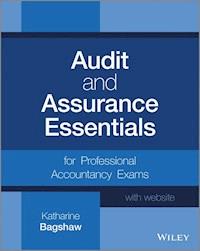
An accessible beginner’s guide to the fundamentals of audit and assurance
Audit and assurance is a basic and vital aspect of the financial world and a key element of all professional accountancy programs. Whereas professional training on the topic frequently immerses students in too much detail while glossing the basics, this book begins with the fundamentals and expands to cover the details in a more measured way. With practical examples and end-of-chapter examples, External Audit and Assurance Essentials breaks down a difficult and challenging field of professional accounting.
Sie lesen das E-Book in den Legimi-Apps auf:
Seitenzahl: 898
Veröffentlichungsjahr: 2013
Ähnliche


















CONTENTS
Introduction
Chapter 1: Auditors, Audits and Other Types of Assurance and Passing the Exam First Time
1.1 The Need for Audit and Other Types of Assurance
1.2 Passing the Exam First Time
Chapter 2: Taking on Professional Work and Maintaining Standards
2.1 Introduction to Professional Standards
2.2 Fundamental Principles, Threats and Safeguards
2.3 Changes in a Professional Appointment
2.4 Obtaining Professional Work
2.5 Professional Ethics: Fees
2.6 Professional Ethics: Conflicts of Interest and Hospitality
2.7 Professional Ethics: Independence and Objectivity
2.8 Appointing and Removing Auditors
2.9 Agreeing Engagement Terms
Chapter 3: Housekeeping: Planning, Materiality and Documentation
3.1 Planning
3.2 Materiality
3.3 Audit Documentation
Chapter 4: The Core of the Audit
4.1 Risk Assessments
4.2 Audit Evidence
4.3 Responding to Risk
4.4 Audit Tools
4.5 More Audit Tools: Using the Work of Others
4.6 Related Parties, Initial Engagements, Opening Balances and Comparative Information
Chapter 5: Corporate Governance, Professional Liability, Regulation and Other Current Issues
5.1 Corporate Governance
5.2 Professional Liability, Regulation and Other Current Issues
Chapter 6: Audit Reporting
6.1 Audit Finalisation
6.2 Modified and Unmodified Audit Opinions
6.3 Emphasis of Matter and Other Matter Paragraphs, Going Concern
6.4 Communications with Management and those Charged with Governance
6.5 Other Information
Chapter 7: Fraud, Money Laundering, Forensic Accounting, Financial Instruments
7.1 Fraud: Auditors’ Responsibilities
7.2 Laws and Regulations: Auditors’ Responsibilities
7.3 Money Laundering
7.4 Forensic Accounting
7.5 Financial Instruments
Chapter 8: The Wider Framework: Assurance, Other Engagements, Audit Quality and Quality Control
8.1 International Standards
8.2 Overall Objectives of Audits, the Framework For Assurance Engagements, ISAE 3000
8.3 Audit Quality and Quality Control
Chapter 9: Smaller Entity Audits, Reviews, Compilations, Agreed-Upon Procedures Engagements, Not-For-Profit Engagements
9.1 Smaller Entity Audits
9.2 Overview of Reviews, Agreed-Upon Procedures and Compilation Engagements
9.3 Review Engagements
9.4 Compilation Engagements
9.5 Agreed-Upon Procedures Engagements
9.6 Not-For-Profit Engagements
Chapter 10: Other Assurance Engagements
10.1 Introduction to Other Assurance Engagements
10.2 Assurance or Agreed-Upon Procedures: Key Performance Indicators
10.3 Social and Environmental Reporting and ISAE 3410 Assurance Engagements of Greenhouse Gas Statements
10.4 Prospective Financial Information
10.5 ISAE 3420 Reporting on the Compilation of Pro-Forma Financial Information in Prospectuses
IAASB Standards and Related Guidance Covered in This Publication
Answers
Abbreviations
Index
© 2013 Katharine Bagshaw
All IFAC material is copyright © January 2013 by the International Federation of Accountants (IFAC). All rights reserved. Used with permission of IFAC. Contact [email protected] for permission to reproduce, store or transmit, or to make other similar uses of this document.
Registered office
John Wiley & Sons Ltd, The Atrium, Southern Gate, Chichester, West Sussex, PO19 8SQ, United Kingdom
For details of our global editorial offices, for customer services and for information about how to apply for permission to reuse the copyright material in this book please see our website at www.wiley.com
All rights reserved. No part of this publication may be reproduced, stored in a retrieval system, or transmitted, in any form or by any means, electronic, mechanical, photocopying, recording or otherwise, except as permitted by the UK Copyright, Designs and Patents Act 1988, without the prior permission of the publisher.
Wiley publishes in a variety of print and electronic formats and by print-on-demand. Some material included with standard print versions of this book may not be included in e-books or in print-on-demand. If this book refers to media such as a CD or DVD that is not included in the version you purchased, you may download this material at http://booksupport.wiley.com. For more information about Wiley products, visit www.wiley.com.
Designations used by companies to distinguish their products are often claimed as trademarks. All brand names and product names used in this book are trade names, service marks, trademarks or registered trademarks of their respective owners. The publisher is not associated with any product or vendor mentioned in this book.
Limit of Liability/Disclaimer of Warranty: While the publisher and author have used their best efforts in preparing this book, they make no representations or warranties with respect to the accuracy or completeness of the contents of this book and specifically disclaim any implied warranties of merchantability or fitness for a particular purpose. It is sold on the understanding that the publisher is not engaged in rendering professional services and neither the publisher nor the author shall be liable for damages arising herefrom. If professional advice or other expert assistance is required, the services of a competent professional should be sought.
Library of Congress Cataloging-in-Publication Data
Bagshaw, Katharine.
Audit and assurance : essentials for professional accountancy exams / Katharine Bagshaw. 1 online resource.
Includes index.
Description based on print version record and CIP data provided by publisher; resource not viewed.
ISBN 978-1-118-45416-9 (ebk)—ISBN 978-1-118-45417-6 (ebk)— ISBN 978-1-118-45418-3 (ebk)—ISBN 978-1-119-96879-5 (pbk.) 1. Auditing—Examinations, questions, etc. 2. Accounting—Examinations, questions, etc. I. Title.
HF5667
657’.45—dc23
2012050741
A catalogue record for this book is available from the British Library.
ISBN 978-1-119-96879-5 (pbk) ISBN 978-1-118-45416-9 (ebk)
ISBN 978-1-118-45417-6 (ebk) ISBN 978-1-118-45418-3 (ebk)
For VB, DB and HLB
With many thanks indeed to David Chopping and Gill Spaul for reading and making helpful observations on this text
INTRODUCTION
Accountancy qualifications matter. Good accountants help economies grow. Accountancy qualifications provide many people with important opportunities and the possibility of financial security. Doors that might otherwise have remained closed, open for qualified accountants. Auditing and assurance exams are an integral part of many accountancy qualifications and the purpose of this text is to help accountancy students pass auditing and assurance papers.
This text seeks to explain the requirements of professional standards in just enough detail to give students the confidence to apply them to the questions that come up in exams.
It is for:
students taking auditing and assurance exams for accountancy qualifications. It covers both international and UK variants;
undergraduate students pursuing degrees and other courses with an auditing and assurance element.
Auditing and assurance exams should not be difficult to pass but pass rates, particularly for lower level papers, are often poor, certainly by comparison with other papers. This is sometimes because students underestimate the paper which often results in inadequate preparation, but there are many students who do work hard and still fail to pass, often by one or two marks. This is a shame. It is often the result of inefficient study methods and exam techniques, both of which can be significantly improved provided students are prepared to do things differently. The first section of this text deals with these issues.
Each section begins with an explanation of why the student needs to read the section, what is important in it, what sort of questions come up and how to stand out from the crowd in exams. The end of each section sets out the essentials, what students need to remember, and questions that give students an idea of areas that often come up in exams.
More questions and answers, updates and discussions of current issues appear at the web-site accompanying this text www.wiley.com/go/bagshaw_essentials
This text is directed at students taking both lower- and higher-level papers, with an emphasis on the elements essential to both. It covers in detail the core elements of the major syllabuses, which are:
professional ethics;
international standards on auditing, review, assurance and related services engagements;
1
regulation, professional liability, money laundering and forensic auditing;
corporate governance and internal audit.
Some verbatim quotes from auditing and ethical standards are provided. They are included with the relevant reference in the main body of the text. However, examiners tend to ask students to explain, describe or discuss matters rather than define them. Demonstrating an understanding is more important than remembering definitions. Detailed references to auditing and ethical standards are provided in footnotes for those who need or want to refer to sources, but no distinction is made between mandatory requirements, indicated in standards by the use of the word ‘shall’, and non-mandatory application material. The distinction is critical to standard-setters, regulators and developers of audit methodologies and software but it is generally less important in auditing and assurance exams.
This text is directed at students studying for the audit and assurance elements of syllabuses including the main ACCA qualification, its Certified Accounting Technician (CAT) qualification and its CertIA programme. It is also relevant to the main ICAEW qualification and its online ISAs programme. It may serve as a guide to up-to-date standards for experienced practitioners.
The author taught auditing and assurance to ACCA and ICAEW students for over a decade in the UK, Eastern Europe, Africa and Asia. She was examiner for ACCA’s lower-level auditing paper for three years and since then has been closely involved in the development and implementation of auditing standards for practitioners in the UK and internationally. She currently works part-time for ICAEW’s Audit and Assurance Faculty, sits on IFAC’s Small and Medium Practitioner Committee, and writes and presents technical material on auditing standards. The views expressed in this text are the author’s own and not those of ICAEW or ACCA.
1 ISAs, ISREs, ISAEs and ISRSs.
CHAPTER 1
AUDITORS, AUDITS AND OTHER TYPES OF ASSURANCE AND PASSING THE EXAM FIRST TIME
Covering:The Role of Audit and Other Types of Assurance in the Economy, Accountability, Stewardship and Agency Theory, the Relationship between Auditors, Management and Shareholders, Overview of the Assurance Process from Planning to Reporting, the Style and Content of Auditing and Assurance Exams, Study Technique and Exam Technique.
Why do I need to read this section?
Because:
questions on the nature and purpose of audit and assurance engagements are set regularly
;
of rising levels of audit exemption, particularly in Europe
;
of the important differences between audits, other forms of assurance, and non-assurance engagements
;
there are many misconceptions about audit and assurance which this short section will help you eliminate at the outset
;
there are many misconceptions about effective study, how examiners set papers and exam technique. This section should help you make the best use of the limited time you have to study for this paper.
With the exception of the material on study, exams and technique, all of the information in this section is covered in more detail in subsequent sections.
What is important in this section?
Understanding:
that audit is a sub-set of assurance and that all assurance engagements are characterised by an assessment of the risk of material misstatement
;
the limitations of an audit as well as its benefits
;
that compilation and agreed-upon procedures engagements in which practitioners do not obtain any assurance at all are very different to assurance engagements such as audits and reviews.
What sort of questions come up in this area?
Questions regularly set in this area cover:
the nature, purpose, advantages and disadvantages of an audit
;
the difference between audit and other forms of assurance such as reviews
;
the difference between assurance and non-assurance engagements, and what type of engagement is appropriate in a given set of circumstances.
How do I stand out from the crowd?
Distinguish clearly between audits, reviews, other types of assurance, and non-assurance engagements.
Give examples of non-audit assurance to demonstrate your appreciation of its growing importance.
Use terminology accurately.
1.1 THE NEED FOR AUDIT AND OTHER TYPES OF ASSURANCE
Like it or not, most of us have little choice about letting others manage our assets for us. We hand over our money to companies, banks, pension funds and governments in the hope that they will look after it and use it properly. We need auditors because we want some assurance about this. We want to be confident that the companies we invest in, the banks that look after our cash, the pension funds we hope will provide for our retirement and the governments that spend our taxes, will use the money we give them the way they ought to, the way they say they will. We also want to know that the money we donate for the education of poor people, for example, goes mostly towards school buildings rather than on the salaries of administrators, and we look to auditors for assurance about that, too.
Audit is a type of assurance. All large-scale operations need auditors because their directors need assurance that the assets and resources for which they are responsible are well-managed. Directors cannot always rely on what they are told by the employees who report to them. Employees make mistakes. Even where there are few mistakes, employees naturally seek to present their own performance in a favourable light. An independent view is likely to be more objective, accurate and critical. Many large bodies such as universities, hospitals and health authorities as well as companies, banks, government departments and pension funds, have internal audit functions for these reasons. Many of these entities are also subject to independent regulatory oversight and have external auditors, because the people needing assurance are not just their directors, but the people to whom the directors are directly or indirectly accountable. Companies, including banks, are accountable to their shareholders. Banks are also accountable to their depositors to some extent but the position of depositors is generally akin to that of creditors, rather than shareholders. Pension funds are accountable to the trustees who act on behalf of pensioners and governments are accountable to taxpayers and electorates. We are all at different times in our lives shareholders, depositors, taxpayers and pensioners. This means that the entities that manage our assets are accountable to us. The external auditors we appoint to them, directly or indirectly, report to us on the financial statements that their directors prepare.
Auditors, Management and Shareholders: Fiduciary Duties, Accountability, Stewardship and Agency
Companies belong to their shareholders.1 Shareholders pay for their shares in the hope that the company will be well-managed, pay dividends from profits and that the value of their shares will increase. They need some confidence in what the company’s managers, i.e. its directors or those charged with its governance, to whom they have entrusted their money, tell them about the company’s performance and position.
Management accounts to shareholders by preparing financial statements showing the company’s performance, i.e. a profit and loss account, its position, i.e. a balance sheet, and its cash flows.2 If shareholders are dissatisfied with how management has performed, they can sell their shares or, if enough of them are dissatisfied, replace management.
Management, not auditors, are responsible for the preparation of financial statements. If the financial statements do not give a true and fair view or present fairly the financial position and performance of a company (the two phrases are deemed to be equivalent), auditors qualify their audit opinion.
Auditors are the agents4 of the shareholders who appoint them, but shareholders rarely disagree with the recommendation of management who also negotiate the auditors’ terms, conditions and remuneration. The payment of auditors by the people they are reporting on creates a potential conflict of interest. For this reason, professional bodies and independent audit regulators monitor the conduct of audits.
In many jurisdictions, until fairly recently, there were statutory audit requirements5 for all incorporated entities.6 Audit exemption has changed this, particularly in the EU where the vast majority of companies are exempt from audit requirements based on their size.7 However, audits of smaller entities continue for several reasons. In family-owned companies, most of the shareholders may also be directors who are actively involved in the day-to-day running of the business. Owner-managers do not need auditors to report to them on their own performance. Other shareholders, however, who are not involved in the business, may want an audit. Some smaller companies are required to have an audit despite the fact that they fulfil the size criteria for exemption, because of the public interest considerations arising from the fact that they operate in the banking, insurance or other financial services sectors, to which special requirements always apply.
The position described above is the UK position. It is similar to the position elsewhere in Europe because all EU Member States are subject to EU audit legislation.
The position in the USA is somewhat different. In the UK and Europe, company audit requirements are in legislation. There are no statutory audit requirements in the USA. Audits are required by the Securities and Exchange Commission (the SEC), a securities regulator, for entities whose securities are listed on the exchanges it regulates, such as NASDAQ and the New York Stock Exchange (NYSE). Auditors in the USA generally report to directors as well as stockholders and the purpose of assurance is to promote the orderly and efficient running of the capital markets.
Assurance and Risk
Audits of historical financial information benefit existing and potential owners of companies by reducing the risk they take when they invest in companies. Audits also provide assurance to employees, tax authorities, customers and suppliers, lenders, trade unions and governments, all of whom need to know that the company they are dealing with is what it appears to be on paper. For tax authorities, audits reduce the risk of collecting the wrong amount of tax. For employees, audits reduce the risk that they will be employed by an entity that cannot pay them. For customers and suppliers, audits reduce the risk that orders will not be despatched and that invoices will not be paid. For lenders, audits reduce the risk that loans will not be repaid. Audits help maintain the quality of financial information on the public record used by government and trade unions in collective negotiations between employer, employees and government representatives. In these ways, the assurance provided by audits contributes to the proper functioning of the economy and society as a whole, as well as benefiting shareholders.
Different Types of Assurance
Audit is only one type of assurance, but it remains the most widely recognised. For exam purposes, the most important distinctions are between:
reasonable assurance engagements
, such as
audits
of historical financial information in which the practitioners’ (auditors’) conclusion is in the form of a positive audit opinion;
limited assurance engagements
, such as
reviews
of historical financial information which consist primarily of inquiries and analytical procedures, in which the practitioners’ conclusion is expressed in negative terms, on whether anything has come to their attention to indicate that the financial statements may be materially misstated;
engagements which do not involve assurance
, such as
compilation engagements
, in which practitioners compile financial information from information supplied, often referred to as accounts preparation engagements, and
agreed-upon procedures
engagements in which practitioners report on the factual findings of procedures they have agreed to perform.
It is important to note that the core work of practitioners in many jurisdictions continues to be accounts preparation, tax and audit work, despite the fact that much of this work is now automated. Changes in recent years mean that firms are no longer restricted to this type of work though, and an increasing number of smaller firms now specialise in providing business and systems advice. Nevertheless, all businesses, especially small businesses, are likely to continue to need professional help to comply with regulatory requirements for the foreseeable future.
In both compilation engagements and audit engagements, the financial statements, including the underlying assumptions and significant judgements made, remain the responsibility of the client.
The proprietors of many businesses assume, perhaps understandably, albeit mistakenly, that good quality accounts preparation software means that they can dispense with the services of a professional accountant. Professional accountants sometimes lose clients who decide either to prepare their own accounts, or to employ cheaper accountants without professional qualifications, only to have the client return after a few years when things have gone wrong. Rightly or wrongly, the level of technical expertise and professional judgement required to prepare even a simple set of financial statements in many jurisdictions is greater than is often expected.
The benefits of employing a professional accountant to prepare accounts or perform an audit include the fact that professional ethics require practitioners to avoid being associated with misleading information. Professional ethics also require that practitioners be objective in the case of accounts preparation engagements, and independent in the case of audit engagements. Professional accountants are subject to regulation and disciplinary arrangements and are accountable for the quality of their work not just to the client, but to a professional body and in some cases an independent regulator.
Assurance can be obtained on non-financial information such as the effectiveness of internal controls and greenhouse gas statements, and on forward-looking information such as profit forecasts and projections, as well as on historical financial information. Different types of assurance are discussed further in section 8.
The Purposes, Benefits and Limitations of Audit
The purpose of an audit is to enhance the confidence of intended users in the financial statements.8
The objectives of auditors are to obtain reasonable assurance about whether the financial statements are free from material misstatement and have been prepared in accordance with the financial reporting framework.9
The benefits of an audit include:
reducing the risk of management bias, fraud and error;
enhancing the credibility of financial information through auditor independence and expertise so that:
the recommendations auditors can make for improvements to internal control;
the financial discipline imposed by an audit which helps companies grow.
The inherent limitations of an audit include:
the fact that 100% testing cannot be performed;
human error in the selection, performance and evaluation of audit procedures;
time and cost constraints which mean that audit evidence is persuasive rather than conclusive;
the inherent limitations of internal controls, which include the possibility of management override of controls, and fraudulent collusion in which employees collude to misappropriate assets and falsify the related records to cover it up;
the inherent limitations of financial reporting, which include subjectivity and the need to exercise judgement in calculating estimates such as depreciation and allowances for bad debts.
An audit is not always in the best interests of a company, or even possible. Audits are not cheap. A compilation engagement may suffice if the association of a well-regarded practitioner with the financial statements is all that is required. Certain conditions must be met for any assurance to be obtained and, if they are not, audits and reviews cannot be performed. The criteria for assurance engagements are further discussed in section 8.
The Assurance Process
Audits, reviews and other reasonable and limited assurance engagements all broadly follow the same overall process.
Acceptance and planning
Before accepting any assurance engagement, practitioners must ensure that they have complied with ethical and quality control requirements. Ethical requirements demand that they independent of the entities on which they report and competent to perform the engagement. There must be no conflict of interests with existing clients and management must not lack integrity. Quality control requirements demand that the firm has in place procedures to ensure that assurance engagements are conducted in accordance with professional standards, by having proper methodologies, human resources procedures and training, for example. They also require the supervision and review of work on individual engagements. If the engagement is a new one, the firm must complete the protocols for changes in professional appointment and make inquiries of the previous practitioner about whether there is any reason the engagement should not be accepted.
Administrative requirements include the need to issue an engagement letter and liaise with third parties involved in the engagement such as internal auditors, firms appointed to other group companies, and any experts. Timetabling and allocation of staff are substantial exercises for large engagements, particularly where there are tight reporting deadlines for large listed entities.
Commercial considerations are always relevant. Has a reasonable fee been negotiated? Is the client able to pay? Firms may perform credit checks using credit rating agencies, like any other business extending credit to a new customer.
Risk assessment by understanding the business
All assurance engagements involve risk assessment. Risk assessments for reasonable assurance engagements involve extensive analysis of the risks associated with internal control, where appropriate. They go further than assessments for limited assurance engagements in which the risk analysis will only extend to determining the risks of material misstatement.
Figure 1.1 Overview of the assurance process
Evidence-gathering
For reasonable assurance engagements, evidence-gathering involves responding to the assessed risks with tests of control and substantive procedures. Substantive procedures consist of tests of details and analytical procedures.11
In limited assurance engagements, evidence-gathering involves addressing the risks of material misstatement with inquiries, analytical and other procedures as appropriate. There is much less emphasis on internal control and practitioners do not seek to verify or substantiate responses to queries in the way that they do for reasonable assurance engagements.
Finalisation
The areas covered when finalising an assurance engagement include:
written representations
which are required to confirm that management acknowledges its responsibility for the information reported on and for the systems underlying it. Representations also confirm that all relevant information has been provided to practitioners. They confirm management assertions and support other evidence in material areas such as the key assumptions on which significant estimates are based;
subsequent events
reviews which are performed after the period-end. Some subsequent events, such as a significant bad debt or the acquisition of a significant new business shortly after the period-end, may require adjustment or disclosure in the information reported on.
Assurance Reports
Assurance reports generally include:
a title and addressee
such as, ‘Independent auditors’ report to the shareholders of XYZCO;
an introductory paragraph
identifying the information reported on, such as the financial statements prepared in accordance with IFRS, often referring to page numbers;
the responsibilities of management
for the information and the assumptions on which it is based;
the practitioners’ responsibilities
to conduct the engagement in accordance with ethical and quality control requirements, auditing or other relevant standards and a summary of the work performed;
a conclusion
in the form of either
an opinion on truth and fairness/fair presentation
in a reasonable assurance engagement, or, in a limited assurance engagement,
a conclusion on whether anything has come to the practitioners’ attention to indicate that the information is materially misstated
;
a signature, date
and
location.
In the UK, the requirement that all financial statements give a ‘true and fair view’ was first introduced in the Companies Act 1947 and amended the former phrase ‘true and correct’. The phrase ‘presents fairly in all material respects’ is more commonly used in the USA.
The ‘true and fair view’ is enshrined in the European Community’s Fourth Directive which sets out the form and content of company accounts.
What an Audit is Not: Common Myths about Auditing and Financial Reporting
An audit is not a guarantee that the financial statements are not materially misstated. The audit opinion is just that, an opinion.
Auditing standards recognise that a properly performed audit may not detect a material misstatement, because of the inherent limitations of an audit, internal controls and financial reporting. Audit risk is the risk that an unmodified audit opinion is issued where a modified one is appropriate. That risk can be reduced to a quantifiable and acceptable level, but it cannot be eliminated altogether.
Some corporate collapses are the result of management fraud, but most arise from some combination of a lack of profitability, an inability to manage cash flows or excessive debt. They are rarely, if ever, caused by auditors.
A Short History
Audits and auditors have been around for a long time. An auditor is someone who hears or listens. The Latin root of the word auditor is auditus, meaning ‘a hearing’. Historically, senior estate staff were said to hear accounts of the management of medieval estate assets and report back to landowners. Modern auditors came into being when companies and corporations started to proliferate in the UK, USA and elsewhere in the 19th century.
Modern companies in the UK and corporations in the USA and elsewhere are artificial legal persons. They exist in their own right independently of their directors and owners (their shareholders or stockholders). Companies and corporations have rights such as limited liability and obligations such as the requirement to prepare financial statements and, in some cases, to have them audited.
In the UK, the Joint Stock Companies Act 1844 and the Limited Liability Act 1855 facilitated collective investments in the risky, diverse and large-scale projects of the industrial revolution such as mines and railways, often overseas. The propensity of some promoters of such projects to overstate their prospects to impressionable investors, together with the need for stocks and shares12 in such entities to be properly priced and traded in well-ordered markets, led to the development of the stock markets, securities legislation and companies legislation. The basic system of company registration introduced in the mid-1800s is still in place in the UK. The forbears of the professional accountancy bodies and firms were founded in the late 19th and early 20th centuries in the UK and the USA.
Prior to the 1844 Act, corporate bodies such as companies and corporations could only be formed by Act of Parliament or Royal Charter or other mechanisms designed for large institutions and groupings such as ecclesiastical institutions, universities, hospitals, cities, guilds and professions. The British East India Company was granted a Royal Charter in 1600. The Dutch East India Company was chartered in 1602 by the States-General of the Netherlands. Both were granted trading monopolies and administrative powers. Much general trade in goods and services in the UK and elsewhere in the world was transacted by individuals and unincorporated associations until the mid-19th century. This was administratively cumbersome because any legal or other action by the association had to be conducted in the joint names of all those involved.
Industrialisation and the development of company law in the UK and securities legislation in the USA in the late 19th and early 20th centuries changed all of this. Modern audit requirements vary enormously from jurisdiction to jurisdiction. We have seen that in the USA there is no statutory requirement for the audit of any entity and that only those with debt or equity securities listed on a US exchange are required to have an audit. By contrast, in some European countries all incorporated entities, regardless of size, are still subject to a statutory audit requirement under company law. Some jurisdictions, including some in the former Soviet Union, have introduced audit requirements conducted under international standards for the first time only fairly recently.13 Some former European colonies in Africa and Asia still follow the practices of the old colonial power, but this is changing.
1.2 PASSING THE EXAM FIRST TIME
Auditing and Assurance Exams and Study Technique
Auditing and assurance present nothing like the intellectual challenge of accounting for deferred tax, fair values, or complex financial instruments, but some very bright people struggle with auditing and assurance exams. There are four ways to avoid this struggle:
respect the paper:
auditing and assurance exams usually have more words than numbers. Some students leave revision for the paper until the last minute, spending more time on other papers that are genuinely more difficult. Auditing is not rocket science but it does require time and effort and it cannot be picked up overnight,
don’t underestimate it
;
question practice and more question practice:
many students overdo rote learning at the expense of question practice. We learn how to sail by messing around in boats. To become a better mountaineer, it is necessary to climb a few mountains. Reading books about sailing and climbing will help, but they are no substitute for the real thing. To pass auditing and assurance exams, it is necessary to practice questions. Most students who struggle with auditing and assurance exams are not lazy, but their efforts are sometimes misdirected and
altering the learning/question practice ratio in favour of the latter always helps
;
better exam technique:
poor exam technique is probably the least common reason for failing auditing and assurance exams, but it can be important. No matter how well you answer questions 1 and 2, in almost all cases, it is virtually impossible to pass the paper if you do not attempt questions 3 to 5. A very small minority of students have handwriting that is so poor as to be illegible where handwritten papers are submitted but many students irritate markers with untidy handwriting, and it is generally better not to irritate your marker if you can avoid it.
‘. . .
my English lets me down’
, is a common worry among students whose first language is not English. It is almost always nonsense. If students make it as far as taking the exam, the quality of their written English is rarely, if ever, the problem. It is important to note that the correlation between oral and written skills is not always as close as might be expected. Some students who do not speak English particularly fluently are very articulate in writing. The fact that you cannot speak English as well as you would like does not mean that you cannot pass an auditing and assurance exam.
good material and good teachers:
there is a small amount of very poor study material around, a great deal of indifferent material and some very good material. It all claims to be the best. Give yourself a chance and use the best you can find and trust your own judgement. Read a bit of it and see. Does it make sense? Is it hard to read? Time spent trying to learn from excessively detailed materials that cover the syllabus but do not explain it, is time lost. If the study materials you have been using have not worked for you, use different material. The same considerations apply to tuition providers.
Some students fail auditing and assurance exams repeatedly, by just a few marks. The cause is almost always some combination of the factors listed above. Re-sitting auditing and assurance exams is avoidable.
Practising questions
It is always a great deal easier to read the book than it is to try a question but the key to passing auditing and assurance exams is practising questions, in full, under exam conditions. There are two reasons for this. Firstly, it makes neurons fire and establishes good thinking habits. Secondly, you learn from the answer. It does not matter how badly you do, provided you try the question without looking at the answer, giving it a decent amount of time, and then underline the elements of the answer you missed, and write or paste them into your own answer. The fact that you may never look at the question again is of no importance. The action of writing or pasting the missed material into your own answer means that when you next encounter something similar, you are much more likely to remember what you missed.
No study material can cover all of the material in every possible exam. Learn from the answers to questions, particularly past exam questions, as well as the study material. There are many past papers together with answers freely available on the examining bodies’ web-sites; use them.
Different types of question
Questions come in many shapes and sizes.
Short form questions generally need answers in note form only; no marks are awarded for writing in full sentences. This type of question does need practice though because short form answers can degenerate. Markers sometimes have to decide whether the student really understands the point and deserves a mark, but has simply failed to articulate it clearly, in which case half a mark may be appropriate, or whether the student simply doesn’t understand and is perhaps trying to hide the fact by being cryptic.
Consider the following part response to the question, ‘. . . give examples of requirements relating to long service applicable to key audit partners’:
The latter point is long on form but has little content. Despite its length, it will probably attract fewer marks than the former. The former is more specific in that it refers to engagement partners rather than staff, and does not simply repeat information in the question. It gives a time period rather than simply referring to long service and it refers to PIEs rather than audit clients generally. Even if the figure given in the first point was wrong, more credit might be given for this than for simply referring to long service. The second point uses three words in referring to professional ethical requirements and uses the term ‘change’, which is correct, but the term ‘rotate’ would be better because that is the term used in IESBA’s Code.
Letters, reports and briefing notes: if letters, reports or briefing notes are asked for, the format alone will often attract marks. Students sometimes waste an extraordinary amount of time trying to think of amusing names for companies or individuals which, unfortunately, can irritate markers. It is much better, albeit not as much fun, to stick with an established format and a set of names and addresses for where they are not provided in the question.
Letters need to look something like this:
Reports need to look something like this:
Briefing notes need to look something like this:
What do I do if . . .?
The question seems to want the same information twice:
it is acceptable to repeat yourself across two different questions, but it is not acceptable within one question. If in doubt as to where within a question to include material, include it at the first possible point and then refer to it the next time it seems to be relevant. The mark allocation might give some indication as to where the material fits best.
The question has something in it that I can’t find a use for in the answer:
tutors spend a lot of time persuading students to answer the question that is set, rather than the question the student thinks should have been set, but sometimes it seems impossible to use what appears to be background information. If you really cannot find a use for it, maybe it is just background information. For example, the introduction to some questions refers to the name of the relevant ISA. Generally, this is genuine background information. It does, of course, mean that no credit will be given for mentioning the name of the ISA in the answer. If a question does not mention the name of an ISA, it might be appropriate to refer to it in an answer but it is unlikely that much credit will ever be given for doing so.
I seem to be stating something really obvious:
some questions seem to want you to make some very simple observations, such as the fact that profits have risen in analytical procedures questions. If the question asks you to comment on profits, you do need to make the observation, but you also need to explain its significance. It is perfectly acceptable to guess what the significance might be, but if you really have no idea, you should still make the observation.
The question asks for three examples and I’ve got four:
ask yourself whether you really have four, or whether two are just different aspects of the same point, and whether you can make them together as one point.
The question asks for three examples but I’ve only got two:
have you really only got two? Are there perhaps two elements of one example that can be separated out? If you really only have two, don’t say the same thing twice just to make three points because it is usually very obvious and, once again, it irritates markers.
Syllabus coverage: there is far too much to learn!
All of the professional bodies revise their syllabuses regularly. Standard-setters are in the business of setting and revising standards. These revisions are often described as radical, but real change is slow. Basic questions on the audit of income, expenditure, property, plant and equipment, inventories, receivables, cash, bank, payables and long-term liabilities have been set in much the same way for many years, and continue to be set, because they remain relevant.
Examiners cannot cover the entire syllabus in one paper, but most attempt to cover it over a series of papers. This means that if an area that is not often examined came up last time, it is less likely to come up this time. If an area that is often examined has not come up for some time, it is more likely to come up next time. It really is worthwhile looking at past papers on the examining body’s web-site to form your own opinion on what might come up. Examiners occasionally examine the same obscure area in quick succession, in an attempt at raising awareness of something they think needs more attention because students did very badly in it the first time round. Many examiners also have their ‘pet’ subjects, which is another reason for looking at what has come up recently.
In a perfect world, with unlimited time to revise, students would go into an exam having thoroughly revised all areas for all papers. Working all areas in detail is ideal but most students simply will not do this. Some hard decisions have to be made about what to cover in detail, what to skim and what to leave out altogether.
Most students try to work the key areas in some detail and have an overview of the other areas. Working key areas in a lot of detail and ignoring other areas completely is another approach and it can work, but it is risky because it limits the number of questions students can attempt in the exam.
Students who choose unpopular questions stand out. Unlike many other exams, there is scope in marking auditing and assurance exams for the exercise of judgement, and for giving or withholding from the student the benefit of the doubt. Markers try not to reward students who attempt unpopular questions disproportionately, but there are fewer candidates to compare the student against, which may work in the student’s favour. This is one reason for attempting such questions but if you really know very little about an obscure area, it is probably best avoided if possible. It is better to scrape a pass on a question that everyone tries, than to fail, marginally, an obscure one!
For a variety of reasons, not all auditing and assurance standards are clear. Occasionally an error has been made, but this is very rare. Sometimes a matter is deliberately left unclear when members of a standard-setting board cannot agree, and a standard needs to be issued. Everyone goes away thinking that their position has been accommodated. Examiners tend to avoid these areas.
No more knowledge-based questions?
From time to time, professional bodies and the bodies that regulate them announce that there have been too many knowledge-based questions and not enough emphasis on higher-level skills, especially application skills. The rationale is that rote learning is not just lazy, but unnecessary because professional ethics and auditing standards are all available online, and many exams are conducted on an open-book basis. Students cannot apply what they do not know, though, and they cannot apply what they do not understand. Some basic knowledge is essential and it is still impossible to pass auditing and assurance exams without it.
Terminology
On the face of it, much of the terminology used by auditors about audits and assurance seems to be straightforward, but it should be treated with care. Many of the words used, such as ‘independence’, ‘review’ and ‘assurance’ have one meaning in ordinary English as well as a technical meaning in the context of auditing and assurance. It is important to understand and use the technical meaning properly. This is one of the reasons that some students underestimate auditing and assurance papers.
Having a life
There is nothing mysterious about passing auditing and assurance exams. No magic wand is required. All that is required is a plan to get through the material in the time period allotted, and a modicum of discipline in sticking to the plan. Easier said than done, of course, but not that hard. Boredom is a problem and managing distractions can be important. Getting friends and family into the habit of leaving you alone for two hours three evenings a week may be hard, but it can be done. Harder still is getting yourself into the habit of staying away from Facebook, emails, texts and TV on a regular basis, but even that can be done. If you cannot face going back to the same room to study, do it somewhere else, but not somewhere with a TV. Try moving the furniture around. If your desk faces a window, turn it to the wall. The alternative is living in a permanent state of anxiety about how much work you have not done!
Exam Technique
In the exam centre:
if you can,
answer the questions on the paper in reverse order
. It means you are out of synch with everyone else and will not be distracted by what they are doing. Alternatively, just do the
easiest question first
to give yourself confidence, but be strict with the amount of time you spend on it;
remember that if you are submitting a handwritten paper,
poor handwriting irritates markers
and you want to make the marker’s life easy. Really clear handwriting is unusual and makes an exceptionally good impression;
split answers up into
manageable chunks
that the marker can tick, but don’t do so artificially because it is usually very obvious;
highlighting and underlining can also irritate markers and are sometimes prohibited;
answer the question set
, not the question you think should have been set;
take the easy marks:
if the question asks for a letter, prepare a letter. If it asks for a report, include a title, an executive summary, a description of the work performed, etc. If brief notes are asked for, no marks will be available for anything more;
keep on writing:
exams are sometimes deliberately set so there is insufficient time to answer all questions on the basis that real life is like this, but there will always be questions you struggle to answer. Think about what the examiner is really looking for, but remember that if you do not write anything, you cannot earn marks. If you write something, it might earn marks.
In the vast majority of cases, examiners are looking for a very small amount of knowledge, but mostly for a lot of imagination in applying that knowledge to a given scenario.
It is impossible to memorise a complete list of tests of controls and substantive procedures, and all of the finalisation procedures for audits, reviews, compilation and agreed-upon procedures engagements, but students sometimes appear to believe that that is the right thing to do. Even the most experienced audit partners cannot do this, but what practice and experience does enable them to do is to come up with a lot of examples. Auditing and assurance exams are often the first stages of that experience and students should have confidence that what they invent, or make up in terms of tests, has value.
Section essentials: what you need to remember
Why assurance is needed.
The overall assurance process.
The meaning of the terms stewardship, agency and accountability.
The benefits and limitations of an audit, and alternatives to audit.
The differences between audits and reviews.
That you have bigger battles to fight than passing auditing and assurance exams! Make sure you get through them first time.
1 ‘Stockholders’ in some jurisdictions.
2 Financial statements also usually include a statement of changes in equity.
3 In some jurisdictions, auditors report to directors as well as, or instead of, shareholders. The phrase ‘true and fair’ is used in the UK. ‘Present fairly’ is used in the USA.
4 Directors are also the agents of shareholders, appointed to manage the company’s assets.
5 Statutory requirements are requirements created by legislation (law).
6 In some jurisdictions a large number of incorporated entities such as companies were created because of an advantageous tax regime. In others, businesses are more likely to be constituted as partnerships or other unincorporated associations for the same reason. There is now a level of uniformity within the EU because of European company law. It provides for two basic categories of company: private and public. The basic distinction between the two is that private companies may not offer their shares or debt securities for sale to the public. In France a Société Anonyme or SA is a public company, a Société à Responsabilité Limitée or SARL is a private company. In Germany and other German-speaking jurisdictions, an Aktiengesellschaft or AG is a public company, a Gesellschaft mit beschränkter Haftung or GmbH is a private company. In the UK, a Public Limited Company (Plc) is a public company, a Limited Company (Ltd) is a private company.
7 Size criteria for audit and accounting purposes in many jurisdictions are based on turnover, assets and number of employees. While the criteria for turnover and assets have changed, the criterion for the number of employees has not, and in the EU that number has been 50 employees for a small company for many years. These limits are dealt with in more detail in section 9.
8 ISA 200 on overall objectives, paragraph 3.
9 ISA 200 on overall objectives, paragraph 11.
10 For very small businesses, audited financial statements are less important to banks lending to them than the security provided by attaching charges to personal and business assets, such as directors’ homes, land and buildings, inventory and receivables.
11 Tests of details involve checking individual transactions such as invoices, and balances such as receivables. Analytical procedures involve the analysis of aggregated data, such as review of expenditure on a monthly basis.
12 In the UK, investors in companies hold shares. In the USA, investors in corporations hold stocks. There is little now to distinguish between the terms ‘stocks’ and ‘shares’. US business terminology is more conservative than its UK equivalent and the term ‘company’ in the USA can refer to a partnership or other unincorporated association, as it once did in the UK. Shares in the UK are traded not on London’s Share Exchange but on its Stock Exchange.
13 Tax audits are still required in many jurisdictions.
CHAPTER 2
TAKING ON PROFESSIONAL WORK AND MAINTAINING STANDARDS
Covering:professional standards, changes in a professional appointment, professional ethics, the audit appointment process, ISA 210 Agreeing the Terms of Audit.
Why do I need to read this section?
In many jurisdictions, anyone can call themselves an accountant, but not everyone can call themselves a Chartered Accountant or a Certified Public Accountant (CPA). Professional accountants and their work are regulated, particularly audit work. Laws and regulation, auditing and accounting standards, professional ethics and the requirements of professional bodies all govern what accountants and auditors may and may not do.
Lesen Sie weiter in der vollständigen Ausgabe!
Lesen Sie weiter in der vollständigen Ausgabe!
Lesen Sie weiter in der vollständigen Ausgabe!
Lesen Sie weiter in der vollständigen Ausgabe!
Lesen Sie weiter in der vollständigen Ausgabe!
Lesen Sie weiter in der vollständigen Ausgabe!
Lesen Sie weiter in der vollständigen Ausgabe!
Lesen Sie weiter in der vollständigen Ausgabe!
Lesen Sie weiter in der vollständigen Ausgabe!
Lesen Sie weiter in der vollständigen Ausgabe!
Lesen Sie weiter in der vollständigen Ausgabe!
Lesen Sie weiter in der vollständigen Ausgabe!
Lesen Sie weiter in der vollständigen Ausgabe!




