


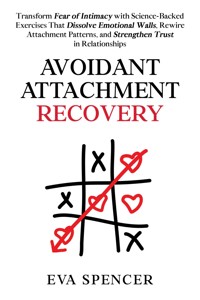
Avoidant Attachment Recovery: Transform Fear of Intimacy with Science-Backed Exercises That Dissolve Emotional Walls, Rewire Attachment Patterns, and Strengthen Trust in Relationships E-Book
Eva Spencer
2,99 €
Mehr erfahren.
- Herausgeber: Eva Spencer
- Kategorie: Geisteswissenschaft
- Sprache: Englisch
Heal the Fear of Intimacy and Build Lasting, Secure Love
Do you often pull away when relationships start to get serious?
Do you feel safer keeping your emotions to yourself, even when you long to connect?
You are not broken; you have simply learned to protect yourself in the only way you knew how.
In Avoidant Attachment Recovery, therapist and relationship expert Eva Spencer provides a compassionate roadmap to help you understand and transform the patterns that keep you distant from the love you desire. Drawing from attachment theory, neuroscience, and therapeutic exercises, this guide helps you dissolve emotional walls, reprogram your nervous system, and rediscover safety in closeness.
Inside Avoidant Attachment Recovery, you will discover how to:
- Identify emotional triggers: Understand the fears that drive distance and detachment.
- Reprogram your nervous system: Learn to feel safe in emotional connection.
- Communicate needs clearly: Express yourself without retreating or shutting down.
- Rebuild trust and intimacy: Take small, steady steps toward meaningful closeness.
- Balance independence and vulnerability: Nurture connection without losing yourself.
- Develop emotional resilience: Love fully while staying grounded in your sense of self.
Start reading today on your favorite device and take the first step toward deeper, more secure love.
Das E-Book können Sie in Legimi-Apps oder einer beliebigen App lesen, die das folgende Format unterstützen:
Veröffentlichungsjahr: 2025
Ähnliche















Avoidant Attachment Recovery
Transform Fear of Intimacy with Science-Backed Exercises That Dissolve Emotional Walls, Rewire Attachment Patterns, and Strengthen Trust in Relationships
Eva Spencer
©CopyrightAndaronPublishing 2025 - All rights reserved.
The content contained within this book may not be reproduced, duplicated, or transmitted without direct written permission from the author or the publisher. Under no circumstances will any blame or legal responsibility be held against the publisher, or author, for any damages, reparation, or monetary loss due to the information contained within this book, either directly or indirectly.
Legal Notice:
This book is copyright-protected. It is only for personal use. You cannot amend, distribute, sell, use, quote, or paraphrase any part of the content within this book without the consent of the author or publisher.
Contents
Introduction
"The greatest barrier to connection is the illusion that we have built enough of them."- Esther Perel
Ineverintendedtobecome an expert on avoidant attachment. My journey began in the quiet corners of therapy rooms, listening to brilliant, accomplished individuals describe the same paradox: a deep longing for connection paired with an instinctive urge to flee from it. These weren't people lacking willpower or understanding; they were often the most insightful clients I encountered. They simply couldn't reconcile their intellectual desire for intimacy with the visceral anxiety it produced.
There was Michael, a successful entrepreneur who could fearlessly navigate business risks yet panicked when his partner asked about his feelings. There was Sophia, a compassionate therapist who helped others heal while keeping her own relationships at arm's length. And there was James, who cycled through relationships the moment they required emotional vulnerability, convinced that "something wasn't right" each time.
What struck me most was their confusion and shame. They wondered why something that seemed effortless for others felt like walking through quicksand for them. Many had read relationship books, attended workshops, even tried therapy, yet nothing seemed to address the specific patterns they experienced. They needed a roadmap designed specifically for the avoidant attachment journey.
Beyond Simple Solutions
The existing literature often left these individuals feeling misunderstood or defective. Mainstream relationship advice typically centers on communication techniques or love languages, valuable tools, certainly, but ones that don't address the neurobiological alarm systems that activate when avoidantly-attached individuals encounter emotional intimacy.
I wrote this book because I believe avoidant attachment is not a character flaw but an adaptive response, a protection mechanism developed for good reason. Your nervous system learned, perhaps very early in life, that emotional closeness wasn't safe. This wasn't a conscious choice, but a survival strategy your brain implemented to protect you.
The science is clear: these patterns are inscribed into our nervous systems through experiences, not decisions. Understanding this can be profoundly liberating. It shifts the conversation from blame to compassion, from judgment to curiosity. This perspective formed the foundation of my approach in these pages.
A Different Path Forward
This book differs from others in several crucial ways. First, it honors your need for independence and autonomy while helping you expand your capacity for connection. We'll never suggest you abandon your strengths: your self-sufficiency, your boundaries, your thoughtfulness, but rather build upon them.
Second, we integrate cutting-edge neuroscience with practical exercises. You'll understand not just the what of your patterns but the why and the how of changing them. Your brain created these patterns through experience, and through new experiences, it can create different ones.
Third, we move at a pace that respects your nervous system. Many approaches to attachment work inadvertently trigger the very defenses they're trying to address. Our approach is gradual, sustainable, and designed to minimize activation of your threat-response system.
Your Journey Begins Here
I'm deeply grateful to my clients who courageously shared their stories and tested these approaches, proving that change is possible regardless of age or history. Their transformations inspired and informed every page of this work. I'm also indebted to colleagues in neuroscience, attachment theory, and trauma-informed care whose research provided the scientific backbone for these methods.
This book is for you if you recognize yourself in these patterns, if you've felt the push-pull of wanting connection while simultaneously feeling suffocated by it. It's for those who've been called "emotionally unavailable" or wondered why intimacy feels more threatening than comforting. It's also for those in relationships with avoidantly-attached individuals, seeking to understand rather than judge.
No special knowledge is required to begin this journey, just a willingness to approach yourself with curiosity instead of criticism. Throughout these pages, I invite you to practice the same compassion toward yourself that you likely extend to others.
The path we're about to walk isn't always comfortable, but it leads to a life where connection and autonomy peacefully coexist rather than battle for supremacy. A life where intimacy feels like coming home rather than losing yourself.
Thank you for trusting me to accompany you on this journey. The courage it takes to examine these patterns is significant, and that courage speaks volumes about your capacity for growth. Turn the page when you're ready, and we'll begin unraveling these patterns together, one gentle step at a time.
Let Love In Without Losing Yourself
For years, I mistook emotional distance for strength. I told myself I was self-sufficient, that needing others made me weak. But the truth was simpler and far more human, I was afraid. Afraid that closeness meant losing control. Afraid that vulnerability would lead to rejection. Afraid that love could not last if I was truly seen.
Healing avoidant attachment begins not with forcing connection, but with understanding the fears that built your walls in the first place. When you start meeting those fears with compassion instead of shame, the walls begin to soften. You learn that safety isn’t found in isolation, but in trust, trust in yourself, and trust in the love that can hold you without consuming you.
To help you uncover what lives beneath those protective layers, I partnered with Books4Growth to bring you the free “What Is Your Psychological Archetype?” quiz. This guided reflection reveals the emotional architecture of your attachments, showing you how to transform guarded independence into grounded openness, and how to meet love without losing yourself.
You are capable of both strength and softness. Begin opening to the kind of connection that heals rather than hurts by taking the quiz at quiz.books4growth.com.
Unlocking The Solitude Safeguard
When Silence Speaks Louder Than Words: The Hidden Language Of Avoidance
Inthequietspaces between conversations, in the subtle shift away from a partner's touch, or in the skillful deflection of personal questions lies a story rarely understood. What many perceive as aloofness or disinterest often masks a profound internal struggle, one where the desire for connection battles constantly with the fear of being hurt. This is the reality for those with avoidant attachment styles, whose apparent preference for solitude is not a choice but a shield.
The misconception that people with avoidant attachment simply prefer to be alone has persisted for too long. Throughout this chapter, we'll unravel the truth behind what appears to be emotional distance but is actually a sophisticated defense mechanism. Avoidant attachment isn't about rejecting intimacy; it's about protecting oneself from the perceived dangers of vulnerability. This critical distinction changes everything about how we approach healing and growth for those who struggle with this pattern.




