


23,99 €
Mehr erfahren.
- Herausgeber: Packt Publishing
- Kategorie: Fachliteratur
- Sprache: Englisch
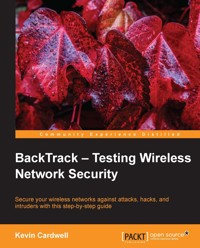
Wireless networks are everywhere. You have probably set one up yourself, but have you ever wondered just how safe you are while browsing online? In the majority of cases, the default settings for your networks are not enough to protect you. With your data being transferred over the air, it can be easily plucked and used by anyone who knows how. Don't let it happen to you.BackTrack - Testing Wireless Network Security will help you secure your wireless networks and keep your personal data safe. With this book, you will learn how to configure your hardware for optimum security, find network security holes, and fix them.BackTrack - Testing Wireless Network Security looks at what tools hackers use and shows you how to defend yourself against them. Taking you from no prior knowledge all the way to a fully secure environment, this guide provides useful tips every step of the way. Learn how to select a wireless card to work with the Backtrack tools, run spectrum analysis scans using kismet, set up test networks, and perform attacks against wireless networks. Use the tools aircrack-ng and airodump-ng to crack the wireless encryption used on the network.
You will learn everything you need to know to set up your wireless network for use within Backtrack and also how to defend yourself against the included attack tools.
Das E-Book können Sie in Legimi-Apps oder einer beliebigen App lesen, die das folgende Format unterstützen:
Seitenzahl: 101
Veröffentlichungsjahr: 2013
Ähnliche

















Table of Contents
BackTrack – Testing Wireless Network Security
BackTrack – Testing Wireless Network Security
Copyright © 2013 Packt Publishing
All rights reserved. No part of this book may be reproduced, stored in a retrieval system, or transmitted in any form or by any means, without the prior written permission of the publisher, except in the case of brief quotations embedded in critical articles or reviews.
Every effort has been made in the preparation of this book to ensure the accuracy of the information presented. However, the information contained in this book is sold without warranty, either express or implied. Neither the author, nor Packt Publishing, and its dealers and distributors will be held liable for any damages caused or alleged to be caused directly or indirectly by this book.
Packt Publishing has endeavored to provide trademark information about all of the companies and products mentioned in this book by the appropriate use of capitals. However, Packt Publishing cannot guarantee the accuracy of this information.
First published: June 2013
Production Reference: 1180613
Published by Packt Publishing Ltd.
Livery Place
35 Livery Street
Birmingham B3 2PB, UK.
ISBN 978-1-78216-406-7
www.packtpub.com
Cover Image by Vivek Sinha (<[email protected]>)
Credits
Author
Kevin Cardwell
Reviewers
Aaron M. Woody
Abhinav Singh
Arif Jatmoko
Lee Allen
Acquisition Editors
Martin Bell
Erol Staveley
Commissioning Editor
Yogesh Dalvi
Technical Editor
Nitee Shetty
Copy Editors
Brandt D'Mello
Insiya Morbiwala
Alfida Paiva
Laxmi Subramanian
Project Coordinator
Joel Goveya
Proofreader
Clyde Jenkins
Indexer
Tejal R. Soni
Production Coordinator
Nilesh R. Mohite
Cover Work
Nilesh R. Mohite
About the Author
Kevin Cardwell currently works as a freelance consultant and provides consulting services for companies throughout the world. He developed the Strategy and Training Development Plan for the first Government CERT in the country of Oman and also developed the team to man the first Commercial Security Operations Center there. He has worked extensively with banks and financial institutions throughout the Middle East, Africa, Europe, and the UK. He currently provides consultancy services to commercial companies, governments, major banks, and financial institutions across the globe.
About the Reviewers
Aaron M. Woody is a security consultant with over 15 years of experience in Information Technology, with a focus on security. He is a speaker and an active instructor, teaching hacking, forensics, and information security. In addition to this, he has been a technical reviewer on several titles published by Packt Publishing. Aaron maintains two blogs: www.n00bpentesting.com and www.datacentricsec.com. Aaron can also be followed on Twitter at @shai_saint.
Aaron is the author of Enterprise Security: A Data-Centric Approach to Securing the Enterprise, Packt Publishing.
Abhinav Singh is a young information security specialist from India. He has a keen interest in the field of hacking and network security and has adopted this field as full-time employment. He is the author of Metasploit Penetration Testing Cookbook, Packt Publishing, a book dealing with pen-testing using the most widely -used framework. Abhinav's work has been quoted in several portals and technology magazines. He is also an active contributor to the SecurityXploded community. He can be reached by mail at <[email protected]> or on Twitter at @abhinavbom.
I would like to thank my grandparents for their blessings, my parents for their support, and my sister for being my perfect doctor.
Arif Jatmoko (MKom, CISSP, CISA, CCSP, CEH) is an IT Security Auditor at Bank Mandiri, Indonesia, and a private pentester for a few government projects. Prior to joining the bank, Arif had spent over 15 years working as a computer security specialist, computer forensicist, and malware analyst. From the early stages of his career, he has been working with top Fortune 500 companies as an IT security officer and has run several pentest projects for government and military institutions.
Now, he is working on a research about protocol reverse- engineering related to application systems within financial transactions such as banking.
Lee Allen is currently the Vulnerability Management Program lead for one of the Fortune 500 countries.
Lee is also the owner of miDgames.com, which is dedicated to bridging the gap between learning and fun by providing 3D video games that teach and reinforce complex subjects such as Linux command-line and penetration-testing skills.
Lee Allen is the author of Advanced Penetration Testing for Highly-Secured Environments: The Ultimate Security Guide, Packt Publishing.
www.PacktPub.com
Support files, eBooks, discount offers and more
You might want to visit www.PacktPub.com for support files and downloads related to your book.
Did you know that Packt offers eBook versions of every book published, with PDF and ePub files available? You can upgrade to the eBook version at www.PacktPub.com and as a print book customer, you are entitled to a discount on the eBook copy. Get in touch with us at <[email protected]> for more details.
At www.PacktPub.com, you can also read a collection of free technical articles, sign up for a range of free newsletters and receive exclusive discounts and offers on Packt books and eBooks.
http://PacktLib.PacktPub.com
Do you need instant solutions to your IT questions? PacktLib is Packt's online digital book library. Here, you can access, read and search across Packt's entire library of books.
Why Subscribe?
Free Access for Packt account holders
If you have an account with Packt at www.PacktPub.com, you can use this to access PacktLib today and view nine entirely free books. Simply use your login credentials for immediate access.
This book is dedicated to Loredana for all of her support and understanding during the many nights of research and writing. Thank you.
Preface
This book is for the reader who wants to understand more about their wireless network, and how to use a software distribution such as BackTrack to be able to survey their wireless environment and select a robust and secure configuration.
What this book covers
Chapter 1, Installing and Configuring BackTrack, shows the reader how to install, configure, and customize BackTrack. At the end of this chapter, the reader will have a working and customized BackTrack application.
Chapter 2, Working with the Wireless Card, shows the reader how to work with the configuration and deal with the sometimes challenging task of getting their wireless card to work within BackTrack. At the end of this chapter, you will have a wireless card that works with the tools within BackTrack.
Chapter 3, Surveying Your Wireless Zone, covers how to use the tools within BackTrack and examines the wireless environment around you. You will learn how to identify wireless networks and determine the characteristics of these networks. At the end of this chapter, you will have a fundamental understanding of the components that are visible when surveying your zone.
Chapter 4, Breaching Wireless Security, introduces the reader to the way in which hackers typically break into networks. Within this chapter, you will get to practice some of the more common types of attacks. At the end of this chapter, you will have seen the technique used to crack WEP and WPA.
Chapter 5, Securing Your Wireless Network, shows you how to apply all of the knowledge gained from the previous chapters, and also gives you the opportunity to examine and evaluate the security settings possible for your wireless network. At the end of this chapter, the reader will be able to make the best decisions when it comes to securing their home wireless networks.
Appendix, Wireless Tools, lists a number of tools, with a brief explanation of each tool and links to other resources with respect to the tool.
What you need for this book
A computer with a minimum 2 GB of RAM (4 GB is recommended) is needed. You will also need virtualization software products. The book uses the VMware Workstation; but if you are familiar with others, you can use them. You will require the BackTrack distribution. The steps for its installation and configuration are included within the book.
Who this book is for
This book is for anyone who wants to know more about wireless networks and/or how to secure their wireless networks. The book has been written for readers at a beginner's level, but they should be familiar with networks. For those who have more experience with the software, this book can serve as a refresher and validation of your skill sets.
Conventions
In this book, you will find a number of styles of text that distinguish between different kinds of information. Here are some examples of these styles, and an explanation of their meaning.
Code words in text, database table names, folder names, filenames, file extensions, pathnames, dummy URLs, user input, and Twitter handles are shown as follows: "Once the machine has booted, you will need to log in with root and a password of toor (root in reverse)."
Any command-line input or output is written as follows:
New terms and important words are shown in bold. Words that you see on the screen, in menus or dialog boxes for example, appear in the text like this: "On the Downloads page, you will see a drop-down window that you will use to select the version of the distribution that you want to download."
Note
Warnings or important notes appear in a box like this.
Tip
Tips and tricks appear like this.
Reader feedback
Feedback from our readers is always welcome. Let us know what you think about this book—what you liked or may have disliked. Reader feedback is important for us to develop titles that you really get the most out of.
To send us general feedback, simply send an e-mail to <[email protected]>, and mention the book title via the subject of your message.
If there is a topic that you have expertise in and you are interested in either writing or contributing to a book, see our author guide on www.packtpub.com/authors.
Customer support
Now that you are the proud owner of a Packt book, we have a number of things to help you to get the most from your purchase.
Downloading the example code
You can download the example code files for all Packt books you have purchased from your account at http://www.packtpub.com. If you purchased this book elsewhere, you can visit http://www.packtpub.com/support and register to have the files e-mailed directly to you.
Errata
Although we have taken every care to ensure the accuracy of our content, mistakes do happen. If you find a mistake in one of our books—maybe a mistake in the text or the code—we would be grateful if you would report this to us. By doing so, you can save other readers from frustration and help us improve subsequent versions of this book. If you find any errata, please report them by visiting http://www.packtpub.com/submit-errata, selecting your book, clicking on the erratasubmissionform




