Table of Contents
Title Page
Copyright Page
Dedication
Preface
THE BALANCED SCORECARD
USING THE BALANCED SCORECARD IN THE PUBLIC AND NONPROFIT SECTORS
HOW THE BOOK IS ORGANIZED
Acknowledgments
NEW ACKNOWLEDGMENTS FOR THE SECOND EDITION
ACKNOWLEDGMENTS FROM THE FIRST EDITION
Chapter 1 - Introduction to the Balanced Scorecard
WHY MEASUREMENT IS SO IMPORTANT
WHY THE BALANCED SCORECARD?
THE RISE OF INTANGIBLE ASSETS IN VALUE CREATION
THE BALANCED SCORECARD
NOTES
Chapter 2 - Adapting the Balanced Scorecard to Fit the Public and Nonprofit Sectors
PERFORMANCE MEASUREMENT IN THE PUBLIC AND NONPROFIT SECTORS
ADAPTING THE BALANCED SCORECARD
IMPORTANCE OF CAUSE AND EFFECT
BENEFITS OF USING A BALANCED SCORECARD
NOTES
Chapter 3 - Before You Begin
DO YOU KNOW WHY YOU’RE DEVELOPING A BALANCED SCORECARD?
EXECUTIVE SUPPORT: A CRITICAL ELEMENT OF YOUR BALANCED SCORECARD
EXECUTIVE SPONSORSHIP IN ACTION
YOUR BALANCED SCORECARD TEAM
WHERE SHOULD WE BUILD THE BALANCED SCORECARD?
CRITERIA FOR CHOOSING AN APPROPRIATE ORGANIZATIONAL UNIT
HUMAN AND FINANCIAL RESOURCES NECESSARY FOR THE BALANCED SCORECARD
YOUR BALANCED SCORECARD DEVELOPMENT PLAN
THE PLANNING PHASE OF BUILDING A BALANCED SCORECARD
THE DEVELOPMENT PHASE
NOTES
Chapter 4 - Training and Communication Planning for Balanced Scorecard Success
TRAINING IS CRITICAL FOR BALANCED SCORECARD SUCCESS
DESIGNING YOUR BALANCED SCORECARD TRAINING PROGRAM
DEVELOPING A COMMUNICATION PLAN TO SUPPORT YOUR BALANCED SCORECARD INITIATIVE
NOTES
Chapter 5 - Mission, Values, and Vision
MISSION
VALUES
VISION
NOTES
Chapter 6 - Strategy: The Core of Every Balanced Scorecard
STRATEGY IS EVERYWHERE
WHAT IS STRATEGY?
DO WE NEED A STRATEGY?
MANY APPROACHES TO STRATEGY FORMULATION EXIST
STRAIGHTFORWARD APPROACH TO STRATEGY DEVELOPMENT
STRATEGY AND THE BALANCED SCORECARD: A CRITICAL LINK
NOTES
Chapter 7 - Strategy Maps
WHAT IS A STRATEGY MAP?
DEVELOPING YOUR STRATEGY MAP
CHOOSING YOUR STRATEGY MAP PERSPECTIVES
REVIEWING BACKGROUND MATERIALS ON STRATEGY MAP RAW MATERIALS
DEVELOPING STRATEGY MAP OBJECTIVES IN EACH PERSPECTIVE
DEVELOPING OBJECTIVES FOR THE CUSTOMER PERSPECTIVE
DEVELOPING OBJECTIVES FOR THE INTERNAL PROCESS PERSPECTIVE
DEVELOPING OBJECTIVES FOR THE EMPLOYEE LEARNING AND GROWTH PERSPECTIVE
DEVELOPING OBJECTIVES FOR THE FINANCIAL PERSPECTIVE
DEVELOPING A SHARED UNDERSTANDING WITH OBJECTIVE STATEMENTS
TIMEOUT
CONDUCTING AN EFFECTIVE STRATEGY MAPPING WORKSHOP
HOW MANY OBJECTIVES ON YOUR STRATEGY MAP?
REVIEWING THE STRATEGY MAP
WHEN ALL ELSE FAILS: KISS
THE STRATEGY MAP JOURNEY AT FOOD FOR THE HUNGRY U.S. (FHUS)
NOTES
Chapter 8 - Performance Measures, Targets, and Initiatives
WHAT ARE PERFORMANCE MEASURES?
DEVELOPING MEASURES FOR EACH OF THE FOUR PERSPECTIVES
MEASURES FOR THE CUSTOMER PERSPECTIVE
MEASURES FOR THE INTERNAL PROCESS PERSPECTIVE
MEASURES FOR THE EMPLOYEE LEARNING AND GROWTH PERSPECTIVE
MEASURES FOR THE FINANCIAL PERSPECTIVE
FINAL THOUGHTS ON SELECTING PERFORMANCE MEASURES
CRITERIA FOR SELECTING PERFORMANCE MEASURES
RECORDING YOUR MEASURES IN A DATA DICTIONARY
TARGETS
INITIATIVES
NOTES
Chapter 9 - Creating Alignment by Cascading the Balanced Scorecard
WHAT IS CASCADING?
THE CASCADING PROCESS
NOTES
Chapter 10 - Linking Resource Allocation to the Balanced Scorecard
HISTORY OF PERFORMANCE AND BUDGETS
LINKING BUDGETS AND BALANCED SCORECARDS
BENEFITS TO EXPECT FROM THE PROCESS
NOTES
Chapter 11 - Reporting Results
FROM THEORY TO PRACTICE
BALANCED SCORECARD SOFTWARE
DEVELOPING YOUR OWN BALANCED SCORECARD REPORTING SYSTEM
THE NEW STRATEGY-CENTERED MANAGEMENT MEETING
NOTES
Chapter 12 - The City of Charlotte: A Balanced Scorecard Success Story
2003 INTERVIEW
2007 INTERVIEW
Chapter 13 - Sustaining Balanced Scorecard Success
UPDATING THE BALANCED SCORECARD
AN EMERGING DISCIPLINE: THE OFFICE OF STRATEGY MANAGEMENT
AN OSM CASE STUDY: NEW BRUNSWICK (NB) POWER
THE BALANCED SCORECARD IS ABOUT CHANGE
NOTES
Appendix - The Importance of Terminology and a Balanced Scorecard Glossary
Index
This book is printed on acid-free paper.
Copyright © 2008 by John Wiley & Sons, Inc. All rights reserved. Published by John Wiley & Sons, Inc., Hoboken, New Jersey. Published simultaneously in Canada.
No part of this publication may be reproduced, stored in a retrieval system, or transmitted in any form or by any means, electronic, mechanical, photocopying, recording, scanning, or otherwise, except as permitted under Section 107 or 108 of the 1976 United States Copyright Act, without either the prior written permission of the Publisher, or authorization through payment of the appropriate per-copy fee to the Copyright Clearance Center, Inc., 222 Rosewood Drive, Danvers, MA 01923, 978-750-8400, fax 978-646-8600, or on the Web at www.copyright.com. Requests to the Publisher for permission should be addressed to the Permissions Department, John Wiley & Sons, Inc., 111 River Street, Hoboken, NJ 07030, 201-748-6011, fax 201-748-6008, or online at http://www.wiley.com/go/permissions.
Limit of Liability/Disclaimer of Warranty: While the publisher and author have used their best efforts in preparing this book, they make no representations or warranties with respect to the accuracy or completeness of the contents of this book and specifically disclaim any implied warranties of merchantability or fitness for a particular purpose. No warranty may be created or extended by sales representatives or written sales materials. The advice and strategies contained herein may not be suitable for your situation. You should consult with a professional where appropriate. Neither the publisher nor author shall be liable for any loss of profit or any other commercial damages, including but not limited to special, incidental, consequential, or other damages.
For general information on our other products and services, or technical support, please contact our Customer Care Department within the United States at 800-762-2974, outside the United States at 317-572-3993 or fax 317-572-4002.
Wiley also publishes its books in a variety of electronic formats. Some content that appears in print may not be available in electronic books.
For more information about Wiley products, visit our Web site at http://www.wiley.com.
Library of Congress Cataloging-in-Publication Data:
Niven, Paul R.
Balanced scorecard step-by-step for government and nonprofit agencies /
p. cm.
Includes index.
ISBN 978-0-470-18002-0 (cloth)
1. Total quality management in government. 2. Administrative agencies—Management—Evaluation. 3. Nonprofit organizations—Management—Evaluation. 4. Benchmarking (Management) 5. Performance standards. 6. Organizational effectiveness—Measurement. I. Title.
JF1525.T67N58 2008
352.3’57—dc
22 2007051409
For my wife Lois, with much love and many thanks
Preface
Although it was almost six years ago, it seems like last week. A retired client asked me to join him for coffee, and during our wide-ranging and, as usual, very enjoyable chat, asked if I had considered writing a “Balanced Scorecard Step-by-Step” book for the public and nonprofit sectors. My first book, written with the private sector as the target audience, had recently been released and, coincidentally, I had begun to receive correspondence from public sector and nonprofit leaders posing the same question. Many had purchased my first book, and while the overall guidance offered was relevant, they craved a text customized to fit the unique challenges they faced when implementing a performance measurement system. Intrigued, I engaged in some additional study and research, and found overwhelming evidence of the need for such a book. Many months of research, interviews, and writing later, in early 2003, Balanced Scorecard Step-by-Step for Government and Nonprofit Agencies was released. I have been amazed and very humbled at the success of the First Edition, which has been translated widely and used by organizations around the globe committed to improving their performance by focusing on the execution of strategy.
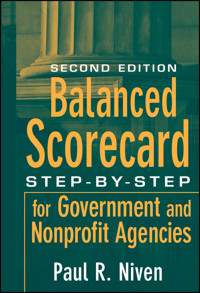
This Second Edition contains the same core implementation guidance offered in the first volume, but has been significantly updated and enhanced to ensure it reflects the latest theory and practice of performance management for the nonprofit and public sectors. Every single word covering the pages of the First Edition was put to the tests of relevancy, accuracy, and importance during the alteration process. In addition to modifying topics appearing in the earlier edition, this text contains expanded coverage of subjects that have matured significantly since its first printing in 2002. My coverage of Strategy Maps—powerful communication tools signaling to everyone, within the organization and beyond, the drivers of organizational success—has been completely revamped with entirely new sections on how to facilitate a Strategy Map session as well as increased coverage of developing objectives for each perspective. The book also features a robust examination of strategy-centered review meetings. I have provided my latest thinking, based on years of field experience, on how to conduct productive meetings that put strategy at the heart of the agenda. Finally, the book will introduce you to a new, and vitally important topic—the Office of Strategy Management (OSM). You’ll learn how this promising function seamlessly marries the worlds of strategy formation and execution.
THE BALANCED SCORECARD
In the early 1990s, Robert Kaplan and David Norton sought to solve a measurement problem plaguing corporations around the globe. The dynamics of business were changing rapidly; globalization, customer knowledge, and the rise of intangible assets were all converging to forever change the way business was conducted. Strategy was considered a potent defense for succeeding in this changing landscape. However, the facts suggested that about 90% of organizations were unable to execute their strategies.
Kaplan and Norton made the startling discovery that performance measurement systems utilized by most firms were incapable of providing the information needed to compete in this new knowledge economy. Most were unchanged from those developed by the early industrial giants at the turn of the twentieth century. Characterized by an almost exclusive reliance on financial measures of performance, these systems were ill-prepared for the challenges faced by modern organizations. Kaplan and Norton believed that organizations should attempt the introduction of balance to their measurement systems. Specifically, the historical accuracy and integrity of financial measures must be balanced with the drivers of future financial performance in an attempt to view a wider spectrum of performance and execute strategy. Their radical, yet profoundly simple, approach was labeled a “Balanced Scorecard” and featured measurement in four distinct, yet related areas: customer, internal processes, employee learning and growth, and financial.
Since its introduction in 1990, the Balanced Scorecard has been embraced by corporations around the world. Recent estimates suggest that at least 60% of Fortune 1000 organizations use a Balanced Scorecard system. For-profit companies have used the system to generate improved financial results, foster accountability, align employees with corporate goals, enhance resource allocation decisions, improve collaboration, and most critically, execute their strategies.
USING THE BALANCED SCORECARD IN THE PUBLIC AND NONPROFIT SECTORS
Public and nonprofit organizations today face unprecedented challenges in carrying out their vital mission-oriented tasks. Increased public scrutiny, demands for accountability, cries of enhanced transparency, and donations linked to stipulations of success, are but a few of the piercing calls you must answer in meeting stakeholder expectations. And of course, you’re required to achieve all of this and more in an environment marked by shrinking budgets, strict regulations, and changing workforce demographics.
Speaking of demographics, the retirement of 76 million baby boomers in the United States will push the ranks of the elderly to more than 20% of the country’s population during the next 20 years. In Japan and Europe during the same period, the legions of elderly will account for almost 30% of the population.a Balancing the needs of retirees (all of whom will require increasing levels of government services) with younger citizens, while still holding taxes to politically sustainable levels, leads to one undeniable conclusion: It’s imperative we get the most from every government dollar.
In the years to come, enhanced productivity, performance improvements, and strategy execution will be transformed from private sector topics that drive bestseller lists to survival imperatives for every public sector agency.
Nonprofit organizations are certainly not immune to the tempest of change swirling about our modern world. Whether it’s a small local arts organization or a national charity, virtually all of the demands faced by public and private sector firms are shared by nonprofits. The laser of scrutiny is being applied with unprecedented vigor everywhere in the nonprofit world; even charitable foundations established by professional athletes have come under the glare of public inquiry. The Wall Street Journal recently dedicated a two-page feature story to an examination of philanthropy in the sports world.b Given the “gotcha” mentality so popular in our watchdog culture, it’s absolutely essential that nonprofits demonstrate results while simultaneously exhibiting prudent financial stewardship.
Take another look at the list of achievements private sector firms have seen from their investment in the Balanced Scorecard: accountability, collaboration, alignment, resource allocation improvement, enhanced financial results, and strategy execution. Each and every one of those benefits is equally available to government and nonprofit agencies willing to implement the Balanced Scorecard system with rigor and discipline. The City of Charlotte, North Carolina, profiled in Chapter 12, embraced the Scorecard framework over a decade ago and has reaped many of the benefits noted above. So too have countless other public sector and nonprofit agencies around the globe. They’ve discovered that with minor modifications, and rendered with care and precision, the tool can be customized to benefit any organizational setting or structure.
Making the transition to this new world of measurement, management, and strategy execution is not without its share of potential pitfalls. This book has been written to help you navigate this sea of change, and capitalize on the many benefits of the Balanced Scorecard, while concurrently avoiding costly implementation errors. Let’s look at what you’ll find in the chapters ahead.
HOW THE BOOK IS ORGANIZED
This Second Edition of Balanced Scorecard Step-by-Step for Government and Nonprofit Agencies is comprised of 13 chapters and an appendix, spanning the entire spectrum of a Balanced Scorecard implementation. The opening chapter introduces the Balanced Scorecard tool, providing an historical perspective and discussing the many facets of this tool. Adapting the Balanced Scorecard to the public and nonprofit sectors is the subject of Chapter 2. You’ll learn that with only minor “geographical” modifications, the Balanced Scorecard is well-suited to meet your measurement and strategy execution challenges.
Upon embarking on a Balanced Scorecard implementation, you’ll quickly discover it is more than a “measurement” initiative. In fact, the Scorecard will touch many disparate elements of your organization. The next four chapters outline the many and varied elements that must be in place to ensure your Scorecard outcomes are successful. Chapter 3 is entitled “Before You Begin” and discusses a number of items that must be considered prior to building a Scorecard, including: your rationale for engaging in this effort, gaining executive sponsorship for the initiative, and building an effective team. Many organizations rush into the Scorecard building process without the aid of training on the subject. Poorly designed Scorecards, and little if no alignment throughout the organization, frequently result from this decision. Chapter 4 provides a training curriculum for your Balanced Scorecard initiative and also discusses the importance of communication planning. In Chapter 5, we begin our transition to the core elements of the Balanced Scorecard beginning with mission, values, and vision. The Scorecard will ultimately act as a translation of these critical enablers of organizational success. In this chapter we’ll explore the nature of these building blocks and offer tools for developing or refining your current statements. Strategy is at the core of every Balanced Scorecard, and Chapter 6 examines this widely discussed, but often poorly understood subject. A straightforward approach for developing strategy is offered.
The next block of chapters will provide you with a guided tour through the development of a Strategy Map of objectives and Balanced Scorecard of performance measures. Chapter 7, which has been extensively updated for this edition, outlines the Strategy Map concept of graphically displaying the key objectives that serve as the translation of your strategy. You’ll find advice on everything from how to interview executives to customizing your Map. Chapter 8 ushers in an examination of how to populate your Balanced Scorecard by examining measures, targets, and initiatives. You’ll learn how to develop measures in each of the four perspectives, why targets are critical, and how initiatives can mean the difference between success and failure on performance.
The final five chapters of the text are dedicated to helping you get the most out of your Balanced Scorecard system. We begin in Chapter 9 which probes the concept of cascading the Balanced Scorecard. This term refers to the process of generating goal alignment throughout the organization by the development of Strategy Maps and Balanced Scorecards at each and every level of the agency. In an era of shrinking budgets, we’re constantly reminded of the importance of aligning spending with results. Chapter 10 provides a method of linking the Balanced Scorecard to your budgeting process, and in so doing aligning spending with strategy. Chapter 11 canvasses the many reporting options available to Scorecard-adopting organizations. Whether you choose to buy an automated software package or develop your own tool, you’ll find the information you need to make an informed decision. This chapter also includes a robust dialog on the concept of strategy-centered management meetings. Like you, I’ve sat through my fair share of boring and unproductive meetings. With the advice offered in this chapter I’m throwing down the gauntlet—no more bad meetings! In Chapter 12, we’re treated to an insider’s view of the Balanced Scorecard at the City of Charlotte, North Carolina. These Scorecard pioneers share their secrets for success, and offer pitfalls that must be avoided on the road to strategy execution. The final chapter provides you with a glimpse into what is necessary to sustain your Scorecard success. A highlight of the chapter is an introduction to the Office of Strategy Management (OSM) concept. You’ll also learn how one organization utilized the concept to tremendous advantage. The book concludes with an appendix outlining the critical nature of terminology to your implementation and a glossary of key Scorecard-related terms.
It’s a pleasure to serve as your guide through the rewarding territory that is the Balanced Scorecard. My goal is to steer you through the terrain that follows by offering a text that is exhaustive in scope without being excessively complex or unduly simplistic. Let’s get started!
February 2008
PAUL R. NIVEN San Diego, California
Acknowledgments
Isaac Newton once remarked that “If I have seen farther than others, it is because I was standing on the shoulders of giants.” And so it is that I am able to deliver this book to you. The individuals mentioned below, and countless others, are largely responsible for giving me the opportunity to share the ideas in this book with you. In many ways, I am merely a vessel through which their ideas, inspiration, and wisdom pass to you, and hopefully from you to many others.
This being a second edition, rigorous scrutiny was applied to every page, with an eye towards updating, clarifying, and enhancing each subject covered. Upon reading the previous paragraph, however, I was unable to change a single word. It rings as true today as it did over five years ago when I completed the first manuscript for this text. Without the kindness, knowledge, and spirit of learning I received from those listed below, this book would never have reached your hands.
NEW ACKNOWLEDGMENTS FOR THE SECOND EDITION
Interest in, and enthusiasm for, applying the Balanced Scorecard to public and nonprofit environments has grown substantially since the First Edition of this book appeared. I’ve been extremely fortunate during that time to work with several organizations from both sectors that have provided immense assistance in advancing my knowledge and expanding the horizons of the Scorecard framework.
From the Corporation for Enterprise Development (CFED) in Washington DC, my thanks go out to Andrea Levere, Genevieve Melford, and Kim Pate for their honesty, sincerity, and earnest commitment to this tool. At the Regulatory Affairs Professionals Society (RAPS), also in DC, I am deeply indebted to Sherry Keramidas for her enthusiastic support of the Balanced Scorecard. Food for the Hungry U.S. (FHUS) provided perhaps the most inspirational environment I’ve ever had the pleasure of working in. My sincerest thanks to the entire senior management team, but in particular: Ben Homan, Loren Kutsko, Matt Panos, and Peter Mawditt. At the Coordinating Office for Terrorism Prevention and Emergency Response (COTPER) of the CDC in Atlanta, thank you to Rich Besser and Galen Carver for your tireless work in support of the principles of performance management. Merl Waschler and Katherine Cecala of the Valley of the Sun United Way in Phoenix have been ardent supporters of the Balanced Scorecard and I thank them for their vision and inspiration. At the Rural Health Resource Center, an outstanding organization demonstrating passionate commitment to the ideals of performance improvement, my thanks to Terry Hill and his enormously talented staff. Finally, to David Hay, Sharon MacFarlane, Christian Richard, and Karin Row of New Brunswick (NB) Power in Fredericton New Brunswick, thank you for your support, generosity of time and spirit, and dedication—I enjoyed every minute we spent together. Christian Richard receives the “above and beyond the call of duty” award. In the midst of guiding the organization’s new Office of Strategy Management with passion and poise, and adjusting to life at home with a new baby girl, Chris, in a request from me, wrote over 20 pages of notes on NB Power’s Scorecard implementation that proved immensely helpful.
In addition to clients, I have benefited from the insights and kindness of many others, including my consulting partner Dennis Barnhart. Thank you for your wise counsel and boundless capacity for learning. To Tor Inge Vasshus and Eric Peterson of Corporater, thank you for embracing the true spirit of partnership as we work together to expand the frontiers of the Scorecard. Oh, and by the way, you’ve built an incredible software product! And finally, to Gerardo Pustelnik and Claudio Nassar of Strategy Execution Consulting in Mexico City (my Latin American partners), thank you for your energy, commitment, and dedication to strategy execution.
ACKNOWLEDGMENTS FROM THE FIRST EDITION
There is a charming story about George Bernard Shaw perusing the shelves of a used bookstore one day and coming across one of his own volumes. Upon turning the cover he found the inscription: “To_______, with esteem, George Bernard Shaw.” He promptly bought the book and returned it to_______, adding the line: “With renewed esteem, George Bernard Shaw.” So it is with this Second Edition, I would like to offer renewed thanks to the following people.
My deepest gratitude is extended to the many individuals kind enough to share their time and information with me. Special thanks to Bobbi Bilnoski at the Concitti Network, Colleen Tobin formerly of Women’s World Finance, Rhonda Pherigo from the Center for Nonprofit Management, Bruce Harber of the Vancouver Coastal Health Authority, Dr. Howard Borgstrom from the Department of Energy, Nancy Foltz at the State of Michigan, Rick Pagsibigan from the Red Cross of Southeastern Pennsylvania, Abbi Stone and Katy Rees from the San Marcos campus of the California State University, consultant Donald Golob, author and consultant William P. Ryan, Jake Barkdoll and the Balanced Scorecard Interest Group, Betty Cabrera at the Dallas Family Access Network, Diane Williams of the Safer Foundation, Dennis Feit from the Minnesota Department of Transportation, Philippe Poinsot from the United Nations Development Programme, and Jeff Celentano from the City of North Bay, Ontario.
An innumerable number of other individuals have an imprint on this book. Let me conclude by mentioning just a few: Lisa Schumacher, Kim Eagle,Tiffany Capers, and Matt Bronson from the City of Charlotte, North Carolina. They were gracious enough to submit to interviews for both editions of this book. Joe and Catherine Stenzel have been wonderful friends and great supporters for many years; my thanks to both of you. Steve Mann provided invaluable assistance with early interviews and research for the First Edition of this book, despite recently retiring! Andra Gumbus of Sacred Heart University offered insight and assistance that is greatly appreciated. Finally, I would like to thank Teri Anderson. Teri gave me my start in the performance measurement field many years ago, and has been a supporter and great friend ever since.
1
Introduction to the Balanced Scorecard
Roadmap for Chapter 1 Before you can begin developing a Balanced Scorecard for your organization, we must ensure that you have a solid foundation of Scorecard knowledge and understanding from which to build. This chapter will provide that base.
We’ll begin by considering just why measurement is so important to the modern public and nonprofit organization. We’ll then look at three factors that have led to the rising prominence of the Balanced Scorecard since its inception over seventeen years ago. You’ll learn that our changing economy, which places a premium on intangible assets, demands more from our measurement systems. Financial measurements and their significant limitations will then be examined. The final factor escalating the growth of the Balanced Scorecard is the inability of most organizations to effectively execute their strategies. We’ll review a number of barriers to strategy implementation.
The Balanced Scorecard has emerged as a proven tool in meeting the many challenges faced by the modern organization. The remainder of the chapter introduces you to this dynamic tool. Specifically, we’ll examine the origins of the Scorecard, define it, and look at the system from three different points of view: as a communication tool, measurement system, and strategic management system.
WHY MEASUREMENT IS SO IMPORTANT
One of the themes of this book is that regardless of what sector your organization represents, there is a role for measurement to improve your performance. So it is in the vein of connecting measurement to virtually any field of endeavor that I offer this historical account to begin our expedition together. In the dense fog of a dark night in October 1707, Great Britain lost nearly an entire fleet of ships. There was no pitched battle at sea; the admiral, Clowdisley Shovell, simply miscalculated his position in the Atlantic and his flagship smashed into the rocks of the Scilly Isles, a tail of islands off the southwest coast of England. The rest of the fleet, following blindly, went aground and piled onto the rocks, one after another. Four warships and 2,000 lives were lost.
For such a proud nation of seafarers, this tragic loss was distinctly embarrassing. But to be fair to the memory of Clowdisley Shovell, it was not altogether surprising. Although the concept of latitude and longitude had been around since the first century B.C., still, in 1700, no one had devised an accurate way to measure longitude, meaning that nobody ever knew for sure how far east or west they had traveled. Professional seamen like Clowdisley Shovell estimated their progress either by guessing their average speed or by dropping a log over the side of the boat and timing how long it took to float from bow to stern. Forced to rely on such crude measurements, the admiral can be forgiven his massive misjudgment. What caused the disaster was not the admiral’s ignorance, but his inability to measure something that he already knew to be critically important—in this case longitude.1
We’ve come a long way since Clowdisley Shovell patrolled the seas for his native Great Britain. If you’re a sailor, today’s instrumentation ensures that any failure of navigation may be pinned squarely on your own shoulders. But for those of you who spend your days leading public and nonprofit organizations, how far have you come in meeting the measurement challenge? Can you measure all those things you know to be critically important? Today’s constituents and donors are better informed than at any time in history. That knowledge leads to a demand of accountability on your part to show results from the financial and human resources entrusted to you. To do that, you must demonstrate tangible results which are best captured in performance measures.
Lesen Sie weiter in der vollständigen Ausgabe!
Lesen Sie weiter in der vollständigen Ausgabe!
Lesen Sie weiter in der vollständigen Ausgabe!
Lesen Sie weiter in der vollständigen Ausgabe!
Lesen Sie weiter in der vollständigen Ausgabe!
Lesen Sie weiter in der vollständigen Ausgabe!
Lesen Sie weiter in der vollständigen Ausgabe!
Lesen Sie weiter in der vollständigen Ausgabe!
Lesen Sie weiter in der vollständigen Ausgabe!
Lesen Sie weiter in der vollständigen Ausgabe!
Lesen Sie weiter in der vollständigen Ausgabe!
Lesen Sie weiter in der vollständigen Ausgabe!
Lesen Sie weiter in der vollständigen Ausgabe!
Lesen Sie weiter in der vollständigen Ausgabe!
Lesen Sie weiter in der vollständigen Ausgabe!