


6,99 €
Mehr erfahren.
- Herausgeber: Atlantic Books
- Kategorie: Geisteswissenschaft
- Sprache: Englisch
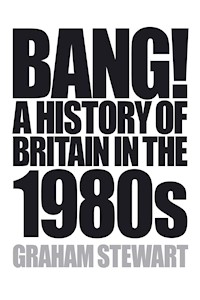
'Graham Stewart has done a terrific job. His book brings the decade vividly to life and convincingly places it in perspective... Excellent' -- Toby Young, Mail on Sunday Britain in the 1980s was a polarized nation. Determined to take the country in a radically different direction was the most dominant, commanding and controversial leader of her age, Margaret Thatcher. With the two main political parties as far apart as at any time since the 1930s, the period was riven by violent confrontation, beginning with the explosion of rioting that rocked England's cities in 1981 and again in 1985; a year-long fight with the National Union of Mineworkers, and then with print workers in Wapping. There was the war to retake the Falkland Islands and the re-escalation of the troubles in Northern Ireland, which began with hunger strikes and peaked with the attempt to assassinate the entire Cabinet in the Brighton bombing. It was also a decade of political innovation - in the life and death of the Social Democratic Party, the mass privatization of state-owned industries, the sale of council houses and the deregulation of financial markets - and cultural ferment, with the rise and fall of indie pop, the emergence of house music, Channel 4 and the growth of alternative comedy; and Prince Charles's interventions on architecture. Graham Stewart's magnificent and comprehensive history of the eighties covers all these events, and many more, with exhilarating verve and detail, and also examines the legacy of a decade that sowed the seeds of modern Britain.
Das E-Book können Sie in Legimi-Apps oder einer beliebigen App lesen, die das folgende Format unterstützen:
Veröffentlichungsjahr: 2013
Ähnliche



















Also by Graham Stewart
Burying Caesar: Churchill, Chamberlain and the Battle for the Tory Party
His Finest Hours: The War Speeches of Winston Churchill
The History of The Times (Volume VII): The Murdoch Years
Friendship and Betrayal: Ambition and the Limits of Loyalty
Britannia: 100 Documents That Shaped a Nation
Published in Great Britain in 2013 by Atlantic Books, an imprint of Atlantic Books Ltd.
Copyright © Graham Stewart, 2013
The moral right of Graham Stewart to be identified as the author of this work has been asserted by him in accordance with the Copyright, Designs and Patents Act of 1988.
All rights reserved. No part of this publication may be reproduced, stored in a retrieval system, or transmitted in any form or by any means, electronic, mechanical, photocopying, recording, or otherwise, without the prior permission of both the copyright owner and the above publisher of this book.
Every effort has been made to trace or contact all copyright holders. The publishers will be pleased to make good any omissions or rectify any mistakes brought to their attention at the earliest opportunity.
10 9 8 7 6 5 4 3 2 1
A CIP catalogue record for this book is available from the British Library.
Hardback ISBN: 9781848871458
Ebook ISBN: 9781782391371
Paperback ISBN: 9781848871465
Printed in Great Britain.
Atlantic Books An Imprint of Atlantic Books Ltd Ormond House 26–27 Boswell Street London WC1N 3JZ
www.atlantic-books.co.uk
For my good friend, Jean-Marc Ciancimino
CONTENTS
Acknowledgements
List of Illustrations
Introduction
1 Jim’ll Fix It
Waiting at the Church
Floating or Sinking?
Crisis? What Crisis?
The Ayes to the Right
2 Hello Maggie!
Marketing Maggie
Five Weeks that Shaped a Decade?
A Woman in Power
3 The Centre Cannot Hold
The Joy of Monetarism
The Pain of Monetarism
‘Wets’ and ‘Dries’
Trouble for Tina
4 Ghost Town
Breadline Britain
Long Hot Summer – The Brixton and Toxteth Riots
The Hunger Strikes
5 The Alternative
The Democracy of the Committed
Gang of Four – Bright Dawn over Limehouse
The Donkey-Jacket Tendency
Breaking the Mould?
6 The Empire Strikes Back
The Last Good-Old-Fashioned War?
White Flags over Whitehall
Towards the Abyss
Sink the Belgrano!
White Flags over Stanley
7 Resurrection
The Resolute Approach
Recovery
The North Sea Oil Bonanza . . . and Where It Went
8 Two Tribes
Protest and Survive
Protect and Survive
Cold Thaw
9 Culture Shock
Paying the Piper
Next Programme Follows Shortly
You Have Been Watching
The British Are Coming . . . and Going
10 Style Over Substance?
After Modernism
Po-Mo – The Spirit of the Age
11 Electric Baroque
Are ‘Friends’ Electric?
Ridicule Is Nothing to Be Scared of
Money for Nothing
The Rise and Fall of the Indies
Welcome to the Acid House
Madchester
12 Moral Panic
No Such Thing as Society
Law and Disorder
Don’t Die of Ignorance
Faith, Hope and Charity
Liberty, Equality, Fraternity?
13 The Workers, United, Will Never Be Defeated
Which Side Are You On? – The Miners’ Strike
The End of the Street – Revolution at Wapping
On the Waterfront
United They Stand?
14 Creative Destruction
Rolling Back the State
A Tale of Two Cities
The Predators’ Ball
Greed Is Good
Loaded, Landed, Leveraged
15 An End To Old Certainties
Ten More Years! Ten More Years!
Whitehall versus Town Hall
The Diet of Brussels
Scrapping the Iron Lady
16 Legacy
Appendix
Notes
Bibliography
Note on the author
Index
ACKNOWLEDGEMENTS
Britain in the 1980s does not lend itself easily to dispassionate analysis. It was a time of primary colours, clashing ideologies and divisive personalities. Any effort now to dodge contentiousness by painting it in gentler, pastel shades can only miss its vibrant power to shock, disturb and excite. Rather than skirt around its arguments, the historian can only join them.
At the same time, I am conscious of the dangers of allowing personal experiences of the decade to cloud judgment. For this reason I have tried to let neither my own partial and perhaps hindsight-contaminated recollections (I was a Scottish teenager for almost all of the eighties) nor the possibly unreliable memories of those who shaped the period, rather than merely grew up in it, assume undue influence. Wherever possible, it is always best to garner the evidence from what is recorded during, or soon after, the events.
For their help in gathering this material I should particularly like to thank Eamon Dyas and Nick Mays at the News International Archive and Record Office and the staff at the London Library and the British Library for all their assistance. Any historian of the politics of the period is also indebted to the Margaret Thatcher Foundation, whose exemplary website provides an easily accessible treasure trove of primary material.
Among the secondary sources that have most influenced this book, I should like to single out John Campbell for his remarkable two-volume biography of Margaret Thatcher, Francis Beckett and David Henche for their history of the miner’s strike, Ivor Crewe and Anthony King for their work on the SDP, Simon Reynolds on early-eighties pop, Matthew Collin on the late-eighties dance scene and David Kynaston for his magisterial study of the City of London. The responsibility for the interpretations drawn from these and other works of scholarship listed in the bibliography is, of course, entirely my own.
At Atlantic Books, I consider myself extremely fortunate to have had Toby Mundy as my commissioning editor, while James Nightingale expertly saw the book through from manuscript to printing press. As ever, my agent, Georgina Capel, has been a tireless advocate and supporter.
Finally, for their kindness, encouragement, ideas and stimulating conversation during the writing of this book I would particularly like to thank Nicholas Boys Smith, Jane Clark, Mark Craig, Thomas Harding, Daniel Margolin, Duncan Reed, Luke Rittner, Cita and Irwin Stelzer, Paul Stephenson, Eleanor Thorp, Edward Wild and Nicole Wright. Jean-Marc Ciancimino has been a very good friend over many years and it is in recognition of this that I should like to dedicate this work.
ILLUSTRATIONS
First section
Margaret Thatcher depicted as national saviour (The Sunday Times Magazine/NI Syndication)
The Brixton riots (DHPL, photographersdirect.com)
Margaret Thatcher in Thornaby (Rex Features)
Michael Foot (Getty Images)
The ‘Gang of Four’ (Mirrorpix)
HMS Illustrious returns to Portsmouth (Popperfoto/Getty Images)
Greenham Common women’s peace camp (Rex Features)
Second section
Ronald Reagan and Margaret Thatcher at the White House (Barry Thumma/AP/Press Association Image)
Spitting Image (ITV/Rex Features)
Andy McCluskey and Paul Humphreys of OMD (Getty Images)
Brideshead Revisited (ITV/Rex Features)
New Romantics (Sheila Rock/Rex Features)
Madness (Redferns)
The Smiths (Redferns)
The crowd at Live Aid, Wembley Stadium, London (Redferns)
Bob Geldof, Prince Charles, Princess Diana, David Bowie, Brian May and Roger Taylor at Live Aid (Getty Images)
Third section
Striking miners battle with police at Orgreave ( Jim Duxbury/Associated Newspapers/Rex Features)
Arthur Scargill arrested at Orgreave picket line (Mike Forster/Daily Mail/Rex Features)
Frankie Goes to Hollywood (L.J. Van Houten/Rex Features)
Wham! (ITV/Rex Features)
Katherine Hamnett and Margaret Thatcher (PA/PA Archive/Press Association Images)
Aids awareness campaign (Gillian Allen/AP/Press Association Images)
Cambridge May Ball ‘survivors’ (Michael S. Yamashita/Corbis)
Jeremy Taylor and Eddie Davenport (Dafydd Jones)
Fourth section
A Room with a View (Everett Collection/Rex Features)
Withnail & I (Getty Images)
Margaret Thatcher and her Cabinet at the Conservative party conference (Martin Shakeshaft)
Neil and Glenys Kinnock (Time & Life Pictures/Getty Images)
Derek Hatton (News (UK) Ltd/Rex Features)
The poll tax riots (Mirrorpix)
City traders (Barry Lewis/Alamy)
London raver (Rick Colls/Rex Features)
Graphs
p. 476 Manufacturing as % of GDP (International Comparison)
p. 479 Opinion Polls: Party Support (%)
INTRODUCTION
The paradox of the eighties is simply put. Everywhere we look around and see its profound influence and yet the decade itself – its tastes, obsessions and alarms – is beginning to seem remote to the point of becoming exotic.
The realization that Britain in the eighties did not, in fundamental respects, resemble the country of today presents an opportunity worth grasping. It suggests that we are gaining distance and critical detachment from events and personalities that divided opinion to a degree that seemed remarkable even at the time. Of course, it is the extremes and peculiarities of any age that tend to be remembered while the quiet continuities remain unexamined or taken for granted. Some Britons rioted and went on protest marches while others hung patriotic bunting and bought shares in British Telecom. Impervious to stereotype, a few may have done all four. Many more did none of these things; history may be shaped by trendsetters but is not just inhabited by them. With the help of selective, and at times repetitive, archive footage to accompany television and newspaper commentary, shoulder pads and striking miners are portrayed as emblematic of the eighties. At the same time, sales of denim jeans held up pretty well and millions of employees simply got on with their work and, every once in a while, won promotion.
Nevertheless, it would take an essayist of wearisome contrariness to argue that the period of the eighties had little that was distinctive, let alone unique, about it and should be conceded no meaning beyond that dictated by the calendar. For a start, no decade had seen Britain served continuously by the same prime minister since William Pitt the Younger in the 1790s; and unlike Pitt (whose terms of office stretched from 1783 to 1801 and 1804 to 1806), Margaret Thatcher’s Downing Street tenure (1979 to 1990) almost perfectly framed the intervening decade as if it were her own. Perhaps this might not have been so significant had she possessed a more technocratic and less commanding personality. That she proved to be one of the dominant figures of modern British history is a defining characteristic of the period. While this book encompasses politics, economics, the arts and society, it has a unifying theme: the attraction or repulsion, in each of these areas, to and from the guiding spirit of the age. That Thatcher was the personification of that spirit is perhaps the least contentious aspect of what will unfold.
There is another recurring theme. It is that what happened during the eighties in the UK was not just significant for those who lived there. The country’s influence was worldwide to an extent that is easily forgotten in the first decade of the twenty-first century. The Cold War and the major strategic role of British forces in defending the ‘Free World’ against the Soviet Union stand out with particular clarity. Thatcher was the first Western leader to identify Mikhail Gorbachev as someone with whom, to paraphrase her, business could be done. She was an important bridge between him and Ronald Reagan. The legacy from that most fruitful of détentes was of unambiguous benefit to mankind, which for the previous four decades had been forced to ponder what, at times, looked like its imminent destruction in nuclear war. Necessarily, though, the ‘cold thaw’ diminished Britain’s strategic significance in the world.
NATO and diplomatic special relationships were only a part of Britain’s significance during the eighties. The international penetration by British youth and progressive cultures was remarkable, with British acts accounting for a third of pop music sales in the United States. On 13 July 1985, it was estimated that more than one fifth of the planet’s inhabitants watched the most spectacular charity appeal in history, coming to them from a stadium in north-west London. In the Live Aid audience at Wembley was Diana, Princess of Wales, an international fashion icon of the period without European, or possibly global, compare.
Political debate, though, remained at the heart of Britain’s influence. If we now take it for granted that a major Western country’s head of government could be a woman, it is primarily because Thatcher made it so. Thirty years on from her election, it is right to argue over Thatcher’s legacy but difficult to dismiss out of hand at least the general sentiment of her official biographer, Charles Moore, that
She is the only post-war British prime minister (her successors included) who stands for something which is recognized and admired globally. ‘Ah, Mrs Thatcher – very strong woman!’ taxi drivers have said to me in Melbourne, Moscow, Paris, Tokyo, New York, Delhi and Cape Town. Indeed, and still the only woman in the history of democratic government to have made a real difference to the world.1
Such admiration was not always felt everywhere, least of all at home. For a while, other nations looked on in horror at the signs of social, economic and political division that run through the narrative of this book. Then – for good or ill – they began to copy the policies that Thatcher’s Britain had experimented with, enacted and promoted. Britain in the eighties was both an inspiration and a warning to the rest of the world to an extent that it has rarely been during the succeeding twenty years. What follows is an attempt to describe, analyse and argue over that momentous period in the nation’s history.
1JIMLL FIX IT
Waiting at the Church
The prime minister had a farm: Upper Clayhill spread out across 138 acres of the Sussex Downs. To the west was the medieval town of Lewes, where more than seven hundred years previously the Father of Parliament, Simon de Montfort, and his fellow barons had defeated a royal army and taken the hapless King Henry III prisoner. To the south was Glyndebourne, home since the 1930s of the celebrated summer opera festival. Set beside a water meadow, the farmhouse at Upper Clayhill was part-Elizabethan, part-Georgian. Built in old Sussex brick, it retained many of its original oak beams and an impressive Tudor fireplace. James Callaghan had taken out a loan to buy it in 1968 shortly after a Cabinet reshuffle had switched him from the Treasury to the Home Office. He found that farming was not only a money-making venture but also a welcome distraction, and it provided him with a weekend retreat where his family could gather for Sunday lunch. Upon becoming prime minister in 1976, he gladly exchanged a pokey flat in Lambeth for 10 Downing Street, and even though he also gained the official country house at Chequers, parting with Upper Clayhill was never his intention. It did not come with the job and it could not be taken away with the job. Its rustic, homely feel contrasted with the formal town-house dimensions of Downing Street. Only the historical bric-a-brac on the walls suggested an occupant with an interest in the vigorous projection of British power in the world: the rooms were decorated with prints and paintings of Royal Navy men-o-war, sails puffed out and cannons ready to repel the enemy.
This artistic taste might have suggested a nostalgic Tory busy fortifying his old-fashioned dwelling against the sombre realities of 1970s Britain, a nation whose relative decline was a recurring subject of discussion in the media, at home and abroad.1 But James Callaghan was the leader of the Labour Party. He had no particular pining for lost imperial glories. What was more, as prime minister, he was as engaged as anyone in the realities of the present and more optimistic than most that years of prosperity lay ahead, especially if his government could, through a partnership with the trade unions, ensure industrial peace and maintain wage restraint as the means to bring down inflation. The sick man of Europe epithet, once used of the Ottoman Empire, may have attached itself to the United Kingdom during the decade as economic dislocation followed an energy crisis and international economists like J. K. Galbraith spoke regretfully of the British disease, yet, unlike the other major European nations, the United Kingdom possessed an asset that seemed destined to protect her from subsequent shocks and through which a dramatically more prosperous future could be secured.
North Sea oil promised riches the like of which previous post-war prime ministers could scarcely have dreamt. Black gold was the abundant substance that would fund higher public spending and remove the burden from the average taxpayer. In June 1977, Gavyn Davies (who would later be chairman of the BBC but was then a member of the Downing Street Policy Unit) sent Callaghan a medium-term assessment which forecast that through a policy of controlled reflation and rising North Sea oil revenues, Labour might be able to reduce income tax to 15 per cent by 1982.2 The eighties could be a decade of dynamic growth, enhanced public sector investment and Scandinavian-style social democracy.
However, if Callaghan wanted to lead this national revival he had first to win a general election. When to call polling day was what particularly preoccupied him during August 1978. With Parliament on its summer recess, Upper Clayhill Farm provided the perfect setting for calm and measured deliberation. After completing his usual early morning tour of the acres, the fields of barley, checking the welfare of the cattle and assessing the likelihood of rain,3 his mind turned to forecasting the consequences if he called a snap general election in the autumn.
There was no need to do so until late the following year since, constitutionally, it was not until November 1979 that there had to be an election. The main argument for waiting until the full five-year term had expired was a powerful one given that the country had only recently emerged from a recession. The longer Callaghan could put off the campaign, the more time there was for a sustained economic recovery to improve the voters sense of material well-being. But prime ministers were out of the habit of going the distance. In search of a workable parliamentary majority in 1966, Harold Wilson had called and won an election seventeen months into his first term of office. In 1970, he went to the polls again, nine months before it was necessary to do so. His Tory vanquisher on that occasion, Edward Heath, proceeded to gamble, unsuccessfully, on a February 1974 election, sixteen months early. Then, in October 1974, the third general election within four years was held. Between 1966 and 1974, declaring early had worked twice and failed twice.
One handicap in calling a snap election was that it could look suspicious. Did the prime minister know something ominous was on the horizon and was trying to secure re-election before the storm hit? It was therefore helpful that the vote should be held not just after several months of improving conditions but in an atmosphere marked by continuing optimism. Both criteria appeared to be met in the summer of 1978. Furthermore, Callaghans generally avuncular public persona he was dubbed Sunny Jim was an obvious asset in this respect. The opinion polls suggested he was both more popular than his own Labour Party and more popular than the leader of the opposition, Margaret Thatcher, whose popularity was lower than that of her Conservative Party. Were it to be a presidential contest, the advantage was clearly with Callaghan. Nonetheless, even the reality of a parliamentary election was not necessarily bad news for Labour. Although the psephological evidence was mixed, with private polling provided to the prime minister by Bob Worcester of MORI suggesting the Tories were clinging on to the slenderest of advantages, other opinion polls showed Labour leads of up to 4 per cent. By October, that lead had grown to between 5 and 7 per cent. Seven per cent represented a decent majority.
Lesen Sie weiter in der vollständigen Ausgabe!
Lesen Sie weiter in der vollständigen Ausgabe!
Lesen Sie weiter in der vollständigen Ausgabe!
Lesen Sie weiter in der vollständigen Ausgabe!
Lesen Sie weiter in der vollständigen Ausgabe!
Lesen Sie weiter in der vollständigen Ausgabe!
Lesen Sie weiter in der vollständigen Ausgabe!
Lesen Sie weiter in der vollständigen Ausgabe!
Lesen Sie weiter in der vollständigen Ausgabe!
Lesen Sie weiter in der vollständigen Ausgabe!
Lesen Sie weiter in der vollständigen Ausgabe!
Lesen Sie weiter in der vollständigen Ausgabe!
Lesen Sie weiter in der vollständigen Ausgabe!
Lesen Sie weiter in der vollständigen Ausgabe!
Lesen Sie weiter in der vollständigen Ausgabe!
Lesen Sie weiter in der vollständigen Ausgabe!
Lesen Sie weiter in der vollständigen Ausgabe!
Lesen Sie weiter in der vollständigen Ausgabe!
Lesen Sie weiter in der vollständigen Ausgabe!
Lesen Sie weiter in der vollständigen Ausgabe!
Lesen Sie weiter in der vollständigen Ausgabe!
Lesen Sie weiter in der vollständigen Ausgabe!




