


Erhalten Sie Zugang zu diesem und mehr als 300000 Büchern ab EUR 5,99 monatlich.
- Herausgeber: Atlantic Books
- Kategorie: Geisteswissenschaft
- Sprache: Englisch
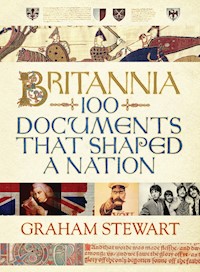
In Britannia Graham Stewart traces two thousand years of an island's story - from Roman province to twenty-first century European nation-state - through one hundred historic documents. From the eighth-century Lindisfarne Gospels to the great testament of Norman bureaucracy, the Domesday Book, and from the designs for the Union Jack in 1606 to Neville Chamberlain's 1938 Munich agreement with Hitler, the documents selected embrace a wide range of national endeavours: politics and religion, warfare and diplomacy, economics and the law, science and invention, literature and journalism, as well as sport and popular music. Thus the first edition of The Times rubs shoulders with the rules of the newly formed Marylebone Cricket Club; the designs for Stephenson's Rocket with the Catholic Emancipation Act; Lord Kitchener's iconic First World War recruitment poster with Clause Four of the Labour Party's constitution; and the Beatles' Sgt. Pepper album cover with Britain's accession treaty to the European Economic Community. These are documents that not only defined their own eras, but which continue to resonate today: Magna Carta and the Bill of Rights became vital legal curtailments of arbitrary royal power; medieval election writs and nineteenth-century reform acts shaped the creation of parliamentary democracy; the great translations of the Bible, the plays of Shakespeare and Dr Samuel Johnson's Dictionary have left indelible marks on the English language; while the influence of Adam Smith's Wealth of Nations continues to guide how we do business. Stylishly written and generously illustrated (including numerous reproductions of the documents themselves, twenty-four of them in full colour), Britannia should belong to anyone who is curious to learn more about the historic roots of our culture, society, language, religious traditions and political institutions.
Sie lesen das E-Book in den Legimi-Apps auf:
Seitenzahl: 742
Veröffentlichungsjahr: 2011
Das E-Book (TTS) können Sie hören im Abo „Legimi Premium” in Legimi-Apps auf:
Ähnliche



















BRITANNIA
Also by Graham Stewart
Burying Caesar: Churchill, Chamberlain and the Battle for the Tory Party
His Finest Hours: The War Speeches of Winston Churchill
The History of The Times: The Murdoch Years
Friendship and Betrayal: Ambition and the Limits of Loyalty
BRITANNIA
100 DOCUMENTS THAT SHAPED A NATION
GRAHAM STEWART
First published in hardback in Great Britain in 2010 by Atlantic Books and Callisto, imprints of Atlantic Books Ltd.
Copyright © Graham Stewart, 2010
The moral right of Graham Stewart to be identified as the author of this work has been asserted by him in accordance with the Copyright, Designs and Patents Act of 1988.
All rights reserved. No part of this publication may be reproduced, stored in a retrieval system, or transmitted in any form or by any means, electronic, mechanical, photocopying, recording, or otherwise, without the prior permission of both the copyright owner and the above publisher of this book.
The picture acknowledgements constitute an extension of this copyright page.
Every effort has been made to trace or contact all copyright holders. The publishers will be pleased to make good any omissions or rectify any mistakes brought to their attention at the earliest opportunity.
Lines from Casino Royale by Ian Fleming © 1953 Gildrose Productions Ltd.
Extract from Life in the UK Test: Practice Questions used with permission.© 2007 Red Squirrel Publishing www.redsquirrelbooks.com
10 9 8 7 6 5 4 3 2 1
A CIP catalogue record for this book is available from the British Library.
Callisto ISBN: 978 0 85740 022 2Atlantic Export ISBN: 978 1 84887 945 4eBook ISBN: 978 0 85789 136 5
Design and layout by www.carrstudio.co.ukPrinted in Great Britain
Callisto and Atlantic BooksImprints of Atlantic Books LtdOrmond House26–27 Boswell StreetLondonWC1N 3JZ
www.atlantic-books.co.uk
For my young nephew,Rufus Stewart
CONTENTS
List of Illustrations
Introduction
I THE DARK AGES
The Vindolanda Tablets, 1st century AD
Roman experiences of life in Britannia
The Romans in Britain
The Lindisfarne Gospels, c.715
An illuminated masterpiece from the Dark Ages
Early Christianity in Britain
Bede’s Historia Ecclesiastica Gentis Anglorum, 731
The first great history of the English Church and people
Bede’s List of ‘Bretwaldas’
Beowulf, 8th–10th century
The greatest surviving work of Anglo-Saxon literature
The Treaty of Alfred and Guthrum, 878–890
Establishing the boundary between Anglo-Saxon and Viking-occupied England
The Anglo-Saxon Chronicle, c.890–1116
Shining light upon the Dark Ages
II THE MEDIEVAL AGE
The Bayeux Tapestry, late 11th century
The story of the Norman Conquest
The End of Anglo-Saxon England
The Domesday Book, 1086
William the Conqueror’s survey of the nation and the centralization of state power
The Assize of Clarendon, 1166
The development of criminal courts, the common law and trial by jury
Magna Carta, 1215
The ‘Great Charter’ limits arbitrary power and establishes an Englishman’s right to habeas corpus
The Chronicles of Matthew Paris, c.1250
A distinguished example of medieval cartography and illustration
Angevins and Plantagenets
Simon de Montfort’s summons for a parliament, 1265
The roots of a representative parliament
The Statute of Rhuddlan, 1284
Edward I’s Anglicization of the Principality of Wales
Medieval Wales
The Declaration of Arbroath, 1320
A statement of Scottish independence
Scottish Wars of Independence
Wyclif’s Bible, 1382–95
The translation of the Bible into English
Spreading God’s Word in English
Henry VI’s charters for Eton and King’s College, Cambridge, 1440–6
Educating the elite
The Growth of Universities
William Caxton’s publication of Malory’s Morte d’Arthur, 1485
The spread of printed books and the enduring appeal of the Arthurian Legend
In Search of Arthur
III RELIGION AND THE RENAISSANCE
Tyndale’s New Testament, 1525–6
The language of Protestant scripture
Parliament’s petition to the pope to annul Henry VIII’s marriage, 1530
The English Church splits from Rome
The Anglo-Welsh Act of Union, 1536
Wales enters into formal union with England
The Anthony Roll, 1546
The inventory and depiction of King Henry VIII’s Royal Navy
The Growth and Decline of the Royal Navy
The Book of Common Prayer, 1549
The liturgy of the Church of England
The royal charter of the Muscovy Company, 1555
The first joint-stock company, funding exploration and the expansion of trade
Foxe’s Book of Martyrs, 1563
Creating a narrative of English Protestant identity under threat from Catholicism
The Thirty-Nine Articles, 1563
The doctrine of the state Church
The Reign of Elizabeth I
The Casket Letters, 1566–7
‘Proof’ of Mary, Queen of Scots’ complicity in murdering her husband
My Ladye Nevells Booke, 1591
William Byrd’s works for keyboard
A Golden Age of Music
The royal charter of the East India Company, 1600
The growth of British trade and empire
The Origins of Empire
The Elizabethan Poor Law, 1601
A national system of poor relief
IV STUART BRITAIN
The ‘Monteagle Letter’ and Guy Fawkes’s signed confession, 1605
The exposure of the Gunpowder Plot
Union Jack designs, 1606
The union of the Scottish and English crowns and the symbol of a British identity
The King James Bible, 1611
The Authorized Version of the Bible in English
Shakespeare’s First Folio, 1623
The plays of William Shakespeare are saved for posterity
A Golden Age of English Drama
The Petition of Right, 1628
The common law versus royal absolutism
The Scottish National Covenant, 1638
Scotland’s pledge to defend Presbyterianism against Charles I’s efforts to Anglicize the Kirk
The record of the Putney Debates, 1647
The New Model Army debates universal manhood suffrage
The death warrant of King Charles I, 1649
The execution of the king
The Civil Wars
The Instrument of Government, 1653
Britain’s first – and short-lived – written constitution
Menasseh Ben Israel’s Humble Petition to the Lord Protector, 1656
The readmission of Jews to Britain
The Jewish Population in Britain 1070–1900
Memorandum for the Royal Society, 1660
The advancement of science in the age of Boyle, Hooke and Newton
The Scientific Revolution
The Clarendon Code, 1661–70
The penalties for dissenting from the Established Church
The Immortal Seven’s Invitation to William of Orange, 1688
The Glorious Revolution
Britain’s Last Successful Revolution
The Bill of Rights, 1689
The constitutional monarchy
John Locke’s Two Treatises of Government, 1689–90
The refutation of divine right and advocacy of government by popular consent
The royal charter of the Bank of England, 1694
Finance and the banker of last resort
A Short History of British Banking
The Act of Settlement, 1701
Establishing the royal succession
Royal Family Tree
The Act of Union, 1707
The United Kingdom of Great Britain
V HANOVERIAN BRITAIN
The music and lyrics of ‘God Save the King’, 1745
The origins of the national anthem
The Jacobite Risings
Samuel Johnson’s Dictionary, 1755
The celebrated English-language dictionary
A Short List of English Dictionaries
The Declaratory Act, 1766
Westminster asserts its rights to tax and legislate in the American colonies
The American Revolution
James Craig’s plan for Edinburgh’s New Town, 1767
Georgian urban planning and the ‘Scottish Enlightenment’
Arkwright’s water frame patent, 1769
Textiles and the Industrial Revolution
Driving Forces of the Industrial Revolution
The Somerset Judgment, 1772
Slavery in England is ruled illegal
Britain and the Slave Trade
Adam Smith’s The Wealth of Nations, 1776
The philosophy of free-market economics
First Edition of The Times, 1785
The ‘Thunderer’ of the free press
The Growth of the Press
Marylebone Cricket Club’s Code of Laws, 1788
Codifying cricket
Cricket’s Early History
VI THE YEARS OF REFORM
Mary Wollstonecraft’s A Vindication of the Rights of Woman, 1792
The birth of feminism
The Anglo-Irish Act of Union, 1800
The creation of the United Kingdom’s Parliament
Ireland 1169–1800
The General Enclosure Act, 1801
Land rights and the agrarian revolution
James Gillray’s The Plum-Pudding in Danger, 1805
Press freedom and political satire
Britain in the Age of Revolution
Stephenson’s design for Rocket, 1829
The birth of the railway age
The Growth of the Railways
The Catholic Emancipation Act, 1829
Growing religious liberty
Religious Liberty in Britain
The Great Reform Act, 1832
The spread of democracy
The Right to Vote
The Tamworth Manifesto, 1834
The birth of the modern Conservative Party
From Toryism to Conservatism
The People’s Charter, 1838
Demands for popular democracy
VII THE VICTORIAN AGE
Brunel’s design for the SS Great Britain, 1839–43
The world’s first screw-propelled, iron-hulled ocean liner
Charles Dickens’s A Christmas Carol, 1843
Popular novels, the Victorian social conscience and the revival of the Christmas spirit
The ‘Crystal Palace’ design for the Great Exhibition, 1851
Joseph Paxton’s innovation in architectural design
The Age of Victoria
The Rules of Association Football, 1863
The ‘beautiful game’ takes its modern form
The Rise of Sport in Britain
The Married Women’s Property Act, 1882
Women gain the same rights as men to own property and run businesses
Charles Booth’s ‘Poverty Map’ of London, 1898–9
Analysing the extent and nature of London poverty
VIII FROM EMPIRE TO THE WELFARE STATE
The Anglo-French Entente Cordiale, 1904
Cross-Channel rapprochement
The Road to the Great War
The Liberal government’s list of nominees for the peerage, 1910/11
The destruction of the hereditary peers’ ability to veto legislation
Fourteen Reasons for Supporting Women’s Suffrage, 1912
The right of women to vote
War recruitment poster, 1914
The First World War and the principles of a volunteer army
Britain in Arms 1914–18
Clause IV of the Labour Party Constitution, 1918
The philosophy of British socialism
The Rise of the Labour Movement
The Anglo-Irish Treaty, 1921
Irish Home Rule and the creation of Northern Ireland
Irish Nationalism 1886–1938
School map of the British Empire, c.1925
Imperial pride, trade and kinship
The High Noon of Empire
The royal charter of the BBC, 1927
Britain’s national broadcasting corporation
Six Decades of Hit TV: The Most Watched Programmes
Edward VIII’s Instrument of Abdication, 1936
The Abdication Crisis
The Life of Edward VIII
R. J. Mitchell’s design for the Supermarine Spitfire, Mark I, 1936
A classic design that helped save Britain from invasion in 1940
The Marks of a Legend
Hitler and Chamberlain’s note: the Munich Pact, 1938
The appeasement of Nazi Germany
The Countdown to War
The Beveridge Report, 1942
Blueprint for the welfare state
London County Council map of London war damage, 1945
The war at home and the destruction and rebuilding of London
The War at Home
Brief Encounter, film script, 1945
Noël Coward, David Lean and Britain’s stiff upper lip
The British Nationality Act, 1948
Opening the door to mass immigration from the Commonwealth
Post-War Immigration
The North Atlantic Treaty, 1949
Britain’s role in the Cold War
British Spending on Defence
The European Convention on Human Rights, 1950
Human rights, from European Convention to British law
IX ELIZABETH II’S BRITAIN
Ian Fleming’s manuscript for Casino Royale, 1952
Creating the Briton who could save the world
The Sèvres Protocol, 1956
The secret document behind the Suez Crisis
The Retreat from Empire: Britain’s Former Colonies Gain their Independence
Anthony Crosland’s Department of Education Circular 10/65, 1965
The abolition of grammar schools and the creation of comprehensive schools
The Beatles’ Sgt Pepper album cover, 1967
An icon of Britain’s ‘Swinging Sixties’
The Swinging Sixties
The Accession Treaty to the European Economic Community, 1972
Britain and European integration
Europe from Rome to Lisbon
The Communiqué of the Sunningdale Agreement, 1973
Efforts to solve Northern Ireland’s ‘Troubles’
Northern Ireland’s Troubles
The New Hope for Britain, the Labour Party election manifesto, 1983
The nadir of British socialism
Thatcher’s Revolution
The verdict in the Factortame (II) case, 1991
European jurisdiction and the limits of British sovereignty
Condolence books and popular inscriptions to Diana, Princess of Wales, 1997
The death of Princess Diana and the weakening of the nation’s stiff upper lip
The Scotland Act and the Government of Wales Act, 1998
A new settlement for the United Kingdom, or the beginning of its break-up?
Iraq’s Weapons of Mass Destruction: The Assessment of the British Government, 2002
Tony Blair’s case for war with Iraq
Blair’s Britain
Life in the United Kingdom, question paper, 2005
Testing Britishness
Acknowledgements
Select Bibliography
Where to Find the Documents
Index
LIST OF ILLUSTRATIONS
Integrated Illustrations
p. 10 Tablet from Vindolanda. © British Museum and Centre for the Study of Ancient Documents. 85.032.a.
p. 21 Page from Beowulf. The Granger Collection/Topfoto.
p. 23 Silver penny of Alfred. © The Trustees of the British Museum.
p. 24 Treaty of Alfred and Guthrum. The Master and Fellows of Corpus Christi College, Cambridge. Ms 383 f.57r-v.
p. 27 Page from the Anglo-Saxon Chronicle. © The British Library Board/HIP/TopFoto.
p. 32 Seal of William the Conqueror. © The British Library Board/HIP/TopFoto.
p. 35 Page from the Domesday Book. Getty Images.
p. 48 Frontispiece to Historia Anglorum. British Library, MS Royal 14.C.VII, folio 6r. © 2010 The British Library Board.
pp. 52–3 Writ and return from Bedfordshire and Buckinghamshire. The National Archives, London. C219-1-1(1).
p. 55 Section of the Statute of Rhuddlan. The National Archives, London. E175/11/5 (6).
p. 64 John Wyclif. TopFoto.
pp. 68–9 Chapel of King’s College Cambridge. Getty Images.
p. 77 Page from Tyndale’s New Testament. © British Library Board. All Rights Reserved/The Bridgeman Art Library.
p. 81 Henry VIII. Topfoto.
p. 89 Frontispiece to the Book of Common Prayer. akg-images/De Agostini Picture.
p. 97 Scene from Foxe’s Book of Martyrs. Private Collection/The Bridgeman Art Library.
p. 99 Thomas Cranmer. © National Portrait Gallery, London.
p. 104 Casket letter. The National Archives, London. SP53/2 (65).
p. 110 Page from My Ladye Nevells Booke. © The British Library Board.
p. 118 Workhouse. Getty Images.
p. 121 Gunpowder plotters. © Topfoto.
p. 127 Frontispiece to the King James Bible. Rare Book and Manuscript Library, University of Pennsylvania.
p. 130 Frontispiece to Shakespeare’s First Folio. ©The British Library Board.
pp. 134–5 The Petition of Right. Parliamentary Archives, London. HL/PO/PU/1/1627/3C1n2 (1628).
p. 149 Execution of Charles I. British Museum, London, UK/The Bridgeman Art Library.
p. 159 Ben Israel’s petition. The National Archives, London. SP 18/125 folio 173.
p. 166 Earl of Clarendon. Topfoto.
p. 174 Declaration of Rights. Topfoto.
p. 183 Bank of England. Getty Images.
p. 196 Words and music to ‘God Save the King’. The Bodleian Library, University of Oxford. A7. 269, Oct, 1745, p.552.
p. 199 Samuel Johnson. The Granger Collection/Topfoto.
p. 206 Plan for Edinburgh’s New Town. © National Library of Scotland.
p. 210 Arkwright’s water frame patent. © Science Museum/Science & Society.
p. 217 Adam Smith. HIP/Topfoto.
pp. 222–23 First edition of The Times. © NI Syndication.
p. 233 Mary Wollstonecraft. Getty Images.
p. 240 Dublin Castle. © Lordprice Collection/Alamy.
p. 243 Enclosure map. Northamptonshire Record Office. Plan no. 34.
p. 247 James Gillray. Getty Images.
p. 250 Sketch of Rocket. © Science Museum/Science & Society.
p. 256 duke of Wellington. Topfoto.
p. 259 Charles Grey. Getty Images.
p. 266 People’s Charter. Private Collection/The Bridgeman Art Library.
p. 271 Paddle engines from SS Great Britain. © Science Museum/Science & Society.
p. 275 Manuscript page of A Christmas Carol. Photo Pierpont Morgan Library/Art Resource/Scala, Florence.
p. 276 Illustration from A Christmas Carol. The Granger Collection/Topfoto.
p. 278 Crystal Palace. V & A Images.
p. 290 Charles Booth. Mansell/Time & Life Pictures/Getty Images.
p. 297 Cartoon of the Entente. Getty Images.
p. 304 Fourteen Reasons for Supporting Women’s Suffrage. Cambridgeshire County Archives. Ref. 550/Q16.
p. 306 Suffragette Punch cartoon. © Punch Limited/TopFoto.
p. 313 Sidney Webb. Topfoto.
p. 318 Page from the Anglo-Irish Treaty. Getty Images.
p. 321 Michael Collins. Getty Images.
p. 327 John Reith. © BBC/Corbis.
p.336 Spitfire Type 300. Solent Sky Museum.
p. 338 Spitfire Mk I. Aeroplane Monthly.
p. 331 Edward VIII’s Instrument of Abdication, 1938. The National Archives, London. PC 11/1.
p. 340 Munich agreement. Topfoto.
p. 341 Neville Chamberlain. Getty Images.
p. 348 Bomb damage. J. A. Hampton/Topical Press Agency/Getty Images.
p. 351 Page from the script for Brief Encounter. BFI special collections/The David Lean Foundation.
p. 353 Brief Encounter film still. Topfoto.
p. 356 Empire Windrush passenger list. The National Archives, London/HIP/TopFoto.
p. 359 Ernest Bevin. AFP/AFP/Getty Images.
p. 371 Ian Fleming. Horst Tappe/Getty Images.
p. 372 Page from the original manuscript of Casino Royale. Reproduced by kind permission of the Ian Fleming Will Trust. Image © Ian Fleming Will Trust.
p. 376 Page from the Sèvres Protocol. The Bodleian Library, University of Oxford. MS. Eng. c. 6168, fols. 1–3.
p. 387 Commemorative postage stamp. Courtesy of Mark Hawkins-Dady.
p. 395 Brian Faulkner and Liam Cosgrove. Dennis Oulds/Getty Images.
p. 401 Michael Foot and Margaret Thatcher. ©PA Photos/Topfoto.
p. 409 Diana Princess of Wales. Tim Graham/Getty Images.
p. 417 Tony Blair and George W. Bush. Getty Images.
First Picture Section
Page from the Lindisfarne Gospels. © The British Library Board/HIP/TopFoto.
Bayeux Tapestry. akg-images/Erich Lessing.
Magna Carta. © The British Library Board/HIP/TopFoto.
Map of Great Britain from Abbreviatio Chronicorum Angliae. © The British Library Board.
Declaration of Arbroath. SCOTLANDSIMAGES.COM/Crown Copyright 2007. The National Archives of Scotland.
Second Picture Section
Founder’s Charter upon Act of Parliament. The Master and Fellows of King’s College, Cambridge.
Mary Rose from the Anthony Roll. The Art Archive/Magdalene College Cambridge/Eileen Tweedy.
Monteagle Letter and Guy Fawkes’s Confession. The National Archives, London. SP14/216 (11a).
Union Flag design. © National Library of Scotland.
Scottish National Covenant. © National Library of Scotland.
Third Picture Section
Death Warrant of Charles I. Houses of Parliament, Westminster, London, UK/The Bridgeman Art Library.
Act of Union. SCOTLANDSIMAGES.COM/Crown Copyright 2007/The National Archives of Scotland.
The Plum-Pudding in Danger. Library of Congress Prints and Photographs Division, LC-USZC4-8791.
Poverty map of London. Atlantic Books Collection.
Fourth Picture Section
War recruitment poster. The Granger Collection/Topfoto.
British Empire map. The Art Archive/Lords Gallery/Eileen Tweedy.
London Blitz damage map. The City of London, London Metropolitan Archives.
Sgt. Pepper album cover. © Apple Corps Ltd.
The Dodi and Diana condolence book at Harrods. Courtesy of Harrods.
INTRODUCTION
In the summer of 1647, Britain was slipping towards anarchy. Five years of civil war had left the Royalist forces broken and scattered. Although King Charles I was held captive, his enemies remained hesitant and unsure. Parliament was in disarray, its politicians reduced to making self-serving gestures having long since lost control of the revolution they had helped set in motion. Only one power in the land seemed capable of restoring order, but even the New Model Army, for all its battle-hardened prowess in war, was riven with dissent in the moment of its apparent victory. Belligerent and unpaid, it marched on the capital. On arrival, its commander-in-chief, Sir Thomas Fairfax, was appointed Constable of the Tower of London. As he was given a tour around the mighty fortified keep, a selection of its treasures was presented for his inspection. Eventually he was shown a fragile document that was already over 400 years old and not even written in English. Nonetheless, it was what the general had specifically requested to see. ‘This is that,’ he declared, gazing reverentially at the Magna Carta, ‘which we have fought for, and by God’s help we must maintain.’
Was the Civil War really a contest over an aged scrap of manuscript? Could the English, so often derided for their indifference to grand ideas, have made such a big issue out of a thirteenth-century set of dictates? In the search to find meaning out of the internecine conflict that gripped the British Isles in the 1640s, historians have identified many strands of discord – social, national, political, economic and religious. There is, however, no reason to assume that those who accompanied Sir Thomas Fairfax on his tour of the Tower looked at him strangely when he pronounced on the importance of Magna Carta. In assembling their case against the Crown, Parliamentarians had spent much of the previous twenty years searching out old documents that they believed provided the legal proof that their case was just and that arbitrary rule was alien to the ancient constitution.
At the beginning of the twenty-first century, Magna Carta still receives an occasional mention in the press and in Parliament, and most Britons are aware of its importance, even if they cannot exactly recall why. Actually, most of it was repealed in the nineteenth century and the provisions that remain tend to make the news only because they are perceived to be under threat. The Act of Union of 1707 is another national treasure that crops up in modern debate, principally because of a Scottish nationalist movement whose nationalist aim is to have it consigned to the dustbin of history. For all the opinions expressed about the Act of Union, how many people have seen it, or even have a mental picture of what it looks like? Much the same may be said of the Bill of Rights, whose 300th anniversary in 1989 was greeted with nationwide indifference.
The contrast with the United States of America could not be sharper. Daily, queues shuffle slowly and reverentially through the neoclassical portico of the National Archives in Washington, DC, for a glimpse of the documents that founded the nation. A high proportion of Americans not only know what their Declaration of Independence and Bill of Rights look like, they even have a pretty good recollection of what they say. In fact, America’s Founding Fathers did not hit upon all their deep philosophical ideas, albeit neatly wrapped up in a few choice expressions, in one blinding flash of original genius. For, like Sir Thomas Fairfax, they had an almost mystical reverence for the eloquent defence of rights, freedoms and equality before the law that had been scratched upon the historic parchments of the country they had left behind.
The Founding Fathers of the United States borrowed liberally from Britain’s archival heritage, even as they were trying to set themselves apart from Britain. Crucially, however, a fundamental difference divided the two English-speaking nations. The Americans – thereafter copied by most of the world – opted for a written constitution while the British persevered with their uncodified system of laws and precedents. Perhaps an absence of what are generally perceived as ‘founding documents’ has made modern Britons believe that their country’s venerable statutes and charters are not especially relevant and that their only real appeal lies in their charming calligraphy.
Certainly, many of the documents collated in this book are a visual delight, but that is not why they are here. They cover a wide range of national endeavours, from law and politics, literature and science, inventions and city planning to sport, economics and religion. The principle guiding their selection is that they definitively shaped their age, and most of them still resonate today. For while we may not be governed by a single constitutional document, we are governed by many, drawn from the better part of two millennia of history – and a representative sample of the greatest of them are collected and contextualized here.
What is more, the term ‘governed’ is meant not only in a narrow administrative sense. Our expressions have been shaped by the great translations of the Bible, by the works of Shakespeare and by the extraordinary compilation of words and meanings made by Dr Samuel Johnson. The influence of Adam Smith’s treatise guides the way in which we do business. We may no longer travel on trains designed by George and Robert Stephenson, nor do we toil over one of Richard Arkwright’s water frames, but we must make a trip (not by rail) to some exceptionally remote parts of Britain to avoid evidence of their influence in industrializing, moulding and uniting the country. All, once, had to be imagined and developed, using ink and paper and, as such, deserve recognition here.
Restricting the number of documents presented to one hundred is, intentionally, a tight discipline. No matter how carefully considered, the choice is ultimately based on personal opinion and therefore open to debate. One could easily fill the entire book with Acts of Parliament and still lament the lack of space available to include many more with a sound claim to fame. To do so, though, would be at the expense of presenting a reasonable spread of documents from across a wider range of national activity. Providing this range necessarily involves selecting some documents as representative of their theme. In this way, the 1832 Reform Act represents legislative measures towards greater democracy. The absence here of subsequent reform acts is not intended to diminish their importance, merely to recognize that they carried on a process that the 1832 Act started. Nor is this book just a compendium of ‘firsts’ – the Rocket was not the original steam train, nor the Spitfire the pioneer fighter plane, nor were the MCC’s Laws the first rule book on cricket. Sometimes it is the document that best expresses an idea, rather than the one that takes the earliest crack at it, that makes the more persuasive case for inclusion. Ultimately, this is a book about documents that have made Britain what it is today, a national focus that must automatically shut out concepts that, while conceived by Britons, are not primarily or exclusively rooted in British society. British inventions that have shaped the world really need a book of their own. An attempt to do them all justice here would only blur the purpose of the compilation.
This is an attempt to tell the history of Britain through its seminal documents. It is not, of course, the whole story, any more than the history of a nation can be told purely through the lives of its monarchs, or the tales of its writers, or the body-counts from its battlefields. There are, therefore, limits to this approach. For instance, serfdom withered and died during the Middle Ages. It was not abolished by any single statute. Sometimes it is the absence of a document that changed the course of British history. The freedom of the press was not created by the stroke of a legislative diktat. Rather, it began to take shape after Parliament’s failure to renew the Licensing Act in 1694. Thereafter, press censorship was primarily regulated by the libel laws (although, famously, in the theatre, the Lord Chamberlain endeavoured to keep a lid on smut and sedition between 1737 and 1968). Nonetheless, for a nation that prides itself on its empiricism and ‘muddling through’ attitude, it is striking how elemental some statues have proved.
Finally, it is important to recognize that, despite centuries’ worth of destructive wars, fires, deliberate desecration, ignorance and absent-mindedness, we are still in possession of so much of our archival inheritance. Not all nations are equally blessed. Britain’s good fortune in this respect owes much to the actions of a few individuals. For instance, many of the most important manuscripts to have survived from Anglo-Saxon England might have been lost following the dissolution of the monasteries and the political traumas of the early seventeenth century, had they not been collected and preserved by two men. One of them was Matthew Parker (1504–75), archbishop of Canterbury, who bequeathed his manuscript library to Corpus Christi College, Cambridge. The other was the seventeenth-century MP, Sir Robert Cotton (1571–1631).
Having failed to interest the state in establishing an academy ‘for the study of antiquity and history’, Cotton began buying as many historic documents as he could afford for the library that he built for Cotton House, his four-storey home adjoining the House of Commons. Politicians as well as antiquarians were given free rein to examine his collection, finding numerous historical precedents with which to challenge the increasingly arbitrary rule of King Charles I. Cognizant of the danger contained in the manuscripts, the king had the library impounded and Cotton briefly imprisoned. Upon his release, he was denied access to his own collection and was still petitioning for readmission when he died, in May 1631, apparently of grief at his library’s fate. Seemingly, Charles I – as much as Sir Thomas Fairfax – was fully aware of the potency of old documents.
Yet Cotton’s irreplaceable collection – which included not just Magna Carta but also the Lindisfarne Gospels, Beowulf and the Anglo-Saxon Chronicle – remained intact. In 1701 his grandson, fearful of what might happen when his ‘two illiterate’ grandchildren inherited it, sold it to the nation. It was the first time that an Act of Parliament secured books and manuscripts for the benefit of the public. Cotton’s collection is now in the safe care of the British Library. Truly, we owe a profound debt of gratitude not just to Cotton and Parker but to all those men and women in private houses, churches, libraries, universities and museums who across the centuries dedicated themselves to preserving manuscripts for posterity, often when others struggled to see the point. It is thanks to their efforts that we can examine the documents that shaped a nation.
I
THE DARK AGES
1ST CENTURY A.D.THE VINDOLANDA TABLETS
ROMAN EXPERIENCES OF LIFE IN BRITANNIA
Britannia was a province of the Roman Empire from the first to the fifth century AD, as long a period as separates the English Civil War from the present day. Yet what do we really know about this long period of Roman rule? Thankfully, accounts such as that by the great historian Tacitus (c. AD 55–120) have survived. For all their contemporary propaganda and rhetorical passages coloured with artistic licence, they tell us much about how Britain was conquered. However, what happened there during the following 300 years has been more a matter for archaeologists.
It is primarily from the remains of its desecrated monuments and hidden treasure that a picture of Roman Britain has emerged. This is because after the Roman legions departed in AD 410, a ‘Dark Age’ descended during which neglect, adaptation and outright destruction did so much to erase testimonies from the land that Romans thought of as the end of the known world.
Intricate floor mosaics and indoor plumbing provide evidence of domestic comfort in the villas of the wealthy and the influential (by comparison, such plumbing was beyond the grasp of even an eighteenth-century British aristocrat). The remains of forts and cities offer a sense of Rome’s ambitious military and civic planning. The network of roads provided an infrastructure so valuable that, resurfaced, parts of it still connect the country nineteen centuries later.
Following Julius Caesar’s abortive expeditions in 55 and 54 BC, in AD 43 the emperor Claudius launched an invasion of the province that the Romans had named Britannia. Although their grip was briefly imperilled during the rebellion of Queen Boudicca of the Iceni tribe in AD 60–61, the invaders clung on and proceeded to consolidate their hold, either by pitting their military might against the hostile British tribes or by bribing the biddable ones into collaboration. Leaving Ireland well alone, the legionaries moved into southern Wales and pushed up into northern Scotland, where their general, Agricola, defeated the Caledonian tribes in AD 84. Thereafter, the Romans fell back to a tighter west–east defensive line roughly between the River Clyde and the Firth of Forth. However, after the emperor Hadrian visited Britain in AD 122, that boundary was redrawn to the south by the construction of his great seventy-three-mile wall running from the Solway Firth to the Tyne. This northern perimeter of Roman rule has furnished some of the most important insights into the lives of the conquerors.
Ironically, the really poignant narratives are not the testaments intended to endure but rather those consciously dumped in the rubbish pit. During the 1970s, discarded writing tablets began to be unearthed from the site of the Roman fort of Vindolanda, west of Hexham. These were, for the most part, ink inscriptions written on the smooth surfaces of thin leaves of wood, between one and three millimetres thick and postcard-sized. Although they are charred or broken fragments the damp environment has, remarkably, helped preserve them over the better part of two millennia. The earliest appear to date from around AD 90, when Vindolanda was already a fort but before Hadrian’s defensive wall system was built nearby.
Many of the writing tablets, now held in the British Museum, are examples of Roman army bureaucracy: receipts for provisions and other commercial transactions, inventories, work assignments, requests for leave and appeals for clemency. From one report, we learn that the fort was garrisoned by soldiers of the First Cohort of Tungrians. The nominal strength was 752 men, but many of them were in fact posted elsewhere. At other times, it was garrisoned by the Ninth Cohort of Batavians. The Tungrians came from the area around the River Meuse and the Batavians from the mouth of the Rhine and the Scheldt, which makes these Roman soldiers, in modern-day terms, Germans and Dutch.
THE ROMANS IN BRITAIN
55 BC Julius Caesar launches the first Roman expedition to Britain, landing near Deal.
54 BC Julius Caesar’s second expedition to Britain.
AD 43 The emperor Claudius orders a full-scale invasion of Britain.
AD 47–50 Londinium (London) founded.
AD 51 Revolt by the British chieftain Caratacus is crushed and Caratacus is paraded through Rome.
AD 61 Boudicca, Queen of the Iceni, revolts and sacks Colchester, London and St Albans before being defeated.
AD 84 The Battle of Mons Graupius during the invasion of Caledonia (Scotland) by Agricola, governor of Britannia.
AD 122 Work begins on the construction of Hadrian’s Wall.
AD 142 The Antonine Wall is constructed between the Forth and the Clyde. It is abandoned by AD 164.
AD 216 Roman Britain is administratively divided into two: Britannia Superior (the South) and Britannia Inferior (the North).
ADc.270 Construction begins of the ‘Saxon Shore’ of coastal forts to repel Germanic pirates.
AD 306 Constantine is proclaimed Roman emperor at York.
AD 369 Mounting numbers of attacks by Picts and Irish-Scots are repelled by the Roman general Theodosius.
AD 396 The Roman general Stilicho assumes authority in Britain and organizes a defence against attacks by Picts, Irish and Saxons.
AD 402 The Sixth Victrix Legion is withdrawn from Britain.
AD 407 The remaining legion, the Second Augusta, is withdrawn from Britain.
AD 410 The emperor Honorius confirms the Roman departure from Britain.
Such documents provide a sense of where Vindolanda’s troops came from, how they were organized and even what they were eating. However, they also provide many more personal details. The extent of literacy is evident from the fact that some of the letters are written by – rather than about – slaves. There are the familiar gripes and expressions of lofty condescension voiced by occupying forces down the centuries. Their relations are either being tapped for useful presents or badgered to send money to cover accrued debts. They are also chided for not writing more often. There is the grim reality of being posted far from home. One soldier refers to the natives, the Brittones, by a derisory nickname, Brittunculi, which, roughly translated, means ‘Wretched Brits’.
The writing on this tablet from Vindolanda, dating from c. AD 97–103, reads in translation: ‘the Britons are unprotected by armour. There are very many cavalry. The cavalry do not use swords nor do the wretched Brits mount in order to throw javelins.’
It was not just at javelin distance that Roman soldiers could expect interaction with the natives. Even after Hadrian’s Wall was constructed as a heavily fortified barrier, it was also a customs post for cross-border trade, suggesting continuing dealings with those who lived on the far side. Nonetheless, any attempt by Hadrian’s successor, Antoninus Pius, to re-establish the Clyde–Forth frontier along the turf ramparts of his Antonine Wall had been abandoned by AD 164, not much more than twenty years after its construction.
Thereafter, while Roman civilization appeared entrenched in the English South and the Midlands, the evidence suggests there were recurring revolts in the North. This necessitated the maintenance of a Roman army in Britain so powerful that it became a destabilizing force in imperial politics, nominating its own – often rival – claimants as rulers. It was, for instance, at York that Constantine was proclaimed emperor in AD 306.
The breakdown of direct authority from Rome was matched by the deteriorating situation elsewhere along the fringes of imperial territories. Troops that ought to have remained in Britain were transferred to the continent, both as part of the internecine struggle for political supremacy between rival power-brokers and in increasingly desperate efforts to hold back the Barbarian onslaught along the empire’s contracting Germanic frontiers.
In Britain, Rome’s enemies seized their chance. Picts attacked from the north while the defences of the southern English coast were probed by Saxon pirates. Nevertheless, Britannia was still essentially an imperial province when, in ad 410, the Visigoths sacked Rome. In that year an appeal was sent from Britannia to the emperor Honorius requesting help. From Ravenna, where his court had removed itself, Honorius replied that he no longer had any soldiers to spare and that, consequently, Britannia would have to fend for herself. Although he may have meant it as a temporary expedient, the decision ensured the collapse of Roman Britain.
C. 710THE LINDISFARNE GOSPELS
AN ILLUMINATED MASTERPIECE FROM THE DARK AGES
A page from the Lindisfarne Gospels is depicted in the first plate section.
During the fourth century, Christianity spread throughout Britain. Tolerated by the Roman occupiers from AD 313, following the emperor Constantine’s Edict of Milan, it was the state religion by 382. The test, however, was whether it could survive the legions’ departure in 410.
It fell to the new generation of Romano-British chiefs – among them perhaps a leader later mythologized as King Arthur – to defend the faith against pagan invaders: the Germanic tribes that poured into the country from the mid-fifth century onwards. In the sixth century, as the Britons largely lost the fight, the tenets of Christianity were rubbed out in the wake of the incomers.
In the lands they now occupied, the Germanic immigrants established regional kingdoms. Tribes of Angles settled in the Midlands and the North, giving their name to a new geographical expression – England. Their intermingling with Saxon settlers first led Europeans in the seventh century to coin the term ‘Anglo-Saxon’ to distinguish them not only from Britain’s Celtic inhabitants but from the Saxon tribes remaining on the continent. In turn, Anglo-Saxons described the Celtic Britons they displaced as wealas, the Old English word for ‘stranger’ from which the modern English word ‘Welsh’ is derived.
During this bleakest period of the ‘Dark Ages’, Christianity survived only where it lay out of the Anglo-Saxons’ reach. St Patrick (c.385–461), a Romano-Briton by birth, took the Christian message across to Ireland. In turn, the Irish missionary St Columba established his monastery on the southern Hebridean island of Iona in 563. From such outposts, the faith was spread throughout the Irish kingdom of Dalriada in western Scotland and to the native Picts beyond.
Christianity returned to England by two routes, one Celtic, the other Roman. In 597, Pope Gregory the Great sent (St) Augustine on a mission from Rome to Canterbury where he baptized the Anglo-Saxon king of Kent, Æthelbert. Converting royalty proved a shrewd ‘top-down’ means of securing powerful protectors for the Roman Church. Æthelbert’s daughter, Æthelburga, married Edwin, king of the Deiran dynasty in Northumbria. At Easter 627, this most powerful of northern rulers followed his wife’s example and converted to Christianity along with his court. After Edwin’s death, the Northumbrian throne passed to Oswald, a member of the rival Bernician dynasty. Oswald had previously been exiled on Iona and he encouraged its missionaries to settle in Northumbria.
Among Oswald’s gifts to them was Lindisfarne. This small island, which twice daily is both connected to and cut off from the Northumbrian coast by the tide, became one of the focal points for the Columban mission spreading out from Ireland and Scotland. While the Church in northern England was staffed largely by Celtic monks, the doctrine became more identifiably Roman during the later years of the seventh century and, in particular, after 664 when the Synod of Whitby pronounced against the Celtic calendar for Easter. Like the other monastic settlements, the monastery at Lindisfarne acclimatized itself to the universal claims of the Roman Church. Over a period of years, a specifically Celtic Christian tradition in the British Isles began to wane.
Lindisfarne was particularly fortunate in enjoying the strong patronage of Northumbria’s monarchs. When the relics of St Cuthbert, its former bishop, were brought there in 698, it became a place of pilgrimage. It was probably with the intention of their being set on the high altar next to St Cuthbert’s shrine that the Lindisfarne Gospels were written.
EARLY CHRISTIANITY IN BRITAIN
AD 63 According to the twelfth-century chronicler William of Malmesbury, Jesus’ disciple, Joseph of Arimathea, reaches Glastonbury.
c.209–304 St Alban becomes Britain’s first Christian martyr, although the exact date is disputed.
313 The emperor Constantine legalizes Christianity throughout the Roman Empire.
314 The bishops of London, York and Lincoln attend the Council of Arles.
382 Christianity becomes the state religion throughout the Roman Empire.
5th century Christianity in Britain is in decline following the withdrawal of Rome and the invasion of pagan Germanic tribes.
563 The Irish missionary St Columba establishes his monastery on Iona. The conversion of Scotland follows.
589 St David, a Welsh preacher who founded monastic settlements in Wales and Cornwall, dies.
597 Pope Gregory the Great sends Augustine on a mission to England. Augustine becomes the first archbishop of Canterbury and converts the Kentish king, Æthelbert.
627 The Northumbrian king, Edwin, is converted to Christianity.
635 Aidan of Iona founds the Lindisfarne monastery.
664 The Synod of Whitby accepts the Roman rather than the Celtic calendar for Easter.
735 Bede translates the Gospel of St John into Old English.
793 Vikings sack Lindisfarne monastery.
c.990 Alfric, an English abbot, translates part of the Old Testament into Old English.
Bound together after completion in a metal-framed cover (subsequently lost), the book contains the gospels of the four evangelists. It is written in Latin, the source for which was an edition, probably Italian in origin, of the Vulgate. In this respect it was far from unique, but what made it one of the highest manifestations of Anglo-Saxon culture was the rich artistry with which it was illustrated.
Remarkably, it appears to be the work of one hand. If we are to believe the assurance of Aldred – a monk who, in the mid-tenth century, inserted between its Latin lines a word-for-word translation into Old English – we even know the identity of this gifted and extraordinarily patient artist-scribe. He was Eadfrith, Lindisfarne’s bishop from 698 to 721.
Although we cannot be certain that Aldred’s attribution is accurate, subsequent scholarship generally supports the book’s likely provenance as Lindisfarne in the period of Eadfrith’s bishopric. Certainly, the monastic community there was sufficient to support him in his undertaking. An extensive library of books, gathered from across Europe, was also available for consultation in the nearby monasteries of Monkwearmouth and Jarrow. Familiarity with such sources may also help explain the Lindisfarne Gospels’ eclectic borrowing from different artistic styles. The result was a work that developed a new English art form, which harmonized influences from Celtic, Germanic, Anglo-Saxon, Roman, Byzantine, Middle Eastern and even Coptic art.
Each of the four gospels is introduced with a portrait of the evangelist and his symbol (a man for Matthew; a lion for Mark; a calf for Luke; an eagle for John). A ‘carpet page’ follows in which the symbol of the cross is contained within a pattern. This form of decoration was common to the Coptic art of the Egyptian Christians, but is augmented in the Lindisfarne Gospels by especially elaborate interwoven rhythmic patterns, with geometrical knots and depictions of birds and animals in the Celtic style. Next comes the ‘incipit page’. Here the opening capital letter and the first words of each gospel are surrounded by rich ornamentation, with the first words transcribed in runic fashion. The attention to detail is astounding. For instance, in the incipit page (folio 139r) of the Gospel of Luke, there are 10,600 individually painted red dots in the adornment surrounding the initial.
This level of laboriously executed intricacy is all the more remarkable given that much of it would have been done with relatively primitive implements, without means of magnification and by candlelight. The personal cost of creating such a visual masterpiece must surely have been considerable eye-strain for its lone artist-scribe. Given Eadfrith’s other burdensome monastic duties, it represented an extraordinary dedication to art and devotion to faith.
Costs of a different kind were incurred in the luxurious nature of the materials. The Lindisfarne Gospels were written on 259 folio sheets of vellum, whose quality of calfskin far exceeds that generally found in other important documents of the period. Nor were the pigments exclusively derived from local sources. Among the colours used appears to be lapis lazuli, which was quarried in Afghanistan.
The fact that a monk, working on a tiny windswept Northumbrian island, could draw on the resources of much of the known world demonstrates the extent to which this corner of Anglo-Saxon England not only connected itself with the visual remnants of Celtic faith but also fully acknowledged its place within the Roman orthodoxy of European Christendom.
Just as it was not cut off from that greater community, so neither was it spared from its assailants. In 793, Vikings launched a surprise attack on Lindisfarne, sacking the monastery. Further assaults followed, forcing the bishop and most of his monks to flee to the greater safety of the mainland. With them, they took St Cuthbert’s remains and the Lindisfarne Gospels, first to Chester-le-Street and later to Durham. It was probably at Chester-le-Street that Aldred added his between-line textual translation into Old English. In doing so, he gave the work an additional importance as the oldest surviving example of the gospels in the English language.
The Lindisfarne Gospels eventually became part of the Cottonian Library after its removal from Durham during the Reformation, and at length found their way, first to the British Museum, and later to the British Library, where they remain to this day.
731BEDE’S HISTORIA ECCLESIASTICA GENTIS ANGLORUM
THE FIRST GREAT HISTORY OF THE ENGLISH CHURCH AND PEOPLE
While the gospels were being adorned on the island of Lindisfarne, a mere six miles away on the mainland another monk was writing one of the most important English documents of the first millennium. His name was Bede and the masterpiece on which he was working was his Historia Ecclesiastica Gentis Anglorum (‘Ecclesiastical History of the English Nation’).
Born around 673 in the nearby environs of what is now Tyneside, Bede was entrusted at the age of seven to the local monastery, which had two closely affiliated endowments, six miles apart, at Monkwearmouth and Jarrow. This twin monastery had been newly founded by Benedict Biscop, an abbot who had amassed a wealth of manuscripts from a life spent travelling through Europe.
By contrast – and despite living to the age of about sixty-two – Bede may never have ventured further than York. His window on the world was the scholarly treasure-trove at his disposal in Biscop’s library. It was there that, having learned Latin, Greek and even some Hebrew, he was able to immerse himself not only in the works of Pope Gregory the Great but even in such non-Christian writers as Vergil.
Bede’s interest was not merely in obtaining knowledge but in adding to it. He wrote poems, songs, biblical commentaries and biographies of St Cuthbert as well as of his local abbots. His enquiring mind ranged over subjects as diverse as the calendar and chronology, grammar and natural science. Yet it was in his devotion to the history of England that he made his greatest contribution.
Written in Latin, the Historia Ecclesiastica is Bede’s attempt to relate England’s story from the invasion of Julius Caesar to the year 731. Although primarily the account of how Christianity – and, in particular, the Roman Church – came to establish itself in England, Bede remains our principal source for early Anglo-Saxon England’s political and military history.
It is through Bede that the most coherent attribution of early Germanic settlement has been handed down. He was insistent that the Angles colonized the North and the Midlands, the Saxons the South-West and South-East, and the Jutes Kent. He was also a detailed chronicler of the early Church in his native Northumbria, providing a lengthy account of the Synod of Whitby’s debate over when to hold Easter and the reign of his hero, King Edwin. One of Bede’s most celebrated passages relates Edwin’s analogy of the acceptance of Christian teaching, using the image of the flight of a sparrow, passing briefly from the dark and cold of a winter’s night through the warmth of a lighted hall and back into the unknown: ‘Somewhat like this appears the life of man, but of what follows or what went before, we are utterly ignorant.’
From Chapter 14: The Conversion of King Edwin
So King Edwin with all the nobles of his nation and very many of the people received the faith and the laver of holy regeneration in the eleventh year of his reign, which was the year of our Lord’s incarnation 627, and about 180 years from the coming of the English into Britain. He was baptised at York on the holy day of Easter, 12 April, in the church of the Apostle Peter which he himself had hastily built there in wood, while he was a catechumen [one undergoing conversion] receiving instruction for his baptism. In that city also he gave an episcopal see to his teacher and bishop, Paulinus. But as soon as he was baptised, he was eager by Paulinus’s direction to construct in that place a larger and more majestic church of stone, in the middle of which might be enclosed the oratory which he had made before. When the foundations had been laid around the former oratory, he began to build the church foursquare. But before the walls reached their full height the king himself was wickedly killed, and left the work to be completed by his successor, Oswald. However, for six years on end from that time, that is, until the end of the reign of the king, Paulinus by his consent and favour preached the word of God in that province; and as many as were foreordained to eternal life believed and were baptised, among whom were the sons of King Edwin, Osfrith and Eadfrith, who had both been born to him in his exile by Cwenburh, daughter of Ceorl, king of the Mercians.
How reliable is Bede’s scholarship? As he put it in a brief autobiographical note, he drew his narrative ‘either from ancient documents, or from the tradition of the elders, or from my own knowledge’. For the period of the Roman conquest, he relied upon classical authors and, for the coming of the Anglo-Saxons, on the sixth-century Welsh monk Gildas, whose [Liber Querulus] De Excidio Britanniae (‘On the Ruin of Britain’) was a diatribe against the sins of his fellow Britons. Inevitably, Bede’s chronology was patchy for this Dark Age, until he was able to build into a flowing narrative with the re-emergence of English Christianity in the seventh century. He was firmly on the side of buttressing religious faith in England and, in particular, was determined to inculcate in English a sense of being part of a greater Roman Christendom. Holding strong beliefs in papal authority, he intended his readers to draw the appropriate conclusions from his chronicle of a young nation stumbling from pagan superstition to religious certainty. Despite these pedagogic aims, Bede’s scholarship lifted him beyond the narrow channels of propaganda and patronage. He made every effort to ensure that his research was based on the most reliable information rather than simple regurgitation. Furthermore, his writing style showed a very human sensibility as well as a gift for storytelling.
Perhaps inevitably, Bede was particularly conscious of events in his native Northumbria. However, far from being parochial in intent, his bias is, if anything, weighted towards an over-emphasis on the extent of English unity. Reviving echoes of Roman Britain, he believed that several of the Anglo-Saxon rulers, including the Northumbrian monarchs Edwin and Oswald, should be recognized not just as the leaders of their own regional kingdoms but as effective emperors of all England. To such rulers the Anglo-Saxon Chronicle would later designate the title of ‘Bretwalda’ (‘Britain ruler’). In depicting history in this way, Bede helped create the perception of a common English identity and destiny. Indeed, it was his usage that did much to popularize the use of the terms ‘England’ and ‘English’.
BEDE’S LIST OF ‘BRETWALDAS’
Ælle of Sussex, reigned 488–c.514
Ceawlin of Wessex, reigned 560–92
Æthelbert of Kent, reigned 590–616
Raedwald of East Anglia, reigned c.600–24
Edwin of Northumbria, reigned 616–33
Oswald of Northumbria, reigned 633–42
Oswiu of Northumbria, reigned 642–70
To which list the Anglo-Saxon Chronicle added:
Egbert of Wessex, reigned 802–39
In 735, four years after he had completed his great history, Bede lay dying. Despite his physical decline, he endeavoured to keep his mind active by translating the Gospel of St John into Old English and composing a five-line ‘death song’ musing on the thought that mortals can never know how a man’s soul will be judged in the afterlife. What most endured of Bede’s own reputation rested with his Historia Ecclesiastica. Copies were made soon after his death and were translated into Old English in the ninth century. Other editions in the original Latin were exported across a European continent that was at last able to enjoy the fruits of Anglo-Saxon scholarship where previously the literary traffic had flowed only in the other direction. As the first historian to systematically use the anno domini dating chronology, he eventually influenced its adoption across Europe.
Meanwhile, in the small corner of England where Bede had spent his entire life, the culture that had nurtured him was under renewed assault. The Viking raids that harassed Lindisfarne also forced the monasteries of Monkwearmouth and Jarrow to be evacuated by the beginning of the ninth century. However, in the eleventh century Bede’s presumed grave was discovered and his remains were re-interred in Durham Cathedral. The tradition of describing him as ‘Venerable’ survived long after the custom for so entitling other monks had withered. The other title that has stuck to him over the centuries, which no amount of subsequent discovery and research has diminished, is ‘the Father of English History’.
8TH–10TH CENTURYBEOWULF
THE GREATEST SURVIVING WORK OF ANGLO-SAXON LITERATURE
We do not know who wrote the epic poem Beowulf, nor whether its eponymous hero sprang from the creator’s imagination or was at least distantly based on a long-dead and subsequently mythologized figure whose deeds grew more extraordinary with repeated telling. An inter-generational debate among historians has failed to determine the century from which the story dates or even the English kingdom in which it was written. However, there is no disputing that Beowulf is the greatest surviving poem written in the Old English language.
The story is set in sixth-century Scandinavia, yet draws on aspects of old Germanic legends. Some of the words used suggest it may have been produced in one of the kingdoms settled by the Angles. Although the central characters belong to a pagan world, there are biblical references. For instance, it is stated that the monstrous Grendel is Cain’s descendant. The work is assumed not to pre-date the eighth century nor to be later than the tenth century.
Beowulf is 3,182 lines in length and is written in the alliterative metre typical of most Old English poetry. It is about a hero governed only by duty, honour and bravery, who finds all too often that his supposed companions either fight among themselves or run away at the first sign of danger. As might be expected of a story set in a warrior society, it is suffused with strong and masculine descriptions; but far from merely being a blood-curdling tale of gore and brutality, its tone is frequently philosophical and reflective.
Grendel, a terrifying semi-human monster, makes repeated attacks on the great hall of Heorot, a Danish kingdom, dragging off and killing one unsuspecting victim after another. Wracked by fear, the community faces disintegration. Hope arrives in the shape of Beowulf, who travels from the land of the Geats in southern Sweden with fourteen warriors bent on freeing the people of Heorot from Grendel’s terror.
The opening page of Beowulf, written in Old English on vellum: Ay, we the Gar-Danes’, in days of yore, the great kings’, renown have heard of: how those princes valour display’d. Oft Scyld Scef’s son from bands of robbers, from many tribes, their mead-benches drag’d away: inspired earls with fear, after he first was found destitute: he thence look’d for comfort, flourished under the clouds, in dignities throve, until him every one of those sitting around over the whale-road must obey, tribute pay: that was a good king! To him a son was afterwards born, a young one in his courts, whom God sent for comfort to the people: he the dire need felt that they ere had suffered while princeless, for a long while. To him therefore the Lord of life, Prince of glory, gave worldly honour. Beowulf was renown’d, the glory widely sprang of Scyld’s offspring In the Scanian lands: So shall a warlike chief Work with good, with bounteous money-gifts, in his paternal home . . .
When Grendel arrives for another raid on the hall, Beowulf wrestles with him, tears off his arm and inflicts a mortal injury. Grendel’s mother, more terrible still, seeks revenge and carries off one of the king of Heorot’s closest henchmen. Beowulf, having volunteered to track down Grendel’s mother, finds her in her lair at the bottom of a lake. A great underwater fight ensues in which Beowulf succeeds in killing the monstrous matriarch.
Beowulf returns to Sweden a hero and is eventually elevated to the throne. He rules long and wisely over his people until a dragon, which has guarded treasure for 300 years, is disturbed and goes on the rampage, burning Beowulf’s hall to cinders. Despite his now advanced age, Beowulf summons up his courage and pledges to slay the dragon. However, so fearsome is the beast that Beowulf’s followers flee in terror, leaving him to his fate. Only a young kinsman, Wiglaf, stands by him. Beowulf gets the upper hand in the fight but, just as he is about to slay the dragon, his sword shatters and the creature inflicts a poisonous wound. Wiglaf helps him kill the beast but the venom takes its effect and Beowulf’s life ebbs away.
By his fidelity, Wiglaf has shown himself Beowulf’s worthy successor and becomes king. He berates those who left the fallen hero to his nemesis, bringing dishonour on themselves and giving hope to the kingdom’s enemies. The poem concludes with Beowulf’s interment in a great barrow with the dragon’s treasure. Around him, his people lament ‘that of all the kings upon the earth he was the one most gracious and fair-minded, kindest to his people and keenest to win fame’.
With themes that embrace the hero as saviour, the testing of bravery, the nobility of the quest and the pitting of man against monster, Beowulf contains many staples of Western storytelling. J. R. R. Tolkien’s The Hobbit and his Lord of the Rings trilogy are perhaps the greatest of the twentieth-century works for which it has been an inspiration. While Professor of Anglo-Saxon at the University of Oxford in the 1930s, Tolkien did much to popularize Beowulf




