


6,99 €
Mehr erfahren.
- Herausgeber: Parkstone International
- Kategorie: Geisteswissenschaft
- Sprache: Englisch
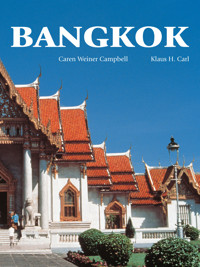
Bangkok by night draws its lifeblood from the realms of the steamy and the seamy. The capital of Thailand is world-famous for its innumerable massage parlours, yet at the same time the city is rich in historical treasures. Some of its Buddhist temples are more than 400 years old, and contrast strangely with Bangkok’s otherwise cutting-edge modernity. Its unique charm stems also from the winding presence of the Chao Phraya river, a waterway that can hardly be seen due to the multitude of small vessels that ply up and down it daily carrying a vast horde of passengers and goods, representing a cameo of the multiplicity of colours and styles that correspond to everyday life throughout Thailand.
Das E-Book können Sie in Legimi-Apps oder einer beliebigen App lesen, die das folgende Format unterstützen:
Seitenzahl: 53
Veröffentlichungsjahr: 2024
Ähnliche



















BANGKOK
Publishing Director: Jean-Paul Manzo
Text: Caren Weiner-Campbell
Design and layout: Newton Harris Design Partnership
Cover and jacket: Cédric Pontes
Publishing assistant: Aurélia Hardy
Photograph credits: Klaus H. Carl, The Thai Tourist Office
© 2024, Confidential Concepts, Worldwide, USA
© 2024, Parkstone Press USA, New York
© Image-Barwww.image-bar.com
All rights reserved. No part of this may be reproduced or adapted without the permission of the copyright holder, throughout the world.
Unless otherwise specified, copyright on the works reproduced lies with the respective photographers. Despite intensive research, it has not always been possible to establish copyright ownership. Where this is the case, we would appreciate notification.
ISBN: 979-8-89405-032-4
Contents
City of Angels
The Grand Palace and Environs
The Wats of Central Bangkok
Thon Buri and its Waterways
The Dusit
A Mosaic of Ethnicities
Thai Life
Modern Bangkok
List of pictures
City of Angels
Friendly yet elusive, up-to-date yet quaint, Bangkok is a city of confounding contradictions. Its relentless 21st-century modernity, manifested in traffic snarls and industrial-strength pollution, manages to coexist with Buddhist temples and flower-festooned spirit houses that serve as quiet reminders of spiritual tranquility. High-decibel motorized water taxis share the Chao Phraya with ornate, intricately carved royal barges. Thais blend music with their boxing and turn kite-flying into a battle. The government indulges the anything-goes carnality of the Patpong red-light district – and yet bans the movie The King and I for its irreverence to the monarchy.
For these reasons and many more, Bangkok has consistently piqued, charmed, and mystified visitors. Indeed, as the capital of a country never colonized by a European power (the name “Thailand,” in fact, translates to “Land of the Free”), it has held a special mystique for Westerners. Among the European sojourners who have tried to capture the city’s allure was novelist Joseph Conrad. “Here and there in the distance,” he wrote in the 1880s, “above the crowded mob of low, brown roof ridges, tower great piles of masonry, giant palaces, temples, gorgeous and dilapidated, crumbling under the vertical sunlight, tremendous, overpowering, almost palpable.” More puckishly, American humorist S. J. Perelman noted in the middle of the 20th century that Bangkok “seems to combine the Hannibal, Missouri, of Mark Twain’s boyhood with Beverly Hills, the Low Countries and Chinatown.” And latter-day travel writer Pico Iyer has called the Thai metropolis “every Westerner’s synthetic, five-star version of what the Orient should be: all the exoticism of the East served up amidst all the conveniences of the West.”
1. A weather beaten barge floats down the Chao Phraya, passing the Grand Palace.
2. This ornate doorway marks the entrance to a minor Bangkok wat – one of some 400 throughout the city.
3. Thai artistry is expressed in this temple’s mural and the musical instrument just in front of it.
It’s rather fitting that so many outsiders have struggled to divine and define Bangkok’s true nature. After all, foreigners don’t even call the city by its real name. Thais refer to their capital – home to roughly 15 percent of the country’s population – as Krung Thep (“City of Angels”), a shortened version of its true, 175-letter name, which translates to “Great city of angels, the repository of divine gems, the great land unconquerable, the grand and prominent realm, the royal and delightful capital city full of nine noble gems, the highest royal dwelling and grand palace, the divine shelter and living place of reincarnated spirits.” (Outlanders, meanwhile, derived the name “Bangkok” in the 18th century from that of a tiny local district, Bang Kok, meaning “place of olives.”)
Yet another contradiction inhabits the city’s history: it’s the capital of a civilization that is almost eight centuries old – but the metropolis itself is younger than the United States. The first capital, Sukhothai (in what is now central Thailand), was relocated to Ayutthaya in the 14th century. In 1766, the rival Burmese attacked Ayutthaya, laying siege to it for 15 months and eventually leaving it in ruins. So Thai general Taksin moved south again, to a site on the west bank of the Chao Phraya river, and established a new capital in the bustling mercantile village of Thon Buri. In 1782, still concerned about threats from Burma, Taksin’s successor King Chao Phraya Chakri (Rama I) moved the capital one last time, relocating it on the river’s eastern shore within an elaborate fortress.
Secure yet lavish, Rama I’s Grand Palace was the first outpost in what would become modern-day Bangkok. So that is where our Krung Thep tour begins.
The Grand Palace and Environs
Nestling in a voluptuous curve of the Chao Phraya river stands the stronghold at the heart of this modern metropolis. A phantasmagoria of curlicued rooftops, golden spires, and ornately carved statuary, the Grand Palace compound is a 61-acre (218,400-square-meter) assortment of towers, temples and royal residences, all contained within the protective embrace of a 1.2-mile (1.9 km) castellated wall.
Rama I (founder of the still-reigning Chakri dynasty) began constructing the palace in 1782. To make room, the Chinese community that inhabited the district was displaced; thousands of Khmer prisoners of war dug canals to link two bends in the Chao Phraya, thereby creating a moat around the royal region.
Rama I modeled the palace itself on the 400-year-old former capital at Ayutthaya. Like its predecessor, the new palace complex included throne halls, royal residences, administrative offices, and temples; the builders even reused materials that had been salvaged from Ayutthaya after its 1767 destruction by the Burmese. Fashioned in the traditional Thai style – incorporating towers, murals, glass mosaics, intricate carvings, and gilded pediments, and roofed with vivid porcelain tiles – the buildings looked out over expansive lawns and gardens, including the Sanam Luang (“Field of Kings”). (Later Chakri kings would augment the Grand Palace with architectural elements from other lands: Rama III introduced Chinese-style porcelains and statuary; Rama IV added a miniature replica of the Khmer temple Angkor Wat, now in Cambodia; and Rama V invited British architects to design the Chakri Throne Hall in 1882.)
4. Repeating rooftops tower over a visitor to the Grand Palace.
5. Two painted soldiers guard a Grand Palace doorway.
6. Elevated pavilions overlook a Grand Palace garden.
7. A carved wooden garuda (mythical half-man half-bird creature) spreads his wings under the eaves of a Grand Palace building.
8.




