


72,99 €
Mehr erfahren.
- Herausgeber: John Wiley & Sons
- Kategorie: Fachliteratur
- Serie: Aerospace Series (PEP)
- Sprache: Englisch
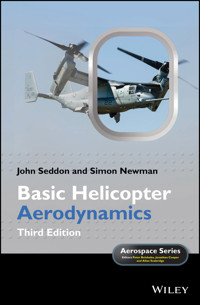
Basic Helicopter Aerodynamics is widely appreciated as an easily accessible, rounded introduction to the first principles of the aerodynamics of helicopter flight. Simon Newman has brought this third edition completely up to date with a full new set of illustrations and imagery. An accompanying website www.wiley.com/go/seddon contains all the calculation files used in the book, problems, solutions, PPT slides and supporting MATLAB® code.
Simon Newman addresses the unique considerations applicable to rotor UAVs and MAVs, and coverage of blade dynamics is expanded to include both flapping, lagging and ground resonance. New material is included on blade tip design, flow characteristics surrounding the rotor in forward flight, tail rotors, brown-out, blade sailing and shipborne operations.
Concentrating on the well-known Sikorsky configuration of single main rotor with tail rotor, early chapters deal with the aerodynamics of the rotor in hover, vertical flight, forward flight and climb. Analysis of these motions is developed to the stage of obtaining the principal results for thrust, power and associated quantities. Later chapters turn to the characteristics of the overall helicopter, its performance, stability and control, and the important field of aerodynamic research is discussed, with some reference also to aerodynamic design practice.
This introductory level treatment to the aerodynamics of helicopter flight will appeal to aircraft design engineers and undergraduate and graduate students in aircraft design, as well as practising engineers looking for an introduction to or refresher course on the subject.
Sie lesen das E-Book in den Legimi-Apps auf:
Seitenzahl: 344
Veröffentlichungsjahr: 2011
Ähnliche


















Contents
Cover
Aerospace Series List
Title Page
Copyright
Dedication
About the Authors
Series Preface
Preface to First Edition
Preface to Second Edition
Preface to Third Edition
Notation
General
Greek
Suffixes
Units
Abbreviations
Chapter 1: Introduction
1.1 Looking Back
1.2 Book Presentation
Reference
Chapter 2: Rotor in Vertical Flight: Momentum Theory and Wake Analysis
2.1 Momentum Theory for Hover
2.2 Non-dimensionalization
2.3 Figure of Merit
2.4 Axial Flight
2.5 Momentum Theory for Vertical Climb
2.6 Modelling the Streamtube
2.7 Descent
2.8 Wind Tunnel Test Results
2.9 Complete Induced-Velocity Curve
2.10 Summary Remarks on Momentum Theory
2.11 Complexity of Real Wake
2.12 Wake Analysis Methods
2.13 Ground Effect
2.14 Brownout
References
Chapter 3: Rotor in Vertical Flight: Blade Element Theory
3.1 Basic Method
3.2 Thrust Approximations
3.3 Non-uniform Inflow
3.4 Ideal Twist
3.5 Blade Mean Lift Coefficient
3.6 Power Approximations
3.7 Tip Loss
3.8 Example of Hover Characteristics
Reference
Chapter 4: Rotor Mechanisms for Forward Flight
4.1 The Edgewise Rotor
4.2 Flapping Motion
4.3 Rotor Control
4.4 Equivalence of Flapping and Feathering
References
Chapter 5: Rotor Aerodynamics in Forward Flight
5.1 Momentum Theory
5.2 Descending Forward Flight
5.3 Wake Analysis
5.4 Blade Element Theory
References
Chapter 6: Aerodynamic Design
6.1 Introductory
6.2 Blade Section Design
6.3 Blade Tip Shapes
6.4 Tail Rotors
6.5 Parasite Drag
6.6 Rear Fuselage Upsweep
6.7 Higher Harmonic Control
6.8 Aerodynamic Design Process
References
Chapter 7: Performance
7.1 Introduction
7.2 Hover and Vertical Flight
7.3 Forward Level Flight
7.4 Climb in Forward Flight
7.5 Maximum Level Speed
7.6 Rotor Limits Envelope
7.7 Accurate Performance Prediction
7.8 A World Speed Record
7.9 Speculation on the Really Low-Drag Helicopter
7.10 An Exercise in High-Altitude Operation
7.11 Shipborne Operation
References
Chapter 8: Trim, Stability and Control
8.1 Trim
8.2 Treatment of Stability and Control
8.3 Static Stability
8.4 Dynamic Stability
8.5 Hingeless Rotor
8.6 Control
8.7 Autostabilization
References
Chapter 9: A Personal Look at the Future
References
Appendix: Performance and Mission Calculation
A.1 Introduction
A.2 Glossary of Terms
A.3 Overall Aircraft
A.4 Calculation of Engine Fuel Consumption
A.5 Engine Limits
A.6 Calculation of the Performance of a Helicopter
A.7 Mission Analysis
A.8 Helicopter Power
A.9 Fuel Flow
A.10 Mission Leg
A.11 Examples of Mission Calculations
A.12 Westland Lynx – Search and Rescue
Index
Aerospace Series List
Basic Helicopter Aerodynamics, Third EditionSeddon and NewmanAugust 2011Advanced Control of Aircraft, Rockets and SpacecraftTewariJuly 2011Cooperative Path Planning of Unmanned Aerial VehiclesTsourdos et al.November 2010Principles of Flight for PilotsSwattonOctober 2010Air Travel and Health: A Systems PerspectiveSeabridge et al.September 2010Design and Analysis of Composite Structures: With applications to Aerospace StructuresKassapoglouSeptember 2010Unmanned Aircraft Systems: UAVS Design, Development and DeploymentAustinApril 2010Introduction to Antenna Placement and InstallationsMacnamaraApril 2010Principles of Flight SimulationAllertonOctober 2009Aircraft Fuel SystemsLangton et al.May 2009The Global Airline IndustryBelobabaApril 2009Computational Modelling and Simulation of Aircraft and the Environment: Volume 1 – Platform Kinematics and Synthetic EnvironmentDistonApril 2009Handbook of Space TechnologyLey, Wittmann and HallmannApril 2009Aircraft Performance Theory and Practice for PilotsSwattonAugust 2008Surrogate Modelling in Engineering Design: A Practical GuideForrester, Sobester and KeaneAugust 2008Aircraft Systems, Third EditionMoir and SeabridgeMarch 2008Introduction to Aircraft Aeroelasticity And LoadsWright and CooperDecember 2007Stability and Control of Aircraft SystemsLangtonSeptember 2006Military Avionics SystemsMoir and SeabridgeFebruary 2006Design and Development of Aircraft SystemsMoir and SeabridgeJune 2004Aircraft Loading and Structural LayoutHoweMay 2004Aircraft Display SystemsJukesDecember 2003Civil Avionics SystemsMoir and SeabridgeDecember 2002© 2011 John Wiley & Sons, Ltd
Registered office
John Wiley & Sons Ltd, The Atrium, Southern Gate, Chichester, West Sussex, PO19 8SQ, United Kingdom
For details of our global editorial offices, for customer services and for information about how to apply for permission to reuse the copyright material in this book please see our website at www.wiley.com.
The right of the author to be identified as the author of this work has been asserted in accordance with the Copyright, Designs and Patents Act 1988.
All rights reserved. No part of this publication may be reproduced, stored in a retrieval system, or transmitted, in any form or by any means, electronic, mechanical, photocopying, recording or otherwise, except as permitted by the UK Copyright, Designs and Patents Act 1988, without the prior permission of the publisher.
Wiley also publishes its books in a variety of electronic formats. Some content that appears in print may not be available in electronic books.
Designations used by companies to distinguish their products are often claimed as trademarks. All brand names and product names used in this book are trade names, service marks, trademarks or registered trademarks of their respective owners. The publisher is not associated with any product or vendor mentioned in this book. This publication is designed to provide accurate and authoritative information in regard to the subject matter covered. It is sold on the understanding that the publisher is not engaged in rendering professional services. If professional advice or other expert assistance is required, the services of a competent professional should be sought.
Library of Congress Cataloging-in-Publication Data
Seddon, John M.
Basic helicopter aerodynamics / John Seddon, Simon Newman. – 3rd ed.
p. cm.
Includes bibliographical references and index.
ISBN 978-0-470-66501-5 (hardback)
1. Helicopters–Aerodynamics. I. Newman, Simon, 1947- II. Title.
TL716.S43 2011
629.133'352‑dc22
2011010960
A catalogue record for this book is available from the British Library.
Print ISBN: 9780470665015
ePDF ISBN: 9781119994107
oBook ISBN: 9781119994114
ePub ISBN: 9781119972723
Mobi ISBN: 9781119972730
To Stella, for everything
About the Authors
The late John Seddon was a research scientist at the Royal Aircraft Establishment and then Director-General in the UK Ministry of Defence. He later became a consultant to Westland Helicopters.
Simon Newman attended Grammar School in Farnborough near the site of the Royal Aircraft Establishment. He then read mathematics at the University of Southampton, graduating in 1970. Continuing the aircraft theme, he then began a career in helicopter aerodynamics, dynamics and design for the next 41 years. Starting at Westland Helicopters, at Yeovil, Somerset, in 1970 he worked in the Aerodynamics Research Department on rotors systems, performance and aeromechanics. After a year back at Southampton in 1974, where he obtained an MSc in Aeronautics, he returned to Yeovil to work in the Aerodynamics and Dynamics Departments on rotor aerodynamics, blade behaviour and shipborne operations. He was in the Technical Office during the Falklands War, contributing to the technical backup. In 1985 he returned to Southampton as a member of academic staff, reaching the grade of Reader in 2007. His research interests have concentrated on shipborne operations, blade sailing in particular, for which he obtained his doctorate in 1995. Other research has focused on the vortex ring state and the tumble behaviour of microlight aircraft. He has several hobbies, principally photography and golf. Apart from his academic duties, he is also an Esquire Bedell of the University, carrying the mace at graduation ceremonies.
Series Preface
The field of aerospace is wide ranging and multi-disciplinary, covering a large variety of products, disciplines and domains, not merely in engineering but in many related supporting activities. These combine to enable the aerospace industry to produce exciting and technologically advanced products. The wealth of knowledge and experience that has been gained by expert practitioners in the various aerospace fields needs to be passed onto others working in the industry, including those just entering from University.
The Aerospace Series aims to be practical and topical series of books aimed at engineering professionals, operators, users and allied professions such as commercial and legal executives in the aerospace industry. The range of topics is intended to be wide ranging, covering design and development, manufacture, operation and support of aircraft as well as topics such as infrastructure operations and developments in research and technology. The intention is to provide a source of relevant information that will be of interest and benefit to all those people working in aerospace.
Helicopters are able to perform a wide range of roles that are not possible with conventional fixed wing aircraft, particularly due to their capability to hover, and to take-off and land vertically. There are a number of technical difficulties that have presented helicopter designers with many challenges over the years, including the aerodynamics of flexible rotors that not only provide lift, but also enable the helicopter to move forward in the desired direction.
This book, Basic Helicopter Aerodynamics, is the third edition of the original version that was written by the late John Seddon. Simon Newman has maintained the ethos of the first book, producing a further revision of this introductory text aimed at undergraduates and engineers new to the field that illustrates the fundamental features of rotor aerodynamics and helicopter design. Importantly, the book also maintains the balance of not delving into too much technical detail, whilst avoiding gross simplification of key important features and physical explanations. There is much to be commended in this latest expanded edition which contains a number of valuable additions to the material.
Peter Belobaba, Jonathan Cooper, Roy Langton and Allan Seabridge
Preface to First Edition
During the past decade and a half, several noteworthy textbooks have been published in the previously neglected field of helicopter aerodynamics, spurred no doubt by a growing acceptance world-wide of the importance of the helicopter in modern society. One may cite in this context Bramwell's Helicopter Dynamics (1976), Johnson's Helicopter Theory (1980) and Rotary Wing Aerodynamics (1984) by Stepniewski and Keys. The appearance now of another book on the subject requires some explanation, therefore. I have three specific reasons for writing it.
The first reason is one of brevity. Bramwell's book runs to 400 pages, that of Stepniewski and Keys to 600 and Johnson's extremely comprehensive treatment to over 1000. The users I have principally in mind are University or Polytechnic students taking a short course of lectures – say one year – in the subject, probably as an ‘optional’ or ‘elective’ in the final undergraduate or early post-graduate year. The object in that time is to provide them with a grounding while hopefully stimulating an interest which may carry them further in the subject at a later date. The amount of teaching material required for this purpose is only a fraction of that contained in the standard textbooks and a monograph of around 150 pages is more than sufficient to contain what is needed and hopefully may be produced at a price not beyond the individual student's pocket.
My second reason, which links with the first, concerns the type of approach. This book does not aim at a comprehensive treatment but neither is it content to consign problems to the digital computer at the earliest opportunity. In between lies an analytical route to solutions, taken far enough to produce results of usable accuracy for many practical purposes, while at the same time providing a physical understanding of the phenomena involved, which rapid recourse to the computer often fails to do. It is this route that the book attempts to follow. The analytical approach is usually terminated when it is thought to have gone far enough to serve the stated purpose, the reader being left with a reference to one of the standard textbooks in case he should wish to pursue the topic further.
The third reason is one of content. Despite the need for brevity, I have thought it worthwhile to include, in addition to treatments of the standard topics – momentum theory, blade element theory, basic performance, stability and control – a strong flavour of research and development activity (Chapter 6) and of forward-looking, if speculative, calculations (Chapter 7). It might be considered that these items are of such a transitory nature as not to be suitable for a textbook, but my criterion of stimulating the student's interest is what has determined their inclusion. Certainly they have proved to be interesting in classroom presentation and there seems no reason why that should not be so for the written word.
In addition to meeting the needs of students, to whom it is primarily addressed, the book should have an appeal as background material to short courses held in or on behalf of industry: such courses are increasing in popularity. Companies and research establishments may also find it useful for new entrants and for more established workers requiring a ‘refresher’ text.
Reverting to the matter of brevity, the recent publication Helicopter Aerodynamics by Prouty is a most admirable short exposition, well worth studying as an adjunct to any other textbook: however it shuns the mathematics completely and therefore will not suffice alone for the present purposes. Saunders' Dynamics of Helicopter Flight is not greatly beyond the target length but as the title implies it is concerned more with flight dynamics than with aerodynamics and is adapted more to the needs of pilots than to those of engineering students already equipped with a general aerodynamic background.
I have taken it as a starting point that my readers have a knowledge of the aerodynamics of lifting wings as they exist in fixed-wing aircraft. A helicopter rotor blade performs the same function as a lifting wing but in a very different environment; and to note the similarities on the one hand and the distinctions on the other can be a considerable fillip to the learner's interest, one which I have tried to nurture by frequent references back to fixed-wing situations. This again is a somewhat non-standard approach.
Substantial omissions from the book are not hard to find. A historical survey might have been included in Chapter 1 but was thought not necessary despite its undoubted interest. To judge by the work effort it attracts, wake analysis (‘Vortex theory’) deserves a more extensive treatment than it gets (Chapters 2 and 5) but here it was necessary to refrain from opening a Pandora's box of different approaches. Among topics which could have been included in Chapter 5 are autorotation in forward flight, pitch-flap coupling and blade flexibility but these were seen as marginally ‘second-line’ topics. The forward look in Chapter 6 might have contained a discussion of the potential of circulation control, the only system which is capable of attacking all the three non-uniformities of rotor blade flow, chordwise, spanwise and azimuthal; but the subject is too big and too distinct from the main line of treatment. The reference to autostabilization in Chapter 8 is brief in the extreme but again the choice was between this and a much lengthier exposition in which aerodynamics would have been largely submerged beneath system mechanics and electronics.
In compiling the book I have been greatly helped by discussions with Mr D.E.H. (‘Dave’) Balmford, Head of Advanced Engineering at Westland Helicopters, to whom my thanks are expressed. Other Westland staff members whose assistance I wish to acknowledge in specific contexts are Dr M.V. Lowson (now Professor of Aerospace Engineering at Bristol University) for Section 7.10, Mr F.J. Perry for Section 6.6, Mr R.V. Smith for Section 7.11 and Mr B. Pitkin for Chapter 8. Naturally the standard textbooks, particularly those mentioned earlier, have been invaluable in places and I trust that this fact is duly recognized in the text and diagrams.
Formal acknowledgement is made to Westland Helicopters for permission to reproduce the photographs at Figures 2.11, 4.10, 4.11, 7.6 and 7.7; to Edward Arnold, Publishers, for the use of Figures 2.10, 2.13, 5.1, 5.3, 6.3, 8.5 and 8.6 from A.R.S. Bramwell's book Helicopter Dynamics (1976); to Mr P.G. Wilby of the Royal Aircraft Establishment for Figures 6.2 and 6.5, which are reproduced with the permission of the Controller of Her Majesty's Stationery Office; and to Dr J.P. Jones for the use of Figures 2.12, 4.2 and 4.4.
My thanks are due to Molly Gibbs of Bristol University who copy-typed the manuscript and to my grandson Daniel Cowley who drew the figures.
J. Seddon
Preface to Second Edition
The original Basic Helicopter Aerodynamics was conceived and written by Dr John Seddon. It found a respected place in the subject of rotary wing aircraft and has informed many. Sadly John Seddon has since passed away and I was very flattered to be asked to revise his manuscript for a second edition. This brought an immediate problem. Do I strip the work down to nuts and bolts or do I revise it as it stands but add my own contributions? Since the book is now under joint authorship, it would have been unfeeling to have pursued the former option since the original concept of John Seddon would have disappeared. For that reason I decided to pursue the latter option of revising the text and adding to it – particularly in the field of illustrations. The design, manufacture and operation of the helicopter rotor tend to be rather esoteric for the newcomer and long textual descriptions can be dry and not helpful. I have added, therefore, a substantial number of images to illustrate and clarify the discussions.
The original diagrams were created by hand, which did not altogether succeed. Since that time, computer technology has improved greatly and the book's graphics have been updated accordingly. The book's size has increased to allow for the additions but I have been mindful of the need to retain the compactness of the original work.
Helicopter rotor aerodynamics continues to be investigated. It is essential to introduce recent developments to the student and I intend to maintain this book in a form that will introduce the latest developments. While an introductory text cannot hope to describe new techniques in detail it must be capable of establishing the correct thoughts in the reader's mind, thus preparing them for more intensive study.
The revisions have been aimed at illustrating, more fully, the various features of rotor aerodynamics and helicopter design. The helicopter is unique in its linking of the aerodynamic and mechanical features and a full appreciation of these air vehicles can only be achieved by understanding these interactions. Many of the extra figures illustrate the diversity in the design and operation of a helicopter and these differences are highlighted in the text.
As with all things aeronautical, a team effort is always needed, and the assembly of this book is no exception. A picture says a thousand words so I have called upon the skills of many people to provide as many photographs as possible to amplify and, hopefully, clarify the explanations. While I have been able to supply a number of these photographs personally, a considerable number have been kindly supplied and I would like to sincerely thank the following people for their generosity. Denny Lombard of Lockheed Martin, Alan Vincent, Alan Brocklehurst and Alan Jeffrey of GKN Westland Helicopters, Harry Parkinson of Advanced Technologies Incorporated, Stewart Penney, Guy Gratton, David Long of Kaman and Steve Shrimpton.
While I am quite pleased with my own photographic attempts, I am mindful that the pictures were taken on the ground, usually on a pleasant warm day with plenty of time to press the shutter release. In contrast, the above mentioned people have obtained better quality results while often hanging out of an aircraft in very difficult situations. This marks the difference between the amateur and the true professional.
I would also like to thank my colleagues and researchers who have provided much thought provoking discussion, which I hope, is reflected in the book. I am very grateful to David Balmford for his suggestions in correcting the text. I also would like to express my thanks to Ian Simons for his constant advice on all matters aeronautical. I offer many thanks to Julia Burden at Blackwell Science for her forbearance. The manuscript was late and she stuck with it, probably biting her lip but giving me valuable support. She offered me the task of revising the book and I hope she is not disappointed.
Finally I would like to thank my wife, Stella, for putting up with my constant whizzing around putting the final touches to this work, snatching a cup of coffee as I speed by.
Simon NewmanWinchesterJanuary 2001
Preface to Third Edition
The first edition of Basic Helicopter Aerodynamics was written by John Seddon and quickly found a place in educating new helicopter engineers and technologists in addition to undergraduates and postgraduates. Very sadly his early demise prevented him from seeing his creation develop. The publishers kindly approached me to conduct the first revision of the book and it was completed nearly a decade ago. It was a real pleasure to provide my own input to the book's evolution; it was certainly daunting but I believe it still has a firm place in the helicopter world. This same daunting feeling returned about two years ago when the present publishers asked me to prepare a third edition. It is imperative in an introductory text, as this book is, not to take the reader too far into the fine details of the subject; however, it is being unfair to lightly touch on the subject and gloss over important factors which link the various theories and analyses together.
Lesen Sie weiter in der vollständigen Ausgabe!
Lesen Sie weiter in der vollständigen Ausgabe!
Lesen Sie weiter in der vollständigen Ausgabe!
Lesen Sie weiter in der vollständigen Ausgabe!
Lesen Sie weiter in der vollständigen Ausgabe!
Lesen Sie weiter in der vollständigen Ausgabe!
Lesen Sie weiter in der vollständigen Ausgabe!
Lesen Sie weiter in der vollständigen Ausgabe!
Lesen Sie weiter in der vollständigen Ausgabe!
Lesen Sie weiter in der vollständigen Ausgabe!
Lesen Sie weiter in der vollständigen Ausgabe!
Lesen Sie weiter in der vollständigen Ausgabe!
Lesen Sie weiter in der vollständigen Ausgabe!
Lesen Sie weiter in der vollständigen Ausgabe!




