


22,49 €
Mehr erfahren.
- Herausgeber: The Crowood Press
- Kategorie: Lebensstil
- Sprache: Englisch
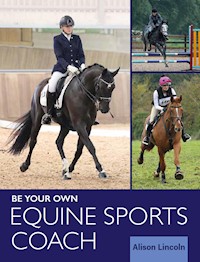
As riders, we often spend many hours training independently without regular access to high quality coaches, sport psychologists, biomechanic specialists or exercise physiologists. This can be the difference between performing well and performing to the best of your ability consistently and reliably over the long term. By bringing together the science of training, coaching and psychology, Be Your Own Equine Sports Coach explores the horse and rider as individual athletes and how, as a combination, you can meet the demands of competition by building highly personalized strategies and techniques that enable you to reach your potential in whatever discipline you choose and whatever your ambition. Key areas covered include: making sports psychology work for you; understanding human peak performance; the physiological and biomechanical demands of horse sport; developing sport specific training programmes; analysing your performance, and finally, strategic development and authentic leadership.
Das E-Book können Sie in Legimi-Apps oder einer beliebigen App lesen, die das folgende Format unterstützen:
Veröffentlichungsjahr: 2022
Ähnliche


















BE YOUR OWN
EQUINE SPORTS COACH
First published in 2022 by J.A. Allen Ramsbury, Marlborough Wiltshire SN8 2HR
J.A. Allen is an imprint of The Crowood Press
www.crowood.com
This e-book first published in 2022
© Alison Lincoln 2022
All rights reserved. This e-book is copyright material and must not be copied, reproduced, transferred, distributed, leased, licensed or publicly performed or used in any way except as specifically permitted in writing by the publishers, as allowed under the terms and conditions under which it was purchased or as strictly permitted by applicable copyright law. Any unauthorised distribution or use of this text may be a direct infringement of the author’s and publisher’s rights, and those responsible may be liable in law accordingly.
British Library Cataloguing-in-Publication Data
A catalogue record for this book is available from the British Library.
ISBN 978 1 90880 998 8
Cover design: Blue Sunflower Creative
Acknowledgements
Thanks to Lottie Stanyon from Lottie-Elizabeth Equestrian Photography and the inspirational Claire Lomas for the use of their images; Carole Vincer for the diagrams; David for the flow charts; and a special thank-you to Paul Buddin from Simple Photo Shots, without whom this book would be a lot less colourful!
Full page image credits
Page 7: P. Buddin; page 8: P. Buddin; page 26: Lottie-Elizabeth Equestrian Photography; page 38: P. Buddin; page 55: P. Buddin; page 56: P. Buddin; page 66: P. Buddin; page 78: P. Buddin; page 84: P. Buddin; page 92: P. Buddin.
Contents
Introduction
Part One: The Rider as an Athlete
1 The Inner Game – Making Sports Psychology Work for You
2 Understanding Human Peak Performance
3 What Limits a Rider’s Performance?
4 Becoming an Independent Learner
Part Two: The Horse as an Athlete
5 Response to Exercise and Training
6 General Training Principles
7 Evaluating the Health and Fitness of Your Horse
8 What Limits a Horse’s Performance?
9 The Biomechanical Demands of Horse Sports
10 Adapting Your Training and Competing in Extreme Weather
11 Feeding for Performance
Part Three: Building a System for Long-Term Success
12 Training and Conditioning Programmes
13 Analysing Your Performance
14 Authentic Leadership
Bibliography
Index
Introduction
This is a book of ideas backed up, or suggested, by science. Its purpose is not to convince you to give up your regular trainer or the system you are following, but to help you become an independent thinker, skilled at identifying what’s working for you and what isn’t. My aim is to present subjects from a slightly different angle, and hopefully, to inspire you to explore some of them further. If a topic resonates with you – great, give it a go. If not, but it sparks another thought or idea – then I have done my job. I hope this book prompts you to keep asking interesting and important questions of yourself and your approach.
There is no need to throw out the tried, tested and traditional way of doing things if it’s working for you; however, if it’s not, then change it. We are all individuals, as are our horses, and what is right for one may not be right for another. Our job as a coach is to be curious, to explore, to experiment and to assess what gives us the results we want, in the way that we want to achieve them. I encourage you to speak to and listen to as many different people as you can, and to take on board the things you think will support your progress – but please don’t be afraid to go your own way: after all, this is your journey to being your own equine sports coach.
PART ONE
The Rider as an Athlete
It might not be the easiest thing for yourself, usually the right thing isn’t the easiest thing. If we do the right thing we will be better off, if you can do the right thing for the longest time then something will fall into your life and you won’t understand why it happened, but it’s because you kept on doing the right thing.
David Kearney, International Event Forum, 2016
CHAPTER 1
The Inner Game – Making Sports Psychology Work for You
Psychological skills are not just for riders who ‘have a problem’: they are essential life skills enabling you to be calm, confident and in control whatever life and horses throw at you. They can also be learned. Developing your mental skills is as important as developing your physical ones, and the brain is just as receptive to training as the body is. This chapter focuses on three specific areas of sport psychology:
• Motivation: Understand what motivates you, and how this motivation can both help and hinder you.
• Imagery: Capitalize on the brain’s inability to differentiate between reality and imagination to improve your skills.
• Resilience: How, by thinking differently, you can cope effectively with challenges and adversity.
You may need to draw on different skills in training and competition, so I encourage you to experiment with the different techniques to find out which bits work best for you and in which situation.
Motivation
How committed do you have to be in order to be an Olympic champion? Most people would say 10/10, but in reality it is 8 or 9/10 because you can be too committed for your own good.
Rod Ellingworth, former GB elite Road Coach and Team Sky Performance Manager
You can be too committed for your own good!
This quote was taken from Rod Ellingworth’s book Project Rainbow: How British Cycling Reached the Top of the World. It’s an interesting paradox that you can be too motivated to reach the top of your sport. In the book, Ellingworth relates this to the level of risk that some highly motivated cyclists are prepared to take – for instance, going training on icy roads (where the potential for getting injured through a fall is high) rather than taking the more sensible approach of going to the gym or postponing the ride until the ice has melted.
Clearly there are parallels for riders, whether this is increasing the risk you take by riding your highly reactive young horse in high winds, or over-riding at a competition, producing tension and delivering a below-par performance.
Quite simply less is more: I used to try too hard and do too much in the saddle. I was too animated in my riding and interfered with the horse. But I’ve accepted that what will be, will be – I’m more relaxed, and it pays off!
Will Biddick, champion point-to-point jockey, Horse & Hound (July 2015)
But maybe we’re getting ahead of ourselves. Let’s start by having a look at motivation itself.
Internal and External Motivation
It’s a commonly held belief that you are either motivated or not. In other words, motivation is something you are born with, and if not, you will need motivating by someone or something. The reality, as always, is more complex. Most of us are motivated to do things that are enjoyable or at which we are successful. More often the challenge is how to keep motivated when things are going wrong, when training gets hard and repetitive, progress is slow, you or your horse are injured, or shows are cancelled.
Generally, what initially motivates us to participate in riding (or anything else for that matter) can be classified as either internally motivated or externally motivated. If you are internally motivated you have an innate need to feel competent and in control. Your participation in an activity will not be driven by receiving any outward reward but because you find the activity itself rewarding. In effect you motivate yourself internally. This is often referred to as having a task orientation. Those who have a task orientation are likely to be more resilient when things are not going well, and are more likely to be longterm participants in a sport or activity for just that reason. Importantly, task orientation is a strategy that can be learned, as we will discuss later in the chapter.
If you are externally motivated, you are more likely to have a need to be recognized as successful, and will generally participate in an activity for the rewards or status it offers. This is often referred to as ‘ego orientation’. Having an ego orientation is a powerful motivator when things are going well, but when the inevitable slumps in performance occur you may find it difficult to maintain your motivation. Riders with an ego orientation tend to draw their confidence and self-worth from factors that are not wholly within their control.
Internal Motivation
External Motivation
If you have a task orientation you will tend to:
• Focus on your own progress
• Compare yourself to your own previous performances
• Focus your energy on the fulfilment of a task
• Be goal directed:
– Learning a new skill
– Getting a personal best
– Training your horse to a new level
– Improving your riding skill
– Gaining qualification
– Believing that taking part is important
• Have your feelings of competence separate from the performance of others
• Believe everyone can demonstrate ability through effort and improvement
• Believe sport teaches the value of doing your best, following the rules and being a good sport
• Have increased persistence, effort and interest in challenging tasks
• Place the emphasis on mastery of skills
• View sport as an opportunity to gain skills and knowledge, exhibit effort, perform at your best and experience personal improvement
If you have an ego orientation you will tend to:
• Focus on the progress of others
• Compare yourself to the performance of others
• Be more concerned with achieving more than others
• Be outcome directed:
– Being highly ranked
– Getting sponsorship
– Winning the most prize money
– Scoring the highest per cent
– Being picked as captain of the team
– Believing that being second is being first loser
• Have your feelings of competence influenced by the performance of others
• Believe only one person can be the best
• Believe sport is about winning at any cost
• To give up and lose interest if failure is likely
• Place the emphasis on achieving more than others
• View sport as a means to an end – wealth, popularity, status, celebrity
Table 1.1 Internal and external motivation.
Clearly Table 1.1 includes a list of extremes, and some statements may resonate with you more than others. Reflect on the following questions to establish where your current source of motivation comes from:
• To what extent are you internally/externally motivated?
• Are you more task- or ego-orientated during training?
• Are you more task- or ego-orientated during competition?
• To what extent does your task/ego orientation help or hinder your performance in training?
• To what extent does your task/ego orientation help or hinder your performance in competition?
Looking through your answers, highlight where your task or ego orientation helps you perform to the best of your current ability, and put this on one list. These are the motivation strategies you are going to focus on during training and/or competing. On the other list write down where your task or ego orientation hinders your ability to perform to the best of your current ability. These are the areas you are going to want to change, or to replace with more helpful motivational strategies.
Motivation is Influenced byYour View of Success or Failure
Studies in sport science have shown that motivation is strengthened when we feel competent and in control of our performance. This sense of control and competence can be influenced, both positively and negatively, by our attributions. Attributions are the reasons you give to explain why something happened. Awareness of the attributions you make to explain your success or failure is important, as they have the power to influence your motivation levels and your future expectation of success and failure.
Reflect on your own attributions:
• What does success mean to me in training?
• What does success mean to me in competition?
• How will I know I’ve been successful in training?
• How will I know I’ve been successful in competition?
Which of the things that you are using to measure success are within your control, and which ones are not? If they aren’t within your control, is there another way of looking at success that is within your control? If one of the ways that you view success relates to what your horse does or doesn’t do, consider whether this is truly within your control. From a motivation point of view, it is better to see success in terms of you exceeding your own goals and aspirations than in terms of winning or surpassing the performance of others.
However you describe a successful outcome, it’s clear that some riders are motivated to achieve success, while others are driven to succeed because they have a deep-rooted fear of failure. You can recognize this source of motivation in yourself. If you like being evaluated or judged, value feedback from others, look for challenges and are not afraid of getting things wrong, it’s likely your motivation stems from a desire to achieve success. If you tend to avoid challenges, dwell on the possibility of getting things wrong and perform poorly when judged or evaluated, it’s likely that your motivation stems from a desire to avoid failure.
Interestingly, your desire to achieve success or avoid failure can drive your competitive decisions. For instance, if the probability of success is high – perhaps you are competing at a level well within your capability – the need to achieve is weakened because you expect to be successful. If the probability of success is low – perhaps you are competing right at, or just above, the limit of your ability – the need to avoid failure is weakened because you don’t expect to be successful.
This explains why a rider who is focused on avoiding failure will often choose tasks that are very simple and where success is virtually guaranteed, rather than tasks that are very difficult where it is highly likely they will fail. It also explains why a rider who is focused on achieving success may perform below their ability when the competition is seen as ‘too easy’ or less challenging, and then becomes frustrated when they don’t win.
Reflect on whether either of these perspectives resonates for you. Is your preference to compete at the limit of your ability, where the probability of success is relatively low and unexpected? Or do you prefer competitions that are well within your capability, where the probability of success is relatively high and therefore success is expected? What does this tell you about your motivation? Looking at your reflections, can you identify whether you are generally motivated to achieve success or to avoid failure? Neither approach is wrong or right, but being able to identify your preferences will help you to understand some of the decisions you make.
The way you describe your performance, and what success looks like to you, provides key information about the level of control and influence you feel you have over it. This in turn has a profound impact on your levels of motivation.
Do You Have an Internal or an External Locus of Control?
If you are someone who takes sole responsibility for your performance, win or lose, you are considered to have an internal locus of control. This simply means you will generally explain good outcomes in terms of your own efforts:
• My preparation paid off.
• I’ve worked hard on my fitness.
• Cross-country is my best phase.
• I find this level easy.
Using these types of explanation places the outcome firmly within your control and creates emotions such as pride, satisfaction and confidence. On the flip side, when things haven’t gone well, you may find yourself using the following phrases:
• I rode like a sack of potatoes.
• I just can’t do it.
• I let everyone down.
• This level is too difficult for me.
This type of internalizing failure can lead to feelings of shame and incompetence.
If you tend to put your success or lack of it down to external factors that are outside your control – for example fate, other people or your horse – you are considered to have an external locus of control. You will tend to use phrases such as:
• Luckily I was drawn last to go.
• Today was just my day.
• That judge always gives my horse high marks.
• He never goes well on soft ground.
• I was never going to win with so-and-so competing.
• If I’d known they were judging I wouldn’t have bothered coming.
In the extreme, this type of externalizing of success means you are unlikely to believe you have any control or influence over the outcome, and this impacts your motivation – the ‘we only won because so-and-so dropped a pole’ attitude. Believing that you have no control over failure or poor performance can lead to frustration, anger and helplessness, because you feel powerless to do anything to change the outcome in the future – the ‘nothing I do makes any difference’ attitude.
Which is the Healthier Attitude to Have?
The answer to which is the healthier attitude is not black or white. Being able to view success as something within your control and unlikely to change promotes feelings of control – ‘I did this’ – and competence – ‘my training paid off’. Viewing a lack of success as temporary and within your ability to change promotes motivation – ‘I can’t wait to get back to training and work on that’ – and a positive attitude – ‘I know what I need to work on’. When you make mistakes or perform poorly, consider if it was due to a lack of effort, preparation, practice or anything else that is within your control. While not nice to acknowledge, this will protect you from feelings of helplessness and frustration and will greatly improve your motivation to improve.
Consider a time when you performed poorly or below your best. Make a list of any factors that influenced your performance under two headings: 1. Within my control; and 2. Not within my control. Looking at the lists, does it change how you feel about that performance?
There is a downside to taking sole responsibility for your performance, particularly for already highly motivated athletes.
I thought I needed a way to feel better after a bad day’s racing, but then I realised I didn’t want to feel OK about a bad ride – I wanted to feel crap so it would drive me to push myself further and further.
A.P. McCoy, champion jockey, Horse & Hound (May 2020)
It’s a balancing act. You need to be motivated enough to take action, to work on areas that need improving and to put in the hours required to achieve your aspirations. However, there comes a point where you can be too committed for your own good. Being too committed can lead to the unnecessary risk-taking described earlier, as well as to overtraining. Overtraining is a phenomenon identified by sports science as a particular challenge for highly motivated athletes who are likely to avoid taking time out for rest and recovery. It’s the belief that the more I do, the better I get. The reality is that there is a threshold beyond which doing more actually reduces performance. Overtraining will be discussed further in Chapter 3.
In his book The Art of Possibility, Benjamin Zander recounts how at the start of term he asks each student to write a letter to him detailing why they got an A (his students’ version of success) at the end of the year. It’s an interesting perspective. Try this: think about the upcoming season, whether it’s a training season or a competitive one. Write down why you were successful – in effect why you would award yourself an A at the end of the season – or an A* for the really competitive! Reflect on what you have written – does it excite you? Do you want to jump up right now and get to work making it happen? If not, ensure you’ve used the motivational strategies you highlighted earlier, that helped your performance. Consider how much of what you’ve written is within your direct control: have you been influenced by your desire to avoid failure, or your desire to achieve success?
Strategies for When Motivation is Low
Let’s face it, all of us will experience times when we are tired, unhappy, stressed, anxious or disillusioned – times when we’re not feeling very motivated to do anything. How then, do we generate the motivation to get going again?
Self-motivation is the extent to which a person will persist with a task even when they are not getting any direct reward for doing it – those tasks that feel especially arduous and repetitive when you are not able to ride or compete for whatever reason. Self-motivation is when you keep doing the fitness training, tack cleaning, poo picking and mucking out even though the tasks are not motivating. This is the epitome of taking action before waiting for motivation to strike: doing the right things, the things that need doing, without any guarantee that you’ll get the rewards for your efforts.
When you’re going through tough times it’s even more important to control the controllables, and the only things you can really control are your efforts and your responses. Being able to adopt a task-orientated strategy and redefine your measures of success will help you be more resilient and motivated, and even to find enjoyment during the inevitable tough times.
Motivation at its Best: Claire Lomas
You might be familiar with Claire Lomas, the advanced event rider who was paralysed from the waist down in a fall at Osberton Horse Trials in 2007. In an interview with the Daily Mirror six years later she recalled the specialist telling her she would be in a wheelchair for the rest of her life. One of her first thoughts was ‘You don’t know who you’re dealing with!’ Since then she has completed the London Marathon in a bionic suit – it took seventeen days; completed a 400-mile cycle challenge across England on a specially built handbike; has become the first paralysed woman in the UK to get a motorbike race licence; has got married, had children and is now learning to fly.
Motivation at its best – Claire Lomas completing a marathon. (Photo: C. Lomas)
Motivation at its best – Claire Lomas racing motorbikes. (Photo: C. Lomas)
So many amazing things have happened to me since I became paralysed that I never dwell on the negatives.
Claire Lomas, Mirror Online (10 May 2013)
Now that’s how you control your efforts and your responses!
Making Motivation Work for You
Motivation is a very personal thing. If you enjoy doing something you are more likely to be motivated to continue. You don’t have to push, pressurize and bully yourself to be successful. But if, like AP McCoy, it works for you, then go for it – just be alert for the signs that you may be overdoing it. Experiment with different motivational strategies to find what works best for you. If being more task-orientated helps you to deliver a better performance, focus on measures of success related to your effort, responses, improvement and previous performances:
• I’m proud of myself for the amount of effort I put in.
• I’ve really mastered that movement.
• That was a big improvement on last year’s performance.
• I didn’t panic when we got the line wrong.
• We kept our cool when we got stopped on course.
• My hard work really paid off.
• That was fun!
Try reframing a desire to beat others in terms of what you need to do in order to win. If a winning dressage score at your level is usually around 80 per cent, then you need to score an average of 8 for each movement. If you are currently scoring an average of 7, what do you need to work on to get it to an 8? You might consider the following:
• Introducing specific strength training into your horse’s training programme.
• Working at a higher level at home so the movements are easier in competition.
• Practising exercises to control any nerves or tension, causing you to override in tests.
• Reading up or taking advice from a trainer/judge on how to improve your scores.
If your discipline involves jumping, consider where your strengths are. How can you use your horse’s scope/speed/agility to get ahead? If your horse has a lot of scope and agility, focus on tight turns and shorter lines. If your horse is fast but has less scope it might be better to go for the longer routes but at a faster pace. The aim is to focus on what you, as a combination, can do best, rather than what other people are doing and the need to beat them at their own game. It isn’t necessary to sacrifice enjoyment for success – you can have both. Yes, it’s hard work; yes, some days are tougher than others; and yes, sometimes you don’t get the reward for the effort you’ve put in. But ultimately, making motivation work for you means accepting the things that are outside your control, knowing that you can improve the things that are, enjoying the process of training and remembering why you got involved in the first place.
A Guide to Imagery – Your Brain Can’t Tell the Difference Between What’s Real and What’s Imagined
Imagery involves using all our senses to create or recreate an experience in the mind. It is based on the principle that the brain can’t tell the difference between what’s real and what’s imagined. In his book The Changing Mind, Daniel Levitin cites an old psychology experiment that demonstrated that people who act as if they’re happy, end up being happy. By activating the zygomatic facial muscle, the muscle you use to smile when you’re genuinely happy, people who forced a smile actually felt happier just because that muscle was engaged. It doesn’t matter whether the brain makes the mouth smile or the mouth makes the brain smile – the brain can’t tell the difference. So, if you’re not feeling good, act as if you are – even if it starts out fake, it can end up becoming real.
Use visualization to enhance your performance.
More recent research has shown that when an individual engages in vivid and absorbing imagery the brain interprets this as identical to the event happening. What this means for us as riders is that we don’t have to ride ten horses a day, or have access to high-level schoolmasters, or daily coaching to improve our riding (although that does all help). Not convinced? Let me give you a simple exercise to demonstrate the power of imagery:
1. Stand with one arm out to the side at shoulder height. Take your arm back behind you, twisting at the waist but without moving from the spot. Go as far round with your arm as you can, and note a point that marks this position – for example a tree, a fence post, a car, or if you’re inside, a lamp, a chair or a picture.
2. Now return to the starting position: close your eyes and without moving, visualize your arm going back to the tree, fence post, picture or chair that you noted. Now visualize it going further round to the next fence post, tree, picture or other marker.
3. Open your eyes and repeat the exercise again, aiming to take your arm as far round as possible without moving from the spot. This time you will be able to take your arm further and reach the spot you visualized. Repeat this several more times, picking points further and further round. See how much you can increase the range that your arm can travel.
In essence, you are showing your mind what is possible and your body is translating this into action. In a few short seconds you have extended your reach without exercising, practising or stretching, just simply by visualizing going further. It’s the same principle behind the famous story of running a mile in less than four minutes. For years, runners had been trying to complete a mile in four minutes or less. It had proved so elusive that everyone thought it was a physical impossibility – and yet once Roger Bannister had achieved it, suddenly, almost overnight (in fact the next time was forty-six days later), many more runners went under four minutes. The brains of these runners now believed it was possible because they’d seen someone do it.
In the imagery exercise above, after the first time of taking your arm round as far as possible, you probably thought that that was as far as your reach went. Yet after visualizing a spot further than your first attempt, you were able to extend that reach and could probably extend it again on your third, fourth and maybe even your fifth attempt. This is the power of ‘seeing’ that something is possible. The only difference here is that we are ‘seeing’ it first in our imagination.
We can harness the power of imagery to improve our skills without physically being on a horse. Why is this important? Well, one of the challenges with riding is that both the horse and the rider need to learn the skills required for their chosen discipline. And it is widely acknowledged that horses learn best if training sessions are kept short, if they learn a different skill each day and, once they have performed the skill successfully a couple of times, they move on to the next task. On the other hand, for a rider we consider that practice makes perfect, and that repetition is the key to making a skill automatic.
The implication is that what is best for the horse in terms of skill development may not be best for the rider, particularly if you have only one horse to ride and train on. Imagery is also a useful tool if you or your horse are side-lined due to injury, if the weather doesn’t allow you to train effectively, or you are in lockdown due to a global pandemic!
Skill Development
At this point it’s worth having a brief run-through of the process involved in learning and refining skills. A skill is the ability to do something – ride a shoulder-in, jump an angled combination, or set up for a drop fence. In sport we consider skill in three areas: cognitive skills, perceptual skills and motor skills (seeTable 1.2).
Cognitive skills
Perceptual skills
Motor skills
The ability to think about and solve problems intellectually.
The ability to sense and interpret what is happening and why.
The ability to control the voluntary movement of the body.
Why does my horse fall in on the right rein?
There’s more contact taken on my left rein, perhaps indicating stiffness through the body?
Asking for a few steps of leg yield using my right leg.
Table 1.2 The three areas of skill.
Perceptual and motor skills are generally put together and referred to as psychomotor skills, or the ability to sense and interpret information, and then act through movement. For a rider this means feeling how the horse is moving beneath you, deciding if this is what is required and then using your aids to make corrections. In order to acquire the psychomotor skills necessary to be able to ride effectively you will go through the following stages: learning the skill, practising and perfecting the skill, and automating the skill.
• Learning the skill: The rider has to figure out, through trial and error, what to do with their body. Conscious attention is paid to detail, which takes a lot of concentration and thus mental energy. At this stage you are learning about your position in walk, trot, canter and jumping, as well as the aids (weight, leg and rein) required to direct the horse.
• Practising and perfecting the skill: The rider understands what is required and is now able to start refining their skills. They are developing a ‘feel’ for how the horse moves and how it is influenced by their body position and movement. This is the stage where you are now able to use your position and aids to influence the horse, get feedback and respond accordingly.
• Automating the skill: The rider is able to use their position and aids automatically to improve the horse and can now concentrate on the external demands of the environment, the individual horse they are riding and the challenge set by the discipline they are involved in. When you’ve reached this stage you are ready to take your skills, and your ability to influence and respond to the horse, into competition.
Once you are able to use your position and aids to influence the horse you are ready for competition. (Photo: P. Buddin)
Imagery for Learning Skills
Beginners or novices can use imagery with cue words to improve their riding technique. Imagining a piece of elastic attached to the top of your hat helps you remember to sit upright and not slouch. Combining this image with the words ‘grow tall’ provides a trigger that can be used when you are riding so your brain automatically knows the adjustment that’s required. If this is embedded in your subconscious, by practising linking the image with the word or words, it becomes a prompt that requires very little concentration to implement and allows you to focus on everything else that is happening.
This is also useful for more advanced riders when learning new skills. Often our position can suffer either because we’re trying hard to get something new right, or our mental energy is focused on the new skill and we haven’t noticed that our shoulders have slouched or that we are holding our breath. A quick reminder such as ‘breathe’ or ‘shoulders down’ automatically cues the body’s well learned response and instantly improves our riding technique.
Imagery for Practising and Perfecting Skills
Using imagery to practise a specific skill repeatedly in the mind helps us to avoid drilling our horses. Remember the brain can’t tell the difference between what is real and what is imagined, so practise the ‘feeling’ in your head and it will come more easily and more automatically when you get on your horse. It helps if you know how the movement should feel from riding a schoolmaster. If you don’t, make sure you have a clear understanding of what is required to perform the skill – the aids required and their sequence – and how the horse’s body should react in response to the aids. Practise this in your head as many times as possible before trying it on your horse.
For instance, when learning how to perform half pass, go through in your mind where you are going to put your inside hand, your outside hand, your inside leg, your outside leg, your weight. Practise the entire sequence, from bringing your horse round the corner, adjusting your position, asking for the movement, feeling your horse’s bend and the sideways steps, and then how you will finish the half pass. Do this on both reins. Obviously this assumes your horse already knows the aids for half pass.
If, however, you are teaching a horse for the first time, think about breaking it down into small chunks or processes and visualize each in turn. How will you ask the horse, which aid, and when? What is the ideal response to each aid, and how will you reward the horse’s effort? How will you finish the movement? You can also take time to visualize the wrong response and how you might correct it. The clearer you are in your head off the horse, the higher the likelihood of success on the horse.
It is important to realise from the beginning that imagery can influence muscles. Muscles can be brought into action or released by images… In this way the quality of control of the arm, leg or whatever can be improved and eventually through practice become automatic.
Sally Swift, Centred Riding
In her book Centred Riding, Sally Swift has a whole appendix on useful images for riders covering balance, hands, breathing, transitions, lateral work and jumping, among many others. Some of my favourites include:
• Breathe through your whole body – imagine that you can breathe all the way down into your feet through an imaginary flexible tube.
• If you imagine riding with your bones, your muscles won’t have to work so hard.
• Keep your knee free as if your whole lower leg is only a weight hanging from the end of a string.




