


14,99 €
Mehr erfahren.
- Herausgeber: John Wiley & Sons
- Kategorie: Ratgeber
- Sprache: Englisch
INTERNATIONAL WINNER: best WELLBEING and best WORK-LIFE BALANCE book at the Goody Business Book Awards FINALIST in the award for HEALTH & WELLBEING at the Australian Business Book Awards Manage overwhelm and find renewed passion in your life and work Never-ending to-do lists, constant deadlines, intense workloads and the guilty feeling you're not doing enough--does this sound all too familiar? If so, it's time to take a step back and find a better balance for your work and life. In this book, you'll discover the simple practices that will help you create a healthy mindset, boost your wellbeing and prevent overwhelm. So say goodbye to fatigue: with Beating Burnout, Finding Balance, you'll rediscover the energy you need to thrive. Mindfulness and performance coach Melo Calarco shares the secrets to flourishing as a high achiever and an effective leader. In this book, he combines science, practical knowledge and mindfulness techniques with the incredible life lessons he has learned as he cycled and trekked his way around the world. You'll learn how you can apply the strategies that top performers--from surgeons to CEOs to Olympic athletes--use to conquer burnout and surpass their goals. * Use simple but highly effective strategies to improve your productivity and happiness * Develop your self-awareness so you can better balance your energy * Build resilience and manage stress so you can perform in high-stakes or unpredictable situations * Find your focus and live with purpose, passion, and drive Through inspirational stories and proven techniques, from mountaintop monasteries to executive boardrooms, Beating Burnout, Finding Balance gives you the tools to achieve your goals and live more meaningfully and mindfully.
Sie lesen das E-Book in den Legimi-Apps auf:
Seitenzahl: 308
Veröffentlichungsjahr: 2023
Ähnliche



















Table of Contents
COVER
TITLE PAGE
COPYRIGHT
DEDICATION
ABOUT THE AUTHOR
INTRODUCTION
How to use this book
CHAPTER 1: ON SELF-AWARENESS
Rural South Australia
Self-awareness: the first step
Mindfulness 101
Formal and non-formal mindfulness practices
CHAPTER 2: ON BURNOUT AND SELF-CARE
The Southwest, United States
Melbourne, Australia
So what is burnout?
Real-life examples of burnout
Stages of burnout
Nobody is exempt from burnout
A too-busy world
The good news about beating burnout
Self-care essentials
More good news
CHAPTER 3: ON STRESS AND RESILIENCE
Virunga National Parc, Rwanda
Modern-day fight-or-flight (the stress response)
Achieving balance
The evolution of stress
Stress vs burnout
A few words on resilience
The power of the breath
CHAPTER 4: ON SELF-REGULATION
Back roads of Uganda
Types of self-regulation
Why is self-regulation so important?
How to develop self-regulation
CHAPTER 5: ON OVERWHELM AND ANXIETY
11 000 feet above South Australia
Overwhelm in the modern world
How creating a stress-reduction course stressed me out
The myth of multitasking
Anxiety
CHAPTER 6: ON FEAR AND TRUST
Kathmandu, Nepal
Primal fear
Demystifying fear and understanding it better
Embracing fear in the workplace
Seeking the uncomfortable
Developing a relationship with fear and trust
On the other side of fear is trust
Flipping your fears
Imposter syndrome and limiting beliefs
CHAPTER 7: ON PURPOSE AND PERSEVERANCE
Pygmy village, Cameroon
Somewhere in Benin
Climbing that mountain
Humans like progress
Never give up on your dreams
Aligning with purpose
It doesn't have to change the world, just your world
Intrinsic rather than extrinsic motivators
The ‘five whys’
Knowing your values
Getting to know your values
CHAPTER 8: ON GRATITUDE AND COMPASSION
Masai Mara, Kenya
What is gratitude?
Not just ‘warm and fuzzy’
The reticular activating system (RAS)
Experiencing happiness
Getting your daily DOSE of happiness chemicals
Easy gratitude journalling
Random acts of kindness
Ladakh, Indian Himalaya
A gentle reminder
CHAPTER 9: ON BALANCE
Koh Tao, Thailand
What is balance?
How do I know if I'm out of balance?
Prevention is always better
The wheel of life
Adopting a positive and growth mindset
CONCLUSION
ACKNOWLEDGEMENTS
REFERENCES
INDEX
END USER LICENSE AGREEMENT
List of Tables
Chapter 6
Table 6.1 examples of flipping your fears to trust
List of Illustrations
Chapter 2
Figure 2.1 types of feelings
Chapter 3
Figure 3.1 creating balance in your day
Figure 3.2 amygdala hijack
Figure 3.3 four phases of the stress cycle
Chapter 4
Figure 4.1 reactive response
Figure 4.2 mindful response
Chapter 5
Figure 5.1 the evolution from overwhelming thoughts to anxiety
Figure 5.2 the formula for dealing with overwhelming, negative, fearful or a...
Chapter 6
Figure 6.1 fear can affect us all differently
Chapter 7
Figure 7.1 extrinsic vs intrinsic motivators
Chapter 8
Figure 8.1 your daily DOSE of happiness
Figure 8.2 random acts of kindness
Chapter 9
Figure 9.1 work–life balance (or imbalance)
Figure 9.2 a balanced wheel of life
Figure 9.3 fixed vs growth mindset
Figure 9.4 add a rating out of 10 for your wheel of life
Guide
Cover
Title Page
Copyright
Dedication
About the author
Introduction
Table of Contents
Begin Reading
Conclusion
Acknowledgements
References
Index
End User License Agreement
Pages
iii
iv
v
ix
x
xi
xii
xiii
xiv
1
2
3
4
5
6
7
8
9
10
11
12
13
14
15
16
17
18
19
21
22
23
24
25
26
27
28
29
30
31
32
33
34
35
36
37
38
39
40
41
42
43
45
46
47
48
49
50
51
52
53
54
55
56
57
58
59
60
61
62
63
64
65
66
67
69
70
71
72
73
74
75
76
77
78
79
80
81
82
83
84
85
86
87
88
89
91
92
93
94
95
96
97
98
99
100
101
102
103
104
105
106
107
108
109
110
111
112
113
115
116
117
118
119
120
121
122
123
124
125
126
127
128
129
130
131
132
133
134
135
136
137
138
139
140
141
142
143
144
145
146
147
148
149
150
151
152
153
154
155
156
157
158
159
160
161
162
163
164
165
166
167
168
169
170
171
172
173
174
175
176
177
178
179
180
181
182
183
184
185
186
187
188
189
190
191
192
193
194
195
196
197
198
199
200
201
202
203
204
205
207
208
209
211
212
213
214
215
216
217
218
219
220
221
222
223
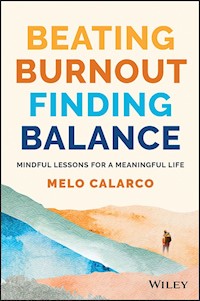
BEATING BURNOUT FINDING BALANCE
MINDFUL LESSONS FOR A MEANINGFUL LIFE
MELO CALARCO
First published in 2023 by John Wiley & Sons Australia, Ltd
Level 4, 600 Bourke St, Melbourne, Victoria 3000, Australia
© John Wiley & Sons Australia, Ltd 2023
The moral rights of the author have been asserted
ISBN: 978-1-394-15459-3
All rights reserved. Except as permitted under the Australian Copyright Act 1968 (for example, a fair dealing for the purposes of study, research, criticism or review), no part of this book may be reproduced, stored in a retrieval system, communicated or transmitted in any form or by any means without prior written permission. All inquiries should be made to the publisher at the address above.
Cover design by WileyCover and chapter opener image: © marukopum/ShutterstockCover image: hiker: © SimpleB/Shutterstock
DisclaimerThe material in this publication is of the nature of general comment only, and does not represent professional advice. It is not intended to provide specific guidance for particular circumstances and it should not be relied on as the basis for any decision to take action or not take action on any matter which it covers. Readers should obtain professional advice where appropriate, before making any such decision. To the maximum extent permitted by law, the author and publisher disclaim all responsibility and liability to any person, arising directly or indirectly from any person taking or not taking action based on the information in this publication.
To my beautiful wife Kila, who is always there for me.
And to my dear daughters, Maalika and Alani, who mean the world to me. I hope the work that I do can help make the world you grow up in a more peaceful and beautiful place.
A special dedication to my 95 year old Dad, who is the strongest and most resilient person I know.
ABOUT THE AUTHOR
Melo Calarco is passionate about three things: his family, travelling the world and helping as many people as possible live their best life.
As a certified mindfulness and performance coach, Melo has the unique ability to bring the best out of the people, and the companies, he works with. His results-based work is grounded in neuroscience, mindfulness, human behaviour, leadership training and other unique tools to help his clients find self-awareness, clarity, focus and, ultimately, success.
Melo learned to manage highly challenging and stressful situations, build mental endurance and rise above adversity from his life lessons on the road, where he cycled, trekked and travelled around the world on his mountain bike. He traversed Africa, Asia, India, Nepal, Europe and North America. Along the way, he had to overcome many obstacles and demanding encounters, including near-death experiences.
He now shares those deep experiences through his popular corporate programs, working with many global Fortune 500 companies, CEOs, directors, corporate executives and medical surgeons, as well as sporting professionals, Olympic athletes, actors, entrepreneurs, thought leaders and individuals who want to be the absolute best at their game.
Melo truly believes that everybody can live a life full of passion and potential without burning out and he is on a mission to empower as many people as possible to achieve this through his programs, workshops and one-on-one coaching.
His work has been described as truly transformational.
Melo loves spending time travelling with his family and exploring the Mornington Peninsula in Victoria, where he lives with his wife, daughters and beloved Swiss Shepherd, Koda.
INTRODUCTION
In my work as a mindfulness and high-performance coach, I have noticed a considerable increase in the rate of burnout over the past few years. I'm passionate about making a difference because burnout is continually on the rise globally, with the unrelenting pace of the modern world and the 2020 pandemic having made a significant impact.
Putting together a toolkit of preventative strategies to manage stress, build resilience and maintain wellbeing is far better than experiencing full burnout and then seeking the road to recovery. Regardless of whether you have experienced a partial or full burnout, are just feeling a bit tired and unmotivated, or if you are someone who is looking to make some improvements towards a more meaningful life, this book will give you the tools and techniques to reclaim balance and prevent the onset of burnout.
Over the years I have run many seminars, workshops and programs focusing on mindfulness concepts and various other techniques for preventing or overcoming burnout as well as helping high performers operate at their best. I am always touched and astounded by the feedback I receive weeks, months or even years later from participants sharing their stories on how the concepts and practices have helped them through difficult times, or saved their marriage, or even helped people negotiate serious illnesses.
When I hear individual stories from people I meet who have attended my workshops, I am reminded of why I love the work I do. It is these encounters that inspired me to write this book to help as many people as possible — including you.
My hope is that within these pages you will find inspirational stories, interesting concepts and some mindful practices and practical tips that you can easily implement to prevent burnout, find balance and live a healthy, meaningful life. My deepest aspiration is that you will adopt some of the simple techniques and incorporate them into your lifestyle to create a positive compounding effect, improve your overall wellbeing and find balance.
Furthermore, with the prevalence of burnout rising globally, I felt an innate need to support people through these challenging times. During the height of the 2020 pandemic, I supported more than 75 000 people globally through my corporate seminars and workshops, but I wanted to help further. I concluded that I not only wanted to write this book to support more people, but I needed to write it.
As the title suggests, this book will help you beat burnout and find balance in your life, but it will do much more than that. It will give you practical, implementable tools and techniques to prevent burnout, manage it or recover from it. You do not need to be experiencing burnout to benefit from this book. Each chapter also shares a valuable life lesson to help you operate at your best every day and to live your best life.
The book's three main takeaways, which I hope you will adopt, are:
the importance of self-awareness, self-regulation and self-care to prevent burnout
how to manage stress and overwhelm while thriving as a high performer
the benefit of living more mindfully and meaningfully.
I'd like to explain that this book does not outline in great detail what burnout is or its historical context; nor is it an in-depth analysis on mindfulness and the clinical research associated with it. There are many books that do this well. I prefer to spend time focusing on tangible ways of preventing burnout and introducing mindfulness into your daily life to find balance. It is one thing to learn about these concepts theoretically; it is another to actually practise them so you can feel the benefits for yourself.
Many of the stories I share on these pages are based on my personal experience and the lessons that I learned from cycling, trekking and travelling around the world on my mountain bike. I also capture some valuable lessons from other people I have worked with professionally over more than 25 years of working as a mindfulness and high-performance coach, including CEOs, corporate executives, medical surgeons, athletes and many other inspirational people from some of the world's leading companies. I interviewed close to 200 people from all walks of life while doing research for this book, and their unique insights and perspectives have been a valuable contribution.
Most of all, I want to share with you some of the techniques that I have tried and tested with many of my clients with positive results. The techniques are simple and easy to implement in your life so you can feel the benefits immediately. Some of these fundamental concepts and practices may already be familiar to you and this could be a gentle reminder that you need to take action.
How to use this book
Ideally, you should read this book chronologically, chapter by chapter, as each chapter has a particular underlying theme. I share stories, concepts, anecdotes, case studies and a life lesson in each chapter as well as short, practical mindful practices at the end of each chapter. The lessons and practices build on each other to give you a complete toolkit of self-coaching techniques and tips to help you navigate life with purpose and passion. For example, it makes sense to develop self-awareness (chapter 1) before self-regulation (chapter 4). But how you use the book also depends on your personal needs. You may choose to bounce through different chapters, depending on what you are looking for at the time.
The book contains some fantastic techniques and practices that can support you on your journey to living a mindful and meaningful life, but I do not propose that you adopt every single practice all at once. It is more beneficial if you grab one or two techniques that appeal to you personally and continue to practise them daily to experience the compounding benefits. My big goal is to simplify the complex and make the techniques easy to implement in your life, with very little effort, to create long-term, sustainable, healthy habits.
What I'd love is for you to pick up this book, learn a few techniques and implement them into your daily life so you, and everybody around you, can benefit. There is space for you to write on the pages, or you can download the worksheets and resources from www.melocalarco.com.
And what I'd love even more is to maybe one day bump into you on the street and listen while you share your story of how you benefitted from this book. ☺
With love and gratitude
Melo Calarco
CHAPTER 1ON SELF-AWARENESS
The first step in preventing burnout and implementing any sustainable change in your life is developing your self-awareness. As you become increasingly self-aware, you will notice if you are working stressfully or feeling fatigued and you can take action to self-regulate depending on how you are feeling (you will read about self-regulation in chapter 4).
For this book, I interviewed close to 200 people who had experienced some sort of burnout and, alarmingly, 90 per cent of them said they were not aware they were burning out until it was too late. It wasn't until they had a panic attack or reached crisis point that they realised they were burnt out.
Put simply, you can't change what you don't notice. Developing self-awareness gives you the ability to practise self-control, to manage stress, to look at different perspectives, to have better decision-making skills and to create solutions. In this chapter we will explore the concept of self-awareness and how you can begin to cultivate a deeper understanding of your inner self, which will benefit many areas of your life. Let's start with a personal story on self-awareness and how it helped me to self-regulate in a very challenging situation.
Rural South Australia
One fine afternoon, five good friends and I sat around a coffee table and spawned the crazy idea of cycling around the world on our mountain bikes for a couple of years. As plans progressed, we looked at maps of Africa, India, Asia, Europe and the United States, and started roughly planning out some of the routes for circumnavigating the globe.
Over the next few weeks, for me the idea became ever more exciting, while admittedly also a little daunting. Unfortunately, my friends, one by one, slowly backed away from this absurd idea for various reasons. And so, I was left with the choice of quitting and staying in my comfort zone, or going solo. Could I trust my self-awareness and intuition to make the right decision in this moment?
You can't change what you don't notice.
Despite family and friends trying to convince me otherwise, my decision was a resounding — and crazy — Yes! Let's go for it!
I started buying special lightweight camping equipment and kitting out my beloved bike with panniers (saddlebags) for the big adventure. I began doing training runs and exposing myself to different types of terrains and conditions.
I also became efficient in ways to carry and set up my equipment. After all, I needed to carry my bed, my kitchen, my wardrobe, my food, my water and myself on my bike on this big adventure. The training runs were sometimes difficult, but mostly fun as I got to push my boundaries and learn to negotiate different challenges. On one particular occasion, I was truly pushed to my limit and my self-awareness and ability to self-regulate were put to the test.
It was a long weekend in winter and there was a mild storm forecast for the remote areas of South Australia, where I lived at the time, so, as part of my training, I decided to head out on my mountain bike and go camping! According to the forecast, the storm didn't look too threatening — I didn't want to put myself in unnecessary danger — so I decided to give it a shot and headed out into fairly mild, wintry conditions. I was so excited to test out my new lightweight equipment and my expensive new tent.
Hour by hour, I cycled further and further away from home. By early afternoon, I noticed the storm clouds brewing on the horizon above the forest canopy and I could hear the gentle, percussive rumble of distant thunder. The landscape around me drew a stark contrast of vivid green forest pines with a looming sky of deep greys and dense, black rain clouds. I had never seen clouds like these in my life, and at that point, I wished I had my camera with me to capture this eerie moment (this was before mobile phones were an everyday accessory). Far away from any towns and deep in a forested area, I was feeling a mix of excitement, fear, strength and freedom. I thought it was probably time to start setting up camp as the dark clouds were continuing to change into obscure shapes and dusk was fast approaching.
I kept riding, but suddenly the mood changed entirely. The sky turned to black and visibility was getting very low. The deep, rumbling thunder was growing louder, and flashes of sheet lightning pierced the darkness. From out of nowhere, 100-kilometre winds started battering the environment and then, within seconds, the whole scene changed for the worse! Cold, stinging rain started belting across my body and I was instantly drenched from head to toe. The rain seemed to be coming at me horizontally as the wind pushed it hard against my frozen face. I didn't even have time to get my brand-new Gore-Tex rain jacket out. I was already wet to the bone from the rain.
It took all of my strength and focus just to keep my bike stable and negotiate the muddy path ahead. I glimpsed the path between the flashes of lightning as the thunderclaps grew stronger and more frequent. I kept riding and looked for a clearing to set up my tent, but I couldn't see much through the sheets of rain. Large tree branches and limbs started crashing all around me. And then, I couldn't believe my eyes: a fully grown gum tree was uprooted by the ferocious winds. I was officially scared and in danger.
I watched in fear and disbelief as large tree limbs were snapped effortlessly by the cyclonic winds and hurtled all around me. I had never seen anything like it and I learned later that it turned out to be one of the worst storms to hit Australia in decades — and I was in the middle of it!
I persevered a bit longer, trying to keep my bike upright against the relentless horizontal rain and wind. I was just about to stop when I heard an almighty crack behind me. It sounded like a shotgun. Suddenly, a falling tree struck me violently from the side, sending my bike and me crashing to the ground. It felt like a truck had hit me at full speed, knocking me to the ground and crushing the bike panniers carrying all my new equipment. I was in shock.
My leg was bleeding and my ribs felt crushed, but luckily I wasn't too badly injured, and I managed to get up. I wanted to make myself a shelter, but some of my tent poles were cracked and the tent shell was ripped. The horizontal rain continued, the howling winds grew even stronger, the temperature dropped rapidly and darkness truly set in. There was no way I could set up my damaged tent in these conditions so I tried to construct something with my bike and the ripped tent shell, but the wind was even too ferocious for that. There was absolutely no way I could light a fire with such intense wind and rain, and the flying branches and limbs were still crashing violently around me. I gathered all my belongings in a neat pile and managed to find a few biscuits in my bag, which I hurriedly ate to give myself some energy. By this time I was genuinely anxious as I was dodging falling branches and debris from above while I continued to look for shelter.
The world around me was literally crashing and crumbling. The wind was howling, branches were flying, trees were being uprooted, lightning was flashing, thunder was grumbling and I was officially in grave danger. I sat down beside my bike and piles of damaged equipment — cold, broken and drenched to the bone. I noticed my hands were frozen and bluish in colour, my teeth were chattering uncontrollably and my lips were numb as I felt hypothermia setting in. Crippled by fear and cold I did not know what to do!
My senses were heightened and I was very self-aware in this moment. Suddenly, a flash thought lit up my mind: If the world around me is a chaotic mess, how about I look inside myself for some inner strength and solace? It's time to go within.
In my pile of belongings, I found a small foil emergency blanket — you know those little square ones you think you will never use (because how could it possibly save anyone's life?). I gave it a try anyway. I wrapped it around my shoulders and hugged myself tightly with it. My next rational thought was to try some breathwork. My Tai chi master had taught me meditation and deep belly breathing techniques over the years, and I recalled him claiming these could help raise your core temperature as well as provide many other health benefits. So, I sat under my tiny foil blanket, put my hands on my lower belly and started to meditate. It took a while to settle and focus as I was constantly distracted by the wind howling through the treetops and the sounds of tree branches crashing around me. At times I was tempted to get up and run, but I had nowhere to run to, so I persevered with the breathing practice.
I diligently counted my breaths to stay focused on my lower belly area — 1, 2, 3 … 7 … 59, 110, 210 — and I counted into the high hundreds. After a while, I started to feel warm, and actually even hot! It was beyond belief, but my thermal fleece was beginning to wick away the moisture from my core temperature, radiating outwards, and my clothes slowly started drying out. I continued counting, with my hands on my belly, and I felt myself drifting in and out of counting and consciousness for what seemed like a few hours. The storm was still crashing all around me, but I was starting to feel a sense of peace and security emerge from deep inside me, like a deep, still ocean beneath the raging waves above. I calmed down and started to believe that I was going to survive this. As I dived deeper inside myself, I felt myself drop down into another layer of subconsciousness as my meditation guided me deeper downwards and inwards. After some time, I actually felt a sense of total inner peace and stillness, oblivious to the outer world. I felt safe, I felt warm and I felt totally calm.
I am not really sure what happened to me over the next few hours. Time meant nothing. I was in a state of being that I had never experienced before. I can't explain it in words. I was not even sure if the storm was still raging around me because I no longer noticed the external world — only the world within me. It was timeless as I sat in this fine balance of a present state of awareness and deep, peaceful consciousness.
I must have sat in meditation from dusk until dawn, drifting between various brain states. I knew the worst was over when I heard the comforting sound of a solitary magpie starting its morning warble. I opened my eyes to see the first rays of sunlight penetrate the forest. It appeared that the storm had mostly passed. I noticed large tree limbs and debris strewn all around me. One particularly large branch was just a metre away, but I have no recollection of it crashing near me. My body was sore, and my legs had pins and needles as I tried to stand up. It took me a few attempts, but I finally managed to get up, feeling a little shaky and weary.
In the morning light, I got busy gathering my senses and my belongings, and temporarily fixing my bike enough to ride to safety. I managed to find a bit of food in my pannier to give me some renewed energy and began my journey home. Before I left, I took a moment to look around me in astonishment that I had just spent a whole night in this forest, all alone in the middle of a ferocious storm, without shelter. I could not believe that one minute I was hypothermic and scared to death and then, through the power of breath and meditation, I was able to self-regulate and feel totally safe, warm and secure.
With weary legs and a cold body I started pedalling on my journey back home to a warm house, a hot shower and some nourishing food. I processed my thoughts and reflected on my experience, grateful to be alive. I didn't tell any of my family and friends about this incident, partly because I was embarrassed and partly because they thought I was safe and sound in my brand-new tent.
You can influence your physiology by changing your psychology, and vice versa.
This challenging experience taught me one big lesson and it definitely changed my life in many ways. It taught me the power of self-awareness and ‘going within’ to self-regulate. It also taught me to trust that you will always have the resources inside you to deal with any situation, which served me well for the travelling adventures that followed.
To this day, I am still not exactly sure what happened between the many hours of dusk and dawn, but I do know this: I am now a firm believer in the profound potential of meditation and breathwork, and it has become my life's work personally and professionally. You can influence your physiology by changing your psychology, and vice versa. The power of the body and mind connection is infinite, and it all starts with self-awareness.
Life lesson: Self-awareness
Self-awareness precedes everything. When you develop self-awareness you become more mindful of your inner and outer environments. You can prevent burnout with awareness by realising what you are experiencing, assessing the situation and taking positive, decisive action in the moment.
Self-awareness: the first step
As I've already asserted, you can't change what you don't notice. It all starts with you, and developing strong self-awareness. A relationship with your inner world is the first step to preventing burnout and finding balance. If I was able to literally find calm in the eye of a storm through meditation and breathwork, I am sure these same techniques can help you remain calm in any challenging situation. You can always find peace within when you develop your deeper sense of awareness, and additionally your ability to self-regulate.
With self-awareness, you can reduce anxiety before it takes over. You can take a renewal break when you notice you are fatigued. You can manage external pressure and stress before you feel overwhelmed. It's a bit like driving your car and the oil light flashes on your dashboard. What happens if you ignore that sign? What happens if you keep driving for days on end without oil? The engine will simply burn out or blow up! It's the same with us. What happens if you notice you are feeling stressed or anxious, but you continually ignore the signs and just keep trying to push on through? You might get so many warning signs through your day — tight chest and shoulders, heart palpitations, lack of focus, fatigue, tension, poor sleep, and so on — but you just keep trying to push through. Unfortunately, there is a price to pay for this ongoing, unmanaged cumulative stress. The price is burnout.
As you read earlier, 90 per cent of the people I interviewed for this book stated they were not aware that they were experiencing burnout until it was too late. The other 10 per cent either ignored the signs or did not have the tools to deal with them. My aim is to give you practical tools and techniques that will help you read the signs and take proactive steps to prevent burnout in the first place — and developing self-awareness is the first step.
Emotional intelligence
In his bestselling book Emotional Intelligence, psychologist Daniel Goleman1 describes self-awareness as the very first domain for developing emotional intelligence. When I'm running corporate leadership programs on this topic, I often ask the group the fundamental question, ‘What is emotional intelligence?’ I am met enthusiastically with some great responses, such as, ‘being able to read the room’, ‘understanding other people's needs’, getting along with your colleagues', ‘having empathy towards your team members’, ‘listening to others’, ‘working together dynamically as a team’, and so on. These are all accurate responses, but most people forget one fundamental aspect: it all starts with you! Self-awareness is the first step.
The two fundamental components of emotional intelligence are:
understanding yourself
: your goals, your values, your behaviours, your emotional responses and your thought patterns
understanding others:
their feelings, and sharing empathy and connection.
It's interesting how most people's answers include the second component and totally overlook the first, which is obviously the more important part. Knowing yourself first is paramount. How can you possibly interact with other people on a deeper level if you do not truly know yourself first? And I mean, truly know yourself deep down: know your behaviours, know your pain points, know your relationship with your emotions and know your tipping point. Know what you do when you feel stressed, sad, angry or upset. Do you recognise your behaviours? Do you withdraw? Do you become reactive? Do you blame others? All of this comes under the banner of self-awareness and sometimes your perception of yourself may be very different from the reality.
One of the general managers of a large bank that I work with explained to me how his team loved him so much and he was admired by them as a leader and a friend. He told me he stayed calm under pressure and never got angry at his team members during tough times. In the subsequent months, I began working with various members of his team and they told me the polar opposite: that he was manic, unapproachable, reactive and often moody. His perception of himself was totally different from how others perceived him. He obviously needed some training on self-awareness 101, which we did, and within months he improved dramatically. He became a much better leader, a better husband and a better person. The first step to good leadership and becoming a better person is self-awareness — and that comes from more introspection and reflection time.
The same is true for avoiding burnout and reclaiming balance in your life: the first step is self-awareness.
Why is self-awareness so important?
Practising self-awareness is all about learning to better understand why you feel the way you do and why you behave in a particular way. Developing self-awareness gives you the opportunity and freedom to change things about yourself, and the choice to respond in a certain way and ultimately to create the life you want. How can you possibly create the life you want when you don't know yourself deeply?
Being self-aware is about having a good knowledge and under–standing of yourself and being aware of your actions and behaviours. It's about knowing your strengths and limitations: knowing what gives you joy, knowing what creates an emotional response in you and what your basic needs are. Then, once you understand yourself better, you are better able to empathise, connect and communicate with others more personally and professionally. As a high performer, you are constantly working in demanding conditions and high-pressure situations where the ability to remain calm under duress is very important.
In terms of preventing burnout, the first step is to be aware of what is happening to your body and mind throughout the course of a day. Being acutely self-aware gives you the ability to make positive choices in various situations every day. It could be as simple as being aware of the choices you make, such as ‘Should I stop for lunch, or not? Should I go to the gym tonight, or not? Should I stay back and work late, or not?’ Burnout is something that can creep up on you over time when you are not making the right choices; therefore, being more aware of your choices and mindful of your basic self-care is very important. The constant wear and tear on the body and mind through lack of self-care and cumulative stress compounds over time and eventually wears you down.
Being acutely self-aware gives you the ability to make positive choices in various situations every day.
Mindfulness 101
One of the best ways to develop self-awareness is to spend more time on your own and to adopt some mindfulness training and practices. I have been practising mindfulness and meditation for about 30 years and have seen the immense benefits in it. Throughout this book I will share various mindfulness stories, concepts, techniques and practices, and I sincerely hope you can benefit as much as I have.
At its most fundamental level, mindfulness is about paying attention to the present moment, without judgement, and being openly aware. It's about being present and engaged with where you are and what you are doing at the time. This sounds really easy in theory, but sometimes it is difficult to practise mindfulness in this busy, overstimulated world we live in. Sometimes we can overcomplicate the simple practice of mindfulness in the modern world and put so many convoluted terms to it that it seems confusing and difficult to achieve.




