


34,99 €
Mehr erfahren.
- Herausgeber: John Wiley & Sons
- Kategorie: Fachliteratur
- Sprache: Englisch
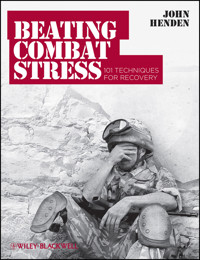
Beating Combat Stress is a one-stop handbook of field-tested techniques and strategies to help service personnel, veterans and professionals to deal with the psychological effects of combat.
- Features 101 field-tested techniques and strategies for managing combat-related stress
- Designed to be accessible and useful both to serving personnel and veterans, and to the professionals and volunteers who are engaged in helping them
- Takes a solution-focused approach to dealing with combat-related problems, promoting simplicity and proven techniques over complex theories and psychological jargon
- User-friendly style and layout, with specially-commissioned illustrations throughout
Sie lesen das E-Book in den Legimi-Apps auf:
Seitenzahl: 153
Veröffentlichungsjahr: 2011
Ähnliche

















Table of Contents
Cover
Title page
Copyright page
Dedication
About the Author
John Henden BA(Hons), RMN, Dip.Couns. (Univ. of Bristol), MBACP
Foreword
Preface – The Book’s Purpose
Acknowledgements
Introduction
How to Use This Handbook
Section 1: Dealing with “Triggers”
The Tools and Techniques
Section 2: How to Deal with Flashbacks
The Tools and Techniques
Section 3: How to Deal with Unwelcome Thoughts
The Tools and Techniques
Section 4: Dealing with “The Lows”
Section 5: Dealing with Sleep Disturbance
A. Techniques for Preparing for Bed
B. Getting off to Sleep
C. Getting Back to Sleep, If Waking or Awakened in the Night
A. Techniques for Preparing for BedB. Getting off to Sleep
C: Getting Back to Sleep, If Waking or Awakened in the Night
Section 6: Living Life to the Full (or as Full as Possible)
Appendix A: The Evidence Base for Solution-focused Therapy
A. Meta-analyses
B. Systematic Reviews
C. Published Follow-up Studies
D. Randomised Controlled Studies
E. Domestic Violence Studies
F. Single-session Studies
Appendix B: Helpful Questions and Statements from the Worker
Appendix C: What Service Users Have Found to be Helpful in This Work
Appendix D: How to Avoid Re-traumatisation and Re-victimisation
Appendix E: Blocks to Disclosing
Appendix F: The Three Stages: Victim – Survivor – Thriver (Living Life to the Full, or as Full as Possible)
Information for Service Users
Appendix G: Benefits of Doing This Important Work
Appendix H: Reassuring Things for Servicemen to Know
Appendix I: Two-day Workshops
Workshop Content
Learning Outcomes
Bibliography
Index
This edition first published 2011
© 2011 John Wiley & Sons Ltd.
Wiley-Blackwell is an imprint of John Wiley & Sons, formed by the merger of Wiley’s global Scientific, Technical, and Medical business with Blackwell Publishing.
Registered Office
John Wiley & Sons Ltd, The Atrium, Southern Gate, Chichester, West Sussex, PO19 8SQ, UK
Editorial Offices
The Atrium, Southern Gate, Chichester, West Sussex, PO19 8SQ, UK
9600 Garsington Road, Oxford, OX4 2DQ, UK
350 Main Street, Malden, MA 02148-5020, USA
For details of our global editorial offices, for customer services, and for information about how to apply for permission to reuse the copyright material in this book please see our website at www.wiley.com/wiley-blackwell.
The right of John Henden to be identified as the author of this work has been asserted in accordance with the UK Copyright, Designs and Patents Act 1988.
All rights reserved. No part of this publication may be reproduced, stored in a retrieval system, or transmitted, in any form or by any means, electronic, mechanical, photocopying, recording or otherwise, except as permitted by the UK Copyright, Designs and Patents Act 1988, without the prior permission of the publisher.
Wiley also publishes its books in a variety of electronic formats. Some content that appears in print may not be available in electronic books.
Designations used by companies to distinguish their products are often claimed as trademarks. All brand names and product names used in this book are trade names, service marks, trademarks or registered trademarks of their respective owners.
The publisher is not associated with any product or vendor mentioned in this book.
This publication is designed to provide accurate and authoritative information in regard to the subject matter covered. It is sold on the understanding that the publisher is not engaged in rendering professional services. If professional advice or other expert assistance is required, the services of a competent professional should be sought.
Library of Congress Cataloging-in-Publication Data
Henden, John.
Beating combat stress : 101 techniques for recovery / John Henden.
p. cm.
Includes bibliographical references and index.
ISBN 978-0-470-97480-3 (cloth)
ISBN 978-1-119-99611-8 (epub)
1. Post-traumatic stress disorder. 2. Veterans–Mental health. I. Title.
RC552.P67H45 2011
616.85'21–dc22
2010035696
A catalogue record for this book is available from the British Library.
Dedication
I dedicate this book to the hundreds of thousands of servicemen and women from all four armed services who have served in the frontline of various theatres of operations over the last few hundred years. The vast majority, as others will in the future, simply dust themselves off before making the necessary readjustments, at their own pace and in their own time. Some will have needed help from comrades, the chain of command, their regimental association, family welfare workers, or other agencies to complete that adjustment. This handbook is dedicated particularly to those servicemen who have found it tough on their return; or who have experienced symptoms later on. It may be used as a manual for welfare workers who are providing the most effective help possible, and as a self-help guide or “buddy-aid” for all service personnel who have need. Service wives or partners, parents or other relatives may find it helpful too, in discovering the widest range of valuable tools and techniques. Theories about what might be helpful for service personnel with combat operational stress reaction (COSR) can be found in many textbooks and papers. This handbook contains no theories; instead, it is a practical how-to-do guide, packed with field-tested tools and techniques that work in the majority of cases.
If there are three lead messages within this handbook, they are as follows:
to get serving troops back to maximum operational fitness and health as soon as possibleto promote early intervention, wherever and whenever possible, for all service personnel who have been on tours of duty, anywhere in the worldto equip both serving personnel and veterans with the widest range of tools and techniques to promote a life lived well.About the Author
John HendenBA(Hons), RMN, Dip.Couns. (Univ. of Bristol), MBACP
John Henden is a former soldier, therapist and trainer of military welfare workers within all four armed services.
John is an acclaimed international author, conference presenter and solution-focused trainer. He is a regular presenter at European Brief Therapy Association conferences and was a founder member of Solutions in Organisations Link-up. Over the last 10 years, he has worked in over 15 countries.
He has worked in health, welfare and support services for over 30 years, having gained both a deep knowledge and a wide experience of “what works”, when it comes to helping individuals get their lives back on track. Throughout his career in health and welfare, he has never lost sight of the potential in people to make the necessary changes to live useful and productive lives, despite any earlier labels they may have been given.
Foreword
The conflicts in Iraq and Afghanistan have thrust into view tragic images of fallen servicemen and women returning home in flag-draped coffins, and heightened public awareness of the need to support those who have suffered life-changing injuries. Those with longer memories may recall the Falklands Campaign of 1982: British television screens filled with pictures of severely burned Welsh Guardsmen struggling off the stricken Sir Galahad or 2 PARA burying their dead at Goose Green. But those whose injuries we see are just a small proportion of those who suffer in the course of duty. Far more numerous are those who suffer through the stress of what they have experienced, and their injuries are invisible to all but themselves and their close families and friends. In past generations these wounds would have gone unrecognised and untreated, but not anymore.
John Henden, an ex-serviceman, therapist and trainer in the military welfare field, is at the forefront of the fight to transform those who suffer from the stress of combat back to being the fully effective soldiers and citizens they once were and, he argues with great conviction, have always been. This practical, no-nonsense book will make a tremendous contribution in this vital area. Anyone who picks it up will realise at once that there is no “psychobabble” here, just soldier-focused common sense.
One of the biggest obstacles to treating those brave individuals who, in previous generations, were likely to have been dismissed as suffering from some sort of “shell shock”, was simply admitting that their reaction was normal. Yes, for them it was unpleasant, worrying and severely depressing, but it is now widely accepted that this is a perfectly normal reaction to situations of great stress. Like any illness it needs to be recognised, accepted and treated. The military’s “macho” culture has often sought to stigmatise those who sought help, but that is increasingly a thing of the past. Few soldiers who have experienced combat can deny they have felt fear, and no one can be certain how they will react the next time. The military community has reached a level of operational competence and professional maturity where it is now fully recognised that all mates in difficulty need help, whether they are bleeding visibly or hurting inside. We understand these things so much better today.
I am sure that this book will make a major contribution to heading off psychiatric injury at an early stage; the practical advice is both simple to understand and wise in substance. Moreover the six sections are divided up in such a way that the subject matter is readily accessible; the reader gains instant benefit from turning the pages. One only wishes others would write and speak in such clear terms. There is nothing to be gained by pretentious language and academic mumbo jumbo; Henden’s communication skills are a lesson in getting a message over with crystal clarity. He introduces readers to the concept of Triggers – random events which can set off unwelcome memories producing debilitating Flashbacks, but he quickly dissolves these scary moments into something that is normal and can be handled with the application of his reassuring strategies. In the sections that follow, he offers similar techniques to deal with Unwelcome Thoughts, “The Lows”, the desire to live Life to the Full, and Sleep Disturbance. The latter is so common that his practical tips will benefit not just those suffering with combat stress, but anyone struggling with the pressures of our overheated society.
Over and above the book’s principal sections, Henden includes nine appendices which underpin all that has gone before. He lifts the veil on his own Solution Focused Brief Therapy, and goes on to provide important signposts for those working in this life-restoring area for the benefit of others. Throughout, while the military focus is evident, it is not applied in such a way that prevents relevance to other walks of life. This will significantly widen the appeal and the success of this invaluable book.
Henden has consulted widely, thought carefully, and offers compelling advice in an area of life that has become much more open to receive it. In this regard he is a man for our times, and this book is a most welcome product. If used as intended, hope will be restored and many lives transformed.
General Sir Richard Dannatt GCB CBE MC DL
Former Chief of the General Staff
July, 2010
Preface – The Book’s Purpose
During the 18 years or so in which I have worked with survivors of all sorts of extreme experiences, I have been struck by the shortage of appropriate help. Often, where this help has been available, it has been of the wrong sort; practitioners have had limited skills; or service users have found it difficult to engage.
Many pamphlets, booklets and leaflets, designed to provide help for both clients and their relatives and friends, have fallen short with regard to specific ideas and techniques for recovery. This has been the case, particularly for service personnel.
The various textbooks aimed at helping practitioners tend to concentrate on background, awareness, theories and statistics, rather than getting down to specifics on what might be useful. Those books that do list tools and techniques do not describe very many; are over-complicated or wordy; and appeal more to highly educated practitioners. This comprehensive handbook is intended to plug this gap in provision, with its many tools and techniques from which to choose.
The book’s twin purpose is both to provide a handbook for practitioners and at the same time to be a self-help book or buddy-aid manual. Regarding other books available for the self-help market, there are two I would endorse, which may be read in addition to this one. The first of these is by Armstrong, Best and Domenici (2006) and is entitled Courage after Fire: Coping Strategies for Troops Returning from Iraq and Afghanistan and Their Families. This is good particularly in regard to tips and techniques for strengthening mind and body; and for coming to terms with changed views of others, self and the world.
The second book is by Charles Hoge (2010), Once a Warrior, Always a Warrior: Navigating the Transition from Combat to Home. The noteworthy strengths of this book are how to deal with the many and various emotions on return from theatre; and how partners and family members can be most helpful.
Those servicemen who have developed reactions to their experiences “on tour” may need help in various ways. The six sections of this handbook are intended to cover all these experiences.
Is this book about “post-traumatic stress disorder” (PTSD)? As mentioned again later, in Section 5, the PTSD label is easy for some practitioners to apply, but difficult for the serviceman to remove. From the solution-focused perspective, PTSD has negative connotations, with ideas of hopelessness and permanence. Seeing PTSD, then, as an unhelpful and outdated term, and using combat operational stress reaction (COSR) instead, breathes “ideas of hope, optimism, temporariness and normality into the situation” (Moore and Reger, 2007, p. 166).
Most of us, at some time or other during our lives, experience reactions to one sort of stress or another. This is life. We acknowledge the stress; think of how we might reduce it; what needs to happen to bring it to an end; and then take action. Time alone, in many instances, will see a lessening of it. The reaction some may have to combat operational stress need not be seen as much different from this.
The majority of the 101 techniques and strategies within this handbook are easy to understand and apply, by both service personnel and veterans themselves. Spouses, partners, relatives and friends will find the same. For practitioners and welfare workers, a basic counselling skills qualification is recommended; and even a preferred therapeutic approach is desirable. This is especially the case with Eye Movement Desensitisation and Reprocessing (EMDR) and the Rewind Technique, where expert professional assistance should be sought.
This book has been written and published for informational purposes, and is not intended to serve as a substitute for therapy or treatment of any specific disorder. The author and publisher are offering information and advice for consideration, but, ultimately, each serviceman or veteran (and spouse, partner, buddy or family member) needs to seek out and find whatever works best for him. This book is not intended to be a substitute for professional help when it is needed.
There are so many good news stories to tell about how different reactions to combat operational stress have been resolved. But there are all too many, still, where the opposite is true: either because the practitioner has insufficient knowledge about the tools and techniques within the pages that follow, or because the serviceman does not know where to find the best self-help technique.
Please take as much as you need from this handbook and pass on the good news!
Acknowledgements
I would like, first, to acknowledge Royal Marine WO1 Ian Robbins, who several years ago encouraged me to develop a two-day training package to equip military welfare workers better in their work with personnel returning from operational theatre. Without delivering these many workshops across all the armed services, and the many conversations and discussions which were had, this handbook might not have been written.
I am grateful, too, to Gail Morris of the Army Welfare Service, whom I have known in her various capacities within that valued service, over the past 10 years or so. At a difficult stage in the development of the handbook, she was able to provide suggestions and ideas to give the project renewed life, and to ensure its publication.
I want to thank Darren Reed, Commissioning Editor of Wiley-Blackwell, who listened with great interest to my original ideas for this book and, believing it to be a virtuous project, gave me appropriate guidance along the way.
My thanks go, too, to David and Pat Hopewell, who were kind in letting me use their Bristol flat, with inspirational views across the city and the hills of North Somerset beyond. Most of the manuscript was written there, over several stays.
I am grateful, as ever, to my wife Lynn who has been very understanding of my need “to go away and write”. She has on many occasions been most patient in her role as “wordsmith’s widow”.
I am grateful to Dr Alasdair Macdonald for his encouragement and support with this project, over some three or four years. This came first in the form of enlightening articles, and then in the form of useful books loaned. Latterly, help with the research base for solution-focused brief therapy (SFBT), as outlined in Appendix A, was much appreciated.
I would like to thank Dr Harry Procter for casting his eye over later drafts of the manuscript, and for making some useful suggestions on both design and content. His quick grasp of both structure and content, and his clarity of thinking, are always appreciated.
My search for an illustrator ended when I remembered Keith Rainer, who had helped me with a previous important project. Thanks, Keith, for all the drawings provided for the various sections within the book.
The person to whom I reserve my deepest gratitude for, in putting the whole handbook together, is Alison Wright, my secretary. She has steadily and patiently word-processed each redrafting of the manuscript over many months. A big “thank you” for this sterling work.
Finally, I would like to thank the many serving service personnel and veterans, whom I have worked with over many years, both in a personal and a professional capacity. Also, I am grateful to the many civilian clients who have survived road traffic accidents (RTAs), near-death experiences, armed robberies and other traumatic events. It is on both military and civilian clients that the tools and techniques in this handbook have been field-tested, by me and others over many years, with both encouraging and amazing results.
Introduction




