


13,99 €
Mehr erfahren.
- Herausgeber: Parkstone International
- Kategorie: Geisteswissenschaft
- Sprache: Englisch
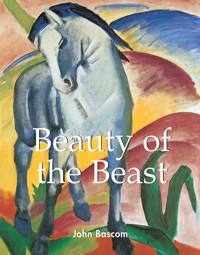
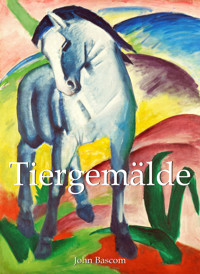
Throughout time, artists have maintained a close relationship with the animal world, which has proved to be an inexhaustible source of inspiration. First, they received inspiration directly from their environment. Next, animals were used in art for their status as domestic friends, symbols of an intimate and familial life, held in particularly high esteem during the Renaissance. Later, in Orientalism, animal art followed the discovery of exotic fauna which appealed to contemporary artists. The animal and its wild beauty are depicted here through works of art from Albrecht Dürer, Pieter Bruegel, Leonardo da Vinci, Katsushika Hokusai, Henri Rousseau, and Paul Klee.
Das E-Book können Sie in Legimi-Apps oder einer beliebigen App lesen, die das folgende Format unterstützen:
Seitenzahl: 69
Veröffentlichungsjahr: 2023
Ähnliche



















John Bascom
Author: John Bascom
© 2023, Confidential Concepts, Worldwide, USA
© 2023, Parkstone Press USA, New York
© Image-Barwww.image-bar.com
© 2023 Chagall Estate/ Artists Rights Society, New York, USA
© 2023 Estate of Morris Hirshfield/ Licensed by VAGA, New York, NY
© 2023 Estate of Pablo Picasso/ Artists Right Society (ARS), New York
© 2023 Ivan Generalic, all rights reserved
© 2023 Andy Warhol Foundation for the Visual Arts/ Artists Rights Society, New York
All rights reserved. No part of this may be reproduced or adapted without the permission of the copyright holder, throughout the world.
Unless otherwise specified, copyright on the works reproduced lies with the respective photographers. Despite intensive research, it has not always been possible to establish copyright ownership. Where this is the case, we would appreciate notification.
ISBN: 978-1-78160-584-4
CONTENTS
Simple notion of beauty
Truth as a condition of beauty
Connections of artand nature
Howbeauty is reached and cultivated
Featured Artists
Index of Illustrations
“Beauty is animalistic, beautiful is celestial.”
— Joseph Joubert, Pensées
Simple notion of beauty
In defining beauty, we say of it, first, that it is a simple and primary quality. It is uncompounded. No two or three qualities in any method present can compass it with their combined effects. No analysis can resolve it into other perceptions, but there always remains something unresolved and unexplained, which is beauty. This is proved by the fact that the most successful of these resolutions, while they hit on qualities frequently concomitant with beauty and intimately related to it, are never able to go beyond this companionship and show the identity of those qualities with beauty, whenever and wherever found. Unity and variety are qualities usually, I think always, in some degree present in beautiful objects. But though this presence may show them to be a condition for the existence of beauty, it does not show them to be its synonym or equivalent. In fact, we find that these qualities exist in many things which have no beauty.
Their range may include the field under discussion, but it certainly includes much more, and thereby shows that these qualities do not produce the distinguishing and peculiar effects of aesthetics. Thus is it with every combination of qualities into which we seek to analyse beauty. Either phenomena which should be included are left unexplained, or phenomena which do not belong to the department are taken in by the theory. These analyses, either by doing too much or too little, indicate that the precise thing to be done has not been done by them, and only prove a more or less general companionship, and not an identity of qualities. It is one thing to show that certain things, even, always accompany beauty, and quite another to show that these always and everywhere manifest themselves as beauty, reaching it in its manifold forms, and leaving nowhere any residuum of phenomena to be explained by a new quality. The idea of beauty has been with patient effort and elaborate argument referred to in association, thus not only making it a derived notion, but one reached through a great variety of pleasurable impressions. It is clear, however, that association has no power to alter original feelings, but only to revive them. Therefore, if beauty is not as an original notion or apprehension entrusted to association, it cannot be given by it since this law of the mind has no creating or transforming, but simply a uniting power. Association can explain the presence of ideas, not their nature.
On this theory, beauty must chiefly be confined to the old and the familiar, since upon these associations it has acted and been correspondingly excluded from the new, as not yet enriched by its relations. This is not the fact. The beauty of an object has no dependence upon familiarity, but is governed by considerations distinctly discernible at the first examination.
In individual experience, it is a matter of accident what objects ultimately become associated with pleasant or with unpleasant memories; and in community, association is as capricious as fashion. No such caprice, however, attaches to the decisions of taste. A uniformity indicative of many well-established principles belongs to these. So far as beautiful objects have been united by a firm association with wealth and elegance, this association itself must be explained by their prior and independent beauty. Beauty has occasioned this permanent and not groundless preference for wealth and elegance. The simplicity of this quality is seen in the presence of an unexplained and peculiar effect, after we have removed all the effects which can be ascribed to the known qualities present.
It is underived. The primary nature of beauty presents a question of some difficulty, since there are qualities with which it is often so intimately associated that its own existence in particular cases is dependent on theirs. Compared to qualities with which it is often associated, beauty can have the appearance of a secondary and subsidiary quality. In many things, their relations give limit and law to their beauty, and, as we here find the impression of beauty dependent on an obvious utility, coming and going therewith, it would seem an easy and correct explanation to refer this peculiar intuition and feeling to the perception and pleasure of an evident adaptation of means to an end in the object before us. The error of such a reference is clearly seen, however, in another class of cases, in which this quality is found to have no such connection with the useful and to exist in a high degree with no reference, or with a very obscure and remote reference, in the object to any use. If we undertake to deduce beauty from any quality or relation of things, however successful we may think ourselves in a few chosen instances, we will find a large number of objects which our theory should explain beyond its power.
The Three Black Auks (detail)
Anonymous, c. 27,000-19,000 BCE. Cosquer Cave, Calanque de Morgiou
Bison Carved in Low Relief
Anonymous, c. 16,000 BCE. Limestone, length: 30 cm. Musée national de la Préhistoire, Les Eyzies-de-Tayac
The Antelopes
Anonymous, c. 1550-1500 BCE. Fresco, 275 x 200 cm. National Museum of Athens, Athens
The Cat Goddess Bastet
Anonymous, 663-609 BCE. Bronze and blue glass. 27.6 x 20 cm. Musée du Louvre, Paris
A more careful examination of the very cases on which we rely will show us, that, while beauty may exist with, it exists in addition to the quality from which we would derive it; that the utility with which it is associated is not a cause, but a temporary condition of its existence, or rather that the same relations of the object include and determine both its beauty and its utility.
As it follows, therefore, in regular sequence, there is no one quality or set of qualities. Instead, we say that it itself is a primary and simple quality. There is involved in this assertion an inability to give any explanation of the attribute, or any definition of the word by which it is expressed. It is compound and derived from things which can be explained. Simple things can only be directly known and felt. Any explanation involves a decomposition of the thing explained, a consideration of its parts, and thus an apprehension of it as a whole, or the reference of it to some source or cause whence it proceeded, and in connection with which it is understood. But no simple thing can be decompounded and explained through its parts; or can a primary thing be referred as a derivative to something back of it, and thus be explained in its cause.
Nor is the word by which such simplicity is expressed, capable of any other definition than that of a synonym. A definition must include one or more characteristic and distinguishing qualities by which the thing in hand is separated from all others.
But in the case of a simple thing there is but one quality, and that alone can be mentioned, and this is to name a synonym.




