


26,99 €
Mehr erfahren.
- Herausgeber: ibidem
- Kategorie: Geisteswissenschaft
- Serie: Samuel Beckett in Company
- Sprache: Englisch
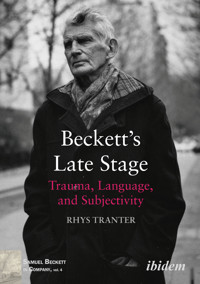
Beckett’s Late Stage reexamines the Nobel laureate’s post-war prose and drama in the light of contemporary trauma theory. Through a series of sustained close-readings, the study demonstrates how the comings and goings of Beckett’s prose unsettles the Western philosophical tradition; it reveals how Beckett’s live theatrical productions are haunted by the rehearsal of traumatic repetition, and asks what his ghostly radio recordings might signal for twentieth-century modernity. Drawing from psychoanalytic and poststructuralist traditions, Beckett’s Late Stage explores how the traumatic symptom allows us to rethink the relationship between language, meaning, and identity after 1945.
Das E-Book können Sie in Legimi-Apps oder einer beliebigen App lesen, die das folgende Format unterstützen:
Seitenzahl: 388
Veröffentlichungsjahr: 2018
Ähnliche




















ibidem Press, Stuttgart
For my grandfather,
William Haydn Jones (“Pappy”),
for encouraging me to apply to university.
Acknowledgements
First and foremost, I would like to thank Neil Badmington for his advice, encouragement and friendship throughout the project. His feedback and fine espressos were the fuel that ensured a steady progression. · I owe a debt of thanks to the following for their support during various stages of the project: Iain Bailey, Elizabeth Barry, Jonathan Boulter, Peter Boxall, Mary Bryden, Mark S. Byron, Julie Campbell, Arka Chattopadhyay, Rick Cluchey, Paul Crosthwaite, Raymond Federman, Matthew Feldman, Peter Fifield, Stanley Gontarski, Dan Gunn, Julia Jordan, David Houston Jones, Seán Kennedy, James Knowlson, James Martell, Ulrika Maude, Laurent Milesi, Irene Morra, Becky Munford, Mark Nixon, Anthony Paraskeva, Bryan Radley, Jean-Michel Rabaté, Laura Salisbury, David Tucker, Dirk Van Hulle, Shane Weller, and Adam Winstanley. · I would also like to thank Series Editor Paul Stewart for his diligence and support during crucial stages, and to Valerie Lange of Ibidem Press for her help and guidance throughout the publication process · I am grateful to the Arts and Humanities Research Council, for their financial support during the principal research of this study · I would like to acknowledge the patient and helpful staff of Cardiff University’s Arts and Social Studies Library. · A big thank you to the supportive community of postgraduate researchers based at the School of English, Communication and Philosophy. · Thank you to John Minihan for kindly providing a photograph for the front cover · A big thank you to my family, Hazel, Brian, and Robert Tranter, and to my in-laws Leslie and Don Whitney, for their generosity, understanding, and support at various points throughout the project· And finally, my largest debt of gratitude goes to Jennifer Dawn Whitney, a tireless listener and scrupulous crrritic who has been a constant source of guidance and inspiration. Needless to say, all errors are my own.
Some sections of the material in this book have appeared in earlier versions in the following publications: ‘“without solution of continuity”: Beckett’s That Time and Trauma Memoir’, Samuel Beckett Today / Aujourd ‘hui, Vol.27 (2015), 115-128; and ‘Late Stage: Trauma, Time and Subjectivity in Samuel Beckett’s Footfalls’ in Samuel Beckett & The Encounter of Philosophy and Literature, ed. Arka Chattopadhyay and James Martell (London: Roman Books, 2013) (ISBN: 9380905513), 118-135.
Rhys Tranter
Cardiff, South Wales
August 2017
Table of Contents
Acknowledgements
Abbreviations
Foreword
Introduction
Travails
Methodologies
After Auschwitz
Selecting the Texts
Chapter Outline
1. Prose: Coming and Going
Preamble
Traumatic Progress
Walking as Thinking
Watt and Traumatic Temporality
Walking as Traumatic Symptom
Blurring National Boundaries
Going Nowhere
Coming and Going
Fort-Da
Coming and Going
Writing ‘About’ Trauma
Language and Dis-Orientation
The Wandering ‘I’
2. Theatre: Late Stage
Late Words
Beginning to End
Lateness
Stage Presence
Not I
Acting Out
Coming to Terms
That Time
Time, Trauma and the Self
Never the Same After That
Three Voices
Footfalls
Not Quite There
Shades
Pas
Imagining Later
3. Radio: The Voice Breaks
Haunted Media
Radio
Spectral Radio
Wireless Subjects
Embers
Diminishing in Tone
Trauma and the Subject
Unspeakably Excruciating
(Character) Studies of Trauma
Spectrality
Traumatic Modernity
Trauma, Modernity, Radio
The Birth of Modern Trauma
The Mechanism Jams
Conclusion: As the Story Was Told
As the Story was Told
When now?
Bibliography
General Bibliography
Online Resources
Film
Samuel Beckett in Company
Copyright
Abbreviations
AST ‘As the Story Was Told’ in Texts for Nothing and Other Shorter Prose, 1950-1976, ed. Mark Nixon (London: Faber and Faber, 2010)
AFAll That Fall in All That Fall and Other Plays for Radio and Screen (London: Faber and Faber, 2009)
CasCascando in All That Fall and Other Plays for Radio and Screen (London: Faber and Faber, 2009)
CR ‘The Capital of the Ruins’ in As No Other Dare Fail: For Samuel Beckett on his 80th Birthday by his friends and admirers (London: John Calder, 1986),
EEmbers in All That Fall and Other Plays for Radio and Screen (London: Faber and Faber, 2009)
FFootfalls in Krapp’s Last Tapeand Other Short Plays, ed. S. E. Gontarski(London: Faber and Faber, 2009)
FNThe Expelled, The Calmative, The End with First Love, ed. Christopher Ricks (London: Faber and Faber, 2009)
FAWFrom an Abandoned Work in Texts for Nothing and Other Shorter Prose, 1950-1976, ed. Mark Nixon (London: Faber and Faber, 2010)
KKrapp’s Last Tapeand Other Short Plays, ed. S. E. Gontarski(London: Faber and Faber, 2009)
LOThe Lost Ones in Texts for Nothing and Other Shorter Prose, 1950-1976, ed. Mark Nixon (London: Faber and Faber, 2010)
NNot I in Krapp’s Last Tape and Other Shorter Plays, ed. S. E. Gontarski (London: Faber and Faber, 2009), 88.
MMurphy, ed. J. C. C. Mays (London: Faber and Faber, 2009).
MCMercier and Camier, ed. Seán Kennedy (London: Faber and Faber, 2010)
MoMolloy, ed. Shane Weller (London: Faber and Faber, 2009)
MPTKMore Pricks Than Kicks, ed. Cassandra Nelson (London: Faber and Faber, 2010)
TNTexts for Nothing in Texts for Nothing and Other Shorter Prose, 1950-1976, ed. Mark Nixon (London: Faber and Faber, 2010)
TOTThe Old Tune in All That Fall and Other Plays for Radio and Screen (London: Faber and Faber, 2009)
TTThat Time in Krapp’s Last Tape and Other Shorter Plays, ed. S. E. Gontarski (London: Faber and Faber, 2009)
U Samuel Beckett, The Unnamable, ed. Steven Connor (London: Faber and Faber, 2010)
WWatt, ed. C. J. Ackerley (London: Faber and Faber, 2009)
WFGWaiting for Godot, ed. Mary Bryden (London: Faber and Faber, 2010)
WWWhat Where in Krapp’s Last Tape and Other Shorter Plays, ed. S. E. Gontarski (London: Faber and Faber, 2009)
DF James Knowlson, Damned to Fame: The Life of Samuel Beckett (London: Bloomsbury, 1996).
Foreword
what is the word
What follows is speculation, often far-fetched speculation, which the reader will consider or dismiss according to his individual predilection.
Freud, Beyond the Pleasure Principle1
In the Spring of 2017, I was fortunate enough to direct a production of Footfalls. My cast were both highly experienced, but were performing Beckett for the first time. From the first read-through, two persistent questions arose: What is wrong with May? and What has happened to her? These questions arose repeatedly during the question and answer sessions with the audiences after each performance. These are possibly inevitable questions from both the actors’ and audience’s perspectives. For the former, the best practice of creating a credible character in a theatrical context might seem to demand some form of knowledge of the character’s history and, hence, her motivation; or, if not knowledge, then at least some form of working hypothesis. For the latter, the desire to diagnose May’s condition is, of course, a desire to know what has been witnessed. The audience knows what it has seen and heard—a woman pacing, responding to an off-stage voice, and then creating a narrative ‘sequel’—and yet seeing and hearing are not felt to be enough and the desire to know what has been witnessed leads to a diagnostic drive. If only, the thought goes, we could come to understand what is wrong with her. If only, we were told what the ‘it all’ is that May keeps revolving in her poor mind.
This diagnostic drive is not to be condemned (after all, much academic work has sought to do the same thing for May, or Mouth, for example) but perhaps should be seen as an inevitable consequence of Beckett’s work. That he was alive to such possibilities is evident long before he turned to the stage. Indeed, Watt could be seen as demonstrating, and possibly undermining, just such a diagnostic drive. When the Galls come to tune the piano, Watt cannot say ‘Yes, I remember, that is what happened then’ (W,61), leaving the incident of the Galls as one of an interplay of its formal facets alone: ‘a mere example of light commenting bodies, and stillness motion, and silence sound, and comment comment’ (W,60). Watt has not ‘executed an interpretation since the age of fourteen, or fifteen,’ so he find this need to know beyond the ‘face values’ deeply upsetting, as many an audience member faced with a late Beckett play might also feel. Indeed, ‘light commenting bodies, and stillness motion, and silence sound’ might serve as a fair description of Beckett’s later work for the theatre in which such formal features fail to provide access to a deeper understanding that an audience might expect and seek. This is not to say that Beckett’s theatre fails to provide such an understanding; rather it invites the attempt to know, to diagnose, and thus focuses the audience’s attention on the processes of bearing witness, endlessly.
The plight of Watt trying to come to terms with the Galls, father and son, is but one of example in the novel of what Arsene describes as ‘the unutterable, the ineffable’ that demands failing attempts to utter it, to eff it (W, 52). ‘To eff’ is of course a non-existent word, despite the fact that it should, logically, be available within the language, as the word’s journey from Latin to English has retained the negative form whilst disposing of the positive, effabilis. It seems as if Beckett makes an appeal within the logic of language to that which is not available within that language. In so doing, Beckett can not describe but only circumscribe a site of emergence. According to this logic, only a successful identification and description of the ineffable would arrest the economy of emergence. This is once again a facet of the diagnostic drive that audience and actors so often feel when encountering Beckett’s work, and upon which the academic community might be said to depend.
In the present work, Rhys Tranter has circumscribed this area of emergence as that of trauma. By definition, Tranter suggests, trauma is precisely that which cannot be identified as such in Beckett’s work: it is always, as it were, off stage or unsaid. If one were to identify the trauma, it could then be successfully ‘disposed of,’ as Freud put it. For Freud, coming to terms—and the word is loaded—is a question of mastery. The traumatized patient repeatedly suffers because there ‘is no longer any possibility of preventing the mental apparatus from being flooded with large amounts of stimulus, and another problem arises instead—the problem of mastering the amounts of stimulus which have broken in and of binding them, in the psychical sense, so that they can be disposed of.’ (Beyond the Pleasure Principle, 30) The therapeutic project would be to ensure just this mastery through the identification of the traumatic episode itself. If we transpose Freud’s description into the field of literary criticism, and in particular Beckett criticism, then immediately a number of concerns become apparent. Firstly, there is a danger that we as critics wish to assume a mastery over texts that repeatedly disavow such mastery. Secondly, the act of ‘binding’ these texts—thereby giving them a coherence around a single focal point or related points—begs the question whether they can then be disposed of, thus silencing both those texts and future critical works. This means that care needs to be taken with whatever critical tools we bring to bear on the works, be it archival, historical or more philosophical and speculative; a care that recognises that we as critics are part of the same economy of emergence and repetition as the texts themselves.
Throughout this book, Tranter stresses that the status of ‘late,’ with all its connotations and complications, should be borne in mind. There might seem to be no more ‘late’ text than what is the word, the final written work, which, according to Van Hulle, was to be Beckett’s last word no matter if another were to follow:
On the first page of the manuscript of what is the word, [Beckett] added in the top margin ‘Keep! for end’, indicating that no matter how much longer he might live and whatever he might still write, the final word had to be this acknowledgement that he could not find the word. (C, xvi)
So, the last word was to be what is the word no matter if it was in fact the last word and, if van Hulle is correct, it was to be delayed in order for it to be the last word. Fittingly, the English translation appeared in print once Beckett was himself ‘late’ as it only appeared posthumously. Perhaps no less fittingly, there is some doubt about what what is the word is; poem or prose? Van Hulle includes it in his Faber edited collection of late prose. Lawlor and Pilling also include it in The Collected Poems of Samuel Beckett. Calder, who was the first to print the piece within a book, included it as prose in the volume As the Story was Told2, although he describes it as Beckett’s last ‘literary utterance’ to avoid the issue of genre (10). (As an aside, in both van Hulle’s collection and The Collected Poems, what is the word is not given the position of the last word at all, as both volumes provide further texts as appendices.)
Whatever its generic status, what is the word exhibits the same ambiguous relation to the diagnostic drive as the incident of Watt and the Galls. Although not written as a question, the title seems to create a series of hesitant responses that approach the word that lies ineffably out of reach. The responses undergo a process of weakening as verbs are lessened in their force or hedged about with caveats. So, ‘see’ becomes ‘glimpse’ which is in turn is weakened into ‘seem to glimpse’ and then further into ‘need to seem to glimpse’. Similarly, the identification of a site ‘there’ is weakened to the point where it becomes ‘afaint afar away over there’(C, 134). As the words pile up, the object of their search recedes still further away, yet those words have been generated precisely in this need to search for the word at last. Even if we posit that ‘what’ is the word that was searched for all along (thus making ‘what is the word’ a statement rather than reading it as a question) the answer would only beg a series of further questions: what does what signify? A condition of ‘whatness’ perhaps? And what might that mean?
One aspect in what is the word that does not suffer this process of lessening is the word ‘folly’. From the outset, ‘folly’ predicates all the various attempts towards naming the word, so, by the end, the text reads:
folly for to need to seem to glimpse afaint afar away over there what –
what –
what is the word—
what is the word
(C, 134-5)
Folly might not be the word, but it is no less a crucial one. Awareness of one’s own foolishness in searching does not stop one searching; after all, we ‘need to seem to glimpse’ what is just ‘over there.’ But such an awareness mitigates against any notion of mastery as we are engaging in an inevitable yet mistaken enterprise from the very beginning. Instead of mastery, there are the steady accretions of language and those accretions might give us access to not folly, but, from the Old French, folie or ‘delight’.
Paul Stewart
November 2017
1 Freud, Beyond the Pleasure Principle in The Standard Edition of the Complete Psychological Works of Sigmund Freud, Vol. XVIII, trans. James Strachey et. al. (London: Vintage, 2001)
2As The Story was Told: Uncollected and Late Prose (London: Calder, 1990)
Introduction
Travails
Trauma is one of the key concepts underscoring the writing and reception of Samuel Beckett’s work. This book sets out to re-read Beckett’s post-war writing as a response to, and theorisation of, traumatic experience, with a particular focus on writing and representation. Biographical readings have taken account of the role mourning has played in the writer’s prose, poetry and drama. Broader historical interpretations trace allusions to the atrocities of twentieth-century cultural memory. Intertextual research has also identified latent traumatic content via the many literary, religious and philosophical texts woven into the works. The influence of trauma is difficult to overstate in relation to Beckett’s texts, although it typically adopts an aesthetic of understatement, allusion, and ellipses. The status of trauma in Beckett’s writing appears to resist concrete or meaningful understandings. Its appearances are, by definition, peripheral and fragmentary, making it difficult to place at the centre of a research project or a sustained critical assessment. This is because, paradoxically, trauma is never fully present in Beckett’s texts, nor is it totally absent: it remains elusive, troubling the borderlines between what exists and what does not. This study will ask how cultural and historical trauma can serve to illuminate the limitations and indeed possibilities of language and representation, and how the belated deferral of written signifiers, performed rehearsals, and electronic broadcasts ask us to rethink notions of presence and agency. To put it another way, trauma manifests as the ill seen and ill said of Beckett’s oeuvre: a concept that challenges the possibilities of witnessing and recording, and, as a result, prompts a revaluation of what we mean by truth, history, and identity.
Through an analysis of several novels and short prose pieces, alongside experimental works for the stage, and radio dramas commissioned by the BBC, this book addresses how trauma, with its connected themes of absence and loss, punctuates Beckett’s approach to writing across different mediums. This study will not attempt to seize, or re-member, latent references within the texts, in order to restore them to some kind of rational coherence. David Houston Jones also contends that ‘it is impossible to recover identifiable historical references’ (Houston Jones 2011, 2) of this kind, and so an amplification of the ‘muted echoes of atrocity’ (2) would be redundant, an ambitious task that would clarify little. Nor is this study intended to be an addition to the already proliferous number of excellent psychoanalytic readings of Samuel Beckett’s work: while it is true that this work engages with psychoanalytic criticism and theory, its primary focus is the relationship between trauma, language, and subjectivity. As a result, psychoanalytic terms have been appropriated and repurposed to explore the strange and unstable status of writing that Beckett’s work so often illuminates. This project is concerned with the unstable status conferred by the term ‘trauma’ itself, and its implications for the way we conceive a literary work; throughout Beckett’s post-war writing, trauma becomes a means by which categories of language, presence, and subjectivity are productively deconstructed. As Angela Moorjani writes The Aesthetics of Loss and Lessness, Beckett’s canon demarcates a contradictory space ‘where timelessness and selflessness, if not placelessness, abound’ (Moorjani 1992, 175).
In her book Theatre on Trial: Samuel Beckett’s Late Drama, Anna McMullan compares a moment in Quoi où, first written in 1983, to its English translation, What Where. The play, which revolves around a series of characters with alliterative names (Bem, Bim, Bom and the Voice of Bam), each an imperfect repetition that appears ‘as alike as possible’ (WW, 151) tentatively discusses the administration of torture in order to extract information from a subject. McMullan notices that the English translation ‘describes the process of torture as giving him “the works” and the French text uses the verb “travailler”’ (McMullan 1993, 43). In English, the term ‘work’ can be made ‘in reference to any action requiring effort or difficult to do’, a ‘hard task’.1 In its original French, the word ‘travailler’ introduces a more direct idea of punishment or suffering.McMullan quips that the two divergent expressions might be read together to suggest ‘enforced study sessions’ (43), and there is a sense in which the observation is correct. Indeed, the action of working in Samuel Beckett’s texts can often be suggestive of a torturous or painful process. Of course, the romantic cliché of the suffering artist is not new to literary studies; in fact, is it something of a staple in accounts by writers and journalists recalling their meetings with Mr. Samuel Beckett. As Charles Juliet puts it in Conversations with Samuel Beckett and Bram van Velde, the writer is perceived as a ‘superior man, a man who inhabits the depths, ceaselessly questioning what is most fundamental. Suddenly it is obvious to me: he is Beckett the Inconsolable…’ (Juliet 2009, 19). But whilst the image of Samuel Beckett as suffering artist is a potent, persistent, and no doubt lucrative one, it bears little relation to the subtleties and complexities of the work itself.
Instead, we might appropriate this canny word ‘travail’ as a way into Beckett’s ‘work’ as a term that employs a multiplicity of definitions. As we have already observed, ‘travail’ is suggestive of a work or an exertion, such as a literary work, that makes specific demands upon an individual in its production and consumption; it might also be considered in relation to a severe pain or ordeal that one is forced to endure. In addition, there is an etymological connection between the word ‘travail’ and the verb ‘travel’. In this case, ‘travail’ can be suggestive of a journey, and combines notions of work, exertion, pain and ordeal with the movement or transmission from one discrete space to the next. Together, these divergent concepts can be usefully applied to Samuel Beckett’s post-war prose, poetry and drama, to initiate an engagement with some of the central precepts of contemporary trauma theory. As Roger Luckhurst has observed, the ordeal of trauma is something that
appears to be worryingly transmissible: it leaks between mental and physical symptoms, between patients (as in the ‘contagions’ of hysteria or shell shock), between patients and doctors via the mysterious processes of transference or suggestion, and between victims and their listeners or viewers who are commonly moved to forms of overwhelming sympathy, even to the extent of claiming secondary victimhood. (Luckhurst 2008, 3)
Luckhurst goes on to posit that post-war responses to ‘unbounded’ events such as the Holocaust are ‘extremely transmissible. Trauma works its way across generations, to the extent that the notion of “transgenerational haunting” has now become its own specialism’ (69). Beckett’s ‘travails’ appear to anticipate this movement: they are suggestive of a painful event or ordeal that literally ‘works’ its way from one generation to the next, transmitted through official historical records, documents and oral accounts as a troubling and unsettling form of cultural inheritance. This ongoing movement is identified in Maurice Blanchot’s reading of Beckett’s How It Is, first published in French in 1961: ‘This is biblical speech: extending from generation to generation, it runs on’ (Blanchot 1993, 330). The novel’s affiliation with transgenerational inheritance, suffering, and religious iconography has been duly noted by other critics. Édouard Magessa O’Reilly observes that How It Is has been read variously ‘as an allegory of earthly existence or of the writing process as such, as the description of a Purgatorio-like afterlife’ (O’Reilly 2009, xiii), or, as critic R.-M. Albérès suggested in a 1961 review for Nouvelles littéraires, it can be likened to ‘the Book of Job and to the works of Pascal for the lyricism of its despair’ (xii).2 As Angela Moorjani memorably puts it: ‘In the French fiction of the forties, Beckett situates the writer writing within a ghostly site, the domain of the unborn and the dead’ (Moorjani 1996, 83). Beckett’s work appears to designate a space for the representation of trauma or traumatic experience, but it is a space that is constantly shifting in tone and perspective: from pathos to irony to tragedy to humour, categories of action and being, past and present, are continually called into question.
The moment we begin to read Beckett’s texts through the lens of an historical or cultural context, we attempt to place them within some form of chronological order (eg. the unfolding events of the twentieth century) or within an aesthetic lineage (noting the presence of traumatic representation in a number of modernist texts, ranging Joyce and Woolf and others). And yet, what I will argue in this study is that Beckett’s work does not neatly conform to rational expectations of timeliness or tradition, but somehow resists our grasp (maintenance), and consequently and our ability to maintain a stable meaning. Whereas standard Freudian accounts of trauma attempt to locate or constitute an event that returns from a previous historical moment, an experience that repeats itself, Beckett’s writing articulates some of the key characteristics of traumatic experience without making them fully present for the reader or the audience. The term ‘travail’, in this sense, suggests that Beckett’s work might be considered as representing a form of traumatic experience that is perpetually on the move, imperfectly echoing past contexts in the present, whilst signalling developments that have yet to arrive in the future. This notion of the travail, echoes Said’s ‘late style’ as an aesthetic of apartness, exile, and anachronism, not only signals a deep and abiding tension at the heart of post-war twentieth-century modernity, but connects to uncertainties about the veracity of language, meaning, and truth, across Beckett’s work in radio, prose, and drama.
Methodologies
In the last two decades, there has been a marked acceleration in the number of academic interpretations of Beckett’s texts assessing the impact of historical events on the writer’s work. Among them, we might list Seán Kennedy and Katherine Weiss’ Samuel Beckett: History, Memory, Archive, a 2009 essay collection that ‘[seeks] to restore Beckett’s work to its relevant historical and cultural contexts’ (Kennedy 2009, 2). Such new critical revaluations are no doubt the product of a general resurgence in Beckett interest since the public centenary celebrations of 2006, and the proliferation of new historical and archival materials that have been made available in recent years.3 In addition to the work of Kennedy and Weiss, there have been other collections that contextualise Beckett within some form of cultural or literary heritage; Beckett’s Literary Legacies4 is just one example, with essays that locate affinities between Beckett and fellow post-war writers, such as Paul Celan and Maurice Blanchot, and more recent contemporary examples, including Sarah Kane, J. M. Coetzee, Paul Auster and Don DeLillo.5
David Houston Jones’ 2011 publication Samuel Beckett and Testimony can also be read as part of a wider movement that contextualises Beckett’s writing as a canon that engages with the cultural and historical fallout of trauma and traumatisation.6 This bold and ambitious undertaking is not without its problems, as Seán Kennedy observes:
Samuel Beckett’s writings can seem particularly resistant to historical readings, an observation that is especially true of those written after the Second World War. Set at an anonymous crossroads, or in strange, unfamiliar cities, the major works that secured Beckett’s reputation give the distinct impression that they are set ‘both anywhere and nowhere’. (Kennedy 2009, 1)
Boxall elaborates on this idea in his monograph, Since Beckett, when he suggests that the work ‘appears to inhabit a different history altogether, a history that cannot easily be slotted between 1929 and 1989. Beckett’s work has seemed to belong to a world of its own, to be sealed into an historical and geographical cylinder’ (Boxall 2009, 3). Nonetheless, the attempt to secure the texts within a general (or specific) historical and cultural context continues. Kennedy states that ‘it has long been noted that traces of history-memory appear throughout Beckett’s oeuvre, and their significance has yet to be fully accounted for’ (Kennedy 2009, 2). It is analogous to the problem of trauma, which signals a partial presence or symptom that demands investigation and explication. Through a process of acting out or working through, a causal explanation and delineation of trauma might be revealed and attained. But, more often than not, the root or origin of trauma is just as difficult, even impossible, to ascertain. There arises a paradoxical condition, where both trauma and literary text offer a suggestion of presence and meaning, whilst simultaneously denying and deferring its final signification. As Alysia E. Garrison suggests of The Unnamable, ‘the condition of absolute silence is nonetheless pierced by the intermittent acoustic pulse of a voice that demands, yet defies, our witness’ (Garrison 2009, 91). This desire to account for the subtle echoes, references and abstractions of Beckett’s theatre and prose thus becomes a condition of the texts themselves.
The recent proliferation of trauma as an operative term in Beckett scholarship is, more than likely, a product of broader developments in the field of trauma studies. In 1995, Cathy Caruth published a groundbreaking collection of articles, interviews and reflections entitled Trauma: Explorations in Memory (1995), which included contributions from Shoshama Felman, Harold Bloom, and Georges Bataille, and which interviewed key figures in the fields of Post-Traumatic Stress Disorder and Holocaust testimony, Robert Jay Lifton and Claude Lanzmann respectively. In 1996, Caruth published Unclaimed Experience: Trauma, Narrative, and History, a work that traces a contemporary psychoanalytic interpretation of traumatisation via a series of literary and critical theoretical readings. Ruth Leys’ 2000 work Trauma: A Genealogy delineates a history of trauma from its psychoanalytic origins in Freud, to recent developments in contemporary medical research. In 2001 came Dominick LaCapra’s study, Writing History, Writing Trauma, a monograph that addresses a number of the central issues of traumatic representation, specifically those pertaining to cultural memories of the Holocaust. Finally, Roger Luckhurst’s The Trauma Question, first published in 2008, provides both a cultural and historical context for contemporary ideas on the subject, alongside a number of literary, artistic and cinematic readings.
Jonathan Boulter has addressed the idiosyncratic representation of traumatic experience in Beckett’s work in a 2004 essay entitled ‘Does Mourning Require a Subject?’. The piece pays attention to Beckett’s Texts for Nothing, a post-war sequence written after the publication of the ‘Three Novels’, Molloy, Malone Dies, and The Unnamable. Boulter notes that trauma and, by extension, the academic field of trauma studies, has become a popular way by which literary texts are investigated and understood in the late twentieth and early twenty-first century. This status as a ‘key trope in contemporary culture’ places it in a privileged position whereby its theorisation is regularly employed as a useful ‘hermeneutic tool’ (Boulter 2004, 332). For Boulter, there is something troubling about the way that trauma is so often employed to explain or decipher modernist and postmodernist literary texts. Boulter stresses that recent works celebrate ‘the shattering and loss of traditional metaphysical and ontological categories such as truth, ethics, and the subject’ (332-3); the irony, for Boulter, lies in the fact that trauma becomes the means by which such categories can be restored through a process of ‘discovering, narrating, working-through’. For Boulter, and I am simplifying here, what makes Beckett’s treatment of traumatic experience radical rather than ironical and conservative is its refusal to constitute a stable human figure at the centre of proceedings: there is no fully-constituted representation of human subjectivity, the hook on which Western metaphysics hangs. As a result, Beckett’s work ‘forces a rethinking of the basic assumptions of narrative and interpretive agency’. Boulter argues that this has deep implications for our understanding of trauma as it might apply to literary studies, since Beckett’s work calls into question many of the concept’s central assumptions. The essay concludes by suggesting that trauma studies can be said to reveal an unsettling conservative undercurrent, that in attempting to ‘work back, to resurrect, and represent the originary scene of loss’ (345), practitioners are in fact pursuing a ‘quintessentially modernist approach’ (346) to restore Western definitions of history, identity, and truth.
In his 2007 essay ‘Endgame’s Remainders’, Russell Smith also addresses the traumatic content of Beckett’s work, in this case by taking a close look at the writer’s 1958 play. Smith takes issue with some of the lines of argument in Boulter’s aforementioned essay, while acknowledging that Beckett’s texts tend to ‘resist explicitly historicist readings of his work’ (Smith 2007, 102). For Smith, the difficulties of Beckett’s texts can indeed be productively read and understood within a traumatic framework. The disagreement between Smith and Boulter is interesting: both scholars offer fascinating engagements with their chosen texts, and both demonstrate a keen and sophisticated knowledge of trauma theory and how it might relate to Beckett’s work. But despite the expertise of both scholars, a divergence persists on how to address the role and status of traumatic experience in Beckett’s writing. How does the traumatic symptom manifest itself in the writer’s post-war texts, and in what ways does it engage with or challenge contemporary orthodoxies regarding the understanding or documentation of traumatic experience? In what ways does Beckett’s work offer more than a simple case study to be noted and resolved? And does his representation of individual traumatic experience in fact signal something broader?
Adding to the recent spate of academic works on trauma and cultural memory,7 Beckett Studies has also accommodated a rising number of academic works that focus on physical, somatic or material analyses of the writer’s prose, poetry and drama. On 24 June 2010, a ‘Beckett and the Brain’ seminar was held at Birkbeck College in London. The seminar aimed to address the following questions:
Recently, archival support for Beckett's knowledge and use of neurological, psychological and psychoanalytic material, allied with an increasingly dominant cultural sense of the mind as a complex epiphenomenon of an evolved neurological substrate, has produced critical studies exploring the suggestive resemblances between Beckett's textual experiments and those neuropsychological and psychiatric disorders that illuminate the modes of functioning of the human brain. What has been less fully explored, however, are the methodological implications of reading Beckett's work alongside historical and contemporary neurology and psychology. What are the critical and ethical problems inherent in relying on a mode of 'resemblance' between Beckett's work and brain science? What new kinds of critical practice might be forged between disciplines? Might Beckett's work have clinical as well as critical uses?8
In 2012, the seminar was expanded into an AHRC-funded research project, spanning three separate workshops in Reading University (hosted by Ulrika Maude), Birkbeck College (Laura Salisbury) and the University of Warwick (Elizabeth Barry).9 This research initiative was hailed as a ‘new discovery for science and art’10 by The Observer, and appears to symbolise a wider multidisciplinary engagement between medical and scientific investigation and fields such as literary criticism or theatre studies. In the same year came the publication of Samuel Beckett and Pain (2009), a collection of essays that takes Samuel Beckett’s direct experience of ‘psychical and psychological pain’ (Tanaka et al 2009, 9) as its starting point for critical reflection. More recently there have been studies like Joseph Anderton’s Beckett’s Creatures: Art of Failure After the Holocaust (2016).
Informed by an engagement with emergent scientific methodologies, Beckett Studies has addressed a number of neglected aspects of the author’s writing. Innovative developments in Western medicine have allowed fresh readings of Beckett’s work, spanning the length of his published career. Plays, novels and short stories can now be interpreted in ways that reconfigure character behaviour and development as causally related to a range of developing scientific theories. However, this recent advancement in empirical knowledge does not stop at the body of Beckett and his protagonists, but also creates implications for the way we read and interpret drafts and alternate versions of the author’s texts. The Beckett Digital Manuscript Project, launched by Mark Nixon and Dirk Van Hulle in June 2011, is an attempt
to reunite the manuscripts of Samuel Beckett's works in a digital way, and to facilitate genetic research: the project brings together digital facsimiles of documents that are now preserved in different holding libraries, and adds transcriptions of Beckett's manuscripts, tools for bilingual and genetic version comparison, a search engine, and an analysis of the textual genesis of his works.11
Genetic research, as Dirk Van Hulle has stated elsewhere, aims to ‘establish a chronology and reconstruct the writing history’ (Van Hulle 2009, 169) of a literary text. The impulse toward scientific and empirical readings of Beckett’s work can suggest a strictly causal approach to interpretation. As Van Hulle warns in his essay on genetic criticism, ‘it may be tempting to project dramatic structures into the writing process in order to be able to present the published text as the dénouement or the inevitable outcome of a linear process’ (169). It could be tempting to explain somatic representations of the human body according to a recognised symptom or condition; or, perhaps, reveal the finer points of Beckett’s theatre and prose with recourse to psychological and physiological theories of consciousness and experience. But this would be to assume that the methodological terms employed by science and medicine are, in themselves, the stable outcomes of a completed investigative process.
This study aims to draw upon the psychoanalytic and medical term ‘trauma’ to complicate, rather than simplify, our understanding of Beckett’s oeuvre. It offers a way to examine a body of work that is primarily concerned with the uneasy status of truth and representation across language and performance text. The promise of ‘inevitable outcome’ is perpetually deferred and complicated throughout the writer’s post-war texts, and trauma is a concept that seems to articulate this quality. The term itself is the product of a long-standing process of cultural and scientific reflection and investigation, but contemporary understandings of it are framed in an awareness of its fragile meaning and delicate applications. The term ‘travail’ is perhaps at its most useful here to elucidate the relationship between trauma and language: it evokes not only the action and embodiment of, say, a literary work and its traumatic substance, but the inherent mobility of that work, its ceaseless transitions from meaning to meaning, and its unstable deferrals.
In early historical observations of trauma patients, physicians formulated a series of diagnostic tests and compiled a series of symptoms. Sigmund Freud’s work in this area is of central historical importance, in part because his psychoanalytic work rests among the founding texts of contemporary trauma studies. Freud noted that ‘patients give us an impression of having been “fixated” to a particular portion of their past, as though they could not manage to free themselves from it and were for that reason alienated from the present and the future’ (Freud 1991, 313). Roger Luckhurst categorizes symptoms of this condition as ‘disordered memory, disturbed sleep and frightful dreams, and various types of paralysis, melancholia, and impotence, with a particular emphasis on the sudden loss of business sense’ (Luckhurst 2008, 22). On the history and development of trauma, Luckhurst identifies ‘the belated onset of these symptoms’ as a central characterizing symptom of the traumatized patient. It would seem, to cite physician John Erichson, that ‘at the time of the occurrence of the injury the sufferer is usually quite unconscious that any serious accident has happened to him [sic.]’.12 The identifying trait, here, is a sense of belatedness, of time out of joint, and, by extension, a strange logic of deferral, repetition and return.
Much contemporary discussion of trauma focuses on descriptions of a specific loss, or a recognized absence, with explicit reference to an originary event. We can trace this pattern from Freud to contemporary writers such as Ruth Leys and Cathy Caruth, who both, despite divergent ideas about the construction and effects of trauma, place great focus on the specificity of an originary event. They have each discussed the difficulty with which the human mind comprehends or controls the traumatic event, and the necessary delay—or belatedness—that defines all traumatized responses. The understanding and apprehension of the traumatic event is perceived as a possible path to recovery; it is a process that prioritizes the excavation and understanding of such events as the primary means to resolve them. In this way, trauma becomes a space to explore what is not accommodated within rational Western subjectivity: that which resists traditional categories, and disrupts the coherency with which subjects attempt to understand the world around them.
Thus, trauma acts as a kind of impasse to representation. Freud himself defined traumatic neuroses by ‘fixation to the moment of the traumatic accident’ that ‘lies at their root’ (Freud 1991, 315). It is a moment that is obsessively returned to and recuperated by the trauma sufferer as an experience that cannot be adequately explained or rationalized. It cannot be grasped via conventional methods because it disrupts chronology, order and our ability to comprehend it. In the introduction to Unclaimed Experience, Cathy Caruth notes that each of the texts she discusses
engages, in its own specific way, [with] a central problem of listening, of knowing, and of representing that [which] emerges from the actual experience of the crisis. If traumatic experience, as Freud indicates suggestively, is an experience that is not fully assimilated as it occurs, then these texts, each in its turn, ask what it means to transmit and to theorize around a crisis that is marked, not by a simple knowledge, but by the ways it simultaneously defies and demands our witness. (Caruth 1996, 5)
This demand to witness and record experiences is vital to our understanding of Western humanist history as a series of linear, ordered events; and, as such, it is a demand that determines our understanding of the subject as a source of agency and meaning. Yet, I would suggest, Beckett’s work attests to the way that trauma problematises standard models of Western knowledge and understanding via a logic of fragmentation, dispersal and deferral.
This book is concerned with the maintenance and appreciation of such deferrals; it aims to identify and uphold the slippery perplexities of Samuel Beckett’s post-war writing in the context of contemporary trauma theory. As Seán Kennedy writes, ‘the post-war writings draw us back, again and again, to scenes of catastrophe that are all the more powerful for remaining inexplicit’ (Kennedy 2009, 5). In Beckett’s work, we can assess how, in the words of David Houston Jones, ‘the authority of the witness is both undermined and, perhaps, paradoxically reinforced by the unbearable and unspeakable nature of traumatic experience, which inscribes testimony with a central indeterminacy’ (Houston Jones 2011, 6). This study does not aim to offer a diagnosis or an elucidation, as such, but to remain attuned to what is indirect and unclear in Beckett’s writing. Instead of categorising or rationalising passages, protagonists, or references according to a prescribed psychoanalytic or empirical explanation, this project will attest to the unclear status of traumatic reference in Samuel Beckett’s writing. In an essay on Beckett and contemporary literature, Peter Boxall addresses the question of historical transmission not with an attempt to harmoniously restore the past to the present, but by preserving the possibility of impossibility, silence, and darkness:
If Beckett has left [Don] DeLillo a legacy, if he has taught him how to think and see in the bright gloom of today, then it is this contradiction in the very possibility of historical transmission that is perhaps one of his more valuable bequests. We can understand the persistence of Beckett’s spirit in DeLillo’s vision of America only if we attend to the impossibility of the road that leads from him to us, from there and then to here and now; only if we hear the silence and see the darkness in which Beckett shapes his thinking and seeing. (Boxall 2007, 224)
Using the work of Cathy Caruth and Roger Luckhurst as a starting point, and drawing upon critical texts by Jacques Derrida and Maurice Blanchot, this work suggests that Beckett’s work constitutes a kind of ‘late stage’ in his creative output, a work that engages with the status of writing and literary inheritance via a traumatic logic of belatedness, untimeliness, and deferral. Beckett’s ‘late stage’ manifests itself in the comings and goings of the post-war prose, the spectral rehearsals of the drama, and the haunted transmissions of the wireless broadcasts, and conjures a space where time, memory, and selfhood fracture and disperse.
After Auschwitz
Speaking of Samuel Beckett as a post-war writer, the author and critic J. G. Ballard once confessed that ‘I have never been able to read him’.13 He explained that he found the writer’s work ‘too grey and reductive’, and drew upon personal experiences of a Japanese internment camp to illustrate his point: ‘I have seen hell—Shanghai 1937-45—and it is nothing like Beckett’s.’14 Perhaps ironically, Ballard’s ‘hell’ found expression through speculative fiction during the immediate post-war period, with novels such as The Atrocity Exhibition (1969) and Crash (1973) delineating a cultural crisis, the ‘marriage of reason and nightmare that has dominated the 20th century’ (Ballard 1995, i). His novels and short stories utilise a number of experimental forms, from the glossary format of The Atrocity Exhibition, to the newsreel of ‘Theatre of War’ (1977),15 travel writing in ‘Having a Wonderful Time’ (1978),16 the questionnaire in ‘Answers to a Questionnaire’ (1985),17 and even the television schedule in ‘A Guide to Virtual Death’ (1992).18
Each of these stories, to a greater or lesser degree, contextualises traumatic subject matter via the recognisable media of the post-war information age. His fictionalised autobiographies, Empire of the Sun (1984) and The Kindness of Women (1991), are perhaps the closest he has come to a full personal account of his wartime experience, and they are written in a more conventional and accessible prose form.19 It is striking, then, that Ballard is so critical of Beckett’s writing. It is difficult to be certain of which texts Ballard is referring to, but one suspects the austere minimalist production design of Endgame, or perhaps Waiting for Godot. If this is the case, then one is inclined to ask why Ballard would place them within the context of a post-war setting, since the time and place of these, and many other Beckett texts, is decidedly vague.20 While Ballard’s reading is dismissive of the manifest content of the work as ‘grey and reductive’, he nonetheless traces some kind of reference, a latent content underscoring the works themselves. At the very moment he dismisses Beckett’s writing, he seems to acknowledge something that permeates it in an indirect yet recognisable way. It is perhaps this uneasy status between presence and absence that troubles the writer’s sensibilities.
Ballard is not the only one to trace the residue of history in Samuel Beckett’s writing. His prose and theatrical work has often been received as a kind of response to the Second World War and the enactment of European atrocities such as the Holocaust. And yet, in contrast to memoir, historical document, or realist fiction and theatre, Beckett’s writing offers tentative engagements emphasising distance and separation, rather than realisations, re-enactments or representations. Peter Boxall notes that ‘if Beckett’s work might still be thought of, even “after Auschwitz”, as poetry, then it is poetry in the process of consuming itself, poetry whose only task and whose only gift is to reveal the impossibility of its own undertaking’ (Boxall 2007, 212). In his biography of Beckett, Damned to Fame, James Knowlson notes that the writer’s ‘challenge to naturalism’ (DF, 636) drew a number of hostile reactions, not least from Sunday Times reviewer Dennis Potter:




