


1,99 €
Mehr erfahren.
- Herausgeber: G2 Rights
- Kategorie: Lebensstil
- Sprache: Englisch
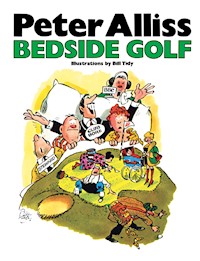
Golf, it has been said, ruins the disposition, hurts the eyes, blisters the hands, ties kinks in the nervous system, debauches the morals, drives men to drink or homicide, breaks up the family, turns the ductless glands into internal warts, induces progressive mendacity and a few other things besides. Peter Alliss disagrees with nine of these. He also finds the game's potential for hilarious mischance one of its most endearing qualities. In Bedside Golf he presents his evidence.
Das E-Book können Sie in Legimi-Apps oder einer beliebigen App lesen, die das folgende Format unterstützen:
Veröffentlichungsjahr: 2015
Ähnliche



















RETRO CLASSICS
is a collection of facsimile reproductions of popular bestsellers from the 1980s and 1990s
Bedside Golf was first published in 1980 by William Collins
Re-issued in 2012 as a Retro Classic
by G2 Rights
in association with Lennard Publishing
Windmill Cottage
Mackerye End
Harpenden
Hertfordshire
AL5 5DR
Copyright © Peter Alliss 1980
ISBN 978-1-909040-32-8
Produced by Lennard Books a division of
Lennard Associates Limited
Editor Michael Leitch
Art Director David Pocknell
Designer Michael Cavers
Back cover photograph Peter Dazeley
This book is a facsimile reproduction of the first edition of Bedside Golf which was a bestseller in 1980. No attempt has been made to alter any of the wording with the benefit of hindsight, or to update the book in any way.
Contents
The Game of Golf
The Commentator’s Box
Members’ Rights
A Sort of Paradise
Heavenly Golf
The Feudal System
Caddies
Golfing Greats
Clubhouse Tales
Seven Ages of a Golfer
The Golf Explosion
A Golfing Fairytale
Municipal Deeds
Woman’s Lot
On the Circuit
Foreign Parts
Celebrity Golf
Clubhouse Clangers
The Game of Golf
t’s a silly game. All games are silly, I suppose, but golf, if you look at it dispassionately, does go to extremes.
Players have to cover a huge area on the ground to carry out something that is really a very pedestrian exercise. And yet the drama and the excitement that golf generates, the sadness and the elation, are there all the time.
Other games have their dramas, of course. But usually those moments are over so quickly. If you take tennis, for instance, it’s all wham, bang, ooh, ah, smash, in the net – and it’s gone. Whereas if you’re watching someone coming down the last hole of a great championship, the suspense can just build and build. The chap paces up and down, gets distracted and walks round and about again. All the while the tension grows. It doesn’t matter how long he takes, there has to be a moment when he must draw back his club and hit the thing. Sometimes the slowness of it is the essence. You may feel like saying: come on, do something. But the game has got you, as well as him, in its grip.
Trevino, to an opponent who has just putted five feet past the hole:
‘You wanna go and hit that now, while you’re still mad?’
I remember Doug Sanders in the Open Championship at St Andrews in 1970. He was in the classic situation. All he had to do was knock the ball in from just under three feet. That was all he had to do. But suddenly he couldn’t do it. He stood over the ball for a long time. Then he bent down to pick up something, a few blades of grass perhaps. Then he stood up and started again. His right shoulder moved forward, and the ball dribbled off to the right of the hole. His great chance was gone. He was forced to play-off with Nicklaus, who beat him.
To me that miss was one of the saddest moments in sport – comparable with Devon Loch collapsing 50 yards from the winning post in the Grand National when it was way ahead of the field; or with Neil Fox in the Rugby League Final missing the match-winning penalty from right under the posts in the last minute.
Since the early days of this century, people have been philosophizing about golf. J H Taylor, who with James Braid and Harry Vardon was one of the great triumvirate of golf in the 1900s, once said:
‘Golf to the man or woman who regards it simply as a game will remain forever insoluble and an enigma: and it will retain its greatness because it contains something which lifts it higher than that of a mere pastime. Golf is more exacting than racing, cards, speculation or matrimony. Golf gives no margin, either you win or you fail. You cannot hedge, you cannot bluff, you cannot give a stop order, you cannot jilt. One chance is given you and you hit or miss. There is nothing more rigid in life and it is this extreme rigidity which makes golf so intensely interesting.’
Taylor touches on another interesting aspect here, which is the honesty that the game demands of its players. There is a story to illustrate this which concerns the great Bobby Jones. He was away in the rough, where no one could see him, and moved the ball in error while lining up his shot. When he came back at the end of his round he declared a penalty stroke, and was astonished when a couple of people suggested to him that it didn’t really matter: if no one had seen him do it, what difference did it make? Jones looked at them as if they were potty. How could he not have declared it – that was Jones’s view. To play the game any other way was unthinkable. In the end, the only person you would be fooling would be...yourself.
Perhaps Bobby Jones’s devilish advocates were under the spell of one of the impressive list of golf-induced ailments isolated by Dr A S Lamb, of McGill University, when he wrote:
‘Golf, it is said, increases the blood pressure, ruins the disposition, spoils the digestion, induces neurasthenia, hurts the eyes, blisters the hands, ties kinks in the nervous system, debauches the morals, drives men to drink or homicide, breaks up the family, turns the ductless glands into internal warts, corrodes the pneumogastric nerve, breaks off the edges of the vertebrae, induces spinal meningitis and progressive mendacity, and starts angina pectoris.’
Sir Walter Simpson apparently thought that the game of golf didn’t screw people up quite so severely. He was more struck by the universal appeal of the game and, many moons ago, wrote this about it:
‘Golf is a game for the many. It suits all sorts and conditions of men. The strong and the weak, the fit and the maimed, the octogenarian and the boy, the rich and the poor, the clergyman and the infidel. The late riser can play comfortably and be back for his rubber of bridge in the afternoon, the sanguine man can measure himself against those who will beat him, the half-crown seeker can find victims, the gambler can bet, the man of high principle may play for nothing and yet feel good. You can brag and lose matches, deprecate yourself and win them. Unlike the other Scotch game of whisky drinking, excess in it is not injurious to the health.’
In a more gentle vein is David Forgan’s description, below. He was a skilled calligrapher, and used to produce charming panels in the style of illuminated addresses. In one he wrote:
‘Golf is a science, the study of a lifetime in which you can exhaust yourself but never your subject. It is a contest, a duel or a mêlée calling for courage, skill, strategy and self-control. It is a test of temper, a trial of honour, a revealer of character. It affords a chance to play the man and act the gentleman. It means going into God’s out-of-doors, getting close to nature, fresh air and exercise, a sweeping of mental cobwebs and a genuine relaxation of tired tissues. It is a cure for care, an antedote for worry. It offers companionship with friends, social intercourse, opportunities for courtesy and kindliness, and for generosity to an opponent. It promotes not only the physical health but moral force.’
The Commentator’s Box
do not think there is a much better way of following golf than on television. True, you miss the involvement and the atmosphere of being at an event, but television allows you to see far more than you would ever be able to follow as a spectator on the course.
At the British Open Championship, for instance, we start at 10.45 in the morning and go through until 7 o’clock, and then show the highlights later in the evening. This blanket coverage might seem idyllic, but there is apparently an unwritten law which says that the more golf you show people, the more complaints you get. ‘Why didn’t you show so-and-so?’ ‘I wanted to see the other match.’ ‘Listen, you stayed with him for 10 minutes and then you switched to him.’ And so it goes on.
The problem at our end is to keep the interest going. This is especially true in head-to-head matches, when one player is clearly winning and there isn’t really enough good material to fill the time allotted. That’s when one gets the urgent voice in the ear:
‘Can you think of something to give it a bit of a lift?’ says the voice.
Inwards groans from the commentator. In America it’s more difficult. Audiences are more fickle, and switch from one channel to another when they think something more exciting is going to happen on the other side. And, because TV people are so ratings-conscious, there’s always that extra pressure to hang on to the viewers for as long as you can. So, if you’ve got a rather flat match, where the viewer thinks he knows who’s going to win, you sometimes find yourself casting around desperately, even thinking, well, God forbid, but if only he’d fall down a hole, or be bitten by a dog, we’d be all right!
Panic can also strike with identifications. You’re looking at your monitor when the producer cuts to a new hole – and suddenly the players aren’t the ones you were expecting. The two you thought would show up have been delayed – perhaps one of them lost a ball – and have been supplanted by two men you’ve never seen before. Panic. Who the hell are they? Perhaps it’s Smith and Brown. According to the programme they would be next. The voice in the ear hisses that it thinks one of them is Smith. It’s the only golf they’ve got at the moment. Do you know anything about them? No. Oh, God. Let’s assume it is Smith and Brown. What does it say in the programme? Name and club. Anything else? No. Probably a couple of little-known young professionals who just managed to quality. Gloom all round. Seconds have passed. Speak. You must speak. In finely modulated, confident tones you say:
‘Interesting match coming up now. Here’s young Smith from Blackburn. Very promising young player.’
It’s not much. But it’s the best you can do, hunched before the monitor in the BBC’s ‘Potting Shed’, as I am inclined to call our commentary box. This architectural wonder, which the Americans find hilarious, is a ‘studio’, usually about 16 to 18 feet long. The builders install a shelf and set three or four TV monitors on them at an angle. Harry Carpenter has one, I have another or share one with Clive Clark, Alex Hay or Mark McCormack – our other major voices! In the middle sits a scorer who keeps a check on what’s happening out on the course.
Harry Carpenter always looks immaculate, at least, the part of him that you see at home. Around his feet are mounds of cable and all kinds of strange gear.




