


4,19 €
Mehr erfahren.
- Herausgeber: G2 Entertainment
- Kategorie: Lebensstil
- Sprache: Englisch
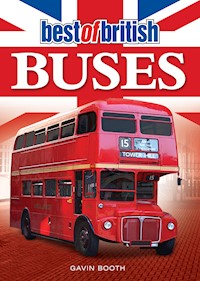
Bus design is often taken for granted, yet from the earliest days of motorbuses coachbuilders have worked hard to produce vehicles that are both attractive and practical. From the 1950s, bus builders and operators have faced the challenges of new shapes and layouts with the widespread adoption of underfloor and rear-engine designs and there was recognition that passengers expected something rather better than a basic bus if they were to leave their cars at home. This new ebook looks at the development and evolution of bus design and covers the years from 1950 to the present day to reveal just how the UK's bus builders have risen to the challenge and produced buses with the elusive 'wow factor'. The book is packed with photographs, many of which are professionally-taken official bodybuilders' or operators' views as these show the many important design features clearly and in detail. These photographs are supported by in-service views, showing the bus in its working environment. This beautifully designed and illustrated book will appeal not only to ardent road transport enthusiasts, but will also be of interest to bus manufacturers and designers, and anyone interested in industrial design.
Das E-Book können Sie in Legimi-Apps oder einer beliebigen App lesen, die das folgende Format unterstützen:
Veröffentlichungsjahr: 2020
Ähnliche

















Contents
1. Introduction
2. Solid and functionalBus design before 1950
3. New looksThe early 1950s
4. Longer and lighterThe late 1950s
5. Styling takes overThe 1960s
6. The spread of standardisationThe 1970s
7. Deregulation and uncertaintyThe 1980s and early 1990s
8. The low-floor revolutionThe years from 1995
Chapter 1
Introduction
There are people who argue that it doesn’t matter what buses look like – bus operators, bus bodybuilders, bus passengers. Buses are, after all, simply boxes providing a means of talking you from A to B and so they should be entirely functional; why on earth should they look attractive as well? In this book you will find examples of buses whose looks apparently owe something to this mind-set.
Fortunately, most operators and bodybuilders don’t think like that and passengers have a right to enjoy the same attention to design and detail as car makers exercise.
Bus design is affected by so many factors – legislation, changing demand, passenger expectation, the economy, the development of new materials and technology – and this book looks at how these have affected the shape and look of buses over the past half-century or so.
More than a century ago, the first motorbuses were practical machines, their bodies owing much to the traditions and skills of coachbuilders who had cut their teeth on horse-drawn buses and trams, and early electric trams. As the motorbus industry grew so did confidence among builders and operators, and soon distinctive designs appeared. Major operators like London General and Midland Red had their own very individual and distinctive views on bus design, and their influence would continue – notably after London Transport had been formed in the 1930s, while Midland Red was a pioneer of several advanced features in the early post-World War 2 years.
For many observers a halfcab double-decker like this 1952 Leeds City Transport AEC Regent III with composite body by Charles H Roe represents the acme of traditional British coachbuilding skills, a teak-framed body designed to blend in with the exposed AEC radiator and featuring gently-curving and well-proportioned lines. After a period when bus body design seemed to lose its way, the importance of good styling is very much on the contemporary agenda.
Although this book concentrates on the post-1950 scene, what was happening then owed much to what had gone before, particularly when World War 2 forced bus manufacturers to put development work on hold – for the best part of a decade, as it would turn out.
The bus is an important part of the street scene throughout the UK and there are designs that have made such a significant contribution to the advances in styling. Views on design are, of course, subjective and it would be surprising if every reader agreed with every one of my views, but I hope readers will accept as a starting-point the importance of combining both function and appearance.
Today there is probably a greater recognition of the ‘wow factor’ in bus design than there has ever been, and we are seeing designers vying to produce buses that have the power to turn heads and attract passengers who may still see buses as cramped, dirty and smelly boxes, and no competition for their private cars.
And by buses I mean service buses, not luxury coaches. Anything, basically, designed to be used on what used to be called stage carriage services. So you may find a few dual-purpose vehicles that are essentially bus shells with more comfortable seats for use on longer-distance, interurban or even express duties, but to do the subject justice I have chosen to ignore vehicles with coach shells that were used on similar duties, or even those relatively few coach shells fitted from new with bus seats.
I have made extensive use of official photographs in this book. In the course of researching various books I have noted the wealth of such photos that resides in the Ian Allan archive. There is something fascinating about official photos, taken obviously to show the bodybuilders’ products off to best effect – for the company records, for the customer and for publicity and advertising purposes. Inevitably these were taken by professional photographers using good-quality equipment – plate cameras in some cases – and bodybuilders had their favoured locations for these. Some posed buses outside the factory doors, while others used a quiet corner of the yard, or a nearby stretch of country road, perhaps in the local park or, curiously, in front of a local stately home. Few, sadly, waited to catch buses in service, but the great advantage of official photos is that they show buses exactly as they were on the day they left the factory, shiny and smelling of new paint and before operators made any adjustments to them. Without the grime of everyday service and the reflections and distractions of street scenes, they provide perfect portraits that will allow readers to understand and appreciate the design features mentioned in the text and captions.
The bus bodies covered in this book were built in the UK. For many years this was inevitable as operators had no need to turn elsewhere for their new buses. Indeed many operators looked to local businesses to supply their buses, and particularly in the case of municipally-owned fleets there were significant implications for local employment and the local economy. You only have to look at Alexander bodies for Scottish operators; the success of firms like East Lancs, Massey and Northern Counties in north-west England; Harkness and its successors in Belfast; Metro-Cammell bodies in Birmingham; Park Royal in London; Roe in Leeds. And on the chassis side, Albions in Glasgow, Daimlers in Birmingham and Coventry, Crossleys in Manchester, and Guys in Wolverhampton.
What was significant was that everything was built in the UK. Although a small number of imported chassis, mainly coaches, had found their way into UK fleets before World War 2, the importance of the bus industry to the postwar UK economy meant that there was little chance of any operator shopping elsewhere. That all changed in the 1960s when Metro-Cammell and Scania combined to challenge Leyland’s dominant market position, and in the early 1970s Volvo started making inroads into the UK, followed by DAF and Scania, working on its own account. Most of the major European chassis builders followed over the next 30 years, but bus body building remained firmly in the UK.
Coach operators started to turn to the products of coachbuilders from continental Europe, particularly in the 1980s when they grew tired of the designs, or the durability, of bodies from the two main UK suppliers, Duple and Plaxton. Some of these builders produced small batches of bus bodies for UK operators, but it was the late 1990s before any significant inroads were made.
Vehicle dimensions and weights are initially expressed in the contemporary style, so the 1961 change in dimensions permitted 36ft x 8ft 2½in vehicles, while the 1967 change permitted 12m-long buses.
Vehicle dimensions and weight have played a crucial part in the way buses have looked and how they were built. From 30ft-long (9.1m) single-deckers in 1950 and double-deckers in 1956, buses grew to a maximum of 36ft (11m) from 1961 and 12m (39ft 4in) in 1967, and in line with EU standards from 2003 could be up to 13.5m (44ft 3in) on two axles, 15m (49ft 2in) on three axles and 18.75m (61ft 6in) for articulated vehicles; previously artics were limited to 18m (59ft 1in). Not every manufacturer or operator rushed for buses to the new maximum lengths, but some did. With the 2003 changes there has been less of a rush towards longer buses, though some
Although this book concentrates on the post-1950 scene, what was happening then owed much to what had gone before, particularly when World War 2 forced bus manufacturers to put development work on hold – for the best part of a decade, as it would turn out.
The bus is an important part of the street scene throughout the UK and there are designs that have made such a significant contribution to the advances in styling. Views on design are, of course, subjective and it would be surprising if every reader agreed with every one of my views, but I hope readers will accept as a starting-point the importance of combining both function and appearance.
Today there is probably a greater recognition of the ‘wow factor’ in bus design than there has ever been, and we are seeing designers vying to produce buses that have the power to turn heads and attract passengers who may still see buses as cramped, dirty and smelly boxes, and no competition for their private cars.
And by buses I mean service buses, not luxury coaches. Anything, basically, designed to be used on what used to be called stage carriage services. So you may find a few dual-purpose vehicles that are essentially bus shells with more comfortable seats for use on longer-distance, interurban or even express duties, but to do the subject justice I have chosen to ignore vehicles with coach shells that were used on similar duties, or even those relatively few coach shells fitted from new with bus seats.
I have made extensive use of official photographs in this book. In the course of researching various books I have noted the wealth of such photos that resides in the Ian Allan archive. There is something fascinating about official photos, taken obviously to show the bodybuilders’ products off to best effect – for the company records, for the customer and for publicity and advertising purposes. Inevitably these were taken by professional photographers using good-quality equipment – plate cameras in some cases – and bodybuilders had their favoured locations for these. Some posed buses outside the factory doors, while others used a quiet corner of the yard, or a nearby stretch of country road, perhaps in the local park or, curiously, in front of a local stately home. Few, sadly, waited to catch buses in service, but the great advantage of official
Chapter 2
Solid and functional
Bus design before 1950
Before we start we need to look back to consider the design of pre-1950 buses in some detail. Motorbus design evolved in the early years of the 20th century, but it took a handful of farsighted visionaries to move things up a notch.
There is a clear sense of function when you look at iconic designs like London General’s B type, built between 1910 and 1919. Here is a bus that today looks as anachronistic as pre-1920 motorcars do, but for a bus industry still finding its feet in an uncertain world there is no doubt that for all its rugged high-built looks, it is a well-balanced design. There are still echoes of the horsebus with the driving position outside the main body, exposed to the elements, and the high frame, and although closed-top tramcars had been around in the UK since the early part of the century the high centre of gravity of the B type didn’t lend itself to the extra weight of a roof for the upper deck.
London was by far the main market for double-deck buses at that time and London designs were often all that was available for customers in the rest of the UK. The over-cautious Metropolitan Police prevented London’s designs from developing organically and so top-covered double-deckers were only permitted in London from 1925, driving cabs with glass windscreens from 1927, and pneumatic tyres from 1929. The rest of the country, beyond the control of the Metropolitan Police, had adopted these improvements rather earlier.
London General nearly cracked it with the NS type in 1923, which incorporated the best features of its predecessors. It was low-built so passengers could climb aboard more easily; it should have had a covered top and driver’s windscreen from new but it would be four years before NSs took to the road in their intended form, and they had to wait another two years for permission to fit pneumatic tyres.
London had decided at an early stage that double-deckers were the answer to keeping the city moving and so its influence on single-deck design in the 1920s was rather less. It took manufacturers, notably Dennis, Leyland and Maudslay, to realise that low-built chassis were the answer and at a time when bodybuilding was often very much in the hands of firms situated close to bus operators, there were few designs that could be seen throughout the UK. One design that challenged this was the Leyland Lion PLSC model, low-built and designed to run on pneumatic tyres, which could be found in many fleets. While the Lion inspired a short-lived ‘look’ it would quickly appear dated when the even lower-built and sleeker designs of the late 1920s came along. These – most notably the AEC Regal and Leyland Tiger ranges – gave bodybuilders the confidence to develop sturdy and stylish designs that would set the pattern for the next 5-10 years. AEC and Leyland also made the running in double-deck design with their low-built Regent and Titan models.
The first properly designed motorbus was the legendary London General B type, built between 1910 and 1919, but it is clear that the main passenger-carrying area still owed much to horse bus practice. The chassis is high-built, with deep steps leading to the interior and to the rear-mounted staircase. The upper deck passengers have no cover from the elements, but the driver at least has a canopy to shelter under. The B type was 19.1ft long with seats for 34 passengers, and weighed 4tons unladen. Although it looks crude by modern standards, the B type was a successful bus and paved the way for a long series of own-design buses for London service.
The London General NS type gradually gained the various refinements that were initially opposed by the Metropolitan Police. This later example dating from 1928 has a covered top and pneumatic tyres, but the driver is still out in the open. The low platform will be noted. The 52-seat NS was 26ft long and weighed 6.25tons unladen.
The great majority of buses in the 1930s were front-engined and just as what was under the bonnet was changing dramatically as diesel engines became the norm and manufacturers like AEC and Daimler offered preselective gearboxes to ease the driver’s lot in urban traffic, the shape of buses was being transformed.
Covered-top double-deckers were de rigueur by the mid-1930s and the top deck was creeping forward over the driver’s cab. Although some operators toyed with forward-mounted entrances, most notably London Transport, Midland Red and Trent, an open rear platform was by far the most common entrance layout; although Leyland’s mould-breaking Titan TD1 was launched with an open rear staircase, the stairs quickly became enclosed in the overall box shape of the bus.
Single-deck buses were less clear-cut on entrance position. The forward entrance, just behind the front axle, was most common but there were significant operators who favoured rear entrances. This was a time when major groups developed their own recognisable styles, sometimes built for them by a range of bodybuilders.
But bus design has never stood still and in the 1930s chassis manufacturers were looking at pushing the envelope. AEC’s side-engined Q, built in single-deck and double-deck form in the 1930s, gave a glimpse of what future generations of bus might look like. London Transport was the major customer for the Q and later worked with Leyland to produce two unusual types, the underfloor-engined TF Tiger and the rear-engined CR Cub. Interestingly, both designs retained the halfcab layout of their front-engined brothers, unlike the Q where bodybuilders eventually rose to the challenge of a full-fronted design.
The technical lessons learned from the Q, TF and CR types would resurface in the postwar years and it is fair to say that, had World War 2 not intervened and stopped normal development, underfloor- and rear-engined designs would have been with us some years before they actually became common.
The first motorbuses were timber-framed, just as horsebuses and contemporary electric trams were, and skilled craftsmen fashioned shapes from hard woods that gave buses subtle curves and meant that they were sturdy and safe. The exteriors were initially panelled in wood, but by the 1920s the use of sheet metal had become widespread, and this technique allowed for easy repair and replacement. In the late 1920s and early 1930s, at the same time as pioneering experiments with diesel engines and epicyclic gearboxes were taking place, bodybuilders were exploring metal-framed bodies and from the early 1930s manufacturers like Short Bros and Metro-Cammell were building metal-framed bodies in increasing quantities. Greater use had been made of aluminium alloy following World War 1, but normally only for body panelling; the use of aluminium for body framing would come later. For most bodybuilders the greater use of metal allowed them to streamline their processes as accurately-sized parts could be produced for easier assembly. Metal-framed bodies, it was argued, could be lighter, stronger and more durable, and safer in the case of accidents or fires.
Some builders and operators preferred to stick to timber-framed bodies, and this would be the situation during and in the years following World War 2, and timber-framed bodies clad in metal panels, and often with considerable metal reinforcement of the timber framing, became known as composite bodies. The term ‘all-metal’ was used for many of the early bodies that were strictly metal-framed, usually in steel, with aluminium panelling and with some wood content, typically for floors, for inserts in pillar sections and for interior finishing.
Among the British bodybuilders that started offering metal-framed bodies in the 1930s were Alexander, Brush, Cowieson, Crossley, English Electric, Leyland, Northern Counties, Park Royal, Roe and Short Bros. Some continued to offer composite or metal bodies, while Roe customers tended to prefer its famously well-built teak-framed composite bodies for some years to come.
Some builders got metal-framed bodies right first time, while others, notably Leyland, experienced problems with early examples. During World War 2 the basic Ministry of Supply specification for utility bodies called for composite construction, but Northern Counties was allowed to produce steel-framed bodies that often lasted longer than contemporary bodies built using poor-quality unseasoned timber.
In the 1930s there were attempts by operators and bodybuilders to create a more modern look, with full-fronted buses and buses that broke away from the essentially box-like shape of the bus with attempts at streamlining, which was very much in vogue at the time. Manchester Corporation’s streamline design is probably the best remembered – and arguably most successful – of these.
But for many, full fronts and streamlining belonged on luxury coaches, and while double-deck buses were essentially functional machines there was no reason why they should not look well-proportioned and handsome.
London Transport – again – led the way with classics like its ultimate 1935 STL design and Leyland’s 1938 body on its Titan TD5 chassis is another timeless style. The Leyland body style fitted to the TD5 and TD7 reappeared after the war fitted to the new Titan PD1 and PD2 chassis and provides a link between the 1930s and the 1950s.
The Leyland Lion PLSC Lion represented an advance for many operators with its low build and distinctive body style. This Leyland-bodied PLSC1 example was new to Ribble in 1926 and shows the two shallow steps to the saloon and the fully-enclosed body.
The Leyland Titan TD1 really established the proportions of double-deckers for the next 30-40 years, with its low build and clean lines. The ‘piano-front’ profile over the driver’s cab was a recognition feature – previously the upper deck on most double-deckers stopped behind the front axle. This Crosville 1930 example, seen in wartime guise, lasted in service until 1953.
Another design that stood the test of time was the London Transport single-deck 5Q5 type, built by Park Royal on AEC Q chassis in 1936. Unlike the bodies on LT’s other Qs, the 80 5Q5s had entrances ahead of the front axle, a layout that would become very familiar on single-deckers some 15 years later.
And London Transport was also responsible for a design classic that would influence the look of new buses for the next 20 years, the RT type built on AEC Regent chassis and introducing a look that others would strive to copy – a low-built radiator with deep driver’s windscreen, lines that flowed and the whole bus looking as if it had been designed from the ground up – as indeed it had been at London Transport’s legendary Chiswick Works – rather than assembled using what was in the body parts bin. The first RTs had been built in 1939 and when production was forced to finish at the end of 1941, 151 had been built.




