


0,00 €
Mehr erfahren.
- Herausgeber: transcript Verlag
- Kategorie: Geisteswissenschaft
- Serie: Critical Studies in Media and Communication
- Sprache: Englisch
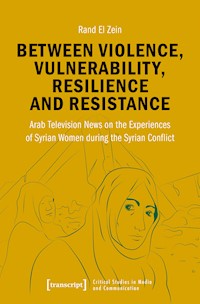
How are the structures of power and the notion of agency among Syrian women during the recent Syrian conflict connected? To explore this matter, Rand El Zein investigates gender politics around displacement, conflict, the body, and the nation. In doing so, she outstandingly reconciles critical media theory as myriad and productive with the theoretical concepts on subjectivity, power, performativity, neoliberalism, and humanitarian governance. The book examines how the Arab television news discursively represented the experiences of Syrian women during the conflict in relation to the four main concepts: violence, vulnerability, resilience, and resistance.
Das E-Book können Sie in Legimi-Apps oder einer beliebigen App lesen, die das folgende Format unterstützen:
Seitenzahl: 340
Veröffentlichungsjahr: 2021
Ähnliche



















Editorial
The series is edited by Elke Grittmann, Elisabeth Klaus, Margreth Lünenborg, Jutta Röser, Tanja Thomas and Ulla Wischermann.
Rand El Zein, born in 1991, is a researcher from Beirut, Lebanon. She received her PhD in Communication Studies at Universität Salzburg and her MA in Media Studies at the American University of Beirut. Her research focuses on Arab media, feminist theory, and cultural studies.
Rand El Zein
Between Violence, Vulnerability, Resilience and Resistance
Arab Television News on the Experiences of Syrian Women during the Syrian Conflict
Diese Publikation wurde im Rahmen des Fördervorhabens 16TOA002 mit Mitteln des Bundesministeriums für Bildung und Forschung im Open Access bereitgestellt.
Bibliographic information published by the Deutsche Nationalbibliothek
The Deutsche Nationalbibliothek lists this publication in the Deutsche Nationalbibliografie; detailed bibliographic data are available in the Internet at http://dnb.d-nb.de
This work is licensed under the Creative Commons Attribution-ShareAlike 4.0 (BY-SA) which means that the text may be remixed, build upon and be distributed, provided credit is given to the author and that copies or adaptations of the work are released under the same or similar license. For details go to http://creativecommons.org/licenses/by-sa/4.0/
Creative Commons license terms for re-use do not apply to any content (such as graphs, figures, photos, excerpts, etc.) not original to the Open Access publication and further permission may be required from the rights holder. The obligation to research and clear permission lies solely with the party re-using the material.
First published in 2021 by transcript Verlag, Bielefeld © Rand El Zein
Cover layout: Yara Abdallah, Beirut, and Maria Arndt, Bielefeld
Proofread: Marie Frohling
Printed by Majuskel Medienproduktion GmbH, Wetzlar
Print-ISBN 978-3-8376-5959-7
PDF-ISBN 978-3-8394-5959-1
EPUB-ISBN 978-3-7328-5959-7
https://doi.org/10.14361/9783839459591
ISSN of series: 2512-4188
eISSN of series: 2747-3937
Printed on permanent acid-free text paper.
Contents
Acknowledgements
1.Introduction
1.1Context and Significance
1.2A Brief History of Television News in the Arab World
1.3The Syrian Conflict as a Case Study
1.4Structure of the Book
2.Theoretical Framework
2.1Vulnerability, Resistance, and the Dependency on Infrastructure
2.2Power and Different Modes of Violence
2.3Defining Resilience in Neoliberal Times
2.4Resistance, Agency, and the Non-liberatory Subject
3.Methodology
3.1Perspective on Language and Discourse
3.2A Critical Approach to Discourse Analysis
3.3Units of Analysis
3.3.1The Sample Selection
3.3.2The Selection of Dominant Themes
3.3.3The Analysis Process
3.4Methodological Questions on Agency and Points of Reversibility
3.5Methodological Reflections
4.Arab Television News Coverage of Former Female Syrian Prisoners in Exile: The Intersection of Shame, Violence, and Stigma
4.1Introduction
4.2Research Data
4.3Analysis
4.3.1Imprisonment, Sexual Assault, and Controlled Mobility
4.3.2From Being Shamed to Being Silenced
4.4Conclusion
5.Rethinking the Relationship between Child Marriage and Failed Infrastructure during the Syrian Conflict
5.1Introduction
5.2Research Data
5.3Analysis
5.3.1Child Marriage
5.3.2Failed Infrastructure
5.4Conclusion
6.Displaced Syrian Women at Work:Everyday Resilience and the Neoliberal Subject
6.1Introduction
6.2Research Data
6.3Analysis
6.3.1Talking to Good Resilient Subjects: Displaced Syrian Women Erasing the Past or Painting it through their Work
6.3.2Training the Good Resilient Subject: A Survey of News Reports on Displaced Syrian Women Participating in Vocational and Cash-for-Work Programs and other blue-collar Jobs
6.4The Notion of Resilience in a Humanitarian Discourse
6.5Conclusion
7.‘Mothers of the Nation’: The Ambivalent Role of Motherhood in Assad’s Syria and the Non-liberatory Subject
7.1Introduction
7.2Research Data
7.3Analysis
7.3.1From Manly Fighters to Ornamented Flowers
7.3.2Motherhood as a National Duty
7.3.3Reflecting on other News Stories
7.4Motherhood in Relation to Agency
7.5Conclusion
8.The Construction of Syrian Women in the Arab Television News
8.1Normalizing Violence and Reaffirming Victimhood in the Television News
8.2Humanitarian Reasoning and Personal Testimonies in the Television News
8.3Questions on Agency and the Dynamics of Shame, Fear, and Dignity in the Arab Television News
9.From Dominant Media Frames to Spaces of Appearance
9.1Television Ownership: Biases and Blind Spots
9.2The Dominant Media Frames and the Procedures of Media Reporting
9.3The Mediated Figure of the Syrian Woman at the Forefront of Geopolitical Tensions
9.4The Intersection of Media Logic, Gender Logic and War Logic in Television News Narratives
9.5A Feminist Logic by Spaces of Appearance?
10.Concluding Remarks
Bibliography
Dedicated to every woman who is grappling through life and refuses to kneel down. Thank you for your strength, thank you for your resistance, but more importantly, thank you for embracing your vulnerability.
“I am my mother’s daughter, which means on days when the world hurts, but I have things to do, I tell it to come back tomorrow.” – Maysan Nasser
List of Tables
Table 1. Keywords for the main concepts
Table 2. Initial sample of news reports
Table 3. Final sample of news reports
Table 4. Main Concepts and Manifestations
Table 5. News reports in the context of violence
Table 6. News reports in the context of vulnerability
Table 7. The news reports in the context of resilience
Table 8. A comparison: the different roles of women towards the nation
Table 9. The news reports in the context of resistance
Table 10. Main findings: dominant media frames and procedures of media reporting
Acknowledgements
I would like to first of all thank my mentor, Prof. Dr. Elisabeth Klaus, for her guidance, advise, expertise, and ecouragement throughout this project as well as my entire PhD experience. Watching her build and lead the doctorate school (DSP) for geschlecht_transkulturell at Universität Salzburg has been one of my best learning experiences. Her mentorship has helped lead me to an area of scholarship that I am genuinely looking forward to continue working in.
I would like to thank the members of my committee, Prof. Dr. Sigrid Kannengieße, Prof. Dr. Kyoko Shinozaki, and Prof. Dr. Rudolf Renger, for their interest, contribution and input. I would also like to acknowledge the support I’ve received from the gendup (Zentrum für Gender Studies and Frauenförderung) and especially the Marie Andeßner Stipendien, as well as the One World Scholarshop at the Afro-Asiatisches Institut. A great thank you to the editors at Transcript Verlag for suggesting to publish my work, and to every person that helped make this publication possible. . My deepest gratitude goes to my mother, my late father and Patrick for their unconditional support, constant care and their belief in me.
1.Introduction
1.1Context and Significance
This book brings together two main fields of interest: communication studies and gender studies. It explores the relationship between power structures and the notion of agency among Syrian women during the recent conflict in Syria. The book poses questions on gender politics in the context of displacement, conflict, the body, and the nation. Its significance lies in its attempt to reconcile critical media theory as myriad and productive with the theoretical concepts on subjectivity, power, performativity, neoliberalism, and humanitarian governance.
Methodologically, the book introduces a research project that employs an inductive approach and uses a critical discourse analysis of Arab television news. Considering each television station’s sociopolitical views and media ownership structures, I examine 32 television news reports aired between Jan 9, 2012 and Sept 27, 2018, from seven leading Arab television news stations: SAMA, SANA, Syria Al Ikhbariah, Al Jazeera, Al Arabiya, Al Aan, and RT Arabic. I explore how the dominant media discourses in the news discursively represented the experiences of women during the Syrian conflict. In the Arab television news, these experiences are frequently addressed in the context of the four main concepts: violence, vulnerability, resilience, and resistance. Therefore, in order to recover the meanings, the news producers give to the practices of representation, I propose a theoretical framework that provides a thorough understanding of the four main concepts and the social, political and cultural meanings they have in the context of the Syrian conflict.
By tracing the practices of representations in the news reports, the book exposes how the figure of the Syrian woman in television news was constructed in five dominant media frames:
a)Women as a source of shame
b)Women as victims of their previous imprisonment
c)Females as destined child brides
d)Women as the neoliberal subject
e)Women as mothers of the nation
I draw a connection between the television media frames and the cultural meanings and language disseminated in the media narratives; I then use this connection to trace the hegemonic discourse in the news reporting.
The hegemonic discourse is traced by examining how the production of the message was carried out by seven different procedures of media reporting:
a)The circulation of shame
b)Stigmatizing the female victim
c)De-humanization by misrecognized female desire,
d)Sentimental de-politization,
e)Strategic silencing
f)De-historicization
g)Nationalizing the female body
By presenting these findings, I expose how the Arab television news naturalized the suffering and precariousness of Syrian women during the conflict, on the one hand, and misrepresented and/or ignored their agentive attempts, on the other hand. The findings also show how the Arab television news either glorified the Syrian women’s agency by depicting them as strong and resisting subjects fighting in the war or represented them as hopeless victims to the widespread outbreaks of violence and social and economic injustice during the conflict. I tackle those dichotomous images by situating this work in relation to previous work from the media, gender, and cultural studies disciplines. I use Judith Butler’s concept of vulnerability and resistance as a main starting point for my research and borrow Michel Foucault’s ideas on discourse, power, governmentality, and the subject, as well as Saba Mahmoud’s thoughts on reading agency beyond liberal politics.
In defining a conception of vulnerability, Judith Butler (2016) compares masculine and feminine ideals. She observes how the ‘masculinist’ model of acquiring agency is implied and practiced when one attempts to overcome a perceived vulnerability. Butler asserts that this ‘masculinist’ model should be challenged, positing that effective resistance comes from mobilizing vulnerability rather than overcoming it. By way of example, mobilizing vulnerability could take the form of a vulnerable subject purposefully walking through dark streets, thereby acknowledging and confronting the possibility of harm. This exposes the subject to risks, biopolitical threats, and violence. Despite this, the subject insists on moving, crossing borders, and defying checkpoints and controls. In this way, mere existence becomes a manifest act of resistance.
This same conceptualization explicates how, during times of conflict, vulnerability is directly tied to infrastructure. Both infrastructure itself and resistance to infrastructural challenges may take myriad forms: In the case of a single mother who has become displaced in a foreign country along with her children, resistance may include demands for clean water, the right to work, a safe shelter with a locking door, a running toilet, or education for her or her children.
The representations of these realities within the context of the Syrian conflict were vastly perpetuated by Arab television news. Given this context, what captures my interest is the manner in which Arab television news construct the subjects’ experiences or struggles during this violent conflict and how they were represented, framed and communicated in relationship to power, gender, and class. Throughout the scope of this research project, I have looked at what has been perpetuated and reproduced in the Arab television news and what has been left unreported and decontextualized from the socio-political circumstances the subjects inhabit.
I address these questions and challenges by pointing towards the complexity of the notion of agency among different groups of Syrian women and how it has been articulated in the dominant media discourses through the intersection of media logic, gender logic, and war logic. Rather than limiting the analysis to whether the news reports represented the figure of the Syrian women through stereotypical gender roles or provided realistic depictions of their experiences, this book complicates notions of power, subjectivity, and agency circulating within and around the television images. Thus, the question of the subject’s agency is always at the center of the news report analysis, as I examine how relations of power operate through the television representations of the subjects.
1.2A Brief History of Television News in the Arab World
A significant factor to consider when analyzing news coverage from Arab television news is the presence of a unique television media landscape that involves diverse media ownership structures.
Until the 1990’s, “mass media in the Arab world were still vastly censored by authoritarian regimes. Arab television stations suffered from a lack of credibility among viewers, who perceived broadcasting as a ‘mere’ propaganda machine for the ruling elite” (Sakr, 2007, p. 10). In this context, the ruling elites are the Arab regimes. Gunter and Dickson (2013) asserted that:
“[Arab Television] broadcasters were subservient to government information ministries... TV was conceived as a national resource that could be utilized for the betterment of the nation. Most TV services were funded entirely by governments and were in consequence seen as an extension of them” (p. 4).
Today, the television media landscape looks different; it is now characterized by a more diversified range of television broadcasters that operate outside or with less government control. Although government-controlled television broadcasting services remain in operation, the launch of Al Jazeera in 1996 changed the entire television media landscape (Kraidy, 1998). Financed by Sheikh Hamad bin Khalida Al Thani, Al Jazeera was the first pan-Arab television station to bring “proper investigative journalism” in the Arab world (Sakr, 2007). It was considered a pioneer for introducing “concepts like democracy and human rights…and demolishing social, political and religious taboos” (Miles, 2017). It also “drastically pushed back the boundaries of free speech” (Miles, 2017). With the motto “The opinion and the counter-opinion,” Al Jazeera is known for its vast coverage of wars and its criticism of Arab regimes (Kraidy, 2002).
For instance, when the war in Iraq broke out in 2003, Arab audiences across nation states were able to watch the bombing of Baghdad and the live portrayal of human causalities through the lens of Al-Jazeera rather than those of CNN.1 For the first time, 24-hour coverage of the war was being provided from a pan-Arab perspective, and Arab audiences did not have to rely on Western television broadcasting to get live updates on the escalating events (Mauer, 2013). Al Jazeera became a game-changer, as Arab audiences became acclimatized to a different type of news coverage. This eventually led to the emergence of more privately owned as well as transnationally operated Arab television stations (Gunter & Dickson, 2013, p. 5). For instance, pan-Arab television stations, such as Al Arabiya and Al Aan, were founded after Arab Gulf States “recognized these wider audiences’ needs and relaxed some editorial controls allowing these services to enjoy greater freedom” (Gunter & Dickson, 2013, p. 6).
Another significance of Al Jazeera was its introduction of political and social talk shows that discussed a wide range of topics such as social taboos and women’s rights in the Arab world. The station’s “given financial resources and regulatory freedom” made it possible to “foster an open debate of difficult issues [and] enhance civil society in the Arab world” (Gunter & Dickson, 2013, p. 11). This gave Al Jazeera global recognition, as it was able to compete with other major western news broadcasters.
However, after the outbreak of the Syrian conflict, Al Jazeera received criticism from journalists and its former employees for providing unfair and biased coverage of the conflict. Its political agenda became fundamentally supportive of the Free Syrian Army. It also started providing a biased coverage of the war, favoring the Islamists in Syria while demonizing the Syrian government. This led many Al Jazeera staff member to resign (RT News, 2012).
A number of academic studies have shown that Al Jazeera’s news production tends to “embrace sensationalism,” as it “uses glossy production formats to stand out from other Arab news broadcasters” (Ayish, 2002; Falk, 2003; Gunter & Dickson, 2013 p. 12). However, the same holds true for Al Arabiya, a for-profit news network that partly relies on advertising revenue to operate (Pavlik, 2016). Al Arabiya, a major competitor of Al Jazeera (Cablegate, 2012), operates from Dubai and is funded by “the brother-in-law of Saudi Arabia’s King Fahd, with additional investment from Lebanon’s Hariri Group and investors from Saudi Arabia, Kuwait, and other Gulf countries” (Najjar, 2018). This indicates that different political elites finance the pan-Arab television station.
Another Arab news station is Al Aan, which is based in Dubai Media City. The station is under the ownership of a holding group called Tower Media, and it is known to be targeted to Arab women. It is politically leaning against the Syrian regime and is supportive of the United Arab Emirates government (Sakr, 2007). With the start of the Syrian conflict, the UAE became a vocal opponent of Hezbollah and Iranian leaders (the political allies of the Syrian regime), as it stood “firm with the Kingdom of Saudi Arabia against Iranian attempts to interfere in the internal affairs of the Arab States’ (United States Institute of Peace, 2015; from Almezaini & Rickli, 2017).
Al Jazeera, Al Arabiya, and Al Aan are not predominantly perceived as government propaganda mouthpieces for the Qatar, Saudi Arabia, and UAE governments respectively, but rather as pan-Arab television stations that try to appeal to diverse set of Arab-speaking audiences. Arab news stations, such as SANA, Syria Al Ikhbariya, and SAMA, are considered less pan-Arab television stations and more regime propaganda tools. For instance, the television station SANA (the Syrian Arab News Agency) is the state-owned Syrian television station operated by the Assad regime. It was established in Damascus in 1965 and “is linked to the Ministry of Information” in Syria (Web.archive.org, 2011). SAMA and Syria Al Ikhbariyah are regime-controlled and essentially reinforce regime policies and report positively on the government performances. Syria Al Ikhbariya is known to be loyal to the Syrian president Bashar al-Assad (Herald Sun, 2012). As for SAMA, this television station started broadcasting in Damascus in 2012 and is the “sister channel of AddouniaTV,” a “mouthpiece of the Syrian government”(Dunham, 2011).
Another Arabic-speaking television news station relevant to this research project is RT Arabic. It is a television station “controlled by the Russian state and funded by the federal tax budget of the Russian government” (Atlantic Council’s Digital Forensic Research Lab, 2018). It was launched in 2005 under the name of Russia Today and reports on international news in English,Spanish, French, German, Arabic, and Russian. Due to its funding source, RT reports with biased journalistic standards of Russian government narratives (Benkler, Roberts & Faris, 2018). Throughout the Syrian conflict, the Russian government has supported the Assad regime politically, contributing with military aid, as well as launching a direct military involvement in the proxy war in Syria (Charap, Treyger, & Geist, 2019). This gives RT Arabic’s news coverages of the Syrian conflict greater significant to the research topic at hand.
Furthermore, it is important to note that the financing source is not the only factor that influences news production. Recent studies have shown that television media discourses on armed conflict are heavily relying on non-governmental organizations (NGOs) for news sources. This gives humanitarian workers present on the ground the role of the reputable experts who are able to provide immediate updates on the situation. At the same time, news outlets are able to receive information without having to send their own journalists to dangerous war zones. The increased dependency on humanitarian organizations to acquire information on the latest events in war zones and refugee camps may influence and shape the public media discourses (Meyer, Sanger, & Michaels, 2017).
Therefore, this research project not only looks the at media ownership of the television stations: it also acknowledges how the growing reliance on NGOs and other experts has influenced the television news coverage of the Syrian conflict.
1.3The Syrian Conflict as a Case Study
What renders the case study of the Syrian conflict a significant one to tackle is the plurality of international actors and regional interests within it, as well as the changing gender realities lived by the internally and externally displaced Syrian communities.
The Syrian conflict began with the 2011 uprising. By late summer 2012, it had escalated into a violent proxy war (Rogers, 2012). The conflict is considered one of the most devastating battles in recent history. Between 2012 and 2013, it caused “about half of all war casualties around the world” (Dupuy & Rustad, 2018). Many powerful regional and international players are involved. The main national fighting actors are the Syrian regime, the Islamic State of Iraq and Syria (ISIS), as well as the Syrian Opposition armed groups that include the Free Syrian Army (FSA), and Islamic brigades, such as Harakat Ahrar al-Sham al-Islamiyya, Jeish Al-Islam, Liwa al- Tawhid, Al Nusra Front (Alsaba & Kapilashrami, 2016). Each actor, unique in its military structure, holds different political views and goals. Moreover, each actor has a different coalition with an international player, who is also a regional power in the proxy war. Alsaba and Kapilashrami (2016) explain the complexity and plurality of these coalitions:
“... Turkey, Qatar, and Saudi Arabia, ... continue to be main sponsors of the fighting actors and [they] use substantial religious and sectarian discourses to justify political involvement. This intersection between ideologies is resulting in a fanatic discourse, which impacts trends of violence in general and against women in particular. In addition to the regional support to the Opposition armed groups, international support comes from the USA, France and the UK... In addition, the Syrian government depends on regional parties like Hezbollah, and Iraqi and Iranian militias, and internationally mainly on Russia... The Kurdish Democratic Union Party (PYD), and the Islamic State of Iraq and Syria (ISIS) have entered the conflict scene more recently...” (p. 6).
This demonstrates how the Syrian conflict is unstructured in nature and has a plurality of international actors and regional interests acting within it.
Granted, the conflict led to intensified levels of violence and a huge number of displacements in the Syrian population (Roger, 2012). “More than 95,000 Syrians have disappeared since March 2011” (The Independent, 2018), while many Syrian women and men continue to flee from areas that were and continue to be dominated by violence. There has been an increase in “torture and acts of sexualized violence committed against women, men, and children in Syria” (Unmüßig, 2016). These “systematic acts of torture are committed inside prisons” by the Assad regime, while anti-regime groups and ISIS members have committed “sexualized violence against women…as one of the main forms of torture” (Unmüßig, 2016). Other brutal war tactics of gender-based violence include “military sexual slavery and forced prostitution” (Alsaba & Kapilashrami, 2016, p. 5). These tactics are used as tools of political repression. Hence, violence against women is being normalized in Syria, along with forced recruitments by militias, forced early marriages, and forced detentions (Alsaba & Kapilashrami, 2016, p. 7).
The mainstream media tend to represent these forms of violence as a uniform experience among all women in Syria. In reality, however, women living across diverse Syrian regions controlled by different fighting groups such as the Syrian regime, the Islamic State of Iraq and Syria (ISIS), and the Syrian Opposition armed groups, are experiencing violence differently (Szanto, 2016). For example, women living in geographical areas controlled by ISIS are facing enforced disappearance, abduction, and enslavement (Alsaba & Kapilashrami, 2016, p.10). On the other hand, women living in Kurdish controlled areas are forced into military recruitments, while women living in those controlled by Syrian opposition have to live under the oppressive ideological doctrines of certain militant groups and are forced into marriages and other arrangements (Alsaba & Kapilashrami, 2016, p. 12). In general, Syrian women caught in the conflict continue to be perceived as assets and treated as commodities in conflict zones, at checkpoints, and in detention centers (Alsaba & Kapilashrami, 2016, p.10).
After many Syrian communities became displaced in the countries bordering Syria, an increase in child marriage cases has been recorded (El Arab & Sagbakken, 2018). A study by the Norwegian Refugee Council (2019) showed that:
“In Jordan…12 per cent of registered marriages involved a girl under the age of 18. This figure had risen to 18 per cent in 2012, 25 per cent in 2013 and 32 per cent by early 2014. In Lebanon …41 per cent of young displaced Syrian women between 20 and 24 years were married before they turned 18. Given that many marriages are unregistered, these figures may, in fact, be understating the actual rates” (Høvring, 2019).
Moreover, internally displaced Syrian girls inside Syria are very likely facing the same problems; however there has been “limited data about the situation inside the country” (Høvring, 2019). All these changes have heightened the vulnerability of Syrian women and girls.
With more violence and ambiguity shaping the daily lives of displaced Syrian women, everyday forms of resilience emerged. For instance, entering a polygynous marriage has become a survival strategy among displaced Syrian women living in refugee camps (Herwig, 2017). Herwig (2017) asserted that,
“… we should not simplify the decision to enter a religious polygynous marriage by always labelling it ›forced‹, thereby leaving no room for agency or resistance. This simplification diminishes the actions that some women take to secure the welfare of their family and improve their situation… Although some women enter very consciously in a polygynous marriage to support themselves and their family or to be less targeted by other men, one should not hold them responsible for the possible negative consequences: an agent can be a victim; a victim can be an agent” (p. 188).
In other words, even though this survival strategy can prove effective, polygynous marriages undoubtably reproduce patriarchal structures of normativity. Nonetheless, this does not necessarily indicate that women who enter those marriages are entirely lacking agency.
Furthermore, with more severely injured Syrian men and others being imprisoned or disappearing, more Syrian women have taken up jobs that were predominantly reserved for men in pre-conflict Syria. Thus, many Syrian women have become the main breadwinners of their households, shifting many traditional gender roles in Syrian culture. However, the shift to a female-led household does not necessarily translate to more equal opportunity among the men and women (Hilton, 2019).
Because a large part of Syria’s population is currently displaced in refugee camps in countries bordering Syria, namely Lebanon, Jordan and Turkey, humanitarian organizations have implemented many resilience-building projects to help Syrian women generate income and financially support their families. These so-called entrepreneurship and skill-building programs are usually tailored to specific purposes, such as women’s empowerment and poverty alleviation, particularly for displaced Syrian women, who find difficulty obtaining a work permit in the host country.
Although these programs can help displaced Syrian women find a job opportunity, they nevertheless have several disadvantages. Alkhaled (2018) writes:
“Historically, feminized industries have been illustrated as a vehicle for women’s empowerment and an alleviator of socioeconomic constraints, both domestically and within their community in the Arab region. However, reflecting on the literature, which emphasizes the “darker sides” of women’s entrepreneurship in contexts of inferiority, it becomes evident that [displaced Syrian women] [are] caught in an entrepreneurial ecosystem that may offer survival, but is not sustainable in the current climate” (p. 250).
Thus, even when programs are successful at integrating displaced Syrian women in the local labor market and perhaps boost the local economy on the long run, many displaced Syrian women still face many constrains in obtaining a decent and sustainable living through such blue-collar jobs and resilience-building projects (Alkhaled, 2018). Furthermore, they tend to reinforce the normative gender division of labor as opposed to shifting them.
The formation of an all-female military force by the Syrian regime and the Kurdish militias has also contributed to the ever-changing gender realities during the conflict (Kajjo, 2017). The recruitment of women soldiers is being used as a tactical approach by the Syrian Arab Army as well as the opposition armed forces. Alsaba and Kapilashrami (2016) stated that recruiting women soldiers:
“…draws extensively on religious beliefs and social constructs of sexuality to shame and emasculates Muslim male fighters. For example, women fighters are recruited by Kurdish militia against ISIS given the belief that being killed by a woman would deny one a place in heaven” (p.10).
Mainstream media outlets have framed the recruitments of women in Kurdish territories as a challenge towards gender norms in traditional Syrian society and have disregarded the fact that most Syrian women who join military forces usually come from low-income families (Szanto 2016). Alsaba and Kapilashrami (2016) asserted that,
“Such recruitments (and involvement of women in military forces) are often hailed by the Western media as challenging gender frames within traditional Syrian society, and showing women as active participants fighting alongside their male counterparts (for instance, Zulver, Aljazeera 2014 focus on Kurdish female fighters). However, the circumstances in which those women soldiers are recruited remain largely undocumented” (p.10).
A study by Szanto (2016) explained how English-speaking mainstream media outlets have overlooked the socioeconomic backgrounds and conditions the female fighters inhabit during the Syrian conflict. At the same time, they glorified the role of female fighters in Syria, as though they are challenging male domination and breaking free from social and governmental control (Szanto, 2016, p. 308).
All these factors point to a predetermined understanding of how women active in armed conflicts are challenging gender norms and how women affected by political violence are lacking agency. This research project challenges this understanding by using the Syrian conflict as a case study. Itexamines the relationship between violent conflicts and the notion of agency among different groups of Syrian women by focusing on their representations in the Arab television news. The main research questions asked along the way are:
1.How do Arab television stations disseminate, maintain, and normalize the experiences of different groups of Syrian women throughout the conflict?
2.How did each television station frame the visibility of different groups of Syrian women in the context of violence, vulnerability, resilience, and resistance?
3.How do the socio-political views and media ownership structures of each Arab television station and the growing reliance on NGOs and other experts influence the dominant media frames and the procedures of the media reporting?
4.How were the agentive attempts of different groups of Syrian women framed in the Arab television news?
1.4Structure of the Book
Chapter 2 provides the theoretical framework for the research project. I explore the ideas and theories of different critical cultural theorists. In Section 2.1, I describe how Judith Butler’s theory of vulnerability was used as a starting point for my research and how I contextualize the notion of ‘dependency of infrastructure’ to the topic of this research. In Section 2.2, I explore the concept of power and the different modes of violence that appear in the news reporting. I borrow ideas from various scholars to explain the different and nuanced meanings of the notion of violence. Section 2.3 focuses on defining the notion of resilience, specifically in a neoliberal context. I borrow ideas from Judith Butler (2003, 2009) and Sara Bracke (2016) to describe how resilience can be understood in relationship to biopolitics. Section 2.4 deals with the notion of agency and how it can be read through the television reporting related to the context of resistance. I refer to Saba Mahmoud’s (2006) concepts from Politics of Piety and draw on her framework that understands the notion of agency beyond liberal politics and in other contexts, such as the Arab Muslim world.
Chapter 3 describes the methodology used in the research project. In Section 3.1, I provide an overview on the meaning of language and discourse and refer to concepts from Michel Foucault and Stuart Hall. In Section 3.2, I describe the type of discourse analysis this book adopts, which includes the three-dimensional framework provided by Norman Fairclough. In Section 3.3, I give a detailed description of the units of analysis and how I collected the sample of news reports. In the same section, I talk about the selection of dominant themes and how the four main concepts (violence, vulnerability, resilience and resistance) were categorized under those themes. In Section 3.4, I address the methodological limitations and pose methodological questions on the Foucauldian understanding of power relations and the points of reversibility.
Chapter 4 is the first data analysis chapter. I examine news reports related to the context of violence. I analyze seven news reports from Al Jazeera, Al Arabiya, and Al Aan, and explore how the news reports generated and naturalized the prevailing images of the violation, assault, and detainment of Syrian women in different physical spaces, such as prisons, checkpoints, detainment centers, bakeries, and homes. I question and interpret the roles these spaces play in relation to the shaming of the victim. The general purpose of the chapter is to propose alternative ways of thinking about the dominant social structures the Syrian women inhabit. I question whether the agentive attempts of the subjects represented in the news have been rendered non-existent, specifically among the groups of Syrian women who faced social stigma and chose or were forced into exile.
Chapter 5 focuses on the concept of vulnerability and analyzes eight news reports from Al Jazeera, Al Arabiya, and Al Aan. In this chapter, I propose rethinking the relationship between the increase in child marriage cases among members of the displaced Syrian communities in Lebanon and Jordan and the deterioration of refugee makeshift shelters that continue to exist on an ad-hoc basis despite their long presence. I examine how the news reports represented child marriage cases in relationship to the states of impoverishment that shape the daily life experiences of the displaced Syrian communities. Throughout the analysis, I question whether the news reports perceived child marriage as a standalone issue that remains decontextualized from the general widespread socio-economic injustice.
Chapter 6 explores the concept of resilience by examining Arab television media news images of Syrian women at work. I survey nine news stories from SANA, Al Aan, Al Jazeera, and Al Arabiya, which, internally and externally, have depicted displaced Syrian women in (post)war adjustment settings. The groups of displaced Syrian women who appear in the news are, internally and externally, displaced Syrian women working in Syria, Lebanon, Iraq, Jordan, and Turkey. A number of these women are depicted participating in vocational and cash-for-work programs funded by the UN and other NGOs. Other groups of displaced Syrian women are shown participating in other types of blue-collar jobs such as tailoring, plumbing, housecleaning, etc. The analysis focuses on the symbolic function of resilience among these different groups of displaced Syrian women, who, I argue, have been rendered neoliberal subjects by the Arab television news. Throughout the chapter, I question whether the prevalent media frames concerning resilience reinforce neoliberal ideals and humanitarian reasoning in the television media narratives.
Chapter 7 explores the representations of Syrian women in the context of resistance. I examine eight news reports from the television stations supportive of the Syrian regime: SAMA, SANA, RT Arabic, and Syria Al Ikhbariyya. The chapter demonstrates how the notion of ‘mothers of the nation’ has prevailed in news reports that represented Syrian women as the “resisting subject” during the war. I explore how the news reports perpetuated the ideological/political views of the Ba’ath Party concerning the role of Syrian women during the conflict and the Syrian women’s duties towards the nation. In the last part of the chapter, I contextualize the main findings and juxtapose them with the notion of agency.
Chapter 8 provides a deeper analysis of the main findings and looks at how displaced Syrian women were portrayed in Arab television news. In Section 8.1, I explain how violence against women has been normalized in the news reports. In Section 8.2, I discuss the role of the expert in the news by referring to the two Latin terms for witnessing an act: testis and superstes. I explain how the humanitarian and personal testimonies in the television reporting were constructed under the aesthetic dimension of the camera. In Section 8.3, I explore the notion of agency among displaced Syrian women during the conflict and voice the need to move beyond liberal and post-structuralist perspectives. I look at the theoretical concept of performativity among the subaltern and use Saba Mahmoud’s ethnographic study on the women’s piety movement in the mosques of Cairo as an exemplary analogy. By posing questions on the displaced Syrian women’s daily struggles, I explore the significance of the power dynamics of shame, dignity, and fear, which were established in the television news.
Chapter 9 summarizes the main findings of the research project and places these in the context of recent scholarship. In Section 9.1, I reflect on the biases and blind spots that have appeared in the reporting in relation to the sociopolitical context of the Syrian conflict. I link these factors to the ownership of each the television station. In Section 9.2, I summarize the dominant media frames that have appeared throughout the news report analysis and reflect on the procedures of media reporting. In Section 9.3, I explore how the figure of the Syrian woman in the Arab television news has appeared as a foreground for the mediated representation situated against the background of the geopolitical tensions during the Syrian conflict. In Section 9.4, I summarize the main findings of the research project according to the concepts of media logic, gender logic, and war logic. In Section 9.5, I propose a feminist logic in the context of the media representations by discussing the notion of ‘spaces of appearance.’2
Chapter 10 provides a conclusion and a brief summary of the findings. I discuss the limitations of this research project and provide insights into how it could be developed in future research.
This introductory chapter has listed the preliminary points of this research project. I gave a brief overview of the Syrian conflict and a brief history of television news in the Arab world, and I outlined why the television depictions of the experiences of Syrian women during the conflict provide an insightful case study on topics and themes related to media, gender, and conflict. In the following chapter, I present the theoretical framework of this research project.
1English-speaking television news outlets from foreign countries, such as CNN (USA), BBC (UK), and RT (Russia) have all created an Arabic-speaking version of their news services to appeal to Arab audiences.
2The term ‘spaces of appearance’ was coined by Hannah Arendt. In the context of this research, it refers to spaces of agency, or spaces where the subject’s voice is heard.
2.Theoretical Framework
2.1Vulnerability, Resistance, and the Dependency on Infrastructure
This research project aims to understand vulnerability in the context of violent conflicts. The term ‘vulnerable’ is “derived from the Latin noun “vulnus,” meaning ‘wound.’ A vulnerable person is someone who is “capable of being physically or emotionally wounded.” In contexts of war and displacement, being vulnerable denotes to being “open to attack or damage” (Merriam-Webster, 2011). In other words, such a person is vulnerable because he or she is exposed to violence. Both Judith Butler and Julia Kristeva suggest that “we need to accept our own vulnerability rather than try to deny it” (Oliver, 2007, p. 8). Kristeva (2014) proposes a positive ontology of vulnerability, asserting that it is an integral part of human existence and should thus be included “with liberty, equality, and fraternity as a key principle of humanism” (Bunch 2017, p. 142;Kristeva 2014). In her essay Rethinking Vulnerability and Resistance, Butler (2016) proposes a reconceptualization of the relationship between vulnerability and resistance. Suggesting that vulnerability appears at a different stage than is commonly understood, Butler places it alongside and in relation to precarity. She asserts that this vulnerability is born in relationship to precarity. Graphic images of refugees settling in camps with dire living conditions, which Butler labelled as “failed infrastructures,” expose the precarity of the subject. Butler (2016) writes:
“Without shelter, we are vulnerable to weather, cold, heat, and disease, perhaps also to assault, hunger, and violence. It was not as if we were, as creatures, not vulnerable before when infrastructure was working, and then when infrastructure fails, our vulnerability comes to the fore” (p.13).
At this point, Butler (2016) asserts that vulnerability is a fundamental condition of humanity, and we cannot negate its existence. However, precarity appears when this vulnerability is exploited, and, as a result, basic aspects of life become impossible to bear.




