


Erhalten Sie Zugang zu diesem und mehr als 300000 Büchern ab EUR 5,99 monatlich.
- Herausgeber: Luath Press
- Kategorie: Geisteswissenschaft
- Sprache: Englisch
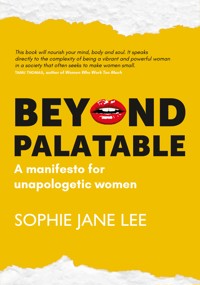
Beyond Palatable is a transformative manifesto for women seeking to embrace their true selves unapologetically. In this powerful work, Sophie Lee acts as both a revelator and a rebel, challenging the societal norms that keep us small and confined. Sophie's compelling voice guides readers to confront the pressures of conformity that stifle individuality. Each chapter is rich with actionable insights, somatic practices and practical tasks, all designed to deepen self-understanding and spark meaningful change. With tools for self-reflection, Beyond Palatable fosters a sense of empowerment that encourages readers to stand firm in their truth, even amidst external resistance. This heartfelt invitation to reclaim authenticity serves as a reminder that the essence of who we are is rooted in our hearts. A must-read for those on a journey of personal growth and liberation, Beyond Palatable challenges you to break free from limitations and redefine what it means to be you. Embrace the journey and discover the power of living authentically.
Sie lesen das E-Book in den Legimi-Apps auf:
Seitenzahl: 322
Veröffentlichungsjahr: 2026
Das E-Book (TTS) können Sie hören im Abo „Legimi Premium” in Legimi-Apps auf:
Ähnliche




















Praise for Beyond Palatable
Sophie Jane Lee has written the book I wish every leader would read before talking about ‘bringing your whole self to work.’ Beyond Palatable exposes the truth: we’ve been trained to abandon ourselves for acceptance, and it’s literally making us sick. This isn’t another self-help manual telling women to ‘lean in’ harder. It’s a manifesto for reclaiming the parts of ourselves we’ve been taught to hide. Her framework for Unapologetic Living isn’t just individual healing, it’s a blueprint for collective liberation. Revolutionary, necessary, and unapologetically brilliant.
In my work transforming organisational cultures, I witness daily how self-abandonment becomes the price of belonging. Sophie Jane Lee’s Beyond Palatable doesn’t just name this epidemic; she dissects it with surgical precision and fierce compassion. From her brilliant analysis of how capitalism, patriarchy, and white supremacy conspire to keep us ‘palatable,’ to her somatic practices for reclaiming our voices, this book is medicine for every woman who’s ever apologised for existing. Sophie writes with the rare combination of vulnerability and authority that makes revolution feel possible. Essential, powerful, and absolutely unputdownable.
ABI ADAMSON, author of Culture Blooming
Sophie’s book Beyond Palatable is exactly what the industry needs – it’s honest, raw, and deeply real. She doesn’t sugarcoat anything but somehow makes you feel seen and supported at the same time. Every chapter blends real stories, case studies and her own experiences so beautifully that it feels more like catching up with a friend than reading a business book. I absolutely loved it.
OLIVIA MAE HANLON, Founder of Girls in Marketing
Beyond Palatable: A Manifesto for Unapologetic Women isn’t a self-help book! It’s the bad-ass bestie who tells you exactly like it is… no sugarcoating, no chaser. Sophie’s raw, personal story drives the narrative, pulling you into the deep end with her. This is a book for ALL womxn ready to dig deeper and thrive in a world that keeps trying to convince them they’re NOT enough.
A must-read for every woman in bloom, no matter the season. Beyond Palatable is a snackable read that gives womxn full permission to exist – loudly, boldly, and without Apology. Sophie goes in on the why and how of our conditioning, the toxic ways we’ve been taught to feel, move, and think, and how we can finally break that damn cycle. Life won’t always be pretty, but this book shows you how to dance through the chaos and still find uninhibited joy.
Throughout the book, Sophie shares the stories of influential womxn from all walks of life, faiths, and experiences. Proof that even in our differences, we share a common pulse of resilience and rebellion.
Storytelling is our greatest weapon, and Sophie wields it masterfully. She reminds us that our stories matter, that they deserve to be told, and that playing small was never part of the plan *tongue pop*.
Peppered with history, poetry, and journal-esque prompts, this book is part memoir, part radical girl gospel, and a full-blown wake-up call to stop conforming and step into your full greatness!
If you’re ready to stop being palatable… then I highly recommend you grab your copy of Beyond Palatable and start existing without apology.
LEAH VERNON, author of Unashamed
Compelling and relatable, Sophie Jane Lee’s Beyond Palatable is a challenge to find your tribe, prioritise your true self, and unleash the beast that is your best self. It’s a coven I need to join and celebrate.
JAMIE KLINGLER, Women’s Safety Activist and co-founder of Reclaim These Streets
This book will nourish your mind, body and soul. It speaks directly to the complexity of being a vibrant and powerful woman in a society that often seeks to make women small. Through real life stories, rigorous research and evidence-based practical tools, Beyond Palatable invites us to reconnect with ourselves and take ownership of who we are. It’s equal parts wake-up call, love letter and guide book, and it’s utterly refreshing.
Personal development books often invite us to improve ourselves without acknowledging the impact of the systems in which we live. In this book Sophie provides context so women can stop blaming themselves and instead become powerful advocates for themselves and others.
I am grateful for this book!
TAMU THOMAS, author of Women Who Work Too Much
Honestly, this book is really quite something unique. This honest, unflinching account is part manual, part memoir and is such an important read, and a really important addition to this conversation. Sophie does such a masterful job of both sharing her story and commenting on things as we find them today. It’s a powerful read that will make you think, pause, reflect, laugh, cry and then leap into changing things. A must read for everyone done with the status quo.
YINKA EWUOLA, Business Strategist, Coach, Speaker, Creator of the Cashflow Accelerator & Founder of All things Rich and Rested
First published 2026
ISBN: 978-1-80425-335-9
The author’s right to be identified as author of this book under the Copyright, Designs and Patents Act 1988 has been asserted.
Typeset in 10.5 point Sabon by Lapiz
© Sophie Jane Lee 2026
Contents
Preface
The Reckoning
A letter to my former self
PART I: The Unravelling
CHAPTER ONE: Why This Work Matters
CHAPTER TWO: How Did We Get Here?
Yasmin Sampson-Da Rocha’s Story
In the Belly of the Beast
CHAPTER THREE: The Triad of Oppression
The Whore of Babylon
CHAPTER FOUR: Internalised Misogyny
The Crystal Gazer
CHAPTER FIVE: Numbing and Shrinking
ii. White lines in black holes
Sapna Pieroux’s Story
CHAPTER SIX: Where Do We Go From Here?
PART II: The Remembering
CHAPTER SEVEN: The Parts of Ourselves
Can you be with the pieces of me?
CHAPTER EIGHT: Becoming More Self-Aware
Sit With It
A Brief Interlude About Language
CHAPTER NINE: The Archetypes
CHAPTER TEN: The Embodied Self
Unremarkably nice
CHAPTER ELEVEN: Wealth Without Hustle
What Have We Learned So Far?
PART III: The Reclamation
CHAPTER TWELVE: The Art of Boundaries
The Power of No
CHAPTER THIRTEEN: Navigating Other People
CHAPTER FOURTEEN: The Way You Say Yes to Life
CHAPTER FIFTEEN: Cyclical Living
Re-generation
CHAPTER SIXTEEN: A Framework for Unapologetic Living
CHAPTER SEVENTEEN: A Manifesto for Your Voice
A Final Note: Let It Shine
Acknowledgements
Endnotes
Additional resources
Book group discussion points
Preface
I SPENT MOST OF my life thinking there was something deeply wrong with me.
I didn’t fit into other people’s expectations of what a neat, good girl should be. My body was too big, my voice was too loud, my ideas too chaotic, my love too intense and I didn’t take ‘because I said so’ as a good enough reason for anything; I wanted to know why. I often got it wrong and regularly felt like I was on the outside.
So, I sought validation and constantly outsourced my sense of worthiness. I searched for love in all the wrong places, became successful in the ways I thought I should be, but inside I was lonely, disconnected and dealing with a raging sense of self-loathing.
It was only when I started doing the real work – unpicking my stories and deprogramming my beliefs – that I became aware of the lies we’re told to keep us small and compliant, and of the ways they destroy our lives.
As a voice and visibility consultant, I listened to hundreds of stories from people of all genders about how they didn’t feel worthy. How afraid they were of using their voice, or how they held themselves back from going after their dreams.
I watched incredible women apologise for themselves in every moment. They had absolutely no idea how phenomenal they were.
Ah, it’s not just a me thing, I realised. This is endemic; we’ve all just got really good at pretending. So, I began researching why we self-abandon, especially as women. I trained in trauma-informed somatics – a discipline that emphasises the mind-body connection to promote healing and awareness – and learned about the nervous system and the impact of dysregulation.
What I discovered blew my mind. Why aren’t we taught this stuff in school? Why is it so hard to find the full picture? It’s no wonder that more and more women are suffering, feeling burnt out and totally disconnected from our joy.
Imagine if tomorrow, every single one of us woke up to our brilliance and realised we already have everything we need to be happy, just as we are.
We’d denounce beauty standards and say ‘No thank you’ to fillers, creams and fad diets. Fuck fast fashion and people who treat us like we’re nothing more than objects for their amusement. We’d disconnect from the corporate machine, live in communities and tune into the cycles and rhythms of nature. It sounds like some kind of ‘woo-woo’ far-off dream, right? Except, it’s the most natural way we could live.
Imagine if we just stopped buying into the system. What would happen? Total collapse would be almost inevitable because we are the ones holding everything up.
It’s time we remember who we are.
Beyond Palatable is a wake-up call. A collection of psychological, sociological and anthropological insights, research and theories, along with stories from women all over the world who share how they woke up and reclaimed their voice and autonomy.
It includes insights and stories from my own life: the years of people-pleasing, the mental health and addiction crises, and my journey back to Self. Using somatic wisdom, social commentary and storytelling tools, this book is designed to help you explore your conditioning and discover who you truly are beneath it all.
It is the slow, holy, messy process of reclaiming your whole Self, especially the parts you’ve silenced to survive. It’s about finding your way back to your voice after years (maybe decades) of self-abandonment, where you swallowed your truth and dulled your shine to fit in.
This is not a self-help book. There are already more than enough of them. I say that as someone who once had a near-religious devotion to self-development, with shelves groaning under the weight of gurus telling me who I should be and how to fix what I hadn’t realised was broken. I remember crossing the road on the seafront in Brighton, mid-chapter of some bestselling blueprint for becoming a better version of myself, when it hit me:
No one knows how to human better than me.
And I certainly don’t know how to human better than you. You are not a problem to be solved. You are not broken, even if you sometimes believe that you are. You already have everything you need, but if you’re like 99.9 per cent of the people I’ve met, you’ve forgotten how exceptional, how worthy, how spellbindingly brilliant you are, just by being you.
This book won’t give you a 5.00am routine or a formula for success. It’s here to help you remember the truth of yourself. Beyond Palatable is a reclamation for those who’ve ever asked themselves:
Is it just me? Am I too sensitive? Too ambitious? Not ambitious enough? Too angry? Too loud? Too quiet? Too complicated to be loved as I am? Too much? Not enough?
This is for all of the women and trans folks who’ve shrunk themselves to fit in. For us, our younger selves and the girls growing up in a world of filters, loud expectations and conflicting messages about what it means to be acceptable.
We are not acceptable. We are exceptional – unapologetically brilliant. Why on earth would you want to be normal anyway? Have you ever met a normal person? No, me neither.
As I was writing Beyond Palatable, I spoke at length to my book coach, Vicky Quinn Fraser, about how important it is to me to be nuanced and bring in as many different perspectives as possible. That said, this book covers an extremely complex topic, and there is only so far I can go.
I’m not an anthropologist, a geneticist or a historian. I am a journalist, and as such, I draw on others’ insights to build my argument. This book is a collection of my hypotheses, supported by numerous theories and research findings. I will always encourage you to think for yourself, and to help your further exploration, I’ve included additional resources at the back of the book and on the beyondpalatable.com website.
Content Note
This book touches on themes that may be upsetting, including mental health struggles, addiction, abuse, rape, disordered eating, suicide and self-harm. These topics are explored with care and context, but they are present, so please take good care of yourself as you explore within these pages. Skip or pause when needed. Your nervous system is more important than finishing a chapter. All the exercises here are only suggestions. Take what works and leave the rest.
With you in the reclamation,
Sophie Jane Lee
Disclaimer
The stories in this book are drawn from real experiences. In some instances, names, identifying details, timelines and circumstances have been changed or blended. Any resemblance to actual persons, living or dead, is coincidental unless explicitly stated. These accounts are presented for informational and illustrative purposes only and are not intended to defame, discredit or cause harm to any individual or group.
The Reckoning
THE STORY BEGINS WITH a picking of threads, and then a complete unravelling.
It was a night like many others. I was sitting in the galley kitchen of an ex-council flat in Hove on a balmy English summer’s evening. The flat with the mismatched parquet floors and wide balcony where we used to pretend to be on a Brighton Pride float, raving to invisible crowds below.
I had moved there with my best friend, Rob, the year before, after ending a horror story with an ex.
There was a neat pile of cocaine on the kitchen counter and a half-drunk bottle of cheap white wine with a picked-apart label that read, ‘Love wine’. I was meticulously measuring out another line when it hit me.
This is all happening because I don’t believe I’m worthy of love.
The ‘all’ in question was my entire life: every self-destructive action, every dangerous decision, the heartbreaks and the never-ending, soul-destroying party.
It hit less like a ton of bricks and more like the settling of feathers after a massive pillow fight. Delicately. Softly. Ah yes. This is it.
I had spent years shoving myself into boxes, afraid of being too much, desperate to fit in when I always felt like the odd one out. Why does everyone else seem to know how to be human? So, I set about pretending.
I thought if only I looked like I had it all figured out, no one would know I was an imposter. ‘An alien in a meat suit,’ as my friend Vicky would say. And I spent half my time fantasising about my own death and the other half praying to the gods of Saturn and Venus that the aliens would come and take me away. I was convinced they’d recognise me immediately upon sight.
Instead of asking myself what I liked or how I wanted to live, I outsourced all of my decisions to other people and what I thought would make me likeable. My entire self-worth was tied up in what other people thought of me. Many of them treated me like absolute shit, and I would still go back over and over again. Please like me. Please tell me I’m acceptable.
When fitting in costs you your voice, your needs and your truth, that’s not belonging. It’s self-abandonment.
When we talk of moving (or in my case, barging) beyond palatable, the title of this book, we’re talking about no longer abandoning ourselves, no longer apologising for our existence, refusing to be kept small by outdated expectations.
This process is about healing the relationship you have with every version of yourself – the one who stayed silent, the one who people-pleased, the one who kept going when she should’ve rested. The one who’s finally had enough and is ready to unleash her brilliance into the world with full frontal PAZAZZAL.*
At this point, it’s important you understand that none of this is your fault. Self-abandonment is taught to us at various stages of our lives. Some ways are covert, while others are so totally obvious they may as well be running naked down the street on a Sunday.
Being your whole self – especially as a woman – is a radical act.
To be full to the brim with life force, feeling all of your emotions, unsuppressed and totally expressed.
To live in rhythm with the cycles of nature.
To honour the wisdom of your body and the land you come from.
To come together as a sisterhood.
To feel joy, depth and knowing without apology. This is what wholeness looks like. And it is risky business.
For thousands of years, women who dared to live this way were silenced, punished or erased. So, it’s no wonder we dim our shine. We had no choice but to abandon parts of ourselves to survive.
And that’s what self-abandonment is. At its core, it’s a survival strategy. Our ancestors learned many centuries ago that it was unsafe to be a self-expressed woman, and we are still taught that lesson today. While the threats may look different, the message often remains the same: ‘Tone it down’, ‘Don’t make a fuss’, ‘Be nice’, ‘Be agreeable’, ‘Be palatable’. Sound familiar?
But here’s where things get really gnarly. Many of us, especially those growing up in the West at the turn of the millennium, were told the world had changed. We were raised on a narrative of ‘empowerment’. You can be anything. Do anything. You are free. You can have it all, sister. Woohooo.
Being told you can have it all is not the same as being supported to live in alignment with your truth. And when ‘having it all’ feels like a fast track to burnout and shutdown, and you still have to advocate for equal pay, medical support and the right to live free from harm, you start to wonder if the whole thing is a setup.
Then, if you dare to say, ‘Actually, this version of success doesn’t feel good to me,’ you’re made to feel like you are the problem. So, you self-abandon. Pushing your needs down in favour of being liked and palatable; it feels much safer that way because it is.
I cannot stress this enough: nothing is wrong with you. You are proving yourself to be a mighty fine survivor. But since you’ve picked up this book, I’m going to make a wild guess that you’re done surviving and are ready to live fully.
So, that brings us to this moment right here. We need to give up our need to be liked and appeasing, and instead create a new experience for ourselves in the world as well-resourced women who can listen to our bodies and live in accordance with our own rhythms.
The goal is to be full of ourselves, even though we’ve been told that’s a highly unpalatable thing to be. Being anything other than full means being emptier, or less full, depending on your disposition.
Do you want to live a less full life? Do you want to strive for emptiness? No.
The ultimate goal is to be so full up that we spill over and create a brilliant impact on the world around us. Not because there’s some expectation to be and to do good, but because that’s the natural way that full people move through the world.
It may seem impossible to you at the moment. You may be reading this thinking, ‘What in the world of delulu is this woman banging on about?’ If so, I get it. For most of my life, I’ve kept myself small, dimmed my light and chipped away at my edges to try to fit someone else’s expectations of what is palatable. I have apologised for taking up space while having a defiant spirit that, if left unchecked, had the pesky habit of becoming far too free and bothersome.
You may relate more to the ‘good girl’ conditioning – perhaps you were one to sit quietly and do as you were told. Maybe you even had a so-called ‘naughty’ kid put next to you in the classroom in the hope that your ‘goodness’ would rub off on them.
I was that naughty kid. Undiagnosed neurodivergent, ridiculously rambunctious and every question started with ‘why?’ I would get into trouble all the time. After a while, I learned my ‘too muchness’ was bad. I was labelled an attention seeker, troublemaker and drama queen, and I started to believe that it was, in fact, my fundamental ‘me-ness’ that was the problem.
Despite being a chronic overachiever, my self-hatred manifested in a campaign of self-destruction, which started around the age of 11 and is something I’m still working on today at 37. I have gone through life questioning every rule, pushing every boundary, getting too close to the edge of the cliff over and over again, all while being desperate for approval.
I’ve learned that the good girl and the rebel are two sides of the same coin. The need for attention and validation drives both, but they have very different game plans. Ironically, the more we push, the less we feel like we belong. This book will explore why that is and, importantly, what we can do about it so that these roles and behaviours no longer run our lives.
Everything you will find in these pages is what I’ve learned through years of investigation into the driving forces behind my unruly behaviour. But it didn’t come easily. I had to push myself to the brink before I finally woke up and realised that I had two choices:
1. Continue as I was going and destroy myself completely.
2. Do the hard work to fundamentally change my relationship with myself and thus, the world around me.
This is demanding work. We’re looking at centuries of conditioning and a lifetime of being palatable, apologising and moulding yourself to fit other people’s expectations. If it were easy, we wouldn’t be in this pickle, would we? But, me oh my, it truly is life-changing. Like genuinely, awe-inspiringly, world-shiftingly worth every single ounce of work you put into it. That I can promise you.
Ultimately, this is a reclamation of your joy and brilliance, which is your birthright but has been systematically stripped away from you. Full up, joyful people are pure magic, and that is a threat to the continuation of power held in place by the triad of oppression – late-stage capitalism, white supremacy and the patriarchy (we’ll be examining these in more detail in Chapter Three).
Why else would there be such a backlash now? If our liberation wasn’t a threat to the status quo, they’d just let us be. By the end of this book, you’ll understand how it all works in its fucked up, technicoloured glory.
But first, let’s go back to the Hove galley kitchen and the moment of realisation…
Becoming aware of the story was only the beginning. If I’m honest, that night in my kitchen didn’t do much other than make me hate myself a bit more. Yet another problem that was my fault.
There was also a part of me that enjoyed the drama; it gave me more reasons to act out. If I were fundamentally defunct, there wasn’t much point in trying to be anything else. I may as well just embrace how bad I was. ‘Let’s drink and do more coke.’
So, there was no biblical reformation. Instead, I finished the gram and ordered another. All the while, talking to my accomplice in a garbled, manic tone about what it means to love yourself and whether any of us really do.
‘If we’re honest, do we, really? Do you? Well, do you?’
‘I think we all secretly hate ourselves, really. That’s just part of being human, right?’
Then we spoke for hours about our childhood trauma, shouting over one another, one-upping each other’s pain without feeling anything at all.
Another line. And another.
‘How would you even go about loving yourself, anyway?’
I woke up the next afternoon, having gone to bed at 7.00am, with an acid burn inside my nose. You may think, surely that was the last time, but alas, no.
One week later, I rushed, breathless and panicked, into the meeting room of a coworking space in Brighton. My blue polka dot polyester dress stuck to the sweat pouring down my back. I’d had precisely 23.7 minutes of sleep. I was late.
‘I’m so sorry,’ I said, unable to look my business partner, Alice, in the eye. She gave a tight smile and introduced me to the woman sitting to her right.
‘This is Anne,’ she said. ‘Anne, this is Sophie.’
I’ll never forget the way that perfectly put-together woman, hard to tell her exact age, but somewhere in her early 50s, looked me up and down. Her manicured hands rested carefully on the table before her. She was wearing a beautiful cream linen suit, a sea-green silk shirt, and a look of abject disgust.
‘Hello,’ she said as I fumbled with my chair.
The room was deafening, even with just the three of us in there. The incessant bang of ‘you are such an idiot’ pounded in my temple. It was a once-in-a-career opportunity, and I can say that now because eight years later, there hasn’t, as yet, been another like it. Anne knew Alice from her previous work and had wanted to invest in our business. Had wanted to take us to the next level. Had wanted to, until she met me.
That afternoon, the email came. I’ll paraphrase, but it went something like:
‘I think you need to seriously consider whether it’s wise to continue working with that woman; she’s a liability.’
I was that woman. I was the liability.
That afternoon, Alice and I went for a walk along Hove seafront and had an honest and challenging conversation, as was always our way. She told me she could see who I really was and that she believed in me.
‘You’re like a light that’s been covered in many heavy sheets. I can see the light under there, I just hope you find a way to uncover it,’ she said, as we stood next to the candy-pink-and-white striped beach hut, the seagulls squawking overhead. That was one of the most brilliant and generous things anyone has ever said to me.
It was at that moment that I decided I was so sick of my own bullshit that I needed to do something about it. And something I did.
That was 2018, and since then, I’ve been on a mission to understand my brain and improve my relationship with myself. I got clean and opened up Pandora’s box, rifling through all of the many ways in which I’d abandoned myself, while playing out the same unlovable, unworthy script.
‘Unworthy’ had been the story of my entire life, from who I chose to date to the creative ways in which I’d put myself in danger; a string of abusive relationships, always starting and returning to the one I had with myself.
I was engaged in an inner war between a constant, manic rebellion and the compulsion to overachieve. From the outside, it looked like I had everything. Inside, I was not waving but drowning.1
And then, the unravelling.
I went in hard. Took on every single kind of therapy available to me. From a Shaman banging a drum and fluffing my energy with a feather, to imagining I was a tree in a quiet forest, to play-acting the roles of my parents. It was a painful time when every nerve felt exposed. Everything I’d worked hard to hide from came crashing to the surface, and it was LOUD.
But it taught me something profound. I realised how much power I held and how it was being channelled in totally unhelpful ways. I was the master of my own fate, but the dial was set to annihilation. How frustrating that I could no longer play the victim with a straight face.
You may understand what I mean when I say I had spent my entire life pretending.
I pretended to be cool to fit in. I pretended my brain worked like everyone else’s. I pretended I wasn’t bothered when men hurt me, that I didn’t have an alcohol and cocaine addiction, that I had my shit together and wasn’t afraid of everything.
I pretended to be palatable while apologising for myself the whole time. Sorry, I’m so sorry I exist.
What would happen if I just… stopped?
And so, I did. I stopped trying to fit in, stopped trying to be acceptable and stopped caring what other people thought (or at least tried my very best). I stopped pretending I was palatable. I stopped shrinking and started being my full self.
Oh, what sweet relief.
From here, I started working with women to help them tell their stories and have since worked with thousands of women in business, founders and C-Suite executives. All absolutely amazing, and almost all holding themselves back from shining their full, unbridled light because of the fear of being too much, while secretly believing they’re not really worthy of greatness.
This book is a collection of learnings and unlearnings, so we can recognise the ways we are holding ourselves back, choose differently in all aspects of our lives and, ultimately, connect more fully with the truth of ourselves and our brilliance. It’s the story of billions of women and ‘outsiders’ around the world who have been told to shut up, shut down and shrink themselves to fit in.
Once we begin to truly understand the various ways society attempts to keep us small, from the language we use to the ways we police each other, we can start to ask the bigger questions.
What if I stopped apologising for my voice and started using it intentionally and powerfully?
What if I used my energy for positive, meaningful impact instead of wasting so much of it on shit that doesn’t matter?
What more would I be capable of?
How to use this book
This isn’t a book you read and then pop on the shelf. It’s a manifesto for unapologetic you-ness, and since you are you and I am me, there’s only so far I can take you.
My intention is for this to be a co-creation, and as you move through the book, you’ll find lots of prompts and exercises to truly make the process your own. Some parts may be confronting, but I hope my words help you feel seen, and this book becomes a valuable tool as you start your own unravelling and reclaiming from a place of unapologetic power.
Each section mirrors a phase of the journey I’ve taken, and the one I want to invite you into. This isn’t self-help. Self-help tells you to fix yourself. Beyond Palatable asks, ‘Who taught you to believe you were broken in the first place?’
The more I’ve explored this issue – the ways women shrink, silence and contort themselves to fit in – the more I’ve realised how widespread it is. This isn’t a niche experience; it’s a near-universal one. But within that shared story, there are countless different realities. And I can only speak from my own: as a white, able-bodied, cis gender woman with a particular set of privileges and limitations.
To be as inclusive and representative as possible, this book weaves in the insights, stories and expertise of women from around the world who have generously lent their voices to this conversation. It has been one of the deepest honours of my life to sit in dialogue with women of different ages, races, religions, cultures and identities – each bringing their own lived truth to the question of self-expression, power and what it costs to self-abandon.
While no two stories are the same, there’s a fierce and echoing clarity at the heart of them all:
1. Being palatable is a route AWAY from joy.
2. Shrinking to fit into a box not made for you will never lead to a full life.
Together, we’re moving beyond what it means to be acceptable and into the uncharted waters of unapologetic self-expression. There will be moments of stickiness as we strip away the layers of conditioning and the stories we have adopted about our identity. The key is to approach everything with curiosity, even when it feels challenging. Curiosity is our access to presence, and presence is our access to truth.
Before we go any further, I also want to acknowledge that while I will be using the term ‘woman’ a lot in this book, this is not an exclusionary experience. I include trans women, those assigned female at birth and non-binary folks in all of this. Whoever you are, wherever you find yourself, you are welcome here. Hopefully, you’ll see yourself reflected in some of the stories.
This is where we’re going from here:
Part I: The Unravelling
We will peek beneath the conditioning and look at all the ways you’ve been taught to doubt yourself, mute yourself and make yourself small. We trace the roots and hear from women and experts who can help us understand how it all works. We become curious about how those stories shape our beliefs and behaviours, and how to unravel them.
I’d encourage you at this stage to take radical accountability for yourself and your life, which may feel confronting. You may want to shake your fist at me and boo and hiss; that’s okay. The work isn’t easy, which makes it all the more important.
We’ll be looking more at radical accountability in Chapter Eight, but for now, just know this: while it’s not your fault, you have the power to choose a new narrative for your life. By the end of this book, you’ll have some more tools to help you navigate that process and create more ease and joy along the way.
No one is coming to the rescue, and the only way to change something is to get super clear about what needs to change and do the hard work of choosing differently.
That which we can’t see, we can’t shift. So, it’s time to investigate and get hyper-honest.
Take a moment now to answer these questions:
1. Why did you pick up this book? What are you hoping to learn and gain?
2. Do you, too, feel like you are shrinking yourself or muting your voice?
3. Why have you been censoring yourself? Do you know? (It’s OK if you don’t).
4. Why now? What do you want to achieve for yourself by taking action?
5. What is at stake if you don’t take that action? How would you feel if, in ten years, nothing had changed?
Part II: The Remembering
Once we’re super clear on how we got here and what’s at stake, we can begin to rebuild. We’ll soften into what’s always been true about you – your voice, your vision, your value. We’ll stop being so tame and acceptable and start rebuilding trust in ourselves, learning to take up emotional, physical and energetic space again.
You will remember who you were before the world told you who to be, and it will be glorious, like a homecoming.
Part III: The Reclamation
The number one regret of the dying is living life to someone else’s blueprint.2 We will not have that regret. We will no longer dim our light to make other people feel comfortable. We will radiate at our most luminous, our most outrageously bright, no-holds-barred brilliance.
This is where the magic happens, and you step into the fullness of yourself and shed all of the bullshit that tells you what ‘good’ looks like.
I intend that by the end of the book, you’ll stop waiting for permission and stop performing to meet someone else’s expectations.
We get loud. We get visible. We take up space.
Now, we rise.
At the end of each chapter, you’ll find practical tasks, journaling prompts and reflection questions. They’re not homework. They’re opportunities. Little stepping stones back to yourself.
Come back to whatever parts you need, whenever you need them.
If your experience is anything like mine, it won’t be linear, and that’s just peachy. We really do need to do away with the idea that humans should be neat. We are raw, messy, filled with complexity. It’s what makes being human so challenging and yet so delicious. Let’s embrace it together, shall we?
Before we get stuck in, let me be clear: you do not need fixing.
You never did.
You may feel like you’re broken at times, but that’s not true.
As my absolute hero, the physician and trauma expert Dr Gabor Maté says, how you are feeling right now is a totally normal reaction to an abnormal situation.3 Human beings are not meant to live as we do in today’s society, hunched over desks and brightly lit computer screens, overworking and performing according to someone else’s script.
Women are intrinsically wild and free. We were made for community and tribes. We’ve just forgotten, that’s all. And you might need some help remembering. It may also take some time to regain your trust in yourself. Take that time. It will be the best investment you ever make.
A quick note for introverts:
This book isn’t prescribing a specific way to be. I may talk about shining and all the razzle-dazzle and use words that don’t resonate with you. Find what works for you and leave the rest.
Being loud doesn’t necessarily mean being loud in terms of volume. Taking up space doesn’t have to look big and bold. The entire intention behind this book and all of my work is to find the glimmer of you. My hope is that you can discover your shine and start exploring the ways you are holding yourself back from being true and expressing yourself in the very specific, unique way that’s you.
So, are you ready?
Let us begin.
* adj. Pizazz meets razzle dazzle (a Sophie special)
A letter to my former self
By Sophie Lee
I love you in the negative spaces
where the lines of your body
have been etched in smudged black coal
and your mind has not yet
learned what is possible.
Like a fawn standing on bowed legs,




