


7,99 €
Mehr erfahren.
- Herausgeber: WriteLife Publishing
- Kategorie: Ratgeber
- Sprache: Englisch
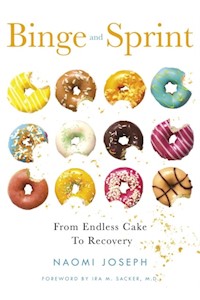
Have you ever stood at the kitchen counter urgently devouring insane amounts of frozen, stale hot dog buns dipped alternatively in jelly and almond butter, while on high alert for approaching humans?
After a lifetime of getting knocked to the ground by the same opponent, a Dark Voice, and then rising repeatedly while praying for a way out, Naomi Joseph wrote the rules of "Binge and Sprint:" Use cake as fortitude to steel yourself to plow ahead and then keep moving, keep achieving, and never ever let the world see your suffering.
Never idle, Joseph takes the reader on a four-decade journey from childhood through college, marriage, buying a home, comparison, community, infertility, low self-worth, work, starting a business, keeping up with the Joneses, and caring for children and ailing parents, all while chained to her secret burden. Readers will understand their own darkness in the midst of "the good life" as the lid is blown off the shameful shroud of the taboo war with food.
Poignant and hilarious, Josesph's journey will help the reader claim their power, and lean into their greatness as they incorporate the many lessons that brought her to recovery into their own lives.
Das E-Book können Sie in Legimi-Apps oder einer beliebigen App lesen, die das folgende Format unterstützen:
Veröffentlichungsjahr: 2021
Ähnliche




















Binge and Sprint: From Endless Cake to Recovery © 2021 by Naomi Joseph. All rights reserved.
No part of this book may be reproduced or transmitted in any form or by any means, electronic or mechanical, including photocopying, recording, or by any information storage and retrieval system, except for inclusion in a review, without permission in writing from the publisher.
This story is told from the author’s experience and perspective. Some names and identifying details have been changed to protect the privacy of individuals.
Published in the United States by WriteLife Publishing (an imprint of Boutique of Quality Books Publishing Company)www.writelife.com
978-1-60808-265-0 (p) 978-1-60808-266-7 (e)
Library of Congress Control Number: 2021947837
Book Design by Robin Krauss, www.bookformatters.com Cover Design by Rebecca Lown, www.rebeccalowndesign.com First editor: Andrea Vande Vorde Second editor: Allison Itterly
Praise for Binge and Sprint and Naomi Joseph
“Readers will find Naomi’s journey about her battle with food, and compulsive worker-bee behavior to be emotionally profound and engrossing. It is a page turner as Naomi addresses you “dear reader” you are drawn into her struggles with a “dark voice” in her head, that she is not good enough! It is chock full of Jewish witticisms and quotes from the Torah.
As an eating disorders expert and the long term moderator of a highly sophisticated book club in the Five Towns, I find Naomi’s story to be raw, riveting and poignant! It leaves the reader with tools for recovery to a place of understanding and acceptance. A must read!”
— Dr. Ellen Schor Haimoff, Ph.D., clinical Psychologist, Director of the Associates for Bulemia and Related Disorders in Manhattan, author of introduction to Why are they Starving Themselves? by Elaine Landau
“An honest and powerful story, Naomi takes us on a journey of her challenges to give us the strength to overcome ours.”
— Charlie Harary, investor, strategic adviser, professor, motivational speaker, radio show host, television personality and author of Unlocking Greatness: The Unexpected Journey from the Life you Have to the Life You Want
“In this book, Naomi Joseph explores the roots of her lifelong struggle with binge eating with unflinching honesty and humor. She puts a magnifying glass on how the most painful aspects of her life influenced her relationship with herself and by extension, with food. Weaving in her experience of growing up in a religious Jewish community, we see how food provided solace yet also created heart-wrenching conflict. Regardless of religion or culture, all readers who struggle with food will relate to the “Dark Voice” within, the voice of shame, the voice that tells us we aren’t good enough. Similarly resonant is the image of an ideal self she calls “Summer,” which highlights the cultural trap of perfectionism and how it impacts us. Realizing that bingeing is a way of coping with the exigencies of life, she explores new ways of being and relating with the world, all of which changes the way she eats. At its heart, Binge and Sprint is the story of psychological birth, which is messy, painful, funny, and ultimately hopeful.”
— Dr. Nina Savelle-Rocklin, PsyD, radio show host and author of Food for Thought: Perspectives on Eating Disorders and The Binge Cure: 7 Steps to Outsmart Emotional Eating
“Naomi has created a compelling narrative that incorporates humor, honesty, and self-reflection. Her approach to storytelling takes a serious challenge that many people hide in shame and brings it to light in a way that makes it totally relatable. I read this book in two days and felt like I was indulging in a novel. Naomi has written a triumph that humanizes the way those in conflict with food view themselves, and will help their loved ones and support system better understand their dance with food.”
— Kim MacGregor, Wellness Entrepreneur, Transformation coach, Author, Speaker
Table of Contents
Foreword by Ira M. Sacker, M.D.
Introduction
Chapter 1 What Is a Binge?
Chapter 2 Binge and Sprint
Chapter 3 Staying Ahead of the Curve
Chapter 4 Summer
Chapter 5 Public Eating
Chapter 6 We Gotta Eat!
Chapter 7 Who Do You Think You Are, Anyway?
Chapter 8 The Surrender Method
Chapter 9 I Got This
Chapter 10 The Core Wound
Chapter 11 Mother Knows Best
Chapter 12 Dealing with Dad
Chapter 13 Getting Help and Support
Chapter 14 Recovery: Relaxed with Food
Acknowledgements
About the Author
“The search for the beloved is fulfilled when you fall in love with yourself.”—Alan Cohen
Foreword
By Ira M. Sacker, MD Eating Disorders Specialist Author of Dying to Be Thin and Regaining Your Self
Imeet each patient with an initial assessment without knowing their life journey ahead of time. So, gathering personal and family history is extremely pertinent to shape the picture of where the patient presently is with an eating disorder. Everyone is different. They can start therapy a few months or several years after the initial behaviors start. Some sample what therapy is by trying out a therapy session(s) but cannot find a therapist they can connect to. Then there are others who have been drowning for decades with disordered eating. Finally, there are some who believe they are the only ones going through this, so they live in silence.
Patients reach out for help either independently or because of someone else. I am proud of all my patients who accept help and take the risk to change. I have been allowed to witness their successes beyond recovery. Finishing high school, travel, graduation from university, dating, marriage, pregnancy, having a family, setting up a home, professional career, and attaining life goals are just some of the examples.
I have been treating eating disorders for over forty-five years. I graduated from UCLA School of Medicine. After my residency at NYU, I was fortunately not drafted for Vietnam and instead got stationed in Frankfurt, Germany, to establish the Frankfurt Youth Health Center. After three years in Europe, I was relocated back to New York where I became Chief of Adolescence Medicine at Brookdale University Hospital in Brooklyn, New York. I started my private practice on Long Island in the 1980s and expanded to Manhattan when I retired from Brookdale in 2005.
My work in Brooklyn made connections with influential rabbis, and that granted me an opportunity to work with many Orthodox communities. I was raised in an Orthodox home. My Bubbe (grandmother) from Russia only spoke Yiddish. She lived with us during my formative years, and that was how I learned Yiddish expressions and context. Both sets of grandparents came to America by 1900, so none of my family was directly affected by the Holocaust. However, my wife’s maternal family almost lost everyone. Her parents left Budapest, Hungary, in October 1938, eleven months before World War II started. They sponsored a nephew to come to New York. He was the only remaining family member who survived the death camps. My in-laws and their nephew shared all the devastating stories of World War II and the Holocaust. This has impacted me forever.
My desire to help the generations of individuals who survived the Holocaust grew from here. I was not sure what it would look like. As a specialist in eating disorders, I have treated many generations of Holocaust survivors, their children, their grandchildren, and their great-grandchildren.
DNA imprint from trauma experienced in the Holocaust has been suspected to have an increased risk of eating disorders for the following generations. The development of an eating disorder in the Jewish community is prevalent. So much so that it falls into a hidden, secret category due to the effect on marriage and fertility issues. There are also limitations for seeking treatment.
Naomi came to see me through a referral from the Orthodox community. While discussing her family history, I learned that she had family members who were Holocaust survivors, her grandparents emigrated from Europe, and her parents were First Generation American.
Once in recovery from binge eating, Naomi had a desire to write a book. Her passion for wanting to help others is why she put pen to paper. We both were similar in wanting to help the individuals who are still struggling and remain voiceless. This is a powerful memoir of her life journey with a reoccurring message: You are not alone, and there is always hope.
In the Beginning
My observations of Naomi, aside from her being extremely task-oriented, was that she overworked herself, and she could never figure out when she would be the priority. Taking a pause was completely impossible because goals had to be met in every aspect of her life from her marriage, children, family, friends, and especially in her work life. A frequent response to a suggestion for putting herself first was, “I don’t have time for that.” Naomi is not alone; I see this difficulty to grasp the notion of self-care constantly.
New Concept
Naomi’s reason for therapy was wanting change that lasted. First, I have to teach the basics of how an eating disorder functions. Any form of an eating disorder is never solely about the food. Binge eating is a symptom, not the underlying issue. It’s not about discovering that fabulous diet, the perfect food plan, or success at the latest trends. None of these will stop binge eating. There needs to be a realization that there is an association between food and feelings. By not connecting to the feelings, food behaviors originate and hide core issues. Examples of underlying core issues are self-doubt, shame, guilt, never feeling good enough, comparisons to others, depression, anxiety, trauma, lack of control, and being voiceless.
Breakthrough
In order to face these core issues, an awareness needs to take place when justifying or escaping to bingeing begins. The trigger response of large quantities of food to mouth never really fills a void. Accept that binge eating is happening. Then stop and look at the patterns that break down the hidden reasons for why it is occurring. Be aware that this will unearth feelings instead of filling the empty void. Beneath that discovery of feelings associated to core issues is when the healing begins. Finding a balance between the mind and body is key.
Recovery
I believe any individual can completely recover from an eating disorder. This comes from an understanding that we have limitations, we are not perfect, and we need to give ourselves permission to be human along with acceptance, forgiveness, gratitude, and the gift of bravery.
Introduction
For my entire life, I identified as fat or skinny. I had two moods when it came to my weight: positively happy or completely miserable. Either I was doing fabulously or I was on the couch unable to function, dying on the inside from both food and emotional overload. Over the last four decades, I swung wildly like Maimonides’s pendulum, from one end of the spectrum to the other, when it came to my eating habits. After forty years of suffering, I was finally able to find middle ground and begin to attain recovery from binge eating, that place of achieving a balanced state where I am in alignment with my soul and who I am supposed to be.
My unhealthy relationship with food began when I was eight years old. This war with food lasted for over forty years. Binge eating, mindless eating, pigging out, stuffing your face, snack-attack, snackccident, compulsive overeating, emotional eating, foodie, abusing food, food connoisseur . . . whatever you call it, on a practical level it all results in the same thing: a lifelong war with food. Food, the very gift that was meant to nourish you to your best self, instead gets distorted in endless ways.
I never planned to be at war with food or myself for that matter. Sure, we could blame history, upbringing, family traditions, or heredity in our DNA. Truly, I take responsibility for creating my own prison. I didn’t mean to invite binge eating into my life. I certainly wouldn’t have knowingly chosen this particular life challenge. One where I have jammed unthinkable quantities of food down my throat, been disgusted with myself for doing it, and then just prayed that it would all magically go away, knowing all along that the whole process would just start over again.
For almost my entire life, I’ve been heavily steeped in the war with food, and now I am not. If your heart is yearning for the same thing, then please join me on my journey so that you, too, can learn the lessons that have brought me to recovery. If you’ve had a consistent, never-ending battle with food, know that I have endured with you. My journey through binge eating has brought me to my knees and destroyed my self-worth a thousand times. But I will tell you that binge eating has been one of my greatest teachers, and I wouldn’t have traded my journey for anything in the world because it’s made me who I am today.
The long and arduous process to recovery has taught me how to feed my life’s purpose instead of listening to the dark voices in my head. I’ve learned how to release what I perceived as the unworthy parts of me, and with it, the exhaustion from carrying those struggles that were never even mine to hold. This evolution brought forth perseverance, love, understanding, empathy, kindness, gratitude, grit, and integrity. You don’t have to obey the dark voice in your head because it is consistently and negatively driving you to destroy your sense of self. Yes, you’ll fall down. But then you get to pick yourself back up, and therein lies your golden opportunities for growth.
After a lifetime of getting knocked to the ground by the same opponent and then rising repeatedly, you get to know the dark voice’s game pretty well. You begin to understand the strategies it employs, the buttons it pushes, and the mind games it holds over you. Once you can slowly turn up the volume and really listen to exactly what that dark voice has been saying, you can understand it and beat it at its own game. You’ll recognize your weak spots and learn how to strengthen them, and then you can use those weaknesses as an ironclad shield against its tricks. And then you’ll rise to the next level, which introduces improvement of your physical self through strength, your mental self through wisdom, and your spiritual self through G-d’s gifts in epic proportions.
It is in this space that you will give yourself grace when things don’t go as planned. You will decide to eat one or two cookies for a little joy without throwing in the towel and consuming the entire box. You will know you look fabulous no matter what you weigh. You will feel justified in rewarding yourself for the small hurdles you master along the way instead of just waiting for the big ones that never seem to be enough. You’ll know that you’re awesome just for making the effort and understand that mistakes are par for the course. You’ll adjust your relationship with your weight to a place where you accept yourself as whole and as worthy. You’ll incorporate all of these practices and more, and coexist peacefully, joyfully, and consistently with food.
I wrote this book for you, my dear reader. It’s my way of paying forward everything I’ve learned. Whatever dysfunctional relationship you have with food, it has most likely held you back from loving your true self. You will learn how to use your authentic voice, show it who’s boss, and in doing so, flourish in countless areas. You can live a life where you will be liberated from constantly researching diets and obsessing about the numbers on a scale. You were meant to surpass this and come out victorious on the other side. Food does not need to have a hold over you indefinitely.
The courage that it took to write this book came from hope. Helping you through the messages on the following pages is a million times more important to me than protecting the vulnerability I feel revealing this part of me I’ve kept secret for so long. I wanted to open my heart to others who are going through the same things I endured, and offer assistance with the consequent realizations about a lifetime of my struggles with food. My healing and growth have helped me release my old story for a new, improved one. And that’s what I wish for you.
Throughout this book, I share my journey of how I came to that place of being comfortable with food and with myself after more than forty years of trials and tribulations. I want to be completely transparent and make it abundantly clear that it’s not as if I’ve “beat” binge eating and now it’s gone from my life forever. Every day, I make conscious choices that bring me closer to living my best life. My story shows how the lessons I learned to make those choices appeared in my life one by one, slowly over time. First, I will take you through my journey of systematic awareness, desensitization to the stimuli of food, and the removal of the detrimental actions that no longer serve me. I will then guide you through how I painstakingly applied and incorporated one new, small principle until it became an organic part of my daily repertoire. Finally, I gained an intuitive awareness that I successfully incorporated into strategies and coping mechanisms. Are you ready to grab hold of them? You may have doubt or reservations, but the benefits will outweigh the risks.
We are going to break the bingeing cycle once and for all by discovering the true depths of your soul, and how you can step into your seismic power and take back your control. It’s about believing you deserve more out of life, choosing to be positive, and applying the wisdom you gain to reach your goals. You will see evidence of the universal truth that we were put on this earth for a purpose so that we can achieve the highest level of spirituality possible. And most importantly, you will spend your life knowing your worth because you are a child of G-d, the heir of a King. Imagine that.
Now is the time to reach deep into your soul and commence yet another journey. I know you have the strength within you to change. So, buckle up and let’s go. I thank you for the gift of allowing me to share my story with you.
CHAPTER 1What Is a Binge?
I have heard every avoidance tactic known to man for taking control over what we put in our mouths. I’ll control my eating:
“When things calm down.”
“When I am less overwhelmed.”
“When I can wrap my head around it.”
“Maybe after the holidays.”
“In the summer, which is better than now.”
“When I am less exhausted.”
“When my kids get settled.”
“When I get more organized.”
“But I just love food. Especially cookies.”
“But I need to get motivated first.”
The unfortunate truth is that there will never be a convenient time to change your relationship with food, and there is no better time than right now. Making the decision to put your foot down once and for all with erratic food habits and change your life for the better will never be convenient. If managing food consumption was easy and we had all the time in the world, everyone would look like an Instagram fitness model. But life will always be in session and is never a straight journey. There will always be obstacles, losses, hardships, disappointments, and difficulties. You feel overwhelmed, depressed, have fears of not being enough, and struggle to manage through illness or injury. You’re tired, overworked, underpaid, unmotivated, euphoric, lacking emotion, or just plain ambivalent. The time will seemingly never be now.
And although you may truly believe that life’s overwhelming circumstances give you a pass, here’s the real deal: none of these reasons give you permission to shove an entire chocolate cake into your face. Or stop going to the gym, or overworking your business, or any counterintuitive action that takes you far away from positive participation toward your life’s goals. Of course there will be times when you need to sit out a day, or go easy on yourself and take a walk instead of your usual intense weight-lifting workout. But “self-care” doesn’t mean giving up on your health because life gets too overwhelming. You are worth more than just giving up. Dust yourself off and try again.
I am here to remind you of your greatness. Your birthright is not to be a slave to food. This is your formal invitation to lean in and become the person you were meant to be. The cake—or whatever you use to soothe yourself—is not your friend. It will only make matters worse because your clothes won’t fit and you will look at yourself in the mirror and wonder what on G-d’s green earth causes you to keep overeating. Why do you keep coming back to the comfort that ironically causes you the most discomfort? Because you do not yet believe you are worth it. I wasn’t clear I was worth it. I am clear now, but it took me over forty years to get to that place.
I have named my food issue binge and sprint. While no two people’s binges are exactly alike, bingeing universally is an exercise in futility that you use to make yourself feel better that just ends up making you feel worse. So you overeat again to make yourself feel better, and round and round you go without fruition. You think you’re using it to center yourself, but it only serves to throw you completely off-kilter. Every time. Without exception.
Dr. Sacker defines binge eating as a type of eating disorder where you eat a large amount of food in a short amount of time without feeling hungry. You can experience a lack of control of what or how much you are eating. The emotional state includes shame, guilt, embarrassment, and the desire to hide by eating in secrecy. Negative body image and self-hatred can further enhance emotional stress, depression, and anxiety.
You may read my forthcoming description of a binge and say, “That’s it? This girl’s got nothing on me.” Or maybe you’ll think, “Woah. I’m not nearly as bad as she is, and I feel so much better about myself after reading that!” But I promise you will find enough similarities in the thoughts and actions behind my eating habits to at least glean a few golden nuggets that will help you on your continued journey to freedom.
If there was a hidden camera in my kitchen, here’s what it would show:
I hurry into the kitchen immediately after experiencing some sort of discomfort. Maybe I was just given a large task to do. Perhaps a phone call made me feel upset. I’m alone, clearly on some sort of mission, and my expression reads determined, perturbed, and glazed over all at once. It’s written all over my face that I have a million things going on in my mind, and I feel completely unsettled because something or everything has been uncomfortable. I open the cabinets and fridge in quick succession, removing the oddest of combinations of the highest caloric foods I can find. My movements are quick and frantic. I clearly have no idea where to start to fill the void and stuff the undesired feeling. I can’t calm down, and then the business of eating starts. I stand at the counter, of course. Bowls of cereal with milk and drizzled honey and handfuls of chocolate chips thrown in. My kids’ snacks for school dipped in almond butter. Anything resembling cake. And then salty. Cheese of all kinds. Margarine on stale crackers. Expired cream cheese on frozen waffles. My brain is completely removed from my body as if something has taken over my actions and I’m working on instinct or being programmed by some alien planet.
When I do a binge, here are the types of thoughts that run through my head: Help me! What can I put in my body that will calm me down? No, wait, I’m bigger than this. This won’t help me. I can stop right now. I can’t stop. I’ll just have this little bit. This will make me feel better. I’ll start again tomorrow.
I really do try to stop, but the pull to food is just so powerful and I’m no match for its strength. Sometimes, I’m completely on autopilot and can think of nothing but what food is in the next cabinet. Anything to stuff that overwhelming feeling. It’s messy, and my stomach hurts, and it’s a massive waste of time, which is ironic because I’m often stressed about not having enough time. I’m clearly trying to pull myself together and falling apart in the process.
Eventually, I begin to slow down, but it’s not because I’m finally satiated. The truth is that I can only fit so much in my body at one time. I see evidence of the binge in empty wrappers and crumbs, but nine times out of ten I couldn’t tell you what I ate. Then the mind unclenches and the binge fog lifts. I am bloated and stuffed and think, Okay, I’m relaxed now. My mind isn’t racing like it was, and I can look at things objectively and calmly and decide what to do next. Meaning I’m exhausted from the binge and lost in a gluten fog. Sometimes that means I’ve truly calmed my brain down sufficiently to think a bit more clearly, but it’s usually rare that I have clarity. Whatever the outcome, it only temporarily reduces the enormity of what I’m facing until the next overwhelming thought takes over and I use food to quiet my mind and body from racing. It’s not like I’m solving any problems. I am just numbing myself.
I’ve binged over issues both big and small since I was eight years old. The issue that catapults the binge may change, but the coping mechanism remains the same. I can’t think what to do next, so I automatically turn to food to pull myself together by stuffing the feeling. And I never know how long it will last. Sometimes I’m back in the kitchen after five minutes. Sometimes after a week or even a year. Bouts of manic eating have lasted different amounts of time at different points in my life. I’ve had binges that lasted for an hour, for a week, for months, or even years. It depends on what I was going through and how much I needed to depend on food to get me through different challenges in my life. When times were particularly difficult, I overate several times a week over a period of a year, or even several years. Sometimes, just here and there would be enough. You can completely tell how I’m doing in my life by my dress size. No need to ask, “Hey, how are you?” You can just look at me and either say, “So glad you’re doing fabulously,” or “How can I help?”
After a particularly long bout of reaching for food in an unhealthy way, there are complicating factors. For one, I’m in a constant sugar coma, which diminishes my ability to think clearly and make good decisions for myself. My determination to succeed subsides, and now I’m an underachiever. In addition, I’ve gained so much weight that I don’t even look like myself, which makes me feel awful. And I binge again.
I decided to ask some close friends who experienced similar struggles what most commonly initiated a binge session. Most people I posed this question to said, “When I’m stressed.” I don’t know about you, but I’m stressed a lot in my life. I mean, I’m not stressed out all day, but I’m usually stressed at some point every day. I asked them for clarification.
“What kind of stress? Good stress, bad stress, happy stress, family stress, work stress, getting-the-kids-on-the-bus stress, not-knowing-what-shoes-to wear-with-your-skinny-jeans stress . . .” The overwhelming answer? “I don’t know. Just . . . stress.” If you are at this point in your awareness around food, I feel your pain. I’ve been there for about forty years. You are not alone.
But after years of not knowing, with some guidance I’ve been able to slow down the process in my mind and become super aware of my feelings before, during, and after a binge. I’ve learned that I don’t have to be happy or sad or bored or euphoric to use food in an unhealthy way. Those general mood categories don’t really have anything to do with a binge for me. The stress I experience as a result of expectations is what causes me to binge most. When others expect something of me, when I expect something of myself, or when someone doesn’t expect anything at all, but I think they do. The thought of it scares me. It started as a kid when I learned to use food as a catalyst to get me through emotional confusion with my family and friends. Like I did, you will need to look at your early years to discover what originally conditioned you to use food in an unhealthy way.




