


2,73 €
Mehr erfahren.
- Herausgeber: Wildside Press
- Kategorie: Fantasy und Science-Fiction
- Sprache: Englisch
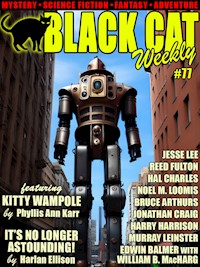
Our 77th issue features a pair of original stories, one by Jesse Lee (which does double-duty as mystery and science fiction), and one by Phyllis Ann Karr (another of her weird westerns, again featuring itinerant gambler Bart Maverel). Plus we have a Bruce Arthurs suspense tale, the first Stainless Steel Rat short story from Harry Harrison, and even a long-long essay from Harlan Ellison! And the usual great selection of science fiction, fantasy, crime, and mystery novels and short stories. As always, special thanks to our acquiring editors, Michael Bracken and Barb Goffman, for their help with this issue. Here’s the lineup:
Here’s this issue’s lineup:
Mysteries / Suspense / Adventure:
“Dirty Water,” by Jesse Lee [Michael Bracken Presents short story]
“A Shipshape Reunion,” by Hal Charles [Solve-It-Yourself Mystery]
“Beks and the Second Note,” by Bruce Arthurs [Barb Goffman Presents short story]
“Dirge for a Nude,” by Jonathan Craig [short novel]
The Powder Dock Mystery, by Reed Fulton [novel]
Nonfiction:
“It’s No Longer Astounding!” by Harlan Ellison
Science Fiction & Fantasy:
“Kitty Wampole,” is copyright © 2023 by Phyllis Ann Karr [short story]
“The Stainless Steel Rat,” by Harry Harrison [short story]
“The Eleventh Hour,” by Edwin Balmer & William B. MacHar [short story]
“Date Line,” by Noel M. Loomis [short story]
“White Spot,” by Murray Leinster [short novel]
Das E-Book können Sie in Legimi-Apps oder einer beliebigen App lesen, die das folgende Format unterstützen:
Seitenzahl: 663
Veröffentlichungsjahr: 2023
Ähnliche
















Table of Contents
COPYRIGHT INFORMATION
THE CAT’S MEOW
TEAM BLACK CAT
DIRTY WATER, by Jesse Lee
A SHIPSHAPE REUNION, by Hal Charles
BEKS AND THE SECOND NOTE, by Bruce Arthurs
DIRGE FOR A NUDE, by Jonathan Craig
THE POWDER DOCK MYSTERY, by Reed Fulton
CHAPTER 1
CHAPTER 2
CHAPTER 3
CHAPTER 4
CHAPTER 5
CHAPTER 6
CHAPTER 7
CHAPTER 8
CHAPTER 9
CHAPTER 10
CHAPTER 11
CHAPTER 12
CHAPTER 13
CHAPTER 14
CHAPTER 15
CHAPTER 16
CHAPTER 17
CHAPTER 18
CHAPTER 19
CHAPTER 20
CHAPTER 21
IT’S NO LONGER ASTOUNDING! by Harlan Ellison
KITTY WAMPOLE, by Phyllis Ann Karr
THE STAINLESS STEEL RAT, by Harry Harrison
THE ELEVENTH HOUR, by Edwin Balmer & William B. MacHarg
DATE LINE, by Noel M. Loomis
WHITE SPOT, by Murray Leinster
CHAPTER 1
CHAPTER 2
CHAPTER 3
CHAPTER 4
CHAPTER 5
CHAPTER 6
CHAPTER 7
CHAPTER 8
COPYRIGHT INFORMATION
Copyright © 2023 by Wildside Press LLC.
Published by Wildside Press, LLC.
wildsidepress.com | bcmystery.com
*
“Dirty Water” is copyright © 2023 by Jesse Lee and appears here for the first time.
“A Shipshape Reunion” is copyright © 2022 by Hal Blythe and Charlie Sweet. Reprinted by permission of the authors.
“Beks and the Second Note” is copyright © 2016 by Bruce Arthurs. Originally published in Alfred hitchcock’s Mystery Magazine, December 2016. Reprinted by permission of the author.
“Dirge for a Nude,” by Jonathan Craig, was originally published in Manhunt, February 1953.
The Powder Dock Mystery, edited and revised version, is copyright © 2023 by John Betancourt.
“It’s No Longer Astounding!” by Harlan Ellison, originally appeared in The Chigger Patch of Fandom #4 (1954).
“Kitty Wampole,” is copyright © 2023 by Phyllis Ann Karr and appears here for the first time.
“The Stainless Steel Rat,” by Harry Harrison, was originally published in Astounding Science Fiction, August 1957.
“The Eleventh Hour,” by Edwin Balmer & William B. MacHarg, is taken from The Achievements of Luther Trant (1910).
“Date Line,” by Noel M. Loomis, was originally published in Thrilling Wonder Stories, October 1948, under the pseudonym “Benj. Miller.”
“White Spot,” by Murray Leinster, was originally published in Startling Stories, Summer 1955.
THE CAT’S MEOW
Welcome to Black Cat Weekly.
Our 77th issue features a pair of original stories, one by Jesse Lee (which does double-duty as mystery and science fiction), and one by Phyllis Ann Karr (another of her weird westerns, again featuring itinerant gambler Bart Maverel). Plus we have a Bruce Arthurs suspense tale, the first Stainless Steel Rat short story from Harry Harrison, and even a long-long essay from Harlan Ellison! And the usual great selection of science fiction, fantasy, crime, and mystery novels and short stories. As always, special thanks to our acquiring editors, Michael Bracken and Barb Goffman, for their help with this issue. Here’s the lineup:
Here’s this issue’s lineup:
Mysteries / Suspense / Adventure:
“Dirty Water,” by Jesse Lee [Michael Bracken Presents short story]
“A Shipshape Reunion,” by Hal Charles [Solve-It-Yourself Mystery]
“Beks and the Second Note,” by Bruce Arthurs [Barb Goffman Presents short story]
“Dirge for a Nude,” by Jonathan Craig [short novel]
The Powder Dock Mystery, by Reed Fulton [novel]
Nonfiction:
“It’s No Longer Astounding!” by Harlan Ellison
Science Fiction & Fantasy:
“Kitty Wampole,”by Phyllis Ann Karr [short story]
“The Stainless Steel Rat,” by Harry Harrison [short story]
“The Eleventh Hour,” by Edwin Balmer & William B. MacHar [short story]
“Date Line,” by Noel M. Loomis [short story]
“White Spot,” by Murray Leinster [short novel]
Until next time, happy reading!
—John Betancourt
Editor, Black Cat Weekly
TEAM BLACK CAT
EDITOR
John Betancourt
ASSOCIATE EDITORS
Barb Goffman
Michael Bracken
Paul Di Filippo
Darrell Schweitzer
Cynthia M. Ward
PRODUCTION
Sam Hogan
Karl Wurf
DIRTY WATER,by Jesse Lee
The Esplanade is the stretch of public green space that extends for three miles one way along the Boston shore of the Charles River from the Boston Museum of Science to the Boston University (BU) Bridge. In addition to providing a beautiful natural landscape, the park is home to the iconic Hatch Memorial Shell, various historical monuments, recreational facilities, and over five miles of pathway for walking, running, or biking.
—https://esplanade.org/the-esplanade/
* * * *
When the walker first spots the person in the Red Sox cap, he knows this is the one. His heart knows, revving up. The person is alone, plugged into some kind of fast music, moving their shoulders to it. The walker takes out his own earbuds in order to fully focus on what is happening on the Boston Esplanade on this muggy July evening. Sun about to set, fewer joggers and bikers and pedestrians than usual. Air quality warnings are keeping people inside.
This past year and a half has been a war, and the walker is a foot soldier on a solitary mission. Not his first mission, and not his last. He stays a good quarter block behind the target, scoping from an angle. The person is easy to keep in his peripheral vision because of their bright orange T-shirt, which clashes with the red of the cap.
They’ve both just passed the docks, usually crowded with sunset peepers at this time of day but now nearly empty. The target slows a little. Dark clouds are rolling in overhead and a shifty wind has started up from the water. The target moves over to the side of the path and the walker watches them digging in their front jeans pocket for something, which they then hold up in front of their face. When he gets closer, the walker sees it’s a cigarette, even though there is no smoking in the park. The target continues to hold it up, staring as though hypnotized.
This is going to be even easier than the walker thought. He saunters right past, slows a little, and then half turns.
“Need a light?” One of the few intimate interactions allowed between complete strangers.
The target doesn’t respond. Earbuds, the walker remembers.
“Hey, do you need a light?” This time almost a shout.
Finally the target looks up, nods.
* * * *
Even in the time of masks Henry Weber never had trouble recognizing any of the tenants in his building, always addressing them by surname and proper salutation. He knew all their regular visitors as well.
The best concierge in Boston. We’re so incredibly lucky.
The Chelsea Arms, two blocks from Storrow Drive, walkable to the Museum of Fine Arts and an easy five-minute drive to Fenway Park, was a landmarked building of thirty units, half studios and half one bedrooms. Its elegant Georgian brick façade with snow-white trim opened out onto a small cobblestone plaza. For twenty-odd years Henry had manned the door from eleven a.m. to seven p.m, five days a week. Week-ends were handled by a Black guy named Dave Ortiz, no relation to Big Papi. The rest of the time residents used two separate keys to enter the building, one to the outer door which let into a foyer, the second to the lobby proper.
Henry knew he cut a striking figure in his forest-green uniform. He was as alert and emotionally steady as the catcher he’d been for the few years he’d played Triple A before a knee injury knocked him out of the game for good. Not tall but well proportioned, clean shaven with fine fair straight hair although his nose was maybe too big and his hazel eyes set a little too close together. His long-deceased father was German and English and he had been brought up as a single child by his mother, who was of southern Italian descent, in the South of Boston, aka Southie.
Henry’s very first week on the job he had been tested. Old Professor Plaster had caned out of the elevator for his morning constitutional, lifted his Panama to Henry, gone out for his round of the block. Upon return another doff and then a sit down on the brown velvet sofa in the lobby. At first Henry thought the man had dropped off, and then he noticed that Professor Plaster’s eyes, although not exactly open and staring, were not closed.
It was not Henry’s first dead body. But even though he had cause to call 911 again on subsequent occasions, the neighborhood was tranquil, even during the baseball season, when you could hear raucous cheers drifting over from Fenway. In March 2020, of course, Boston was a ghost town. Throughout lockdown Henry never missed a day of work, unlike Dave, who freaked out so that at the beginning the building was locked up on week-ends. When people were afraid to go to the store it was Henry who would carry grocery deliveries up to each resident’s front door. He would even haul their garbage bags out to the cans in the alley out back.
Years before Covid, Henry’s mother thought his job was dangerous.
“The Boston Strangler.”
“The Boston Strangler just did women, Ma.”
“The first victim was in Fenway. And there were two others in Fenway as well.”
It was the fairy tale he’d been hearing all his life. His mother had been a nurse at Mass General during the reign of terror. No matter what he told her—It’s the day shift, Ma—she fussed and fretted. Of course he never described to her how much he looked forward to his commute, especially the walk home, when he’d changed out of his uniform and was just a civilian like everyone else on the Esplanade.
Through a high school buddy, he’d rented a basement one-bedroom in a Back Bay townhouse, on a street even fancier than the one where he worked, although much further from the Charles. Henry liked knowing he was close to the water. One of his childhood dreams had been to crew on a steamship, the kind that transported wheat and corn all over the world.
Aside from his old steamer fantasy, Henry was not a natural thrill seeker. He didn’t play video games and these days only watched baseball when he was in a bar. He liked to read spy stories and history and listen to ’60s and ’70s rock, the more obscure the better. He did spend quite a lot of time on social media and was an enthusiastic member of several private groups. These groups had been mostly talk until the pandemic, when things had started getting really interesting. There were calls to action. Henry began to post more frequently.
* * * *
The two of them are silent as they lean over the flame of the Bic. It takes a couple of tries because of that impish wind. The walker himself is a secret smoker. Not in his apartment, but after midnight certain bars in Boston lock the doors and put out ashtrays. The light of the filthy day is fading and the target’s face looks better, almost attractive, with thin lips that are somehow sensual.
In a normal transaction of this kind the target would say Thanks and the walker would continue on his way. Now they continue standing there, not speaking, angled about a foot apart on the walkway, which is now nearly empty. Over the sound of the traffic on Storrow Drive the river sighs and swirls below the embankment. Muddy lights are blinking on across the water in Cambridge.
The target seems in a dream, but a much more tranquil one than when listening to the mysterious hyper music. How old? There is something about the slow lifting of the cigarette that makes the walker think: not too young. The baseball cap is tilted in a way where the walker can’t check for an Adam’s apple. The target stands a couple of inches shorter than the walker—smaller than the walker had guessed—and the T-shirt—losing its color now in the dying light—is baggy enough to hide the contours of the torso.
But the walker knows.
Even when they were young, the walker thinks, this person was not beautiful. As the target smokes and looks into their dream, the walker feels a strange pity, but not enough for him to walk away. A mission is a mission.
* * * *
When people asked Reyna Gomboa Carson what she did for a living and she replied, “Doula,” there was always a smile until she added that she was not a birth doula but an end-of-life doula.
What? People did not like the sound of that.
She would explain: “You have many birthdays but you only have one deathday. I am there to make your deathday as easy as possible. I am there to see you off.”
When lockdown began, Reyna’s husband Doug insisted she stop working. It broke Reyna’s heart, because now of course her cell was ringing nonstop. On the news she watched how intensive-care nurses used iPads for patients and loved ones to say good-bye. She couldn’t stop crying.
“I have to do something,” she told Doug. “This is not how the universe is supposed to work.”
He said, “You are only one person, mahal. Just wait it out. This won’t last forever.”
Reyna was the youngest of seven and by the time she was sixteen she was ready to leave her tiny home village in Lanao del Sur, Philippines. Her mother had died a month after Reyna’s birth and she barely saw her father, who owned a construction company and had a mistress with a second family, so she was basically brought up by her older siblings. Benigno, the second child and first boy, was the smartest of all of them, graduating early from high school and getting into Wesleyan College in Connecticut, USA. When Beni started his residency as a pediatrician in Los Angeles, he sponsored Reyna and she enrolled in the nursing program at UC San Francisco, specialty geriatrics. Beni was good at youngsters and Reyna was good at oldsters, although, as Reyna often pointed out, sometimes there wasn’t much of a difference.
She met Doug at her first job at a nursing home in Santa Cruz. Doug’s mother, a former professional figure skater and to most of the staff “a princessy pain in the ass” adored Reyna and set her up with her son. Reyna relocated to Boston, where Doug worked for the Harvard Foundation, and secured the position of head nurse at Belmont Manor which she kept until she retired.
Retirement did not suit her. The hardest adjustment for any first-generation immigrant, Reyna believed, was not having extended family around. She and Doug had no children and Beni and his family were still on the West Coast. Reyna was not close to her other siblings and had no desire to go back to the Philippines. Boston was her home, for better or worse.
Then a nurse friend had called in a panic and Reyna ended up attending a difficult death: pain, convulsions, hysterical family. Reyna was the calm center. She was over seventy but if you saw her from a distance she had the stride and energy of a much younger woman. She was slight but strong after years of hefting obese dead weight, and perpetually cheerful, not saccharine, but in the pragmatic way of a truly happy person. She had her faith. Unless a client was actively dying, she never missed Saturday evening mass at St. Cecilia’s.
The nature of her work was that Reyna was always on call, with no fixed schedule, no telling how long a job would last. Sometimes she would start to run home to grab a couple of hours’ sleep, only to be summoned to return. After she was done, no matter how exhausted, if the job were within a two-mile radius and it was before midnight, Reyna would walk home. It was her way of unwinding, of processing, discussing with God what she had just witnessed.
In 2021 after she had gotten the two boosters and sworn to Doug she would take every precaution, including a face shield, she began to accept jobs again.
Lenore Hastings died on a Friday afternoon at the beginning of the Independence Day holiday weekend, just about when the doctor on call had predicted. A fifty-two-year-old woman with third recurrence breast cancer, two daughters bedside. Mrs. Hastings was unconscious and there wasn’t much drama, but Reyna had done what she could, raising the top of the bed to ease breathing, talking to the daughters and holding Lenore’s hand and stroking it so that it made it more natural for the daughters to do the same.
Drained—she was always drained after a job—Reyna made her way to the Esplanade via Arlington Street, both her knapsack and the late afternoon feeling heavy on her shoulders. As usual when exiting a client’s she had stripped off the face shield but not the mask. It was so humid she finally gave in and walked barefaced on the Esplanade towards the Harvard Bridge and home. The sullen but strong sun bothered her so she pulled her hair out of its tight bun and put on an old baseball cap. She texted Doug and told him to order delivery from QingDao Garden. She did not feel well, didn’t need to check on her phone camera to see what her face looked like. Haggard, sick even. She hoped she could make it home.
The walkway was not crowded, especially for a holiday afternoon, although traffic seemed heavy on Storrow Drive. The people she could hear talking seemed frenetic. An uncharacteristic melancholy filled her heart. Her beloved Boston, her second home, was not the same. Was it Covid? Her age?
Maybe she would make Doug go to mass with her.
Reyna heard an odd humming that she knew was the sound of her own blood. Even with the mask off, it was hard to breathe. Better sit down. The one bench in sight was occupied by a teenage couple. Her stomach gave an ominous lurch. Who would help her if she passed out? She walked carefully onto the grass, and then down towards the river. She needed air.
* * * *
It’s almost full dark by the river. The Esplanade is never the walker’s preference, too close to home, but there’s something about this target. The target looks back at him and then lifts the brim of the baseball hat.
“Okay.” A flat tenor.
They both step off the path and begin walking, the target about a foot ahead, towards the field in front of the Hatch Shell. The target has done this before because now the steps are surer, the glowing cigarette making a bright arc as it lifts up and then down again. The walker’s heart begins to beat even faster. The wind has picked up another notch, as if it is going to storm, and now he can hear cheering from Fenway.
Good. The noisier the better.
When they reach the field, the grass is spongey underfoot and the walker can feel the moisture through the soles of his sneakers. It seems that the target is headed towards the shell itself.
Perfect, thinks the walker.
* * * *
As the youngest member of the string section, the lockdown had been particularly hard on second violinist Nathan Lam. He wasn’t allowed to practice in the Beacon Hill apartment he shared with his sister Sophie, a creative writing adjunct at Emerson. It wasn’t Sophie that was the problem, but the co-op board, who enforced a complicated code of regulations that included noise.
As much as Nathan was thrilled to be a member of the BSO, he suspected that even at the best of times that city would not have been the best fit for him. He and Sophie had been brought up in Hong Kong and then Queens. Boston felt stiflingly provincial, despite the great universities and the BSO itself.
Nathan’s Julliard years had been rocky. He drank too much, dabbled in heroin. He blamed it on school pressure, as well as the internal pressure of his own sexuality. He liked both boys and girls. Sometimes he thought about becoming a girl, but not enough to do anything about it. Harry Styles was his idol, so well-adjusted. Some people were so much themselves societal norms held no sway. But those people were not children of East Coast Asian immigrants. Moving in with Sophie had been a mandate from their parents.
What did Nathan accomplish during lockdown? Basically, nothing. Sophie still had her same class schedule, Zoom and then hybrid. Covid did not prevent her from working on her novel; in fact, her writing thrived. She was happy getting into her PJs at nine p.m. on the nights she wasn’t with her boyfriend, an MIT grad student in nuclear physics.
Nathan kept close tabs on Sophie’s schedule because he would time his hookups to when she was occupied. Action lagged a little at the beginning of lockdown, especially when bars were closed, but revived when the weather got warmer. The only surprise was that he didn’t contract Covid sooner. It was Sophie who noticed he had something worse than a summer cold. She was furious at Nathan for being so careless, and even more so when she had to move to her boyfriend’s shared house in Allston during his isolation.
Although his only hospital time was that first visit to the emergency department, Nathan never felt the same afterwards. By Thanksgiving he still had not gotten back his sense of smell or taste. He moped, scored a fix here and there. He had not picked up his violin in months.
In early 2021 when the BSO recorded the Spirit of Beethoven series, Nathan was able to rouse himself from his funk to attend most of the rehearsals. By the first performance he was back to form, elegant in black silk shirt and trousers, his hair, long to begin with and which he hadn’t touched since the beginning of lockdown, in a neat bun. He even got a manicure although Sophie dissuaded him from putting color on his nails.
When the summer schedule email landed in his inbox in April he ran around the apartment like a maniac. The BSO would finally be in residence at Tanglewood again. He started Googling “practice studios Boston Cambridge.” He would travel if necessary. He would practice on the fucking Boston Common if he had to. When he answered his phone and it was the orchestra manager he was feeling so confident he wondered if he were being promoted to first violin.
But it was the opposite. The manager told him that the BSO were letting him go.
“Furlough?” he asked. It had been happening to a lot of his friends.
“The truth is, we need to replace you.”
At first Nathan couldn’t believe what he was hearing and then he realized: It was the old story. She didn’t need to point out how many rehearsals he’d come late to, or even missed. The fact that he was the best sight-reader in the orchestra didn’t matter. Talent didn’t matter. Why had he thought Boston would be any different?
Still he asked: “Why?”
There was a silence the space of a single breath and then the manager said, “Look, I like you. I really hate having to make this call. But we need all our musicians to be consummate professionals.”
“Why did you email me send me the summer schedule?”
“Our apologies, that was a mistake.”
Fucking WASP New England snottiness. Nathan didn’t tell Sophie he’d been fired. On what would have been rehearsal days he went out cruising by the river. There was better action in men’s rooms in certain office buildings and malls downtown, but he didn’t own a car and was too dispirited to go anywhere that required public transportation. When his sister asked why he was so grumpy he told her he was having trouble learning the music for Tanglewood.
Sophie said, “OK Nate, but at least wash your hair.”
* * * *
They climb the concrete steps into the shell which to the walker feels like a gorge, it’s so dark. The whispery tread of their sneakers is eerily amplified by the acoustics of the wooden structure. Are they alone? It seems so. Now the walker can barely see the target, just hear soft steady breathing—or is that the wind? He strains to see in the gloom and a sick feeling goes through him, like his guts are being pulled down.
Don’t be a fucking wuss, he tells himself. This could be the best one yet. Fingers around his wrist, drawing him to the right. Yes, the walker thinks. They are coming to the last part of the dance which began with the lighting of the cigarette. He follows until he nearly stumbles onto the target, who has stopped short.
A wall. He is being backed against a wall. Hands on the walker’s shoulders pressing him down.
OK, the walker thinks. He can do this. His head descends and he feels the teeth of the zipper of the person’s open fly, the heat of soft cotton. As the walker leans his face in he feels the target’s hands slide from the tops of his shoulders to the sides of his head.
That’s it.
The walker can’t tell which one of them has spoken. He doesn’t care.
Fingertips against the walker’s ears, back down, tender, almost tickling.
* * * *
Reyna opened her eyes. Just like in a movie, she said aloud to no one: “Where am I?”
It took her about ten long seconds to remember. The Esplanade. Lenore Hastings, the younger daughter having to rush out of the room and the older crying without making a sound. It was so dark. What time was it? Doug would be worried. She was lying on her back in wet grass. Thank God she had fallen on the grass, although she thought she had done something to her left hip. Probably just a bruise. She felt around for her pack, then realized it was dangling from one strap around her left elbow. With her right arm she reached gingerly underneath her butt for her phone, which she usually kept in her back jeans pocket. Holding it over her face, she pressed the home button. Nothing. Battery dead? Or was it broken? She pressed power. Still nothing.
She was just about to try and sit up when she heard it. A scuffling sound, and then a splash. A very loud long splash. A splash in stages. Not any kind of normal river sound. She hadn’t realized she was so near the Charles. Had someone fallen in? Should she go down and investigate? She rolled carefully over onto her stomach.
“Sweet Ca-ro-line!”
Doug had explained why Red Sox fans had to sing that in the middle of the eighth inning of every home game, but it still didn’t make any sense to her.
Then she heard footsteps coming in her direction. Chuk chuk chuk. From the dock, she realized. She was lying about thirty feet away but her eyes were still adjusting to the dark. The footsteps stopped, and she held her breath. She saw the figure silhouetted. It made a half turn and looked back to where it had come from, the water. There was a tiny insect sound, and then a face.
A man lighting a cigarette.
* * * *
“Strangled,” said Lizzie Derringer. She wasn’t talking to Henry but to Barb Weiss in 2D. Recently Chelsea Arms residents had begun socializing in the lobby again, which they were not supposed to do during Covid. As president of the co-op board you would have thought that Barb would have known better.
They were talking about the body under the dock. It was Monday now but the fuss had started up late Friday afternoon, sirens screaming, news vans clattering by on the cobblestones. Earlier that day Henry had been looking out at the plaza and thinking that Boston finally felt back to normal. After a miserable 2020 season, the Red Sox were neck and neck with New York for second place in the AL East, and human fans were back at Fenway, their cheers carried over by the wind. Most pedestrians were unmasked now but at his station in the lobby or under the royal blue awning Henry always wore his black N95, careful not to dislodge it by too energetic talking or even smiling.
Lizzie Derringer in 4B came out to walk Cookie Monster, her Bichon Frisé. Middle-aged with a severe red bob, Lizzie had what Henry’s mother called bedroom eyes, even when she wasn’t wearing makeup. Usually she was talking on her phone or otherwise distracted but this time she stopped where Henry was stationed at his little desk. He bent to pet the dog. “Hiya Cookie Boy.”
“Did you hear what happened?” Lizzie sounded breathless. She wasn’t wearing a mask, and when she stopped speaking her mouth remained a little open.
“The sirens? Sounded like they were going to the Esplanade.”
Lizzie nodded. “They found a body.”
“Oh?” said Henry.
Lizzie made a face that was supposed to be Ewwww but actually looked excited. “It was in pretty bad shape. Been in the water for days, they said.”
Henry was not inclined to continue the conversation but to be polite and because Lizzie gave him two hundred dollars at Christmas he asked: “Who found it?”
“A BU grad student. He walked his bike to the end of the dock and when he sat down he noticed there was something, you know, caught under.”
“Hmm,” said Henry. He suspected Lizzie had more details, and he didn’t want to hear them.
Sure enough, she said: “Foul play.”
“That’s awful.”
“Isn’t it? Well, Cookie and I are going out to have a look see.”
“They’ll have it cordoned off.”
“Oh, I know. We’ll just walk by to get the feel of things.”
Henry watched them strut across the cobblestones off towards the river. How did Lizzie know all these details? Did she listen to the police radio? He suddenly remembered the glint of Professor Plaster’s half open eyes. The pandemic had gone on too long, people were going batshit crazy. Netflix wasn’t enough, they had to go and gawk at a crime scene in real life.
Now it was Monday, with details released to the media, and Lizzie was more excited than ever, Cookie Monster dozing at her feet as she sat on the sofa gabbing with Barb.
“Makes you think of the Boston Strangler,” Lizzie said.
That fucking Boston Strangler again. BS. The BS was BS.
Barb said: “I bet it was a hate crime.”
A pair of bleeding hearts, Henry thought, though not the kind who would do more than talk.
Lizzie shook her head, then leaned over and whispered into Barb’s ear. So much for social distancing. And it was fucking rude. If they wanted to talk privately why didn’t they just go upstairs. Or text.
For the past week Henry had been what his mother would call out of sorts. He’d even gotten a PCR test just to be sure. Negative. He flexed his hands. His right rotator cuff felt out of alignment—he’d have to get a script for physical therapy.
“What do you think, Henry?” Barb called out to him.
Henry turned around to face them, shook his head. “Terrible. You ladies should be extra careful. Don’t go out by yourselves after dark.”
For some reason this made them both titter like teenage girls.
“Oh, Henry,” said Lizzie. “Who would want to hurt an old lady like me?”
Barb stopped laughing. “Well, I hope they find whoever did it soon. This is all we need, a new crime wave in Boston.”
* * * *
It’s not clear to the walker how many seconds elapse before he knows. By then it doesn’t matter. His brain is not forming clear thoughts anymore.
He’s fighting, and then he’s not. He’s glad he got high before he went out walking. The last thing he hears in his head is the opening measures of the violin in Bruch’s Concerto No. 1 in G minor, the solo that made him want to become a musician in the first place. By the time the wind instruments come in, the music is mixing with the sound of blood in his ears, and then finally he hears nothing at all.
* * * *
The police told Sophie she didn’t have to come in to identify her brother, just provide a DNA sample. Water victims were hard to look at. At the door to her apartment, she handed them a toothbrush and hairbrush in a Ziploc bag.
“When can I take him back to New York?” she asked, directing her question to the more polite officer.
They were weeks backed up on autopsies, but there was no nice way to tell her this, so he didn’t. “As soon as possible. I’ll keep you posted, but you can call me anytime.”
He handed her his card. Boston Police. JAMES BOHAN JR. DETECTIVE. Homicide.
* * * *
“I never thought I would say this,” said Doug, “but Boston may not be safe for you. Not because of your age”—Reyna had started to protest—“but because of violence against Asians.” He was standing in the kitchen door looking at her as she lay on the sofa wrapped in a homemade afghan a patient’s family had given her.
“That’s New York,” she said. “And maybe other places, but not here.”
“Here,” he said, and on his iPad showed her the front page of the Globe.
“Maybe we can move to Los Angeles,” she said.
She knew Doug was a bred-in-the-bone New Englander. All of his family were in the area, including the dead ones dating back to the Mayflower. She expected him to sigh or suggest an alternative such as North Carolina as he usually did.
Instead, he asked, “Would you be happier there? Close to Beni and his family?”
He looked so worried that Reyna had to laugh. “I don’t know. I really don’t know. Anywhere with you, mahal. Maybe not a city then. Maybe somewhere in the country where you can easily commute to Cambridge but where I can have a big garden.”
Now her husband did sigh. “We can do that.”
When he had finally stopped fussing over her and gone back to his study, Reyna woke up her phone and read in full the story Doug had shown her. She felt a chill all over. Sometimes you just knew. She had not told Doug about the man she had seen on the dock the week before, not wanting to worry him even more. After a few drags on the cigarette the man had briskly moved off, back to the path, Reyna thought. She herself had waited a good fifteen minutes more before making her own way back to the walkway and then to Arlington Street, where she had walked into a fancy apartment building and asked the concierge, an elderly white man in a navy-blue suit, if she could use his phone.
At the end of the article there was the usual phone number for tips but she knew if she called they would probably ask her to come in anyway. Police headquarters was Schroeder Plaza, a brief Uber ride away. She’d been convalescing long enough.
Throwing off the afghan, she called out to Doug: “I’m going out for a little walk.”
* * * *
These days Henry, or as he was known in his social groups, @mrkleen, was a hero. The comments on his posts were going crazy. He had to discipline himself not to check his phone at work. Not even open it, because you never knew who might be watching. Only when he was on his way to or from work, in civilian clothes, did he allow himself to look.
The only person in his daily real life who was acting different around him was Lizzie Derringer, although maybe he was being paranoid. All she could talk about was the body under the dock. Especially with him. “Henry, have you heard any news?” Like he was some kind of specific source. He was relieved to get away from her when he took his annual two-week vacation in August. He rented a little beach shack in Truro and went for walks and ate clam rolls or lobster every lunch and dinner. And thought. During those two weeks Henry had lots of time to think.
* * * *
After all the tests, Reyna’s collapse on the Esplanade turned out to be just dehydration, but Doug put an app on their phones so he would always know her exact location. Now she called, not just texted, as soon as she arrived at a job, and then again as she was leaving. She still had not told her husband about the splash or the figure on the dock even though the murder remained unsolved.
At police HQ they had been very interested in her story and her description had been recorded. White, slender, late thirties. Red Sox cap, angular features, five o’clock shadow. They had called in a sketch artist and Reyna did her best.
“Not sure how we’re going to use this but let’s at least do it while the details are still fresh in your mind.”
“Don’t worry, I’m never going to forget that face.”
Then Detective Bohan had taken her through a bunch of mug shots on a computer. No luck. He gave her his card and she put his number into her phone.
The first week of October Reyna was walking home from a job on a Sunday morning and heard something that sounded like a child crying. She stopped short on the path and said, “Who’s there?” and a little dog had run out in front of her. He had black patches of mud on his white curls and looked like a clown whose makeup had run, the big brown eyes red-rimmed and watery. A loose blue leash dragged on the ground behind him.
Reyna squatted down on her creaky knees. “What’s the matter?” Under her touch she felt the creature shivering. “Bebe,” she said, and scooped him up. In her arms he cried. “You’re wet,” Reyna said. “Why are you so wet?”
She walked around for a while, asking, but there were few people out and no one claimed the dog, so she took him home. Since there was no information on the collar she called the Animal Rescue League, who told her how to generate and distribute flyers. After two months there was no response. She and Doug decided to keep the little Bichon, which they named Payaso.
* * * *
One evening while Henry and his high school friend were in a bar watching Boston take the Wild Card from New York Henry’s friend said: “I know you’re not looking, but there’s a sweet spot opening in one of my buildings. Five days, but it’s an earlier shift than you have now.” He named the salary and Henry was silent.
He was thinking about Lizzie Derringer, how she had accosted him in the lobby one morning before his summer break. I’ve seen you on the Esplanade you know. You wear a baseball cap to hide your face but I know it’s you. It wouldn’t look good for the building, if they knew.
What exactly had she been trying to say? But it was the mention of the baseball cap that had sealed it. Better not take chances. He took care of it one Saturday evening in early October, when she went out to walk Cookie Monster. Surprised her in the alley where the trashcans were. Dragged her into the basement through the utility room entrance. He had a pack of black leaf bags ready to hide her until it got darker and he could haul her into the van he’d borrowed from one of his social pals. He drove non-stop in the middle of the night to his old beach shack in Truro. This time he’d prepared, known to weight the body with bricks, studied the tides so there was the least possibility of it drifting back in to shore. On Monday, when Barb Weiss had asked, he told her that Ms. Derringer was visiting her niece in Chicago.
“What do you think?” asked Henry’s friend. The friend was not in any of Henry’s social groups, as far as he knew, just a guy trying to do him a favor.
“What’s the address?” The friend told him. Henry couldn’t believe it. It was a sign. Like fate was handing him the solution he needed. Like things coming full circle. “I know the place. About fifteen units, right? It’s only a few blocks from me.”
“Yeah, it’s a beautiful building. Like the Chelsea, but smaller. Your job would actually be easier. Not to mention basically no commute.”
“I thought there was some trouble there this summer.”
“You mean the Lam kid? He actually wasn’t even on the title, the place belonged to his sister. Anyway what happened to him was just random, got mugged turning tricks on the Esplanade.”
“The sister still live there?”
“She put the place on the market and went back to wherever, New York I think.”
Henry had already decided but he said: “Let me think about it.”
“Your mother would be happy.”
“Yeah, because Boston’s so dangerous.”
They both laughed as if that were the funniest thing in the world.
* * * *
Of all the Boston neighborhoods, Beacon Hill was Reyna’s favorite. She felt advance nostalgia as she walked to what would turn out to be her last job of the year. It was the week after Thanksgiving, the start of what Reyna called her busy season. No one suspected that in three weeks the omicron variant would shut the city down again. She and Doug had put a deposit on a 19th century saltbox in Manchester-by-the-Sea—basically a fixer upper so probably it would be late summer before they could move in. Only thirty or so miles from Boston, but Reyna knew that it would feel like three thousand. Doug kept pointing out that they had ocean views but Reyna knew she would miss the dirty old Charles—the boats, the crowds on the Esplanade—despite what had happened the evening after Lenore Hastings had died. She would still take the train in for work but it wouldn’t be the same, there wouldn’t be the walk home where she talked to God. There wouldn’t be St. Cecilia’s, or her friends for an impromptu coffee break.
At least, she thought, Payaso would love being in the country.
Today’s job was not a hospice but residential, and as Reyna exited the Esplanade at Charles Street she checked her email for the address. It turned out to be only a block from the Esplanade, so the apartments facing the back would have a river view. Reyna hoped her client would have one of those apartments.
As she approached the entrance, one of the double doors swung inwards, as if the building had been expecting her. The maroon-suited concierge bowed his head and she followed him into the marble foyer.
“Reyna Carson for Stephen Moscowitz in 5C,” she said. The concierge faced the row of call bells and picked up the receiver to announce her.
“Go on up, you’re expected,” he said, and as he turned to her she took in the hazel eyes, set a little too close together. Under the black N95 she couldn’t see the Roman nose but knew it was there, as well as the thin lips and pointed chin.
“Thank you,” she said, and walked to the elevator. When the doors opened on the fifth floor and she took out her phone, the first call she made was not to her husband.
ABOUT THE AUTHOR
Jesse Lee, who publishes novels and poetry under another name, is originally from the Golden State and has lived all over the world but is now based in New York City. “Dirty Water” is Jesse’s debut crime fiction. As a Yankees fan, Jesse found it satisfyingly subversive to be able to base a murder within shouting distance of Fenway Park.
A SHIPSHAPE REUNION,by Hal Charles
Retired Commander Kaye Ball ran her fingers over the shiny brass buttons on her freshly-pressed uniform. The Navy had been good to her, and still being able to fit comfortably into the dress whites brought a smile to her face.
When Lt. Chris Kent had asked her to speak at the five-year reunion of her old crew, Kaye had immediately agreed, especially since the junior officer had organized an auction benefiting a local veterans club to highlight the get-together.
Lt. Kent had reserved the USS Blanton, a 19th-Century three-masted schooner harbored at a downtown dock, to host the event. The day’s activities had gone extremely well, and the lieutenant had proudly announced that the auction’s proceeds had exceeded all expectations.
Now, Kaye noticed Lt. Kent heading in her direction, and the look on his face was anything but proud. “Commander Ball,” he blurted out, “somebody’s taken the money!”
Kaye rose to meet him. “The proceeds from the auction?”
“Every last cent,” said Kent. “After the auction I locked the money in the ship’s office, planning to take it to the bank before our reunion dinner. When I returned to retrieve the cash box, it was empty.”
“Are you sure you locked the office?” Kaye said.
“Ma’am, that’s not the kind of thing I would forget.”
“Since you didn’t say the office was broken into,” said Kaye, “my next question is who besides you had a key?”
“Robert Ransom, the Blanton’s manager. He’s in charge of the ship’s operation as a tourist attraction.”
“Anyone else?”
“Ensign Howard Rosenberg was heading up catering and secured a key to give him computer access so he could coordinate deliveries.”
“Rosenberg?” said Kaye.
“I realize that you prided yourself on knowing everyone under your command, but Ensign Rosenberg came on ship a few days before your retirement. I hadn’t met him myself before today.”
“Is that everybody?”
“Petty Officer Jena Ramey. She was in charge of the reunion sign-in and needed a place to secure her equipment.”
“I remember Petty Officer Ramey well,” said Kaye.
“As soon as I found the money missing,” said Kent, “I locked down the Blanton. All three of the key holders are on board.”
Kaye was able to eliminate Ransom as a suspect immediately when Kent confirmed that the manager had spent the afternoon working out at a local gym and had returned to the ship just a few minutes earlier.
The commander found Petty Officer Ramey chatting with some of her former shipmates toward the stern of the ship and decided to take the direct approach. “Jena, what do you know about the theft of the auction proceeds?”
“Theft?” said Jena, a startled look on her face.
“Lt. Kent locked the money in the ship’s office, and it appears someone with a key took it about an hour ago.”
“Commander… Kaye, that lets me out. I’ve been involved in a cut-throat poker game since before the auction ended. The rule was nobody leaves the table. We just finished.”
Crossing the room, Kaye encountered a tall, thin young man with ROSENBERG embossed in white on his black name badge. “Ensign Rosenberg,” she said.
After a momentary hesitation, the man replied, “Yes.”
“I need to talk with you for a minute,” Kaye said. “It seems we’ve had a robbery, and I’d like to know your whereabouts immediately after today’s auction.”
“Why me?”
“The money was in the ship’s locked office, and you have a key.”
“I can assure you I had nothing to do with any robbery,” said the man defensively. “I was preparing food all afternoon, and the kitchen is on the left side of the ship at the rear, nowhere near the office.”
Kaye signaled to Lt. Kent. “Lieutenant, I don’t know if the Blanton”s brig is still operative, but I believe the ensign belongs there.”
Solution
Kaye first grew suspicious of the ensign when he failed to respond immediately to his name. Then when he used the terms “kitchen,” “left,” and “back” rather than “galley,” “port,” and “stern,” she knew he was not navy personnel. Confronted, the imposter confessed that he had stolen the office key and the identity of the real Howard Rosenberg, who lived in his apartment building and had grown ill after bragging all week about the reunion and the charity auction.
The Barb Goffman Presents series showcasesthe best in modern mystery and crime stories,
personally selected by one of the most acclaimed
short stories authors and editors in the mystery
field, Barb Goffman, for Black Cat Weekly.
BEKS AND THE SECOND NOTE,by Bruce Arthurs
Most bank robberies follow a simple scenario. A teller is handed a threatening note, cash is handed over, and the bank robber leaves.
This one hadn’t followed the script.
The sky was overcast, and a chill autumn wind was being funneled between downtown’s high buildings as I arrived. EMTs were wheeling a gurney out the bank’s entrance as I stepped out of my car. The gurney’s occupant was cursing a blue streak.
“He shot me! The motherfucker shot me! What the… I just needed a fix, damn it. I just needed… goddam…” His voice faded.
The patient was a young thin guy, too thin. He was pale, not just from loss of blood. His right arm and shoulder were swathed in gauze and dressings. His shirt had been cut off, but there were still smears of blood on his torso and arm, and larger patches drying to a deep ugly brown on his pants. I could see needle marks on his left arm, the one handcuffed to the gurney. A uniformed officer I didn’t know accompanied the cursing junkie into the ambulance before it pulled away.
I looked around at the numerous police vehicles clustered by the curb and in the street outside the bank. The ends of the street had been blocked off, and officers were directing traffic to other downtown avenues until the crime scene was processed. Other officers were standing in small groups on the sidewalk, and I recognized one of them. “Sergeant Pepper!” I called out.
Yeah, people make fun of Bill Pepper’s name; we had that experience in common. I liked the gruff son of a bitch. He even seemed to like me in return, something not all that common.
“Detective Beks,” he answered. He smiled briefly, then his features snapped back to a grim expression, heightened by a thick dark mustache. “We have a mess, Bok.”
“Fill me in.”
“A needle-head tried to rob the bank, ended up getting shot. That was him on his way to the hospital.”
“Dispatch reported an officer-involved shooting. An officer took him down?”
“That’s why it’s a mess. Another bank customer was carrying concealed, took the junkie down when he showed his gun. The first officer through the door saw someone holding a gun. The guy who played hero is dead.”
“Jesus, Mary—” I began. “Take me inside.”
The bank building dated from the 1950s, before the proliferation of smaller bank branches across the city and suburbs. A gust of chill autumn wind blew in with us when we entered. The bank had a big lobby and a long line of teller windows. There was a lot of genuine marble, and the lighting came from high chandeliers instead of fluorescents. Stanchions and velvet ropes designated waiting lines, one in front of each teller window.
A body lay on the floor, still uncovered, near the teller window closest to the door. There was a blood pool under him, starting to dry at the edges. Several yards away, more blood smeared the marble. Medical debris—wrappers and needle caps and such—littered the floor around the second bloodied area, where the junkie must have fallen after being shot. The EMTs would have treated and stabilized him there, on the floor, before putting him on the gurney.
There’d been no need to try and treat the dead man. The entrance wound on his cotton jacket was directly over the heart. He lay on his back, sightless eyes staring up at the high ceiling. I could infer the larger exit wound had to be on his back, where so much blood would have drained out from his exploded heart. He’d probably been dead before he hit the floor.
I crouched by him for a closer examination. He was a Black male, about six feet tall, medium build. His hair was close-trimmed, and he was clean-shaven. Besides the cotton jacket, he was wearing a dark-blue T-shirt, gray twill pants, and sensible black shoes. Workingman’s clothes, all a little faded and worn.
“Any ID?” I asked Pepper.
“Wallet in a jacket pocket. His name’s Robert Taylor, with an address in the Willingham district.”
The Willingham was a run-down part of the city. Poverty, crime, drugs were systemic there; not a nice place to live. Taylor’s having a gun with him might be a sign he hadn’t been a good citizen, or he might have been a good citizen with a need to protect himself from less-good neighbors.
But why had he died here, in a downtown bank miles from his home? “Family?” I asked.
“An emergency contact card listed a wife, Shara Taylor. The phone number’s out of service. We’re sending an officer over to check.”
“Employer?”
“Nothing to indicate one. There was a food-program card in the wallet, so he may have been unemployed.”
That fit with the worn clothing. I stood up; I wanted to know more about Robert Taylor, but there were other questions to ask. “I’ll need to talk to the teller and to the officer who made the shot. Did security cameras catch what happened?”
“Haven’t had a chance to look at them yet. The bank manager is in his office and can show you the video. I put the bank teller in an empty office for questioning, and Officer Willis in a third. Go easy on the kid, Bok. He’s only been out of the Academy a few months. It’s his first shooting. That’s never easy, and this…” Pepper shrugged. “He’s taking it hard.”
“I’ll see the footage first.”
Pepper pointed me at the manager’s office, toward the far end of the lobby. As I walked toward it, the bank’s entrance doors opened as someone came in or went out, and another gust of wind blew through the lobby. A flicker in my peripheral vision caught my eye. I turned to check it out and focused in on a folded piece of paper on the floor by one of the service desks. It had skittered slightly across the tile when the wind blew in. I detoured a few steps and picked it up.
It was the holdup note. In the commotion and gunfire, it must have fallen to the floor, then been blown across the lobby by the brisk winds that entered the building every time the front doors opened. I wanted to see that security footage, so I took one of the plastic evidence bags from the inner pocket of my coat and dropped the note inside carefully, trying to avoid leaving fingerprints of my own, and continued on into the manager’s office.
“Mister…” I read the nameplate sitting on the manager’s desk. “Babcock? I’m Detective Beks. Bok Beks.”
“Bach? Like the composer?”
“B-o-k,” I spelled out. “It’s Dutch.” It’s not, but telling people about my father’s idiosyncrasies was too long and painful a story to tell.
Babcock was a paunchy middle-aged guy with male-pattern baldness rocketing back across his head. He was still shaken by what had taken place in his bank, but he managed to call up security footage on his desk’s computer monitor.
* * * *
The footage began with Junkie Boy joining the first teller line. He looked nervous, shifting from foot to foot. Another customer got in line behind Junkie Boy, then Taylor entered the bank and joined the same line.
To my surprise, after about half a minute Taylor stepped away from the first line and went to the end of the second teller’s line.
The lines slowly progressed as customers were served. Junkie Boy continued to fidget, and I could see he’d gotten Taylor’s attention. Taylor’s head kept turning toward the first line, then turn back away and stare straight ahead—trying to ignore what he thought he saw?—only to turn toward the first line again.
Junkie Boy stepped up to his teller’s window and passed a piece of paper to her. The teller, a petite, mahogany-skinned Black woman with dark curly hair, visibly started as she read the paper. An icon appeared in the upper corner of the monitor’s image.
“Penny was able to press the floor switch for the silent alarm just then,” the manager explained. “That’s why the police came so quickly.”
Penny was also very frightened. I could see her shaking as she tried to open her cash drawer, fumbling at it. Junkie Boy was starting to twitch. In the second teller’s line, Taylor’s hand went into his jacket pocket.
Junkie Boy was visibly upset as seconds ticked by. He leaned toward the teller window, seemed to say something to her. The teller, Penny, reached up with a shaking hand and wiped at her eyes. Junkie Boy pushed the edge of his coat back, revealing a gun tucked into his waistband. He put his hand on the grip and began to pull it out.
Taylor’s hand came out of his jacket holding a gun. He stepped out of the second line and raised the gun in a two-handed firing stance. He’s had training, I thought. Taylor fired, and Junkie Boy twisted and went down, scarlet blossoming on his shoulder. Junkie Boy’s own gun dropped from nerveless fingers as he fell to the marble tiles.
Bank customers scattered and ran. Taylor stepped forward, keeping his gun aimed at Junkie Boy, and kicked the fallen gun off to one side.
And then a uniformed police officer entered the building, gun drawn and raised. He barked something at Taylor. Taylor turned toward the officer. But he didn’t drop his own gun. He was starting to lower it toward his side as he turned, but it was still in his hand.
The officer fired. Taylor staggered backward, his own scarlet blossom forming on his chest, then fell.
* * * *
“As soon as I pulled up and stepped out of the squad car, I heard a gunshot from inside,” Officer Willis said when I questioned him a few minutes later. His eyes had a distant look, and his voice shook a little.
“I drew my weapon and went in. Customers were running and screaming. There was a man crumpled on the floor. There was blood on him, around him. A second man stood over him. The second man had a gun in his hand, pointed down at the bleeding man. I shouted ‘Drop your weapon!’ as I raised and aimed my own firearm. The man began to turn toward me. He was still holding his gun.”
Willis took a deep shuddering breath. “I can’t believe it all happened so fast. I can’t believe I fired so quickly.”
Willis looked up at me with pleading in his eyes. “It wasn’t because he was Black. I swear it wasn’t. I… I hope it wasn’t. It was the gun. It was the gun in his hand that made me think he was the perpetrator.”
* * * *
The teller’s full name was Penny Burrows. She was still trembling when I spoke with her. She’d been working as a teller for less than a year.




