


Erhalten Sie Zugang zu diesem und mehr als 300000 Büchern ab EUR 5,99 monatlich.
- Herausgeber: Crown House Publishing
- Kategorie: Ratgeber
- Sprache: Englisch
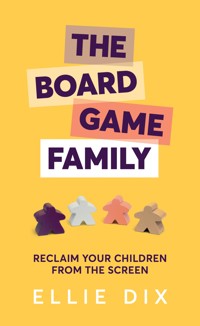
A roadmap to integrating board gaming into family life, filled with inspiring ways to engage even the trickiest of teenagers and manage game nights with flair. In The Board Game Family: Reclaim your children from the screen, Ellie Dix offers a roadmap to integrating board gaming into family life and presents inspiring ways to engage even the trickiest of teenagers and manage game nights with flair. Many parents feel as if they are competing with screens for their children's attention. As their kids get older, they become more distant leading parents to worry about the quality of the already limited time they share. They yearn for tech-free time in which to reconnect, but don't know how to shift the balance. In The Board Game Family, teacher and educationalist Ellie Dix aims to help fellow parents by inviting them and their families into the unplugged and irresistible world of board games. The benefits of board gaming are far-reaching: playing games develops interpersonal skills, boosts confidence, improves memory formation and cognitive ability, and refines problem-solving and decision-making skills. With these rewards in mind, Ellie shares a wealth of top tips and stealthy strategies that parents can draw upon to unleash the potential of those dusty game boxes at the back of the cupboard and become teachers of outstanding gamesmanship equipped to navigate the unfolding drama of competition, thwart the common causes of arguments and bind together a happier, more socially cohesive family unit. The book contains useful tips on the practicalities of getting started and offers valuable guidance on how parents can build a consensus with their children around establishing a set of house rules that ensure fair play. Ellie also eloquently explains the 'metagame' and the key elements of gamification (the application of game-playing principles to everyday life), and describes how a healthy culture of competition and good gamesmanship can strengthen relationships. Furthermore, Ellie draws upon her vast knowledge to talk readers through the different types of board games available for example, time-bound or narrative-based games so that they can identify those that they feel would best suit their family's tastes. The book complements these insights with a comprehensive appendix of 100+ game descriptions, where each entry includes a brief overview of the game and provides key information about game length, player count and its mechanics. Ideal for all parents of 8 to 18-year-olds who want to breathe new life into their family time.
Sie lesen das E-Book in den Legimi-Apps auf:
Seitenzahl: 358
Veröffentlichungsjahr: 2019
Das E-Book (TTS) können Sie hören im Abo „Legimi Premium” in Legimi-Apps auf:
Ähnliche




















For my own board game family.
CONTENTS
INTRODUCTION
WHY YOU NEED BOARD GAMES AS PART OF YOUR FAMILY LIFE
THE PURPOSE OF THIS BOOK
This book is aimed at parents who want to spend more time with their children, and enjoy it. When you have older children in the house, it is not unusual to go through an entire week or more without having a proper conversation with them. Indeed, most conversations with young adults are transactional: arranging lifts, lending money, negotiating meals … For many parents, the in-depth debriefs about the school day, the anxious heart-to-hearts about worries and the excited outpourings of triumphs and successes disappeared around the child’s tenth birthday (if they ever did happen). Although it may be normal to barely speak to your children, that doesn’t mean it is right for us as parents or for them. However, it isn’t easy to just strike up a proper conversation with someone who is permanently shielded by headphones and giving off ‘leave me alone’ signals. For conversation to flow naturally, we need to spend good chunks of time face-to-face with our children. You can’t have a proper conversation through a door.
It can be challenging to share time with your children, particularly if they’ve reached that awkward stage at which they appear to be doing what they can to avoid you. The amount of time I want to spend with my own children can depend on what mood they are in, how many jobs I have to do and whether I’m equipped with a nice cold glass of my favourite tipple. But even when life is busy and tensions are high, I yearn for some quality time with them. I expect you do too; that is why you are here.
This book will help you to reconnect with your children through introducing board games to the family home. I understand that the idea of your kids willingly skipping downstairs when the ‘family bell’ sounds on a Sunday afternoon, calling excitedly for their younger siblings and declaring that they’d just love to embark on a three-hour epic game with the whole family may have you snorting tea out of your nose. So let me make a few points about the realities of family gaming:
I do not live in the Little House on the Prairie and I know you don’t either.
You do not have to play long games, ever. Unless you want to. There are loads of brilliant games that fit happily into a 20-minute slot.
You don’t have to play games as a whole family. Nobody should ever be forced into playing.
You don’t need to set a pre-scheduled time for playing.
Family games are so much more than they used to be, so abandon your preconceptions. The choice and quality available will blow your mind (and your children’s).
If you follow the ideas in this book, game playing will become normalised in your family. At some point your children will bolt downstairs to play and you’ll not even raise an eyebrow, let alone splutter out your tea.
Through reading this book, you’ll find out how to hook your children into board gaming through clever exposure and stealth tactics. You’ll discover your own love of playing games and, in the process, develop your skills as a player and as a teacher of board games. You’ll learn how to navigate through the choppy seas of sibling rivalry, minimising the arguments and the tears, and promoting gamesmanship. You’ll modify and redesign those games you already own to better suit the family. You’ll discover your sweet spots, finding games that work well for you and your children that don’t break the bank. And, crucially, you’ll become a master of the metagame: the most important game of all.
This is not an encyclopaedia of games. Although I will mention lots of different games and point you in the direction of ones that your family might enjoy, this book is not designed as a reference guide to every game you may ever want to play. There are thousands of new games released every year, and I won’t even play 1 per cent of them (and I play a lot of games). There are already some outstanding resources available for you to conduct your own research, so I’ll point you in the right direction and show you where to look.
When I mention a game in the book, it will be to illustrate a point. Don’t expect full explanations of rules or detailed reviews because you won’t get them here. Any game which is set in bold italics is listed in the appendix, where each entry includes a brief overview of the game and key information about game length, player count, etc. To find out more about these games, you can search for video and blog reviews online, where you’ll find play-throughs, reviews and explanations of the rules. The appendix is designed to be an aid to the discussion in this book, rather than a go-to reference for all things board game related.
WHY ME?
Someone recently asked me what skills board games have taught me. For me, that question is a bit like asking what skills you’ve developed due to having a sister, or from going to school. It is a big question and practically impossible to answer. Board games have been woven through the very fabric of my life, so I can’t disconnect that one element to make a judgement about their impact on me. Games have just always been there as a completely normal activity. I know that playing games has contributed enormously to my ability to interact with others, manage failure, work creatively with available resources, experiment with multiple paths to success, solve interesting problems, adapt to changing situations and make decisions quickly. But I don’t have another non-board-gaming version of me to compare myself with, so I can’t know what I would have been like without games. Nor do I really want to.
I love board games. I loved them when I was a child and I still love them now. I love that each game provides a potted experience in a box. Whether I’m a farmer making decisions about field planning and crop rotation, one of a group of people running from an erupting volcano or a space explorer trying to expand my own civilisation, I’m able to immerse myself in the world of the game and the puzzles and problems presented by the mechanics. I get absorbed in the decision-making process, trying to optimise the outcomes as best I can. There is real pleasure to be found in making discoveries and testing out new strategies.
When I was a child, all my friends’ families had board games at home and played them regularly. Being a board game family was unremarkable. In my case, however, a few other ingredients were thrown into the mix that may have cemented my fate as a lifelong game lover. My mum was a senior lecturer in primary mathematics at Homerton College, Cambridge. She loved teaching maths through games and would often make up her own and test them out on my sister and me, before trying them with her students. Mum is a great believer in the importance of mastery of mental mathematics and believes that the easiest way to get your children to practise mathematical skills and to develop mathematical understanding is by disguising that practice in a game. Mental arithmetic, logic, probability, properties of shape and space, patterns, networks, systematic working and more can all be taught and reinforced through games. Once a year, Mum would give her students an assignment to design and create their own games. These prototypes would pass through our house for assessment … and that meant being played with.
My father gets bored very easily and uses two main strategies to manage this. Firstly, he creates very structured, optimised routines, so that a dull task happens in the most efficient manner. For example, in about 1983 he wrote a computer programme that, when he types in items needed from the supermarket, will order them according to the layout of the shop. This reduces time spent backtracking and gets the task done in the most time- and energy-efficient manner. Although Dad now lives in a different town, with a different shop, he still uses the programme weekly. And, yes, Tesco does insist on moving everything around every now and then, at which point the programme is rewritten. Secondly, he gamifies life. A favourite obsession of his is to use random generation to ‘keep life interesting’. This can be fun: randomly selecting meals for the week or the next CD to play. It can also be frustrating: his wife, my stepmother, was once forced to phone her Uncle Norman because his name came up on the random family phone calls spreadsheet. But it can go too far. My mother was once subjected to an underwhelming week-long holiday in Swepstone in Leicestershire because of random numbers being applied to the index of the Gazetteer of British Place Names. In 43 years, neither of them has been back. It’s good to find ways for games to become part of your life, but not ways for them to determine the destination of your holidays!
So as a child, board game design and gamification were familiar concepts. When we got bored with the standard versions of games we owned, my sister and I would modify them to mix things up a bit. New character cards and new rules were created for Guess Who. Happy Families were much happier with great-grandmas, grand-nieces and second cousins twice removed. The code-breaking classic Mastermind was more challenging with five or six pegs. Mum says her copy of The Great Game of Britain still contains our customised event cards, involving much more outlandish, unusual and (frankly) revolting events than the standard version does.
Our favourite game was Railway Rivals. Mum heard of it in an article written in around 1984 by a maths teacher who had used the game to teach his bottom set maths groups.1 Its designer, David Watts, a maths teacher himself, self-published the game and, in order to get a copy, Mum wrote to him, enclosing a cheque. The game arrived in the post in the cardboard tube in which it still lives all these years later. In the game, players firstly construct their own railway by drawing lines with dry-wipe pens from hexagon to hexagon across a map. In the second half of the game, they run trains on the lines they’ve created. I recently conducted an extended family audit and discovered that, over five households, we have 32 different Railway Rivals maps, including three copies of South Sweden, four copies of London and Western and one prized copy of J. R. R. Tolkien’s Middle Earth that none of us knew my sister Jenni owned. Although Railway Rivals won the 1984 Spiel des Jahres, a prestigious German award given to the game of the year, it was never mainstream. Even after winning the award, it remains obscure and undiscovered even by the keenest gamers. A far cry from most family games of the time, Railway Rivals allowed you to create your own network from scratch, creating a unique board for every game. The flexibility and creativity that Railway Rivals allows has hugely influenced my attitude towards board gaming.
My mum also says that she wanted us to learn how to lose. Both my parents would play to win. There may have been handicapping built into the house rules for a few games, but once this had levelled the playing field, it was everyone for themselves. This gave us plenty of chances to fail. I’m sure I didn’t always handle losses with grace, but when I won, I knew I had earned it. House rules allowed us to compete as equals. My parents enjoyed playing just as much as we did. Parental enthusiasm rubs off on children and I’m sure I have my parents to thank for sparking my delight in board games.
I was also blessed with a wonderful granny, who lived with us for my entire childhood in a granny flat attached to the house. Every evening my sister and I would each take a turn with Granny. Daily turns lasted around 20 minutes. Sometimes Granny and I would chat, but usually we’d play word games and card games: Beat Your Neighbour, Go Boom, Whist, Town and Country, Consequences, Boxes … Granny taught me lots of versions of Patience, to help me entertain myself more effectively. Granny would never have anything planned or something more important to do; she would always just be there ready to do whatever we wanted – for 20 whole minutes. When I’d used up my Granny time and nobody else wanted to play with me, I’d execute full games of Monopoly with my cuddly toys – me taking turns for each of them. I’d usually win. My toys were kind to me.
As an adult, I’ve always worked with teenagers in some way or another. In my early twenties, I worked at a summer camp in upstate New York, became a director for a children’s theatre company, ran after-school drama groups, spent nine months working as a teen activity coordinator on a cruise ship and eventually became the head of drama in a secondary school. Throughout all these jobs, I modified and designed loads of games to aid my teaching and to keep the teens in my care entertained. I created drama games based on fractions and decimals, scavenger hunts that involved a series of mini logic problems and complex trust games that involved mazes and programming actions.
From 2004 to 2017, alongside my husband, Paul, I was owner and director of Pivotal Education, the UK’s largest team of school behaviour specialists. Pivotal Education helps school leaders to define and build positive cultures in their school, improve relationships and embed exceptional behaviour. Pivotal Education has helped thousands of teachers to transform their classrooms and improve outcomes for their learners. My understanding of behaviour and experience of helping teachers to change their own behaviour to impact that of their learners helps me to understand the challenges that parents face in managing behaviour in the home.
In the early days of Pivotal Education, I ran training sessions for primary school teachers in how to teach maths more actively. These sessions would use drama and gamification to challenge them to expand their practice and to take more risks to increase pupils’ engagement with the subject. These workshops fired up my mathematical interest, which had been lying dormant since completing my A levels, and I embarked on a second part-time undergraduate degree with the Open University. Six years on, I’ve nearly completed my BSc in mathematics. I keep getting side-tracked, because the course content provides such great inspiration for board games that I have to go off and make them.
I’ve been a board-gaming teenager and a board-gaming teacher of teenagers, and now I am a board-gaming parent of one teenage son and another who soon will be. Other people feed their children hearty and varied meals; I feed mine board games. They do get food too (and reasonably healthy stuff), don’t worry, but I aim to nourish their souls with games. I realise I’m more than a little obsessed, but games have had such a positive impact on the family that, for me, it is a total no-brainer. Board games are part of our family brand and that’s a badge we all wear proudly. I recently overheard my younger son telling my older one that he can only have a new girlfriend on one important condition: she must like playing games. My elder son agreed. Now I’m putting my understanding of behaviour, my experience with gamification, my teaching skills and my game-playing history to use by helping other parents to introduce board games into family life.
WHY BOARD GAMES?
So why board games? There are other ways to engage teenagers in family activities. Other hobbies do exist. You could construct model aircraft, strip and rebuild a car engine, play basketball or do scrapbooking … But board games are different; they are special. Here’s why:
The bar to entry is very low. You don’t need special training or certification. Board games don’t rely on any special skills or expertise and you don’t need to have played a hundred different games to be able to teach someone how to play one. Most games are designed to be picked up, learned and played quite quickly by those who have never touched them before. While you may come across some real board game geeks, you certainly don’t have to be one to join in.
There is a huge amount of variety within board gaming. The types of experience you have while playing games, the differences in mechanics, themes, artwork, characters and components are truly mind-boggling. Games vary in length and complexity. Different games require different skills and knowledge for success. There are games to suit everyone.
Board games are portable and easy to store. You don’t need to take over the loft, as you might with a miniature railway set. You can grab a game from the cupboard and set it up in minutes.
There is no major long-term commitment. Adults may have grand plans about huge projects to embark on with their children, but even when initially greeted with enthusiasm, the project may easily outlive a teenage attention span (and possibly an adult one too). One rainy day of trying to build a treehouse might be the beginning and end of a gloriously billed parent–child project. Board games have no such issue; each play is a complete experience in itself.
Board gaming is an indoor pursuit. In the UK it rains. And for months of the year it gets dark early. You may love mountain biking as a family, but it isn’t always weather-appropriate. On those long, dark, wet evenings, board games will not let you down.
Board games will fit into your day. You can select the game according to the number of players you have and the time you want to spend. You can select a game that you can play in half an hour or that takes a full afternoon. Set-up time is minimal. You can grab a game and be up and running quickly.
Once you own a game, you can play it over and over again: it’s an unlimited resource. You aren’t restricted to a certain number of plays before the game becomes useless. So if you launch into a game and you’re not feeling it, you can pack it away and pick another, with no wastage and no cost.
Board games increase interaction and boost relationships.2 When you play games, players focus on one another, but within the safety and structure of the game. To be successful, you learn to communicate effectively so that you can accomplish your objectives.
Playing games can increase your awareness of others. Players learn to truly listen to obtain information about other players. The timbre, pitch, tone and volume of the voice gives indications of how they are feeling about their moves. A player’s body language – like switching the order of the cards in their hand, or becoming unnaturally still, or the direction of their gaze – gives micro-clues to their possible next plays and overall strategy.
Board gaming is inclusive. Anyone can play. All ages can play together. Many disabilities can also be catered for. Children can compete on a level playing field with their parents. With the right games, strength, age, physical ability and prior knowledge will give you no discernible advantage.
Playing games improves memory formation3 and cognitive skills,4 increases processing speed,5 develops logic and reasoning skills,6improves critical thinking,7 boosts spatial reasoning,8 improves verbal and communication skills,9 increases attention and concentration,10 teaches problem-solving,11 develops confidence12 and improves decision-making.
Playing games teaches competitiveness within a limited domain. The family learns to play to win but they don’t need to win. Everyone gets used to experiencing defeat; games involve failure on a manageable scale.
Playing games can increase our consideration of and respect for others. A common parental mantra is, ‘You wouldn’t like it if your sister did that to you’ and with the fast pace of turn-by-turn action in board games, your children can see the implications of this phrase being played out in real-time. ‘Treat your brother as you want him to treat you’ has a lot more meaning if the tables are going to turn in the next 30 seconds. Through games we learn to consider the impact of our actions on others.
Board games provide players with challenge. We strive to improve our own performance by experimentation. Mistakes are remembered and learned from. While beginner’s luck may occur from time to time, usually players who have had the most experience at playing a game will be the most successful. Players learn that the time taken on refining their strategy and game play will reap benefits in the future.
Playing games has proven health benefits13 as it induces laughter14 and reduces stress, which boosts the immune system and lowers blood pressure.15
All this potential from a few dusty boxes lurking at the back of a cupboard.
You may come to this book with preconceptions about board gaming. Unless you have played some of the new games that have been published in the last few years, these will likely come from your own experiences of board gaming as a child. But the world of board games is very different now. The rise of crowdfunding has had a huge impact on tabletop games, sparking a surge in innovation and allowing hobby game designers to get their creations out into the world. In the same way that social media has driven a shake-up of traditional journalism, so has crowdfunding forced the big game publishers to get creative. This isn’t a renaissance of board gaming; it has never been this good.16 Inventive mechanics, clever interactions, interesting themes and beautiful components will draw you in and get you hungry for more. If you go to a game convention or a specialist game shop, you’ll see people from every walk of life. Board gaming is magnetic and indiscriminate in its attraction. It’s time to banish your assumptions and get ready for the ride of your life.
WHY NOW?
It seems that everyone is spending more time on their smartphones or other devices and less time communicating face to face. Young people are growing up in increasingly digital environments and some are suffering from reduced social skills, difficulty sleeping and, in some cases, technology addiction. As adults, we too turn to screens for our entertainment and relaxation. There are families all over the country in which people are sharing experiences with their smartphones, rather than with each other. Children are growing up in a world in which this is the new normal. But it seems obvious that it shouldn’t be normal. How long should we let this go on before we look back, assess the real damage and understand the cost?
It feels like every week a new study emerges warning about the consequences of our children’s reliance on smartphones: from social isolation to concentration problems, bullying, bad language and exposure to pornography. Children as young as 12 are eligible for treatment for gaming addiction on the NHS.17 The World Health Organization has officially classified ‘gaming disorder’ as a disease,18 and we have heard that the more time people spend on social media, the lonelier they are likely to become.
Technology is here to stay. We aren’t going to reverse back to a ‘simpler time’ nor would most of us want to. Development will speed up, not slow down. What needs to change is our relationship with technology: our reliance on it and our life outside of it. We need to find ways to manage digital technologies around our relationships, not the other way around. Dr Richard Graham, consultant in digital psychiatry at Nightingale Hospital, runs the UK’s first technology addiction service. He says, ‘Clearly new technologies are not just blindly positive for all,19 and critically, knowing when not to use devices may be a cornerstone to digital-wellbeing.’
Today, the majority of parents will have grown up before the internet, the rise of smartphones and the ubiquity of Wi-Fi. When we were growing up, we had to entertain ourselves, make our own fun and experience boredom. But this was a while ago and many of us have forgotten how we used to entertain ourselves, how we discovered information and how we communicated with friends. Today’s young adults were born into a time when the internet was mainstream. They’ve not known a different world. In a very short space of time, all parents will be of the internet generation. Nobody will have even those hazy and rose-tinted memories of life before widespread technology. If we, today’s parents, don’t make an effort to create rich offline experiences for our families, how will our children be able to do the same for their own children when they are parents? As the bridging generation – who were children pre-internet and parents with-internet – we are in a unique position to challenge and define the new world order. We can’t stop the march of technology, but we can establish its place within our families. Fear and panic may help us to educate our children about the perils of the online world, but it won’t teach them the joys of the offline one.
As parents, we recognise the problem, but many of us don’t know how to shift the balance – so, to start with, it is time to be honest with ourselves about our own relationship with technology. It isn’t fair to expect our children to withdraw from screens when we ourselves don’t even go to the toilet without our smartphone. There may be a nagging voice in my head that tells me that I shouldn’t be on mine, but there is a louder voice that pipes up with all sorts of justifications. If you pine for screen-free time for your family, you should start with yourself. While you read this book and test out the ideas, put yourself through a gentle digital detox. (Have a look at How to Break Up with Your Phone by Catherine Price for starters.20) Gradually change your relationship with your smartphone so that you are in control of it, rather than the other way around.
You, as a parent, are the best person in the best position to teach your children how to fully live outside their smartphone, tablet or games console. We need to develop our family’s offline lives to keep pace with our online ones.
YOU ARE NOT ALONE
Most teenagers develop what their parents would (politely) describe as an over-reliance on their smartphones, creating a refuge into which they can retreat for many hours. Much of the time, they are living within their online worlds. When they are forced out of this world and back into ours, where the structures, hierarchies and rules are different, sparks can fly.
You’re not alone; managing children’s interaction with their online world is reportedly the biggest issue for modern parents:
Action for Children’s latest research has found that nearly a quarter of parents struggle to get their children to “unplug” and take part in activities away from television, smartphone and computer screens. When asked which behaviour they found most difficult to control in their children, more parents said they struggled to limit technology-based activity(23 per cent) than get children to eat healthily (19 per cent), go to bed (18 per cent), or do their homework (10 per cent).21
The battles that you are having are being played out in households everywhere. You may not realise how widespread the issue is because many parents choose not to talk about it. A child’s dependency on their smartphone (or other screens) may be seen as a parenting issue, or even as a parenting failure. Along with the worry about the amount of time spent online goes the guilt that you should be more effective at reducing it. Guilt or embarrassment can prevent parents from openly sharing their concerns with others. So take heart, this is a problem that almost all parents have to deal with. What you may not realise is that you are already way ahead of the others in starting to find a long-term solution. By the time you get to the end of this book you will have the understanding and practical strategies you need in order to reconnect with your children through board gaming and begin to balance your family life.
Time passes quickly. It is so important that we try to make the most of the time we have with our children while they are still at home. It is a common family scene to find everyone (including the parents) gazing at their own small screen, but when each person is engaged in their own online world, fewer shared memories are being made in the offline one. If this is true almost every time the family meets, how can you foster a sense of family belonging? Through shared experience we strengthen our relationships and create memories.
Getting caught up in the day-to-day routines and battles stops parents from taking the time to draw the line and make a change. You’re not going to do that anymore. There is never a perfect time, but you don’t need a perfect time. Follow the strategies in this book and you’ll make the change despite the tiredness, the hectic activity and the demands of being a parent.
Most advice about reducing screen time seems to revolve around enforcing restrictions. Keep all smartphones in the kitchen overnight, have prescribed screen-free downtime at least an hour before bed, impose limits on screen time, make sure that there are no phones at the table, etc. Practical advice on what you should do to plug the gaping screen-sized hole left in the fabric of family life is much thinner on the ground. Well, I’ll tell you now, restricting screen time won’t work. I’ll say it again because it’s important. Restricting screen time won’t work. In itself, it isn’t a solution. The feeling of needing to spend time online, in one’s own digital world, is very strong. This feeling, which will drive your children to creatively bypass restrictions or just harangue you until you give up, is so strong that you are fighting a losing battle before you even start. This path will lead you to a world of arguments, suspicion and lies – not the kind of family environment that you yearn to create. Don’t get me wrong, restrictions can work, especially when partnered with using screen time as a reward rather than a right,22 but not in isolation. If you can offer something more important to focus on, then introducing restrictions will be easy. Until that point it will always be hard work. Your job is to work on making your family’s offline world irresistible. Hook them in using stealth tactics until they are smitten and then watch as the smartphones lie abandoned and unnoticed in another room.
This book will guide you in how to develop a family that plays together. It will open your eyes to the huge impact that play can have on the strength of your family’s relationships and the quality of the time you spend together. It won’t happen all at once. There’ll be times when nothing much seems to be happening. But there will come a day when your kids will come home from school, throw down their bags and beg you to get off your laptop and play a game with them. Patience will pay off. You may need to read this book more than once. Use it as a resource and a guide. When there has been a messy explosion and you are loudly reminded (which you will be) that you are stupid, that this game stuff is stupid and that the whole family is stupid, return to the book. You may find something you missed the first time, something that will be the hook for your child. You’ll know it when you find it.
Remember, you’re already way ahead of most parents.
Get excited: life is about to change.
1 Unfortunately, I’ve been unable to track down the source.
2 Lawrence Robinson, Melinda Smith, Jeanne Segal and Jennifer Shubin, The benefits of play for adults, Help Guide [blog] (November 2018). Available at: https://www.helpguide.org/articles/mental-health/benefits-of-play-for-adults.htm.
3 ‘Nothing lights up the brain like play. Three-dimensional play fires up the cerebellum, puts a lot of impulses into the frontal lobe – the executive portion – helps contextual memory be developed.’ Stuart Brown, ‘Stuart Brown: play is more than fun’, TED.com [video] (12 March 2018). Available at: https://www.youtube.com/watch?v=HHwXlcHcTHc.
4 Health Fitness Revolution, Top 10 health benefits of board games, Health Fitness Revolution [blog] (15 May 2015). Available at: http://www.healthfitnessrevolution.com/top-10-health-benefits-board-games/.
5 Allyson P. Mackey, Susanna S. Hill, Susan I. Stone and Silvia A. Bunge, Differential effects of reasoning and speed training in children, Developmental Science, 14(3) (2011): 582–590.
6 Jennie Pennant and Liz Woodham, Developing logical thinking: the place of strategy games, NRICH Maths (November 2013). Available at: https://nrich.maths.org/10019.
7 Gwen Dewar, Board games for kids: can they teach critical thinking? Parenting Science [blog] (n.d.). Available at: https://www.parentingscience.com/board-games-for-kids.html.
8 Shen-Li Lee, How to help children develop spatial reasoning skills, Figur8 [blog] (8 February 2017). Available at: https://www.figur8.net/2017/02/08/developing-spatial-reasoning-skills/.
9 John Leana, Sam Illingworth and Paul Wake, Unhappy families: using tabletop games as a technology to understand play in education, Research in Learning Technology, 26 (2018). Available at: https://journal.alt.ac.uk/index.php/rlt/article/view/2027.
10https://www.scholastic.com/parents/kids-activities-and-printables/activities-for-kids/arts-and-craft-ideas/benefits-board-games.html
11 Damian Corless, Teaching life skills using board games? It’s child’s play … Independent.ie (1 November 2010). Available at: https://www.independent.ie/life/family/learning/teaching-life-skills-using-board-games-its-childs-play--26790410.html.
12 Jean Rhodes, 10 reasons mentors should play cards with their mentees, The Chronicle of Evidence-Based Mentoring [blog] (12 April 2015). Available at: https://www.evidencebasedmentoring.org/play-cards/.
13 Alessandro Viggiano, Emanuela Viggiano, Anna Di Costanzo, Andrea Viggiano, Eleonora Andreozzi, Vincenzo Romano, Ines Rianna, et al., Kaledo, a board game for nutrition education of children and adolescents at school: cluster randomized controlled trial of healthy lifestyle promotion, European Journal of Pediatrics, 174(2) (2015): 217–228.
14 Lawrence Robinson, Melinda Smith and Jeanne Segal, Laughter is the best medicine, Help Guide [blog] (November 2018). Available at: https://www.helpguide.org/articles/mental-health/laughter-is-the-best-medicine.htm.
15 See http://www.healthfitnessrevolution.com/top-10-health-benefits-board-games/.
16 Mason Boycott-Owen, After books and vinyl, board games make a comeback, The Observer (13 May 2018). Available at: https://www.theguardian.com/lifeandstyle/2018/may/12/millennials-drive-board-games-revival.
17The Telegraph, NHS to treat child gaming addicts as young as 12 isolated from friends (31 July 2018). Available at: https://www.telegraph.co.uk/news/2018/07/31/nhs-treat-child-gaming-addicts-young-12-isolated-friends/.
18 See https://www.who.int/features/qa/gaming-disorder/en/.
19 Richard Graham, A cure for the fear of missing out? Huff Post [blog] (22 May 2016). Available at: https://www.huffingtonpost.co.uk/dr-richard-graham/fear-of-missing-out_b_7349230.html.
20 Catherine Price, How to Break Up with Your Phone: The 30-Day Plan to Take Back Your Life (London: Trapeze, 2018).
21Action for Children, ‘Unplugging’ from technology (6 January 2016). Available at: https://www.actionforchildren.org.uk/news-and-blogs/whats-new/2016/january/unplugging-from-technology/.
22 See Noël Janis-Norton, Calmer Easier Happier Screen Time (London: Yellow Kite, 2016).
CHAPTER 1
DISRUPT YOUR THINKING
Home truths to get to grips with.
The amount of information and advice that is thrown at us when we become parents is enormous. It can often seem like any decision we make is the wrong one. There is always someone ready to criticise or contradict, usually armed with a barrage of stories to back up their point of view. Doubt and guilt go hand in hand with parenting. As children grow, the challenges change. Dealing with teens and pre-teens can feel like we are navigating our way through a minefield, blind.
But, as a parent, you know your children better than anyone else and you are the person who is the most qualified to bring them up. Gather information, listen to advice, but make your own decisions about what will work with your family in your home. Be confident with your choices, even if those around you are making different ones.
To help you make parenting choices that will enable you to reclaim family time and play more together, here are my home truths. Grasp these and you’ll pull your family closer rather than drifting apart as your children mature.
HOME TRUTH 1: THE WAY YOU USED TO PARENT WON’T WORK NOW
Parenting needs to grow as our children do. Children have a way of going through rapid bursts of development, particularly when they hit puberty, and these changes can sneak up on parents and catch us unawares. It is really hard to let go of how we used to parent, especially if we’ve been successful in the past. Therefore, it is important to be as reflective and self-aware as possible.
When children are young, they rely on us for everything. The parent is their main guide and provider of information about the world and how to operate within it. Younger children tend to believe what their parents say, display less scepticism and are more easily influenced. Most younger children look up to their parents, and adulthood is often revered as a pretty exciting and magical existence.
As children get older, we give them more of an insight into the reality of adult life; we share our weaknesses, fears, worries, responsibilities and concerns. Of course, we must do this to teach them life skills and to help them become rounded, considerate people, but it removes some of the mystery around adulthood and the reverence often diminishes with it. It is hard to retain the control that many parents fight for when you’re dealing with young adults who have a wider social network that provides them with external influences on their behaviour and values. This fight between control and independence causes lots of problems in many families.
The desire for independence pushes children away from their parents. Although this is a natural part of growing up, it is often hard for parents to live with. They seem to want to talk, only not to us. As they start to build their own personal lives, they become more secretive and private. Of course, this independence is combined with the fact that they believe they’ve already learned everything you have to teach them, so they are less open to discussion and advice. Of course, some teenagers are more, well, teenagery than others. Most fluctuate, even in small ways, between wanting to be part of the family and wanting everyone to just leave them alone.
So, as parents of teens or pre-teens, what can we do to make the road a bit smoother and to keep the relationship strong, even in murky hormonal waters? People with adult children often talk about ‘coming out the other side’. After the distance and tumult of the teenage years, the bond between parent and child strengthens again. Focusing on the long-term relationship and seeing teenage behaviour for what it really is can be enormously helpful to a harried parent. Deal with the issues with as much detachment as possible and save your emotion for showing your hormonal children love. Look for opportunities to be proud. Look for ways to reinforce how important they are. They might think all sorts of things about you, but never let them think that you don’t love them.
HOME TRUTH 2: YOU’LL NEVER GET YOUR CHILDREN TO TELL YOU ABOUT THEIR DAY
Parenting older children is particularly challenging. Communication becomes less open and relationships more strained as they strive for more freedom without yet having any of the tools with which to achieve independence. You keep trying to communicate, but it often feels like you’re spiralling further away from each other. You long for the ease with which you communicated when they were younger.
This is how the separation spiral takes hold:
The child chooses to spend less time with their parents than they used to, so the parents are not as involved in their day and they don’t have as many natural opportunities to chat.




