


11,99 €
Mehr erfahren.
- Herausgeber: John Wiley & Sons
- Kategorie: Fachliteratur
- Sprache: Englisch
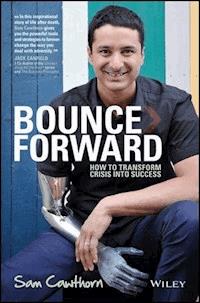
An inspiring business book that shows leaders and businesspeople how to turn adversity into innovation, productivity, and profitability When he was just twenty-six years old, Sam Cawthorn's life changed forever. A terrible car accident cost him his arm, left him in a coma, and put him in a wheelchair for the rest of his life--or so he thought. Today, Sam is one of the most successful motivational and inspirational speakers around, addressing some 100,000 people around the world each year, from some of the world's biggest companies. Sam's recovery was more than just a bounce back to where he had been before the accident. Instead, he used his accident as a launching pad to bounce forward to reach even greater heights than before. Now, Sam uses his own story to share the secrets of both personal and corporate turnarounds, how to use adversity as a springboard to greater heights not just for individuals, but also for companies and teams. Sam speaks to bankers, salespeople, leaders, corporate executives, government workers, students, and anyone else who faces challenges and setbacks every day. In Bounce Forward, Sam shares the tools, strategies, and psychology that anyone can use to overcome any obstacle. If Sam can bounce forward from the accident that nearly took his life, there's almost nothing that you can't overcome. * An inspiring and motivational guide to overcoming challenges in life and in business * Ideal for corporate leaders and employees, business managers, and anyone else who needs to motivate themselves or their teams * Packed with the tools, strategies, and secret formulas it takes to turn adversity into success No matter what kind of challenge you face--in the office, at home, or even in your own heart--Bounce Forward gives you the insight you need to climb higher than ever before, in business or in life.
Sie lesen das E-Book in den Legimi-Apps auf:
Seitenzahl: 334
Veröffentlichungsjahr: 2013
Ähnliche

















In this compelling book, Sam Cawthorn shares important life lessons that emerged from his extraordinary experience of overcoming adversity. Sam’s inspiring message, conveyed with his characteristic clarity, charm and humour, will empower you to overcome obstacles and savour the joy of living every day.
— Michael J. Gelb, author of How to Think Like Leonardo da Vinci
Sam has an inspirational story of ‘life after death’. Sam lives his message and he is the most qualified to talk about this subject. This book has practical tips and advice to overcome any obstacle in life.
— Dr V.S. Ramachandran, best-selling author and one of Time magazine’s top 100 most influential people in the world
It’s not often that a man comes back from the dead and lives to tell the tale but Sam is one of those miracle men.
— The Telegraph
First published in 2013 by John Wiley & Sons Australia, Ltd
42 McDougall St, Milton Qld 4064
Office also in Melbourne
Typeset in 11/13.5 pt ITC Berkeley Oldstyle Std
© Empowering Enterprizes Pty Ltd
The moral rights of the author have been asserted
National Library of Australia Cataloguing-in-Publication data:
Author: Cawthorn, Sam
Title: Bounce forward: how to transform crisis into success / Sam Cawthorn.
ISBN: 9781118641347 (pbk.)
9781118641354 (ebook)
Notes: Includes index.
Subjects: Mind and body.
Mental healing.
Self-actualization (Psychology)
Conduct of life
Dewey Number: 158.1
All rights reserved. Except as permitted under the Australian Copyright Act 1968 (for example, a fair dealing for the purposes of study, research, criticism or review), no part of this book may be reproduced, stored in a retrieval system, communicated or transmitted in any form or by any means without prior written permission. All inquiries should be made to the publisher at the address above.
Cover design by Jennifer Sheahan, [email protected]
Author photo © Summer Rain Photography
Printed in Singapore by C.O.S. Printers Pte Ltd
10 9 8 7 6 5 4 3 2 1
Disclaimer
The material in this publication is of the nature of general comment only, and does not represent professional advice. It is not intended to provide specific guidance for particular circumstances and it should not be relied on as the basis for any decision to take action or not take action on any matter which it covers. Readers should obtain professional advice where appropriate, before making any such decision. To the maximum extent permitted by law, the author and publisher disclaim all responsibility and liability to any person, arising directly or indirectly from any person taking or not taking action based on the information in this publication.
Contents
Preface
About the author
Acknowledgements
Introduction: The bounce cycle
PART I: The Bounce Principles
1 Principle 1: Crisis creates opportunity
2 Principle 2: Proximity is power
3 Principle 3: Leveraging positivity to fuel success
4 Principle 4: Bounce forward not back
PART II: The 12-Day Challenge
5 The 12-day crisis turnaround challenge
Conclusion: The power of bounce
Afterword: The bounce movement
PREFACE
There are pivotal, game-changing moments in every person’s life — the Greeks called them ‘kairos moments’. For some those moments are so significant that they immediately fracture that life, ripping it forever into two parts — everything before that moment, and everything that came after.
My kairos moment occurred just after 3 pm on 3 October 2006. The day had started normally enough. I woke up early as usual, assisted by my eldest daughter Emelia, who was three and a half at the time. As the house stirred into life Milly (as we affectionately call her) left my wife, Kate, and me and went to wake up her little sister, Ebony, who was just 15 months old. The girls watched some cartoons as Kate prepared their breakfast and I got ready for work. It has been a Cawthorn family tradition that we all sit down at the table together, eat our breakfast and discuss our plans for the day. After breakfast the girls and I put on some loud music and danced around the living room. I would throw each one up in the air and catch her as she squealed and giggled with delight. I thought to myself how lucky I was and what a great way it was to start the day.
At the time I was working as an industry adviser to young people’s trends and careers, like a youth futurist, an initiative funded by the Australian Federal Government. I’d been in the job only a few months but I loved it. I was 26 years old; I had a big job, good salary and great company car, plus I had a huge amount of freedom to work how I pleased. Essentially, my job was to follow cultural and economic trends so I could help predict how those trends would affect 13- to 19-year-olds entering the workforce. I would then liaise with employers and government to make sure young people were encouraged to move into industries and professions where there were job opportunities. I also watched for signs of market saturation so I could pass information back to the government, which would alert them to any likely reduction in new jobs in a particular industry or field.
I had a young family and a full-time job that sometimes required that I drive up to 1500 kilometres a week. I was also involved in my local community, running a youth group, and owned my own music studio where I taught hip-hop and singing. Life was definitely hectic.
As I climbed into my car — a white Holden V8 Statesman — Kate and the girls stood at the door to wave me off. There was a little L-shaped dent on the roof of the Statesman just above the driver’s seat and Milly always thought it looked like a love heart. We felt it was a good omen of love and protection as I set off to work each day.
I had a couple of meetings and a lunch appointment in Burnie, about 150 kilometres from our home in Launceston in Tasmania, which is where I grew up and have spent most of my life. It was a little after three in the afternoon when I said goodbye to my lunch companions. I remember shaking hands, little knowing that this was the last right-handed handshake I would ever share. I began the journey home on the Bass Highway and about 10 minutes out of Devonport, a city half an hour from Burnie, near Parramatta Creek, I fell asleep at the wheel.
In a semi-conscious state I drifted across the road into the oncoming traffic. The driver of the truck I collided with thought I was trying to commit suicide. I wasn’t. I was just exhausted from trying to keep so many balls in the air, and something had to give. What gave was the side of my Holden V8 Statesman sedan.
The first driver had successfully swerved out of the way, but the driver of the semi-trailer behind was not so lucky. Police estimated that upon impact, the truck driver and I were travelling at a combined speed of around 206 kilometres per hour. The first impact spun me around several times and ripped open the entire right side panel of the car. Within a fraction of a second another car, which had been travelling behind the truck, ploughed straight into me — and I mean straight into me. Without the side panel there was no protection whatsoever. I can still hear the terrible impact of that final collision.
That moment changed my life forever.
When the roaring of twisted metal finally came to a stop, there was absolute silence — at least I couldn’t hear anything. I could see the damage but somehow it didn’t register in my mind as being real. Smoke billowed from the carnage and I remember looking down at myself; I was a mess. I could see my bones and flesh exposed and there was blood everywhere. My right arm had been obliterated, the elbow was completely gone and my hand was attached to my arm by a thin thread, my right leg was completely shattered, and the pain was like nothing I’ve ever experienced!
Despite the late afternoon sun, I was very cold. ‘HELP!’ I yelled. ‘GOD SAVE ME!’ Every ounce of energy within me was trying to coordinate my breathing and my yelling. ‘HELP, GOD, GOD, PLEEEEASE HELP ME, DON’T LET ME DIE TODAY. PLEASE TELL MY WIFE I LOVE HER.’
When Kate was told of the accident a friend rushed her to the hospital. Unfortunately there was only one way to get there and it meant driving past the scene of the accident. One of the worst moments of her life was recognising the little L-shaped love heart on the roof of the mangled Holden, and wondering how anyone could have escaped alive.
In truth, it was initially thought I didn’t escape alive. Six months after the accident I was in a wheelchair having dinner at a restaurant and I was approached by a guy who wanted to know if I was the man from the Parramatta Creek accident. It turned out he was a coroner’s taxi driver. He was informed that there had been a really bad accident on the Bass Highway and he was probably going to be needed to collect a body — mine! Thankfully the paramedics successfully resuscitated me when they arrived on the scene.
My right arm was destroyed, I broke six ribs, lacerated my liver, punctured my kidney and both lungs collapsed. I dislocated my hip; my entire quad muscle was ripped from the bone on my right leg. My cruciate ligaments had torn and I shattered my femur, knee cap, fibula and ankle and lost the nail on my right big toe. I was devastated at having lost my big toenail!
Yet as far as I am concerned I was incredibly lucky. First, no-one else was badly injured. Second, I was alive. My accident certainly changed my life, but as the Greek philosopher Epictetus once said, ‘It’s not what happens to you, but how you react to it that matters.’
So often people talk about ‘bouncing back’ after disaster, crisis, tough times or difficulty, but my body was broken. There was no way I could ever bounce back to the old Sam Cawthorn. It wasn’t physically possible. I began to obsess about this idea and started to research resilience and how others had overcome incredible obstacles to pull off amazing comebacks. In countless cases individuals and businesses used great challenges to forge ahead and create a better life or create even greater success.
Nothing in life stays the same for long. Change and challenge are constant, although the speed and complexity of change now means we can expect upheaval every few years. World economies are still reeling from the global financial crisis that began in 2007–08. Business is getting tougher and tougher and yet there are still success stories everywhere you look. Clearly some people have already instinctively tapped into the power of bounce and learned how to use the inevitable difficulties of life as a springboard to something better.
No-one is immune to the challenges of life. Bad stuff happens to everyone regardless of wealth, background or education. For some their crisis will be professional — losing a major client, being made redundant or having to adapt to a changing market during an economic downturn. For others their crisis may be personal — the breakdown of a relationship, serious illness or, like me, physical injury. Pain is inevitable; it is part of being alive. But misery is optional. I knew I had a choice: I could give up, listen to the doctors who told me I’d never walk again, and wallow in misery and bitterness. Or I could accept that things had changed and use the crisis to reinvent myself and get better. I chose the latter. The challenges we face in life are not meant to be some sort of punishment; rather, they are an invitation to change — and an opportunity to create something even better than before.
Since my accident I have experienced excruciating pain but I have also become stronger, happier and more determined because of it. I have come to understand the transformational power of acceptance and have developed a process to help businesses, organisations, teams and individuals to go far beyond ‘recovery’ or ‘bouncing back’ to create revolutionary change by bouncing forward into greater joy and success.
Too often, when crisis knocks on our door — whether professional or personal — either we ignore it, or we use all our energy and resources to try to go back to the way things were. We scramble to fix the problem so either it goes away or life somehow goes back to the way it used to be.
I believe that the reason crisis sometimes destroys people or breaks their spirit is that they are fixated on what used to be. All their efforts are directed toward trying to recapture that experience or way of life. But sometimes there really is no going back. There is, however, always a way forward. I’m not promising that it’s going to be easy, but this book is your road map through crisis so you can bounce forward into a better life.
Bounce consists of four crucial principles:
• Crisis creates opportunity.
• Proximity is power.
• Leverage positivity to fuel success.
• Bounce forward not back.
If you want to successfully navigate crisis and difficulty so you can use adversity to achieve even greater success, then you must understand these principles. Each of the four principles, as outlined in chapters 1–4, is facilitated by four habits. These habits may not come naturally to you, but if you focus on fostering each one in your daily life you will master crisis and learn how to consistently benefit from difficulty. Finally, once I’ve explained all four principles, in chapter 5 you will be invited to take the 12-day crisis turnaround challenge. This process will help get you into the right frame of mind to take action, to advance quickly through your current challenge by activating the power of the bounce principles.
Although I will focus mainly on bouncing forward in business and your career following redundancy or a career setback, bounce is as applicable to a personal crisis as it is to a professional one. You will learn about cutting-edge science and the research that underpins the bounce forward process, and how to use it to make real, long-lasting positive change — whether the problem you face is a minor irritant or a disaster so huge it has recalibrated your life forever.
My crisis demanded full recalibration. I lost my arm and I still have several physical limitations; I can’t, for example, bend my right leg. But I honestly wouldn’t change a thing. Everything that has happened in my life, including my accident, has made me the person I am today. In 2008, two years after my accident, Kate and I welcomed our son, Jacob, into our family and I now live a life I couldn’t even have dreamed of before my accident.
And if I can do it, so can you. Remember, pain is inevitable — misery is optional. Forget about trying to recover what used to be. Instead embrace the crisis and use it to bounce forward into a life that is bigger, better and brighter than ever before.
ABOUT THE AUTHOR
A busy global keynote speaker, businessman and philanthropist, Sam Cawthorn has been through a massive change from his humble beginnings as a country farm boy from Tasmania who was a high school dropout.
In October 2006 Sam’s life changed forever where he was involved in a major car accident that left him with an amputated right arm and a permanent disability to his right leg. Yet it was this journey that enabled him to develop a mental resilience that gave him the tools to miraculously recover from his accident.
Today he is a leading expert and thought leader in resilience and positive psychology and has an unrivalled ability to distil complex strategies into simple and powerful models that can be applied immediately to produce measurable and lasting results. Sam was awarded Young Australian of the Year for Tasmania in 2009.
Sam has a diverse background within the Australian Federal Government as a Youth Futurist and is a highly skilled musician, and one of the only people in the world who retaught himself to play the guitar with an above-elbow amputation. Sam has been honoured for his business acumen, strategic intellect and humanitarian endeavours.
Sam and his wife Kate started a very unique charity building green sustainable schools in India working specifically with kids living with a disability and in the empowerment of women.
He has the unique ability to transform impossibilities into possible realities. You only need to speak with Sam’s audiences to understand how powerful Sam truly is — and he does all this with the most advanced bionic arm in the world.
Sam is married, with three children and currently lives in Sydney, Australia.
Connect with Sam:
> Website: www.samcawthorn.com
> LinkedIn: www.linkedin.com/pub/sam-cawthorn/a/885/368
> Facebook: www.facebook.com/sam.cawthorn
> Instagram: /samcawthorn
> Twitter: https://twitter.com/samcawthorn
ACKNOWLEDGEMENTS
This book was written in honour of my brother David. You inspire me every day!
I would like to thank Karen McCreadie who was the backbone in putting this book together. My awesome wife Kate and my three children, Emelia, Ebony and Jacob. Lucy Raymond and the Wiley team who believed in me. Darren Hill for the inspiration of Bouncing Forward. My speaker friends who were instrumental in the journey. My father Peter, who inspires me every day of my life. I would also like to thank God, the reason why I live a passionate life.
INTRODUCTION
THE BOUNCE CYCLE
The ancient Greeks had two words for time: chronos and kairos. Chronos, the source of the word ‘chronological’, refers to ordered or sequential time. Kairos refers to an indeterminate moment within time when something special happens. It’s an interesting and fine distinction. For most of us, day-to-day life is just the passage of time, but then there are moments, days, weeks, months or even years that stand out as especially significant. This sort of time changes lives.
Change of any sort can be uncomfortable, confronting and painful. For the most part we automatically assume that change is difficult and should be avoided wherever possible. And yet who said that change was bad? Change is like the weather: it’s inevitable and in itself is neither good nor bad — it just is. Rain is good for the farmer who needs it to grow his crop. If, however, you’ve saved all year to take your family to Disney World and it rains every day, then the same condition is far from welcome. Interestingly, kairos also means weather in both ancient and modern Greek.
Change for me came when I was fitted with the most advanced bionic arm in the world. Learning how to control the bionics in my arm has been a difficult change, yet looking back I realise that my bionic arm can do more and is stronger than my real arm ever was.
Our attitude to change essentially comes down to who initiates the change or how it is initiated. If we initiate the change, then it can be seen as positive and exciting. If change is thrust upon us, then it is rarely welcomed and seldom viewed optimistically. My kairos moment was most definitely thrust upon me; it started when my car smashed into a truck and ended several months later when I realised that not only was it not possible for me to go back to my old life, but that I genuinely didn’t want to.
I didn’t realise it at the time, but I’d entered the bounce cycle.
Crisis
The first stage of the bounce cycle is the kairos moment of crisis — an event or situation that either occurs in an instant or creeps up on you over time. Either way you will know when you reach the crisis point as it will be seared into your consciousness forever.
In business these moments can take a multitude of different forms. Perhaps you’ve lost a major client or you’ve been informed of legislative change that will require massive reinvestment. Perhaps you’ve lost a key member of staff or your market share has dropped dramatically. Perhaps your business has received negative press and this has negatively affected sales. Whatever the cause, you are in crisis.
Immediately after my accident my body went into shock, but I wasn’t really sure how bad it was because I couldn’t move. Also, other motorists had stopped to see if they could help and I could tell by the looks on their faces that my situation was not terrific. When someone recoils in horror and puts their hand up to their mouth and gasps, wide-eyed, it’s not terribly comforting.
Thankfully three women, whom I’ll call Jane, Michelle and Sharon to protect their privacy, didn’t recoil in horror and stayed with me until the paramedics arrived. They kept talking to me, asking me questions in an effort to keep me conscious. They asked me if I was married and whether I had children. If I answered with only one word they pushed for more information so I would not drift off. I told them about Kate and my two little girls and asked them to call Kate and tell her I loved her. I would mumble responses and groan with the pain. Sometimes, as something shifted in my body, I would scream out in agony. It was like my whole body was one raw nerve. And yet the thought of leaving my family was far worse than the physical pain. I knew they wouldn’t understand why I’d been taken away from them so young — I was just getting started! My mind was racing but weirdly sluggish at the same time. It was almost as though I was suspended in time, between two different worlds. Part of my mind was assessing the situation and flashing images for a hundred different scenarios simultaneously — Kate and the girls at my graveside dressed in black, crying at my funeral, the shock, single mother, fatherless children.
Research into near-death experiences (NDE) has highlighted that there is a similarity between what people experience during and ‘after’ death. Obviously these people don’t end up dying but come back and can then describe events or conversations they could not have been privy to. For example, there are many documented examples of patients recounting conversations in operating theatres after they have been pronounced dead. Part of that experience frequently includes a bright light, a sense of calmness and what is called a ‘life review’. In the life review a person will receive a panoramic view of their own life including everything they did and said and how their actions affected others.
For me it was slightly different. I did experience the bright light and the calmness, but the review didn’t focus only on the past. I was thinking about everything — what life meant; my friends, my family and my whole life up until that point. I was calm and yet agitated. What could I have done differently? Why couldn’t I have cherished my life more? Was this really the end? Would I have an opportunity to go back and change things? Why had I taken so much for granted? It’s amazing how desperately you want to live when you are about to die.
Downturn
This is the make-or-break point following a crisis! Decisive action needs to be taken in order to bounce. In many ways this is the most crucial time in the bounce cycle, because it simply won’t be possible to bounce if the tough decisions are not made.
Some people don’t make it past this point. Unable to see a life worth fighting for beyond the crisis, they accept defeat and immediately slip into downturn. Or they avoid the tough decisions and instead get ‘busy’, tinkering at the edges of the crisis. They convince themselves they are doing something but the something they are doing is too small or irrelevant to turn the monster. Fiddling around with little shifts and tweaks can simply prolong the crisis and stop you from bouncing, which means you slip into downturn anyway.
Downturn happens if you are either not being real about the situation or not making the tough decisions for drastic change! A downturn happens when you are not sufficiently prepared for the crisis and no mechanisms are in place to counteract the downturn or you have not taken decisive action. The bounce (the next one in the cycle) will happen only if the tough decisions are made.
Trapped in my wrecked car I was clearly badly injured and I was struggling to stay awake. I was exhausted and the pain was intense. I was in crisis — physically, emotionally and spiritually. My kairos moment had arrived. I couldn’t ignore it. I couldn’t think positively and pretend to myself that I wasn’t in a mangled car fighting for my life. I had a very real problem and no amount of positive thinking, denial or pretending was going to change it. I was heartbroken at the thought of leaving my family. I felt overwhelmed by the sorrow and guilt I felt and I slipped into the darkness of downturn.
Downturn is the time between crisis and rock bottom. In the downturn you have only two choices. You can slide to rock bottom and hope the deeper crisis that causes creates enough momentum for change. Or you can choose to act sooner rather than later and use the distance and momentum between where you are now and rock bottom to bounce!
I chose the latter. I chose to fight and I chose to live. I decided in that moment that I would become a living demonstration of the transformational power of bouncing forward, although I didn’t call it this at the time.
Bounce
This stage of the bounce cycle is the turning point. But it’s also the toughest time because it’s the lowest point of the cycle.
That was certainly my experience. I’m not going to lie — it took everything I had to fight. The pain was brutal and it would have been much easier to surrender to the calmness and drift off to sleep, but I wanted to live. Jane, Michelle and Sharon were still with me, encouraging me to talk. Sharon kept repeating to me over and over again, ‘Sam, just keep breathing, breathe in, breathe out, just keep breathing and you’ll be okay.’ It was great advice and I dragged all my attention and focus to the simple rhythmic act of breathing. Unknown to me at the time both my lungs were collapsing so breathing was neither simple nor rhythmic but it was essential if I was to survive. Besides it didn’t require me to move too much so I obsessed about this one small act.
I’m not sure how long I was in the wreckage but I know if it wasn’t for those three women who stopped to help I wouldn’t have made it.
Paramedics arrived on the scene together with firefighters who brought the ‘jaws-of-life’, a hydraulic tool used to force or cut open wrecked cars so the trapped occupants can be extracted. I don’t remember much about this time, but I do remember the jaws-of-life — it was horrendous. It was very difficult for the paramedics to know where my body ended and the car began and vice versa. It felt like it took forever for them to work out how to free me and then get the jaws into the right position so they could make a cut to the car. Because I was literally part of the car I felt every cut, and the sound of grinding metal was almost as bad as the pain caused by each incision. Little by little the car was prised away from my body. It was obviously appallingly painful but I realise that pain was a necessary part of the crisis process. I needed to push through that pain to get to the new life on the other side. I was being broken free of the car but at the same time I was breaking free of my past too. The last thing I remember was being pulled from the wreckage, then everything went black.
Beyond the change curve
Each crisis takes a different form but the process of transition remains much the same. In 1969 Swiss-American psychiatrist and near-death studies pioneer Elisabeth Kübler-Ross wrote a book called On Death and Dying. In this book she proposed that everyone faced with the news of their impending death will move through five distinct stages of grief:
1 denial
2 anger
3 bargaining
4 depression
5 acceptance.
The Kübler-Ross Model revolutionised medical care for terminally ill patients and she later expanded her theoretical model so it might be applied to any form of dramatic change. Not everyone who experiences a life-threatening or life-altering event experiences each stage or necessarily transitions through the stages in this order, but the model has become a widely accepted and much-used framework to guide people through major crisis.
In business this model is known as the change curve and often contains additional stages including initial shock, which usually precedes denial, and integration, which usually follows acceptance.
After the crash I was most definitely in shock. My first real memory after the blackout was looking across and seeing my mother sitting by my bedside. She tried to explain to me what had happened — that I’d been involved in a car accident and I was in intensive care. But by then I had moved into denial, assisted by vast quantities of pain medication. I remember looking at her and she was telling me about my arm but all I kept thinking was that I needed to take Kate out for coffee in Paris. (Later my medical team told me they had been talking to me about ‘plaster of Paris’!) Denial can be a useful mind trick to get you through the initial trauma of a crisis, so long as you don’t stay there for too long.
I think it’s the mind’s way of helping you cope. Think of crisis as a door that needs to be opened. Denial will gently open the door a fraction and let you imagine that it’s still closed for a little while. If that door had been flung open immediately and I’d fully registered the extent of my injuries, I might have extinguished the bounce I had experienced when I decided to fight and have gone into freefall, slipping back to downturn.
By the time I opened my eyes I had been in a coma for six days. I was obviously heavily medicated, which went some way to explaining the elephants parading around the walls of my hospital room and the water seeping from the ceiling, falling on me and running off to create rivers on the floor! One minute I would be talking to Kate and the next I would be alone in my room wondering why I was there. Everything was disjointed. I don’t know when I realised I’d been injured. Maybe I always knew it but didn’t want to admit it.
As the drugs wore off and my body started to heal I became more alert. With my awareness returning the door opened more fully and I began to acknowledge what Kate and my mother were telling me. I was seriously hurt. My injuries were horrific: the crash had broken and mangled my body. My right arm had been amputated midway between my elbow and shoulder, but all I could see were the dressings and where my arm now ended. Seeing that was a shock.
They kept me largely immobilised at first to prevent me from injuring myself further. I was hooked up to various monitors via endless tubes and wires, and my right leg was encased in a metal frame that passed through my leg to hold the bones together — it was inside and outside my leg at the same time. That was also a shock. Just looking at it made me feel queasy!
I can honestly say I didn’t experience anger. It wasn’t like it was anyone else’s fault, and frankly even if it had been what would have been the point of getting mad about it? It wouldn’t bring my arm back. I didn’t think there was much point bargaining either. The extent of my injuries was pretty clear. I’d even been told I probably wouldn’t walk again. That information floored me again and made me feel sad for the first time. I just couldn’t shake the feeling that I’d let my family down. I couldn’t see how I could contribute to their world if I was so badly injured. Kate hadn’t worked since having our girls. I was the breadwinner. How were we going to manage if I couldn’t even walk?
At this point the only people I’d seen were Kate and my mother; I hadn’t yet seen the rest of my family or my friends. And while they had both been very sensitive, I didn’t know what they really thought of me now. I wasn’t depressed but I was definitely morose! Lying there in that hospital bed, I was pretty gloomy. It wasn’t just about my ability to provide for my family or even my injuries, but the doctors’ prognosis meant I’d never play with my kids again. Never run alongside them or go swimming with them. It was just so demoralising. I didn’t want to be a burden to them. I didn’t want them to grow up looking after their disabled dad, pushing me along in my wheelchair. That was my first real insight into just how much my life had changed.
Thankfully I didn’t stay morose for very long. And I have my family, my friends and my faith to thank for that. I remember very clearly the moment I bounced into the fourth stage of the bounce cycle.
Opportunities
Kate had deliberately kept our daughters, Milly and Ebony, away from the hospital because she didn’t want to scare them. Ebony was still very young, but Milly was keen to come and visit and a few days after I woke up we decided it was time. I’ll never forget that day. I heard Milly skipping along the corridor and singing to herself and I propped myself up in the bed as best I could. I don’t mind admitting I was terrified. What would she think? How would she react to me? I didn’t know if she would panic. I didn’t look the same anymore. I was enveloped in tubes, my arm was missing and my leg was in a metal cage! What would happen if she didn’t accept me? I wasn’t sure if I could cope with that. I’d already been through the mill stressing about how I was going to provide for them all and how I was going to be a good dad — what would I do if she couldn’t even look at me? The last time I’d seen her was the morning of the accident. We’d been dancing in the living room, with me throwing her up in the air and catching her as she screamed and giggled. I’d never be able to do that again.
Before I had time to gather my thoughts she was outside the door. I heard her stop and she went quiet. I didn’t move a muscle. I then saw two tiny little hands grab hold of the door from the side, and she peered into the room. A moment later she burst in and climbed up on the bed. ‘Daddy! Daddy! Daddy!’ She didn’t care that I was a bit broken; she still accepted me and I knew that everything would be alright. I was still Daddy and I was ALIVE!
My little girl brought laughter back into that hospital room and bounced me forward. Although I wasn’t able to move and hug her it was so wonderful to see her little face. As usual she launched into a thousand questions. ‘Daddy! Daddy! Daddy! Did you have a car accident?’ I nodded. ‘Daddy, Daddy, Daddy! Did you lose your arm in the accident?’ I said, ‘Yes, I lost my arm.’ Then she looked me straight in the eye, with that serious expression only a three-and-a-half-year-old can pull off. ‘And Daddy, the doctors looked for your arm but they couldn’t find it anywhere!’
After the accident Milly had overheard a conversation between Kate and the police about my having lost my arm. She had thought that meant that it had fallen off and I couldn’t remember where I’d put it. As she explained this to me everyone in the room laughed. Apparently people were looking for it now and the doctors had better have sticky tape with them when they found it so they could make me better again, ‘because, Daddy, sticky tape fixes everything!’
Interestingly, the more my mood lifted and the more optimistic and determined I became to seek opportunities and bounce into a better life, the more sombre my doctors became. They say when life gives you lemons, make lemonade. Well I went into lemonade production overdrive and my doctors were seriously concerned that I wasn’t accepting the reality of my situation. I clearly wasn’t cycling through the change curve as expected.
It may be that for some forms of crisis denial can work for a long time. It’s certainly possible to stick your head in the sand if your sales are down or if you’ve lost a major client, but there is something very real about physical injury that makes denial a little silly. I had accepted my accident. I knew that my life was different now and that I needed to find a different path and new solutions to various very real and tangible problems, such as how I was going to make a living. But I genuinely didn’t see why I had to be miserable about it. Pain is inevitable and facing months of agonising physiotherapy I was fully aware of that, but I was determined that misery didn’t need to accompany it. I didn’t want to be one of those people who just gave up on life.
As the weeks turned into months and my physical recovery continued they kept expecting my optimism to crack. I was warned over and over again that it was a mask or shield that my mind had created to protect me from the trauma that had occurred. On more than one occasion the doctors told me that it was okay to feel upset or depressed, that it happened to everyone eventually. They’d say things like, ‘Look Sam, we’ve seen you adopt this façade of happiness and your rehabilitation is going well, but you will hit a brick wall so you need to be ready for the inevitable dark times that will follow.’ It was as though they were trying to talk me into it! And the more they tried, the more I was determined to prove them wrong.
I didn’t accept that my optimism was a mask I wore to prevent people from knowing my real feelings. To me, I’d been given a second chance. My family loved me unconditionally. I was alive. I would find a way to walk and I’d adapt to losing my arm. No matter what condition I was in, it was my decision that determined who I was and the life I wanted to live. No-one else was injured. I was still me; no-one was going to tell me who I was or the life I was going to live — that was my choice. I might look a little different but my spirit wasn’t damaged, just my body. These simple realities gave me hope and fuelled my determination to press on and break through any barriers that blocked my way.
Bounce forward
In his book Halftime American author and businessman Bob Buford tells his story. In the first half of his life Buford was the president and CEO of a tremendously successful cable TV company. He enjoyed a happy marriage and a loving relationship with his only son. He had good friends and loved his life, yet he couldn’t shake a gnawing feeling that something was missing. At 44 Buford recalls experiencing ‘success panic’ — ‘a quiet, insidious intruder, disturbing the dark peace and slinking about at the trappings of life overflowing with contentment, money, achievement, and energy’. Suddenly he began to look at his life differently: the accumulation and drive for success phase was over, and he craved something deeper and more meaningful. This sense of unease and growing dissatisfaction was brought to a head with the sudden tragic death of his only child. Needless to say, Buford and his wife were devastated. Their loss pushed them both into what he calls ‘half-time’. In the same way that a football or basketball game has half-time, Buford suggests that every life also has a half-time when we must assess the first half to see if we are happy with our performance. If not, then we have the second half to put it right.
When I read Halftime it really struck a chord with me. Management guru Peter Drucker, a friend of Buford’s, said, ‘The biggest discovery in half time is that all of us have more than one life to live. And the opportunity we have in half time is to regain control of our lives and reallocate them to something that’s more about meaning than money.’




