


7,19 €
Mehr erfahren.
- Herausgeber: McNidder and Grace
- Kategorie: Geisteswissenschaft
- Sprache: Englisch
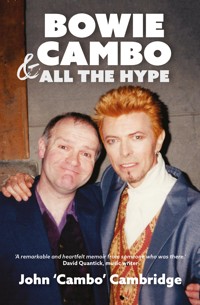
In Bowie, Cambo & All the Hype we get a backstage pass to key people and events during those crucial early years. This is a heartfelt story of a unique friendship. Drummer, musician and friend John 'Cambo' Cambridge lived with Bowie at Haddon Hall when he had his first hit record 'Space Oddity' and toured with him in Junior's Eyes. He was there for him at many key moments – when Bowie lost his father, passed his driving test, played his first Glam Rock gig with Hype, even acting as best man when Bowie married Angela Barnett in 1970. And if John had not persuaded his former Rats colleague Mick Ronson to join Bowie in February 1970, there might never have been a Ziggy Stardust or the stellar career which followed.
Das E-Book können Sie in Legimi-Apps oder einer beliebigen App lesen, die das folgende Format unterstützen:
Seitenzahl: 251
Veröffentlichungsjahr: 2021
Ähnliche




















ii
Praise for Bowie, Cambo & All the Hype
‘A warm, engaging first-hand account of a pivotal time in David Bowie’s career, full of fascinating insight and turn-of-the-’70s detail.’
Rob Hughes, music journalist, Uncut
‘You were a great player in that early transition from David’s acoustic sound to the full-on rock sound that eventually gave birth to Ziggy. You have a big story to tell.’
Tony Visconti, record producer, musician and singer
‘I know how much you have meant to David.
Iman Bowie
‘There is no doubt about it; with that extended gesture of friendship and belief (in both David Bowie and Mick Ronson) John Cambridge single-handedly altered the trajectory of popular music.’
Kevin Cann, Bowie authority, author and designer
‘History is full of ‘What if’s’. What if Lennon had never met McCartney. What If Elvis never became entangled with the conniving Colonel Tom Parker. And what if John Cambridge had never uttered the words ‘Mick’ and ‘Ronson’ within hearing distance of David Bowie. His book is full of enthusiasm, pathos, John’s infectious good nature and humour… and almost inevitably a fair few What if’s. It needed to be written. Thanks John.’
Marc Riley, BBC Radio 6
‘David Bowie created a brilliant public persona in which you were never sure what was true and what was artifice. His work will be discussed for generations and he will remain a major influence on new performers. It is excellent that somebody as close to him as Cambo should present his own take on that rise to fame.’
Spencer Leigh, author and journalist iii
‘Behind every great man are a great many friends. John ‘Cambo’ Cambridge was one of Bowie’s greatest friends.’
Will Sergeant, Echo & the Bunnymen
‘Cambo plays killer wig-out drums on one of my all-time favourite recordings, the radio session of March ’70 when he, Bowie, Ronson and Visconti laid down the blueprint not just for that mighty song of songs ‘The Width Of A Circle’ but for the rest of 1970s rock’n’roll through prog, glam, punk and beyond.’
Mike Scott, The Waterboys
‘A remarkable and heartfelt memoir from someone who was there.’
David Quantick, music writer
iv
BOWIE, CAMBO & ALL THE HYPE
JOHN CAMBRIDGE
v
For my wife Angela and our children Aaron, Adele and Lucy, our grandchildren Georgia, Ethan, Jacob, Joely, Summer, our new great-granddaughter Ivey May and my brother Ken. vi
FOREWORD
The entertainment industry, just like any other walk of life, is littered with ‘What if?’ stories; some are even legends. One of my favourite music industry ‘what if?’ comes directly from the man who wrote this book, Mr John Cambridge no less. It is, of course, the story of John introducing Ronson to Bowie and his personal battle to encourage a reluctant Hull gardener (and respected semi-pro musician) down to London to meet a sceptical up-and-coming pop singer.
The soap opera that then ensued after John first recommended his old friend Mick Ronson to David Bowie and his producer Tony Visconti you will get to in this book and it’s quite something, littered with – not just one – but many ‘What if?’ moments; moments that, in the main, pivoted around John himself. And at any point of his fascinating recollection you can be forgiven for thinking, ‘Just give up on it John! They don’t deserve you.’ But he didn’t.
Bear in mind, when John left London for Hull that day David had still not actually said to John, “Okay then, bring him down.” John had simply given up asking and decided to take matters into his own hands.
Now this isn’t to say that, without this particular intervention and its impact on David’s creativity we wouldn’t still be talking about David Bowie today, because I’m sure we would. A talent like that was already primed, fuelled and ready to launch. But, if you were to totally exclude Mick Ronson from that final equation, and at such a crucial time in David’s development, it would certainly have made David’s story much poorer. That’s unequivocal. viii
And what would have become of The Man Who Sold The World, Hunky Dory, Ziggy Stardust, Aladdin Sane and Pin Ups without Mick? These albums, of course, have his gifted dabs all over them like an indelible watermark.
It just makes you wonder though, what if John Cambridge had given up at any point during that testing week in early 1970?
What if?
There is no doubt about it, however; with that extended gesture of friendship and belief (in both David and Mick) John Cambridge single-handedly altered the trajectory of popular music.
The same question then, could also be applied to John’s dismissal from David’s band at another pivotal moment. What might have happened if John had remained the drummer in Bowie’s band? For that you will find John’s own candid answer in this book. In fact, it is a very frank answer in a no-nonsense memoir, a story that I thought I was pretty familiar with myself. But there are always things to learn for us all. And, while working on this book, even John discovered a few things he was previously unaware of before he started putting pen to paper (which is often the nature of things when our stories become so interwoven with the lives of others).
Over the years we have known each other, John has always, without fail, been there when I needed him. Whether it was to answer a string of questions for my own projects, or for the various live events I invited him to be part of, John has always been fully supportive. It’s therefore been a pleasure to finally return a little bit of that support for an important project of his own.
It’s certainly been an entertaining read too.
Kevin Cann July 2021
CONTENTS
INTRODUCTION
Here we go again! Another book on David Bowie, I hear you say. Somebody else trying to cash in? Well, I promise you, this will not be like any other Bowie book you read.
At home I have a large cardboard box full of other people’s books and magazines, mostly about David. Some have been gratefully signed by their authors as a thank you for me helping them with their research and lending a bit of weight to their writing, checking, adding or correcting details when I thought they weren’t quite accurate or were incomplete. Over the years, I’ve always given my time freely and willingly to talk about this remarkable time in my life.
My kids have been urging me for many years to write down all of my stories too, and to bring out my own book, but up until now, I could never really be arsed. I suppose, being able to say you were friends with David Bowie for nearly 50 years would be a good enough reason for most people to put pen to paper (although admittedly there were some large breaks in us keeping in touch), and being partly responsible for, or a witness to, some of the most important breakthrough moments in his career does make you seem, in some people’s eyes, really important.
I was there when David went through some significant rites of passage. When he had his first big hit with ‘Space Oddity’, when he got married, when he played his first Glam Rock gig, when he passed his driving test, when his father died, when he celebrated his 50th birthday, etc. I am also one of the few people who can say I shared a car, a dressing room, and even a bed with him!
I was good friends with someone who was later to become one of the most famous, iconic faces of the twentieth century. Someone 2who would alter the course of rock and pop music, fashion, media and people’s attitudes towards diversity, tolerance and sexuality. Someone who, when I knew him, was always just a mate.
And that’s what he was, to most of us who knew him then. Granted, he was a very talented mate, who also liked a laugh and a joke, the occasional water pistol fight or kick-around with a football in the garden at Haddon Hall, but who was still finding his way professionally when I drummed for him at the end of the ’60s and the beginning of the ’70s.
I’m proud to say he was someone who remained a mate right until the end, despite all the craziness that happened in between. David and I never had a cross word and at every reunion or contact we always seemed to pick up where we’d left off. I feel that the time to write about it is definitely right now – before the ageing process gets in the way!
Readers might be surprised at some of the other memories I’ve included here and some of the bands that shared the bill, such as Pink Floyd, Rod Stewart, Free, Genesis Black Sabbath and Fleetwood Mac, and some of the famous musicians I met or shared a dressing room with, such as Jeff Beck, Robert Palmer, Ozzy Osborne, Jon Anderson and Jimi Hendrix.
Ken Pitt, David’s ex-manager, was probably the first person to ask me for help with a book, The Pitt Report, in 1982 and rang me out of the blue to ask if I could remember a few dates I did with David. ‘Do you remember when you did such and such?’ he asked. ‘Was it between January and February 1970?’. And I could confidently reply: ‘I can tell you exactly when it was because I kept a diary of every gig I have ever done, not just with David.’ And it’s true, beginning with the Regal Rooms, ABC Cinema, Hull on Thursday, 10 December 1964 (teatime, a children’s party with my first band The Gonx), and right through to the present day.
This attention to detail is another reason I have been consulted so often by Bowie biographers, who frequently get the timing, personnel, events, conversations and even years wrong. I’ll refer to some of those as we go through the book – and hope this will be my opportunity to set the record straight on certain important details.
People sometimes ask me how David’s name is pronounced. It is exactly the same as the ‘bow eey’ knife (as in ‘bow and arrows’ or 3‘rainbow’) and that was the pronunciation he used and preferred. He told me once that he got the name from the 1960 John Wayne film The Alamo, which featured Richard Widmark as Jim Bowie, the man who made famous the Bowie fighting knife.
Sometimes in this book I’ll refer to him by his Christian name ‘David’ and sometimes as ‘Bowie’ because, well, that’s what we did at the time. It’s not about me being inconsistent or over-familiar. Sometimes we just called him ‘Dave’ (Angie Bowie refers to him as ‘Davey’). In the same way, I’ll sometimes refer to Mick Ronson as ‘Mick’ and sometimes as ‘Ronno’ because that’s what we called him. It was his nickname and he even called a band after it.
And finally, a very good friend gave me some advice about how I should actually go about writing this. ‘Do it for your family, your kids, and grandkids,’ he said. And he was right, it’s much easier when you have somebody in mind – so I am imagining that they are all in front of me, now. After all, they are the ones who have been urging me to write it all down. So, here we go.
This is for them. 4
Chapter 1
MY HOME AND MY FAMILY
My family come from the North of England. Marjorie Mary Getliffe, my mother, was from Manchester and Tom Cambridge, my dad, from Goldthorpe, a small mining town between Doncaster and Barnsley – just ten miles from where David Bowie’s father, Haywood Stenton ‘John’ Jones was born, five years earlier than dad in 1912.
I often wonder, and others have speculated too, if maybe David felt the Yorkshire ‘Northern’ connection between us and that’s one of the reasons we got on so well. It does seem a bit of a coincidence that so many other people involved with his early career came from Yorkshire too, including his Feathers bandmate John ‘Hutch’ Hutchinson; Trevor, Mick and Woody, the three Spiders from Mars; and Bowie’s former bodyguard Stuey George, who was also our roadie in the band The Rats and whom I still see occasionally.
Even Gary Miller who produced the track ‘Everyone Says “Hi”’, a much later Bowie hit from the Heathen album, was a Hull lad too. Later in the book I will describe the time David and Angie Bowie came ‘up north’ to stay with us in our little flat in Hull and my parents’ reaction to that.
Mam and Dad met while they were in the army and were married in Salford just after the Second World War. My brother Ken was born on 25 May 1946. I was born down Albany Street on Spring Bank in Hull on 8 May 1949.
Dad originally moved to Hull with his elder brother Bill after the Second World War as the city had been badly bombed in the Blitz. He was a plasterer by trade and there was plenty of work to be had rebuilding the city. 6
Dad and Mam Cambridge with son Aaron
John with brother Ken
7I remember Dad telling me all these amazing stories about the war, and how, as a prisoner of war in Italy, he had escaped, only to be captured and then to escape again. I was always saying to him, ‘You ought to write a book about your life.’ It seemed to be just one adventure after another and something which was actually worth writing down.
His answer was much the same as mine used to be (‘I can’t be arsed!’) even though his achievements were far more notable than mine. Mine are mostly about music, football, running pubs or working on building sites, not to mention the all-important family life.
I often wonder about what my Dad had to do when he was 22, the year the Second World War broke out, compared to what a typical 22-year-old has to do nowadays and compared to what I’d done by that age – virtually nothing.
Dad was a massive influence on my life and if he was still around, he would no doubt give his own, typically down-to-earth take on the Bowies’ stay with us in Hull: how they ran up a big telephone bill, smoked his fags and how he may have provided David with inspiration for some of his most famous lyrics.
One thing I will always remember about Dad is that he was an avid reader; mostly paperback novels, potboilers, cowboy stories, war sagas, etc. which he used to buy from the West Hull Bookshop near Madeley Street off Hessle Road. My mam would go and collect five or six at a time, at a shilling a book, and when he’d finished she’d take them back and swap them for five or six more.
She kept doing this for years to the point where nobody knew what he’d read and what he hadn’t. Sometimes I’d go shopping with her on Hessle Road, pick up a book and ask: ‘Has he had that one, Mam?’, only to find when we got back that he’d usually already read five out of the six we’d got for him.
If he knew I was writing a book, he would probably say something like: ‘Son, you don’t have to put big words in a book to make it interesting; big words like “wheelbarrow”, “lighthouse” and “marmalade”. And don’t forget, never use a big word when a diminutive one will suffice’. (As you can see, I inherited my dad’s sense of humour.) 8
Dad died in 1981 – if he somehow finds out I need a ghost writer, I’m sure he’ll be the first to be in touch.
Sense of humour was another one of the reasons David Bowie and I got on so well, and our South Yorkshire fathers would probably have enjoyed a pint together and had a lot in common too.
We lived in a couple of other bedsits after Albany Street, before eventually moving into a council flat into Brisbane Street, in 1954. We were within easy walking distance of both the city centre and the shops and pubs of the famous Hessle Road trawling and fishing community, which was Hull’s main industry at the time.
Our flat was brand new in a three-storey block; we were its first tenants.
Although it was modern, it didn’t have many modern facilities. There was no central heating, just one coal fire in the lounge with a back boiler attached, which meant if you wanted hot water you had to pull the damper out under the fire to heat the water. In winter the bedrooms could get pretty cold and even though my mam and dad had a little two-bar electric fire, they would normally only ever have one bar on to save money.
And these were the days when you had to put a shilling in the meter too. It was less than ten years after the Second World War and the devastation, especially in Hull and within striking distance of the docks, was still to be seen on the streets all around in the rubble and the bombed buildings.
Dad’s army gear was still about the flat too, especially his tin hat and great army overcoat. My brother Ken and I used to share a bed then, as brothers often did; a big metal frame with springs that could be bounced up and down on like a trampoline. In cold winter weather, we’d sometimes get frost on the inside of the window and Mam used to put Dad’s army greatcoat on the bed as a top cover for extra warmth.
One night when we’d gone to bed, I shouted through to her, ‘Mam, our Ken’s pulling the big coat over to his side and he won’t give me any of it!’ She came rushing in.
‘Will you be quiet!’ she said. ‘Your Auntie Maud’s here.’ (We had loads of aunties in Hull, most of whom weren’t our real aunties.) ‘She’s only in the front room and she can hear you both, so stop showing me up! Anyway, it’s not a coat, it’s an eiderdown.’ And off she went, back through to the front room. 9
Ten minutes later I shouted through again, ‘Mam, Ken’s just ripped the sleeve off the eiderdown.’
Many people in Hull used to have photos taken at Jerome’s on Whitefriargate – in the ’50s and ’60s as you can see. They are the ones who provided the cowboy suit in the photo – a shape of things to come!
John – Cowboyman Jnr
10My nickname was always Cambo (pronounced ‘came bow’, as in ‘bow tie’) and it has stuck with me for most of my life. When Angie Bowie wrote to Mum and Dad, she even called them ‘Mum and Dad Cambo’!
When David and Angie Bowie came to stay in our Brisbane Street flat, in February 1970, they slept in that same room Ken and I had shared, in that same cold bed.
I first became properly interested in music while I was a pupil at Saint Wilfred’s Catholic School on Saner Street, next to the Boulevard. When I was aged about ten, I used to bang on my little school desk with rulers, constantly drill the tabletop with my fingers or use my mam’s knitting needles to batter the cardboard covers of Beano annuals placed on my bedspread to look like a drum kit. It was as if the drummer inside of me was impatient to get out.
I had a fairly normal, happy and uneventful childhood, really. I have always liked sport, especially football, and as a ‘black and whiter’ I was always a keen supporter of Hull FC rugby league club.
My big brother Ken was a big influence on me growing up. He was three years older, and it was through him I first got to listen to many of the big stars of the day. Stars like Eddie Cochran, Johnny Kidd & the Pirates and of course the King, Elvis.
My mam and dad were going to get me an electric train set for Christmas when I was 12, but Ken persuaded me to ask for a joint present of a Dansette record player, as they could never have afforded both. That Dansette was to play a big part in my musical education right through the ’60s. I’d plug it in in the bedroom, close the door and play along on my Beano annuals in time to the likes of ‘Glad All Over’ by the Dave Clark Five, ‘Linda Lu’ by Johnny Kidd & the Pirates and ‘F.B.I.’ and ‘Man of Mystery’ by The Shadows.
By the time I was about 14, I used to go regularly to nearby Madeley Street Baths on roller-skating nights, where basically all you did was skate round on the boarded-over swimming baths on old roller skates that you hired for the night. (Only the posh kids had their own roller skates). Once again music was a big factor, especially in 1963, which was a momentous time for music in this country, and the world.
In this year the Beatles continued their domination of the charts with ‘Please, Please Me’, following up ‘Love Me Do’, their big hit 11of the previous year. Meanwhile, down in the capital, an unknown teenager called David Jones recorded his first demo single ‘I Never Dreamed’ with The Konrads.
My brother Ken took his copy of the Beatles’ ‘Please, Please Me’ to the skating sessions to give the elderly DJ in a tuxedo his first taste of the Fab Four. Other groups had begun to break through on the pop scene too, especially the Rolling Stones, The Searchers and The Hollies, and I would go to my bedroom, knitting needles in hand (the thicker, the better), to practise tapping along to the beat of their latest releases.
At this stage I’d still never played on a real drum kit. In fact, I don’t think I’d even seen one close up either. In desperation I even sent away for brochures and catalogues with pictures of drums in them so I could study them.
Everything changed when I started going to the so-called Beat clubs in Hull. It was a busy and active scene for live music in the early ’60s in Hull and I remember particularly the Gondola Club in Little Queen Street and the Kontiki Club in Whitefriargate, both in the town centre. These clubs would be packed out, especially on weekends at the Gondola, when we would be treated to acts such as The Grease Band (featuring Joe Cocker) and other famous acts just breaking through. There was always a surcharge on the door at the Gondola for the ‘name’ bands, but it was also a place where decent local bands could cut their teeth playing live.
I became an enthusiastic regular and, as the Kontiki wasn’t licensed, a kid my age could also get a burger and soft drink and relax to enjoy live music by the many local up-and-coming performers. And, of course, it also meant an opportunity for me to study some real drum kits and get familiar with the local drummers, their techniques and their repertoires.
One night at the Kontiki, a group from the East Yorkshire town of Driffield, called The Roadrunners, came back to play their second set after going to the pub in the break. Their drummer was late getting back, so the rest of the band stood on stage waiting for him, ready to go, and I could see the crowd were getting a bit twitchy.
One of my mates shouted: ‘John’ll stand in while he comes back, won’t you, John?’ And even though I didn’t have any knitting needles with me, I said: ‘Oh yes’ – and was a bit surprised when the 12singer said: ‘Come on then. Do you know “Mona”?’
I’d only ever heard the Rolling Stones’ cover of the song, which fortunately happened to be the version that they did. It turned out to be quite an easy one to play, though, with a kind of thumping beat required on the floor tom-tom. It dawned on me halfway through the performance that I didn’t have the equivalent of a bass drum on the Beano annual set-up, so I really surprised myself to find I kept hitting the bass drum pedal instinctively throughout the song.
It turned out that Mick ‘Woody’ Woodmansey, who replaced me in both The Rats and with David Bowie, also joined The Roadrunners after their drummer had left – another one of many remarkable coincidences in my career. At the end of my debut, I got a round of applause from the band (and my mates) – possibly because their drummer had returned, possibly because I hadn’t made an arse of myself.
Either way, my career as a drummer had begun!
A few weeks later virtually the same scenario occurred again (bloody late drummers), this time with a group from Scarborough called The Incas, only now the song was a lot harder to play.
‘“Long Tall Sally”?’ the lead singer asked, as I, now an experienced live performer, nodded confidently, thinking that the Beatles’ version I knew was the only version there was.
At this stage, I wrongly assumed that Lennon and McCartney had written all their own songs.
Even being generous I would probably give myself no more than two out of ten. Off we went, stopped, started, stopped again and then went at it like the bloody clappers. I suppose the best I could say is: ‘I got through it’, but at least it now made me want to master the instrument and finally get my own proper drum kit.
I’d actually seen one in a second-hand shop in Midland Street, not far from us, in Hull. It was a worn, battered, white assortment of drums and looked very old-fashioned, but as far as I was concerned it was definitely the one for me. After walking past it every weekend on my way to the city centre, I finally plucked up courage to go in and ask how much it was.
‘Fifteen quid,’ the shopkeeper said, which at the time was right out of my reach.
The next step was to get round my dad. 13
There were some amazing, inspirational drummers around at that time. There were no big arenas yet, so in smaller venues there were plenty of opportunities to get really close up to see all the best local players in action – such as Adrian Gatie of The Aces and Jim Simpson, who also played in The Rats when Mick Ronson was a member, as well as many visiting future legends.
In 1963 at Hull City Hall, I saw ‘up close’ no less than the Rolling Stones, who weren’t even top of the bill that night but had just had a hit with Chuck Berry’s ‘Come On’.
Top of the bill was reserved for Johnny ‘Shakin’ All Over’ Kidd & the Pirates and The Aces (another top local band), supported by Heinz & the Saints (formerly of The Tornados). Although the gig was sold out, I managed to get a special, cheap rear-view seat, actually on the stage and behind the bands. Most people would have been disappointed, but I was in my element because I was right next to the drummer – just a wheelbarrow’s distance from Charlie Watts! I remember going to the toilets behind the stage and excusing myself to Mick Jagger and the band who were waiting in the wings as I squeezed by: ‘Sorry, but I’m busting for a piss.’
I was beginning to collect autographs at this point, and that night managed to get Johnny Kidd & the Pirates (without even bothering to ask The Stones). Years later, when I finally got David Bowie to sign my book (it would have felt a bit daft asking him when I lived with him), he was really interested in some of the other names in it too, many of whom were his heroes.
I failed my eleven plus so was unable to go to the Catholic grammar school. Instead, I stayed at St Wilfred’s RC School until 1964 and left when I was just fifteen. My dad got me a job as an apprentice plasterer with him, and as I was now starting to get a regular income, I thought it was finally time to invest in a drum kit of my own.
After years of tapping my scratched and scored Beano annuals, it was time to act.
I had made my mind up I wanted to play in a band and now, with the means to pay, Dad and I went to Gough & Davy, which at the time was the biggest music store in Hull, to look at some kits and sort out hire purchase (HP) terms on this impressive red ‘sparkle’ kit I’d seen in the window. 14
My dad signed the HP papers but after a few days we had a letter to say our application had been rejected because of what would nowadays be classed as a ‘poor payment history’. My dad was livid, seeing as we’d never had any bad credit in the past, so naturally he wanted to know the details from the finance company. Imagine his shock when he was told he’d bought a pram, cot and highchair six months before and never paid for them.
‘Who for?’ he said, irate. ‘John? He’s only fifteen and we’ve no grandkids! Why would I want a load of baby gear?’
The finance company discovered that a friend or relation of the people in the flat below had nicked my dad’s identity to buy all the baby gear items. We’d never actually seen the correspondence or paperwork that went with it, which I can only assume had been somehow intercepted by them.




