


1,99 €
Mehr erfahren.
- Herausgeber: Quickie Classics
- Kategorie: Gesellschafts- und Liebesromane
- Sprache: Englisch
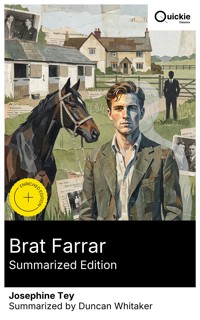
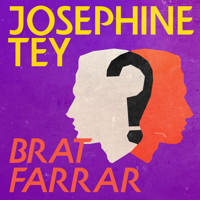
Brat Farrar begins when a rootless young man is recruited by faded actor Alex Loding to impersonate Patrick Ashby, the long-missing heir to Latchetts, a South Country horse-breeding estate. Coached in family minutiae and stablecraft, Brat enters a household shadowed by Patrick's presumed death and by the coolly ambitious twin, Simon. Tey's prose is lucid and dryly witty, its suspense built from horsemanship, landscape, and exact social detail, marking a bridge from Golden Age puzzle to postwar psychological suspense. Josephine Tey - pen name of Scottish novelist and playwright Elizabeth MacKintosh (also Gordon Daviot) - brings a dramatist's feel for role and rehearsal to questions of identity. Skeptical of formula series detection, she turns instead to motive, memory, and performance. Writing in 1949, she threads postwar unease about inheritance, class, and the fate of rural enterprise through a taut narrative whose credibility owes much to her theater experience and cool, economical style. Recommended to readers who prize character-driven crime fiction and understated tension. Admirers of Sayers or Allingham will relish its classic clarity, while fans of later psychological thrillers will recognize its anticipations. For anyone curious how a country-house mystery can become a study in belonging and truth, without relinquishing fair-play satisfactions, Brat Farrar is essential. Quickie Classics summarizes timeless works with precision, preserving the author's voice and keeping the prose clear, fast, and readable—distilled, never diluted. Enriched Edition extras: Introduction · Synopsis · Historical Context · Brief Analysis · 4 Reflection Q&As · Editorial Footnotes.
Das E-Book können Sie in Legimi-Apps oder einer beliebigen App lesen, die das folgende Format unterstützen:
Veröffentlichungsjahr: 2026
Ähnliche





Brat Farrar (Summarized Edition)
Table of Contents
Introduction
In a world where lineage confers power and memory can be rehearsed, Brat Farrar traces how choosing who one is—impostor or heir, witness or suspect—becomes a severe trial of conscience and desire, as a borrowed identity offers warmth and belonging yet draws its maker into ever-closer scrutiny, while the past, thought settled and mourned, rises to demand an accounting, so that every act of trust, every gesture of affection, is balanced against the peril that the role performed to survive might expose a deeper truth that cannot be stage-managed, and the heart learns that love complicates deception more than fear.
First published in 1949, Josephine Tey’s Brat Farrar stands at the intersection of the traditional detective story and the psychological novel, a taut work of British crime fiction set in rural England in the immediate postwar period. Its world is shaped by a family-run riding stable, neighboring lanes and fields, and the quiet hierarchies of village and gentry life. Rather than relying on locked-room ingenuity, the book attends to motive, memory, and manner, extending the genre’s Golden Age concerns into a more intimate register. The result is a suspense narrative whose puzzles turn on character, overlapping loyalties, and the ethics of inheritance.
The premise is stark and irresistible: a young orphan, strikingly similar to a long-missing heir, is persuaded to claim a place in a prosperous family whose eldest son vanished years before. What begins as a carefully coached impersonation unfolds into a study of temptation, tenderness, and risk, as the claimant navigates a household still marked by loss and expectation. Tey’s third-person narration is lucid, dryly observant, and paced with unshowy confidence, moving from intimate interiors to open paddocks with equal poise. The tone is patient rather than sensational, allowing unease to thicken quietly as relationships deepen and questions accumulate.
Tey anchors suspense in the textures of work and place, and the equestrian milieu is not mere ornament but the novel’s living grammar. Stables, training rings, and country shows provide occasions for competence, pride, and rivalry, revealing character under pressure without melodrama. The rhythms of feeding, grooming, and schooling horses give the story a steady pulse, while a village’s tacit codes—who notices, who speaks, who listens—shape what can be concealed or proved. When doubt surfaces, it does so in glances, gestures, and small slips of knowledge, moments that feel earned because they arise from routines the reader has come to inhabit.
At its heart the book is a meditation on identity’s sources and costs: whether the self is built from blood and memory or from choices, loyalties, and work. It probes how grief reshapes families and how the promises of inheritance can warp affection or clarify it. The imposture forces a confrontation with responsibility, because to occupy a role is to answer for its burdens as well as its privileges. Tey also explores the tension between private conscience and public performance, asking how far one may go to repair a loss, and whether truth is a discovery to be made or a duty to embrace.
These concerns remain urgent for contemporary readers, shaped as we are by curated selves, contested narratives, and the seductions of belonging. Brat Farrar speaks to debates about authenticity in an age of performance, to the precariousness of found families, and to the moral weight of opportunity when it arrives in ambiguous form. Its crime is inseparable from social fabric rather than spectacle, anticipating today’s appetite for character-driven suspense. The novel’s restraint refuses cynicism; it trusts readers to notice patterns, remember small facts, and listen to conscience. In that trust, it offers a counterpoint to noisier thrillers, rewarding attention with quiet, durable insight.
Reading Brat Farrar is to encounter crime fiction that proceeds by sympathy and implication, a study of how people come to know one another and what they refuse to know about themselves. Tey’s calm intelligence orchestrates mounting tension without pyrotechnics, guiding the reader through ethical shadows toward a resolution shaped by character rather than contrivance. The book honors the pleasures of mystery while insisting on the dignity of ordinary labor and care. For new readers, it offers an elegant initiation into mid-century British suspense; for returning ones, it remains a humane, unsettling reminder that the self is both given and chosen.
Synopsis
Josephine Tey’s Brat Farrar (1949) opens in the English countryside at Latchetts, the Ashby family’s horse-breeding estate. Years earlier, the elder twin, Patrick, vanished and was presumed dead, leaving his brother, Simon, as heir. Bee Ashby, their guardian, has kept the household and business steady, raising the remaining children and keeping Latchetts solvent through hard work with hunters and show horses. The local community has settled into a fragile equilibrium shaped by loss and the expectation that Simon will inherit. Into this quiet order comes the possibility of disturbance: the past refuses to stay buried, and the family’s future rests on uncertain ground.
Brat Farrar, a rootless young man with an aptitude for horses, is approached in London by Alec Loding, an actor who once knew the Ashbys. Startled by Brat’s resemblance to the missing Patrick, Loding proposes a bold imposture: with coaching, Brat could claim to be the long-lost heir and secure a share of Latchetts. The plan promises money, but it also offers the belonging Brat has never had. After initial resistance, he is drawn in by the prospect of a life among stables and fields. Loding undertakes to supply dates, names, and mannerisms, shaping Brat into a plausible return.
Preparation is meticulous. Brat memorizes family histories, rooms at Latchetts, and the small markers of childhood that might win recognition. He develops a credible account of years lost to wandering and reticence, leaning on the absence of a body and the community’s lingering hope. Introduced to solicitors and then to Bee Ashby, he faces polite skepticism but also a readiness to be convinced. Tests of memory, photographs, and chance encounters at local events gradually establish his footing. The deception rests on observation and nerve, yet it also depends on what others need to believe, opening doors he had not expected.
Life at Latchetts proves both intoxicating and perilous. Surrounded by horses and the rhythms of training and shows, Brat finds himself performing competence rather than mere imitation, earning respect from stable hands and neighbors. Bee’s cautious kindness and the family’s everyday intimacies make the lie heavier. Simon, however, registers a guarded hostility that sharpens whenever questions touch the past. The estate’s finances, tied to the heir’s legal status, bring practical pressures to the surface. As Brat settles into the role, he becomes enmeshed in affections, obligations, and responsibilities that complicate his bargain, making the falsehood feel increasingly untenable.
The return also reopens the unresolved mystery of Patrick’s disappearance. Brat discovers discrepancies in memories, timelines, and physical traces preserved at the house. Accepted explanations fail to account for certain objects and habits, and questions of who benefited from the tragedy surface. Simon’s brittle composure suggests unease, while public outings and equestrian events place the supposed heir under intense observation. A dangerous incident on horseback hints at malice rather than chance. Loding, meanwhile, proves unreliable, his opportunism clashing with Brat’s growing conscience. The imposture that began as a calculated play becomes a search for truth with personal costs.
Following faint leads, Brat retraces the last known movements of the missing boy and looks anew at the geography around Latchetts. He consults people who were present at the time, compares accounts, and fits financial and legal incentives against remembered scenes. The pattern that emerges points toward a private reckoning rather than an accident, and it narrows the circle of suspicion. His attachment to Bee and the others deepens his dilemma: exposure could ruin them as well as him. As tensions mount, official interest is roused, and confrontations loom that will test loyalty, courage, and the boundaries of self-invention.
The narrative builds to revelations that resolve the question of Patrick’s fate and force a final choice upon Brat. Without revealing turns, the conclusion addresses culpability, restitution, and the meaning of kinship, restoring order while acknowledging its price. Tey’s craftsmanship lies in the quiet accumulation of psychological detail, the steady pressure of practical matters like money and property, and the authenticity of stable life. Brat Farrar endures as a study of identity shaped by desire and circumstance, and as a crime novel that derives suspense from character rather than spectacle, inviting reflection on truth, belonging, and the lives we invent.
Historical Context
Josephine Tey, the pen name of Scottish writer Elizabeth MacKintosh (1896–1952), published Brat Farrar in 1949, in the immediate aftermath of the Second World War. The novel is set in contemporary England, largely in the countryside, within a family-run horse-breeding and training establishment overseen by trustees and bound by English inheritance practices. Its plot turns on questions of identity and succession that engage real institutions: parish records, civil registration, probate courts, and the everyday operations of rural estates. Without rehearsing its twists, the book anchors a crime story in the recognizable social and legal frameworks of late-1940s Britain.
Britain in 1949 was governed by Clement Attlee’s Labour administration (1945–1951), which implemented sweeping reforms: the National Health Service began in 1948, and national insurance and welfare expanded. Wartime austerity persisted; food and clothing rationing continued into the early 1950s, affecting households and businesses. Country houses and landed families faced higher estate duties and rising costs, prompting sales of land, donations to the National Trust, or diversification into commercial activities. In rural districts, many properties sought income through livery work, riding schools, or specialized breeding. The novel’s estate economy reflects these pressures, depicting a working enterprise rather than a purely leisured domain.
The equestrian world depicted in the novel mirrors postwar British racing’s revival. During the war, racing was severely curtailed; full programs resumed from 1945. The Jockey Club regulated flat racing, while the National Hunt Committee oversaw jump racing; licensed trainers, owners, and jockeys operated under their rules. Sales houses such as Tattersalls in Newmarket remained central to bloodstock trade, and veterinary oversight modernized stables. Riding instruction expanded through organizations like The Pony Club (founded 1929). With London hosting the 1948 Olympic Games, equestrian sport regained visibility. This institutional backdrop grounds the characters’ livelihoods, ambitions, and reputations within an exacting, rule-bound milieu.
The narrative relies on English legal realities concerning inheritance and identity. Wills and settlements placed family properties under trusteeship, with minors’ interests managed by the courts. Probate proceedings and civil registration—births, marriages, and deaths recorded since 1837—structured claims to name and property. Common law recognized a presumption of death after seven years’ unexplained absence, a doctrine that figured in real inheritance and insurance disputes. From 1939 to 1952, wartime national registration required civilians to carry identity cards, yet everyday identification still depended on photographs, signatures, and personal recognition. Such mixed safeguards created opportunities and tests for anyone asserting or contesting a lineage.
Brat Farrar draws on authentic mid-century child welfare conditions. Britain’s orphaned or vulnerable children were commonly placed in institutional homes run by charities, including Dr. Barnardo’s Homes (founded 1866) and the Church of England’s Waifs and Strays Society (1881). The Adoption of Children Act 1926 created legal adoption in England and Wales, and the 1946 Curtis Committee’s inquiry into care standards led to the Children Act 1948, which established local authority Children’s Departments. Young people leaving care often entered service, agriculture, or stables as live-in trainees. The novel’s portrayal of opportunity and precarity within that system matches contemporary pathways into rural work.
Policing and forensic practice in late-1940s England shaped how crimes and claims were tested. County and borough forces, consolidated by the Police Act 1946, investigated alongside the expanding network of Home Office forensic laboratories, established from 1931. Methods emphasized witness interviews, alibis, handwriting and document comparison, ballistics where relevant, and fingerprinting; DNA analysis lay decades in the future. Sudden deaths were examined by coroners, with public inquests, and serious prosecutions proceeded to Quarter Sessions or Assizes. In a case touching inheritance, investigators and lawyers would weigh tangible records against memory and demeanor, the balance on which reputations and property could turn.
The mid-century British press shaped public attitudes toward scandal, crime, and class. Mass-circulation newspapers such as the Daily Express, Daily Mail, and News of the World reached millions, while the BBC’s radio output dominated national broadcasting. Libel laws were robust, yet sensational coverage of family disputes and missing-person cases influenced opinion and sometimes investigations. Josephine Tey’s broader work, notably The Franchise Affair (1948), criticized the haste with which rumor becomes accepted truth. Brat Farrar benefits from this context: knowledge spreads unevenly, reputations are made or unmade in print, and the plausibility of an identity claim is tested in public as well as private.
Published as British crime fiction shifted from puzzle-centered detection toward psychological inquiry, the novel exemplifies its moment. Alongside contemporaries moving in that direction, Tey emphasizes motive, memory, and social texture over elaborate clues. The book engages enduring structures—inheritance, class, rural labor—under postwar strain, and it probes how law and custom can both stabilize and unsettle identity. In depicting a viable working estate, changing welfare systems, and rule-bound equestrian culture, it reflects reconstruction-era pragmatism. Its critique lies in showing how easily appearances persuade institutions and communities, and how character, rather than status, must answer the uncertainties of modern Britain.




