


1,99 €
Mehr erfahren.
- Herausgeber: Quickie Classics
- Kategorie: Krimi
- Sprache: Englisch
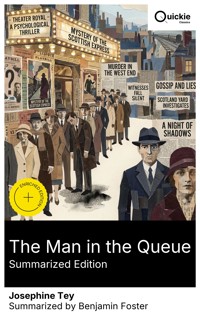
First published in 1929, The Man in the Queue launches Inspector Alan Grant with a murder born of urban anonymity: a man stabbed while waiting outside the Woffington Theatre to see the American star Ray Marcable. Grant's chase from London's playhouses to Scotland is less a puzzle-box than a study in faces, chance, and the perils of eyewitness certainty. Tey's lucid, lightly ironic prose and theatrical milieu place the novel within the Golden Age while privileging psychology and atmosphere over contrived clue-mongering. Writing as Josephine Tey, Scottish author Elizabeth MacKintosh—also the playwright Gordon Daviot—brought a practised ear for stagecraft to this debut Grant novel. A former physical-training teacher who split her life between Inverness and London, she honed an alertness to posture, crowd movement, and public myth, prefiguring her later skepticism about received truths in The Daughter of Time. This Musaicum Vintage Mysteries edition offers a crisp, humane investigation ideal for readers of Christie and Sayers, scholars of interwar culture, and newcomers seeking an elegant entrance to Tey's quietly subversive detective art. Quickie Classics summarizes timeless works with precision, preserving the author's voice and keeping the prose clear, fast, and readable—distilled, never diluted. Enriched Edition extras: Introduction · Synopsis · Historical Context · Brief Analysis · 4 Reflection Q&As · Editorial Footnotes.
Das E-Book können Sie in Legimi-Apps oder einer beliebigen App lesen, die das folgende Format unterstützen:
Veröffentlichungsjahr: 2026
Ähnliche















The Man in the Queue (Summarized Edition)
Table of Contents
Introduction
In a city where strangers brush shoulders without seeing one another, The Man in the Queue explores how a single, unseen act amid a crowd can rupture the comforting order of everyday life and force a quiet, relentless search for truth that tests the reliability of memory, the pull of public opinion, and the delicate boundary between chance and intention, inviting readers to consider how people become invisible in plain sight and how patience, empathy, and disciplined attention can illuminate a death that begins as an irritation in a theatre line and deepens into a study of modern urban conscience.
Josephine Tey’s novel belongs to the Golden Age of detective fiction and introduces Inspector Alan Grant, a professional investigator who would anchor a celebrated series. First published in 1929, the story unfolds in London, beginning in the West End outside a popular theatre and moving through streets, stations, rooms, and offices shaped by interwar rhythms. Its procedures and formal poise reflect a moment when the classic whodunit was being refined, yet Tey already nudges the form toward psychological observation. This Musaicum Vintage Mysteries reissue allows contemporary readers to encounter its period textures without requiring specialist knowledge of the era.
The premise is stark in its simplicity: at the doorway to entertainment, a man in a queue is found dead, and the crush and confusion of the crowd yield no clear witness to the fatal act. Grant must identify the victim, reconstruct movements that lasted minutes, and coax meaning from ordinary objects and fleeting gestures. Tey shapes the inquiry with calm, unshowy prose, wry intelligence, and steady accumulation of detail. The tone balances humane curiosity with procedural rigor, avoiding sensationalism while letting tension gather from the quiet difficulty of knowing anything for certain when everyone has seen, and remembers, something different.
Inspector Grant emerges as a mindful observer rather than a flamboyant sleuth, attentive to voice, habit, posture, and the ways people tell their stories. His method is patient and ethical, shaped by listening as much as by examination, and animated by the respect he gives to ordinary lives disrupted by the crime. Through him, Tey guides us across social layers connected by the theatre and the city’s transit, attentive to accents, occupations, and private spaces. The investigation proceeds through thoughtful interviews and gradual inference, privileging character over contrivance and inviting the reader to weigh possibilities alongside a detective who distrusts easy answers.
Beneath the mechanics of inquiry, the novel meditates on identity and anonymity, on how a face in a line can seem known yet remain unplaced, and on the instability of recollection when narrative pressure mounts. Tey probes the tension between the desire for swift closure and the obligations of due process, attending to how rumor, class expectation, and fatigue can complicate the pursuit of justice. She asks what it means to recognize someone, or to misrecognize them, and what remains when the tidy labels of the case file fail to capture the full shape of a life suddenly interrupted.
For contemporary readers, the book’s questions feel urgent: how do we weigh testimony in a crowded, noisy world, and how do we keep empathy from being drowned out by speed and spectacle? The crowd at the theatre resembles today’s feeds and platforms, where proximity does not guarantee knowledge and certainty can be manufactured. Grant’s steadiness models an ethics of attention that resists scapegoating, reminding us that process matters when facts are contested. Tey’s emphasis on motives and misperceptions resonates in debates about policing, memory, and accountability, offering a measured antidote to the impulse to decide first and investigate later.
Approached as a classic introduction to Alan Grant or as a stand-alone puzzle with a humane center, The Man in the Queue rewards attentive reading. Its architecture is clean, its scenes brisk yet suggestive, and its clues often lie in plain habits rather than theatrical flourishes. The novel invites participation without demanding arcane knowledge, and its resolution derives from the same disciplined observation it teaches along the way, keeping surprises rooted in character. As a reintroduced vintage mystery, it offers both period atmosphere and a quietly radical insistence that understanding other people is the detective’s most demanding, and most necessary, craft.
Synopsis
Josephine Tey’s The Man in the Queue (1929) introduces Inspector Alan Grant of Scotland Yard through a striking urban crime: a man collapses, fatally stabbed, while waiting among hundreds outside a London theater. The crowd has formed for a much-anticipated performance by a celebrated stage star, and in the crush the killer slips away unseen. With no obvious motive, the assailant vanished into the throng, and the victim initially unidentified, the case presents Grant with a puzzle born of city anonymity. Tey frames the investigation against the rhythms of theatrical London, beginning a patient inquiry that sets procedure and intuition in measured, revealing counterpoint.
In the immediate aftermath, Grant confronts the difficulty of extracting reliable testimony from excited, contradictory witnesses who shared a close physical space yet noticed little beyond the spectacle they awaited. The queue’s shifting lines, dim light, and collective distraction create conditions that thwart straightforward reconstruction. Meanwhile, public fascination grows as newspapers seize on the paradox of a murder committed in full view. Grant and his colleagues work to stabilize the facts: the victim’s approximate age and appearance, the timing of the collapse, and the few gestures anyone recalls. The investigation’s first goal becomes deceptively basic: to discover who the dead man was.
That identification effort drives the early movement of the case. Clothing, ticket stubs, and small personal effects generate tentative leads that draw Grant into the informal networks of theatrical staff, lodgings, and cafés clustered around the entertainment district. Tey emphasizes the era’s investigative toolkit—legwork, interviews, and cross-checking memory—over sensational devices, and she uses each witness encounter to test Grant’s capacity to sift personality from performance. Uncertainties accumulate: the victim’s habits, his last acquaintances, any link to the theater star who drew the crowd. With motive still obscure, Grant proceeds by narrowing possibilities, measuring consistency, and refusing premature certainty.
A possible suspect emerges when a pattern of sightings coalesces around a man seen near the victim, whose behavior during and after the stabbing appears evasive. Attempts to trace him through London’s lodging houses and workrooms yield only partial success, and the search expands beyond the city. As the inquiry widens, Tey contrasts metropolitan bustle with the steadier tempos of provincial and regional settings, using travel and terrain to mirror Grant’s shifting hypotheses. Pursuit sharpens the novel’s central question: is the apparent suspect the right one, or merely the most visible? Grant balances the demands of action with the unease of doubt.
Along the way, Grant encounters people drawn at the edges of the theater’s glamour: agents, landladies, clerks, and shy admirers whose lives brush fame without entering it. Their small loyalties and guarded truths complicate the neat story the case seems to promise. The inspector’s tact, patience, and fairness become as crucial as deduction, as he sorts rumor from memory and kindness from concealment. Tey dwells on how chance gatherings and social currents can trap individuals, suggesting that character, not only circumstance, determines where responsibility lies. The investigation acquires a moral weight: solving the crime means understanding the motives that animated ordinary days.
Mounting evidence crystallizes into an official theory, and pressure builds for resolution. An arrest becomes plausible, and with it the institutional drive to close the file. Grant, however, remains alert to elements that do not fit—the silence of certain witnesses, a timeline that feels too tidy, and the psychological texture of the people involved. The novel’s tension pivots on his willingness to revisit assumptions even when the path forward appears set. Tey sustains suspense by keeping crucial connections just out of reach, guiding readers through reversals that hinge less on trickery than on the slow, sober testing of belief against fact.
Without revealing its final turns, The Man in the Queue stands as a foundational Alan Grant case that blends procedural clarity with a sympathetic eye for ordinary lives caught in public drama. First published in 1929, it reflects interwar London’s crowded modernity and the pressurized spectacle of celebrity while questioning how well crowds, and investigators, truly see. Its measured pace and emphasis on character mark Tey’s distinct contribution to Golden Age detective fiction. The book endures for its exploration of justice as a moral, not merely administrative, achievement, and for its reminder that certainty earned too quickly may conceal the deeper truth.
Historical Context
Josephine Tey’s The Man in the Queue first appeared in 1929, initially under her alternative pen name Gordon Daviot. Tey, born Elizabeth Mackintosh (1896–1952) in Inverness, set the novel in London’s West End, where a man is found murdered while waiting outside a theater. The investigation introduces Inspector Alan Grant of Scotland Yard, the Metropolitan Police’s criminal investigation arm. The book’s stages, pavements, and booking offices reflect a city defined by show business and crowds. Its institutions—Scotland Yard, coroner’s courts, and London newspapers—anchor the narrative in recognizably interwar British civic life and its formal procedures surrounding sudden death and public order.
The West End of the late 1920s was a magnet for mass entertainment, with musical comedies, revues, and straight plays drawing large audiences. Crowds routinely queued for popular productions, mirroring the star-driven culture of the era. Figures such as Noël Coward and Ivor Novello helped define London’s theatrical tone, while commercial houses like the Theatre Royal, Drury Lane, and His Majesty’s (later Her Majesty’s) emphasized spectacle and celebrity. The novel’s opening in a ticket line speaks to this public ritual of urban leisure, where anonymity and proximity converged—conditions ripe for both chance encounters and, as the story posits, sudden, concealed violence.
The novel’s milieu was shaped by profound post–First World War social changes. The Representation of the People Act 1918 and the Equal Franchise Act 1928 dramatically expanded the electorate, the latter granting women voting equality with men. The Sex Disqualification (Removal) Act 1919 widened professional opportunities for women, affecting workplaces from law to offices tied to the entertainment industry. In cities, the “modern girl” image and new consumer culture coexisted with older class codes. The theater world in particular showcased independent public women—stars, managers, and patrons—reflecting the era’s shifting gender norms that inform the book’s casting of characters and social settings.
Policing in the 1920s combined tradition and modernization. Scotland Yard’s Criminal Investigation Department had used fingerprint identification since 1901, supplementing witness testimony and routine fieldwork. Forensic medicine gained public stature through Home Office pathologists such as Sir Bernard Spilsbury, whose courtroom authority shaped perceptions of scientific detection. Coroner’s inquests provided early scrutiny of unexplained deaths, often generating press attention. Institutional memory also included turbulence: police strikes in 1918 and 1919 prompted the Police Act 1919, banning unionization and establishing the Police Federation. The novel’s investigative atmosphere reflects these forces—professionalized procedure, growing scientific confidence, and a public primed to judge police competence.
The interwar press heightened crime’s visibility. Mass-circulation papers like the Daily Mail and Daily Express, along with evening tabloids, pursued sensational stories with photographs, bold headlines, and rapid updates. Reporters clustered around inquests and police stations, and crime columns became fixtures. This environment shaped public expectations of swift results and dramatic revelations. Fictional detectives of the period often reckon with journalists, leaks, and rumor—tensions mirrored in the novel’s depiction of scrutiny around a public murder near a theater. Libel laws and official reticence constrained reporting, but competitive newsrooms still amplified conjecture, influencing reputations and investigative pressure.
Urban mobility and national connectivity underpin the book’s plausibility. London’s buses, taxicabs, and Underground enabled rapid movement across neighborhoods, while the 1921 Railways Act’s 1923 “grouping” created the Big Four companies—LNER, LMS, GWR, and SR—streamlining long-distance travel. Investigations could extend efficiently beyond the metropolis, including to Scotland and provincial towns, via regular express services and coordinated timetables. Telephones, managed by the General Post Office, allowed long-distance calls through operators, enabling timely coordination across jurisdictions. These networks gave police broader reach and suspects greater avenues for flight or concealment, shaping both narrative pacing and realistic logistical constraints.




