


6,99 €
Mehr erfahren.
- Herausgeber: tredition
- Kategorie: Lebensstil
- Sprache: Englisch
The North Atlantic and its adjacent waters are among the most dangerous in the world. Countless shipwrecks speak for a rough ocean. And yet, these seas are rich in wildlife like playful dolphins and colorful puffins. Ignoring the hazards and curiously, almost obsessed by sailing the European Atlantic, George and his wife cast-off in the Baltic to an open-end adventure. They sailed to Norway, Scotland, the Hebrides, the Iberian peninsular and promptly fell in love with these countries and their people. The nature in Norway is breathtaking, wildlife on the Hebrides stunning, Scotland is divine, the beer in Dublin is cold, and the sun nearly always shines in southern Europe. With autumn approaching, the Atlantic Ocean faced its first hurricane on the European side in history and underlined its reputation. The crew took it easy and saw what they hoped to see and much more. Then a virus came along, silently, mysteriously, and ruined all travel plans. Relaxing with each day passing by, the crew realized, live and perceive the moment.
Das E-Book können Sie in Legimi-Apps oder einer beliebigen App lesen, die das folgende Format unterstützen:
Seitenzahl: 361
Veröffentlichungsjahr: 2020
Ähnliche



















George Fohr
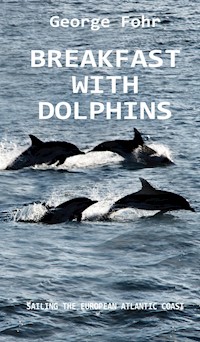
Breakfast with Dolphins
Sailing the European Atlantic coast
© 2020 George Fohr
Publisher
tredition GmbH
Halenreie 40-44
22359 Hamburg
ISBN
Paperback
978-3-347-17682-9
ebook
978-3-347-17684-3
Hardcover
978-3-347-17877-9
All rights reserved. No part of this publication may be reproduced, stored in a retrieval system, or transmitted in any form or by any means, electronic, mechanical, photocopying, recording or otherwise without prior written permission of the publisher.
For all the sympathetic and charming people who enriched our voyage and made it worth experiencing. Profoundly thanks to the crew ashore. The travel would not have been possible without your assistance.
Content
Prolog
About an ocean - a journey - a language - a law
No action for the brain
Odd jobs - a handsome guest and a world championship
Baltic Rim
Baltic summer - fast cogs - it never stops
Getting started or Mission to Mars!
Empty rooms - wannabe doctor - Brexit - equipment - the crew
The good old days of tomorrow
Kuehlungsborn - and splash
Denmark
Danish lifestyle - Copenhagen - Streetfood from BBQ Masters to Vegan - Helsingor and Kevlar sails - Anholt, a lesson in fog - Captain Sparrow
Sweden
Varberg and GT - the pearl of the West Coast - a prayer in Swedish
Northern Denmark
Gothenburg to Hirtshals
Norway
Black gold and setbacks - Preikestolen - Utsira - Hardanger Fjord - Folgefonna Glacier - Bergen
The North Sea and a Monster
The Draupner platform - troubled waters - Inverness
Scotland - Caledonian Canal
Let’s start spooky - Inverness to Oban - Lochness, an old tale and a posting - low brainers
The Hebrides
Oban, Tobermory and distilleries - Canna, going back in time on puffin island - Skye - Stornoway - Portree - Ardfern
Northern Ireland
Bangor, red diesel and a stamp - Belfast, blood, sweat and tears
Ireland
North Channel, a splash in the neck - Dublin and Irish hospitality - Arklow, a memory line
UK - Wales
Milford Haven, a lesson in wind over tide - a flamboyant speech
Sailing nonstop
Bristol Channel, Irish Sea, Gulf of Biscay - Stugeron, or a complete moron
Spain - Galicia
A Coruña – la dolce vita - Santiago de Compostela - Finisterre - Costa da Morte - ¿Habla usted español? - Vigo, no love at first sight - Baiona, walking in sunshine
Northern Portugal
Póvoa de Varzim, sailing to Manhattan - Porto, wine, bridges and a bookstore - bad luck
Porto to Cascais
Figueira da Foz - Coimbra - Nazaré
A Portuguese winter - Lisbon
Sintra, standing in a line - Cascais, the city of kings and fishermen - Eugenia and classic cars - Lisbon, modern architecture and celebrities
Southern Portugal
Sesimbra, a touristic town - Sines, she spied on us - Sao Vincente - Lagos
Lagos, a sailor community
Living in the sunshine- traders on a winning streak - Albufeira - small paradise Culatra - Vilamoura
Deadlock holiday
A virus and many colored views
Live and perceive the moment
Swiss lifestyle - competence wrangling - free again
Photos
Prolog
About an ocean - a journey - a language - a law
Traveling by train to the Baltic Sea, I realized with a sigh that I had forgotten again some names of islands and cities scattered along the European side of the Atlantic, places we would like to travel to. I always do this when I have plenty of time, committing words or names to memory. At least I should know exactly where we have been already and where we would like to sail next.
Our first sailing adventure along the European Atlantic coast almost two decades ago is still well in my recollection. Unexpectedly, we got the chance for a sabbatical, one solid year of sailing. We bought the very first yacht we surveyed on the spot and spent every minute practicing to sail our ATHENE safely. Three years later, we had drawn countless course lines in the waters of the Ijsselmeer and Dutch coast. In June 2002, we set sail for our once in a lifetime adventure. After thirteen months and 5500 nautical miles of experience, we returned safely to Holland. We are still in possession of the yacht, another startling fact. We never thought we would be crazy enough to own and maintain a boat for such a long time. In retrospect, the right decision, by now, we sailed ATHENE just under 20,000 miles.
I bring this up since we had published a book in Germany about our first journey under the title ‘Breakfast with Dolphins.’ Having a lot of free time on our hands in the years to come, we like to sail courses generously on the European side of the Atlantic. Remotely, I toyed with the idea of committing more stories of our adventures to writing; people we met, marvelous landscapes, flora and fauna, impressive cities and stately homes, delicious food, beach parties, getting ourselves in trouble and out, and so forth. Why not publish a new edition? To add spice for the younger generation, a title like ‘Breakfast with Dolphins, Reloaded’ or ‘SAIL HARD,’ written by a fictional writer named Bruce Winslow, might pay out better. I think just ‘Breakfast with Dolphins’ sounds charming too.
The idea of writing took shape after meeting Peter Förthmann in Hamburg. He is the manufacturer of the world-known Windpilot, a self-steering system for sailing yachts. His well organized, snug workshop impressed me. Peter is energetic and has a winning nature. At the end of an entertaining conversation, I did not doubt that he still has many ideas and plans to realize. One keyword led to another, and he showed me his multilingual books about the Windpilot. Free of charge, shy below two million copies were downloaded. As you might guess, the English text outreached the others by far. In the foreseeable future, readers have to pay two or three euro a copy.
His plan stuck with me for a while until a divine afflatus touched me, and I wondered why not to write in English too? For several reasons, actually. One, I always wanted to do it. What should I wait for? There is nothing to lose besides my spotless reputation. Second, it’s an excellent chance to improve my English language skills. Third, it is the opportunity to be a pain in the neck of English native speakers and other experts on this matter. Fourth, when I’m lucky, my potential readers might get useful information, a hint, or just an inspiration. Fifth, when I am fortunate, my readers enjoy the complete story, and that’s what matters most.
The more my wife and I talked about places where we would love to sail to, places where we have been already and like to see again, the more challenging it was to keep track of. One reason is, we don’t pay much attention to the news regarding the Atlantic Islands, besides an Azores High, gladly stated in the weather forecast by a friendly speaker. To cite another example, I can’t remember any news on TV or in the papers about the Shetland Islands this year. Maybe a crime story, ‘Murder on Shetland,’ but that is not exactly what we are looking for.
To categorize the dimensions and distances of the areas we like to sail a few dates. The Atlantic Ocean is the second-largest in the world, and it covers a 5th of the globe’s surface. It spans from pole to pole, from the Arctic to the Antarctic, from Europe to the east coasts of the United States and Canada. In the southern hemisphere, the Atlantic links from West Africa to countries like Brazil and Argentina. It locates several of the world’s biggest islands in its waters. The British Isles, Greenland, Ireland, Iceland, Newfoundland, archipelagos like the Azores, Bahamas, Bermudas, Falklands, Canaries, and Cape Verde.
All the islands’ population figured up, regardless of the nations, are small by world standards. In the world economy, the isles are consequently peripheral, besides the United Kingdom and Ireland. Commercial shipping takes advantage of the ocean with the consequence a vast fleet of cargo ships sails to and from Europe. Because of its importance to the world economy and its strategic value for the Navy, engineers built artificial canals in Panama and Suez to the adjoining waters, the Pacific and the Indian Ocean.
At the turn of the twentieth century, significant advances in transatlantic travel were being made. Shipping lines like White Star or Cunard offered their passengers the fastest Ocean liners. Cunard was the most innovative in the world; electric lighting and wireless communication were on board. The Mauretania held the Blue Riband for the fastest crossing of the Atlantic from 1909 to 1929. Well, on 15 April 1912, it didn’t work out for White Star Line, and supposedly 1514 souls were lost at sea. In its rough northern parts, the Atlantic was, is, and will be challenging for sailors. A fact we have to consider when we sail to the Shetlands and maybe further north to the Faeroe Islands.
Writing about travels in Europe, one should not disregard the last decades’ outstanding achievements, despite all legitimate criticism on Brussels. I was born and raised in Trier, Germany, close to Luxembourg, Belgium, and France. When my parents took the family in the car to visit Luxembourg on a beautiful Sunday in the 1970s, we were fortunate enough to waste an hour only stuck in traffic until we had passed the border inspection controls. Even worse were the French at that time. At the ‘douanes’ what they call customs in French, a group of heavily armed border guards welcomed visitors. Dressed in black, two men inspected the cars, sneaked around the vehicles, and peaked in the windows. Two others held submachine guns in hands, ready to fire any second. As much as I liked France, crossing the border in the 1970s and early 1980s was often horrifying.
The European Economic Community developed into the EU, passed the Schengen Agreement, which became applicable in 1995. One could - as I once did unintentionally in Luxembourg - speed over the border at 100 km/h. Oops! Was there a state border? For a good 20 years, we have the privilege of moving freely around in Europe. We will use this achievement and trust that all people in Europe will appreciate it and not misuse it.
With the boat stationed at the Baltic Sea, we spent numerous vacations in Danish waters such as the Great Belt, the Sound, and Kattegat, the sea link between the Baltic and North-Sea. And here we like to start. Not only because we have to leave the Baltic Sea somewhere, we know this sea area well. An easy task for the first weeks, a warm-up. Heading further north, the Skagerrak will be our first challenge. It contains some of the busiest shipping routes in the world, with vessels from every corner of the globe, and supports an intensive fishing industry. Luckily, the distance between Hirtshals in Denmark to Kristiansand in Norway is only 73 nautical miles, easy to sail in daylight. Once in Norway, we like to proceed slowly to cities like Stavanger and Bergen.
I still like to think about Stavanger today, even if I have not been to the city before. At the age of about ten, a stay with my grandparents was an integral part of my summer vacation. I was allowed to dwell in an attic room with a separate entrance. Here my best friend of the night was waiting for me, an old tube radio, an impressive piece of furniture. On the left, a radio, below a record player, on the right an empty, dimly lit bar, very corny. More than once, I had examined the device, hoping the heavy wooden lid would bang open, and I had the privilege to uncover all its secrets.
Radio reception was best at night. I turned it on, waited until a magical green eye appeared, tuned in to mediumwave, and listened to a Jazz station broadcasting from Stavanger, Norway. When I was lucky, I could receive a station from Aberdeen, Scotland, as well.
So, we like to see Stavanger by yacht, something I never dreamed of in my wildest fantasies, and I have a lot. Bergen, the second-largest city in Norway, is known as the ‘city of seven mountains.’ Just the fact, Bergen became a bureau city of the Hanseatic League at the end of the 13th century is worth a visit, not to mention its famous quays, a World Heritage Site.
To get used to open waters, we like to set course to the Shetland Islands with its capital Lerwick, a subarctic archipelago located northeast of Great Britain. With the Orkney’s only 90 nautical miles south, it’s just a day trip to the ‘warmth.’ Scotland is always worth visiting for its whiskey breweries, breathtaking nature, wildlife, and outdoor activities, to name a few.
In 2003, we sailed straight from A Coruña in Spain to a little town on the Irish east coast called Arklow. The Irish heartily welcomed us. We loved the island, the people, the spirit, and promised ourselves to come back one day. Besides Irish Folk music and same-named pubs worldwide, I like to tell you some less known striking facts.
Muckanaghederdauhaulia, in County Galway, is the longest place name in Ireland. James Joyce once described Guinness stout as ‘the wine of Ireland.’ One of the most popular radio shows in rural Ireland is still the daily broadcast of local obituaries. The Wild Atlantic route winding along the coast from Cork to Donegal is over 2,500 kilometers long, with 156 discovery points. It is reputedly the longest defined coastal route in the world. To reach the top of the Irish music charts, an album only needs to sell 5,000 copies, while a book needs only 3,000 units to make it to the top of the bestseller list. You see, one more reason to write in English. Ireland is the only country with a musical instrument - the harp - as a national symbol.
We like to spend all summer in Ireland, with so much to see and to do, it should be diverting. All the same, there is another reason to stay before we set sail to the French Atlantic coast. The Gallic spend their vacations in July and August. The whole nation is en route, either on roads or on the sea. On top are high prices in the marinas, not exactly places where we like to go. It is much more relaxed in September when we want to explore France from the city of Brest in the Northwest.
Further south, sailing meccas are on the list, like Les Sable d’Olonne, La Rochelle, Arcachon, and Biarritz close to the Spanish border. The first time we sailed to Spain, we passed the Gulf of Biscay directly from Falmouth, England, to A Coruña. Having more time, we like to visit Northern Spain, places like Bilbao, Santander, Gijón, and Cordillera Cantábrica, the Cantabrian Mountains.
Portugal is a great place to pass the time away. And the country has a lot to offer - historic cities, spectacular beaches, and with Madeira and the Azores deep-sea islands. If conditions are favorable, we like to explore Gibraltar and perhaps a stretch of Mediterranean Spain, like Marbella and Malaga.
Yet one question is still to answer: what awaits you, my reader? One group prefers sailing descriptions, according to the slogan, ‘how did they do that? Others are looking for insights, personal experiences, stories of people. To satisfy both, I write about sailing when it is the first time or an unusual trip. This book is certainly no travel report with corresponding requirements for factual description. If you are interested in reading a narrative, this is the place to be.
One last word
I’m no expert in the law, and in a way, I am grateful for that. However, in times of paving personal chatter and photos across the web, one has to be prudent when it comes to third party involvement. The EU originates a so-called General Data Protection Regulation. In a nutshell: The primary objective of the basic regulation is to preserve every natural person’s fundamental rights and freedoms. As a rule, personal data may not be collected or processed. Personal details are subject to strict conditions and require the prior consent of the person concerned. Before I get into trouble by writing the real names of people and yachts, I solemnly declare, all names are fictitious. The same applies to photos of people. I will not publish without their consent. The only exceptions are people of public interest, just in case we meet some, like Donald Trump, Boris Johnson, Vladimir Putin, and other well-known sailors. Should the invented names show similarities with living persons and real actions, this is purely coincidental. Cross your fingers that should take care of it!
No action for the brain
Odd jobs - a handsome guest and a world championship
May 2018
Being crazy enough to prepare a yacht for long-distance sailing or even more for circumnavigation, you either accept the fact you’ve to work day in day out, do a lot of odd jobs you wouldn’t do at home at all, get no pay, much worse, you have to spend a bag full of money. Or you state at length what rubbish it is to work so hard and you can’t wait to go out to sea. A short time later, you find yourself in a lovely marina, work day in day out, do a lot of odd jobs, spent even more money, and get the job done. Eventually, both fellas, the well organized and the unprepared, meet each other in a sunny marina somewhere in Portugal or Spain and complain widely about the most powerful hypnotic craziness known to man, something called sailing. No, it isn’t that bad; I just made it up.
There is a third kind of sailor for completeness, the ones who can’t do the work themselves. Either they have no time or got two left hands, no fingers, thumbs only. They employ professionals or semi-pros to get the jobs done. Best so far I ever watched was a guy who appeared on the scene with a premium car. He wore a power suit, took off his fine jacket, folded it neatly, and put it back in the car. He stuffed the tie between two buttons of the shirt, climbed up the ladder leaned against the boat, a hose in hand. Once on deck, he sprayed the dust off like our janitor waters the flowers. An hour later, the ship was launched. He and his wife sat in the cockpit and sipped a coffee. The yacht: a Bavaria 32 holiday. For non-sailors, a small craft.
The work got a grip on me. More often than not, I thought I’m the only person in the boat sheds who isn’t reasonable. I wore a pair of bib overalls, stained with all sorts of color I had applied in the past somewhere in the most inaccessible spots. Much more fun, the freshly applied paint stained the bib overall, still wet, only too willing to blur the upholstery in an absent-minded moment of the skipper. The first person who noticed was my wife; how could it be otherwise. Once, a professional painter said, you can do the best paint job of your life, and the male customer is all too happy. His wife comes along, a brief look, raises her voice, stretches out a finger, and points precisely to the only dust particle on the hull. I’ve never figured out how they do that.
Anyway, you can always spot a sailor who is ‘up to something’ by a stained overall. Does he wear a baseball cap advertising Yanmar, Volvo or another marine company, face and hands blurred in red, blue or black, one knows, he has just painted some antifouling on his boat. If in doubt, the strong and for sure unhealthy tang that hangs in the air clarifies any questions.
The boat sheds I’m working in are located in a little town named Burgstaaken on the sunny island of Fehmarn, Germany. Once a lively fishing port with a railway line, big silos, and tall brick buildings for the islands cereal harvest. Those days are gone. The former railway line was converted to a cycle path, and the fishing boats vanished like the fish. Only a very few survived and aged like their owners. Yet the island’s farmers are still in business. In late summer and fall, endless lines of huge tractors, with fully laden trailers line up from dawn to dusk to transport their harvest to the harbor. Commercial vessels regularly distribute the cargo all over the Baltic. Nowadays, the island is popular among British sailors. An English sailor dropped a comment on his conservative fellow countrymen. ‘I guess,’ so his explanation, ‘one was daring enough to set sail to Germany, visited Fehmarn, was all too happy with the place and people and wrote a kind article in an English sailing magazine. Others read it, pleased he had survived Continental Europe. Encouraged, they sailed to the continent too, appreciate the advantages of Europe and the benefit of lower prices in Germany compared to the UK.’
Two of those venturous folks are Jack and Ann from Yorkshire, fine people I know for three years. Last year they bought a new camper, secondhand, in pretty good shape. I was in one of those ‘why do I do this’ moods when Jack came along. ‘Tell me,’ I asked him, ‘you got a yacht and a camper. Which one do you like best?’
‘Yacht,’ he summarized his experience in one word.
‘What’s wrong with the camper?’ I asked.
Sparing with words, he nodded to his wheel-estate and said, ‘No action for the brain.’ As an afterthought, he added, ‘and I don’t like the people. A satellite dish was mounted on its roof. It was the first thing I had to get rid of. I don’t buy a camper and watch TV like at home.’
Motivated by his inducement, I checked my to-do-list what’s next. Those of you unspoiled by yachting should know, a to-do-list is a kind of endless paper roll, notated most essential issues only. You flip pages by pages, and before you know it, it starts on page one again in some mystical way.
Let’s have a brief look. Teak deck removed completely, deck welded, 600 hours of work. Done. Underwater ship completely sandblasted in a shipyard two years ago, hull repainted. Done. A new air heater fires up the yacht in the cold season. Done. A powerful inverter and charger supply electrical power for the cooker and washing machine. Done. Large capacity batteries, alternator, and solar panels are installed. Done. Fine, let’s flip to page six. New electronics for navigation awaits installation, such as a plotter (a tiny screen with black lines and color shaded areas called sea chart), radar, GPS, and autopilot.
Because of its weight and size, we didn’t like the idea of a Rader installed high on the mast. I bought a stainless steel pole to be fitted somewhere at the stern.
I mention this because it takes me back to the English again. Above all, they are friendly and helpful. And if you like British humor, which I’m very fond of, they’re funny as well. And often they’re experienced sailors! One sailor I love to talk to is Phil, who worked with Westerly, a well-known British yard for sailing boats. It’s safe to say, Phil and his wife Mel are the best-organized sailors at least ten miles around. Their yacht is always shipshape, shines up like a new penny whenever I look at what they had just mounted for the forthcoming season. I asked Phil for advice on the radar mast. In response, he let go of his tools and followed me back to our yacht. I explained my pros and cons; he listened thoughtfully, shook the head, and came up with a new idea, more straightforward and better. It took him barely two minutes, and he was right. Four hours later, the radar-mast pointed skywards, rock-solid, even Phil was surprised how fast it was done.
Fast is a relevant keyword for my guest I’m delighted to have with me tonight. Fast is one word, but there are more words worthy to note. Easy on the eyes, athletic figure, sportingly hairstyle, and maybe best of all, her priceless smile. You might wonder whom I talk about? She is one of the world’s most talented surfers, who was also successful at world championships.
Tina and I know each other for fourteen years, discussed all the world and his wife, whenever it was her shift at the nearby ship-chandler. I wondered when was the last time I prepared a meal for a world-class athlete, a dinner for two, on a sailing yacht ashore. Okay, there is always a first time, even at my age. We had an appointment at quarter past six, and there she was.
You might expect, I welcomed her on deck, bend forward, kissed her hand, led her to a comfortable deck chair, clapped in the hands, and a steward served drinks. Together, we enjoyed the neighboring buildings’ rooftops, plastered with solar panels in the warm evening sun. Well, it was slightly different. Tina climbed up the long ladder at the stern; that’s what one has to do all day long on a boat outside its fluid element. She trod on a bench, always prudent not to lose balance, swung her legs one more time around the big steering wheel, and stood in front of me.
I think the best way to characterize her is a story she told. Years ago, she was one of the three leading girls in a German Championship for Surfers on the island of Sylt, North Sea. Because of the weather conditions, the organizers interrupted the contest for a few hours. The pause had to be filled, so they thought it’s a good idea to take the first three girls on stage for an interview. A PA-system was installed all over the place, even at the beach. The first woman athlete proudly talked about her social skills, all the good things she does for people. The second one spoke of voluntary work, such as teaching children surfing. Tina asked herself, gosh, aren’t there any ordinary people? Should I be honest and declare my love for good BBQ’s here on the stage? The interviewer called her name and asked the questions a third time. She said I don’t know what was on my mind. My mouth was spontaneous and quick when I heard myself saying, ‘I make people laugh.’ She said there was a moment of total silence when roughly 1500 people laughed simultaneously. Tina makes people laugh! In my opinion, no better way to describe her.
Dinner was to her taste. We had more wine later as she talked about her life. In her twenties, she traveled for the first time to the one and only hot spot for surfers, Hawaii. She loves the islands and spends her extended vacations from November to February in the warmth. Eighteen years of enjoyment by now, but 2018 was different. One morning in February, the sirens went off, and so did her cellphone. She got up and read ‘Hawaii is under nuclear threat. Missiles launched in North Korea, expected any moment.’
Dumbfounded, she left the apartment, asked a native English speaker what he would make out of this, but he wasn’t a clue wiser as she was. She went back, shut the door, and sat down. Should I ring up my parents in the middle of the night, tell them it’s the last time you hear your daughter speaking? No good idea. Instead, she fixed a coffee and thought, I just turned forty-one. I didn’t expect my life would end so soon and this way. She considered a nearby Walmart. But the noises from the street, people screaming, cars honking, let her stay where she was. Suddenly she received a message on the phone, saying it all was a fault. She needed two days to get over this.
Tina sat down in the companionway and got her hair entangled in a Velcro tape, blaming herself for being clumsy. We use the Velco in combination with a net to keep insects out. Standing behind her, she couldn’t see my face. I grinned from ear to ear and took one more mental note on my secret vanity list. The first time, I picked the blond hair of a world sportswoman out of Velcro tape. She left around midnight. Unharmed!
The next morning, it was action time for hands, the radar dome assembly, an external GPS, and an electronic compass for the autopilot. It’s no big deal; only the cables can be very challenging. Various hatches had to be opened, cables pulled in one by one, to install the equipment neatly. Of course, you have no chance to see what you’re doing because hand and head don’t fit in the hatch’s opening at the same time.
I don’t know what direction human evolution will take. If I may suggest significant improvements for sailors, it would be an additional joint in each arm, an eye on the back of the hand, and last but not least, a light in the fingertips. Even if it looks out of place, a third arm wouldn’t be bad either.
I rechecked the to-do-list — not much to do on the hard. We’ll launch the yacht the next day. It’s more comfortable and easier to work in a marina. Action for the brain tomorrow? Well, it doesn’t do any harm. Practically, it’s more action for the crane and the guys operating it.
Baltic Rim
Baltic summer - fast cogs - it never stops
June 2018
There are things in life you do year by year, and despite the routine, they are forever a refreshing experience. The first night on the yacht in its fluid element has always enchanted me. It’s slight movements, swaying back and forth, being in nature and fresh air, makes my heart jump again and again with joy. I woke up excited. The sun had just climbed above the horizon; its full disc shone brightly from the east. The sky was blue, only a few of those big fluffy clouds you often see in nautical paints added white spots. I rewarded myself for the work and burden of the past weeks with a copious breakfast in the cockpit. I sat there for at least an hour, mindlessly, a pleasure of the moment.
Rigging up a yacht is a job for two. Unfortunately, my wife was at home. But it was not that bad. I could take my time, raised sail by sail, and slowly settled into the ultimate life aboard a sailing yacht. Installing technical stuff like navigation lights, antennas, cable bundles is not entertaining. Still, the work excited me. Many craftsmen say nothing is more enjoyable to see and touch what you have done after a fulfilled day of working.
Alone in miserable company! Neither I have time for a second breakfast, a lovely lunch break, nor a five o’clock tea. Settling everything on schedule and having the boat ready to sail puts all other needs in the background. Two days later, ATHENE was shipshape and Bristol fashion like the English use to say.
We had no particular plans, neither in destinations nor in some challenging sailing maneuvers. We just hoped all equipment installed lately would do well. So we sailed the Baltic, Travemunde first, followed by the old town of Wismar. The city was part of the Hanse, and it still shows its glorious past to visitors. We moored for a few days in the ‘wanderer marina’ east of the town. It’s easy to access and compared to Travemunde cheap. On the downside, the commercial quay close by isn’t great fun. At the time of our visit, a Dutch-registered vessel delivered wood to a nearby company that produces pellets for private home heating. From dust to dawn, two cranes discharged the timber out of the vessel’s deep cargo bay. Must have been an enormous forest they had chopped down.
The wind remained favorable; we set sail for Rostock. Thankfully, we saw a different and undoubtedly better use of timber, three wooden replicas of the famous Hanse cog. With course east and wind from the west, the cogs met favorable conditions for their square sails. The ships made for Rostock, a Hanseatic, city commemorating its 500th anniversary in 2018.
Every sailor knows the saying a sailor is a sailor, two sailors are a regatta. The cogs were surprisingly fast and gradually crept past us. Finally, with Warnemunde and the first fairway buoys to Rostock insight, the cogs were no longer beatable.
A day later, we took a local train from Warnemunde to Rostock and visited the colorful and noisy harbor feast. The cogs were open to the public, so we grabbed the opportunity and talked to a crew member we were in ‘a race with’ the day before. Asked why they picked up speed, he said, ‘the cogs’ arrival opened the harbor festival. The organizers wanted maritime pictures for television and newspapers. The camera teams were already waiting in boats and even in a helicopter. Expensive as it was, we got instructions by radio to be on time.’ The skippers started the engines and offered the spectators an idea of what it will have looked like in Rostock 500 years ago. A typical ship of that age had a cruising speed of about ten knots in favorable conditions.
The summer of 2018 was parched and hot inland. With Rostock, we had presumably chosen the wrong site to enjoy the heat. Next afternoon, a pitch-black cloud wall approached from the west and blackened the space between the Baltic Sea and the sky. The scenery wouldn’t be out of place in a Hollywood dystopian movie where the hero screams at the top of his lungs: ‘I don’t know what it is, but it’s getting closer. Take the children into the house….’ The wind blew with forty knots and emptied buckets of water per square meter on the southern Baltic. A typical low-pressure system like this lasts five days, enough time to get to know the location and relax.
For all of you who enjoy the Baltic Sea and its spas, we would like to recommend Mecklenburg Pomeranian, with Rostock at sea. Sandy beaches await visitors, cafes, restaurants, endless paths, which are level and effortless to cycle along. The well-marked trails are easy to follow.
I mentioned, for summer 2018, we had no particular travel plans, just testing the boat. Somehow ATHENE must have noticed and probably checked herself. We were ready to cast off when the autopilot activated an alarm.
Robert, as we call him, is reliable and has served us well for eighteen years. Maybe he didn’t like the prospect of another journey. To make a long story short, one more day in the marina. We disassembled the autopilot part by part, got deeper into its technology, and came up with a definite diagnosis: Robert is only worth remembering. We need a replacement!
Somehow, we had hoped that the compass or whatever was wrong with the autopilot could still be repaired. The information by the company was sobering. Robert was a representative of the Stone Age to the rapidly developing electronics industry. Lucky you, it lasted 18 years was a comment.
To harmonize the system entirely, we bought an autopilot from the same manufacturer, B&G. Todays’s world has a fantastic achievement; discuss the price of the entire purchase, pull the credit card, and buy. Two days later, a parcel service delivered the order directly to the marina. We required almost a week to install the equipment and were eager for the first test run with BeeGee like we called the new helmsman. One can twist and turn it, Robert was not exactly Stone Age but no longer state-of-the-art too. BeeGee steers excellent!
Beate was already reluctant to leave the boat in July to pick up her irritating work at home. In September, we took another short break of sailing in the Western Baltic Sea. Although only two weeks on the way, we experienced the full program, summer, thunderstorms, rain, and cold.
Early October, we lifted ATHENE out of the water for the last time before the long journey in 2019. And promptly, we experienced a surprise. The weather or whatever circumstances favored barnacles. They did not only populate keel and propeller; they had almost conquered it. No wonder the boat was no longer fast under engine. A miracle, the propeller was still working.
Concerning our preparations, I can finally write, that’s it! The fun starts in spring 2019.
Getting started or Mission to Mars!
Empty rooms - wannabe doctor - Brexit - equipment - the crew
February, March 2019
Half a year ago, I thought it’s no big deal to sort things out at home, a piece of cake. We’ll sell the car, the janitor takes care of the apartment, a neighbor of the letter post, and the tax accountant does the ugly part of one’s life. With barely five weeks left before we start, our brains spun around. Lists are filled and crossed. We consulted doctors and car dealers, and the never-ending shopping list steadily emptied the bank account.
We believed ourselves not experts on this matter. However, the experience of our sabbatical two decades ago is still in vivid memory. Or not? In retrospect, everything was pretty relaxed, just an extended vacation. I can twist and turn it any way I want; the present situation is different. The family got older, people deceased, close relatives are busy. In short, we’re lucky to have friends and neighbors who are happy to support us.
They were curious about what we will do with the apartment. When sailors talk to each other, this topic pops up pretty soon. It’s my understanding there are three kinds of world travelers. The first group wants to be as free as a bird; no obligations, no taxes, no repairs. They sell everything, lock, stock, and barrel, put the money on a bank account, and enjoy an attractive yield. Well, it was long before Mr. Draghi and his beloved European Central Bank. Last year I spoke to an English sailor, Ted, who said sailors still sell their homes in the UK. A well-prepared plan anticipates imponderabilities and does not care for return on investments. People want to be free.
Ted raised concern if it’s wise to sell a property. Retired, he and his wife cast off for years cruising the Med and US. They kept the house somewhere in Scotland and were all too happy. He said, traveling in general and sailing in particular will be challenging at times. The mere thought of having no home, no place to go, dampens the spirit in challenging situations remarkably. Ted said, in a way, these folks are homeless.
The third group empties the house or condo and put it on the market for hire. They welcome the extra money and have no trouble with the tenant, hopefully.
We discussed these options too. Well, I talked, my wife listened and came up with a statement carved in stone. Our home is our home, and I see no need to change. For the time being and peace of mind, we will keep it and pay what we have to pay.
I mentioned doctors before. Last month I had to learn a lesson. It’s my understanding of traveling for a long time and far off the coastlines to run this venture like a business. Calculate the chance–risk ratio, look closely at potential problems, and what we can do to prevent or solve it? Because life is a dangerous undertaking, I don’t want to imagine a lot of things, but I have to be a prudent sailor in a sort.
Yes, I was naïve in hoping to get a straight and simple answer to medical issues. For a layman, the possibilities are limited to first aid or some pills. Doctors have more probabilities to help or even mend an amateur should not dream of it merely because it’s their job. One doctor asked me, what makes you think you can do what I’ve studied and practiced for decades?
In secret, I’ve hoped I would get instructions from a physician like ‘take a knife, cut the poor body open, disconnect the green nerve, wait a minute or gulp a Scotch, reconnect the nerves, and you’re a done.’
‘Copy that! What if it doesn’t work?’
‘Easy! Keep course and speed and say a prayer or two. That’s what we do, besides course and speed, but don’t tell the other patients!’
The unfortunate crew member might kick the bucket, but the wound can easily be sealed with superglue. In other words, we do not have to practice sewing chicken legs as a substitute for open wounds, as offered in courses for sailors. Well, at least something.
I say this because it was a long way to go to accept my limits. Sometimes I thought I prepare sailing like a mission to Mars. Both in technical and medical terms. The medications an amateur can handle are the usual relievers, such as painkillers, antibiotics, and minor diseases like the flu. We’ve to focus on avoiding risks and hope for the best. The old sailors of bygone days had to face these challenges; therefore, sailing was called Christian seafaring. Hope and pray sounds good enough for people like us. The upside is, we’re not the only ones sailing offshore. There are plenty of commercial vessels, and we can communicate via radio or satellite phone, in case we sail to the ‘end’ of the world.
The Brits liked to spice up our travel plans too in March 2019. Whenever the British Parliament voted concerning Brexit, we became interested viewers of BBC. The way the Brits discuss, sitting close to each other in the House of Parliament, and shouting ‘aye’ or ‘nay’ is fantastic. After debating all arguments, Mr. Speaker asks to vote on the all-important question: Shall we leave the EU on terms Brussels does not except or shall we leave the EU our terms we consider the finest ones ever written in British history? The ayes are five votes ahead of the nays because politicians didn’t figure out the difference in time. Mr. Speaker, John Bercow, is always worth watching. I got the impression he does his very best to focus on the job. Back home, he is in fits of laughter for at least three hours. Hopefully, the circus will not screw up our plans to sail to Scotland and the trouble of getting a visa because the British government isn’t prepared for. The Scots have a heart for us and want to postpone the procedure until the end of October. Mr. Speaker, count us in; the amendment suits us well.




