


Erhalten Sie Zugang zu diesem und mehr als 300000 Büchern ab EUR 5,99 monatlich.
- Herausgeber: The History Press
- Kategorie: Lebensstil
- Sprache: Englisch
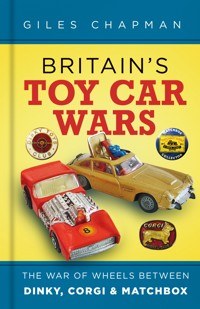
For fifty years, Britain made the best toy cars in the world, expertly shrinking every kind of reallife vehicle and producing them in their countless, die-cast millions. Dinky Toys were the 1930s pioneers, then in the 1950s came the pocket-money Matchbox series, followed by Corgi Toys bristling with ingenious features and movie stardust. But who were the driving forces behind this phenomenon? And how did they keep putting the latest, most exciting cars into the palm of your hand year after year? In this illustrated and expanded edition of Britain's Toy Car Wars, Giles Chapman reveals the extraordinary battle to dominate Britain's toy car industry, and the dramas and disasters that finally saw the tiny wheels come off …
Sie lesen das E-Book in den Legimi-Apps auf:
Seitenzahl: 311
Veröffentlichungsjahr: 2021
Das E-Book (TTS) können Sie hören im Abo „Legimi Premium” in Legimi-Apps auf:
Ähnliche














Frontispiece: Aston Martin DB5 James Bond toy cars being produced at Corgi’s Swansea factory. (Alamy)
First published 2021
The History Press
97 St George’s Place, Cheltenham,
Gloucestershire, GL50 3QB
www.thehistorypress.co.uk
© Giles Chapman, 2021
The right of Giles Chapman to be identified as the Author of this work has been asserted in accordance with the Copyright, Designs and Patents Act 1988.
All rights reserved. No part of this book may be reprinted or reproduced or utilised in any form or by any electronic, mechanical or other means, now known or hereafter invented, including photocopying and recording, or in any information storage or retrieval system, without the permission in writing from the Publishers.
British Library Cataloguing in Publication Data.
A catalogue record for this book is available from the British Library.
ISBN 978 0 7509 9909 0
Typesetting and origination by The History Press
Printed in Turkey by Imak.
eBook converted by Geethik Technologies
Contents
Introduction
1 Die-casting and Modelled Miniatures
2 Runaway Success
3 Dinky’s Post-War Resurgence
4 New Pocket-Sized Thinking
5 Feature-packed Corgi Toys
6 A Universe of Miniature Dinky Transport Rolling out of Binns Road
7 Matchbox 1–75 Series and the Industrial Juggernaut of Hackney’s Star Enterprise
8 Designed in Northampton, Built in Swansea: Corgi Toys Fed the Imagination
9 Home-grown Rivals who Chased the Big Three
10 Hot Wheels Barges in and Causes Mayhem
11 Struggle of the 1970s: Fighting Back against Star Wars and Teenage Indifference
12 Sad Endings as Britain’s Little Wheels Come Off
13 Destiny for the Greatest Names in Die-casts
14 Celebrity Status: Icons Inspired by the Big and Small Screen
15 Collecting: A Personal View on Survival and Big Money
Bibliography and Acknowledgements
Introduction
This is the intertwined story of three iconic names in British toy-making. It’s the most detailed, the deepest, and the most comprehensive examination of the contrasting stories of Dinky Toys, Matchbox and Corgi Toys, and how they competed intensely with each other for thirty solid years.
These world-famous products were locked in a ferocious battle for the attention of boys and, crucially, their parents and benevolent relatives, whose custom turned their manufacturers into world-renowned businesses.
The name of the game was excellence in miniaturising the machines that boys (and, sorry ladies, but it was predominantly us chaps) fixated upon or dreamed about. Mostly these were cars but the British die-cast phenomenon also extended to trucks, tractors, motorcycles, buses, aircraft, tanks and ships, and later on formed tie-ups with films and TV shows to add new elements of fantasy and inspired design ingenuity.
From their three corners of Britain, Meccano’s Dinky Toys, Lesney’s various Matchbox series and Mettoy’s Corgi Toys took distinctive and individual approaches to what they produced. As they fuelled imaginations and filled up toy boxes the world over, the skill of the three businesses at extracting pocket money from children and providing gift answers to perplexed grown-ups led to stellar corporate growth, profits and, indeed, acclaim for a world-beating British industry.
Yet from highpoints in the mid/late 1960s, all three of these legendary toy-making enterprises endured a rocky road in the turbulent society of the 1970s. The nation’s three toy car heroes drove onwards, updating and refreshing their wares to stimulate as much ‘play value’ as possible. It was even tougher as the decade turned the corner into the 1980s. Tastes, trends, technology and, indeed, teenagers changed rapidly; the complex and carefully crafted manufacturing processes of which each company was so justly proud suddenly became a burden, cumbersome and uncompetitive. If you were passionate about real-life British cars and lorries, then the parallels with the country’s declining motor industry of the time were especially poignant.
They were all to stumble and, ultimately, disappear as the digital era dawned. It’s like it never happened … except for the fact that these three companies’ obsolete products are now collected so avidly that five-figure sums have changed hands for single items originally intended to be mass-produced in their millions.
It’s impossible for me to relay this saga without including my own thoughts and interpretations. I’ve loved Matchbox, Corgi and Dinky vehicles my entire life. Actually, I’d go further. They’ve had a profound effect on me. I was born with a congenital eye problem called aphakia, rare in children, that meant my lenses were malformed, and so I had no focusing power at all. It’s hard to explain how this feels to a person with normal eyesight, but if you try looking the wrong way through binoculars or a camera lens then you might get some idea of how frustrating the distant, uncorrected, unfocused effect is. Back in the mid-1960s, specialists weren’t able to operate on me to correct it and in fact chose to bide their time until I was five years old to get some sort of cogent spoken feedback from me about what I could and couldn’t see. Then they could assess the compromised state of my developing vision and I could be furnished with glasses.
Are Toy Cars Still Relevant?
In modern life, with all its digital distractions and instant entertainment, toy cars don’t exert the pull they once did. But the fact that they are important to people’s lives was recorded in 2015 by research undertaken by pollsters Opinion Matters and funded by carmaker Honda. They found one in five adults admitted to still playing with toy cars and that one in ten wouldn’t be embarrassed to do so in the company of other adults. Indeed, 13 per cent said they had received one as a gift in adult life and then, when buying them as gifts for others, a quarter of the survey said they enjoyed the process because of the happy memories it brought back of childhood. A third of these adults said they had hung on to toy cars from their youth, with 10 per cent saying they kept them stored safely away, and a similar number saying they had them on proud display at home.
I do have a vague memory of putting on my first specs. I was strangely reluctant to wear them at the start but they provided a revelation in clarity. Objects were distinct, their edges unbelievably crisp, and I could make out letters in a book rather than from prompt cards with gigantic type sizes. There followed several days of wandering about simply examining things at home and these naturally included my toys.
Now I could see what my toy cars were really like, up close. Peering at them before had been hopeless, of course. One, in particular, captivated me. It was the Matchbox No. 12 Land Rover Safari. Before, I could trace its features with my fingers but not really see them and now I could examine its fully detailed interior and the fine moulded outlines of its doors, radiator grille, even a number plate. Most impressive to me was its roof-mounted cargo, an intricately recreated brown plastic representation of tightly grouped suitcases and containers secured for a long sortie into inhospitable terrain. It was spellbinding to hold this in my hand and then, later, recognise a version of the real thing on the road from the back seat of our family car.
Toy cars became my passion, the only things I wanted for my birthday and the possessions I most coveted (if they were different from my own) of my friends.
I began to accumulate a pretty big collection from the three main British manufacturers. Dinky, Corgi and Matchbox were all stocked by our local toyshop, Sidney W. Dine Ltd of Scartho, just outside Grimsby in Lincolnshire. The latest releases were showcased in a lockable cabinet near the shop door, while shelves behind the counter groaned with models in their tantalising packaging, sporting an abundance of bright yellow and red to snag and mesmerise the young addict. I would take my pocket money in there and spend an hour or more weighing up what to get next, while the proprietor and his assistants in their brown shop coats sighed and tutted.
The vehicles I really desired were almost always beyond my means, but quantity was important and I wanted something new every week. Rather than go without my ‘fix’ for seven days and save up for a temptingly presented Corgi gift set or an impressive Dinky Toys lorry, I was often tempted by Dine’s strategy (the period in question is 1974–78) of offering ‘old stock’ at reduced prices. And this triggered in me a fascination for the changing style of model design, together with the graphics and typography of the packaging. The old stuff, even then, seemed to me finer, as though the newer products had been demeaned by cheapening, garish paintwork and a general dumbing down of detail. At that time, though, I couldn’t begin to guess at why.
Yet I was aware of the great venerability of, in particular, Dinky Toys. My father still had all his from a childhood in the 1940s and early ’50s and, although I was allowed to play with them, he removed them stealthily from any situation involving potential damage and kept them very much ‘his’ rather than ‘ours’. Of course, in the mid-1970s, pre-war Dinky Toys were just emerging as ‘collectibles’ and yet the self-same brand, now with plastic parts and lurid paintwork, was still on sale at our village toyshop. I found it all very intriguing.
My collecting took a quantum leap in my young teenage years. Family friends and relations, aware of my passion, would give me box-loads of old toy cars when lofts or grown-up sons’ bedrooms were cleared. But also, now owning a bike and allowed to go where I wanted on it on Saturdays, I picked out more at junk shops and jumble sales, purchasable with a few coppers. Often, with no reference sources, my finds were totally new and strange, such as a delightful Alfa Romeo Spider made by an outfit called Lone Star, or a superb Bentley stamped underneath ‘Spot On Models by Tri-ang’. I was beginning to piece together fragments of information about British die-cast toys and their fascinating provenance even though there were no reference sources I knew of to consult. Each second-hand one I got my hands on was quite literally a discovery.
I was frequently left bewildered by the very appearance and aura of the toy vehicles themselves. Almost anything carrying the Corgi Toys stamp, for example, exuded a true car enthusiast’s stickling for authentic detail. It was as if the unseen and unknown driving force behind their creation read and absorbed the same car magazines as I did, and chose high-performance subjects to model that were directly intended, uncannily, to pique my own interest. The anomalies were confusing. How come Corgi’s Range Rover had contours and wheels that made it look so hopelessly unfaithful to the real thing while the one from Dinky Toys – more normally the brand with the clumsiest hand at miniaturisation, I found – captured this desirable car so brilliantly? Full-size vehicles often had a ‘stance’, such as the angled, nose-down profile of the Citroën Dyane, which both Corgi and Dinky artfully recreated at small scale. But then there was no other car in the real world to resemble the Mini, and the various iterations produced by Dinky, Corgi and Matchbox represented the same thing seen through wildly different eyes. Britain’s most recognisable real-life motor car seemed to warp alarmingly in the hands of the country’s three leading toy car makers.
I first attended a ‘swapmeet’ in about 1981, in Mansfield. Swapmeets had once been the exclusive preserve of old toy-train fanatics, meeting up to trade in locos and layout scenery, but now these specialist collectors’ fairs were welcoming in the old Dinky Toys that had begun to demand big money at vintage toy auctions in London. Seeing some of the prices demanded for original boxes, I was glad I’d instinctively kept many of mine.
Shortly thereafter, my interest waned as other teenage leanings took over. Aged 16, admitting to collecting toy cars was never going to sound cool to any girl. However, I had reason to be grateful to my extensive hoard of Corgi, Dinky and Matchbox when years later the time came to buy a flat. Selling them off helped towards the deposit.
Anyway, that was all a long time ago. Now, with so much researched and published about the three rivals, it’s finally possible to mix my personal experience of collecting with the incredible stories of these three legends of British toy manufacturing. There have been plenty of reference books on one or other of the brands, most of them tackling the tangled matters of numbering, issue dates, specifications and values. For Corgi, the design genius behind the range of products for three decades managed to compile a reference book of unparalleled completeness long before he took his knowledge to the grave with him. In the case of Dinky and Matchbox, some of the most definitive reference books have depended on the diligent detective work of amateur collectors, whose accumulated discoveries and cataloguing have built up the massive knowledge base that exists today. Certainly, these two manufacturers themselves never made understanding their history easy and mostly treated really avid collectors with bemused indifference.
Then again, all three companies had more pressing issues of survival to wrestle with than worry about toy car-mad and truck-mad foamers. This is a saga – the story of their rise and fall – that runs from the just post-Depression era of the early 1930s, via the ‘You’ve never had it so good’ period of the 1950s, through the soaring exuberance of the 1960s and the rocky ride of the 1970s, culminating in Margaret Thatcher’s arrival in Downing Street. As British industry was decimated by dreadful industrial relations and devastating economic conditions, Meccano, Lesney and Mettoy faced the onslaught and all collapsed. If you’d been reading the City pages in your daily paper, you might have been aware of their plight and inevitable demise; you might have understood the wider circumstances and the strategic mistakes the companies made. However, if you were merely a keen consumer of their wares, you probably wondered, in bewilderment, what on earth could have gone so terribly wrong.
So in this book we begin at the birth of Britain’s craze for the miniature vehicle cast in metal in the early 1930s and retrace every step of this blockbuster product’s odyssey through our childhoods to the point where the legendary names behind them effectively ceased to exist. We’re going to find out what really happened. We’ll be taking this journey with the enormous benefit of hindsight, copious historical facts and information, revealing interviews with those intimately involved, and, if you’ll allow me, plenty of personal observations, musings and conclusions from decades of collecting, buying and selling.
Author’s Note to this Edition
The first version of this book was published in 2016. The idea for it came to me a year earlier as something different and complementary to all the incredible reference sources already published, many of which are acknowledged in the Bibliography. I was elated when The History Press liked the concept and agreed to publish it … and amazed that that book itself has now become collectable and quite hard to find. However, rather than just reprint it, I wanted to produce a heavily revised edition expanded and updated with new research, interviews and information. Once again, I’m so delighted The History Press, especially Amy Rigg and Gareth Swain, share my belief that this story strikes a chord with possibly millions of people who were once mad about toy cars, and possibly still are, and who will enjoy this even more probing exploration behind the scenes of Dinky, Corgi and Matchbox! If I am a geek about it all then fine, very happy to be so, and will be even happier if this tale satisfies other grown-ups for whom a part of them is forever lying on the living room floor, toy car in hand, making muffled engine noises …
1
Die-casting and Modelled Miniatures
Frank Hornby, born on 18 May 1863, never did receive the knighthood he so richly deserved. His brief spell at the heart of the British establishment was confined to a single term as Tory MP for Everton and even that was cut short by his death in 1936.
Yet Hornby built a business empire with an uncanny knack for innovation, marketing and exports. He was one of the most dynamic entrepreneurs of his time – brilliant at turning promising contemporary ideas into products that people wanted. Simultaneously, he created and nurtured the groundbreaking Meccano construction toy and Hornby Trains, both of which became major influences on male British childhood. Then, almost by accident in 1934, Dinky Toys was to join his stable of world-famous brands.
Mr Hornby began his working life as a bookkeeper with a Liverpool meat importer. A respectable family man who worked hard during the day, he was a skilled amateur metalworker and in slack moments when he wasn’t occupied with his wife and three children he relaxed by building metal models of bridges and cranes for his sons Roland and Douglas, using skills gained by working briefly for his own father, a model engineer. It was very much the nature of playthings of the time that they were mostly home-made. The British toy ‘industry’ was in its infancy and the average white-collar employee, with no welfare state as backup, was hard-pressed to meet his bills and pay for a home, never mind buy toys for the family.
Therefore, Frank’s ‘Eureka moment’ was to devise a metal construction toy with the versatility to be assembled into various contraptions that could then be taken apart and the parts used to build something else entirely. He must have been perpetually exhausted, because he poured countless hours in his evenings and weekends into development, but the work was rewarded by a ringing endorsement from Professor Henry Hele-Shaw of Liverpool University. He was fulsome in his praise for what he recognised as a toy that could get boys excited by the engineering possibilities of metal strips and brackets with drilled holes that could be joined together using nuts and bolts.
Prof Hele-Shaw, who was also president of the Society of Model and Experimental Engineers, was happy to commit his opinion to a letter, and Hornby used this as part of his pitch to his employer, David Elliott, to lend him the £5 necessary to take out a patent. Only, Elliott thought the product was such a potential winner that he instead proposed a formal partnership with the earnest new inventor and funded a workshop next door to the meat emporium, where Hornby could concentrate on perfecting his ideas, manufacturing the parts, and packaging up his new product as Mechanics Made Easy.
It was, at first, a tough sell. Wholesalers were often sniffy about the relatively high 7s 6d cost of a set and the fact that it was pseudo-educational mostly left them cold. Only when Mechanics Made Easy built-up models were placed in shop window displays did the penny drop and when, in 1907, the catchy new Meccano name was registered, sales began to move.
And it wasn’t just in Britain. Foreign importers couldn’t get enough of Meccano (which is easy to pronounce in any language). Hornby was swift and adept at ramping up production of his rapidly growing arsenal of bolt-on components and by 1912 he’d also established Meccano France with his 23-year-old, French-speaking son Roland at its helm.
However, these deft moves seemed small beer next to Hornby’s acquisition, in 1914, of an enormous, 216,000sq ft factory at Binns Road, Liverpool. Even rivals grudgingly conceded that it was probably the best-equipped toy factory in the country, and Hornby brought in advisers to help him plan the separate departments and organise really large-scale manufacturing.
After this impressive entrepreneurial splurge, in 1920 Meccano launched its first toy model railway set under the new banner of Hornby Trains. Meccano first offered clockwork motors, imported from Märklin in Germany, in 1912, and in 1915 marketed a train set also thought to have been made by Märklin. The Hornby Trains, though, were made entirely at Binns Road, and were ingeniously constructed along Meccano’s familiar nut-and-bolt principles. The sets came with ready-built models, albeit ones that could be taken to pieces because they were assembled from, well, basically Meccano.
Ever the perfectionist, Hornby – whose own name was on this product – was stung by criticism that the trains looked clunky and he ordered that they quickly evolve to become much more lifelike. Hornby soon copied successful German toy firms such as Märklin in adopting the O gauge for his track, setting the scale at about 1:48. The emphasis switched from tinkering with the trains themselves to building an interesting and realistic layout and the company created numerous tinplate and wooden accessories for added authenticity. The first ever set was officially called the Hornby Tinprinted Train Set. This catalogue title unwittingly highlighted one of the limitations of metal toys at the time.
Tinplate strips could be bent and turned to give a decent amount of three-dimensional detail. However, intricate representations of the small parts of a real railway steam locomotive – such as its exterior pipework – had to be printed on to the tin sheet, just as elaborate decorative detail was printed on to tins for things such as biscuits and mustard. To sustain Meccano’s pace for innovation, and to feed the detail freaks that youngsters were rapidly becoming, another technique was needed and it lay in the latest developments in die-casting.
The basic die-casting process is simple to understand. It’s the forcing of molten metal into a shaped cavity under high pressure. The two parts of the ‘die’ together form a negative of the object being cast inside and, once the metal has cooled and solidified, it will have adopted every contour of the inner die sections. The process was a refinement of the basic casting process that stretched back through the centuries. Only in 1849 did one J.J. Sturgis successfully lodge a patent for the first manually operated die-casting machine, which was used for casting printer’s type in lead, and you can fully understand the impact and prospects this represented to the publishing industry. In 1893, at The World’s Columbian Exposition in Chicago (later known as the Chicago World’s Fair) the Line-O-Type type-casting machine was announced by its inventor Otto Mergenthaler and within two years this automated apparatus was in operation providing type for newspapers, which it would do right up to the 1970s. The fine detail such equipment allowed was soon harnessed by other manufacturers of consumer goods, everything from door knobs to parts for gramophones and cash registers, which could be churned out in huge quantities to hitherto unknown standards of consistency. When hydraulically assisted machines came on stream from around 1910, manufacturing volumes ballooned.
Many businessmen with new ventures in mind were excited by the possibilities that die-casting offered and one of them was Charles O. Dowst, a Chicago bookkeeper who, in 1879, took his first steps into publishing. Two years later he and his brother Samuel launched The National Laundry Journal to capitalise on a fast-growing sector of the US economy.
The Dowsts were, naturally, early adopters of a new Line-O-Type machine, but as it performed its task for the pages of the Journal, the brothers realised it could be adapted to other uses. They were soon casting a range of tiny items vital to the laundry industry, including collar buttons, cufflinks and tiny promotional irons. These irons, indeed, were soon part of a range of metal charms that also numbered ships and animals. They were sold to the confectionery trade as cake decorations, free gifts in boxes of popcorn and eventually, and most famously, used as playing pieces in the board game Monopoly.
In 1906, as the prospects were brightening for Frank Hornby’s Mechanics Made Easy on the opposite side of the Atlantic, Samuel Dowst’s son Theodore S. ‘Ted’ Dowst joined the Chicago family casting business as a clerk. It may have been his inventiveness that caused the firm to add a model car to its range in 1911, a tiny limousine made of lead with the innovation of rotating wheels. By all accounts, it was an instant hit.
This and other items opened up a new avenue for Dowst Brothers as toy manufacturers. They found a particularly strong-selling line in furniture for dolls’ houses, which from around 1921 was sold under the Tootsietoy brand name. It was officially trademarked on 11 March 1924, although few could have known that Tootsie was actually Ted Dowst’s affectionate nickname for his daughter Catherine. Even fewer knew that she was the illegitimate result of a liaison between Dowst and a secretary at the company; it was a point of bitter conflict between Ted and his father Samuel for years and the parents only married once the disapproving old man was dead and gone.
The Tootsietoy section of the Dowst catalogue soon boasted several vehicles, with models of the massive-selling Ford Model T proving particularly popular.
Not that cast toys were exclusively a US phenomenon. In 1893, London toymaker William Britain perfected the ‘hollowcast’ process for making toy soldiers. This involved pouring molten lead into a multi-part mould of a figure, swilling it around and then, as it was setting as a skin around the inside, pouring out the excess to leave a hollow metal soldier that could then be realistically painted. It made the raw material go much further and, of course, produced a finished product that was much lighter than a solid lead soldier. The Britains company became world leaders in this technique, before anyone made the link between lead toys (coated in lead-based paints) and the terrible poisoning hazard if they were sucked on by small children!
The realism of Britains’ figures, which also included a range of farm animals, together with their excellent worldwide sales, must surely have been noticed at Meccano. Done at the appropriate scale, which would need to be somewhat smaller than Britains’ 1:32, a similar range would make an excellent extension of the railway scenery paraphernalia that had grown up around Hornby Trains.
Although it’s unlikely Frank Hornby had much hands-on involvement with their development – in 1931 he was 68, ailing from diabetes and busy with his political commitments – Meccano added its first Modelled Miniatures to its Hornby Accessories line-up. Its arrival was speeded by Hornby’s decision, in 1932, to take his company public, which raised £300,000 in new working capital.
Modelled Miniatures were slush-cast from lead, a slightly simpler version of hollow-casting, and the first few issues included such layout essentials as station staff, farmyard animals, a shepherd set, passengers, and a cute lineside novelty advertising hoarding consisting of two workmen carrying a Hall’s Distemper sign on their shoulders! They were of an extremely high quality and beautifully hand-painted. The figures were also available singly and the range was quickly augmented by a series of very small and simple cast trains intended for toddlers who were too young to handle building a layout and running the trains on tracks that needed to be assembled. One can fervently hope that the material used for these didn’t cause too much brain damage …
Modelled Miniatures was a strong-selling line for Hornby, drawing owners of train sets back into toyshops to add to their growing miniature rail networks. In December 1933, announced in the company’s high-circulation Meccano Magazine, came the Modelled Miniatures set: the 22 Series of Motor Vehicles.
Just like all the other MM issues, they were cast in a lead-rich metal alloy and at the approximate 1:48 scale O gauge that made them natural partners to Hornby locos and rolling stock. The cost for the whole set was 4s, or they were offered separately for between 6d and 1s a pop.
No. 22a was a two-seater sports car, a generic representation but not unlike a Standard Avon roadster, while 22b was a Sports Coupé redolent of the rakish SS 1 – ancestor of the first Jaguar. Then 22c and 22d were respectively a pickup truck and a delivery van sharing the same chassis, while 22e was a farm tractor similar to a Fordson. Finally came a military Tank as 22f, dripping with fine cast detail replicating rivets and louvres, and boasting rubber tracks on six concealed wheels. Talking of wheels, these were lead castings like all the other small parts, apart from the radiator shell on the two cars, van and truck, which was a tiny tinplate attachment.
A Thirst for the First
A major Dinky Toy collection would have to include Modelled Miniatures as a bedrock, but deep pockets are essential these days. On 22 November 2011, auctioneer Vectis sold the exceptionally rare Sports Coupé and Sports Car from the original 1933–34 22 Series for £3,800 and £2,100 respectively, while in 2014 a complete line-up of 22 Series Motor Vehicles found a new home at £7,200.
Anyone going Christmas shopping for children in 1933 who set eyes on these little vehicles was no doubt impressed and beguiled by their fine detail and bright paint colours. From January to March 1934, they were still a talking point in the toy trade, although toyshops and department stores would have regarded them as simply another part of the Hornby offering for which display space would have to be found. That, however, was all about to change.
2
Runaway Success
Frank Hornby had the idea for a magazine devoted to the self-contained worlds his products created in 1916, when Meccano Magazine was first published. It was the chirpy organ through which, among the articles about how to build an Eiffel Tower from Meccano or real-life features on the locomotives aped by Hornby Trains, new products were previewed. So the April 1934 edition of the monthly was highly significant in introducing Meccano’s ‘Dinky Toys’ to the world.
The recently released Modelled Miniatures series, briefly renamed Meccano Miniatures, now formed the first Dinky Toys series of road vehicles, but an idea of the ambitions for this new venture was provided by the announcement of the 23 Series of Racing Cars, the 24 Series of Motor Cars, the 25 Series of Commercial Motor Vehicles, No. 26 a single Rail Autocar, a Tram at No. 27, and the 28 Series of Delivery Vans.
The new products were outlined in brief and then rolled out throughout the year. In June, the No. 50 Series of Dinky Toys Ships and the No. 60 Series of Aeroplanes were announced. By the end of Dinky Toys’ first nine months in Britain’s toyshops, the catalogue positively groaned with some 150 different items.
However, what is especially impressive about this workload is that it was all achieved just over one year after Modelled Miniatures first appeared. And in that time Meccano put itself through a sudden and fascinating tangential change in where it was heading with die-cast toy cars. Why the hesitant launch of Dinky Toys and then the sudden blitz of new products? For the answer, we need to return to Theodore Dowst.
Dowst’s Tootsietoys had been selling well all over the USA – so well, indeed, that the manufacturer of life-sized cars Graham-Paige teamed up with Tootsietoy with a plan to manufacture toy versions of its automobiles that could be a valuable promotional tool in the hands – literally – of sons of potential purchasers. It wasn’t quite the first time that children-targeted persuasion had been harnessed by the motor industry; in the 1920s, Citroën had its own clockwork tinplate cars made on its behalf by CIJ. However, the Graham-Paige deal, we must presume, stipulated that there should be a range of models to represent all the different body styles offered on the real things. And it was probably for this reason that Dowst designed and patented a new die-cast concept.
This consisted of two castings. There was a standardised one for the chassis element that would include the base and the four mudguards and then individual ones for the various upper body options including limousines, sedans, coupés and delivery vans.
The bodies were designed to fit into the chassis, where the axles were then inserted from the side through matching holes in both parts to hold them together. These axles were essentially like nails, with the flattened head at one end holding the wheel in its position, and the pointed end machine-flattened to secure the wheel on the other side, and also to hold the whole vehicle together.
It was an ingenious and versatile piece of design work, and the two major components helped to spread the pressure on the toys when they were played with enthusiastically, meaning the castings were much less prone to breakage. And it’s important to remember too that their realism was hugely boosted by tiny white rubber tyres on cast metal wheel hubs.
Tootsietoy’s ‘Grahams’ were handsome and robust playthings and they were launched in 1933 in shops and as showroom giveaways. However, they didn’t do too much for the Graham-Paige marque itself, which stopped making cars after 1945. Meanwhile, Tootsietoy extended the concept to a range of LaSalle models (LaSalle was a division of Cadillac), while also continuing to make cheaper die-cast cars as single castings, including Fords and Mack trucks. The toy industry was notorious for copycat products and Dowst would have made a stout legal defence of its patents. Its rival the Parker White Metal company, for instance, was tempted to mimic Tootsietoy’s Grahams for its Erie-branded toy cars, but soon abandoned the idea, while Manoil swiftly modified its die-cast cars after its first batch of obvious Tootsietoy doppelgangers.
Over in Liverpool, though, the directors of Meccano must have seen the Graham range soon after it appeared and these Tootsietoys clearly caused panic at Binns Road as they represented a serious rival for Modelled Miniatures – especially because they were to O-gauge size like Hornby Trains. They were also of manifestly better, stronger design, not just in their construction method but because they were made from a relatively new die-casting alloy called zamak. The name is an acronym of the German words for zinc, aluminium, magnesium and copper (kupfer), and it is overwhelmingly zinc with 3–4 per cent aluminium, 1–2 per cent copper and a tiny pinch of magnesium.
Meccano did nothing less than copy wholesale the Graham design for its 24 Series cars and much of the same concept for the 25 Series lorries. This was even down to the rubber tyres and separate radiator grilles. A version of the zamak compound was used but under the British name of mazak. Meccano must have gambled that Liverpool was beyond the reach of Dowst’s lawyers in the USA, but it was still an audacious move and was no doubt done to pre-empt any licensed manufacture of Tootsietoys in Britain; to get in first. Their gamble paid off: no patent infringement suit was ever launched against Meccano and the Liverpool company even had the temerity to include a Town Sedan and an Ambulance in its 24 Series, blatantly copying Tootsietoy.
Dinky Toys were sold at between 6d and 1s apiece, and the motor vehicle series was also sold as boxed sets for between 3s and 6s 6d. What was so captivating about them was their detail – nothing like it had been seen up to that time in mass-produced toy cars of this handheld size. Of course, this was thanks to the intricate craft of the model maker who, with the die-casting process, was able to incorporate fine, almost hairline detail into the hardened steel of the moulds themselves. This would have begun with the hand-crafting of a wooden master model, with, for example, the door shut lines and bonnet louvres added in wire as the item made its slow process towards becoming the master for casting. All this intricate detail on the 24 Series Sportsman’s Coupe, Town Sedan and Ambulance was picked out artfully.
Meccano was proud of its bright paint-colour palette for its new range and, although this could be chipped off when the toys were played with, the mazak casting underneath remained very sturdy. Or, rather, it should have done.
The quality of the molten metal in the alloy was crucial. There would always be traces of other metals present as impurities, but anything more than minute quantities could ruin the balance of the constituents and lead to a kind of metal fatigue called ‘zinc pest’. Not that anyone could have known that at the time when production got under way. However, the company soon had to get a grip on the purity of the material to stop Dinky Toys’ wheels from disintegrating or their window pillars cracking. It is thought that one cause of the fatigue that led to fine parts crumbling into granules may have been foil wrappers from cigarette packets, tossed casually into the molten metal by Meccano workers.




