


6,99 €
Mehr erfahren.
- Herausgeber: Open Book Publishers
- Kategorie: Geisteswissenschaft
- Sprache: Englisch
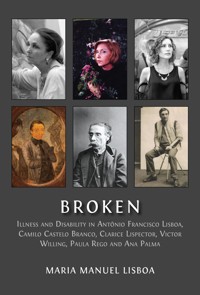
'Broken: Illness and Disability in Antônio Francisco Lisboa, Camilo Castelo Branco, Clarice Lispector, Victor Willing, Paula Rego and Ana Palma' traces the lives and works of six major artists and writers from Portugal, Brazil, and Britain through the lens of 'being broken'—in body, mind, or both. Spanning from the eighteenth century to the present, the volume explores how sociopolitical and somatic factors such as mental illness, psychological abuse, arthritis, genital mutilation, and multiple sclerosis shaped their creativity, while also reflecting broader national, social, sexual, and political pressures.
Engaging both literature and visual art, the book offers an original and provocative perspective that unsettles conventional narratives of health, gender, and identity in Lusophone and transnational contexts.
By situating canonical figures alongside emerging voices, 'Broken' bridges generations and disciplines, revealing how art and fiction transform experiences of illness and disability into critical insights on society, history, and power.
Das E-Book können Sie in Legimi-Apps oder einer beliebigen App lesen, die das folgende Format unterstützen:
Veröffentlichungsjahr: 2025
Ähnliche


















BROKEN
Broken
Illness and Disability in Antônio Francisco Lisboa, Camilo Castelo Branco, Clarice Lispector, Victor Willing, Paula Rego and Ana Palma
Maria Manuel Lisboa
https://www.openbookpublishers.com
©2025 Maria Manuel Lisboa
This work is licensed under the Creative Commons Attribution-NonCommercial 4.0 International (CC BY-NC 4.0). This license allows you to share, copy, distribute and transmit the text; to adapt the text for non-commercial purposes of the text providing attribution is made to the authors (but not in any way that suggests that they endorse you or your use of the work). Attribution should include the following information:
Maria Manuel Lisboa, Broken: Illness and Disability in Antônio Francisco Lisboa, Camilo Castelo Branco, Clarice Lispector, Victor Willing, Paula Rego and Ana Palma. Cambridge, UK: Open Book Publishers, 2025, https://doi.org/10.11647/OBP.0500
Further details about CC BY-NC licenses are available athttps://creativecommons.org/licenses/by-nc/4.0/
Copyright and permissions for the reuse of many of the images included in this publication differ from the above. This information is provided in the captions and in the list of illustrations. Unless otherwise stated, figures are reproduced under the fair dealing principle. Every effort has been made to identify and contact copyright holders and any omission or error will be corrected if notification is made to the publisher.
All external links were active at the time of publication unless otherwise stated and have been archived via the Internet Archive Wayback Machine at https://archive.org/web
Digital material and resources associated with this volume are available athttps://doi.org/10.11647/OBP.0500#resources
Information about any revised edition of this work will be provided at https://doi.org/10.11647/OBP.0500
ISBN Paperback: 978-1-80511-748-3
ISBN Hardback: 978-1-80511-749-0
ISBN Digital (PDF): 978-1-80511-750-6
ISBN HTML: 978-1-80511-752-0
ISBN Digital ebook (epub): 978-1-80511-751-3
DOI: 10.11647/OBP.0500
Cover images: Ana Palma (2012), CC BY-NC-SA 4.0; Paula Rego (1997), ©John Haynes. All Rights Reserved 2025/Bridgeman Images; Victor Willing in his London studio (1979), ©Victor Willing. All Rights Reserved 2025/Bridgeman Images; Clarice Lispector (Photo: Maureen Bisilliat), CC BY-SA 4.0, https://commons.wikimedia.org/wiki/File:Clarice_Lispector_por_Maureen_Bisilliat_em_agosto_de_1969._Acervo_IMS.jpg; Camilo Castelo Branco (Photo: Bohemia do Espirito), public domain, https://commons.wikimedia.org/wiki/File:Camilo_Castelo_Branco_Bohemia_do_Espirito.png; Antônio Francisco Lisboa (Photo: Inauguração do Museu de Congonhas), CC BY 2.0, https://commons.wikimedia.org/wiki/File:Inaugura%C3%A7%C3%A3o_do_Museu_de_Congonhas_(23425316429).jpg
Cover design: Jeevanjot Kaur Nagpal
For Bernard McGuirkBernard, after exactly forty years, this one is for you, with love. Thanks for the memories.
Let’s be perfectly clear boys and girls,Cunts are still running the world.Jarvis Cocker, ‘Running the World’
Table of Contents
Acknowledgements
Author’s Biography
List of Illustrations
A Note on Texts, Translations and Images
Introduction: Faulty Merchandise
1. Little Cripples: Antônio Francisco Lisboa (‘O Aleijadinho’)
2. Camilo Castelo Branco’s A brasileira de Prazins: ‘When in Danger or in Doubt, Run in Circles, Scream and Shout’
3. ‘I Know Where You Were Last Night’: Clarice Lispector or When Stars Become Supernovas
4. Victor Willing: Being There
5. Paula Rego: A Brick through a Window Never Comes with a Love Note
6. Menstrous/Monstrous: Bleeding, Amenorrhea and Feminine Hygiene in the Art of Ana Palma and Paula Rego
Interviews and Recollections
Interview with Lila Nunes
Interview with Ana Palma
In memoriam:Paula Rego and the Stories Left Untold
Helder Macedo (Translated by Maria Manuel Lisboa)
Index
Acknowledgements
Sister,
you’ve been on my mind
Sister, we’re two of a kind
So sister,
I’m keepin’ my eyes on you.
(Táta Vega) Quincy Jones, ‘Miss Celie’s Blues’1
There are many reasons why I lament the death of Paula Rego. I would not be right to call her a friend. We weren’t close. But I don’t quite know how else to feel about someone who once offered to come and look after me when I was ill (bearing in mind the treatment of sick dogs in her works I said thanks very much, but no thanks); someone who offered do my portrait (I was afraid she’d make my legs look unfairly fat, so I didn’t pursue the matter); but, more to the point, someone who allowed me to reproduce her images free of charge in two monographs and numerous articles, ensured they were made available to me without any problem and, over the years, even gave me a few hand-dedicated prints as a thank you for my writings on her. She changed my life and provided the visual narrative to many of my concerns. What she depicted, I often feel. Maybe we both belong in jail. The women in her images now smirk at me from my walls, somewhat menacing but also my kin. They know what’s on my mind. Sometimes I feel the way they seem to. I’m not ashamed. And I’m not afraid of you, Paula! Sometimes we laughed, but who or what was she laughing at? Me? I was never sure. Wherever she may be right now, she is definitely not here, and the solution to the current cost and bureaucratic difficulties of reproducing images by her and by her late husband, Victor Willing, have been circumvented by giving internet links to them in this volume. Many of her images have also been reproduced in my other book, Essays on Paula Rego: Smile When You Think about Hell, which can be read for free on-line at https://www.openbookpublishers.com/books/10.11647/obp.0178
This is not ideal, but it is the best I can do. Numquam desistas. Or as the great Diane Keaton (aka Annie Hall) would say: ‘la-di-da’.
Ana Palma has kindly allowed me to reproduce her art work and discussed it with me in an interview in a way that helped me tremendously.
I thank the following for helping me track down material used in this volume: Francisco Bethencourt, Helena Buescu, Helder Macedo, Viktor Mendes and Máire Ní Mhaonaigh.
A research grant from St. John’s College, Cambridge covered the costs of image reproduction rights and editing this volume.
Last but absolutely not least, I thank the band of brothers and sisters I always mention in every book I have ever written, for making my life sweet, easy and fun. You know who you are. I am very lucky to have you.
Author’s Biography
Maria Manuel Lisboa holds a Personal Chair in Portuguese Literature and Culture at the University of Cambridge and is a Fellow of St. John’s College, Cambridge. She lectures and supervises on Portuguese, Brazilian and Mozambican Literatures, Film and Art. This is her eighth monograph. The others cover Literature, Film and Art from Portugal and Brazil as well as a comparative one on the theme of Apocalypse. She is also the author of approximately seventy articles and book chapters on all these areas.
See https://cambridge.academia.edu/MariaManuelLisboa
1 See https://www.youtube.com/watch?v=YQq7RqYVb38
List of Illustrations
I.1
Kevin Carter, The Vulture and the Little Girl (1993), Wikipedia, https://en.wikipedia.org/wiki/File:Kevin-Carter-Child-Vulture-Sudan.jpg
1.1
Antônio Francisco Lisboa, Church of Saint Francis of Assisi (1749–1809) São João del Rei, Congonhas, Brazil. Photo by Marinelson Almeida (2014), Wikimedia Commons, CC BY 2.0, https://commons.wikimedia.org/wiki/File:Igreja_de_S%C3%A3o_Francisco_de_Assis._A_joia_rara_de_S%C3%A3o_Jo%C3%A3o_Del_Rei_-_MG_(15277299478).jpg
1.2
Supposed Portrait of Aleijadinho. Artist unknown (early nineteenth century), oil on parchment. Image size approx. 39.6 × 41.7 cm. Museu de Congonhas. Photo by Janine Moraes/Ministério da Cultura (2015), Wikimedia Commons, CC BY 2.0, https://commons.wikimedia.org/wiki/File:Inaugura%C3%A7%C3%A3o_do_Museu_de_Congonhas_(23425316429).jpg
1.3
Antônio Francisco Lisboa, Museum Casa dos Contos (1782–84), Ouro Preto, Brazil. Photo by Cecioka (2019), Wikimedia Commons, CC BY-SA 4.0, https://commons.wikimedia.org/wiki/File:Museu_Casa_dos_Contos_2019_26.jpg
1.4
Antônio Francisco Lisboa, Church of Our Lady of Carmel (1767–80), Ouro Preto, Brazil. Photo by Joedison Rocha (2019), Wikimedia Commons, CC BY-SA 4.0, https://commons.wikimedia.org/wiki/File:Igreja_de_Nossa_Senhora_do_Carmo,_Ouro_Preto-MG.jpg
1.5
Antônio Francisco Lisboa, The Ascent to Calgary (1796–99), polychromed wood, life size sculptures. Sanctuary of Congonhas da Campo, Brazil. Photo by Rosino (2011), Wikimedia Commons, public domain, https://commons.wikimedia.org/wiki/File:Aleijadinho_01.jpg
1.6
Antônio Francisco Lisboa, Jesus’ Crucifixion (1796–99), polychromed wood, life size sculptures. Photo by Ricardo André Frantz (2015), Wikimedia Commons, CC BY 3.0, https://commons.wikimedia.org/wiki/File:A_crucifica%C3%A7%C3%A3o_de_Jesus_-_Aleijadinho_-_Congonhas.jpg
1.7
Antônio Francisco Lisboa, Church of the Good Lord of Matosinhos and the Twelve Prophets (1800–05), life-size soapstone statues. Photo by Silvia Schumacher (2014), Wikimedia Commons, CC BY-SA 4.0, https://commons.wikimedia.org/wiki/File:Conjunto_da_Bas%C3%ADlica_do_Senhor_Bom_Jesus_de_Matosinhos3.JPG
1.8
Tarsila do Amaral, Workers (1933). © Artistic-Cultural Collection of the Governmental Palaces of the State of São Paulo. Wikipedia, https://pt.wikipedia.org/wiki/Ficheiro:Operarios.jpg#/media/Ficheiro:Operarios.jpg
4.1
Photograph of Fernando Pessoa (1914). Wikimedia Commons, public domain, https://commons.wikimedia.org/wiki/File:Pessoa_chapeu.jpg
4.2
Victor Willing, Rien (1980, oil on canvas, 200 × 183 cm. ©The Estate of Victor Willing, https://www.tate.org.uk/art/artworks/willing-rien-t03187
4.3
Victor Willing, Self-Portrait at 70 (1987), oil on canvas, 56 × 56 cm. Pallant House Gallery, Chichester. ©The Estate of Victor Willing. Photo by Mark Bridge (2006), https://www.flickr.com/photos/markbridge/179893540
4.4
Victor Willing, Judge (1982), oil on canvas, 250 × 200 cm. ©The Estate of Victor Willing, https://artuk.org/discover/artworks/judge-70485
4.5
Victor Willing, StandingNude (1952–53), oil paint on hardboard. Support: 1538 × 1234 mm; frame: 1583 × 1286 × 75 mm. ©The Estate of Victor Willing, https://www.tate.org.uk/art/artworks/willing-standing-nude-t07126
4.6
Damien Hirst, The Physical Impossibility of Death in the Mind of Someone Living or Death Denied (2008), glass, steel, shark, acrylic and formaldehyde solution. Photo by Agent001 (2009), Wikimedia Commons, CC BY-SA 3.0, https://commons.wikimedia.org/wiki/File:Shark83.JPG
4.7
Tribute, Mark Rothko Art Centre, Daugavpils (Latvia), October 2017. Photo by Traqueurdelumieres (2017), Wikimedia Commons, CC BY-SA 4.0, https://commons.wikimedia.org/wiki/File:Tribute,_Mark_Rothko_Art_Centre,_Daugavpils_(Latvia),_October_2017.jpg#/media/File:Tribute,_Mark_Rothko_Art_Centre,_Daugavpils_(Latvia),_October_2017.jpg
4.8
Victor Willing,Self-Portrait (1957), oil on canvas, 56 × 56 cm. ©The Estate of Victor Willing, https://www.creativeboom.com/inspiration/visions-a-major-retrospective-of-the-mid-century-british-painter-victor-willing/
4.9
Victor Willing, Place of Exile (1976), charcoal and pastel on paper, 31.4 × 50 cm. ©The Estate of Victor Willing, courtesy Marlborough Fine Art, https://artscouncilcollection.org.uk/artwork/place-exile
4.10
Victor Willing, Place Triptych (1976–78), oil on canvas, 66 × 116 cm (left panel, 190 × 216 cm (centre panel), 166 × 116 cm (right panel). ©The Derek Williams Trust, https://derekwilliamstrust.org/news/victor-willing-takes-his-place-in-the-collection/#
4.11
Paula Rego, The Family (1988), acrylic on paper on canvas, 213.4 × 213.4. ©Victoria Miro, https://www.victoria-miro.com/artworks/29907/
4.12
Victor Willing, Mud (1979–80), oil on canvas, 183.2 × 426.1 cm. ©The Estate of Victor Willing. Arts Council Collection, Southbank Centre, London, https://artuk.org/discover/artworks/mud-64323
4.13
Victor Willing, Stepladder (1976), oil on canvas, 183 × 152 cm. ©The Estate of Victor Willing. Pallant House Gallery, Chichester, https://artuk.org/discover/artworks/painting-with-stepladder-70480
4.14
Victor Willing, Swing (1978), oil on canvas, 152 × 83 cm. ©The Estate of Victor Willing, https://artuk.org/discover/artworks/swing-70536
4.15
Victor Willing, Place with a Red Thing (1980), oil on canvas, 200 × 250.2 cm. ©The Estate of Victor Willing, https://www.tate.org.uk/art/artworks/willing-place-with-a-red-thing-t03186
4.16
Victor Willing, Breathe (1982), pastel and charcoal on paper, 42.2 × 30 cm. ©The Estate of Victor Willing, https://www.artsy.net/artwork/victor-willing-untitled-breathe
4.17
Victor Willing, Cart (1978), oil on canvas, 188 × 208 cm. ©The Estate of Victor Willing. Bridgeman Images, https://www.bridgemanimages.com/en/willing/the-cart-1978-oil-on-canvas/oil-on-canvas/asset/1079709
4.18
Victor Willing, Effigy (1978), crayon and pastel on paper, 25 × 32.5 cm. ©The Estate of Victor Willing. Timothy Taylor, https://www.timothytaylor.com/artworks/16711-victor-willing-effigy-1978/
5.1
Paula Rego, Crivelli’s Garden (1990–91), acrylic on canvas, 189.9 × 945.3 cm. ©National Gallery, London, https://artlyst.com/whats-on-archive/paula-rego-crivellis-garden/
5.2
Artemisia Gentileschi, Judith Beheading Holofernes (1614–20), oil on canvas, 199 cm × 162.5 cm, Uffizi Gallery, Florence. Wikimedia Commons, public domain, https://commons.wikimedia.org/wiki/File:Judit_decapitando_a_Holofernes,_por_Artemisia_Gentileschi.jpg
5.3
Jan Massys, The Ill-matched Pair (1566), oil on panel, 97 × 134 cm, National Museum, Sweden. Wikimedia Commons, public domain, https://commons.wikimedia.org/wiki/File:The_Ill-matched_Pair_(Jan_Massys)_-_Nationalmuseum_-_17511.tif
5.4
Artemisia Gentileschi, Samson and Delilah (1930–38), oil on canvas, 90.5 cm × 109.5 cm, Palazzo Zevallos Stigliano, Naples. Wikimedia Commons, public domain, https://commons.wikimedia.org/wiki/File:Samson_und_delilah.jpg
5.5
Paula Rego, Red Monkey Beats His Wife (1981), acrylic on paper. 65 × 105 cm. ©The Estate of Paula Rego. Victoria Miro, https://www.victoria-miro.com/artworks/29917/
5.6
Paula Rego, Dog Woman (1952), pencil on paper, 15.5 × 21.5 cm. ©The Estate of Paula Rego, https://shop.tate.org.uk/paula-rego-dog-woman/paureg2122.html
5.7
Paula Rego, Dog Woman (1994), pastel on canvas, 120 × 160 cm. ©The Estate of Paula Rego. Victoria Miro, https://www.victoria-miro.com/artworks/29910/
5.8
Paula Rego, Girl Lifting Up Her Skirt to a Dog (1986), acrylic on paper mounted on canvas, 76 × 55.5 cm. ©The Estate Paula Rego. Bridgeman Images, https://www.bridgemanimages.com/en/rego/girl-lifting-up-her-skirt-to-a-dog-1986-acrylic-paint-on-paper-mounted-on-canvas/acrylic-paint-on-paper-mounted-on-canvas/asset/8369496?offline=1
5.9
Antoine Watteau, The Toilette (first half of the eighteenth century), oil on canvas, 45.2 × 37.8 cm, the Wallace Collection, London. Wikimedia Commons, public domain, https://commons.wikimedia.org/wiki/File:Antoine_Watteau_-_The_Toilette_-_WGA25473.jpg
5.10
Jean-Honoré Fragonard, Two Girls on a Bed Playing with their Dogs (date unknown), oil on canvas, 74.3 × 59.3 cm, Resnick Art Collection, Los Angeles. Photo by Sotheby’s (2022), Wikimedia Commons, public domain, https://commons.wikimedia.org/wiki/File:Jean-Honor%C3%A9_Fragonard_-_Two_girls_on_a_bed_playing_with_their_dogs_-_collection_Resnick.jpg
5.11
Jean-Honoré Fragonard, Young Girl and her Dog (1770–75), oil on canvas, 89 × 70 cm, Alte Pinakothek, Munich. Photo by Jebulon (2014), Wikimedia Commons, public domain, https://commons.wikimedia.org/wiki/File:Jeune_fille_et_son_chien,_Jean-Honor%C3%A9_Fragonard,_HUW_35,_Alte_Pinakothek_Munich.jpg
5.12
Paula Rego, The Betrothal: Lessons: The Shipwreck, after ‘Marriage à la Mode’ by Hogarth (1999), pastel on paper mounted on aluminium, 165 × 500 cm, Tate, London. ©Paula Rego. Tate, https://www.tate.org.uk/art/artworks/rego-the-betrothal-lessons-the-shipwreck-after-marriage-a-la-mode-by-hogarth-t07919
5.13
William Hogarth, Marriage A-la-Mode: The Tête à Tête (c. 1743), oil on canvas, 69.9 × 90.8 cm, the National Gallery, London. Wikimedia Commons, public domain, https://commons.wikimedia.org/wiki/File:William_Hogarth_-_Marriage_A-la-Mode_2_The_T%C3%AAte_%C3%A0_T%C3%AAte.jpg
5.14
William Hogarth, A Harlot’s Progress, Plate 1 (1732), etching and engraving on paper, 31.6 × 38.8 cm, British Museum. Wikimedia Commons, public domain, https://commons.wikimedia.org/wiki/File:A_Harlot%27s_Progress,_Plate_1_(BM_1858,0417.544).jpg
5.15
William Hogarth, Hudibras and the Skimmington (1725–26), engraving (second plate of three), 26.9 × 50.8 cm, New York Metropolitan Museum of Art. Wikimedia Commons, CC0, https://commons.wikimedia.org/wiki/File:Hudibras_and_the_Skimmington_(Twelve_Large_Illustrations_for_Samuel_Butler%27s_Hudibras,_Plate_7)_MET_DP826937.jpg
5.16
Paula Rego, Wife Cuts off Red Monkey’s Tail (1981), acrylic on paper, 68 × 101 cm. ©The Estate of Paula Rego. Marlborough Fine Art, https://www.researchgate.net/figure/Paula-Rego-Wife-Cuts-off-Red-Monkeys-Tail-1981-Acrylic-on-paper-68-x-101-cm_fig3_335537543
5.17
Paula Rego, Girl and Dog (1986), acrylic on paper, 112 × 76 cm. ©The Estate of Paula Rego. Marlborough Fine Art, https://www.researchgate.net/figure/Paula-Rego-Girl-and-Dog-Untitled-b-1986-Acrylic-on-paper-112-x-76-cm-Photograph_fig11_335537284
5.18
Paula Rego, Snare (1987), acrylic on paper on canvas, 150 × 150 cm. ©The Estate of Paula Rego / Bridgeman Images. British Council Collection, https://artuk.org/discover/artworks/snare-176993
5.19
Paula Rego, Two Girls and a Dog (1987), acrylic paint on paper on canvas, 150 × 150 cm, Calouste Gulbenkian Foundation, Lisbon. ©The Estate of Paula Rego, https://gulbenkian.pt/cam/en/publications/paula-rego-4/
5.20
Paula Rego, Descent from the Cross (2002), pastel on paper on aluminium, 75 × 72 cm. ©The Estate of Paula Rego. Bosc d’Anjou (2021), https://www.flickr.com/photos/boscdanjou/52136949210
5.21
Paula Rego, Lamentation (2002), watercolour and ink on paper, 21 × 29 cm, property of the Portuguese State (Portuguese State Contemporary Art Collection). ©The Estate of Paula Rego. Victoria Miro, https://www.artsy.net/artwork/paula-rego-lamentation-at-the-foot-of-the-cross
5.22
Paula Rego, Deposition (1998), pastel and graphite on paper mounted on aluminium, 160 × 120 cm, private collection, https://www.christies.com/en/lot/lot-5335320
5.23
Paula Rego, The Little Mermaid (2003), pastel on paper mounted on aluminium, 140 × 110 cm, Kunsthal Charlottenborg, Copenhagen, https://www.christies.com/en/lot/lot-5608702
5.24
Paula Rego, Mermaid Drowning Wendy (1992), coloured etching and aquatint, 27.7 × 20 cm, Cristea Roberts Gallery, London, https://cristearoberts.com/artists/206-paula-rego/works/90242/
5.25
Winslow Homer, The Blue Beard Tableau: Fatima Enters the Forbidden Closet (1868), wood engraving, 11.4 × 11.7 cm, Boston Public Library, Print Department. Wikimedia Commons, public domain, https://commons.wikimedia.org/wiki/File:Blue_beard_tableau_(Boston_Public_Library).jpg
5.26
Paula Rego, Dressing Him Up as Bluebeard (2002), lithograph, 73 × 54 cm, part of a limited set, Museum of Modern Art, Tate, The Metropolitan Museum of Art, Art Institute of Chicago, https://www.artsy.net/artwork/paula-rego-dressing-him-up-as-bluebeard-from-the-jane-eyre-series
5.27
Paula Rego, Mother Takes Revenge (2003), pastel on paper, 104 × 79 cm. © The State of Paula Rego. Bridgeman Images, https://www.bridgemanimages.com/en/rego/mother-takes-revenge-red-riding-hood-series-2003-pastel-on-paper/pastel-on-paper/asset/8835840?offline=1
5.28
Paula Rego, Mother Wears Wolf’s Pelt (2003), pastel on paper, 84 × 67 cm. © The Estate of Paula Rego. Bridgeman Images, https://www.bridgemanimages.com/en/rego/mother-wears-the-wolf-s-pelt-red-riding-hood-series-2003-pastel-on-paper/pastel-on-paper/asset/8835842?offline=1
5.29
Paula Rego, Night Bride (2009), etching and aquatint, 36.5 × 50 cm, Royal Academy Collection, https://www.royalacademy.org.uk/art-artists/work-of-art/night-bride
5.30
Paula Rego, Escape (2009), etching and aquatint, 49 × 36.5 cm. ©Ostrich Arts Ltd/Amgueddfa Cymru - Museum Wales, https://museum.wales/collections/online/object/2e7a7812-96c6-357f-98d1-681ff3ae4012/Escape/?field0=string&value0=roman&field1=with_images&value1=1&page=196
6.1
Paula Rego, Nativity (2002), property of the Portuguese State (Portuguese State Contemporary Art Collection), https://www.researchgate.net/figure/Paula-Rego-Nativity-2002-Pastel-on-paper-mounted-on-aluminium-54-x-52-cm-Belem_fig1_335537454
6.2
‘We Won’t Go Back’, coat hanger sign from demonstration in front of SCOTUS, 3 May 2022. Photo by Janni Rye (2022), Wikimedia Commons, CC0, https://commons.wikimedia.org/wiki/File:We_wont_go_back_-_coat_hanger_-_sign_-_Demonstration_in_front_of_SCOTUS_May_3_2022_754.jpg
6.3
Paula Rego, Untitled Triptych; Abortion (left-hand panel) (1998–99). Pastel on paper mounted on aluminium, 110 x× 100 cm. ©The Estate of Paula Rego and Victoria Miro, https://womensartblog.wordpress.com/2018/05/21/the-abortion-pastels-paula-rego/
6.4
Paula Rego, Untitled (Abortion) (1988), pastel on paper mounted on aluminium, 110 × 100 cm. ©The Estate of Paula Rego and Victoria Miro, https://www.nationalgalleries.org/sites/default/files/features/EFENJJWW4AADxdy_1.jpg
6.5
Paula Rego, Agony in the Garden (2002), pastel on paper on aluminium, 79.5 × 76.5 × 4.5 cm, Virgin Mary Series. ©Paula Rego. All rights reserved 2025/Bridgeman Images, https://www.bridgemanimages.com/en/rego/agony-in-the-garden-2002-pastel-on-paper-on-aluminium/pastel-on-paper-on-aluminium/asset/8617906
6.6
Ana Palma, Entrails II (2021), acrylic and watercolour pencil on paper, 35 × 50 cm, CC BY-NC-SA 4.0.
6.7
Ana Palma, The Cycle (2016–19), graphite pencil and acrylic on paper, 59.4 × 84.1 cm, CC BY-NC-SA 4.0.
6.8
Ana Palma, You Died on Me (2013), graphite and watercolour on paper, 47 × 42.5 cm, CC BY-NC-SA 4.0.
6.9
Ana Palma, Orange (2017), watercolour on paper, 29.7 × 42 cm, CC BY-NC-SA 4.0.
6.10
Ana Palma Rebirth (2017), coloured pencil and acrylic on paper, 42 × 59.4 cm, CC BY-NC-SA 4.0.
6.11
Ana Palma, Truth (2019), graphite pencil and acrylic on paper, 29.7 × 42 cm, CC BY-NC-SA 4.0.
6.12
Ana Palma, Found It! (2017), watercolour pencils on paper, 70 × 50 cm, CC BY-NC-SA 4.0.
6.13
Ana Palma, Inner Spring (2019) , graphite, watercolour pencils and acrylic on paper, 29.2 × 42 cm, CC BY-NC-SA 4.0.
6.14
Ana Palma, Demeter (2021), graphite and watercolour on paper, 29.7 × 42 cm, CC BY-NC-SA 4.0.
6.15
Ana Palma, Persephone (2021), graphite and watercolour on paper, 29.7 × 42 cm, CC BY-NC-SA 4.0.
6.16
Siena, Sibilla Cumea, Sienna Cathedral, mosaic floor detail. Photo by Sailko (2011), Wikimedia Commons, CC BY-SA 3.0, https://commons.wikimedia.org/wiki/File:Siena,_sibilla_cumea_01.JPG
A Note on Texts, Translations and Images
All translations from Portuguese are by Maria Manuel Lisboa. Although not all academics would opt to use on-line texts rather than established editions, this author follows a different logic: where a text is available on-line in an accurate rendition, it is more democratic to refer to that than favouring one specific print edition over another in the case of texts widely available under different presses in different countries, as is the case of works by Eça de Queirós, Camilo Castelo Branco, Fernando Pessoa, Clarice Lispector and others. This book contains two types of illustrations: images reproduced directly in the text, and external images accessible via stable URLs and QR codes, each accompanied by a thumbnail. Certain images are provided through links rather than full reproduction in print because of resolution, permissions or cost constraints.
Today, the ‘polymath’ [...] is distrusted. He has few colleagues. He will commit errors and oversights, perhaps trivial or readily corrected, but of a kind which exasperates the specialist, which casts doubt on the work as a whole. I have, on occasion, been careless over detail, over technical discriminations. Impatience, […] the pressure of deadlines and public platforms […] have marred texts which could have been, formally at least, unblemished. An unripe restlessness, […] has made me drop subjects, problems, disciplines once I thought, erroneously perhaps, that I had seized their gist, that I knew where the matter led. My belief that cows have fields but that passions in motion are the privilege of the human mind has long been held against me.
George Steiner, Errata
Introduction: Faulty Merchandise
©2025 Maria Manuel Lisboa, CC BY-NC 4.0 https://doi.org/10.11647/OBP.0500.00
The world breaks everyone, and afterward, some are strong at the broken places.
Ernest Hemingway, A Farewell to Arms
Let us talk about disability. Are you physically impaired, incapacitated, crippled, debilitated, limited, restricted, maimed, paralyzed, disabled, paralytic, differently-abled? Or are you mentally ill, neurodiverse, mad, batty, barmy, insane, crazy, a lunatic, a psycho?
Or are you both? If you are extremely unlucky (in the words of the deeply politically-incorrect Ian Dury), are you spasticus/autisticus?1 Are you either? Are you neither? Will it kill you? As is the case with most things, the answer to these questions depends partly on race, sex, age, class, occupation, tenacity, wear and tear, fatigue, despair.
One man’s shell shock is another woman’s hysteria (Showalter, 1987). If you are a young, promising university student, tough though life may be, the world of disability resources is your oyster. If you are an overweight, chain-smoking, unemployed, council-house mother-of-six, you are seen as a benefits scrounger. If you are somewhere in the middle, ‘outcomes’ may depend on whether or not you are someone who is able to ‘self-advocate’ (aka, a sufficiently-grumpy cripple).
In the enlightened world of academia, for example, where pigs definitely fly, one finds a whole industry of Disability Studies: Disability in Literature; Disability in Art; Disability in Film; Disability in Science Fiction (‘there are no ramps in space’); Disability in History; Disability in Society; Cultural Studies and Disability; Queer Disabilities; Transnational Disabilities; Disability and Race; Transgender Disability; Post-human Disability; etc. Just put the word ‘disability’ on Amazon or in your library’s search engine and you will find that you will never walk alone (if you can walk at all). Praxis is a beautiful word, of course, but look out for Theory overburden. Bandwagons can be adapted for the disabled: blue-badges-for-all. Just don’t annoy your line manager, lest (to use another over-used/abused/abusive term) you queer the patch for another cripple down the line.
In the past fifteen years or so, Disability Studies have mushroomed in universities, from books to dedicated journals, to forums, to workshops.2 But why only now? Back whenever it was, Oedipus became blind through self-harming, the latter problem in its turn having been triggered by a dysfunctional family and polis. Cripples, like the poor, have always been with us.
Paraphrasing Tolstoy, all healthy people are alike; each unhealthy person is unhealthy in their own way. The modalities of being broken, be it in body or in mind, are as numerous as there are living organisms on the planet. One of the most obvious but thought-provoking comments anyone ever made to me was that in the wild all animals die a nasty death. The same, of course applies to many human beings, either in the wild or in one’s own neighbourhood. And the difference between humans and non-humans, let alone between verdant, dry or concrete jungles, is not always clear. Less often (but not never), ‘regarding the pain of others’3 can kill the viewer too. Rubber-necking a car crash may not always be done with impunity.
In 1996, a song by the Welsh band Manic Street Preachers, titled ‘Kevin Carter’, reached number nine on the UK Singles Chart. The subject of the lyrics was the eponymous Pulitzer Prize-winning photographer, who in 1994 was awarded the Prize for Feature Photography for his image, The Vulture and the Little Girl, taken in what is now South Sudan during the notorious 1993 famine. The image showed a small child crawling on the ground with a vulture loitering close by. Carter was a South African photographer and member of The Bang-Bang Club, a group of four conflict photographers active within the townships of South Africa between 1990 and 1994.
Fig. I.1 Kevin Carter, The Vulture and the Little Girl (1993), Wikipedia, https://en.wikipedia.org/wiki/File:Kevin-Carter-Child-Vulture-Sudan.jpg
http://hdl.handle.net/20.500.12434/3e75498e
He was shocked by what he had just photographed and chased the vulture away, but then boarded a small UN plane and left the child behind. The photograph first appeared on 26 March 1993 in the New York Times4and was syndicated worldwide. Many people contacted the newspaper to ask about the fate of the child. The paper replied that according to Carter, ‘she recovered enough to resume her trek after the vulture was chased away’ but that it was unknown whether she had reached the nearest UN food centre. In 2011, the child’s father revealed the child was actually a boy, Kong Nyong, who had in fact reached the aid station but had died in 2007, of unspecified ‘fevers’.
Carter was reportedly troubled by the conflict between his professional responsibilities (photographic reportage) and moral considerations (intervening in what he was photographing). Four months after winning the Pulitzer he killed himself by carbon monoxide poisoning, aged thirty-three. His suicide note read as follows:
I’m really, really sorry. The pain of life overrides the joy to the point that joy does not exist… I am haunted by the vivid memories of killings & corpses & anger & pain… of starving or wounded children, of trigger-happy madmen, often police, of killer executioners...5
Or, as the Manic Street Preachers would put it:
Hi, Time Magazine, hi, Pulitzer Prize
Tribal scars in Technicolor
Bang-bang club, AK-47 hour
Kevin Carter
Hi, Time Magazine, hi, Pulitzer Prize
Vulture stalked white piped lie forever
Wasted your life in black and whiteKevin Carter. (Manic Street Preachers, 1996)
The permutations of life as a phenomenon that is nasty, brutish and short has been the subject of cultural artifacts ever since humanity began to decorate its caves.
It is one of the never-ending preoccupations of literature, music and art. This volume will gather together essays that focus on literary and visual works from Brazil and Portugal, from the eighteenth century to the present, created under the malignancy of disease, both physical and mental, as well as the impact of the shortcomings in societies’ care for their un-fittest.
Kermit the frog memorably lamented that it wasn’t easy being green when everything around one was green too: ‘It seems you blend in with so many other ordinary things’. But he re-thought his position, and in a moment worthy of the Portuguese poet Alberto Caeiro’s6 philosophical laid-backed posture, he ruminates that:
When green is all there is to be
It could make you wonder why
But why wonder why wonder
I am green, and it’ll do fine
It’s beautiful, and I think it’s what I want to be. (Raposo, 1970)
I like everything to be real and for everything to be correct.
And I like it because it would be so even if I didn’t like it.
Therefore, if I die now, I will die happy,
Because everything is real and everything is right.(Caeiro, 1946 [1993], p. 87)
The physical and emotional/mental cripples of the world would agree. Being whole(some) and unremarkable is ‘beautiful, and I think it’s what I want to be’. But there again, where would the Arts be without life’s damaged goods? God may have made ‘all things bright and beautiful’ (which, however, as the Epicurean paradox rightly points out, begs the question ‘if so, where did the rest come from?’) but his Son was less picky: he purportedly loved all things, bright and ugly.
The biographical circumstances of the subject of Chapter 1—race, illegitimacy and deformity—and the fact that Antônio Francisco Lisboa’s life was to be both defined and unconfined by them, offers the blueprint for how we may approach the ontological drive in the chapters that follow, behind broken minds in Camilo Castelo Branco’s Marta, Clarice Lispector’s Macabéia and Laura, and broken bodies in Victor Willing, Paula Rego and Ana Palma. He becomes the scaffolding for thinking about their works.
Chapter 1 considers the life and work of the Brazilian eighteenth-century architect and carver, Antônio Francisco Lisboa, also known as ‘o Aleijadinho’ (‘the Little Cripple’). Lisboa was best-known as the creator of churches and religious statuary in the state of Minas Gerais. He was a key representative of the Baroque movement not only in Brazil but in the whole of South America. The chapter will highlight his achievement in view of profound disability that for a considerable part of his life deprived him of the use of his feet, and at a later stage, most of his fingers.
Chapter 2 discusses A brasileira de Prazins, a nineteenth-century novel by the Portuguese author Camilo Castelo Branco, in which, breaking from his customary High Romantic style, he uses the trope of the mental illness of the eponymous heroine as a means of commenting on the political decline of the nation in the aftermath of the loss of its empires in South Asia and Brazil.
Chapter 3 considers two texts by Clarice Lispector, a twentieth-century Brazilian descendent of Ukrainian Jewish refugees whose work became iconic amongst French Feminist theoreticians such as Hélène Cixous. The two texts considered here, a short story (‘A imitação da rosa’) and a novel (A hora da estrela) focus on Lispector’s signature concern with mental and physical entrapment as the result of gender and poverty expressed through the means of verbal embattlement.
Chapter 4 looks at the work of the twentieth-century artist, Victor Willing (Portuguese by marriage and sometime-resident in Portugal), the second phase of whose paintings were defined by his disability, caused by multiple sclerosis.
Chapter 5 analyses the use of physical trauma in the visual works of Paula Rego, inflicted by medical factors (illness, abortion, female genital mutilation) as well as social and political violence.
Chapter 6 considers the visual works of London-based Portuguese artist Ana Palma and analogies with Paula Rego, in a series of paintings, drawings, watercolours and sketches inspired by the physical and mental effects of amenorrhea (absence of menstruation in women of child-bearing age).
The book closes with interviews and recollections: an interview with Lila Nunes, Paula Rego’s main female model over many decades, one with Ana Palma and an in memoriam by her old friend, Helder Macedo are also included.
Works Cited
Caeiro, Alberto, 1946 [1993], ‘When Spring Comes’, in ‘Poemas Inconjuntos’, in Fernando Pessoa, Poemas de Alberto Caeiro, 10th ed. (Lisbon: Ática), p. 87.
Davis, Lennard J. (ed.), 2016, The Disability Studies Reader (London: Routledge).
Goodley, Dan, 2024, Disability Studies: An Interdisciplinary Introduction (London, New York, Dehli and Singapore: SAGE Publications).
Hall, Alice, 2015, Literature and Disability (London: Routledge).
Manic Street Preachers, 1996, ‘Kevin Carter’ (Everything Must Go).
Raposo, Joe, 1970, ‘Bein’ Green’ (The Muppet Show).
Showalter, Elaine, 1987, The Female Malady: Women, Madness and English Culture, 1830-1980 (London: Virago).
Sontag, Susan, 2004, Regarding the Pain of Others (London: Penguin).
Tolstoy, Leo, 2003, Anna Karenina (London: Penguin Classics).
Yu, Tiffany, 2025, The Anti-Ableist Manifesto: How to Build a Disability-Inclusive World (Guildford: Souvenir Press).
1 See further, https://dangerousminds.net/comments/spasticus_autisticus_the_day_the_bbc_banned_ian_dury/
2 See Davis, 2016; Goodley, 2024; Hall, 2015; Yu, 2025; and the Disability Studies Quarterly journal.
3 Sontag, 2004.
4 See further https://en.wikipedia.org/wiki/The_Vulture_and_the_Little_Girl
5 See https://www.lehigh.edu/~jl0d/J246-02/carter.html
6 See Chapter 4 in this volume.
1. Little Cripples: Antônio Francisco Lisboa (‘O Aleijadinho’)
©2025 Maria Manuel Lisboa, CC BY-NC 4.0 https://doi.org/10.11647/OBP.0500.01
Cavalhadas, Luminárias.
Sinos, procissões, promessas.
Anjos e santos nascendo
em mãos de gangrena e lepra
Finas músicas broslando
as alfaias das capelas.
Todos os sonhos barrocos
deslizando em pedra.
Cecília Meireles, referring to Antônio Francisco Lisboa, ‘Romance XXI ou das Idéias’, in Romanceiro da Inconfidência1
Ah gits weary
An’ sick of tryin’
Ah’m tired of livin’
An’ skeered of dyin’.
William Warfield, ‘Ol’ Man River’
Introduction
This chapter focuses on the life and work of the Brazilian eighteenth-century artist, architect and carver Antônio Francisco Lisboa, against the background of severe disability in a society where his status as the mixed-race son of a slave and of a Portugues migrant did not prevent him from becoming a key proponent of the Baroque style in South America, as well as a major influence on the Brazilian Modernist movement, one-and-a-half centuries later.
***
The Aleijadinho: The Man, His Body and His Work
The life of Antônio Francisco Lisboa is inextricably linked to any consideration of his work both as sculptor and carver, the nature of the work itself being in fact almost entirely determined by the tastes and interests of the financial entities that commissioned it (mainly the Roman Catholic Church in Brazil at the height of the Baroque movement in the eighteenth century). Were it not, therefore, for the extraordinary adversity of his circumstances (race, disability), the homem behind the obra might have remained as anonymous as those behind many of the great architectural and design monuments of that period, or indeed any other period anywhere. There are exceptions, of course (Michelangelo, Christopher Wren, Antoni Gaudi, Le Corbusier, Frank Lloyd Wright, Norman Foster), but in general does anyone, other than architectural art historians, know the names of those responsible for the conception of King’s College Chapel in Cambridge, the Monastery of the Jerónimos in Lisbon or even Versailles? We may know which kings, governments or entities commissioned famous buildings; their architects, sculptors, carvers and builders, however, tend not to be household names, and many are not known at all. Not so, however, in the case of ‘Aleijadinho’ (the ‘Little Cripple’). Even more so than in the case of the writers and artists that will be discussed in the chapters that follow, in this instance, the legend and the life are of the essence regarding the work, determined by a combination of biographical factors which throw light on the ‘texts’ (I use the term ‘texts’ advisedly, albeit possibly anachronistically), but which also exceed them in terms of the interest they aroused. We know about the Church of Saint Francis of Assisi in São João del-Rei (Fig. 1.1) and the Church of the Good Lord of Matosinhos and the Twelve Prophets (Fig. 1.7) because they are the work of Aleijadinho.
Fig. 1.1 Antônio Francisco Lisboa, Church of Saint Francis of Assisi (1749–1809) São João del Rei, Congonhas, Brazil. Photo by Marinelson Almeida (2014), Wikimedia Commons, CC BY 2.0, https://commons.wikimedia.org/wiki/File:Igreja_de_S%C3%A3o_Francisco_de_Assis._A_joia_rara_de_S%C3%A3o_Jo%C3%A3o_Del_Rei_-_MG_(15277299478).jpg
Plato, ‘like all heroic Greeks, a cunt’2 (paraphrasing Jorge de Sena, who knew a thing or two about diversity) did not approve of anything that was not perfection. The ugly and the sick, for example, had no place in his utopian republic. Neither did artists or playwrights, as it happens, which would leave the artist to be discussed here very much in the doghouse for being what he was (deformed) and doing what he did (art). Or worse than the doghouse, since in The Republic the Greek praises dogs for being true philosophers as well as/or because they were xenophobic in the most literal sense of the word (lovers of the familiar, who distinguished the face of a friend or an enemy purely on the criterion of knowing and not knowing them) (Plato, 2018, p. 60).
We will return to this. But perhaps Pierre Bourdieu’s lament that ‘every established order tends to produce the naturalization of its own arbitrariness’ had a point, then and now (Bourdieu, 1977, p. 115). For Bourdieu the body is a generator of social divisions which it mirrors. It carries symbolic value imprinted on particular bodily forms. De(form)ities? And Bordo (not Bourdieu), albeit with a focus on gender (but it applies to other areas of marginalization such as disability) debates the ways in which body ideals serve as mechanisms of social power and control.
In ‘The Body Beautiful: Symbolism and Agency in the Social World’, Erica Reischer and Kathryn S. Koo draw on Bourdieu and Foucault to debate how the body has become of interest to social theory which, rather than considering it through a ‘naturalistic approach […] as a biological given’, redefined it as a ‘sociocultural and historical phenomenon’: ‘the body as a conduit of social meaning’ (Reischer and Koo, 2004, p. 298). Mary Douglas (1970) memorably defined it as a text or script upon which social meanings are inscribed; and albeit from the specific perspective of the female body under patriarchy (but it will have relevance here too), Bordo sees body ideals not simply as harmless symbols of social values but also as mechanisms of social power and control, body size and shape signifying the moral state of the individual. Plato would have agreed.
The way we look determines how society engages with us, and for Maurice Merleau-Ponty (1958), the reverse is also true.
The living body […] could not escape the determinations which alone made the object into an object and without which it would have had no place in the system of experience. (Merleau-Ponty, 1958, p. 63)
The human body [is] the outward manifestation of a certain manner of being-in-the-world. (Merleau-Ponty, 1958, p. 64)
Sense experience, thus detached from the affective and motor functions, became the mere reception of a quality, and physiologists thought they could follow, from the point of reception to the nervous centres, the projection of the external world in the living body. The latter, thus transformed, ceased to be my body, the visible expression of a concrete Ego, and became one object among all others. Conversely, the body of another person could not appear to me as encasing another Ego. It was merely a machine, and the perception of the other could not really be of the other. (Merleau-Ponty, 1958, p. 64)
In the end, however, if the body is a vehicle for the imposition of social, political and economic forces onto individuals and groups, it must also be seen as the instrument of resistance to those forces. It ‘can never be a struggle-free zone’ and has the ability to challenge them (Comaroff, 1985, p. 40).
Antônio Francisco Lisboa (born in either 1730 or 1738, died 18 November 1814, Fig. 1.2), better known as Aleijadinho, was a sculptor, carver and architect in colonial Brazil, noted for his works on various churches as well as religious art, statuary, reliefs and carvings (Fig. 1.3). He is considered the greatest representative of the Baroque movement in the Americas. Almost all of his work was carried out in the state of Minas Gerais, especially in the cities of Ouro Preto (formerly Vila Rica), Sabará, São João del-Rei and Congonhas. Practically all the information about his life is derived from a biography written in 1858 by Rodrigo José Ferreira Bretas, forty-four years after his death, and allegedly based on documents and testimonies of individuals who had known the artist personally: Traços biográficos relativos ao finado Antônio Francisco Lisboa, distinto escultor mineiro, mais conhecido pelo apelido de Aleijadinho [Biographical Notes Regarding the Deceased Antônio Francisco Lisboa, Distinguished Sculptor from Minas Gerais, better known as The Little Cripple]3 in which he reproduced excerpts from the original document, that were later lost. Recent criticism has tended to consider this biography unreliable but it cannot be entirely discarded, since it is the oldest and most substantial evidential text, most of the later accounts being to a greater or lesser extent based on it. Critical studies carried out by the Brazilian Modernists in the first half of the twentieth century also put forward unverified interpretations of his life and work, which added to the legend that surrounded him and is perpetuated to this day in the popular imagination, both by critics and by tourism interests in the cities where he worked. Aleijadinho was described by Bretas in the following terms:
He was dark brown, had a strong voice, a passionate speech, and an angry temper: his stature was short, his body was full and poorly shaped, his face and head were round, and his forehead was voluminous, his hair was black and curly, that of his beard [was] bushy and broad, broad forehead, regular and somewhat pointed nose, thick lips, large ears, and short neck.4
Fig. 1.2 Supposed Portrait of Aleijadinho. Artist unknown (early nineteenth century), oil on parchment. Image size approx. 39.6 × 41.7 cm. Museu de Congonhas. Photo by Janine Moraes/Ministério da Cultura (2015), Wikimedia Commons, CC BY 2.0, https://commons.wikimedia.org/wiki/File:Inaugura%C3%A7%C3%A3o_do_Museu_de_Congonhas_(23425316429).jpg
Antônio Francisco Lisboa was the illegitimate son of a respected Portuguese master builder and architect, Manuel Francisco Lisboa (whose surname suggests he may have been a crypto-Jew on the run to Brazil from the Portuguese Inquisition) and his African slave, Isabel. He was manumitted by his father on the occasion of his birth. The birth certificate does not specify a date and there is credible evidence that he was in fact born not in 1730, as sometimes thought, but in 1738, a date accepted by the Aleijadinho Museum and recorded on his death certificate.
In 1738, his father married Maria Antónia de São Pedro, a Portuguese migrant from Azores, with whom he had four children. The artist grew up with them. He was never legitimized, but according to Bretas, his knowledge of drawing, architecture and sculpture was acquired from his father, for whom he worked as an apprentice.
From 1750 to 1759, he boarded at the Seminary of the Franciscan Donatos of the Hospice of the Holy Land, in Ouro Preto, where he learned grammar, Latin, mathematics and religion, at the same time assisting his father in the work the latter carried out at the Church of Antônio Dias and the House of Stories (Casa dos Contos, Fig. 1.3). His first individual project dates back to 1752: a design for the fountain in the courtyard of the Governors Palace in Ouro Preto.
Fig. 1.3 Antônio Francisco Lisboa, Museum Casa dos Contos (1782–84), Ouro Preto, Brazil. Photo by Cecioka (2019), Wikimedia Commons, CC BY-SA 4.0, https://commons.wikimedia.org/wiki/File:Museu_Casa_dos_Contos_2019_26.jpg
In 1756, it is thought that he travelled to Rio de Janeiro accompanying Friar Lucas de Santa Clara, in charge of gold and diamonds to be shipped to Lisbon, and while there he may have been influenced by local artists. Two years later, it is thought that he created a soapstone fountain for the Holy Land Hospice and soon after that he became self-employed. Being of mixed race, however, he was often forced to accept contracts as a day labourer rather than as a master builder, and was paid accordingly, at a much lower rate.
From the 1760s until close to his death, Aleijadinho produced a large number of works, but in the absence of supporting documentation, several are only considered attributions. Upon his father’s death in 1767, Aleijadinho, as an illegitimate son, was not included in his father’s will, but back in Ouro Preto, he began to receive important commissions, including the design of the façade of the Church of Our Lady of Carmel (Fig. 1.4).
Fig. 1.4 Antônio Francisco Lisboa, Church of Our Lady of Carmel (1767–80), Ouro Preto, Brazil. Photo by Joedison Rocha (2019), Wikimedia Commons, CC BY-SA 4.0, https://commons.wikimedia.org/wiki/File:Igreja_de_Nossa_Senhora_do_Carmo,_Ouro_Preto-MG.jpg
Around 1770 he organized his workshop, which in 1772 was regulated and recognized by the Chamber of Ouro Preto. Still in 1772, on 5 August, he was received as a Brother in the Brotherhood of São José de Ouro Preto. John Bury (2006) argues that he role of the Brotherhoods (Guilds) in the social life of Minas Gerais served mainly mixed-race artisans (mulattos)5 and attracted carpenters. They were organizations that sponsored the arts, fostered the spirit of Christian living, created a network of mutual assistance for their members, and dedicated themselves to caring for the poor. The Brotherhoods also had a political role, acting in the promotion of social consciousness in an environment otherwise dominated by the white Portuguese elite. Aleijadinho became a member of the Brotherhood of São José, at a time when Minas Gerais was in a state of political and social agitation, being pressured by the Portuguese Crown to increase the productivity of gold mines, a problem that gave rise to the Minas Gerais Conspiracy (Inconfidência Mineira). Aleijadinho may have had dealings with one of the conspirators, Cláudio Manuel da Costa.
Bretas reports that around 1777 he began to show signs of a degenerative condition which in due course earned him the nickname Aleijadinho, i.e. ‘Little Cripple’. The exact nature of his illness remains unclear, but possible diagnoses have included leprosy (an unlikely suggestion, however, since he was never excluded from social contact), deforming rheumatism, ‘cardine’ intoxication, syphilis, scurvy, physical trauma from a fall, rheumatoid arthritis, poliomyelitis or porphyria (the latter being a disease that causes photo-sensitivity—which would explain the fact that in later years he worked at night or protected by an awning).
He always worked by commission, earning half an eighth of gold a day, and kept three slaves: a main helper with whom he shared his earnings, a carving assistant, and one who guided the donkey he used to move around.
As the disease progressed, his body became greatly deformed, and he endured constant pain. He lost several fingers, leaving only the index and thumb of one hand, as well as part of his feet, which forced him to drag himself on his knees. In order to work, he had to have chisels tied to the stumps of his hands, and in the most advanced stage of the disease he had to be carried. His features were also damaged, lending it a grotesque appearance. In order to hide his condition he supposedly wore loose-fitting clothes and large hats that concealed his face.
Even with increasing difficulty, however, Aleijadinho continued to work. In 1796, he received an important commission: the realization of the sculptures of the Via Sacra for the Sanctuary of Bom Jesus and the Twelve Prophets of Matosinhos, in Congonhas (Fig. 9), now considered to be his masterpiece.
Between 1807 and 1809, with his illness at an advanced stage, he closed his workshop, but continued to work. From 1812 onwards, his health deteriorated further. By this time, he was nearly blind and he died on 18 November 1814. He was buried in the Mother Church of Antônio Dias, in a tomb next to the altar of Our Lady of the Good Death.
Bretas praised Aleijadinho’s achievements against a hostile environment and overwhelming illness in quasi-hagiographical terms, and at the beginning of the twentieth century (1922, the centenary of Brazil’s independence from Portugal in 1822), the Modernist movement adopted his work as part of their agenda to define a Brazilian (i.e. non-European) cultural and ethnic identity, seeking to transform the nation’s Portuguese heritage into something original and geographically specific. Aleijadinho’s illness became and continues to be an important element in the endeavour to exalt the monumental (pun intended) effort of his work.
Monstrously Unwell: Illness, Badness and Deformity
But I am a blasted tree; the bolt has entered my soul; and I felt then that I should survive to exhibit, what I shall soon cease to be—a miserable spectacle of wrecked humanity, pitiable to others, and intolerable to myself.
Mary Shelley, Frankenstein
Nobody loves a freak, but historically we certainly seem to have enjoyed ogling them. For a large part of his life, Aleijadinho endured the illness that deformed his limbs, face and body and ultimately turned him into a miscreation. What links him to Frankenstein’s monster, Quasimodo, the Phantom of the Opera, Richard III, the Elephant Man and the bearded lady at the circus was physical deformity, which traditionally has been considered both to cause and reflect moral abjection (according to Bretas, as his condition worsened, Aleijadinho became aggressive and paranoid).6 We may have our own voyeuristic propensities and cruelty in part to blame for that, going back at least as far as Plato’s Diotima7 (although the former may have been merely observing what myth and legend had taught him to be true). The Sphinx, the Basilisk, the Chimera, the Manticore, the Hydra, the Medusa and the Sirens (to name but a few) all suggest that whilst the good are supposedly beautiful in a cause-and-effect confederacy, the same logic applies to ugliness and viciousness. Handsome is as handsome does. And again, vice versa, ‘vice’ being the operative word.
In Act I, Scene I of Shakespeare’s Richard III, following the famous ‘winter of our discontent’ opening, Richard elaborates on how in effect the Plantagenet ‘glorious sun’ of York is a red herring, glimpsed briefly before darkness descends again in all its hideousness: ugliness that is physical but, more to the point, moral:
But I, that am not shaped for sportive tricks,
Nor made to court an amorous looking-glass;
I, that am rudely stamp’d, and want love’s majesty
To strut before a wanton ambling nymph;
I, that am curtail’d of this fair proportion,
Cheated of feature by dissembling nature,
Deformed, unfinish’d, sent before my time
Into this breathing world, scarce half made up,
And that so lamely and unfashionable
That dogs bark at me as I halt by them;
Why, I, in this weak piping time of peace,
Have no delight to pass away the time,
Unless to spy my shadow in the sun
And descant on mine own deformity:
And therefore, since I cannot prove a lover,
To entertain these fair well-spoken days,
I am determined to prove a villain. (Shakespeare, italics added)
Richard, according to himself, is evil because he cannot help being ugly. The rest is history, in the form of two princes murdered and buried in the Tower of London (while Richard himself was ignominiously forgotten in what eventually became an urban car park in Leicester five-and-a-half centuries later).8 Or it is so at least in the rendition by this tract of Tudor (i.e. anti-Plantagenet) propaganda. Richard’s turpitude is both the cause and the reflex of his deformity, one becoming the objective correlative for the other, as often debated by critics (Zamir, 1998; Torrey, 2000).
Across time, geography, genre and media, critics have tended to agree that disease and deformity spoke about individual or collective failure in body and soul. Matthew Ancell, writing on the poet Luis de Góngora, maintains that the ‘poetics of disfiguration addresses epistemological problems precipitated by the sceptical crisis. […] What is at play in Góngora, then, is an aesthetic expression of sceptical arguments that increasingly found purchase as conventional knowledge came under attack. By the late sixteenth century, a concatenation of factors—religious conflict, the discovery of the New World, an increasingly educated public, scientific discoveries and technologies, as well as economic, political, and legal changes—challenged world views and promoted a growing epistemological doubt that found confirmation in ancient Greek scepticism’ (Ancell, 2011, p. 549). Claire Catenaccio, on the subject of Sophocles’ Oedipus Tyrannus, suggests that ‘the king’s flawed feet are intimately connected with his flawed understanding of himself. They are the visible, dramatic representation of his spiritual defect’ (Catenaccio, 2012, p. 102) which in turn brings plague upon the city. In a different context, Randall Griffin, on the subject of Andrew Wyeth’s iconic painting Christina’s World (1948)9 states that the image ‘provides insights into how the diseased body is socially inscribed. It serves as a reminder that the “abnormal” body is often inextricably bound to notions of femininity and poverty. Furthermore, the incongruities of Christina’s body raise unsettling questions about the way selfhood is eroded and fragmented when the body becomes assaulted by disease’ (Griffin, 2010, p. 45).
Elena Lazzarini maintains that ‘even in moments of great splendour, beauty and order’, the human body is accompanied by its ‘indispensable counterparts, ugliness and disorder’ (Lazzarini, 2011, p. 415), and that, drawing upon Aristotle, ‘the ambivalent depiction of monsters means that they are vehicles of both pleasure and horror’ (Lazzarini, 2011, p. 418). And for Sarah Covington, ‘the wounded body has long provoked writers to explore the associated stigma and pain, but also the manner in which individuals transform bodily traumas into a new sense of being in the world’ (Covington, 2008, p. 14).
In a society (Brazil in the eighteenth-century)—a country that, having been colonized by the Portuguese in 1500, became Spanish in 1580, Portuguese again in 1640, and in which the indigenous population had become nearly extinct whilst black people and mixed-race groups were slaves—anyone who wasn’t white, prosperous and preferably male was in effect flawed in body, mind and soul. They were deemed to be existentially (or later, one would say, Darwinianly) aleijados (cripples), even if their body was intact, which in the case of the Aleijadinho it was not: whether his malady was one that carried stigma (leprosy) or an undiagnosed one that merely evoked pity.
All This and Black Too: The Question of Race
The notion of Brazil as a racial democracy has never been anywhere even close to the truth. Its population may be extraordinarily mixed, but certain rules of thumb apply now as they did from the time of European contact, and even after independence from Portugal, little changed. It was the last country in the Western hemisphere to abolish slavery (in 1888), and even when it did, no measures were taken to cater to the subsistence needs of freed slaves.10
The term ‘mongrel complex’ (‘complexo de vira-lata’, a ‘vira-lata’ being an ownerless dog of indeterminate breed) coined by the Brazilian writer Nelson Rodrigues in the 1950s,11 was a derogatory expression, usually used by nationalists to refer to a supposed ‘collective inferiority complex’ purportedly felt by many Brazilians when comparing Brazil and its culture to other parts of the world, primarily the developed world. The term carries associations with racism and ultra-nationalism.
The idea that the Brazilian people were inferior to others or ‘degenerate’ can be officially traced back to the nineteenth century, when Arthur de Gobineau visited Rio de Janeiro in 1845 and described the city’s residents as ‘unbelievably ugly monkeys’.12Gobineau’s race theories gained currency in Brazil in the 1920s and 1930s, when sociologists such as Raimundo Nina Rodrigues, Francisco José de Oliveira Viana and José Bento Renato Monteiro Lobato proclaimed that the white race was superior to others and miscegenation was the root of all of Brazilians’ problems:
Brazil, son of inferior parents—destitute of these strongest characters that imprint an unmistakable stamp in certain individuals, such as it happens to the German and the English, grew up sadly—resulting in a worthless kind, incapable of continuing to self-develop without the vivifying assistance of the blood of some original race.(Lobato, 1959, p. 1903)
What was formulated in the nineteenth century, must of course, be traced back to the earliest beginnings of Brazil post-contact with Europe (Portugal) in 1500.13 In ‘Race and Identity: Sílvio Romero, Science, and Social Thought in Late 19th Century Brazil’, Marshall C. Eakin (1985) offers an incisive summary of the views of cultural analysts whose work had untold effect on the way Brazil saw itself from its earliest days as a colony. Although what follows is the result of a phenomenon that post-dated the life and work of Aleijadinho, it arguably builds upon the reality of the century that preceded it, and his lived experience.14
In the second half of the nineteenth century, Sílvio Romero was one of the great ‘influencers’ (using current terminology), whose open racism against mixed-race groups (mulattos) had no repercussions on the high regard in which his work was and still is widely held (História da literatura brasileira and other works). Romero believed that the literary critic must examine the social basis of literary production. Literature, he argued, is a manifestation of man’s interaction with other men and of his social relations. This view went beyond literature as textual criticism to explore its social roots. This critical approach led Romero to believe that Brazil had reached a crucial juncture in its historical development that ought to set the agenda for future analysis and action. Looking back at Brazilian culture, he saw four centuries of cultural sterility relieved by very few writers or intellectuals of true quality. Only in the last half of the eighteenth century, and the first half of the nineteenth century, did he discern the beginnings of original Brazilian contributions to humankind’s (mankind’s) cultural progress. According to him, in order to contribute significantly to world-culture, Brazil had to repudiate the past and strikeout on a different course, drawing inspiration from new currents of thought and new philosophies. The time had come to ‘reform the intellectual, literary, and scientific order of the country’, and to bring about changes in the ‘political and social orbit’ of Brazil, in the fields of ideas, politics and society (Eakin, 1985, p. 12).
Under the influence of Tobias Barreto, Romero became an ardent disciple of the ‘scientific’ world view, and this provided the foundation for his brand of literary and social analysis. ‘The new generation reads the scientific writers,’ Romero wrote, and ‘there is no poet worthy of that name who is not at least slightly acquainted with the modern philosophers and naturalists. […] Knowledge which is not generalized,’ he wrote, ‘remains unprofitable and sterile’. (Eakin, 1985, p. 13–15).
Romero became one of the leading proponents of naturalism in Brazilian literature, and in doing so, he took an uncompromising positivist stance. The study of man, he maintained, demanded rigorous criticism, and this criticism required the aid of natural science. Here Romero expounded the imperialism of the scientific world view at its extreme: science became the only valid and useful form of knowledge. (Eakin, 1985, p. 15)
Romero had acquired this typically nineteenth-century social evolutionist scheme from Herbert Spencer’s belief in the inherent inequality of peoples, with race providing the key to his social thinking regarding human evolution. For Romero, three centuries of African slave trade and miscegenation had led to a multiracial Brazil with more black and mixed-raced people than white people. Romero and his contemporaries found themselves in an uncomfortable intellectual bind as they attempted to reconcile Brazil’s ethnic reality with European theories that denigrated non-white and racially-mixed societies. Brazilian intellectuals who espoused these theories had to accept that their country was by definition inferior and on a path to further degeneration: a problem that led to intellectual anguish and social alienation. Nothing, according to them, could be done to alter the regressive tendencies of Brazil’s racial mixture. Romero, like the notorious Raimundo Nina Rodrigues (1862–1906), stood out as the most pessimistic and fatalistic of the Brazilians who embraced ‘scientific’ race/racist theorists.
Romero believed that Brazil’s history resulted from the encounter of white, black and indigenous peoples which created a fourth category: the mestiço. He recognized that miscegenation (between three entirely ‘distinct’ races: black, white and indigenous Índios) had played a central part in the formation of Brazilian society, something which a subsequent generation of Brazilian social scientists led by Gilberto Freyre after the First World War took to its logical conclusion. Freyre took Romero’s concept of miscegenation as the Luso-tropical driving force in the evolution of Brazilian society, although unlike Romero, he emphasized its positive aspects. Freyre espoused a new vision of Brazil which recognized the role of racial mixture in his country’s history. He provided a bridge from Romero’s cultural contempt to a Luso-tropicalist sociology of hope. Freyre’s utopian ‘racial democracy’, however, notoriously lent itself to the purposes of what proved to be mostly totalitarian propaganda, and the result continues to be that of a country recognized, by charities such as Oxfam, as one of the most unequal societies in the world in terms of indexes of race, sex, sexual preference and distribution of wealth.15
The impact of race on inequality is a determinant factor in what is, ironically, one of the most ethnically-mixed populations in the world, composed of indigenous Índios, Europeans of various provenance (but mainly Portuguese), and black people brought in under the slave trade from Africa. Slavery in what became Brazil had begun long before the first Portuguese settlement, but the Portuguese colonizers became heavily dependent on indigenous labour during the initial phases of settlement in order to maintain a subsistence economy. The enslavement of the indigenous populations quickly gave way to the importation of African slaves, which began in earnest half-way through the sixteenth century and continued until the stages of the 1871 Rio Branco Law/Law of the Free Womb (all children of slaves born after the law was passed were born free); the 1885 Saraiva-Cotegipe Law/Sexagenarian Law (all slaves over sixty years of age were freed); and the 1888 Lei Áurea/Total Emancipation Law (the complete abolition of slavery). In cases of mixed-race children such as Aleijadinho, if the white parent was the father (which accounted for the vast majority of cases), the child could be manumitted either at birth or later in life.
The topic of race in Brazil has continued to inform social, political and cultural debate extending from Romero and Nina Rodrigues, through Freyre to Lília Moritz (1993); António Cândido (2006); Florestan Fernandes (2006, 2007 and 2008); Octávio Ianni (2004); and Eduardo França Paiva (2009). It continues, to this day, to signal just another way of being disabled.
The Baroque in Brazil
The Baroque movement, of which Aleijadinho became the foremost proponent in architecture, carving and painting in Brazil, originated in Italy at the turn of the sixteenth century, in the midst of the greatest spiritual crisis Europe had ever faced: the Protestant Reformation. It was a style of reaction against the Neo-Classicism of the Renaissance, whose foundations revolved around symmetry, proportionality, economics, rationality and formal equilibrium. Baroque aesthetics valued asymmetry, excess, expressiveness and irregularity: a culture that emphasized contrast, conflict, dynamism, drama, grandiloquence and the dissolution of boundaries, along with an accentuated taste for the opulence of shapes and materials, making it a perfect vehicle of expression for the Counter-Reformation Catholic Church and the rising absolutist monarchies. It also represented the attempt by Jesuits to appeal to popular taste, as an aggressive proselytizing campaign against Protestant austerity via the arts.
The Baroque in Brazil became the dominant artistic style during most of the colonial period, making its appearance in the country at the beginning of the seventeenth century. It was introduced by Jesuit missionaries and was shaped by a close association between the Church and the State. In a colony which did not boast a court that would serve as patron of the arts, the majority of the art and architecture of the Brazilian Baroque period was sacred art: statuary, painting and the work of carving for the decoration of churches and convents, or for private worship. The most typical characteristics of the Baroque were described as a dynamic, narrative, ornamental style, its purpose being decorative but also the transmission of Catholic doctrine. In the plastic arts, its greatest exponent was Aleijadinho, and it took root mainly in the Northeast Region of Brazil (Nordeste) and in Minas Gerais.
The




