


17,99 €
Mehr erfahren.
- Herausgeber: John Wiley & Sons
- Kategorie: Fachliteratur
- Sprache: Englisch
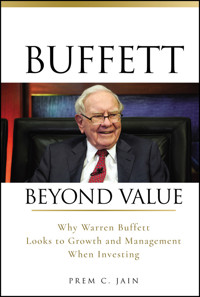
A detailed look at how Warren Buffett really invests
In this engaging new book, author Prem Jain extracts Warren Buffett's wisdom from his writings, Berkshire Hathaway financial statements, and his letters to shareholders and partners in his partnership firms-thousands of pages written over the last fifty years. Jain uncovers the key elements of Buffett's approach that every investor should be aware of.
With Buffett Beyond Value, you'll learn that, contrary to popular belief, Warren Buffett is not a pure value investor, but a unique thinker who combines the principles of both value and growth investing strategies. You'll also discover why understanding CEOs is more important than studying financial metrics; and why you need an appropriate psychological temperament to be a successful investor.
- Reveals Buffett's multifaceted investment principles
- Discusses how Buffett thinks differently from others about portfolio diversification, market efficiency, and corporate governance
- Highlights how you can build a diverse and profitable investment portfolio
With this book as your guide, you'll learn how to successfully invest like Warren Buffett.
Sie lesen das E-Book in den Legimi-Apps auf:
Seitenzahl: 441
Veröffentlichungsjahr: 2010
Ähnliche


















Guide
Cover
Table of Contents
Begin Reading
Pages
C1
v
iii
iv
ix
x
xi
xii
xiii
xiv
xv
xvi
1
3
4
5
6
7
9
10
11
12
13
14
15
16
17
18
19
20
21
22
23
25
26
27
28
29
30
31
32
33
34
35
36
37
38
39
40
41
42
43
44
45
46
47
48
49
50
51
52
53
54
55
56
57
58
59
60
61
62
63
64
65
66
67
68
69
70
71
72
73
74
75
76
77
79
78
80
81
82
83
84
85
87
89
90
91
92
93
94
95
96
97
99
100
101
102
103
104
105
106
107
108
109
110
111
112
113
115
116
117
118
119
120
121
123
124
125
126
127
129
130
131
132
133
134
135
136
137
138
139
140
141
142
143
145
146
147
148
149
150
151
152
153
155
156
157
158
159
161
162
163
164
165
166
167
169
170
171
172
173
174
175
177
178
179
180
181
182
183
185
186
187
188
189
190
191
192
193
195
196
197
198
199
200
201
202
203
205
206
207
208
209
210
211
212
213
214
215
216
217
218
219
220
221
222
223
225
224
226
227
228
229
231
232
233
234
235
236
237
238
239
240
241
242
243
244
245
246
247
249
251
252
253
254
255
257
258
259
260
261
263
264
265
266
267
268
269
270
271
273
274
275
276
277
278
279
280
281
282
283
284
285
286
287
288
289
290
291
292
293
294
295
296
297
298
299
300
301
302
303
304
Buffett Beyond Value
Why Warren Buffett Looks to Growth and Management When Investing
Prem C. Jain
Copyright © 2010 by Prem C. Jain. All rights reserved.
Published by John Wiley & Sons, Inc., Hoboken, New Jersey. Published simultaneously in Canada.
No part of this publication may be reproduced, stored in a retrieval system, or transmitted in any form or by any means, electronic, mechanical, photocopying, recording, scanning, or otherwise, except as permitted under Section 107 or 108 of the 1976 United States Copyright Act, without either the prior written permission of the Publisher, or authorization through payment of the appropriate per-copy fee to the Copyright Clearance Center, Inc., 222 Rosewood Drive, Danvers, MA 01923, (978) 750-8400, fax (978) 750-4470, or on the web at www.copyright.com. Requests to the Publisher for permission should be addressed to the Permissions Department, John Wiley & Sons, Inc., 111 River Street, Hoboken, NJ 07030, (201) 748-6011, fax (201) 748-6008, or online at http://www.wiley.com/go/permissions.
Limit of Liability/Disclaimer of Warranty: While the publisher and author have used their best efforts in preparing this book, they make no representations or warranties with respect to the accuracy or completeness of the contents of this book and specifically disclaim any implied warranties of merchantability or fitness for a particular purpose. No warranty may be created or extended by sales representatives or written sales materials. The advice and strategies contained herein may not be suitable for your situation. You should consult with a professional where appropriate. Neither the publisher nor author shall be liable for any loss of profit or any other commercial damages, including but not limited to special, incidental, consequential, or other damages.
For general information on our other products and services or for technical support, please contact our Customer Care Department within the United States at (800) 762-2974, outside the United States at (317) 572-3993 or fax (317) 572-4002.
Wiley also publishes its books in a variety of electronic formats. Some content that appears in print may not be available in electronic books. For more information about Wiley products, visit our web site at www.wiley.com.
Library of Congress Cataloging-in-Publication Data:
Jain, Prem C. 1950-
Buffett beyond value : why Warren Buffett looks to growth and management when investing/Prem C. Jain. p. cm.
Includes bibliographical references and index.
ISBN 978-0-470-46715-2 (cloth)
1. Investments. 2. Investment analysis. 3. Buffett, Warren. I. Title.
HG4521.J264 2010
332.6-dc22
2009041474
Preface
This book is for everyone with a serious interest in learning about stock market investing using principles espoused by Warren Buffett. Just over 20 years ago, while teaching at the Wharton School, I stumbled upon an essay by Warren Buffett that motivated me to carefully investigate his investment style.1 I was intrigued when I realized that there was a fundamental difference between Buffett’s attitude toward investing and the academic approach. While academics generally anchor on the impossibility of making above-average returns, Buffett proposes just the opposite. He argues that with a careful study of company fundamentals and management quality, investors definitively can earn above-average returns. His outstanding long-term record supports his claim. When faced with Buffett’s record, most academics either dismiss it as an outlier or brand him a genius who cannot be copied or explained. I wanted to know if there was a systematic way of understanding and emulating his investment philosophy.
Most authors, including academics, characterize Buffett as a value investor. Buffett is not just a value investor—at least not in the popular sense that the “value” moniker is used. Buffett’s publicly traded company, Berkshire Hathaway, has grown at an annualized rate of about 20 percent in assets, revenues, net worth, and market value for 44 years. His performance is closer to what would be expected from a successful growth investor. Unlike other businessmen who may have also amassed great fortunes, Buffett stands alone because his long-term success reflects growth of his business and investments in several different industries without ever riding a hot trend. There is another major difference between Buffett and other successful investors, which is actually the main reason I chose to study him diligently. Warren Buffett is a man of the highest level of integrity. He knows that he has a special gift, and instead of keeping it to himself, he has chosen to share his immensely valuable experiences with anyone who cares to do some research. A remarkable teacher, Buffett has written a considerable body of material on his ideas and principles, which allows for careful examination of his strategies and motivations.
The key reason for Buffett’s unparalleled success is not only his ability to stay resolute with the primary value investing principle of maintaining a low downside risk but also his skill at pairing it with the growth investing principle of putting money into companies with sustainable growth opportunities. Thus, he combines the principles of both the value and growth investment strategies. Yet, he does not invest in high-tech companies, as so many growth investors do. His growth strategy is best understood by studying the businesses he has purchased at Berkshire Hathaway. Buffett buys good businesses that already possess outstanding, high-integrity management. He relies on the same principles for investing in common stocks. I elaborate on his investment principles throughout the book along with the specific topics covered in each chapter. These principles are useful whether you are investing in a bull market or a bear market.
Buffett and Contemporary Teachings at Business Schools
My goal as a teacher-researcher is not only to explore what Buffett practices but also to find answers to why his practices are successful. In 1997, my desire to understand why Buffett’s investment style works and how his strategies blend with the lessons from contemporary finance led me to develop a new course at Tulane University. This course took a new approach to finance, where students studied Buffett’s writings and decisions in conjunction with modern finance research. The students also analyzed a large number of businesses. In 1999, Tulane contributed $2 million from the university’s endowment fund to create a portfolio to be managed by students under my guidance. I left Tulane in 2002 for Georgetown University, but Professor Sheri Tice continues to teach the increasingly popular course at Tulane.
From the outset, it is important to recognize that Buffett’s ideas are not always at odds with modern finance theories. For example, the concepts of discounting cash flows and net present value are taught in all business schools. Resembling the net present value concept, concepts like intrinsic value and margin of safety are at the core of Buffett-style investing. Furthermore, the much-talked-about concept of diversification is discussed in a somewhat similar, although not identical, fashion both by investment texts and by Buffett. There is plenty of commonality between the business school curriculum and Buffett’s approach. However, this book covers ideas from Buffett that go beyond what professors generally offer. My goal is to provide additional insights to lead you toward a more practical approach to investing in the stock market.
Focus on Important Questions
One key trait that makes Buffett successful is his ability to focus. To remain focused, I present many sections of the book in a question-and-answer format. This Socratic style forces one to pinpoint important questions that fellow investors, students, and colleagues have asked me over the years. At Berkshire Hathaway annual meetings, many of which I have attended over the past 20 years, Warren Buffett and Charlie Munger (chairman and vice chairman of Berkshire Hathaway, respectively) answer questions from the audience for several hours. Buffett also used a question-and-answer format in 2003 when he accepted my invitation to address Georgetown University MBA students and faculty.
Although this book concentrates on Buffett’s investing style, I bring in related ideas from other investors and academic research to help improve your investment strategies. For example, no discussion on investing is complete without incorporating the pioneering and still relevant works of Benjamin Graham and David Dodd. Similarly, I draw from the thoughts of Philip Fisher and Peter Lynch to discuss growth investing strategies.
No one can teach Buffett’s ideas better than Buffett himself. Clearly, he knows a thing or two about investing. In March 2008, Forbes magazine ranked Buffett as the world’s wealthiest man with an estimated personal wealth of $62 billion.2 I wrote him a letter in 1997 suggesting that future generations would thank him if he were to write a book. He responded, “I definitely have a book in mind, though much of what I have to say has been covered in the annual reports.” While we wait for Buffett to write his investment book, I decided to share my own analyses. To unmask his thoughts, I carefully studied Berkshire Hathaway’s annual reports from the past 50 years, his 1958 to 1969 partnership letters, and as many of his other writings as I could find. I have benefited immensely from this effort and have done my best to capture Buffett’s investment ideas in this book.
How Much Background Do You Need to Understand Buffett’s Principles?
Buffett does not recommend sophisticated mathematical models. He writes, “To invest successfully, you need not understand beta, efficient markets, modern portfolio theory, option pricing, or emerging markets.”3 With this sentiment in mind, I have made certain that you do not need any knowledge of mathematical finance to benefit from this book. Consistent with Buffett’s teachings, my experience tells me that the use of mathematical models to pick individual stocks is not particularly helpful. It may even be harmful because it can lead you to become overconfident in your abilities. As the financial crisis in 2008-2009 has shown, over-reliance on mathematical models can result in a false sense of security in the understanding of risk and return.
Some knowledge of accounting and finance is essential to follow this book, but most people investing in the stock market already understand such terms as earnings, dividends, and return on equity. My objective is to show how to interpret those terms so that you can use them effectively to improve your investing style. If you have no knowledge of basic investment terms, you may find some sections of this book a little advanced. Even then, you will see that there is more to picking a stock than being a whiz in manipulating numbers. If stock picking could indeed be formulated as a mathematical model, mutual fund managers could simply hire a bunch of rocket scientists and earn superior returns. But the evidence is just the opposite: It appears that investors who use simple principles generally do better than those who rely heavily on mathematical models.
To concentrate on Buffett’s investing principles, I restrict my discussion to Buffett’s investment-related ideas, how we can learn from them, and why they work. Others have already reviewed his interesting life story.4 I doubt that you need to be as fascinated by bridge or baseball as he is to become a successful investor. Similarly, you need not have been born in Omaha, Nebraska, or share his taste in food. Even his friend and business partner Charlie Munger does not agree with all of Buffett’s philosophical ideas. While Buffett is a Democrat, Munger is a Republican. You need not be either. By keeping the book focused on Buffett’s investment philosophies, I highlight only the issues relevant to investing.
What Can You Learn from This Book?
This book is divided into nine parts and 30 chapters. There is continuity across chapters, but you can read most of them independently.
In Part I (Chapters 1 and 2), my main objective is to convince you that investing is like searching for buried treasure. One reason Buffett is successful is that he enjoys this process, and you are more likely to be successful if you treat it as a game and have fun with it. Next, I chronologically outline several important events in Berkshire’s history to draw insights into Buffett’s philosophy. Such a historical background is useful to keep the remainder of the book in perspective.
Part II (Chapters 3 to 6) explains basic investment strategies, so-called value investing and growth investing. Using concrete examples, I explain how you may compute intrinsic value and margin of safety before you invest. Particularly in Chapter 6, I explain why Buffett’s strategies should not be classified as value investing in the traditional sense. He does what is most logical and frequently combines value and growth investing strategies effectively. In general, it is a mistake, and would limit your imagination, to pigeonhole Buffett’s approach into any single investing style. He does what is most rational to create value in the long run. For lack of a better term, I simply call him a renaissance investor.
In Part III (Chapters 7 to 9), I look at how Buffett uses insurance to generate cash flows for other investments. To understand Buffett, you must have some understanding of the insurance business, which is the mainstay of Berkshire Hathaway.
In Part IV (Chapters 10 to 13), I discuss several of Buffett’s investments in retailing, utilities, and manufacturing. These examples provide further insight into his emphasis on growth and management quality. In Part V (Chapters 14 to 17), I emphasize Buffett’s opinions concerning several classic topics, such as diversification and risk.
In Part VI (Chapters 18 and 19), I discuss Buffett’s thoughts on market efficiency and the ways in which you may incorporate his thoughts into your decision making.
In Part VII (Chapters 20 to 24), I review several important issues related to profitability and accounting. Although these chapters will not make you an accountant, they will provide you with a perspective that is not common in investing circles.
In Part VIII (Chapters 25 and 26), I focus on psychology because to be a successful investor, you must understand yourself and the biases that play a role in your decision making and the decision making of others.
Part IX (Chapters 27 to 30) is devoted to corporate governance, Buffett’s thoughts on CEOs and other managers, and why he emphasizes appropriate compensation structure throughout a firm. The conclusion of the book discusses Buffett’s emphasis on developing a suitable temperament for winning in the market, just as a baseball player needs to develop a temperament for winning on the diamond.
Overall, the book will allow you to discover that Buffett has achieved success by emphasizing the importance of high-quality managers more than any other metric. He calls his managers the “All-Stars” and discusses their accomplishments lavishly in Berkshire annual reports. By contrast, most research and teachings in business schools use financial numbers as the key metric for financial success and understanding businesses. My objective is to develop your understanding beyond the ideas you may have learned in your college courses, gleaned by reading articles in the popular media, or picked up through any other outlets. My motivation is not just to provide rules for investing but also to help improve your mind-set for investing. Having the right mind-set is pivotal, whether you are an individual investor, a student, an academic, or a professional portfolio manager.
PREM C. JAIN
Acknowledgments
When I initially narrated Warren Buffett’s success story, my father, always a philosopher, reminded me what I frequently asked him when I was a child: “Why?” The answer is that I am grateful. I am grateful to my students at Wharton, Tulane, and Georgetown over the past 25 years who asked innumerable questions and helped me focus my thoughts. My colleagues, ever skeptical as professors are, gave me the benefit of their explanations and understanding of differences between how academics think and how businessmen and money managers think. I am sincerely grateful to my longtime friend Larry Weiss, who read an early version of the entire book and went through several chapters over and over again as I developed my ideas. My special thanks go to my friends Valentin Dimitrov, a careful reader and a trusted co-author, for his discussions with me for many years about Buffett’s principles and for his ongoing comments on the manuscript at different stages, and Nancy Pitts, who read every word with a critical eye, asked many questions, and helped improve the manuscript. I thank Elisa Diehl and Cindy Leitner for carefully copyediting the entire manuscript at different stages.
I have benefited from my colleagues’ and friends’ knowledge about investing and Buffett. They listened patiently, sometimes argued and discussed, gave detailed comments, and contributed to the book in many ways. For this, I thank Reena Aggarwal, Bill Baber, Dale Bailey, Gary Blemaster, Jennifer Boettcher, Jim Bodurtha, Randy Cepuch, Preeti Choudhary, George Comer, George Daly, Hemang Desai, Bill Droms, Jason Duran, Allan Eberhart, Patricia Fairfield, Therese Flanagan, Aloke Ghosh, Jack Glen, Zhaoyang Gu, Ingrid Hendershot (babyb), Jim Heurtin, Manish Jain, Saurabh Jain, Varun Jain, S. P. Kothari, Amit Kshetarpal, Subir Lall, Charles Lee, Jeff Macher, Ananth Madhavan, Jim Marrocco, Jerry Martin, Alan Mayer-Sommer, John Mayo, Chuck Mikolajczak, Vishal Mishra, Lenka Naidu, Kusum Narang, Keith Ord, Sandeep Patel, Lee Pinkowitz, Dennis Quinn, Sundaresh Ramnath, Korok Ray, Pietra Rivoli, Srini Sankaraguruswamy, Carole Sargent, Missie Saxon, Jason Schloetzer, Pamela Shaw, Paul Spindt, Emma Thompson, Sheri Tice, Cathy Tinsely, Joaquin Trigueros, Joanna Shuang Wu, and Teri Yohn. I am certain I have not included everyone, and I apologize to those whose names should also appear here.
I thank Warren Buffett for allowing me to use copyrighted material from his letters to shareholders and other sources. For my initial education and ensuing gifts in life, I credit my teachers in an elementary school in a small town in India. All my earnings from this book will be donated to children’s education. Most important, I am especially grateful to my parents, my brother Subhash, and my three sisters Gunmala, Kanak, and Manju and their families for their unwavering love and support.
P. C. J.
Part OneINTRODUCTION AND BACKGROUND
In Chapter 1, I explain why it is easy to beat the professional mutual fund managers and how, with some effort, you can also outperform the market as a whole. I demonstrate that in the long run, rewards from playing the game of investing are large. In Chapter 2, I use important events from Berkshire Hathaway’s history as a backdrop for various investing lessons that can be learned from Warren Buffett.
Chapter 1The Thrill of Investing in Common Stocks
It’s not that I want money. It’s the fun of making money and watching it grow.1
—Warren Buffett
Warren Buffett has often mentioned that he enjoys running Berkshire Hathaway and has fun making money. I assume that you too want to earn high rates of return on your investments while having fun doing it. It is not difficult to do if you master certain principles that Buffett follows. You play baseball, golf, bridge, or the stock market because it is enjoyable. But you enjoy the game even more when you defeat the opponent, especially when you beat a seemingly superior player. Can you win in the game of investing? Yes, you can, so long as you are willing put some effort into it. And not only can you win; the thrill of the game arises because you can win often. You have weak opponents: “Mr. Market,” who suffers from up-and-down moods, and professional money managers, who can be outperformed just as easily.2 This game is not as difficult as most people think. It is as much fun as a treasure hunt. Berkshire Hathaway is just one of the treasures I have discovered. This introductory chapter will convince you that the rewards from becoming a better investor are enormous. Later in the book, I explain Buffett’s principles and why they work, so that you may use them to earn those rewards by investing in the stock market.
How a 1 Percent Advantage Becomes a 100 Percent Gain
Only one in five actively managed mutual funds beats the Standard & Poor’s (S&P) 500 index. Thus, if you invest in actively managed mutual funds, your odds of beating the market are only one-in-five. These odds are indeed low. A very simple approach to improve your odds is to invest in index funds because their returns will be close to the market returns. By investing in index funds instead of mutual funds, your odds of beating the market improve from one-in-five to four-in-five. But why stop there? If you have some money to invest for the long run, why not invest in common stocks? With common stocks, you can improve your returns even more, especially if you enjoy the process and put some effort into learning the principles that master investors like Buffett have laid out. Another great investor, Peter Lynch, echoes this viewpoint: “[A]n amateur who devotes a small amount of time to study companies in an industry he or she knows something about can outperform 95 percent of the paid experts who manage the mutual funds, plus have fun doing it.”3
How much skill do you need to be much better off than investing in actively managed mutual funds? In the long run, not much! Let me explain. Based on a long historical record, the expected return on the market is about 7 percent to 10 percent per year. For simplicity, let’s use 10 percent as a benchmark. Then, your return from an average mutual fund will be only 8 percent because about 2 percent goes toward expenses in running the mutual fund, which includes the management fees. If you invest $1,000 with a mutual fund and the mutual fund gives you a return of 8 percent per year, your initial investment of $1,000 will become $6,848 in 25 years; that is, you will have a net gain of $5,848.
Assume that you are able to develop just a 1 percent return advantage over the market in the game of investing or picking stocks. Remember that you also do not incur the 2 percent expenses in fees and charges when you invest in mutual funds. With 1 percent above the market, or 11 percent per year, your initial $1,000 investment will become $13,585 at the end of 25 years, which is a net gain of $12,585. Thus, your net gain is more than twice what you would have had if you had invested in mutual funds. It is almost unbelievable, but the numbers do not lie. Even if you decide not to put all your money under your own management and invest all of it in individual stocks, you may find it worthwhile to take charge of some of your own investments. If nothing else, it will be a great learning experience and a new source of excitement.
Figure 1.1 Growth of $1,000 after 25 or Intermediate Years at Different Rates of Return
An additional advantage of investing in individual stocks is that you will pay lower taxes. If you pick your investments carefully and do not sell them for a long time, you pay substantially less in taxes than if you had invested in mutual funds. Thus, even if you do not develop a 1 percent advantage over the market, you will come out substantially ahead when you judiciously invest in individual stocks rather than mutual funds.
Figure 1.1 shows what $1,000 will become in 10, 15, 20, and 25 years if you earn 5 percent, 10 percent, or 15 percent per year. Note that if you can earn 15 percent per year, your advantage over the market is enormous. A $1,000 initial investment will become $32,919 in 25 years at a 15 percent annual rate of return.
The 2008-2009 stock market crash may have made you pessimistic about investing. However, history tells us that you have an advantage. This event actually offers you a great opportunity to find good stocks to invest in. Buffett recently wrote in the New York Times that for his personal account, he is buying common stocks in this market.4 Another legendary investor with an outstanding record over several decades writes, “One principle that I have used throughout my career is to invest at the point of maximum pessimism.”5 So, spend some time learning to invest wisely. Let’s first look at returns you would have earned if you had invested in Buffett’s company, Berkshire Hathaway.
How Much Would You Have Earned If You Had Invested with Buffett?
In the past 30 years ending in 2008, Berkshire Hathaway has given an annualized return of over 23 percent per year. This is twice the rate of return you would have earned with the Dow Jones Industrial Average or the S&P 500 index. Obviously, Warren Buffett’s performance is incredible. In terms of dollar amounts, if you had invested $1,000 in Berkshire Hathaway about 30 years ago, your investment today would amount to about $500,000. The lesson is clear: Learn from Warren Buffett’s investment philosophy, which is described throughout this book. You may not be able to attain his level of success, but you do not have to be Warren Buffett to earn respectable returns in the stock market. If you can replicate even, say, one-fourth or one-third of the advantage he has over the market, you will earn very high long-term returns. The average investor is likely to be a relatively small investor. It is easier to beat the market with smaller amounts of money than with large investments. When Buffett ran his partnerships in the late 1950s to late 1960s, his returns were even larger. Now, Buffett cannot invest in smaller companies because the Berkshire portfolio is so large. But a small investor has the advantage of being able to invest in smaller companies. For Berkshire as a whole, returns were higher when the company was smaller, but even over the past 15 years, the average annualized return has been 12 percent compared with only about 6 percent for the S&P 500 index.
You never know: You might have the skills to pick the right stocks and become as good an investor as Warren Buffett. As long as you are not reckless, there is little downside in trying to find out whether you have some of the skills to be successful. One great thing about Buffett is that he has written generously about what he does and how he does it. If you have patience and the willingness, let’s start learning about businesses and investing from the master.
Conclusions
Buffett has often described his investing philosophy as simple but not easy. It is simple in the sense that all you need to do is to identify outstanding businesses that are run by competent and honest managers and whose common stock is selling at a reasonable price. But how do you that? This book makes the process of discovering those businesses as easy as possible.
Chapter 21965-2009: Lessons from Significant Events in Berkshire History
History is philosophy teaching by examples.
—Thucydides, an ancient Greek historian
When Warren Buffett took control of Berkshire Hathaway in 1965, it was a small textile manufacturing company in New England. The prospects of the textile industry at the time were rather bleak. Buffett has transformed Berkshire into a large insurance, utility, manufacturing, and retailing conglomerate. In 44 years, the company’s book value has grown from $19 to $70,530 per class A share, and the stock price has correspondingly grown from about $8 to $96,600. The following list of significant events in Berkshire history serves two purposes. First, it is important to learn from the examples others have set; and second, it presents a quick look at many of Buffett’s principles. In later chapters, we will explore these principles further.
1965: Not Throwing Good Money after Bad
Event Warren Buffett is listed as a Berkshire director for the first time, although he is not yet the chief executive of the company. Starting to accumulate Berkshire shares in 1962 at $7.60 per share, Buffett acquired a controlling interest in the company by 1965 with an overall average cost of $14.86 per share.
Lesson Revenues at Berkshire have been declining, from $64 million to $49 million, in the prior 16 years. However, the company did not invest much to prop up the declining textile business. The decision not to invest in a declining business is a good example of the often-used maxim: “Don’t throw good money after bad.” Berkshire’s cash flows are instead used for buying its own shares back in the open market and for investing in other securities. The main lesson is that one should be careful in investing in a company that is using its cash flows to sustain a dying business.
1967: Invest in Your Circle of Competence
Event Berkshire makes its debut in the insurance business by acquiring two insurance companies for $9 million: National Indemnity Company and National Fire and Marine Insurance Company. Both companies are based in Omaha where Buffett lives.
Lesson Buffett probably had a long-term plan to slowly develop the insurance business. This is a nearly perfect example of how a long journey starts with a small first step. He invests within his circle of competence: insurance.
1973: Cash Flow Is King
Event Berkshire increases its investment in Blue Chip Stamps.
Lesson In the trading stamp business, the company receives cash in advance for stamps: an IOU. The company does not have to pay interest on these IOUs, and it can use the cash thus received for investments in other businesses. This is a good example of Buffett’s philosophy of generating cash flow with little risk. The insurance business has similar characteristics.
1977: Successful Growth
Event The insurance business continues to grow at a fast pace through expansion and acquisitions. Buffett reports that in the prior 10 years, insurance premiums grew by about 600 percent, from $22 million to $151 million.
Lesson Buffett’s excellent knowledge of the insurance industry helps him to identify top managers and then delegate them to run individual units. Note that insurance was not a fast-growing industry. Outstanding managers are the key to successful growth. Invest with them when you find such opportunities.
1980: Buying Shares after Prices Fall
Event Berkshire initially invested in GEICO in 1976 when GEICO was close to bankruptcy. Berkshire increases its holding in GEICO to 7.2 million shares, equal to an equity interest of about 33 percent.
Lesson Buffett explains his investments in GEICO and American Express as follows:
GEICO’s problems at that time put it in a position analogous to that of American Express in 1964 following the salad oil scandal. Both were one-of-a-kind companies, temporarily reeling from the effects of a fiscal blow that did not destroy their exceptional underlying economics. The GEICO and American Express situations, extraordinary business franchises with a localized excisable cancer (needing, to be sure, a skilled surgeon), should be distinguished from the true “turnaround” situation in which the managers expect—and need—to pull off a corporate Pygmalion.1
Buffett has emphasized that most turnaround candidates do not succeed. However, GEICO and American Express are exceptions because the underlying businesses were healthy. You should buy shares after a precipitous fall in prices only when you can assess that the company’s problems are temporary.
1984: Reported Versus True Financial Results
Event Buffett describes how estimates of losses in the insurance business can be substantially different from the final tally, and, therefore, reported earnings are subject to change. In 1983, reported underwriting results, based on estimates in 1983, indicated a loss of $33 million; but a year later, corrected figures turn out to be $51 million, about 50 percent more than the original estimate.
Lesson The following story explains that when managers plan to manipulate earnings, it is not difficult.
A man was traveling abroad when he received a call from his sister informing him that their father had died unexpectedly. It was physically impossible for the brother to get back home for the funeral, but he told his sister to take care of the funeral arrangements and to send the bill to him. After returning home, he received a bill for several thousand dollars, which he promptly paid. The following month, another bill came along for $15, and he paid that, too. Another month followed, with a similar bill. When, in the next month, a third bill for $15 was presented, he called his sister to ask what was going on. “Oh,” she said. “I forgot to tell you. We buried Dad in a rented suit.”2
Preparation of financial statements requires a large number of estimates. When analyzing a company, you should examine several years’ worth of financial statements, not just the recent ones.
1985: Capital Expenditures
Event Berkshire Hathaway closes its textile operations, which was its main business when Buffett took control of the company in 1965.
Lesson Buffett writes: “It [is] inappropriate for even an exceptionally profitable company to fund an operation once it appears to have unending losses in prospect.”3 As an example, Buffett states that Burlington Industries, another textile company, unsuccessfully invested more than $200 per share on the $60 stock. He writes, “When a management with a reputation for brilliance tackles a business with a reputation for poor fundamental economics, it is the reputation of the business that remains intact.”4 When you see a company making new investments in a dying business (e.g., the auto industry in the United States in recent years), you should not invest in that company.
1986: Corporate Jets and Other Luxuries
Event In small print, Buffett writes, “We bought a corporate jet last year.”5
Lesson Corporate jets are very expensive and cost a lot to operate and maintain, or, as Buffett puts it, “cost a lot to look at.” While it seems appropriate for Buffett to acquire a corporate jet, he clearly feels uncomfortable. As Benjamin Franklin said, “So convenient a thing it is to be a reasonable creature, since it enables one to find or make a reason for everything one has a mind to do.”6 As an investor, you can learn about a company’s true culture from its spending practices.
1988: Holding Period of an Investment
Event Berkshire buys 14.2 million shares of Coca-Cola for $592 million. With respect to this first major purchase of Coca-Cola stock, Buffett states that his favorite holding period is forever. He further states, “We continue to concentrate our investments in a very few companies that we try to understand well.”7 He also recalls Mae West, “Too much of a good thing can be wonderful.”8
Lesson In about 10 years, the market value of the Coca-Cola stock holding will increase tenfold. One reason Buffett can hold investments for long periods is that he invests only in companies that he understands and that have outstanding management. With respect to Coca-Cola’s CEO, Buffett writes:
Through a truly rare blend of marketing and financial skills, Roberto [Goizueta] has maximized both the growth of the product and the rewards that this growth brings to shareholders. Normally, the CEO of a consumer products company, drawing on his natural inclinations or experience, will cause either marketing or finance to dominate the business at the expense of the other discipline. With Roberto, the mesh of marketing and finance is perfect and the result is a shareholder’s dream.9
Excellent investment opportunities are few and far between. When you find such stocks, you should buy a lot and hold them for a long time.
1989: Looking Foolish Versus Acting Foolish
Event In 1989, two natural disasters affected the insurance industry significantly. First, Hurricane Hugo caused billions of dollars of damage in the Caribbean and the Carolinas. Second, within weeks, California was hit by an earthquake causing insured damage that was difficult to estimate, even well after the event.
Lesson Before the 1989 natural disasters, premiums in the insurance industry were inadequate. Unlike many others, Buffett stayed away from unprofitable businesses. Immediately after the earthquake, the tables were turned. Given its strong financial position, Berkshire Hathaway offered to write up to $250 million of catastrophic coverage, advertising the offer in trade publications.
As Buffett explains: “When rates carry an expectation of profit, we want to assume as much risk as is prudent. And in our case, that’s a lot.”10 Taking large risks with adequate premiums is profitable in the long run but may appear foolish. To this, Buffett responds: “We are willing to look foolish as long as we don’t feel we have acted foolishly.”11 The key lesson is to act rationally, regardless of how it appears to others.
1990: Pessimism Is Your Friend
Event For the banking industry, 1990 was a disastrous year. Fears of a California real estate disaster caused the price of Wells Fargo stock to fall by almost 50 percent. Buffett purchased an additional 4 million shares in Wells Fargo, increasing Berkshire’s holding to about 10 percent of the bank’s outstanding shares.
Lesson Buffett writes: “The most common cause of low prices is pessimism—sometimes pervasive, sometimes specific to a company or industry.”12 But you also need to be careful, Buffet cautions: “None of this means, however, that a business or stock is an intelligent purchase simply because it is unpopular; a contrarian approach is just as foolish as a follow-the-crowd strategy. What is required is thinking rather than polling. Unfortunately, Bertrand Russell’s observation about life in general applies with unusual force in the financial world: Most men would rather die than think. Many do.”13 In 2008-2009, when the stock market was down by about 40 percent, Buffett writes, “When investing, pessimism is your friend, euphoria the enemy.”14
1991: Risk
Event Midway, Pan Am, and America West enter bankruptcy, making 1991 a disastrous year for the airline industry. Buffett estimates that Berkshire’s investment of $358 million in U.S. Air had declined by 35 percent to $232 million. Only a year earlier, Buffett had written that the U.S. Air investment “should work out all right unless the industry is decimated during the next few years.”15
Lesson There is always risk in investing, whether you invest in airlines or AIG. It is possible to lose a significant percentage even in fixedincome securities, although they are generally less risky. There is yet another lesson about the airline industry: “Despite the huge amounts of equity capital that have been injected into it, the industry, in aggregate, has posted a net loss since its birth after Kitty Hawk,”16 writes Buffett. After his experiences with U.S. Air, Buffett seems to have decided that investing in the airlines industry is not in his circle of competence. If you invest in your circle of competence, you are likely to avoid highly risky investments.
1992: Stock Splits
Event Berkshire’s stock price crosses the $10,000 mark for the first time.
Lesson A stock price level should not be used as an indicator of potential returns. A stock split is not helpful for a long-term investor. Buffett states, “Overall, we believe our owner-related policies—including the no-split policy—have helped us assemble a body of shareholders that is the best associated with any widely held American corporation.”17 In the end, what matters is the performance of the company. Do not invest in a company just because it has had a stock split. In 2009, Berkshire announced that it would split its class B shares for 50:1 in connection with its acquisition of Burlington Northern Santa Fe. Without the split, small Burlington shareholders would not receive Berkshire shares in a tax-free exchange.
1993: Identifying Excellent CEOs
Event Buffett’s admiration for Mrs. B, Nebraska Furniture Mart’s CEO, is well-known. In admiration, he writes the following:




