


32,99 €
Mehr erfahren.
- Herausgeber: John Wiley & Sons
- Kategorie: Fachliteratur
- Serie: SAS Institute Inc
- Sprache: Englisch
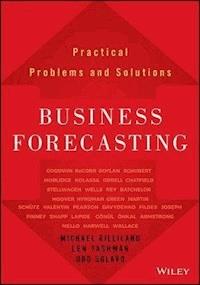
A comprehensive collection of the field's most provocative, influential new work Business Forecasting compiles some of the field's important and influential literature into a single, comprehensive reference for forecast modeling and process improvement. It is packed with provocative ideas from forecasting researchers and practitioners, on topics including accuracy metrics, benchmarking, modeling of problem data, and overcoming dysfunctional behaviors. Its coverage includes often-overlooked issues at the forefront of research, such as uncertainty, randomness, and forecastability, as well as emerging areas like data mining for forecasting. The articles present critical analysis of current practices and consideration of new ideas. With a mix of formal, rigorous pieces and brief introductory chapters, the book provides practitioners with a comprehensive examination of the current state of the business forecasting field. Forecasting performance is ultimately limited by the 'forecastability' of the data. Yet failing to recognize this, many organizations continue to squander resources pursuing unachievable levels of accuracy. This book provides a wealth of ideas for improving all aspects of the process, including the avoidance of wasted efforts that fail to improve (or even harm) forecast accuracy. * Analyzes the most prominent issues in business forecasting * Investigates emerging approaches and new methods of analysis * Combines forecasts to improve accuracy * Utilizes Forecast Value Added to identify process inefficiency The business environment is evolving, and forecasting methods must evolve alongside it. This compilation delivers an array of new tools and research that can enable more efficient processes and more accurate results. Business Forecasting provides an expert's-eye view of the field's latest developments to help you achieve your desired business outcomes.
Sie lesen das E-Book in den Legimi-Apps auf:
Seitenzahl: 734
Veröffentlichungsjahr: 2015
Ähnliche

















Praise for Business Forecasting: Practical Problems and Solutions
This book is the survivor's guide for business forecasters. It covers a wide range of need-to-know topics from “what is demand” to “why should I trust your forecast.”
—Scott Roy, Collaboration Planning Manager, Wells Enterprises Inc.
This is a wonderful resource for anyone in the field of forecasting, covering all of the major areas that a practitioner would need in order to be successful. This book covers the key areas of concern for most folks dealing with forecast, from basics such as forecastability and benchmarking to more advanced topics like dealing with politics in forecast. I would definitely recommend this reader as a key resource for those looking to learn more or to have knowledge at their fingertips for that moment when they need a refresher.
—Curtis Brewer, Forecasting Manager, Bayer CropScience
An essential reading on business forecasting indeed! Every article is in its place, and every one is worth reading. In spite of my many years in forecasting and planning, the reading was so captivating that I could not stop before it was over. Absolutely a “must read” for every person working in business forecasting.
—Igor Gusakov, Consulting Director, Goodsforecast
The science of forecasting has existed for centuries and continues to evolve. However, while it asymptotically approaches better methods of prediction, it will always have its limits. Forecasting must be recognized as a science and an art. Business Forecasting: Practical Problems and Solutions is an honest and true look at the craft of forecasting. This is a tremendous compilation from some of the best forecasting analytics and business minds of today. A reference that should be on the shelf of anyone whose job is to develop forecasts.
—Jim Ferris, Director of Supply Chain Analytics, Clarkston Consulting
The editors do an excellent job of introducing a broad set of topics critical for deploying and maintaining a successful forecasting process within an organization.
—Sam Iosevich, Managing Principal, Prognos
In this age when “big data,” “machine learning,” and “data science” are attracting all of the attention, the art and science of forecasting is often neglected. Since many forecasting methods and practices date back decades, the temptation is to conclude that “there is nothing new there.” This terrific compilation of writings—from virtually all of the big names in the forecasting community—proves that innovation in forecasting is vibrant. More accurate forecasts can be one of the most effective drivers of a firm's financial performance, and the learnings gleaned from this book are sure to help any organization improve.
—Rob Stevens, Vice President, First Analytics
This book is a wonderful compendium of demand planning and S&OP insights drawn from some of the best minds and practitioners in the industry.
—Patrick Bower, Sr. Director, Global Supply Chain Planning & Customer Service, Combe Incorporated
Finally, a book tailored to business forecasting that is comprehensive for everything from data gathering to the art and politics of explaining why we are wrong!
—Eric Wilson, Director Demand Planning and S&OP, Tempur Sealy International
Business Forecasting: Practical Problems and Solutions gathers knowledge from around the globe some 60 years after computer-era forecasting research began by pioneers such as Robert G. Brown (the “father of exponential smoothing”). As a protégé of Brown's, I appreciate the content as it reflects his aptitude for capturing “lots of good ole logic.”
—Donald Parent, CPF, CFPIM, CSCP, LOGOLville.com
The editors of this book of essential readings for the business forecaster have achieved their objective to “assemble a mix of the most interesting, important and influential authors and their writings in applied forecasting since 2001.” Practitioners as well as forecasting managers will find this volume well-organized in these four general areas: fundamental considerations, methods of statistical forecasting, performance evaluation and reporting, and process and politics, which, along with the summaries beginning each section, make it easy for the reader to find the appropriate selection addressing the real-world forecasting challenge being faced. I predict that this volume will prove vital as a reference to all those who seek “to generate forecasts as accurate and unbiased as can be reasonably expected—and to do this as efficiently as possible.”
—Carolyn I. Allmon, Detector Electronics Corporation
Wiley & SAS Business Series
The Wiley & SAS Business Series presents books that help senior-level managers with their critical management decisions.
Titles in the Wiley & SAS Business Series include:
Agile by Design: An Implementation Guide to Analytic Lifecycle Management
by Rachel Alt-Simmons
Analytics in a Big Data World: The Essential Guide to Data Science and Its Applications by
Bart Baesens
Bank Fraud: Using Technology to Combat Losses
by Revathi Subramanian
Big Data Analytics: Turning Big Data into Big Money
by Frank Ohlhorst
Big Data, Big Innovation: Enabling Competitive Differentiation through Business Analytics
by Evan Stubbs
Business Analytics for Customer Intelligence
by Gert Laursen
Business Forecasting: Practical Problems and Solutions
edited by Michael Gilliland, Len Tashman, and Udo Sglavo
The Business Forecasting Deal: Exposing Myths, Eliminating Bad Practices, Providing Practical Solutions
by Michael Gilliland
Business Intelligence Applied: Implementing an Effective Information and Communications Technology Infrastructure
by Michael Gendron
Business Intelligence and the Cloud: Strategic Implementation Guide
by Michael S. Gendron
Business Transformation: A Roadmap for Maximizing Organizational Insights
by Aiman Zeid
Connecting Organizational Silos: Taking Knowledge Flow Management to the Next Level with Social Media
by Frank Leistner
Data-Driven Healthcare: How Analytics and BI Are Transforming the Industry
by Laura Madsen
Delivering Business Analytics: Practical Guidelines for Best Practice
by Evan Stubbs
Demand-Driven Forecasting: A Structured Approach to Forecasting, Second Edition
by Charles Chase
Demand-Driven Inventory Optimization and Replenishment: Creating a More Efficient Supply Chain
by Robert A. Davis
Developing Human Capital: Using Analytics to Plan and Optimize Your Learning and Development Investments
by Gene Pease, Barbara Beresford, and Lew Walker
The Executive's Guide to Enterprise Social Media Strategy: How Social Networks Are Radically Transforming Your Business
by David Thomas and Mike Barlow
Economic and Business Forecasting: Analyzing and Interpreting Econometric Results
by John Silvia, Azhar Iqbal, Kaylyn Swankoski, Sarah Watt, and Sam Bullard
Financial Institution Advantage and the Optimization of Information Processing
by Sean C. Keenan
Financial Risk Management: Applications in Market, Credit, Asset, and Liability Management and Firmwide Risk
by Jimmy Skoglund and Wei Chen
Foreign Currency Financial Reporting from Euros to Yen to Yuan: A Guide to Fundamental Concepts and Practical Applications
by Robert Rowan
Fraud Analytics Using Descriptive, Predictive, and Social Network Techniques: A Guide to Data Science for Fraud Detection
by Bart Baesens, Veronique Van Vlasselaer, and Wouter Verbeke
Harness Oil and Gas Big Data with Analytics: Optimize Exploration and Production with Data Driven Models
by Keith Holdaway
Health Analytics: Gaining the Insights to Transform Health Care
by Jason Burke
Heuristics in Analytics: A Practical Perspective of What Influences Our Analytical World
by Carlos Andre, Reis Pinheiro, and Fiona McNeill
Hotel Pricing in a Social World: Driving Value in the Digital Economy
by Kelly McGuire
Human Capital Analytics: How to Harness the Potential of Your Organization's Greatest Asset
by Gene Pease, Boyce Byerly, and Jac Fitz-enz
Implement, Improve and Expand Your Statewide Longitudinal Data System: Creating a Culture of Data in Education
by Jamie McQuiggan and Armistead Sapp
Killer Analytics: Top 20 Metrics Missing from your Balance Sheet
by Mark Brown
Mobile Learning: A Handbook for Developers, Educators, and Learners
by Scott McQuiggan, Lucy Kosturko, Jamie McQuiggan, and Jennifer Sabourin
The Patient Revolution: How Big Data and Analytics Are Transforming the Healthcare Experience
by Krisa Tailor
Predictive Analytics for Human Resources
by Jac Fitz-enz and John Mattox II
Predictive Business Analytics: Forward-Looking Capabilities to Improve Business Performance
by Lawrence Maisel and Gary Cokins
Retail Analytics: The Secret Weapon
by Emmett Cox
Social Network Analysis in Telecommunications
by Carlos Andre Reis Pinheiro
Statistical Thinking: Improving Business Performance, Second Edition
by Roger W. Hoerl and Ronald D. Snee
Taming the Big Data Tidal Wave: Finding Opportunities in Huge Data Streams with Advanced Analytics
by Bill Franks
Too Big to Ignore: The Business Case for Big Data
by Phil Simon
The Value of Business Analytics: Identifying the Path to Profitability
by Evan Stubbs
The Visual Organization: Data Visualization, Big Data, and the Quest for Better Decisions
by Phil Simon
Trade-Based Money Laundering: The Next Frontier in International Money Laundering Enforcement
by John Cassara
Understanding the Predictive Analytics Lifecycle
by Al Cordoba
Unleashing Your Inner Leader: An Executive Coach Tells All
by Vickie Bevenour
Using Big Data Analytics: Turning Big Data into Big Money
by Jared Dean
Visual Six Sigma, Second Edition
by Ian Cox, Marie Gaudard, Philip Ramsey, Mia Stephens, and Leo Wright
Win with Advanced Business Analytics: Creating Business Value from Your Data
by Jean Paul Isson and Jesse Harriott
For more information on any of the above titles, please visit www.wiley.com.
Business Forecasting
Practical Problems and Solutions
Edited by
Michael Gilliland
Len Tashman
Udo Sglavo
Cover design: Wiley
Copyright © 2015 by Michael Gilliland, Len Tashman, and Udo Sglavo. All rights reserved.
Published by John Wiley & Sons, Inc., Hoboken, New Jersey.
Published simultaneously in Canada.
No part of this publication may be reproduced, stored in a retrieval system, or transmitted in any form or by any means, electronic, mechanical, photocopying, recording, scanning, or otherwise, except as permitted under Section 107 or 108 of the 1976 United States Copyright Act, without either the prior written permission of the Publisher, or authorization through payment of the appropriate per-copy fee to the Copyright Clearance Center, Inc., 222 Rosewood Drive, Danvers, MA 01923, (978) 750-8400, fax (978) 646-8600, or on the Web at www.copyright.com. Requests to the Publisher for permission should be addressed to the Permissions Department, John Wiley & Sons, Inc., 111 River Street, Hoboken, NJ 07030, (201) 748-6011, fax (201) 748-6008, or online at http://www.wiley.com/go/permissions.
Limit of Liability/Disclaimer of Warranty: While the publisher and author have used their best efforts in preparing this book, they make no representations or warranties with respect to the accuracy or completeness of the contents of this book and specifically disclaim any implied warranties of merchantability or fitness for a particular purpose. No warranty may be created or extended by sales representatives or written sales materials. The advice and strategies contained herein may not be suitable for your situation. You should consult with a professional where appropriate. Neither the publisher nor author shall be liable for any loss of profit or any other commercial damages, including but not limited to special, incidental, consequential, or other damages.
For general information on our other products and services or for technical support, please contact our Customer Care Department within the United States at (800) 762-2974, outside the United States at (317) 572-3993 or fax (317) 572-4002.
Wiley publishes in a variety of print and electronic formats and by print-on-demand. Some material included with standard print versions of this book may not be included in e-books or in print-on-demand. If this book refers to media such as a CD or DVD that is not included in the version you purchased, you may download this material at http://booksupport.wiley.com. For more information about Wiley products, visit www.wiley.com.
Library of Congress Cataloging-in-Publication Data:
Names: Gilliland, Michael, editor. | Sglavo, Udo, 1968 – editor. | Tashman, Len, 1942 – editor.
Title: Business forecasting : practical problems and solutions / edited by Michael Gilliland, Udo Sglavo, Len Tashman.
Description: Hoboken : Wiley, 2015. | Series: Wiley and SAS business series | Includes bibliographical references and index.
Identifiers: LCCN 2015039621| ISBN 978-1-119-22456-3 (hardback) | ISBN 978-1-119-22829-5 (ePDF) | ISBN 978-1-119-22827-1 (ePub) | ISBN 978-1-119-19988-5 (obook)
Subjects: LCSH: Business forecasting. | BISAC: BUSINESS & ECONOMICS / Forecasting.
Classification: LCC HD30.27 .B874 2015 | DDC 658.4/0355—dc23 LC record available at http://lccn.loc.gov/2015039621
List of Tables
Chapter 1
Table 1.1
Table 1.2
Table 1.3
Table 1.4
Table 1.5
Table 1.6
Table 1.7
Table 1.8
Table 1.9
Chapter 3
Table 3.1
Table 3.2
Table 3.3
Table 3.4
Table 3.5
Table 3.6
Table 3.7
Table 3.8
Table 3.9
Table 3.10
Table 3.11
Table 3.12
Table 3.13
Table 3.14
Table 3.15
Table 3.16
Table 3.17
Table 3.18
Table 3.19
Table 3.20
Table 3.21
Table 3.22
Chapter 4
Table 4.1
Table 4.2
Table 4.3
Guide
Cover
Table of Contents
Preface
Pages
xv
xvi
xvii
xix
xx
1
2
3
4
5
6
7
8
9
10
11
12
13
14
15
16
17
18
19
20
21
22
23
24
25
26
27
28
29
30
31
32
33
34
35
36
37
38
39
40
41
42
43
44
45
46
47
48
49
50
52
53
54
55
56
57
58
59
60
61
62
63
64
65
66
67
68
69
70
71
72
73
74
75
76
77
78
79
80
81
83
84
85
86
87
88
89
90
91
92
93
94
95
96
97
98
99
100
101
102
103
104
105
106
107
109
110
112
113
114
115
116
117
118
120
121
122
123
124
126
127
128
129
130
131
132
133
134
135
136
137
138
139
140
141
143
144
145
146
147
148
149
150
151
152
153
154
155
156
157
158
159
160
161
162
163
164
165
166
167
169
170
171
172
173
174
175
176
177
178
179
180
181
182
183
184
185
186
187
188
189
190
191
192
193
194
195
196
197
198
199
200
201
202
203
204
205
206
207
208
209
210
211
212
213
214
215
216
217
218
219
220
221
222
223
224
225
226
227
228
229
230
231
233
235
237
238
239
240
241
242
243
244
245
246
247
248
249
250
251
252
253
254
255
256
257
258
259
260
261
262
263
264
265
266
267
268
269
270
271
272
273
274
275
276
277
278
279
281
282
283
284
285
286
287
288
289
290
291
292
293
294
295
296
297
298
299
300
301
302
303
304
305
306
307
308
309
310
311
312
313
314
315
316
317
318
319
320
321
322
323
324
325
326
327
328
329
330
331
332
333
334
335
336
337
338
339
340
341
342
343
344
345
346
347
348
349
350
351
352
353
354
355
356
357
358
359
360
361
362
363
364
365
366
367
368
369
370
371
372
373
374
375
376
377
378
379
381
383
Foreword
Vice Admiral Robert FitzRoy is a man whom most people will not have heard of, but should have—for at least two reasons.
Readers would likely fail to name FitzRoy as the captain of HMS Beagle, the ship on which Charles Darwin sailed when Darwin was formulating his thinking on evolution through natural selection, thoughts that eventually saw the light of day in The Origin of Species.
What is even less well known is that FitzRoy was the man who founded what was later to become the British Meteorological Office. Furthermore, he was the one to coin the term forecast to describe his pioneering work. In The Weather Book, published in 1863, he wrote: “[P]rophesies or predications they are not; the term “forecast” is strictly applicable to such an opinion as is the result of a scientific combination and calculation.”
A century and a half later, the Met Office is still around and still involved in “scientific combination and calculation.” The intervening years have seen enormous advances in the understanding of the physics of weather systems, in the speed, quality, and quantity of data collection, in mathematical techniques, and in computational power. Today, organizations like the Met Office own some of the most powerful computers on the planet. As a result, weather forecasts are significantly more accurate than they were even 10 years ago.
Despite these advances, it is still not possible to forecast the weather with any degree of confidence more than a week or so into the future—and it almost certainly never will be. This is because there are practical limits to what it is possible to predict using any approach known to man.
Our everyday experience of weather forecasts serves as a salutary lesson to those working in the messy and complex world of business who might be tempted to believe that the path to better forecasting lies in using ever more sophisticated mathematics. However, despite what we know about our ability to predict the weather, people with a naïve faith in the power of mathematics are not hard to find. This is good news for some software vendors who make a handsome living from selling exotic black-box forecasting solutions to clients who want to believe that a fancy system will somehow make their forecasting problems disappear.
Happily, the editors of this book do not share any of these shortcomings. This is not because they lack technical expertise—far from it—nor is it because of a lack of faith in the value of forecasting to business. It is because they have the intellectual self-confidence to recognize the limits as well as the value of mathematical computation, the humility to be open to new ideas, and the honesty to let results be the judge of what is right and good. I respect and admire these qualities, so I was happy to write this foreword.
But if more math is not the “silver bullet” for forecasting, what is?
I cannot improve on the analysis advanced by David Orrell in his excellent book, The Future of Everything. He argues:
Mathematical models interpret the world in simple mechanical terms, which have limited applicability in the context of complex systems such as living systems or systems that contain living systems, such as economies and organizations.
Such living systems have properties that elude prediction. This is not just because such systems are complex; it is because they adapt and evolve. Their very nature involves making the future different from the past, which limits our ability to forecast the future by extrapolating from what has gone before.
Forecasting has a large psychological component. Human beings are not automata; we can be rational, but we are also passionate, intuitive, and impulsive, and the way our brains are wired makes our judgment prone to bias and hopeless at understanding probability. This is compounded by the fact that, in organizations, forecasts are often embedded in a political process where many stakeholders—such as those in sales, finance, and general management—have vested interests that can skew the outcome.
Some predictions (forecasts) are still possible. The future is never the same as the past, but neither does it completely differ. So approaches that involve mathematical modeling based on what has gone before are an essential part of the forecasting process, not least because our brains need their help to deal with the complexity of the world.
Orrell concludes that we fall short of what is possible—and to get better, we need to change our approach to making predictions. His prescription involves a more eclectic approach, using multiple perspectives rather than having blind faith in a single algorithm. We should draw on different mathematical methodologies and supplement them with judgment and intuition.
This doesn’t mean abandoning rigor. We should aim to develop a deeper understanding of the mechanics of the systems we are forecasting, rather than treating them as a black box. We need to improve by testing our predictions against reality and learning from what our errors are telling us about the shortcomings of our methods. And forecasting should be embedded in a properly specified business process, run by appropriately trained and equipped professionals.
As practitioners, we should never lose sight of the fact that forecasting is only of value if it helps us deal with the real world. This means that we need to be able to explain and convince our colleagues, recognizing that not everyone will share our knowledge or perspective on the world or our motivation to expose the objective “truth.” It also means that we need to be able to balance the aesthetic pleasure we derive from an elegant piece of mathematics or a beautifully designed process with the usefulness of the results and the degree of effort required to produce them.
I believe that forecasting in business should be regarded as a craft. Good craftspeople understand the materials they are working with and know that their work will only be as good as the tools they use. But they understand equally that real skill comes from knowing how and when to use those tools. So we need craftspeople who are eclectic but rigorous, professional, and pragmatic.
Acquiring such knowledge from personal experience can take a lifetime, which is longer than most of us are prepared to give. What we can learn from others is worth a high price.
I don’t know of a better source of forecasting craft than this book—and I commend it to you.
Steve Morlidge
CatchBull Ltd.
London, UK
Preface
Anthologies are only as good as the material compiled, and 2001 saw publication of a seminal anthology in the forecasting field, J. Scott Armstrong’s Principles of Forecasting. That broad collection, along with the Armstrong and Kesten Green website www.forecastingprinciples.com, has been a standard reference for academics, forecasting software developers, and a subset of forecasting practitioners. And yet, the principles and evidence behind them remain largely unpracticed by the great majority of business forecasters.
Now, in 2015, the editors of this volume sought to assemble a mix of the most interesting, important, and influential authors and their writings in applied forecasting since 2001. Our objective was to provide material that is both thought-provoking and of great practical value to everyone involved in the business forecasting function. Our intended audience includes forecast analysts, demand planners, and other participants in the forecasting process, as well as the managers and executives overseeing the process and utilizing the forecasts produced.
Several articles highlight findings of recent research, and many reveal areas still subject to discussion and dispute. The common message, however, is that enlightened forecasting management (not just fancy new algorithms) may be the best way to improve forecasting practice.
This book could be subtitled: What Management Must Know about Forecasting. Forecasting is an inherently politicized process within organizations, and the self-interests of process participants are frequently at odds. This is an issue that only management can solve, but to do so, management must first be cognizant of the problem.
One thing every business executive does know is the harm of error in an organization’s forecasting. Harms include customer service failures, revenue shortfalls, and other public embarrassments. But what is the solution? The standard quick fixes—implementing fancy-sounding forecasting algorithms or elaborate collaborative processes—have generally failed to effect improvement. What is needed, we contend, is something less familiar—a critical understanding of the capabilities, and limitations, of what forecasting can realistically deliver.
The material is organized into four chapters:
Chapter 1: Fundamental Considerations in Business Forecasting
Chapter 2: Methods of Statistical Forecasting
Chapter 3: Forecasting Performance Evaluation and Reporting
Chapter 4: Process and Politics of Business Forecasting
We provide a brief introduction to each chapter, along with commentary on the significance and implications of each article.
Much of this book’s content first appeared in Foresight: The International Journal of Applied Forecasting, and appears with permission from the International Institute of Forecasters. Len Tashman, co-editor of this compilation and Foresight’s editor in chief, extends special thanks to his staff: Liza Woodruff, Kim Leonard, Mary Ellen Bridge, Ralph Culver, and Stacey Hilliard.
We include several articles from the Journal of Business Forecasting, with permission graciously provided by its editor-in-chief, Dr. Chaman Jain. Thanks also to our longtime friends at the Institute of Business Forecasting: Anish Jain, Stephanie Murray, and Latosha Staton.
In addition, we incorporate various book, blog, and newsletter adaptations, as well as some original material, with thanks to Elizabeth Proctor of APICS, Rob Hyndman of Monash University, Andrey Davydenko and Robert Fildes of Lancaster University, Eric Stellwagen of Business Forecast Systems, Shaun Snapp of SCM Focus, Tim Rey of Steelcase, and Chip Wells of SAS.
The authors wish to thank SAS Press and Wiley for accepting the manuscript into the Wiley and SAS Business Series. We were assisted at SAS by Julie Platt, Shelley Sessoms, and Karen Day with the book contract and administration, by Brenna Leath as our managing editor, and by Jeff Alford and Denise Lange in many of the nuts and bolts of book production. Deborah Blackburn of BB&T reviewed and commented on the manuscript.
A special debt of gratitude is owed to Steve Morlidge of CatchBull Ltd., who wrote the foreword in addition to providing four of the articles.
Last, and most important, the editors wish to acknowledge all the authors whose work has been included in this book. We thank them for their tremendous contributions to the understanding, and better practice, of business forecasting.
Michael Gilliland
SAS Institute
Cary, North Carolina
Len Tashman
Foresight
Golden, Colorado
Udo Sglavo
SAS Institute
Cary, North Carolina
CHAPTER 1Fundamental Considerations in Business Forecasting
Challenges in business forecasting, such as increasing accuracy and reducing bias, are best met through effective management of the forecasting process. Effective management, we believe, requires an understanding of the realities, limitations, and principles fundamental to the process. When management lacks a grasp of basic concepts like randomness, variation, uncertainty, and forecastability, the organization is apt to squander time and resources on expensive and unsuccessful fixes: There are few other endeavors where so much money has been spent, with so little payback.
This chapter provides general guidance on important considerations in the practice of business forecasting. The authors deal with:
Recognition of uncertainty and the need for probabilistic forecasts
The essential elements of a useful forecast
Measurement of forecastability and bounds of forecast accuracy
Establishing appropriate benchmarks of forecast accuracy
The importance of precisely defining
demand
when making demand forecasts
Guidelines for improving forecast accuracy and managing the forecasting function
Lesen Sie weiter in der vollständigen Ausgabe!
Lesen Sie weiter in der vollständigen Ausgabe!
Lesen Sie weiter in der vollständigen Ausgabe!
Lesen Sie weiter in der vollständigen Ausgabe!
Lesen Sie weiter in der vollständigen Ausgabe!
Lesen Sie weiter in der vollständigen Ausgabe!




