


13,99 €
Mehr erfahren.
- Herausgeber: The History Press
- Kategorie: Geisteswissenschaft
- Sprache: Englisch
Originally the eastern half of the mighty Roman Empire, Byzantium grew to be one of the longest-surviving empires in world history, spanning nine centuries and three continents. It was a land of contrasts – from the glittering centre at Constantinople, to the rural majority, to the heartland of the Orthodox Church – and one surrounded by enemies: Persians, Arabs and Ottoman Turks to the east, Slavs and Bulgars to the north, Saracens and Normans to the west. Written by one of the world's leading experts on Byzantine history, Byzantium: A History tells the chequered story of a historical enigma, from its birth out of the ashes of Rome in the third century to its era-defining fall at the hands of the Ottoman Turks in 1453.
Das E-Book können Sie in Legimi-Apps oder einer beliebigen App lesen, die das folgende Format unterstützen:
Veröffentlichungsjahr: 2005
Ähnliche



















About the Author
John Haldon is Director of the Climate Change and History Research Initiative and Emeritus Professor of Byzantine History and Hellenic Studies at Princeton University. He is widely acknowledged to be one of the world’s leading experts on Byzantine history.
Praise for The Byzantine Wars
One of the BBC History Magazine Books of the Year, 2001
‘Compelling’
History Today
‘A welcome and excellent book… belongs in every library of Byzantine and medieval history’
Speculum: A Journal of Medieval Studies
‘The battles are recounted vividly… replete with battle-plans, and striking colour photographs’
Jonathan Shepard, English Historical Review
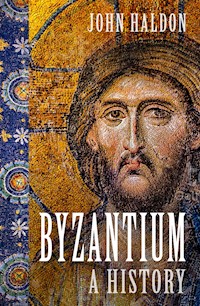
Cover illustrations: Thirteenth-century depiction of Jesus Christ, from a mosaic in Hagia Sophia; Blue mosaic with geometric shapes, Mausoleum of Galla Placidia.
First published 2000
This new edition published 2022
The History Press
97 St George’s Place, Cheltenham,
Gloucestershire, GL50 3QB
www.thehistorypress.co.uk
© John Haldon, 2000, 2002, 2005, 2022
The right of John Haldon to be identified as the Author of this work has been asserted in accordance with the Copyright, Designs and Patents Act 1988.
All rights reserved. No part of this book may be reprinted or reproduced or utilised in any form or by any electronic, mechanical or other means, now known or hereafter invented, including photocopying and recording, or in any information storage or retrieval system, without the permission in writing from the Publishers.
British Library Cataloguing in Publication Data.
A catalogue record for this book is available from the British Library.
ISBN 978 0 7509 5673 4
Typesetting and origination by The History Press
Printed and bound in Great Britain by TJ Books Limited, Padstow, Cornwall.
eBook converted by Geethik Technologies
Contents
Foreword
A Note on Names and Transliteration
Introduction
Part I The Last Ancient State
1 The Transformation of the Roman World c.300–741
2 A Medieval Empire c.741–1453
Part II The Byzantine World
3 The Peoples and Lands of Byzantium
4 The Byzantine State
5 Life in Town and Countryside
6 Byzantine Political Society
7 Church, State and Belief
8 Power, Art and Tradition in Byzantium
Conclusion
Notes
Glossary
Appendix 1: Emperors of the Eastern Roman Empire
Appendix 2: Chronological Chart
Appendix 3: Further Reading
List of Illustrations
Foreword
Many people, both friends and colleagues in the field of Byzantine Studies as well as in other fields, have contributed in one way or another to the present brief introduction to Byzantium. Perhaps most important have been the students, especially the undergraduate students, whom I have had the pleasure to teach over the last twenty years, since this book is aimed chiefly at them and at members of the general public who are looking for more than the usual romanticising political history, or catalogue of Byzantine art and architecture, as an introduction to the history of the medieval East Roman Empire. I should like to thank all of them here, in particular James Morris and Rosemary Morris, who kindly read the manuscript in draft and offered many valuable criticisms and comments. If I have not been able to incorporate all their suggestions for improvement of the book, I can only plead the constraints of time and publishers’ word limits! Finally, I owe an especial debt of thanks to Anthony Bryer, who first opened my eyes to Byzantium and who helped me to ask some of the right questions. He has always been keen and able to make Byzantium accessible to more than just the specialist, and the present contribution is intended as a recognition both of that aim and of his own contribution.
John HaldonBirmingham, March 2000
A great deal of further research has taken place in the field of Byzantine history in the twenty-two years since the publication of the first edition. In particular the field of Byzantine archaeology has greatly expanded and we now know a great deal more about the evolution of towns and cities, trade and commerce and pottery, for example. But scholarship and understanding has advanced in many areas of research. The application of new scientific methods and the development of new collaborations between historians, archaeologists and palaeoenvironmental scientists, for example, means that we can now begin to study Byzantine land-use and agriculture using proxy data quite independent of the written sources as well as of the archaeological material. In general terms my sketch of Byzantine history, society and culture over the period covered by the book reflects current opinion, although I have kept changes within the text to an absolute minimum. To account for the changes that have taken place, however – many of them small but significant – I have added some of the more helpful recent publications to the chapter bibliographies at the back of the book. For readers who wish to follow up on the various topics raised, as well as on changes in our interpretation and understanding of the history of the empire and of Byzantine culture and civilisation more generally, new material will be found there.
John HaldonPrinceton, March 2022
A Note on Names and Transliteration
All books dealing with the Byzantine world begin with a note on the transliteration of Greek words, for the simple reason that there are several different systems in use. I have decided to use the simplest: Greek terms will be transliterated as literally as possible, but without employing macrons on long vowels (thus no ê or ô for the letters eta and omega), or the phonetic rendering of certain letters (thus b will be kept as ‘b’ rather than ‘v’, for example, which is the way it would have been pronounced in most contexts). There are a few concessions towards standard modern Greek phonetic transliterations – thus Thessaloniki, rather than Thessalonike – because these are now the common form, but not many.
In addition, while Greek was the language of culture and government from the later sixth and seventh centuries, both Greek and Latin were employed before that time, and indeed the empire included at various times considerable areas where Latin was the main or only language – parts of Italy, parts of the northern Balkan region and central and western North Africa. To Latinise Greek names of the medieval period looks odd, just as Hellenising earlier Latin names and terms appears unreasonable or confusing. I have, inevitably, had to compromise. Technical terms and names will, therefore, be presented usually in their Latin form for the period before the year AD 600, and in their Greek form thereafter. This leaves many contradictions, but is the best that can be done. Where standard English versions of technical terms, personal names or placenames exist, I have used them (thus Constantine rather than Konstantinos).
Introduction
The name ‘Byzantium’ is a convenient convention, coined by French scholars during the seventeenth century to describe the Roman Empire in the East after the fifth and sixth centuries AD. Consecrated in 330, Constantinople was the ancient city of Byzantion, in origin a colony of Megara in Attica, which was renamed the ‘city of Constantine’ by the first Christian emperor of the Roman world. He made it his capital in an effort to establish a new strategic focus for the vast Roman state, as well as to distance himself from the politics of the previous centuries. By the middle of the fifth century, the western parts of the Roman Empire were already undergoing the process of transformation which was to produce the barbarian successor kingdoms, such as those of the Franks, Visigoths and Ostrogoths, and the Burgundians, while the eastern parts remained largely unaffected by these changes. When exactly ‘Byzantine’ begins and ‘late Roman’ ends is a moot point. Some prefer to use ‘Byzantine’ for the eastern part of the Roman Empire from the time of Constantine I, that is to say, from the 320s and 330s; others apply it to the Eastern Empire from the later fifth or sixth century, especially from the reign of Justinian (527–565). In either case, the term ‘Byzantine’ legitimately covers the period from the late Roman era on, and is used to describe the history of the politics, society and culture of the medieval East Roman Empire until its demise at the hands of the Ottomans in the fifteenth century.
The ‘Byzantines’ actually called themselves Romans – Romaioi – and if they did use the word ‘Byzantium’ or ‘Byzantine’, it was used (an illustration of the connections which learned Byzantines drew between their own culture and that of the ancient world) to describe the capital city of their empire: Constantinople, ancient Byzantion. The hallmarks of this culture were that it was Christian, that the language of the state and the dominant élite was Greek, and that its political ideology was founded on its identity with the Christian Roman Empire of Constantine the Great. Much more importantly from the perspective of cultural self-identity, the literate Byzantine élite from the later eighth and ninth centuries located its roots in the late Roman world, and regarded the classical inheritance in learning and literature – naturally in a suitably Christian guise – as its own. The élite used this cultural identity to differentiate itself both from the foreigner, barbarian or outsider and, within Byzantine society, from the semi-literate or illiterate masses of rural and townsfolk.
Byzantium was a society of contrasts: a mass of provincial peasant producers, perhaps 90 per cent of the total population for most of its history, and a few major urban centres. Constantinople – the Queen of Cities, the second Rome – was by far the largest and wealthiest. It was the seat of emperors, the focal point of literacy and élite culture. The Byzantine empire was a sophisticated state, with a complex fiscal system supporting an army, navy and administrative bureaucracy, able to preserve the basic forms of the late ancient state well into the late Middle Ages. It was also the heartland of the Orthodox Church; from the ninth century it became the centre of a far-flung Christian cultural commonwealth and of a network of imitative polities stretching from the Balkans to the Russian principalities. The empire functioned through a complex political-theological system, in which the emperor was an autocratic ruler whose power derived directly from God, and whose task was to maintain order and harmony in imitation of the heavenly realm. In consequence, ceremony and ritual were fundamental components both of court life – which itself was felt to act as an exemplar for the rest of society and the barbarian world – and of Byzantine understanding of the world. Emperors were appointed by God; but emperors could be overthrown, and a successful usurper must, it was reasoned, have the support of God (even if people were unable at first to grasp the logic of His choice!) otherwise he could not have met with success. God’s choice of a bad ruler and, by the same token, the occurrence of natural calamities and phenomena of all kinds, including defeats in battle or enemy attacks, were interpreted as signs from God, usually of His displeasure. A seventh-century story records that the abbot of a monastery near Constantinople had a dream in which he was able to ask God if all rulers and tyrants were appointed by divine choice. The answer was in the affirmative. ‘Then why, O Lord’, replied the abbot, ‘did you send the wicked tyrant Phocas to rule over the Romans?’ ‘Because I could find no one worse’, came the reply.
Plagues, earthquakes, comets, wars and other such phenomena were thus part of the relationship between the human and the divine, and were acted upon accordingly. Disasters or political calamities were frequently taken as warnings that the Chosen People – the Christian Romans – had strayed from the path of righteousness and were to be brought back to it by appropriate action, so that the search for a reason, or a scapegoat, usually followed. Such logic underlay many important imperial initiatives, even if there were longer-term social and economic factors at work which determined the choice of a particular form of action or response. Such motives also lay behind the stress on Orthodoxy (‘correct belief’, that is, correct interpretation of the Scriptures and the writings of the Fathers of the Church), so that many of the ecclesio-political conflicts within the Byzantine world, and thus between the Byzantine Church or government and the papacy, for example, were set off by conflicts begun over the issue of whether or not a particular imperial policy was accepted as ‘Orthodox’ or not.
Given the length of its existence, it is not surprising that considerable changes in state organisation, as well as in social and cultural values, took place over time, so that, while there are enough constants and continuities to make the use of one term for the whole social and political formation entirely legitimate, it is also true to say that in several respects the state and society of the fifteenth century bear little relationship to those of the sixth. This is particularly true of the social and economic relationships in Byzantine society and the vocabulary through which they were understood; it is even more so in the case of many of the state’s key administrative apparatuses.
In 1869 the historian William Lecky wrote:
Of that Byzantine empire, the universal verdict of history is that it constitutes, without a single exception, the most thoroughly base and despicable form that civilisation has yet assumed. There has been no other enduring civilisation so absolutely destitute of all forms and elements of greatness, and none to which the epithet mean may be so emphatically applied… The history of the empire is a monotonous story of the intrigues of priests, eunuchs, and women, of poisonings, of conspiracies, of uniform ingratitude.1
This image, which nicely reflects the morality and prejudices of the mid-Victorian world, has been remarkably resilient. Indeed, it lives on in some popular ideas about the Byzantine world, a combination of Victorian moralising and Crusaders’ prejudices, and in the use of the adjective ‘Byzantine’ in a pejorative sense. And there are some modern writers – for the most part, not professional historians – who have, consciously or not, transferred these prejudices to the world of contemporary scholarship, if not in respect of the ‘corrupt’ Byzantine court, then in terms of a romantic, ‘orientalist’ image of Byzantium which merely contributes to the continued obfuscation of the true nature of Byzantine society and civilisation. In the light of the evidence in the written sources and the material record, the Byzantine court was certainly no more corrupt, venal or conspiracy-ridden than any other medieval court in the West or East. But it has taken a long time to deconstruct these attitudes. Historians working within the Western European tradition have been particular victims in this respect of the nationalist and Eurocentric propaganda which first arose in the seventeenth and eighteenth centuries, in the context of the evolving nationalist and rationalist attitudes of the age. Northern and Western European culture was credited with an integrity, sense of honour and straightforwardness which the corrupt ‘orientalised’ Byzantine world (and that of Islam) had lost.
Like any other political system, the East Roman Empire struggled throughout its existence to maintain its territorial integrity. Its greatest problem was posed by its geographical situation, for it was always surrounded by potential or actual enemies: in the east, the Sassanid Persian empire until the 620s, then the Islamic Caliphates, and finally the Seljuk and Ottoman Turks; in the north, various groups of immigrant Slavs (sixth–seventh century), along with nomadic peoples such as the Avars, Bulgars, Chazars, Hungarians (Magyars) and Pechenegs; and in Italy and the western coastal region of the Balkans the Lombards and Franks, and later both Saracens (from North Africa and Spain) and Normans (later tenth to mid-twelfth century). Finally, from the twelfth century, Italian maritime powers vied to maximise their influence over Byzantine emperors and their territory. Over-ambitious (although sometimes initially very successful) plans to recover former imperial lands, and a limited and relatively inflexible budgetary system, were key structural constraints which affected the history of the empire. From the eleventh century the empire’s economy was gradually overtaken by the rapidly expanding economies of Western Europe and the Italian peninsula. The capture and sack of Constantinople by the Fourth Crusade in 1204 and the partition of its territory among a variety of Latin principalities and a Latin ‘empire’ – a rump of the former Byzantine state – spelled the end of Byzantium as a serious international power. In spite of the re-establishment of an imperial state at Constantinople in 1261, the growth of Balkan powers such as the Serbian empire in the fourteenth century, and the Ottomans in both Anatolia and the Balkans thereafter, was to prevent any reassertion of Byzantine power in the region. By the time of its final absorption into the Ottoman state, the ‘empire’ consisted of little more than Constantinople, some Aegean islands, and parts of the southern Peloponnese in Greece.
The history of Byzantium is not just the history of its political fortunes. The evolution of Byzantine society, transformations in economic life, the relationship between urban centres and rural hinterlands, the constantly shifting apparatuses of the state’s fiscal and administrative machinery, the nature and development of Byzantine (Roman) law, the growth of ecclesiastical and monastic power (both in economic as well as in ideological terms), developments in forms and styles of visual representation, literature, architecture, the sciences: all these elements are just part of a complex whole described by the term ‘Byzantine’ which this brief survey will introduce. Beyond description, however, comes explanation, and in the following pages I will try to provide enough information for the uninitiated reader to piece together a picture which will at once describe the course and shape of Byzantine history and also suggest an explanation for them. Byzantine society was just like any other medieval society in the sense that its social relations – based on kinship, private wealth and power, control of natural and man-made resources, and access to political authority and other forms of legitimation – can be analysed and dissected by a careful and painstaking interrogation of the relevant sources. In what follows I will attempt both to demystify the Byzantine world, and at the same time to explain its uniqueness.
There are many approaches one could adopt to introduce the Byzantine world. Two of the most useful are readily available in English, in the form of Cyril Mango’s excellent Byzantium: the empire of New Rome, and Alexander Kazhdan and Giles Constable’s People and power in Byzantium. An introduction to modern Byzantine Studies, both of which deal with a series of topics thematically and concentrate primarily on the conceptual, experiential and material-cultural world of Byzantium. The present short volume does not pretend to rival these studies in its coverage or in its approach to the cultural and conceptual universe of the Byzantine world, but to complement them in the form of an introduction to this complex social and cultural formation. Historians of Byzantium have already devoted many volumes to its art and its literature, to the history of its Church and to Orthodox Christianity, and to its cultural evolution in general. These are topics which this volume barely touches upon, still less treats in detail, nor does it set out to present anything like a complete history of the Byzantine world and its complex culture, an undertaking which, modern historians generally agree, is probably too big for an individual to undertake, at least with any hope of doing it properly. Therefore I have tried to present, as concisely as possible, those aspects which I believe will be most helpful to those who want to understand – and who would like to know more about – how the Byzantine state worked, how it was rooted in, and how it actively moulded, the society which supported it.
With this in mind, I have provided for each chapter some further reading, which is intended as a starting point from which readers may follow particular issues in greater detail, where they may find more detailed literature and, more importantly, where they will find more information about the sources for Byzantine history. Every historian comes to his or her material from their own particular perspective, and this perspective unavoidably influences the interpretation which follows. Explaining what that perspective is and how it determines a historical account is important. But in the end the best introduction is the self-image, as reflected unconsciously through different kinds of original source material, of the people who inhabited the past themselves.
Part 1
The Last Ancient State
1
The Transformation of theRoman World c.300–741
The End of the Late Roman Order
The third century saw the Roman world rent by a series of civil wars and barbarian invasions, which made fundamental administrative changes in both the military as well as the civil apparatus of the state inevitable. A number of features contributed to this. In the first place, the government had to contend with the enormous length of the imperial frontiers, stretching from Britain in the north, along the Rhine and the upper Danube, across the Danube to the northern Balkans and thence to the Black Sea; and in the east from the Black Sea and Caucasus region down through Armenia, Iraq and Mesopotamia to the Sinai peninsula. In Africa, the border stretched along the coastal strip and north of the Atlas mountains to the Atlantic coast and the westernmost province of Tingitania. Even in times of peace, maintaining garrisons and soldiers to police such a frontier incurred huge costs; while in times of war it was virtually impossible to defend if challenged on more than one front at the same time. Unfortunately for Rome, this is precisely what happened during the third century. In the eastern theatre the new Sassanid Persian kingdom – which had replaced the Parthian empire with which Rome had shared Iraq since the late Republic – presented a formidable and dynamic challenge to Roman control and influence in the region. In the north, Germanic immigrant populations pressed against the frontier defences along the Rhine and the Danube, so the eastern front required constant attention. The result was increasing concentrations of troops under provincial commanders whose distance from Rome meant that the central government was unable to exercise any effective authority. The demands of the soldiers for pay and rewards, the burden on the central treasuries, and the bond between soldiers and successful generals on the frontiers provoked rebellions and civil wars, so that the third century saw the empire’s very existence threatened by a long series of upheavals. By the end of the century, following a series of successful frontier wars, some semblance of stability was restored; but the system as a whole – which had far outgrown its ability to control and administer such a vast empire – was seriously compromised.
After a number of attempts to introduce the changes necessary to meet the challenges posed by the new situation had proved unsuccessful, the emperor Diocletian resolved to approach the problem from a different perspective. Given the size of the empire and the difficulties of communicating between Rome and the armies on the frontiers, it was decided to divide the empire’s military command into four regional groupings. A ‘college’ of rulers was established, consisting of two senior Augusti, Diocletian and Maximian, the latter in the West, the former in the East, each supported by a junior ‘Caesar’, Galerius and Constantius respectively. The latter would succeed the senior rulers when their rule ended, appointing two new junior Caesars in their place. This Tetrarchy – ‘rule of four’ – worked well initially, but collapsed when Diocletian abdicated in 305, compelling his fellow Augustus, Maximian, to abdicate along with him. Diocletian had formulated policy and directed government in all spheres; and, since the tetrarchic structure applied to the military only (the civil administrative apparatus remained unified), as soon as he resigned, squabbles among his successors resulted in further civil war and disruption. The sons of Maximian, former Augustus in the West, and of Constantius, his Caesar, were passed over in the appointment of new Caesars, the choice falling upon favourites of Galerius: Severus, now appointed in the West under Constantius, and Maximinus Daia in the East under Galerius. When Constantius died his son Constantine was acclaimed emperor by his troops at York; another claimant to the imperial throne appeared at the same moment, Maxentius the son of Maximian, who – with the support of his father, who came out of retirement – was able to force the surrender of Severus, whom he executed. Thus, Maxentius declared himself Augustus.
The following conflict involved a quarrel between Maxentius and Maximian, an alliance between the latter and Constantine, the appointment of Licinius – a client of Galerius – as Caesar in the West, and a second abdication by Maximian; by the year 310 the empire was ruled by no fewer than five Augusti. In 312 Constantine allied himself with Licinius, invaded Italy and defeated Maxentius at the famous battle of the Milvian bridge, during which Constantine’s soldiers bore the chi-rho symbol (the first two letters of the name Christos) on their shields. Constantine saw his victory as the response to his appeal to the God of the Christians. Once established in Rome, he disbanded the praetorian guard, and in 313 he met with Licinius and agreed an edict of toleration by which Christians would henceforth be entirely free in their worship, and have any property which had been confiscated during the persecutions of Diocletian and Maximin Daia restored. Galerius had already recognised the failure of Diocletian’s policies which, coming after a period of half a century of toleration of Christianity, were too late to destroy a by now well-established religious organisation. The edict of Milan of 313 finalised this recognition. Relations between Constantine and Licinius remained peaceful but uneasy. Finally, in 323 war broke out, and in 324 Constantine was able to defeat Licinius, depose him, and become sole emperor. The empire remained united until the end of the century.
Constantine recognised that the empire as a whole could no longer effectively be ruled from Rome. He moved his capital eastwards, to the site of the ancient Megaran colony of Byzantium, now renamed the ‘city of Constantine’, Konstantinoupolis. Its strategic position was attractive, for the emperor could remain in contact with both Eastern and Western affairs from its site on the Bosphorus. Roman civic institutions were imported wholesale to the new capital, with the establishment of a senate and of central administrative institutions. The city was expanded, new walls were constructed and the emperor undertook an expensive building programme. Begun in 326, the city was formally consecrated in 330.
Constantine inaugurated a series of important reforms within both the military and civil establishment of the empire. The fiscal system was overhauled and a new gold coin, the solidus, introduced in a successful effort to stabilise the monetary economy of the state. Military and civil offices were separated; the central administration was restructured and placed under a series of imperially chosen senior officers directly responsible to the emperor. The armies were reorganised into two major sections: those based in frontier provinces and along the borders, and several field armies of more mobile troops attached directly to the emperor’s court as a field reserve, ready to meet any invader who broke through the outer defences. The provincial administration was reformed; more and smaller provincial and intermediate units were established, to permit central control and supervision of fiscal matters. Finally, with the toleration of Christianity and its positive promotion under Constantine at the expense of many of the established non-Christian cults, the Church began to evolve into a powerful social and political force which was, in the course of time, to dominate East Roman society and to vie with the state for authority in many aspects of civil law and justice.
In spite of Constantine’s efforts at reform, however, the size of the empire and the different concerns of West and East resulted in a continuation of the principle of a split government, with one ruler in each part, although the tetrarchic system was never revived. Upon Constantine’s death in May 337, his three sons inherited his position with the support of the armies. Constantine II, the eldest, was recognised as senior and ruled the West. Constantius ruled in the East and Constans, the youngest, was allotted the central provinces (Africa, Italy and Illyricum). Tension between Constans and Constantine resulted in war in 340 and the defeat and death of the latter, with the result that Constans became ruler of the western regions as well. Following popular discontent among both the civilian population and the army in the West, however, Constans was deposed in 350 and his place taken by a certain Magnentius, a high-ranking officer of barbarian origin. Magnentius was not recognised by Constantius, and he invaded Illyricum. But he was defeated in 351, escaping to Italy where – after further defeats – he took his own life. Constantius ruled the empire alone until his death in 361.
In 355 Constantius had appointed his cousin Julian to represent him in Gaul; in 357, he was given the command against the invading Franks and Alamanni and, following a series of victories, he was acclaimed by his soldiers as Augustus. Constantius was campaigning against the Persian king Shapur who had invaded the eastern provinces in 359, and the acclamation may have been stimulated by the emperor’s demand that Julian send him his best troops for the Persian war. Julian marched east, but on the way to meet him Constantius died in 361, naming Julian as his successor. Although a competent general and efficient administrator, Julian was unpopular with many of his soldiers because of his attempts to revive paganism, often at the financial expense of the Church. During the Persian campaign of 363 he was mortally wounded, probably by one of his own men. The troops acclaimed the commander of Julian’s guards, a certain Jovian, as emperor. Having made peace with Shapur, Jovian marched back to Constantinople, dying in Bithynia a mere eight months later.
Jovian’s successors were Valentinian and Valens, brothers from Pannonia (roughly modern Austria and Croatia), elected by the leading civil and military officers at Constantinople. Valentinian ruled in the West and established his capital at Milan, while Valens had to face a rebellion almost immediately, led by the usurper Procopius and caused by the soldiers loyal to Julian, whose favourite Procopius had been. But the rebellion petered out in 366.
The two new emperors each had substantial military challenges to overcome. In the West Valentinian had to deal with invasions from Franks, Alamanni and Saxons in Gaul, from Picts and Scots in Britain, and from rebellious chieftains in Mauretania. He died in 375 while fighting a Germanic people in Pannonia, the Quadi, and was followed by his chosen successor Gratian. In the east, Valens had to deal with repeated Gothic invasions of Thrace, caused by pressure from the Huns who had destroyed the kingdom of the Ostrogoths (east Goths) in the Ukraine in 373, while he campaigned in Armenia in 371 to recover territories seized by the Persians. In 377 he moved back to Thrace to confront a Gothic invasion, and was disastrously defeated and killed at a battle near Adrianople in Thrace in 378. The Goths overran and plundered Thrace.
Gratian appointed the general Theodosius – son of a successful general of the same name and himself an experienced commander – initially as commander-in-chief and then as Augustus, and by a combination of diplomacy and strategy Theodosius was able to make peace with the Goths, permitting them to settle within the empire under their own laws, providing troops for the imperial armies in return for annual food subsidies. Following the death of Gratian in 383 as the result of a coup, and the eventual overthrow of the usurper, Magnus Maximus, by Theodosius in 388, Theodosius became sole ruler. He was, however, the last emperor to hold this position. At his death in 395 his two sons Arcadius (in the East) and Honorius (in the West) ruled jointly. But as minors they were greatly influenced by the chief military and other officers at court. The Germanic generals Stilicho and Gainas were the effective rulers, and although the latter held his position for only a short while at Constantinople, the weakness of the imperial authority was apparent. Even under Stilicho’s authority, however, the Western half of the empire began to fall apart. The British provinces were abandoned to their own devices in 410 (after further unsuccessful revolts); Rome itself was sacked by the Visigoths in 410; barbarian tribes were increasingly bought off – frequently by near kinsmen in positions of authority within the imperial government – with territorial concessions which effectively established more or less autonomous petty chieftainships within Roman territory. And by the 430s whole provinces were under barbarian rule, technically as allies or federates of the Romans, but effectively independent: the Vandals in North Africa, the Suebi in Spain, the Visigoths in southern France and Spain. When the last Western emperor was deposed in 476, Italy itself was effectively dominated by Germanic officers, led by the general Odoacer, and occupied by barbarian troops.
The eastern half of the empire survived for a variety of reasons: a healthier economy, more diversified pattern of urban and rural relationships and markets, and a more solid tax base, for Constantinople had Egypt and the rich provinces of Syria at its disposal. In addition, Eastern diplomacy encouraged barbarian leaders to look westward, while at the same time the walls of Constantinople – newly built on a massive scale under Theodosius II (408–450) – rendered any attempt to take that city fruitless. The magistri militum – ‘masters of the soldiers’ – who commanded the imperial field forces nevertheless remained for the most part of German origin and continued to dominate the court. Only with the appointment of Emperor Leo I (457–474) was this cycle broken, for Leo – although a candidate promoted by the master of soldiers, Aspar, the ‘king-maker’ – was able to take the initiative (through using Isaurian mercenaries) and during the last years of his reign rid himself of Aspar. While the Isaurians, who were involved in factional strife at court and in the provinces, were themselves something of a problem, some stability was thereafter re-established. Leo I was succeeded by his grandson Leo II, the son of a certain Zeno, who had married Leo I’s daughter and was commander of the excubitores, Leo’s Isaurian guards. Leo appointed his father co-emperor, but died in 474, leaving Zeno as sole emperor. After defeating a coup d’état and winning a civil war (which lasted for much of his reign) with the help of Gothic mercenaries, whom he was then able to send to Italy on the pretext of restoring imperial rule there, Zeno died in 491.
His successor was Anastasius (491–518), an able civil official chosen by Zeno’s empress Ariadne with the support of the leading officers and court officials. An Isaurian rebellion was crushed in 498; an invasion of Slavs was eventually repulsed; and a campaign against the Persians was finally brought to a successful conclusion in 506. Anastasius’ most important act was a reform of the precious-metal coinage of the empire, through which he stabilised the gold coin, the solidus (or nomisma in Greek), and the relationship between it and its fractions, on the one hand, and the copper coinage, on the other.
Upon his death in 518, Anastasius was succeeded by Justin, who had in turn been commander of the excubitores, and who was elected by popular acclaim and with the support of both the garrison troops in Constantinople and leading state officials and senators. His reign saw a stabilisation along the eastern front and the consolidation of the political stability won during the reign of his predecessor; when he died in 527 he was succeeded without opposition by his nephew, Justinian. The reign of Justinian was to prove a watershed in the evolution of East Rome – Byzantium – and can be said in many ways properly to mark the beginnings of a medieval East Roman world.
Throughout the period from Constantine’s accession, the history of the empire was marked by the fundamental importance of the Christian Church and the development of Christianity itself for its cultural and political evolution. For Constantine, the Christian Church had been a valued political ally in his effort to stabilise the empire and to consolidate his own power. For that reason, it had been essential that the Church remained united; discord and disagreement were politically threatening for an emperor who, while not being baptised until shortly before he died, nevertheless privileged the Christian Church both with the confiscated wealth from pagan temples and formal recognition in his political plans. But, almost immediately, Constantine was forced to deal with a major split within the Church, brought about by the appearance of Arianism, a heresy about the Trinity and the status of Christ. Arius (250–336) was a deacon of the Church at Alexandria. Trained in Greek philosophy, he became an ascetic, and in his attempts to clarify the nature of the Trinity, produced a creed which was for many contemporaries heretical. His philosophical background prevented him from accepting the notion that God could become man: he taught that Jesus was not eternal and co-equal with the Father, but created by Him. He was not God, but not human either, rather a kind of demi-God. Arius was excommunicated in 320 by the bishop of Alexandria, and in 325 he was condemned and exiled by the Council of Nicaea, which asserted the equality of Father and Son in eternity, and that Son and Father were homoousios, that is to say, ‘con-substantial’. Arius returned in 334, but died in 336. The problem was exacerbated by the fact that Constantine himself began eventually to favour the Arian position, and after his death in 337 his son and heir Constantius approved it in the eastern part of the empire. In contrast, in the West, Constans supported the Nicene position. Many synods were held to debate the issue, until in 350 Constans died and the Nicenes were persecuted. But the Arians were themselves split into three factions: those who argued that Father and Son are unlike; those who believed that Father and Son are alike, but not consubstantial; and those who thought that Father and Son were of almost one substance – a group which eventually accepted the Nicene position. Constantius died in 361; in 362 the Council of Alexandria restored Orthodoxy, and in 381 the ecumenical Council of Constantinople reaffirmed Nicaea.
The early fifth century saw a further Christological split in the form of Nestorianism, which took its name from Nestorius, a monk of Antioch who had studied under Theodore of Mopsuestia. In 428 he was appointed bishop of Constantinopole by Theodosius II, but aroused considerable hostility in Constantinople when he publicly supported the preaching of his chaplain that Mary should not be referred to as the Theotokos – ‘the God-Bearer’. Demonstrations in the city followed; and the emperor was persuaded to summon the third ecumenical Council after Cyril, Bishop of Alexandria (which saw itself as a rival to Constantinople), appealed to Rome, and the Roman Pope Celestine condemned Nestorius. The Nestorians developed a theology in which the divine and human aspects of Christ were seen not as unified in a single person, but operating in conjunction, and they referred to the Virgin as Christotokos, ‘Christ-bearer’, to avoid attributing to the Divinity too human a nature. The Nestorians were accused, unfairly, of teaching two persons in Christ, God and man, and thus two distinct Sons, human and divine. But the Nestorian position was condemned in 431 (Council of Ephesus), and proceeded to secede, formally establishing a separate Church at their own council at Seleucia-Ctesiphon in Persia in 486, whence it established a firm foothold in Persia and was spread across northern India and central Asia as far as China during the following centuries. It survives today – particularly in northern Iraq – as the Assyrian Orthodox Church.
Although Nestorianism was driven out of the Roman state during the fifth century, the debates it generated contributed to the evolution of a much more significant split within Christianity in the form of the Monophysite movement, which – although only referred to under this name from the seventh century – represented a reaction to some of the Nestorian views. The key problem revolved around the ways in which the divine and the human were combined in the person of Christ, and although two ‘schools’ of Monophysitism evolved, the more extreme version – elaborated by a certain Eutyches – was that the divine was prior to and dominated the human element; hence the description ‘Monophysite’: mono meaning ‘single’ and physis meaning ‘nature’. A council held at Ephesus in 449, which was marred by violence and intimidation on the part of the monks who supported Eutyches, found in favour of the Monophysite position. But at the Council of Chalcedon in 451 a larger council rejected it and redefined the traditional creed of Nicaea to make the Christological position clear. The political results of this division can be seen both in the politics of the court at Constantinople and in the regional identities of different provinces of the empire. In Egypt and Syria in particular, Monophysitism became established in the rural populations, and led to occasional – but harsh – persecutions. At court, in contrast, imperial policy varied from reign to reign leaving some confusion within the Church as a whole, and involving persecutions by both sides. The emperor Zeno (474–491) issued a decree of unity – the Henotikon – which attempted to paper over the divisions. Anastasius supported a Monophysite position, Justin I was ‘Chalcedonian’, and Justinian, partly influenced by the empress Theodora (d.548), swung between the two. Theodora lent her support to the Syrian Monophysites by funding the movement led by the bishop Jacob Baradaeus (whose name was afterwards taken to refer to the Syrian ‘Jacobite’ Church); a similar ‘shadow’ Church evolved in Egypt, and the Armenian Church also adopted the Monophysite view. In each case, the form of traditional belief may have been one of the most important factors, but it has also been suggested that alienation from the Constantinople regime, especially following the occasional persecutions which took place, also played a role.
These were not the only heretical movements to affect the Church and directly involve the emperors during this period. The ‘Donatist’ movement, a strictly North African heresy, was led by a puritan sect claiming that the tradition of consecration of bishops of Carthage was improper. Because the Church authorities were supported from Rome, African regional feeling was inflamed, and the heresy flourished – although as a small minority – until the seventh century. Other regional heresies included Messalianism, a Syrian monastic heresy which spread from Mesopotamia to Syria in the fourth century. With a crude and materialistic view of God and sin, it was attacked and finally condemned by the Council of Ephesus in 431. Pelagianism was a largely Western heresy, begun by a British monk, Pelagius, during the later fourth century. It was repeatedly condemned: in 411 and again in 416–448 and, finally, because its chief spokesman Celestius associated himself with Nestorianism, at Ephesus in 431. These local heresies had few longer-term results, but directly involved the emperors on every occasion and cemented the association between the interests of the Church and those of the imperial government.
The Forging of Byzantium:Justinian to Leo III (527–741)
Although the western part of the empire had been transformed into a patchwork of barbarian successor states, the emperors at Constantinople continued to view all the lost territories as part of their realm, and in some cases to treat the kings of the successor kingdoms as their legitimate representatives, governing Roman affairs in the provinces in question until Constantinople could re-establish a full administrative and military presence. This is most obviously the case with the (Arian, and therefore heretical) Ostrogoths who – under their leader Theoderic, who had been brought up in Constantinople – had been despatched under Zeno against the usurper Odoacer, who had deposed the last Roman emperor in the West, Romulus Augustulus, and claimed to represent the empire in his stead. Theoderic was successful, and although he ruled nominally in the name of the emperor, he in fact was able to establish a powerful state in Italy. By the same token, Clovis, the leader of the Salian Franks in northern Gaul, had quite deliberately adopted Orthodox Christianity in the last years of the fifth century in order to gain papal and imperial recognition and support for his rule, where he also claimed, at least nominally, to represent Roman rule, exploiting the fact of his Orthodoxy to justify warfare against his Arian neighbours, the Visigoths in southern Gaul in particular.
Roman emperors thus considered the West not as ‘lost’, but rather as temporarily outside direct imperial authority. Under Justinian, this point of view was the basis for a series of remarkable reconquests, aimed at restoring the Roman world in its greatness, and re-establishing Rome’s power as it had been at its height. Naturally, the plan was too ambitious – in respect of the resources required to carry it out – to have had any real chance of success. But Justinian came very close to achieving a major part of his original aims. The problems which arose after his death and as a result of his policies illustrated their unrealistic aims.
When Theoderic the Ostrogoth died in 526 conflict erupted over the succession, throwing the kingdom into confusion. The same occurred in the Vandal kingdom of North Africa, established during the first half of the fifth century after the Vandals had swept across the Rhine, through Gaul and into Spain, and eventually across the straits of Gibraltar into North Africa. Within a few years their kings had established a powerful kingdom with considerable resources at its disposal, and had also built up a fleet with which they raided Italy, disrupted shipping, and threatened the remaining parts of the empire. The political conflict and civil strife which broke out upon the death of the Vandal king gave Justinian his chance and, in 533, in a lightning campaign, the general Belisarius was able to land with a small force, defeat two Vandal armies and take the capital, Carthage, before finally eradicating Vandal opposition. Encouraged by this success, Sicily and then southern Italy were occupied in 535 on the pretext of intervening in the affairs of the Ostrogoths to stabilise the situation. The Goths felt they could offer no serious resistance: their capital at Ravenna was handed over, their king Witigis was taken prisoner and sent to Constantinople, and the war appeared to be won. At this moment Justinian, who appears to have harboured suspicions about Belisarius’ political ambitions, recalled him, partly because a fresh invasion by the new and dynamic Persian king Chosroes I (Khusru) threatened to cause major problems in the East. In 540 Chosroes was able to attack and capture Antioch, one of the richest and most important cities in Syria, and since the Ostrogoths had shortly beforehand sent an embassy to the Persian capital, it is entirely possible that the Persians were working hand-in-glove with the Goths to exploit the Roman preoccupation with the West and to distract them while the Goths attempted to re-establish their situation. For during Belisarius’ absence they were able to do exactly that, under a new war leader, the king Totila. Within a short while, they had recovered Rome, Ravenna and most of the peninsula. It took the Romans another ten years of punishing small-scale warfare throughout Italy finally to destroy Ostrogothic opposition, by which time the land was exhausted and barely able to support the burden of the newly re-established imperial bureaucracy.
However, Justinian’s ambitions did not end there. He had further expansionist plans, but in the end only the south-eastern regions of Spain were actually recovered from the kings of the Visigoths, also Arians. As part of the realisation of his plan to restore Roman greatness, he ordered a codification of Roman law, which produced the Digests and the Codex Justinianus and provided the basis for later Byzantine legal developments and codification. He persecuted the last vestiges of paganism in his efforts to play both Roman and Christian ruler, defender of Orthodoxy and of the Church, and he also introduced a large number of administrative reforms and changes in an effort to streamline and bring up to date the running of the empire. But his grandiose view of the empire and his own imperial position brought him into conflict with the papacy during the so-called ‘Three Chapters’ controversy, for example. In 543 the emperor issued an edict against three sets of writings (the ‘Three Chapters’) of the fourth and fifth centuries, by Theodore of Mopsuestia, Theodore of Cyrrhus and Ibas of Edessa, who had been accused by the Monophysites of being ‘pro-Nestorian’. The intention was to conciliate the Monophysites, and required the agreement and support of the Roman Pope Vigilius. The Pope did indeed – eventually – accept the edict, but there remained very substantial opposition in the West, and in 553 an ecumenical council at Constantinople condemned the Three Chapters. The Pope was placed under arrest by imperial guards and forced to agree. But the attempt at compromise failed to persuade the Monophysites to accept the ‘neo-Chalcedonian’ position. Justinian was by no means always popular within the empire, either. In 532, he nearly lost his throne in the great ‘Nika’ riots, and there were several plots against him during the course of his reign which were uncovered before they came to anything. The historian Procopius, who accompanied Belisarius on his campaigns and kept a record of the reign, wrote a scurrilous ‘Secret History’ in which he denounced virtually every act of Justinian. Procopius’ book is suggestive of the hostility that the emperor’s policies and attitude towards particular individuals – especially Belisarius – seems to have engendered.
Upon his death in 565 Justinian left a vastly expanded but perilously overstretched empire, both in financial as well as in military terms. Justinian had seen himself as the embodiment of Roman imperial power; his successors were faced with the reality of dealing with new enemies, lack of ready cash, and internal discontent over high taxation and constant demands for soldiers and the necessities to support them. Justin II, Justinian’s successor and nephew, opened his reign by cancelling the yearly ‘subsidy’ (in effect, a substantial bribe paid to keep the Persian king at a distance, and regarded by the latter as tribute) to Persia, beginning a costly war in the East. In 568 the Germanic Lombards crossed from their homeland along the western Danube and Drava region into Italy, in their efforts to flee the approaching Avars, a Turkic nomadic power which, like the Huns two centuries earlier, was in the process of establishing a vast steppe empire. While the Lombards rapidly overran Roman defensive positions in the north of the peninsula, soon establishing also a number of independent chiefdoms in the centre and south, the Avars occupied the Lombards’ former lands and established themselves as a major challenge to imperial power in the northern Balkan region. Between the mid-570s and the end of the reign of the emperor Maurice (582–602), the empire was able to re-establish a precarious balance in the East. Although the Romans suffered a number of defeats, they were able to stabilise the Danube frontier in the north; the lands over which the campaigning took place, especially in Italy and the Balkans, were increasingly devastated and unable to support prolonged military activity. Maurice cleverly exploited a civil war in Persia in 590–591 by supporting the young, deposed king Chosroes II. When the war ended, with Roman help in the defeat of Chosroes’ enemies, the peace arrangements between the two empires rewarded the Romans with the return of swathes of territory and a number of fortresses which had been lost in the previous conflicts.
Maurice was unpopular with the army in the Balkans because of the hard nature of the campaigning there, as well as because of his efforts to maintain some control over the expenses of this constant warfare. This was, rightly or wrongly, perceived as miserly and penny-pinching by the soldiers, and in 602 the Danube army mutinied, marched on Constantinople, and imposed their own candidate as emperor, the centurion Phokas. Maurice’s entire family was massacred, and the ‘tyranny’ of Phokas (602–610) began. While he seems to have been a fairly incompetent politician, his armies seem to have held their own in the Balkans and against the Persians who, on the pretext of avenging Maurice, had invaded the eastern provinces. Phokas was popular in many regions of the empire, but not all, and in 610 the military governor, or exarch, of Africa at Carthage – a certain Heraclius – set out with a fleet to depose him, while his cousin Nicetas took a land force across the North African provinces, through Egypt and northwards into Asia Minor. Phokas was deposed with little opposition, and Heraclius was crowned emperor. But some of the troops remained loyal to Phokas, and his deposition was followed by a short period of civil war in Egypt and Asia Minor. But the empire was now unable to maintain its defences intact, and within a few years the Avars and Slavs had overrun much of the Balkans, while the Persians occupied and set up their own provincial governments in Syria and Egypt between 614 and 618, and continued to push into Asia Minor. Italy, now divided into a number of military commands isolated from each other by Lombard enclaves, was left to its own devices, encouraging an increasing degree of local autonomy and self-reliance which was eventually to lead to its severance from the empire in all but name. In 626, a combined Persian-Avar siege of Constantinople was defeated (contemporaries attributed the victory to the intercession of the Mother of God), while from 623 Heraclius boldly took the war into Persian territory, invading through Armenia into the Persian heartlands and, in a series of brilliant campaigns, destroyed Chosroes’ armies and forced the Persian generals (Chosroes himself having been deposed and murdered) to sue for peace. The status quo ante was re-established, and the dominant position of the Roman Empire seemed assured. Although the Danube remained nominally the frontier, the Balkans were, in practice, no longer under imperial authority, except where an army appeared, while the financial situation of the empire, whose resources were quite exhausted by the long wars, was desperate.
The complex ecclesiastical politics of the Church continued to play a crucial role. The disaffection brought about by Constantinopolitan persecution of the Monophysites in particular – under Justin II, for example – rendered some sort of compromise formula an essential for the reincorporation of the territories whose populations had been largely Monophysite and which had been lost to the Persians. Under Heraclius, the patriarch Sergius and his advisers came up with two possible solutions: the first referred to as ‘monoenergism’ – whereby a single energy was postulated in which both divine and human aspects were unified. At this point, the arrival of Islam on the historical stage made the need for a compromise – which would heal the divisions – even more urgent. Even more importantly, the defeats at the hands of the Arabs will have been interpreted (in keeping with the fundamental assumptions of the era) as a sign of God’s displeasure, requiring some sort of action on the part of the Romans or their guardian and God’s representative on earth – the emperor – to make amends. Heraclius and his patriarch, Sergius, undoubtedly framed their proposals for compromise with monophysitism with these considerations in mind. But monoenergism was rejected by several leading churchmen. The alternative, the doctrine of a single will – ‘monotheletism’ – although initially attracting the support of moderate Monophysites, was eventually rejected by both the hard-line Monophysites and by the majority of the Western Chalcedonian clergy, surviving as an imperial policy which had to be enforced by decree after Heraclius’ death in 641. But by this time, of course, the Monophysite lands had been lost to the Arabs and the whole purpose of the compromise was lost.




