


7,49 €
Mehr erfahren.
- Herausgeber: A.J.Kingston
- Kategorie: Geisteswissenschaft
- Sprache: Englisch
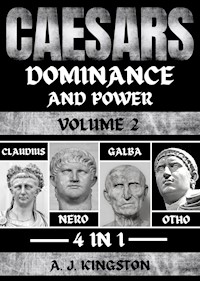
Step back in time to the world of ancient Rome with "Caesars: Dominance and Power," a four-in-one book bundle that explores the fascinating lives and reigns of four of the most intriguing emperors in history: Claudius, Nero, Galba, and Otho.
Each of the four books in this bundle delves deep into the personality and rule of a different emperor, offering a comprehensive and engaging exploration of their lives and legacies. In "Claudius: The Unlikely Emperor," you'll discover how a man once deemed an imbecile rose to become one of Rome's most just and successful emperors, while "Nero: The Legacy of a Damned Emperor" takes a closer look at the mad tyrant who played the lyre while Rome burned.
"Galba: The Short-Lived Emperor" explores the rise and fall of a man who struggled to hold onto power and ultimately met a violent end, and "Otho: The Forgotten Emperor" sheds light on the brief but significant reign of a man who briefly seized power after Galba's assassination.
Together, these four books offer a captivating and comprehensive exploration of ancient Rome and the individuals who shaped its history. Whether you're a history buff or simply fascinated by the world of ancient empires, "Caesars: Dominance and Power" is a must-read. So why wait? Order your copy today and embark on a journey through one of the most intriguing and tumultuous eras in history.
Das E-Book können Sie in Legimi-Apps oder einer beliebigen App lesen, die das folgende Format unterstützen:
Veröffentlichungsjahr: 2023
Ähnliche










CAESARS
DOMINANCE AND POWER
4 IN 1
CLAUDIUS, NERO, GALBA & OTHO
VOLUME 2
BOOK 1:
CLAUDIUS: THE UNLIKELY EMPEROR
BOOK 2:
NERO: THE LEGACY OF A DAMNED EMPEROR
BOOK 3:
GALBA: THE SHORT-LIVED EMPEROR
BOOK 4:
OTHO: THE FORGOTTEN EMPEROR
BY A.J. KINGSTON
Copyright © 2023 by A. J. Kingston
All rights reserved. No part of this book may be reproduced or transmitted in any form or by any means, electronic or mechanical, including photocopying, recording, or by any information storage and retrieval system, without permission in writing from the publisher.
Published by A. J. Kingston
Library of Congress Cataloging-in-Publication Data
ISBN 978-1-83938-290-1
Cover design by Rizzo
Disclaimer
The contents of this book are based on extensive research and the best available historical sources. However, the author and publisher make no claims, promises, or guarantees about the accuracy, completeness, or adequacy of the information contained herein. The information in this book is provided on an "as is" basis, and the author and publisher disclaim any and all liability for any errors, omissions, or inaccuracies in the information or for any actions taken in reliance on such information.
The opinions and views expressed in this book are those of the author and do not necessarily reflect the official policy or position of any organization or individual mentioned in this book. Any reference to specific people, places, or events is intended only to provide historical context and is not intended to defame or malign any group, individual, or entity.
The information in this book is intended for educational and entertainment purposes only. It is not intended to be a substitute for professional advice or judgment. Readers are encouraged to conduct their own research and to seek professional advice where appropriate.
Every effort has been made to obtain necessary permissions and acknowledgments for all images and other copyrighted material used in this book. Any errors or omissions in this regard are unintentional, and the author and publisher will correct them in future editions.
Join Our Productivity Group and Access your Bonus
If you're passionate about history books and want to connect with others who share your love of the subject, joining our Facebook group (search for “History Books by A.J.Kingston”) can be a great way to do so. By joining a group dedicated to history books, you'll have the opportunity to connect with like-minded individuals, share your thoughts and ideas, and even discover new books that you might not have come across otherwise. You can also access your FREE BONUS once you joined our Facebook group called “History Books by A.J.Kingston”.
>> Click Here to Join Our Productivity Group <<
One of the biggest advantages of joining our Facebook group is the sense of community it provides. You'll be able to interact with other history book enthusiasts, ask questions, and share your own knowledge and expertise. This can be especially valuable if you're a student or someone who is just starting to explore the world of history books.
>> Click Here to Follow A.J. Kingston <<
>> Click Here to Download your Free Bonus <<
If you love audiobooks, then joining our YouTube channel that offers free audiobooks on a weekly basis can be a great way to stay entertained and engaged. By subscribing to our channel, you'll have access to a range of audiobooks across different genres, all for free. Not only this is a great opportunity to enjoy some new audiobooks, but it's also a chance to discover new authors and titles that you might not have come across otherwise.
>> Click Here to Join our YouTube Channel <<
Lastly, don’t forget to follow us on Facebook and YouTube by searching for A.J. Kingston.
Table of Contents – Book 1 - Claudius: The Unlikely Emperor
Introduction
Chapter 1: The Early Life of Claudius: A Sickly and Unremarkable Childhood
Chapter 2: Claudius the Historian: The Life and Times of Etruscan Rome
Chapter 3: The Unlikely Heir: How Claudius Became Emperor
Chapter 4: Claudius the Reformer: Administration, Infrastructure, and Public Works
Chapter 5: A New Era of Roman Expansion: The Conquest of Britain
Chapter 6: Claudius and the Imperial Family: Marriages, Scandals, and Betrayals
Chapter 7: A Murderous Court: The Assassination of Messalina and the Rise of Agrippina
Chapter 8: Building an Empire: Claudius and Roman Foreign Policy
Chapter 9: The Legacy of Claudius: Succession, Historiography, and Memory
Chapter 10: The Claudian Era and Beyond: Reflections on the First Century AD
Table of Contents – Book 2 - Nero: The Legacy Of A Damned Emperor
Chapter 1: A Star is Born: Nero's Early Life and Education
Chapter 2: The Young Emperor: Nero's Rise to Power and the Role of the Praetorian Guard
Chapter 3: Nero's Rome: Art, Culture, and Society in the First Century AD
Chapter 4: The Fire of Rome: Fact and Fiction in the History of Nero
Chapter 5: "Nero Fiddled While Rome Burned": Debunking a Myth
Chapter 6: The Politics of Fear: Nero's Persecution of the Christians
Chapter 7: The Last Great Conquest: Nero's Ambitions in the East
Chapter 8: Nero and the Imperial Family: Matricide, Patricide, and Incest
Chapter 9: The Death of Nero: Suicide, Assassination, or Escape?
Chapter 10: The Legacy of Nero
Table of Contents – Book 3 - Galba: The Short-Lived Emperor
Chapter 1: A Life in Service: Galba's Early Career and Rise to Power
Chapter 2: The Year of the Four Emperors: Galba's Role in the Succession Crisis
Chapter 3: From Spain to Rome: Galba's March on the Capital
Chapter 4: Galba and the Praetorian Guard: The Importance of Military Support
Chapter 5: The Short Reign: Galba's Administration and Reforms
Chapter 6: "The Old Man": Galba's Reputation and Personality
Chapter 7: The Plot Against Galba: The Assassination of an Emperor
Chapter 8: The Legacy of Galba: A Footnote in Roman History?
Chapter 9: The Significance of Galba: Lessons from the Year of the Four Emperors
Chapter 10: Galba's Rome: Society, Politics, and Culture in the Late Julio-Claudian Era
Table of Contents – Book 4 - Otho: The Forgotten Emperor
Chapter 1: From Friend to Foe: Otho's Relationship with Nero and Galba
Chapter 2: A Desperate Gamble: Otho's Bid for the Imperial Throne
Chapter 3: Otho's Rome: Culture, Society, and Politics in the Year of the Four Emperors
Chapter 4: The Battle for Italy: Otho vs. Vitellius
Chapter 5: Otho's Army: Composition, Tactics, and Leadership
Chapter 6: The Suicide of Otho: A Tragic End to a Short Reign
Chapter 7: Otho's Legacy: The Forgotten Emperor of the Year of the Four Emperors
Chapter 8: A Man of Letters: Otho's Literary Works and Patronage
Chapter 9: Otho's Image in History: From Biased Sources to Modern Interpretations
Chapter 10: Otho and the Roman Empire: Lessons from a Failed Emperor
Conclusion
About A. J. Kingston
Introduction
Welcome to "Caesars: Dominance and Power," a book bundle that brings together four captivating historical accounts of some of Rome's most notorious emperors - Claudius, Nero, Galba, and Otho.
In "Claudius: The Unlikely Emperor," you'll explore the life of a man who was once deemed an imbecile and written off by the royal court. Yet, he ultimately rose to become one of Rome's most successful and just emperors, bringing about significant reforms and leading the empire through challenging times.
In "Nero: The Legacy of a Damned Emperor," you'll uncover the notorious legacy of a man often depicted as a mad tyrant who played the lyre while Rome burned. Despite his artistic pursuits, Nero's reign was marked by scandal, assassination attempts, and political turmoil that ultimately led to his downfall.
In "Galba: The Short-Lived Emperor," you'll learn about a man who rose to power in a moment of crisis but struggled to hold onto it. Galba's reign was marked by unpopular policies, rebellion, and betrayal, ultimately leading to his assassination after only a few months in power.
Finally, in "Otho: The Forgotten Emperor," you'll delve into the life of a man who briefly seized power after Galba's assassination but was ultimately defeated by a rival claimant to the throne. Though his reign was short, Otho left behind a legacy that is often overlooked in the annals of Roman history.
Together, these four books offer a fascinating exploration of the complexities of power and dominance in ancient Rome, as well as the unique personalities that defined the era. "Caesars: Dominance and Power" is a must-read for history buffs and anyone interested in the fascinating world of ancient Rome.
BOOK 1
CLAUDIUS:
THE UNLIKELY EMPEROR
BY A.J. KINGSTON
Chapter 1: The Early Life of Claudius: A Sickly and Unremarkable Childhood
Claudius, the fourth emperor of Rome, was long considered by his family to be a weak and feeble-minded child, unfit for the rigors of public life. Born in the year 10 BC, Claudius was afflicted with a variety of ailments from an early age, including a limp, tremors, and stammering speech. These physical limitations led his family to view him as a liability, rather than an asset, and Claudius was subjected to frequent ridicule and scorn throughout his childhood.
In the eyes of his mother, Antonia, Claudius was a monster. Antonia, the daughter of Mark Antony and Octavia, sister of the Emperor Augustus, was a formidable figure in her own right, renowned for her beauty, wit, and intelligence. But she had little patience for her awkward and ungainly son, whom she saw as an embarrassment to the family name. Antonia often referred to Claudius as a "cretin" or a "fool", and she did little to hide her disappointment and disgust.
Claudius's father, Drusus, was no better. Drusus was a celebrated general and the son of the Emperor Tiberius, but he had little time or affection for his sickly son. Drusus was known to mock and belittle Claudius in front of others, and he even went so far as to accuse the boy of feigning his disabilities in order to avoid military service. This constant mistreatment took a toll on Claudius, leaving him feeling isolated and alone.
But perhaps the most damaging influence on Claudius's childhood was his own nephew, Caligula. Caligula, who would later become Emperor himself, was only a few years older than Claudius, but he was already a vicious and cruel individual. Caligula took great pleasure in tormenting his younger cousin, subjecting him to beatings, verbal abuse, and public humiliation. Claudius was often reduced to tears by Caligula's taunts and attacks, and he grew to fear and hate his cousin.
Despite the many challenges he faced, Claudius was not entirely without allies. His grandmother, Livia, the wife of Augustus and the mother of Tiberius, took a keen interest in his education and well-being. Livia recognized that Claudius was an intelligent and thoughtful boy, despite his physical limitations, and she encouraged him to pursue his interests in literature, history, and philosophy. Livia also defended Claudius against the attacks of his family members, although her influence was limited.
As Claudius grew older, he began to develop a keen sense of self-awareness. He realized that he was different from other boys his age, and he became increasingly self-conscious about his physical limitations. But he also began to channel his energies into intellectual pursuits, devouring books and spending hours in conversation with scholars and philosophers. Claudius discovered that he had a natural talent for learning, and he became determined to prove his worth to himself and to others.
In the end, Claudius's childhood was a difficult and often painful experience, but it also shaped him into the man he would become. His struggles with disability and discrimination taught him to persevere in the face of adversity, and his love of learning and intellectual curiosity would serve him well in his later life. Despite the cruelty of his family and the taunts of his peers, Claudius remained true to himself, and he emerged from his difficult childhood as a thoughtful, intelligent, and ultimately successful leader.
The early education and intellectual development of Claudius were shaped by his innate love for history and his passion for learning. Despite being viewed as a weak and sickly child by his family, Claudius possessed a keen mind and a thirst for knowledge that would propel him to become one of the most learned emperors in Roman history.
From a young age, Claudius was fascinated by the past. He devoured books on history, literature, and philosophy, and spent countless hours in conversation with scholars and philosophers. His grandmother, Livia, recognized his potential and encouraged his interests, providing him with access to the best tutors and mentors in the Roman world.
Claudius's education was eclectic and varied. He studied Greek and Latin, as well as mathematics, astronomy, and music. He was well-versed in the classics of both Greek and Roman literature, and was particularly interested in the history of his own family and the early years of the Roman Republic. Claudius also had a keen interest in the natural world, and was fascinated by the plants, animals, and landscapes of his native Italy.
Despite his love for learning, Claudius faced many challenges in his early education. His physical disabilities made it difficult for him to keep up with his peers, and he often struggled to express himself verbally. But he was determined to succeed, and he developed his own methods of learning and communication that allowed him to overcome his limitations.
One of the most influential figures in Claudius's early education was the historian Livy. Claudius was a devoted student of Livy's works, which chronicled the history of Rome from its founding to the death of Augustus. Livy's vivid descriptions of battles, politics, and society captured Claudius's imagination, and he became obsessed with the idea of preserving the history of his own time for future generations.
As Claudius grew older, his interest in history began to take on a more practical dimension. He began to see history not just as a source of intellectual pleasure, but as a tool for understanding the present and shaping the future. He saw in the study of history a way to learn from the successes and failures of the past, and to apply those lessons to the challenges of the present.
Claudius's love for history would play a crucial role in his later life as emperor. As he rose to power, he drew on his knowledge of Roman history and his understanding of the strengths and weaknesses of previous emperors to guide his own rule. He was particularly interested in the early years of the Roman Republic, and saw in the virtues of the early Romans a model for his own leadership.
Claudius also recognized the importance of preserving the history of his own reign. He commissioned a number of works on his own life and times, including a history of the Julio-Claudian dynasty and a detailed account of the conquest of Britain. He saw in these works a way to ensure that his legacy would be remembered and celebrated long after his death.
In the end, Claudius's love for history was one of his greatest gifts. It allowed him to connect with the past in a way that few others could, and to draw on that knowledge to shape the future of the Roman Empire. His passion for learning and intellectual curiosity would be remembered long after his death, and his contributions to the study of history would influence generations of scholars and thinkers.
Claudius, the fourth emperor of Rome, was born into a world that did not value his physical abilities. From an early age, he struggled with a range of physical challenges and disabilities that would shape his life and his reign. But despite these obstacles, Claudius would go on to become one of the most successful and influential emperors in Roman history.
Claudius was born into the illustrious Julio-Claudian dynasty in 10 BC. He was the son of Drusus and Antonia Minor, and the grandson of Augustus, the first emperor of Rome. But despite his noble birth, Claudius was viewed as a disappointment by his family. He suffered from a range of physical disabilities that made him seem weak and fragile, and his speech was often slurred and difficult to understand.
As a child, Claudius was subjected to ridicule and bullying by his siblings and peers. He was excluded from the rough and tumble games of childhood, and was often left alone to pursue his own interests. But it was during these solitary moments that Claudius discovered his love for learning and his passion for history.
Despite his difficulties, Claudius was not without his strengths. He was blessed with a keen intellect and a remarkable memory, and he was able to absorb vast amounts of information through reading and conversation. He was also known for his wit and his sharp sense of humor, which he used to deflect the cruel taunts of his siblings and peers.
As Claudius grew older, his physical disabilities became more pronounced. He suffered from tremors and convulsions, and his limbs were often weak and uncoordinated. He also suffered from a speech impediment that made him appear slow-witted and inarticulate. But despite these challenges, Claudius remained determined to make his mark on the world.
Claudius's physical challenges would continue to affect his life in significant ways. He was often excluded from political and social events, and was frequently passed over for important roles and appointments. But he was able to use his love of history and his remarkable memory to carve out a niche for himself in Roman society.
As a young man, Claudius began to write and publish works on history and politics. He became known for his insightful analysis of Roman history and his sharp critiques of contemporary politics. He also became a trusted advisor to his uncle, the emperor Tiberius, who recognized his nephew's talents and intellect.
It was during the reign of Tiberius that Claudius was given his first taste of power. He was appointed to the prestigious office of quaestor, and was sent to govern the province of Illyricum. Despite his physical challenges, Claudius proved to be a capable and efficient administrator, and he won the respect and admiration of the people he governed.
Claudius's physical challenges would continue to impact his life in significant ways. But he refused to let his disabilities define him or limit his potential. Instead, he used his love of learning and his passion for history to become one of the most learned and influential emperors in Roman history.
In the end, Claudius's physical challenges were not a weakness, but a strength. They taught him resilience, determination, and perseverance in the face of adversity. They also allowed him to see the world from a different perspective, and to approach his role as emperor with empathy and understanding. For Claudius, the obstacles he faced were not a curse, but a challenge to be overcome. And overcome them he did, leaving behind a legacy that would inspire generations to come.
The Julio-Claudian dynasty was one of the most illustrious and influential dynasties in the history of the Roman Empire. It was founded by Augustus, the first emperor of Rome, and was followed by a succession of powerful and ambitious rulers, including Tiberius, Caligula, Claudius, and Nero. But despite its many achievements, the dynasty was also marked by a series of scandals, betrayals, and intrigues, many of which centered around the black sheep of the family: Claudius.
Claudius was born into the Julio-Claudian dynasty in 10 BC. He was the son of Drusus and Antonia Minor, and the grandson of Augustus himself. But from an early age, Claudius was seen as an outsider in his own family. He suffered from a range of physical disabilities and speech impediments that made him seem weak and ineffectual, and he was often the target of ridicule and bullying from his siblings and peers.
Despite these challenges, Claudius was a man of remarkable intellect and talent. He was an accomplished writer and historian, and his works on Roman history and politics were highly respected by his contemporaries. He was also a skilled administrator and governor, and he proved himself to be an effective leader during his tenure in Illyricum.
Despite his many accomplishments, however, Claudius was never fully accepted by his family. He was seen as an embarrassment and a liability, and he was excluded from many of the important political and social events of the time. He was also passed over for many important roles and appointments, and was often relegated to the sidelines of Roman politics.
Despite this marginalization, Claudius remained a devoted member of the Julio-Claudian dynasty. He served as a trusted advisor to his uncle, the emperor Tiberius, and he worked tirelessly to promote the interests of his family and the empire as a whole. He also maintained close relationships with his siblings and other members of the imperial family, even when they treated him with disdain or indifference.
But Claudius's loyalty to his family would ultimately be tested when he was unexpectedly elevated to the imperial throne. In the wake of Caligula's assassination, the Roman Senate turned to Claudius as a compromise candidate, hoping that his lack of political ambition and his devotion to the empire would make him a safe and stable ruler.
Despite initial skepticism and resistance, Claudius proved to be a surprisingly effective emperor. He implemented a series of reforms and public works projects that improved the lives of ordinary Romans, and he established a stable and prosperous period of peace and prosperity that would last for several years.
But Claudius's time on the throne was not without its challenges. He faced a series of conspiracies and assassination attempts, many of which were orchestrated by members of his own family. He also struggled to balance the demands of his office with his personal relationships and obligations, which often put him at odds with his siblings and other members of the imperial family.
Despite these challenges, however, Claudius remained committed to his role as emperor and to the legacy of his family. He continued to promote the interests of the empire and to work tirelessly to maintain its stability and prosperity. And although he was never fully accepted by his family, he remained a loyal member of the Julio-Claudian dynasty until the end of his life.
In the end, Claudius's place in the Julio-Claudian dynasty was a complex and multifaceted one. He was both an outsider and an insider, a black sheep and a loyal member of the family. He was marked by his physical disabilities and his marginalization, but he was also defined by his intellect, his talent, and his dedication to the empire.
The reign of Claudius, the fourth emperor of the Roman Empire, was marked by a series of reforms and public works projects that transformed the empire and improved the lives of its citizens. But Claudius was an unlikely emperor, a man who had been dismissed and marginalized by his own family for much of his life. So how did this unremarkable and unassuming man rise to the highest office in the land? The answer lies in Claudius's early experiences in politics and administration, which gave him the skills and knowledge he needed to become a successful emperor.
Claudius was born into the Roman aristocracy in 10 BC. He was the son of Drusus and Antonia Minor, and the grandson of Augustus, the first emperor of Rome. From an early age, Claudius was marked by his physical disabilities and speech impediments, which made him seem weak and ineffectual. As a result, he was often the target of ridicule and bullying from his siblings and peers.
Despite these challenges, Claudius was a man of remarkable intellect and talent. He was an accomplished writer and historian, and his works on Roman history and politics were highly respected by his contemporaries. He was also a skilled administrator and governor, and he proved himself to be an effective leader during his tenure in Illyricum.
It was in Illyricum that Claudius first began to distinguish himself as a politician and administrator. He was appointed governor of the province by his uncle, the emperor Tiberius, and he quickly set about implementing a series of reforms and improvements that earned him the respect and admiration of the local population. He improved the infrastructure of the province, built new roads and aqueducts, and encouraged the development of trade and commerce.
Claudius's success in Illyricum did not go unnoticed. He was soon appointed to a series of other important administrative roles, including membership in the powerful Roman Senate. He used these positions to advocate for the interests of the empire and to promote policies that would benefit the Roman people. He was a strong supporter of the military and worked tirelessly to ensure that the empire remained secure and protected.
But Claudius's rise to power was not without its challenges. He faced opposition and hostility from many members of his own family, who saw him as a liability and an embarrassment. He was often excluded from important political and social events, and he was passed over for many important roles and appointments.
Despite these setbacks, however, Claudius remained committed to his role as a politician and administrator. He continued to work tirelessly to promote the interests of the empire and to improve the lives of its citizens. And his hard work and dedication eventually paid off.
In 41 AD, the emperor Caligula was assassinated, and the Roman Senate turned to Claudius as a compromise candidate to fill the power vacuum. Despite initial skepticism and resistance, Claudius proved to be a surprisingly effective emperor. He implemented a series of reforms and public works projects that improved the lives of ordinary Romans, and he established a stable and prosperous period of peace and prosperity that would last for several years.
Claudius's early experiences in politics and administration had prepared him well for the challenges of the imperial office. He had developed the skills and knowledge he needed to govern effectively and to make a positive impact on the lives of his subjects. And although he had been dismissed and marginalized by his own family for much of his life, he had proven himself to be a capable and effective leader who was more than worthy of the title of emperor.
In the end, Claudius's reign was a testament to the power of hard work, dedication, and perseverance. Despite the many obstacles he faced, he never wavered in his commitment to the empire and its people.
Chapter 2: Claudius the Historian: The Life and Times of Etruscan Rome
Claudius, the fourth emperor of the Roman Empire, is often remembered for his contributions to Roman law, administration, and public works. But there is another side to Claudius that is often overlooked - his deep and abiding love of history. This passion for the past was an important part of Claudius's life and career, and it played a crucial role in shaping his outlook and approach to the world.
Claudius's love of history can be traced back to his childhood. As a sickly and disabled child, he was often isolated from his siblings and peers, and he spent much of his time reading and studying. It was during this time that he developed a fascination with the past and a desire to understand the events and personalities that had shaped the world around him.
This interest in history was nurtured and encouraged by Claudius's family. His grandfather, Augustus, was a keen historian who had written extensively about the early days of the Roman Republic. His mother, Antonia Minor, was also a lover of history, and she often regaled her children with stories of Roman heroes and legends.
As Claudius grew older, his love of history continued to deepen. He spent countless hours reading and studying the works of the great Roman historians, such as Livy and Tacitus. He also collected and catalogued a vast array of historical artifacts and documents, which he used to supplement his studies and research.
It was this love of history that led Claudius to pursue a career in public service. He believed that a thorough understanding of the past was essential for anyone who wished to govern effectively, and he saw his role as a public servant as an opportunity to put this knowledge to use.
During his time in public service, Claudius used his love of history to great effect. He was a skilled and knowledgeable administrator, and he used his historical knowledge to help guide his policies and decisions. He was particularly interested in the legal and constitutional history of Rome, and he worked tirelessly to ensure that the laws and institutions of the empire remained true to their historical roots.
Claudius's love of history also had a profound impact on his personal life. He was a collector of antiquities and artifacts, and he was particularly fond of ancient coins and inscriptions. He also took a keen interest in the preservation of historical monuments and landmarks, and he was responsible for the restoration of several important Roman buildings and structures.
But perhaps the greatest legacy of Claudius's love of history was his own written works. Claudius was a prolific writer and historian, and his works on Roman history and politics were highly respected by his contemporaries. He wrote extensively on the early days of the Roman Republic, and his histories of the reigns of Augustus and Tiberius are still regarded as important sources of information on these periods.
Claudius's love of history was a defining characteristic of his life and career. It was an interest that was nurtured and encouraged from an early age, and it played a crucial role in shaping his outlook and approach to the world. His passion for the past was not simply a hobby or pastime, but a fundamental aspect of his identity as a Roman citizen and public servant.
In the end, Claudius's love of history was a testament to the power of knowledge and learning. It was a reminder that the past is always present, and that a deep understanding of history is essential for anyone who wishes to make a meaningful impact on the world. Claudius's passion for the past remains an important legacy, and it continues to inspire and inform scholars and historians to this day.
In the history of ancient civilizations, few have captured the imagination of scholars and historians quite like the Etruscans. This enigmatic culture, which flourished in central Italy from the 8th to the 3rd centuries BCE, has long been a subject of fascination and study for those interested in the history and culture of the Mediterranean world. Among those who were particularly drawn to the Etruscans was the Roman emperor Claudius, who had a deep and abiding interest in their civilization and culture.
The Etruscans are often considered one of the most mysterious and enigmatic of the ancient peoples. They were a confederation of city-states, centered around the modern-day region of Tuscany, whose origins and language are still the subject of intense debate and speculation. What is known about the Etruscans comes from a combination of archaeological evidence, ancient texts, and historical accounts from neighboring civilizations such as Greece and Rome.
Despite the challenges of studying the Etruscans, they left behind an impressive legacy that continues to intrigue scholars to this day. Their art, architecture, and engineering achievements are particularly noteworthy, and they were renowned for their expertise in metalworking, pottery, and textiles. They were also known for their religious practices, which included the use of divination and the worship of a pantheon of gods and goddesses.
For Claudius, the Etruscans were a source of particular fascination. He was deeply interested in their history and culture, and he spent much of his life studying and collecting artifacts from their civilization. He was particularly drawn to their written language, which was based on an alphabet that was distinct from the Greek and Latin alphabets. Claudius believed that the Etruscan language was key to unlocking the secrets of their civilization, and he spent years trying to decipher it.
Claudius's interest in the Etruscans was not just academic, however. He saw them as a source of inspiration for his own reign as emperor, and he sought to emulate their achievements in art, architecture, and engineering. He was particularly interested in their use of arches and vaults in their construction, and he commissioned several buildings in Rome that incorporated these features.
Despite Claudius's interest and enthusiasm, the Etruscan civilization eventually faded into obscurity. By the end of the 3rd century BCE, they had been absorbed into the Roman Republic, and their culture and language gradually disappeared. Yet their legacy lives on, and their influence can still be seen in the art, architecture, and culture of modern-day Tuscany.
The story of the Etruscans is a testament to the enduring power of ancient civilizations, and to the fascination and curiosity that they continue to inspire. For Claudius, the Etruscans were not just an academic subject, but a source of inspiration and pride. His interest in their culture and civilization was a reflection of his own intellectual curiosity and his commitment to preserving the legacy of the past.
In the end, the Etruscans remain a source of mystery and wonder for scholars and historians. Despite the challenges of studying their civilization, their achievements continue to inspire and captivate those who seek to understand the ancient world. For Claudius, the Etruscans were a source of inspiration and pride, and their legacy continues to inform and inspire our understanding of the ancient Mediterranean world.
The ancient Etruscan city of Veii, located just a few miles outside of Rome, has long been a subject of fascination for scholars and archaeologists. Known for its impressive engineering feats, including a complex system of underground tunnels and cisterns, Veii was a major center of commerce and culture during the Etruscan era. Its rich history and impressive ruins drew the attention of many ancient historians, including the Roman emperor Claudius, who devoted much of his life to studying and excavating the lost city.
Claudius was deeply interested in the history and culture of the Etruscans, and he saw Veii as a particularly important site for study and excavation. He believed that the city held important clues to understanding the Etruscan civilization, and he made it a personal mission to uncover as much as possible about its history and culture.
To this end, Claudius commissioned a team of archaeologists and engineers to begin excavating the site in earnest. They spent years uncovering the remains of the city, carefully sifting through the layers of history to piece together a picture of life in ancient Veii. Their efforts were often hampered by the challenges of working with ancient materials and techniques, but they persisted in their efforts, driven by their passion for uncovering the lost city.
As the excavation progressed, Claudius became increasingly involved in the project. He spent hours poring over ancient texts and maps, trying to decipher the history and layout of the city. He even visited the site himself on several occasions, taking an active role in the excavation and providing valuable insights into the history and culture of the Etruscans.
One of the most significant discoveries made during the excavation of Veii was the so-called "Pyramid of Veii," a massive structure that was unlike anything else in the ancient world. This structure was believed to have been a temple or shrine, and it was covered in intricate carvings and reliefs that provided valuable insights into the religious practices of the Etruscans.
Another important find was the "Porta dell'Arco," or Arch Gate, which was a massive stone gate that had once guarded the entrance to the city. This gate was notable for its impressive engineering and design, and it provided valuable insights into the architecture and engineering practices of the Etruscans.
Despite the challenges of working with ancient materials and techniques, Claudius and his team were able to uncover a wealth of information about the lost city of Veii. They pieced together a picture of a thriving metropolis that was a center of trade, culture, and religion, and they provided valuable insights into the daily lives of the Etruscan people.
The excavation of Veii was a testament to Claudius's passion for history and his commitment to preserving the legacy of the past. His efforts helped to uncover a wealth of information about the Etruscan civilization, and they provided valuable insights into the history and culture of the ancient Mediterranean world.
Today, the ruins of Veii remain a popular destination for scholars and tourists alike, and they continue to inspire new generations of historians and archaeologists. The legacy of Claudius and his team lives on in the ongoing study and excavation of this important site, a testament to the enduring power of the past and the human drive to understand our shared history.
The Etruscan League was a confederation of cities and tribes that dominated central Italy during the first millennium BCE. The league was founded in the 8th century BCE and lasted for several hundred years, exerting a significant influence on the political, economic, and cultural landscape of the region.
The league was made up of a number of independent city-states, each with its own government and ruling class. These city-states were bound together by a shared language and culture, as well as by a desire to protect themselves against external threats.
The league was ruled by a council of magistrates, known as the "Lucumones," who were elected by the various member states. The Lucumones served as both political and religious leaders, presiding over the league's affairs and overseeing the worship of the Etruscan gods.
The league's power and influence grew over time, as it established itself as a dominant force in central Italy. Its member states became known for their wealth and sophistication, with advanced systems of government, trade, and culture.
One of the most notable achievements of the Etruscan League was the construction of impressive public works, such as roads, aqueducts, and bridges. These feats of engineering allowed the league to maintain its power and influence over a vast territory, and they demonstrated the advanced technological skills of the Etruscan people.
Despite their many successes, however, the league was ultimately unable to withstand the rise of Rome, which gradually absorbed the Etruscan cities into its own empire. The league was officially dissolved in the 4th century BCE, as the various member states were incorporated into the Roman Republic.
The legacy of the Etruscan League, however, lived on. The league's cultural and artistic achievements continued to influence the Roman Empire and beyond, and its legacy can still be seen in the many surviving examples of Etruscan art and architecture.
Perhaps most importantly, the Etruscan League served as a model for future confederations and alliances, demonstrating the power of collective action and cooperation in the face of external threats. Its legacy can be seen in the many alliances and federations that would emerge in the centuries to come, as nations and city-states banded together to protect themselves against common enemies.
In the end, the Etruscan League may have been absorbed into the Roman Empire, but its legacy lives on. Its contributions to the culture, politics, and engineering of ancient Italy remain a testament to the enduring power of human cooperation and ingenuity, and its memory serves as a reminder of the many ways in which the past can shape the present and the future.
The legacy of Claudius, the fourth emperor of Rome, is not limited to his reign, but extends to his historical writings and the impact they had on Roman historiography and the modern study of the Etruscans. Despite being considered an unlikely emperor, Claudius was a scholar and a historian, who had a deep love for history and the preservation of the past. His legacy in the field of history is as significant as his political legacy, if not more.
Claudius' interest in history and his love for the Etruscans can be traced back to his childhood, where he was educated in the classics and history by some of the greatest scholars of his time. He inherited his love for history from his mother, Antonia, who was a great lover of literature and the arts. As a result, Claudius became an avid reader, a prolific writer, and a scholar with a deep understanding of the past.
During his reign, Claudius wrote a number of historical works, including an eight-volume history of the Etruscan civilization, which he titled "The Etruscan History." The work was a comprehensive account of Etruscan history, culture, and society, and it represented a major contribution to the study of the Etruscans. The book was also a reflection of Claudius' love for the Etruscans and his desire to preserve their history for future generations.
Claudius' historical writings had a significant impact on Roman historiography. Before Claudius, historical writing in Rome was often biased and focused on glorifying the ruling elite. Claudius, on the other hand, was more objective in his approach and wrote history from a neutral perspective. He was critical of his predecessors and their biased accounts of history, and he advocated for a more factual and balanced approach to the writing of history.
Claudius' influence on Roman historiography was significant, as it paved the way for a new generation of historians who were more objective in their approach and less interested in glorifying the ruling elite. His approach to history also had a significant impact on the development of modern historiography, as his emphasis on objectivity and balance continues to be a hallmark of the modern study of history.
Claudius' legacy in the study of the Etruscans is equally significant. His work "The Etruscan History" is considered one of the most comprehensive accounts of the Etruscan civilization, and it remains a valuable resource for modern scholars studying the Etruscans. Claudius' love for the Etruscans also inspired other writers and scholars to take an interest in the Etruscan civilization, and his work helped to establish the Etruscans as a significant part of Italy's cultural heritage.
In addition to his historical writings, Claudius' reign also had a significant impact on the study of the Etruscans. During his reign, he sponsored a number of archaeological excavations in Italy, including the excavation of the Etruscan city of Veii. These excavations were a significant contribution to the study of the Etruscans and helped to shed light on their history, culture, and society.
Claudius' legacy in the field of history and the study of the Etruscans is significant and enduring. His love for history and his desire to preserve the past for future generations inspired a new generation of historians and scholars, and his objective and balanced approach to history continues to be a hallmark of the modern study of history. His contributions to the study of the Etruscans were significant, and his work helped to establish the Etruscans as an important part of Italy's cultural heritage.
Chapter 3: The Unlikely Heir: How Claudius Became Emperor
The assassination of Caligula, the third emperor of Rome, in AD 41 was a pivotal moment in Roman history. The event marked the end of the Julio-Claudian dynasty and ushered in a period of chaos and instability known as the Year of the Four Emperors. The assassination of Caligula was a result of his tyrannical rule and his brutal treatment of the Roman people.
Caligula had ascended to the throne in AD 37, after the death of his predecessor Tiberius. He was initially popular with the people, who saw him as a breath of fresh air after the repressive and austere rule of Tiberius. However, Caligula's rule quickly descended into tyranny, as he began to display increasingly erratic and cruel behavior.
Caligula's rule was marked by excess and debauchery. He squandered the state's resources on lavish displays of wealth and extravagance, and he engaged in perverse sexual practices and indulged in sadistic behavior. He was also known for his disregard for the law and his willingness to use violence to achieve his goals.
The assassination of Caligula was carried out by a group of conspirators, led by Cassius Chaerea, a tribune of the Praetorian Guard. The conspirators had become disillusioned with Caligula's rule and his mistreatment of the Roman people. They saw his removal from power as necessary to restore order and stability to the empire.
On January 24, AD 41, Caligula was attending a theatrical performance in the palace when he was attacked by the conspirators. He was stabbed to death in a brutal and violent manner, and his body was left lying on the floor of the palace.
The assassination of Caligula plunged Rome into chaos and uncertainty. With no clear successor to the throne, the empire was thrown into a state of political and social turmoil. The Praetorian Guard, who were responsible for the security of the emperor, seized the opportunity to install their own candidate as the new emperor.
The Praetorian Guard proclaimed Caligula's uncle, Claudius, as the new emperor of Rome. Claudius was an unlikely choice for the throne, as he was considered by many to be a weak and feeble-minded individual. However, the Praetorian Guard saw him as a pliable puppet who could be easily manipulated to serve their interests.
The accession of Claudius to the throne marked the beginning of the Year of the Four Emperors, a period of instability and chaos that lasted from AD 68 to AD 69. During this time, four different men claimed the title of emperor, each with the support of different factions within the Roman army.
The assassination of Caligula was a defining moment in Roman history. It marked the end of the Julio-Claudian dynasty and ushered in a period of chaos and instability that would last for several years. The assassination was a result of Caligula's tyrannical rule and his brutal treatment of the Roman people. The event also highlighted the importance of the Praetorian Guard in the political life of Rome, as they played a key role in the selection of Caligula's successor.
In summary, the assassination of Caligula in AD 41 was a pivotal moment in Roman history. The event marked the end of one dynasty and the beginning of a period of chaos and instability that would last for several years. The assassination was a result of Caligula's tyrannical rule and his brutal treatment of the Roman people. The event also highlighted the power of the Praetorian Guard in the political life of Rome, as they played a key role in the selection of Caligula's successor.
The appointment of Claudius as Emperor of Rome in AD 41 was an unlikely event that was fraught with political intrigue and power struggles. The circumstances of his appointment were unusual, as he was not seen as a strong candidate for the throne due to his physical disabilities and his reputation as a weak and ineffectual leader.
Claudius was the uncle of the previous emperor, Caligula, who had been assassinated by a group of conspirators led by the tribune of the Praetorian Guard, Cassius Chaerea. After Caligula's death, the Praetorian Guard declared Claudius as the new emperor, bypassing other potential claimants to the throne.
The appointment of Claudius as emperor was unexpected, as he had not been seen as a serious candidate for the throne. Claudius suffered from a number of physical disabilities, including a limp and a stutter, which had caused him to be ridiculed and marginalized by the imperial court. He was also seen as a scholar and a historian, rather than a military or political leader.
Despite these disadvantages, Claudius had served in a number of important administrative roles in the Roman government, and had gained a reputation as a competent and diligent public servant. He had a keen interest in history and archaeology, and had written several books on the subject, which had earned him the respect of scholars and intellectuals.
After the assassination of Caligula, the Praetorian Guard was left without a clear successor to the throne. They feared that the chaos and instability that had followed the assassination of Julius Caesar would be repeated, and that the empire would be plunged into another civil war. In order to avoid this outcome, they decided to appoint Claudius as the new emperor, believing that he would be a pliable and easily controlled leader.
The appointment of Claudius was met with skepticism and even derision by many members of the imperial court. They saw him as a weak and ineffectual leader, who would be easily manipulated by the Praetorian Guard and other powerful factions within the government. However, Claudius was determined to prove his critics wrong, and he set about consolidating his power and establishing himself as a legitimate and effective ruler.
One of the key challenges that Claudius faced in the early years of his reign was securing the loyalty of the Roman army. Many members of the military had supported other claimants to the throne, and they were reluctant to recognize Claudius as their new emperor. To win their support, Claudius embarked on a series of military campaigns and military reforms, which helped to establish his reputation as a capable and effective military leader.
Claudius was also committed to improving the welfare of the Roman people, particularly those who had been marginalized or oppressed under previous regimes. He introduced a number of reforms to the legal system, including the establishment of a new court system that was more accessible to ordinary citizens. He also invested heavily in public works projects, such as aqueducts and roads, which helped to improve the infrastructure of the empire.
Despite his initial difficulties, Claudius was able to establish himself as a successful and effective ruler. He remained on the throne for thirteen years, during which time he oversaw a period of relative stability and prosperity in the empire. His reputation as a scholar and a historian also endured, and he was widely respected as one of the most learned and intelligent emperors in Roman history.
In summary, the appointment of Claudius as emperor in AD 41 was a surprising and unexpected event that was driven by political expediency and a desire for stability in the Roman Empire. Despite initial skepticism and ridicule, Claudius was able to establish himself as a capable and effective ruler, who oversaw a period of relative stability and prosperity in the empire.
Claudius was an emperor beyond expectations. Despite being seen as an unlikely candidate for the throne due to his physical disabilities and reputation as a scholar rather than a warrior, he proved to be a capable and effective ruler who oversaw a period of relative stability and prosperity in the Roman Empire.
Claudius' reign was marked by a number of significant achievements, particularly in the areas of administration, public works, and military conquest. He was committed to improving the welfare of the Roman people, particularly those who had been marginalized or oppressed under previous regimes. He introduced a number of reforms to the legal system, including the establishment of a new court system that was more accessible to ordinary citizens.
Claudius also invested heavily in public works projects, such as aqueducts and roads, which helped to improve the infrastructure of the empire. He oversaw the construction of a new port at Ostia, which helped to increase trade and commerce throughout the Mediterranean region. He also ordered the construction of a new aqueduct that brought fresh water to the city of Rome, which had been suffering from a chronic water shortage for many years.
In addition to his domestic policies, Claudius was also an effective military leader. He oversaw a number of successful military campaigns, including the conquest of Britain in AD 43. This was a significant achievement, as previous attempts to conquer Britain had been unsuccessful. Claudius' success in this endeavor helped to expand the reach of the Roman Empire and establish its dominance in northern Europe.
Claudius was also committed to promoting education and scholarship throughout the empire. He had a keen interest in history and archaeology, and had written several books on the subject, which had earned him the respect of scholars and intellectuals. He also established a number of schools and libraries throughout the empire, which helped to promote learning and knowledge.
Despite his many accomplishments, Claudius faced a number of challenges during his reign. One of the key challenges was securing the loyalty of the Roman army. Many members of the military had supported other claimants to the throne, and they were reluctant to recognize Claudius as their new emperor. To win their support, Claudius embarked on a series of military campaigns and military reforms, which helped to establish his reputation as a capable and effective military leader.
Another challenge that Claudius faced was the opposition of the Roman Senate, which was dominated by members of the aristocracy who saw him as a weak and ineffectual leader. Despite their opposition, Claudius was able to maintain his grip on power and establish himself as a legitimate and effective ruler.
In the end, Claudius' reign was marked by a number of significant achievements that helped to establish the Roman Empire as a dominant force in the Mediterranean region. His commitment to administration, public works, and military conquest helped to strengthen the empire and promote its growth and expansion. His legacy as an emperor beyond expectations endures to this day, as he is remembered as one of the most capable and effective rulers in Roman history.
The Praetorian Guard was one of the most important institutions of the Roman Empire during its early years. Established by Augustus in the aftermath of the civil wars that had rocked the empire, the Praetorian Guard was initially intended to be a small, elite unit of soldiers who were responsible for protecting the emperor and his family. However, over time, the Praetorian Guard came to wield significant military and political power, and its influence was felt throughout the Roman Empire.
One of the key reasons for the Praetorian Guard's rise to prominence was its close proximity to the emperor. The Praetorian Guard was stationed in Rome, and its members were responsible for guarding the imperial palace and the emperor himself. This gave the Praetorian Guard a level of access to the emperor that was unrivaled by any other military unit, and it allowed them to exert a significant influence on the emperor's decisions.
In addition to its proximity to the emperor, the Praetorian Guard also had significant military power. The Guard was made up of highly trained and skilled soldiers, many of whom had fought in the Roman army before joining the Guard. This gave the Guard a level of military expertise that was unmatched by other military units, and it allowed them to exert significant influence on military matters.
Perhaps even more significant than its military power, however, was the Praetorian Guard's political influence. The Guard was made up of some of the most influential and powerful men in Rome, and its members often used their influence to shape political outcomes. They had close connections with the imperial family and with the Roman Senate, and they often acted as intermediaries between the two groups.
The Praetorian Guard's political power was most evident in the role it played in the selection of new emperors. When an emperor died or was deposed, the Praetorian Guard had the power to choose his successor. This gave the Guard a level of influence over the imperial succession that was unparalleled in the Roman Empire, and it allowed them to play a significant role in shaping the course of Roman history.
However, the Praetorian Guard's influence was not always positive. At times, the Guard used its power to further its own interests, rather than those of the emperor or the Roman people. In AD 41, for example, the Praetorian Guard played a key role in the assassination of the emperor Caligula, and they then went on to install their own candidate, Claudius, as the new emperor. This showed that the Praetorian Guard was willing to use its power to achieve its own political ends, even if it meant acting against the interests of the Roman people.
Despite these shortcomings, the Praetorian Guard remained an important institution throughout the early years of the Roman Empire. Its influence was felt throughout the empire, and its role in shaping the course of Roman history cannot be overstated. Even after the Guard was disbanded by Constantine in the 4th century AD, its legacy endured, and its influence on the development of Roman political and military institutions continues to be felt to this day.




