


13,99 €
Mehr erfahren.
- Herausgeber: The History Press
- Kategorie: Geisteswissenschaft
- Sprache: Englisch
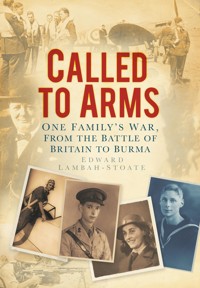
On a cold day in January 1944, as war raged in Europe, Betty Hussey and Jack Stoate were married. In so doing they brought together two families, whose members fought across the globe to defeat the Axis. In Called to Arms, Edward Lambah-Stoate traces the wartime experiences of nine relatives, including his parents, to present a fascinating account of the impact of conflict on the ordinary people of Britain who gallantly came forward to do their bit. These included a decorated fighter pilot, a Land Girl, a member of the Home Guard, a Royal Marine, an artilleryman, an RAF doctor and a merchant seaman, who between them fought in North Africa and Italy, were captured by the Japanese and worked on the Burma-Siam Railway, and took part in D-Day. Not all of them survived, but their contribution was invaluable – and representative. Using a wealth of previously unpublished material including log books, private correspondence and memoirs and interviews with surviving friends, this book provides a unique insight into one family's war – and by extension, everybody's war.
Das E-Book können Sie in Legimi-Apps oder einer beliebigen App lesen, die das folgende Format unterstützen:
Veröffentlichungsjahr: 2011
Ähnliche




















To my wife Kitty, and to all those men and women who understand the meaning of loyalty and duty.
CONTENTS
Title Page
Dedication
Acknowledgements
Foreword by Admiral Sir Jonathan Band
1 Entry Level
2 A Dream Come True
3 A Proper Job at Last
4 Italy and Home
5 The Final Journey
6 Singapore and Survival on the Burma–Siam Railway
7 The Bridge
8 The Small Ships War
9 Gloucestershire to the Low Countries
10 Back to Africa and Italy
11 Carrying On
Hussey/Stoate Family Tree
Poem for Roy Hussey
Poem Dedicated to the Crew of HMML 909
Bibliography
About the Author
Copyright
ACKNOWLEDGEMENTS
I would like to thank Jean Roberts who sowed the seed for this book, Rodney Scrase who warmly introduced me to many people who knew and flew with Roy Hussey, and Alistair Donald at the Royal Marines Museum, Eastney. Also all those long suffering and interested people at the National Archives and the Imperial War Museum who were so unfailingly enthusiastic and helpful, Stuart Cruse who produced my maps and David and Geoffrey Stoate who not only gave me material help but moral encouragement as well. Last but not least, many thanks to Angus Mansfield who introduced me to his publishers, and Shaun Barrington at The History Press who encouraged me onward.
THE PRINCIPAL MEMBERS OF THE FAMILY WHO SERVED
Jack (Arthur Donald) Stoate. The author’s father. Transferred from the Home Guard to the Royal Marines.
Betty Hussey. The author’s mother. Served in the Women’s Land Army.
Roy Hussey. Fighter pilot.
Tom Stoate. RAF doctor.
David Stoate. Lieutenant in the Honourable Artillery Company and prisoner of the Japanese.
Norman Stoate. Naval rating and later commander of a fast patrol boat.
Geoffrey Stoate. Royal Observer Corps.
FOREWORD
I met Edward Lambah-Stoate a little while ago now, at a wedding. I recall us having an interesting chat about a little local difficulty that we at the Royal Navy were having at the time – namely, the recovery of one our destroyers that had hit some rocks in the Southern Ocean. It was with pleasure and I might say some surprise that after all these years Tony Mather, a mutual friend, contacted me to say that Edward had written a book about the Second World War and would I consider writing a foreword?
There are of course many books about the Second World War but with the passing of time those actually involved in that struggle become fewer and with a refreshingly light touch Edward has successfully managed to embody many personal reminiscences from those survivors yet maintain an authoritative structure to entertain and educate the reader. At times we are asked to hover above the daily activities of members of the family and at others it is precisely those daily experiences that captivate and enthrall. Inevitably, the story is sometimes heartrending but happily it often provides amusement. In all we are provided with a well crafted, almost complete picture of that conflict. The only notable gap in theatres not served in by the family is the North Atlantic.
What marks this work out from most is that although there are many books about individuals or even groups of individuals, this book tracks the war experiences of a single family – or more correctly two families that were joined by marriage. Almost as if it were set up for future readers, the members of the family served in all the services, Royal Navy, Royal Marines, Army and Royal Air Force. We are also let into the workings of the home front, by way of the Home Guard and Women’s Land Army, and the invaluable work of the Royal Observer Corps in protecting our island shores.
It must be rare indeed to see a single family so widely represented across the services and across the main theatres of war having a descendant with the enthusiasm and skill to inform and entertain us in the same breath. We move from the Indian Ocean, to the Eastern and Western Mediterranean, Home Waters and D-Day and on to the Baltic, sailing in Capital Ships and what the author calls the Small Ships War. We endure gruesome years of captivity on the Burma–Siam Railway under the Japanese as well as life in the RAF through the eyes of a well decorated fighter pilot ace and contrastingly through those of a frontline doctor in North Africa, Sicily and Italy.
This book is a timely reminder that today’s conflicts are vastly different. There is no ‘front line’ – hardly a visible enemy. Our forces are thin on the ground yet if we get it wrong, the effect could be as far reaching as failure would have been against Nazi oppression. The major difference between then and now is that then every family was touched in one way or another – today we can pretend we are not.
The research that has gone into this book which might otherwise have remain buried has, I am told, been very informative to the surviving members of the family, made more poignant by the intervening death of three veterans of 72 Squadron with whom the author spent some time. It is a sad reminder that first-hand accounts of those days are slipping away from all of us.
From my years of service as a regular officer, I can acknowledge the debt that we all owe those ordinary civilians who became servicemen as volunteers or by conscription; it should never be underestimated, but at the same time we should never undervalue either those regulars whose job it was to train and organise this vast, eclectic mass of individuals to fight for their nation as never before.
Admiral Sir Jonathan Band GCB DL
1
ENTRY LEVEL
A birthday celebration opens a window on the past
My uncle, Tim Hussey, was celebrating his 80th birthday in the Black Horse Inn Mangotsfield, near Bristol, just down the road from the Folly Inn where he and his siblings were brought up. During the evening a woman came up to me and said, ‘You don’t know who I am, do you?’ I replied that I knew exactly who she was (and I did) but that I couldn’t remember her name. Jean Roberts (that was her name) and I struck up a conversation. Nine months or so later, Jean and her husband Lloyd presented me with several newspaper cuttings, postcards and letters concerning my uncle Roy Hussey, many of these clippings I remember having seen as a small boy in a box of my mother’s, but these had been lost after her death in 1972. I was thrilled.
As we got talking, she and he husband Lloyd (who had been at Chipping Sodbury Grammar School with Roy) told me where Roy’s grave was located, at Coxley just south of Wells. Close to Armistice Day in November 2005 my wife Kitty and I went down to look at the churchyard and at my wife’s suggestion we put a small cross and poppy on the grave with the name Edward Hussey (my mother’s maiden name) and my mobile phone number on the back.
Three months later my phone rang and a voice said, ‘Is that Edward Hussey?’ I replied that it was (knowing that the caller could only have that name from the poppy my wife and I had left at Roy’s grave) and so I was introduced to Rodney Scrase, a veteran fighter pilot of the Second World war who had flown in 72 Squadron with my uncle and who still made an annual pilgrimage to Roy’s grave from his home in south London.
I had a rough idea of my uncle’s and parents’ war. Roy I knew to have been a decorated fighter pilot in North Africa and Italy; but now I had a rich source of new information and so the germ of an idea to write this book was sown.
Hubert Hussey and Nellie Herniman were married in early 1920. Nellie was the eldest of seven children of Edwin and Alice Herniman. Edwin must have been an adventurous spirit. Some time before 1900, he took a job as a herdsman for cattle being transported from England to Canada. The herd having been delivered and Ernest paid off, he went in search of gold and found sufficient to buy Littlewell Farm and later Greystones in Coxley just south of Wells, Somerset, and there he fattened beef and sold it in his butcher’s shop at 16–18 Queen Street, Wells.
Hubert and Nellie Hussey. (Author)
Betty aged 12, after her father died. (Author)
Nellie and Roy Hussey. (Author)
Leonard Stoate. (Geoffrey Stoate)
Edwin’s sons were Jack and Ted and of his daughters, Nellie was the eldest, followed by Dolly, Ivy, Priscilla, Ethel (Epps) and Edwina. Edwin looked after his children well, Ivy cared for Prissy, who had special needs having fallen out of a loft window we were told. After the Second World War Jack ran a café and a taxi service from the Queen Street premises in Wells and Dolly and her husband Stan were set up at Stream Farm, North Wootton, nearby.
Nellie and Bert took a milk round in the Wells area, run from St Cuthbert Street, but Bert it seems was not a good businessman and ultimately they ended up as landlords of The Beaufort Arms, commonly known as the Folly Inn at Mangotsfield just north of Bristol. There, Nellie had three children, Betty (my mother) born on 10 September 1920, Roy, on 23 March 1923, and John (Tim) on 13 November 1925.
Bert had a keen sense of humour but he suffered from a depressive side also. The story goes that he had rustled a sheep or some such thing that caused a very public family row at the bar and on 12 March 1932 Bert took himself off and swallowed poison in a corner of a nearby field.
The suicide of her father at 12 years old had an understandable effect on my mother, Betty, and the rest of the family. Nellie had trouble coping with three children and the business on her own and Betty left home to live with her grandparents. A couple of years later she moved to London to live with a relative in Hampstead Heath where she worked in the Gown Department of Green and Edwards in Finchley High Street, London.
Betty was a bright pupil at school, but the traumas at home had cut her formal education short. During her life she never stopped educating herself and she became very knowledgeable on many matters – including ancient Middle Eastern history – until her untimely death from cancer aged 52 on 16 May 1972.
Her brother Roy Hussey was educated at Downend School and Chipping Sodbury Grammar school, he also was a bright pupil, good looking, personable and an excellent and competitive sportsman. representing the school at cricket, football and swimming. Lloyd Roberts, several years Roy’s junior, described Roy as the schoolboy hero the younger ones looked up to. Roy left grammar school at 17 years old and worked for Parnall and Sons in Bristol for a few months before he lied about his age and was accepted into the Royal Air Force Volunteer Reserve. His younger brother, Tim, and school were not naturally suited, Tim was born to be a farmer and so it transpired.
The Stoate Children. Left to right, Brenda, Tom, Norman, Donald (Jack) David and Geoffrey. (Author)
Temple Mills. (Geoffrey Stoate)
In 1911, elsewhere in the southwest of England, Leonard Stoate (a staunch Methodist) and Elsie Roberts were also married. Leonard was a shareholder and Managing Director of Stoate and Sons Ltd, his brother William being Chairman. Stoate and Sons was a flour milling business started by Leonard’s grandfather, William in 1832, ultimately with interests in Watchet near Minehead, Bristol and Swansea. They ran a few ships which traded in that triangle and that is how the man from Somerset and the girl from Swansea met and fell in love. The Stoates lived at various addresses in Bristol but principally large houses called the Hermitage, in Falcondale Road, Westbury on Trym, and Redrock, Stoke Bishop, where their children, Brenda, Tom, David, Norman, Donald (Jack) and Geoffrey were brought up and privately educated.
In 1911 the Mill in Watchet suffered a disastrous fire, the business relocated and took a new 99-year lease from the Temple Church Ecclesiastical Trustees on a site on the Floating Harbour at Temple Way, Bristol. There it constructed a brand new flour mill, upon the top of which the brand VIGOL Brown bread was prominently advertised until the mill’s demolition in the 1980s. In 1933 the business was sold to Spillers Milling and Leonard, although not retiring from his position of Managing Director until 1945, used this capital to invest in farms in Somerset and the Bristol area, thus fulfilling his first wish, to be a farmer. His father had insisted that he went into the family milling business.
One of those farms was called Henfield Farm, it was not far from the Folly Inn and so the scene is set for the family of modest means – publicans – and an altogether more prosperous family of landowners and businessmen to be caught up in a worldwide conflict.
2
A DREAM COME TRUE
Lying in a tin box unnoticed and unremarked upon for the best part of 60 years lay a veritable treasure, the log book, papers, photographs and documents of a Second World War fighter pilot. The pilot was my mother’s brother, Roy Hussey.
Roy always wanted to be a pilot, his younger brother Tim recalled – and Tim knew even when they were small boys that all he ever wanted to be was a farmer. His elder brother Roy would tease him, whirling around all the while with his arms stretched out like aeroplane wings. ‘You go on and be a farmer on your farm and I’ll bomb you from my aeroplane.’ So both boys knew exactly what they wanted to do in life.
Roy was 17 when he left Chipping Sodbury Grammar School and found a job at Parnall and Son, a manufacturer and supplier in the aircraft industry. The company was formed in 1820 initially as a weights and measures business, but through its association with the retail industry went on to become a shop fitter. The bronze shop fronts of the Piccadilly Arcade were created by the firm. The business then progressed to fitting out ships. During the First World War it manufactured components for aircraft and seaplanes. During World War II it again concentrated on aircraft components including the wings for the Tiger Moth, wing flaps for the Handley Page Halifax heavy bombers, fuselages for the Short Brothers’ Stirling and for the Airspeed HORSA gliders and tail planes for the Bristol Beaufighter, the heavy fighter.
In 1936 the RAF had instigated the RAF Volunteer Reserve in an attempt to attract a wider range of applicants to the service, that is, non public school/officer class. The decree was ‘a citizens air force’, modern and democratic, attracting ‘air-minded’ young men from factory, shop and office. With the expansion programme, thousands of young men were now being given a choice of how they would fight the next war. Before war recruitment began the RAF recruited annually about 300 pilots and 1600 airmen but from 1935 to 1938 the average intake rose to 4500 pilots and 4000 airmen and apprentices. Pay in cash and kind was set between £340 and £520 a year. A £300 gratuity was payable after four years service or £500 after six. Roy, who still longed to fly, exaggerated his age a little and applied to the Volunteer Reserve. In 1940, his application was successful.
Pre-war the RAF boasted that no air force in the world set itself a higher standard of training. This included a detailed and exact knowledge of navigation, the theory of flight, the structure of an aeroplane, the workings of an aeroengine; of air gunnery, radio, air photography and instruments; fighter tactics, bombing methods and so on. In wartime the need for pilots rose ten-fold – could quality be sacrificed for quantity?
1941, the young Roy Hussey goes to train in America. Most photographs in this chapter were kept in Roy’s tin box.
The Link trainer.
Fairchild PT 19 trainer in Canada.
Roy Hussey climbing into the rear cockpit of a Fairchild PT19 trainer at 3 BFTS Oklahoma.
In response to that question the Service developed a four-stage training process, first a posting to an Initial Training Wing, next an Elementary Flying Training School, then a Service Flying Training School and finally to an Operational Training Unit. When the pupil had passed the tests and examinations in the various stages he would reach the ultimate goal – an Operational Squadron.
At the Initial Training Wing, where the posting would last about a month, the pupil would spend half his time in the classroom studying the theoretical side of flying and being given basic information on health, the other half was spent at sports and games, as physical fitness was part of the training. Actual flying was not part of the ITW, but the pupil might be introduced to the workings of joystick and rudder bar in an ingenious piece of equipment called a Link Trainer. The Link Trainers had stubby fuselages and wings and were attached to the floor of a hangar by a set of bellows, which would inflate and deflate themselves in response to the movements of the joystick. It was sophisticated enough even to respond to turns of the rudder bar and manoeuvres to the extent of a spin. In 2010 I met Tony ‘Red’ Weller, a veteran fighter pilot of 72 Squadron and who, after the War was in the same line of business as another branch of the Stoate family, the Gliddon’s of Watchet. Tony was to fly with Roy and he told me the Links were particularly useful for instrument flying training. They had a hood that closed over the ‘pilot’s’ head leaving nothing to ‘fly’ by except the instruments in front of him.
Once the examinations were passed the student passed to Elementary Flying Training School and would learn to fly. The usual types flown were the Miles Magister monoplane or the Tiger Moth biplane, although in Roy’s case, as we will see, he trained in American aircraft. Once again, half the day would be spent in the classroom but now the other half was devoted to practical flying. Fifty hours or more flying time would be recorded in the pupil’s logbook before he completed the course. He would have learned to make forced landings, undertake simple aerobatics and short cross-country flights.
At the next stage, the Service Flying Training School, he would fly an aeroplane five or six times more powerful than hitherto, such as the two-motor Airspeed Oxford or the Avro Anson, or the single-engined Miles Master or North American Harvard. The choice was not randomly made, the pupil would have shown whether he was best suited to twins or singles and his allocation was by careful study of his temperament, rather than guesswork.
Practical flying and theory would continue side by side, but the screw tightened with blind approaches and night flying. The training programme was so thoroughly crafted that final examination failures were rare; and so at last our pupil would be proudly entitled to sew the coveted ‘wings’ on to his tunic.
Roy’s flying logbook records his attestation took place in Oxford, he then went to a receiving station at Babbacombe near Torquay in Devon and on to No.3 Initial Training Wing in Torquay for basic training. This was followed by a PRC (Personnel Reception Centre) at Wilmslow, Cheshire and from there to Cruock (on the Clyde) where he embarked on the SS Stratheden for Halifax,Canada (his flying logbook was issued by the Royal Canadian Air Force).
The Stratheden was one of the P & O ‘Strath’ sister passenger liners. She was relatively new having been laid down in 1938. On board the same ship was Rodney Scrase. Roy and he were later to fly together, but on the 23,722-ton Statheden they were just two of the 1,000 or so passengers the vessel was capable of transportng, and did not meet up.
From Halifax Roy transferred via the Manning Department in Toronto to number 3 BFTS (British Flying Training School) in Miami, Oklahoma.
At this stage of the war many pilots were trained in the US partly because the weather conditions permitted a greater number of flying hours and thus pilots were trained faster, but also because the skies over Britain were fairly busy operationally.
Number 3 BFTS produced a little in-house magazine called Open Post. Squadron Leader A.C. Kermode wrote a short history of number 3 BFTS in the first edition. ‘It will never be easy to decide when number 3 BFTS first came into being … We say that it was born in the early hours of that Monday morning when the British boys first met representatives of their American hosts.’ That is to say 18 June 1941, when number 1 course began in earnest.
Roy’s logbook begins on 27 August 1941. His was number 3 course, that is the third intake for the new unit. No.3 course had 51 cadets of which 19, including Roy, were in Fulmar flight. On the inside of the front cover of Roy’s copy of Open Post the pupils of Fulmar flight have signed their names. Amongst those signatures was one George Longbottom. A pilot of the same name appears again in this story, but more of this later.
By 24 September 1941, the school was up to full strength with 181 cadets, split into units or ‘flights’ which were competitively set against one another in sports and other activities. The school was inspected on 13 October 1941 by air Marshal Garrod, Air Member for Training and Air Marshal Harris, head of the RAF delegation in Washington (later head of Bomber Command). 3 BFTS combined instruction on the Link Trainers (in which Roy completed stages 1 to 9, marked as average) as well as classroom sessions and practical flying.
On 27 August 1941 in the second seat of a Fairchild PT 19 fitted with a Ranger engine, sits Roy, learning the effect of controls, straight and level flying and medium turns, climbing and gliding. On 10 September 1941 after adding stalls and spins to his second-seat repertoire he undertook his first solo. Before doing so, he certifies in red ink ‘That I understand the operation of the fuel system, the brake system, the hydraulic system including the emergency operation of the undercarriage in event of fire of a PT 19 aircraft.’ September is taken up with daily flying involving Chandelles, steep turns and loops both solo and with course instructors, Rundle and Tucker. During October, again flying virtually every day, navigation, instrument flying, slow rolls and forced landings were introduced. [Rodney Scrase kindly explained ‘Chandelle’ – ‘French for candle. The term was used in the early days of flying when the French were much involved. It is a reaction out of a steep climb, when approaching the stall you would do a sharp downward turn. Really a question of co-ordination and very often our American instructors would combine it with lazy eights. (flying a figure eight on its side and facing the ground).’]
By this time Roy had clocked up nearly 72 hours of flying, about half and half dual and solo including five hours of instruments/cloud flying. On that class of aircraft, the Fairchild PT 19, Wyman P Roger, Flight Commander assessed him ‘above average’.
During November he commenced flying instruction in the Voltee BT 13A with a Pratt & Whitney engine and variable pitch propeller and on 8 October 1941 took his first solo in that aeroplane.
December 1941 saw the introduction of the Harvard North American AT6 (curiously enough for a trainer, an aeroplane notoriously difficult to recover from a spin and fickle in cross-wind landing) and on the 9th he undertook his first solo in that marque of aeroplane after, of course, certifying in red ink ‘That I understand the brakes, fuel, flaps and hydraulic system of the North American Harvard AT6 and action to take in case of fire in the aircraft.’
Two days prior to that was the attack on Pearl Harbor. Amongst Roy’s papers is an extra edition of the Joplin Globe dated 6.00 pm 7 December 1941.
JAPS WAR ON U.S.
Tokyo, Dec. 8 (Monday) Japan’s Imperial Headquarters announced at 6 a.m. (3 p.m. Sunday Joplin time) today that Japan had entered a state of war with the United States and Britain in the Western Pacific as from dawn today …
… Japan attacked the United States today, striking by air at the great Pearl Harbor naval base at Honolulu, and latest reports indicated that the United States had won the first battle.
Meanwhile back at 3 BFTS advanced coordination and night flying appears in Roy’s logbook, with a 1 hour 40 minute cross-country run leaving and returning to Miami via Bartlesville and Chanute.
3 BTFS Roy Hussey looking out of a Voltee BT 13A with variable pitch propeller.
North American Harvard AT–6 trainer at 3 BTFS. Next stop England and Spitfires.
The Joplin Globe, 7 December 1941.
On 22 January 1942 he completed the course. The assessment stamp needs a second glance. It seems initially it was stamped ‘above average’ but subsequently amended by a splotchy ink eradicator to ‘average’ with a note ‘requires supervision!’ Whilst he was at Miami Roy compiled a photograph album. It is difficult to glean much from the many photographs as most of them are not annotated. There are, however, a couple of shots of various trainers on their noses. Maybe that had something to do with the change of certification – we will never know. Roy’s total flying time is recorded as 168 hours 24 minutes, of which 46 hours and 13 minutes were dual, 50 hours and 16 minutes 30 solo, 15 hours and 50 minutes night dual, 3 hours and 20 minutes night solo and 19 hours and 44 minutes instrument/cloud flying.
On 2 May 1942 Roy returned to England to 17 AFU (Advanced Flying Unit) Watton, in Norfolk, where he flew the Miles Master and Master II aircraft, the former powered by a Bristol Mercury engine and the latter by the American Pratt and Whitney unit, he also put in a couple of sessions on a Link on 3 and 12 May. He emerged from that on 22 May 1942 with total flying time 179 hours 44 minutes, assessed ‘average’ and under any special faults ‘erratic’. Only the Operational Training Unit now lay between him and an operational squadron. Prior to the Second World War pilots learned operational flying in an operational squadron. But wartime conditions made this impractical, it being far too risky for both existing pilots in the Squadron and new entrants. The purpose of the OTU was to introduce the pupil to combat flying without the risks of actual combat. Fighter pilots were taught combat tactics and offensive operations against ground targets. In other words pilots were taken to the edge of war without exposing them or their colleagues to its risks. Nevertheless, there were many casualties in the training units. It was at OTUs that bomber pilots were often teamed up with crews who would stick together in active service.
24 May 1942 saw Roy posted to 53 OTU (Operational Training Unit) at Llandau, near Bridgend in South Wales. It was here that another of his future colleagues in 72 Squadron, Jimmy Corbin, had been posted six months earlier as an instructor. Here the Master II was upgraded to a Spitfire I (he also put two and half hours on the Link trainer here, probably to re-enforce instrument flying training). His first solo in a Spitfire was on on 24 May. Things become a little more serious now, apart from the usual flying training, we see ‘stern attacks’ and ‘aerobatics’; also in June we see camera guns and drogues (canvas targets behind towing aircraft) in use. It was probably at 53 OTU that Roy was handed a neat little booklet called Bag the Hun! Estimation of range and angle off. It is a highly diagrammatic instruction book on deflection shooting and estimation of range. The latter achieved principally by judging the wingspan of the target against the diameter of the ring sight. This was in the days before the introduction of the reflector sight, let alone the giro sight. For example, at 400 yards the wingspan of a Wellington bomber fitted exactly across the ring, at 250 yards the ring was just outboard of the two engines. Roy was a pretty fair hand with a shotgun and rifle, this and his ability on the sportsfield would stand him in good stead later on.
On 17 June 1942, it might have all ended then as the logbook records ‘Force landed 800 feet over Llandau due to engine failure – made wheels-down landing on runway – no damage.’ All that investment (an estimated £20,000 against the price of a new Spitfire at £5000) and those hours of training had paid off. On 5 July 1942 Roy records ‘Sgt Swan and Sgt Pearce killed – dogfighting.’
Extract from the training manual; ‘Estimation of Range and Angle Off. – Bag the Hun’.
Nellie, Betty, Roy and Tim, taken whilst Roy was at OTU. The inscription on the back in my mother’s hand reads, ‘Last time we were all together.’ (Author)
Fun, nevertheless, seemed to be part and parcel of these fighter boys’ prescription. ‘Beating up’ was a common practice, Roy’s friend Barney Barnfather, in the biography written by his grandson Angus Mansfield, describes beating up his home town of Keynsham, near Bristol; Jimmy Corbin did the same and so did Roy. My Uncle Tim well remembers the growl of Roy’s Spitfire, waggling its wings and rattling the roof tiles as he screamed at low level over his home, the Folly Inn, and no doubt the nearby Henfield Farm where my father was farm manager. Being 20 years old and in charge of what was effectively the ultimate ‘piece of kit’ is something of an open invitation to such behaviour.
It is instructive to compare Roy’s training programme with that of two of his friends in 72 Squadron, Barney Barnfather and Jimmy Corbin. In Barney Barnfather – Life on a Spitfire Squadron by Angus Mansfield, Angus writes
Barney joined the RAFVR in 1940. Upon completion of basic training he was posted to Babbacombe with the Reserve Wing. Later called Initial Training Wing. After square bashing and simple exams were undertaken, flying training was carried out elsewhere in Elementary Flying Training Schools (EFTS). Barney went to 14 EFTS Elmdon Nr. Birmingham in April 1941 where he remained until the end of May. At that time Barney had clocked up approximately 13 hours dual flying and 16 hours solo in a Miles Master, he had covered cross-country flying, instrument flying and at that time was an aspirational pilot. Following some hours in a Hawker Hurricane he was awarded his wings and was posted to 57 OTU where he learned to fly Spitfires. At the time he was posted to an operational squadron he had logged a little over 200 hours flying time.
Jimmy Corbin in his book Last of the 10 Fighter Boys, describes how he joined 66 Squadron, his first operational squadron, after 29 hours flying in Spitfires as well as having spent some 13 weeks at the FTS although as he says, it should have been seven weeks, the course was extended due to bad weather. Jimmy notes that he was never taught aerobatics.
In 1938/9 the normal time in an OTU was six weeks. In 1940 at the height of the Battle of Britain it shortened on occasion to two weeks. It was a frequent criticism that some pilots had never fired at an aerial target before going into action. One of those early recruits, Geoffery Wellum in his book First Light reveals he had completed a mere 160 hours and had never sat in, let alone flown, a Spitfire when he was posted operational to 92 Squadron. So it is heartening to note that in early 1942 Roy’s time at OTU at Llandow was twelve weeks. His time there shows him doing air-to-ground, air-to-sea and air-to-air firing practice with and without camera gun, including dogfighting, deflection attacks, aerobatics and formation weaving.
On 3 July 1942, 53 OTU was moved to Rhoose, near Cardiff and ten and half months after starting his training in Oklahoma, on 21 July 1942, Roy passed out, assessed by Squadron Leader A.R Edge as ‘above average’ with total flying hours of 240 hours 53 minutes under his belt. A sergeant pilot. Next stop an operational posting.
3
A PROPER JOB AT LAST
Roy Hussey takes his newly learned skills to war in North Africa
When Roy joined 72 Squadron aged 19 at the beginning of July 1942. He had completed 168 hours and 24 minutes of flying in America, 11½ hours at the Advanced Flying Unit at Watton, Norfolk and 52 hours on Spitfires in 53 Operational Training Unit at Llandau and Rhoose. The investment in him was therefore very considerable. On 2 July 1942 he took his first flight at 72 Squadron of 30 minutes – a reconnaissance flight in a Spitfire 5b – an aeroplane he was to become very familiar with.
72 Squadron was not just any old squadron, it was battle-hardened and Roy was fortunate to be in the company of seasoned pilots such as Brian Kingcome (the CO who between June and October 1940 destroyed seven enemy aircraft) David Cox, Robbie Robertson, Bobby Oxspring, Jimmy Corbin, Danny Daniels and others who had seen action in the Battle of Britain. These people understood the importance of flying and fighting as a unit, trusting in and being trusted by your colleagues.
Jimmy Corbin joined 72 Squadron shortly after Roy, in August 1942. He had experienced combat at the end of the Battle of Britain, had been an instructor at 53 OTU, and was 23 years old – known to some as ‘uncle’ because of his extreme age! He describes Roy, in The last of the Few: ‘Roy Hussey was a Sergeant Pilot. He was a nice boy, an excellent pilot who shot down quite a few enemy aircraft.’
During August and September 1942, apart from a one-hour convoy patrol Roy completed some 42 hours of additional training with 72 Squadron including gunnery – ground and air target practice – formation flying and so forth. On 6 and 11October he undertook 2 hours and 25 minutes convoy patrol and then the Squadron was transferred, via Morpeth, to Ayr in Scotland. On 9 September Roy was transferred again to Londonderry and on 21 October 1942 he departed from Londonderry on HMS Bideford en route to Gibraltar and a proper job, now having 284 hours 43 minutes of flying time to his credit. It is worthy of note that the Squadron was split into various ships embarking from different ports, Jimmy Corbin, for example, embarked on SS Staffordshire, a merchant cargo vessel starting from the Manchester Ship Canal though Liverpool to the Clyde where the convoy formed up. Staffordshire arrived at Gibraltar two days before Roy on board the Bideford.
The Sergeant Pilot returns. Roy Hussey shortly before overseas posting with 72 Squadron. Found in Roy’s tin box.
HMS Bideford was a Shoreham Class naval sloop, a general-purpose escort vessel, used in convoys to mine sweep and for general convoy duties. She was built in 1931 and broken up by 1949.
In stark contrast to German U-boat failures after the Enigma code was broken in 1943 (after which two in every three U-boat crew perished) in October 1942, German U-boat activity was causing massive attrition to Allied shipping. The Squadron’s journey from Belfast to Gibraltar was by no means safe or straightforward; on 6 October Roy records that Bideford picked up 36 survivors from a torpedoed liner. The squadron was later to learn that part of their personal luggage and some 20 tons of the Squadron’s stores carefully stowed on board a merchant ship were also lost – an event to be repeated later when the Squadron transferred from Tunisia and Malta to Italy, where a ship carrying squadron equipment was sunk in Bari harbour near Brindisi in southern Italy.
Since the entry of the US into the conflict on 8 December 8 1941 her efforts were poured into arresting the Japanese advance through the southern Pacific and halting Rommel’s push to Egypt. 72 Squadron was on its way to support an Allied offensive in North Africa that was in effect a plan ‘B’. The Americans were all for an immediate offensive in North West Europe, however, Churchill managed to persuade Roosevelt that such an enterprise could not be undertaken with available resources until 1943 at the earliest. On 19 August 1942 the assault at Dieppe failed, where the Canadians took the brunt of the losses, and it was not until June 1944, D-Day, that sufficient troops and equipment were assembled to make an offensive move into North West Europe a practical proposition.
The plan ‘B’ was Operation Torch, an attack upon French West Africa to clear Axis forces completely out of the southern Mediterranean, so this area would be free to create a springboard into Italy, southern France and the Balkans (the so-called soft underbelly of Europe).
The reaction of the French to such an undertaking was by no means a forgone conclusion, particularly if the assault in French-held territories was to be by British troops. Consequently the Americans were to lead the operation under the overall command of General Dwight D. Eisenhower.
The attacking forces were split into three components: the Casablanca Force (the Western Task Force) made up of US troops; the Oran Force (The Central Task Force) made up mainly of US but with some British troops; and the Algiers Force (The Eastern Task Force) mostly British but with some US troops, led by Major-General Ryder. Roy Husssey with 72 Squadron was part of the Algiers Task force.
Air support was to be given by a mixture of new and experienced squadrons and crews, with the majority of bomber capability American, and fighter capability British. Air Marshall Sir Arthur Coningham was head of the North-West African Tactical Airforce. 72 Squadron, part of 324 Wing, was an experienced Battle of Britain unit led by Bobby Oxspring, DFC and Bar. The Wing, at that time, was commanded by Gp. Capt. R.B Ronnie Lees, DFC and Bar and the Wing Leader was Wg Cdr D.A.P. McMullen, DFC and 2 Bars. The Wing fell under 242 Group.
On 12 November 1942, the Squadron landed at Gibraltar. Roy records in his logbook the following pilots under the heading ‘72 Squadron overseas’.
CO: S/Ldr Oxspring DFC & Bar & Bar
A Flight
Afternotes
B Flight
Afternotes
F/Lt Krohn
posted
F/Lt Forde
DFC
F/O Hardy
NZ DFC
F/O Cox
F/Lt DFC + Bar
P/O Le Cheminant
DFC
P/O Daniels
S/Ld. DFC + Bar
P/O Robertson
DFC (Wounded)
P/O Prytherch
DFM (Missing)
P/O Corbin
DFC
P/O Macdonald
RAAF (missing)
P/O Lowe
(Killed in action)
W/O Charnock
P/O DFM DFC
W/O Gerr
P/O DFC
SGT Fowler
P/O Posted
P/O Lewis
(USA)
SGT Hussey
P/O
P/O Malan
(Killed)
SGT Mottram
(Missing)
SGT Browne
(Missing)
W/O Hunter
P/O RCAF (Missing)
SGT Frampton
P/O (Posted)
SGT Smollet
(Posted)
SGT Pearson
Posted India
F/O Keith
(Killed)
SGT Piggott
Posted India
P/O Stone
(Killed)
SGT Smith
(Killed)
On 16 November 16 of the Squadron’s aircraft were transferred from Gibraltar to Maison Blanche, Algiers. This might sound quite straightforward but the distance required the fitting of long-range fuel tanks. None of the pilots had flown an aircraft with a long-range tank before, they had no idea of how the aircraft would fly or even how to get it off the ground. Undaunted, they removed the armour plating behind the cockpit, stuffed their belongings down the fuselage, refitted the plating, assembled at the end of the runway and waited for Bobby Oxspring, the CO to show how it was done!
The same day French troops in Tunisia joined with American paratroops and attacked German Forces. Not surprisingly Algiers was very busy, packed with every kind of aircraft imaginable, from bombers to light trainers and the landing and dispersal arrangements there were as chaotic as was the departure from Gibraltar.
The squadron remained at Maison Blanche, carrying out its share of airfield patrols until the 18th when they transferred, again using long-range tanks, to Bone, a port about 300 miles to the East. Bone was little more than a single track road (the runway) surrounded by rough ground, full of stones, holes and dust. No sooner had they landed, climbed out of their aircraft and settled down when they were strafed by a Me109. There was nothing to be done but watch it happen. The lesson however was not lost and from then on there was a two-man airfield patrol, flying about 200 yards apart, virtually the whole time during daylight hours, with two other aircraft in readiness. On 19 November F/O Owen Hardy (a New Zealander) bounced a Me109F which was chasing a Spitfire over the harbour at Bone. Hardy opened fire, Glycol streamed out of his target, its propeller came free and it crashed into a hillside. This was the Squadron’s first victory in North Africa. The squadron was flying Tropical Spitfire Vbs and was now in the thick of the action.
Sketch map of Tunisia.
The Spitfire V was the most common type, 6787 were built. It was powered by various incarnations of the Rolls-Royce Merlin engine having a maximum speed of 371 mph at 20,000 feet. It had a service ceiling of 37,500 feet and could climb to 10,000 feet in 4 minutes 18 seconds. Above 20,000 feet it had a climb rate of 2440 feet per minute. The typical armament was four Browning mk. II machine guns and two 20-mm Hispano cannon. The arrangement was such that the outboard gun was a third of the way in from the wing tip which, it was said, could cause some flexing when the guns fired making them less accurate. The tropical version was fitted with a modified air filter. The modifications had, however to be further improved by 72 Squadron’s engineer Greggs Farish. He designed, built and fitted another external filter for use on take-off. Once airborne the pilots would release it for re-use.
Jack Lancaster, a former sergeant fitter with 72 Squadron, told me about the thousands and thousands of spark plugs he must have thrown away in the desert. After each sortie all the plugs on Roy’s Spitfire (and presumably all other Spitfires) were replaced as the fine desert sand entered the combustion chambers and slowly deposited a glaze on the points that was unbudgeable – no spark, no engine. Jack is sure – taking nothing away from the skill and dedication of the pilots – that part of the reason 72 Squadron was consistently at the top of the score table was the care that the fitters and armourers put into ensuring that ‘their’ pilot’s aeroplanes were as near perfect as possible. When I spoke to Jack in Malta in 2010 there was no mistaking his pride, after 70 years, in his’ ownership’ of ‘his’ pilot’s aeroplane.
The Spitfire armament arrangement contrasted with the Hurricane, which some considered a better gun platform, the latter having machine guns arranged in two groups of four as close in to the fuselage as they could be placed consistent with clearing the propeller arc.
On 20 November after a raid on Beja the Squadron was transferred to Souk-el-Arba, an airfield that would be easily recognised because, they were informed, there was a crashed bomber in the middle of it! In any event it was located – and a very rough place it was. The surface was like the moon with mud and potholes. The town of Souk-el-Arba led directly away from the airstrip by way of a road with ditches on either side. Into this ditch they placed the four-gallon fuel tins and ammunition which had been delivered by ground troops, little knowing then that the German pilots ranged their fire along these ditches.
Having scrounged some tents and thin blankets they settled down to a very cold night in the desert. These grim conditions continued for about two weeks, during which time the Squadron was fully operational, flying most days.
On 22 November Roy records ‘CO shot down by ground gunners – returned OK later in the day.’ Bobby Oxspring was leading eight Spitfires on a sweep over the Mateur-Bizerta road and he had to force-land eight miles from Beja.
The squadron base was being subjected to constant enemy air attacks. On the 22nd it was subjected to three raids with Me109F bombers, Focke Wolfs 190s, Junkers 87s (Stukas) and Macchi 202s. Roy was hit by friendly fire on 23 November. It was on this day also that the airfield was subjected to an intensive attack by a group of Me109s. The squadron was expecting to be joined by another that day and initially thought the group of approaching aeroplanes was the new squadron. When they realised their mistake, there was no chance of getting their aircraft off the ground so they dived for cover as best they could. The petrol and ammunition supplies went up with a mighty whoosh. Remarkably, none of the pilots was hit but this did not apply to the aircrew, some of whom were killed. Roy tried to drag one poor fellow suffering wounds to his stomach to a safer position. Robbie Robertson, to whom Roy was then flying No.2, helped him and they found ‘shelter’ under a lorry. Fortunately for them, that particular lorry was not targeted.
The aerodrome was being shared with other squadrons, including 152 and 93. 93 was a newly formed squadron led by Sqn Ldr Nelson-Edwards. One of its flight commanders was Flt/Lt Alan Smith DFC, a young New Zealander who had been the wingman of the famous Douglas Bader until the latter’s crash and capture as a PoW. The loss of and damage to equipment meant 72 and 93 Squadrons flew as one for a while, being led by either Sqn Ldr Bobby Oxspring or Sqn Ldr Nelson-Edwards.
On 25 November 72 Squadron scored again with ‘Chas’ Charnock downing an Me109E, ‘Danny’ Daniel an Me109 and ‘Robbie’ Robertson an Me109.
Chas, it seems, was quite a character. At 37 he was considerably older than the rest of the pilots, having been commissioned before the war, court-martialled and dismissed the service. When war came he reapplied and was accepted back with the rank of sergeant pilot (later Warrant Officer). By all accounts he was an awesome pilot and an excellent shot. On 27 April 1943 he was re-commissioned and was awarded the DFC. Daniel was also an experienced pilot, a flight commander, later to become Squadron Leader of 72 Squadron. Robbie was as battle experienced and Roy often flew as his number 2 at this stage.
On 26 November 1942, a week after Owen Hardy’s ‘first kill’, Roy had his own, where he fired several bursts at a Me109E in a sweep over Medjez-el-Bab at 3000 feet. Pieces fell off the wings and the aircraft went down vertically. It crashed into a hillside and exploded. This is graphically described in Tom Docherty’s book Swift to Battle.
The Messerschmitt was at 9000 ft when Hussey attacked from astern, giving it a one-second burst. The Messerschmitt immediately turned and dived away, followed by Hussey who fired more bursts at the fleeing German whose aircraft lost pieces with each burst. Flg.Off. Cox observed Hussey’s skill watching the Messerschmitt diving vertically with showers of sparks and emitting white smoke, turning black, before it hit a hillside and exploded.
On the next day Roy recorded a probable Me109F. P/O J Lowe (Johnny) failed to return from this sweep.
All the while the airfield was being attacked. Apart from strafing the Germans used butterfly bombs which, when they hit the ground, spread shrapnel all over the place. Tents were no protection but lying flat on the ground was a good plan. The tents became perforated and more slit trenches were dug; a good night’s sleep, however, was not to be expected.
A preoccupation of mine is riding fast motorcycles, I have written a book on the subject. One of my friends in that pursuit, Tony Butler, is a serving Wing Commander in the RAF and he introduced me to the word ‘dits’. No doubt service personnel will be familiar with the word but to me it was new. Basically, it is shorthand for a service story that may or may not be true, it is probably based on some sort of fact, but more importantly, it entertains. There is a dit relating to 72 Squadron’s time under canvas in North Africa. Sharing Souk-el-Arba with 72 was a Beaufighter squadron. Beaufighters, according to Danny Daniel, produced a particular whistling noise in the air, so one night when a whistling noise was heard Danny advised the company to relax, it was only a Beaufighter coming in; a bloody great explosion followed as the whistle was in fact a bomb. Danny struggled to live that one down.




