


12,99 €
Mehr erfahren.
- Herausgeber: John Wiley & Sons
- Kategorie: Fachliteratur
- Serie: Global Futures
- Sprache: Englisch
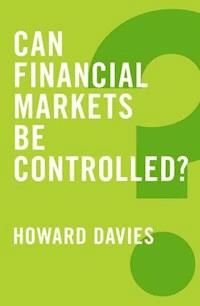
The Global Financial Crisis overturned decades of received wisdom on how financial markets work, and how best to keep them in check. Since then a wave of reform and re-regulation has crashed over banks and markets. Financial firms are regulated as never before.
But have these measures been successful, and do they go far enough? In this smart new polemic, former central banker and financial regulator, Howard Davies, responds with a resounding ‘no’. The problems at the heart of the financial crisis remain. There is still no effective co-ordination of international monetary policy. The financial sector is still too big and, far from protecting the economy and the tax payer, recent government legislation is exposing both to even greater risk.
To address these key challenges, Davies offers a radical alternative manifesto of reforms to restore market discipline and create a safer economic future for us all.
Sie lesen das E-Book in den Legimi-Apps auf:
Seitenzahl: 135
Veröffentlichungsjahr: 2015
Ähnliche
















Contents
Cover
Title Page
Copyright
Prologue
Acknowledgments
Heading for a Fall
Financialization
Notes
The Global Financial Crisis
The global saving glut
Income inequality and demand for credit
Regulatory failures
Central banking
Notes
Regulation and Reform
Notes
What More Should be Done?
Imbalances
Debt
Fragmentation
Regulatory structure
Credit and financialization
Regulators and markets
Conclusion
Notes
Further Reading
End User License Agreement
Guide
Cover
Table of Contents
Begin Reading
Pages
i
ii
iv
v
vi
viii
ix
x
xi
xii
xiii
xiv
xv
1
2
3
4
5
6
7
8
9
10
11
12
13
14
15
16
17
18
19
20
21
22
23
24
25
26
27
28
29
30
31
32
33
34
35
36
37
38
39
40
41
42
43
44
45
46
47
48
49
50
51
52
53
54
55
56
57
58
59
60
61
62
63
64
65
66
67
68
69
70
71
72
73
74
75
76
77
78
79
80
81
82
83
84
85
86
87
88
89
90
91
92
93
94
95
96
97
98
99
100
101
102
103
104
105
106
107
108
109
110
111
112
113
114
115
‘Nobody is better placed than Howard Davies to describe the evolution of the financial system during and after the crisis, and to answer the central question of whether financial markets can ever be controlled and future crises prevented.’
David Smith, Economics Editor, The Sunday Times
‘As a former top regulator and as a board member and adviser to large financial institutions, no one is better qualified than Howard Davies to explain the causes of the Global Financial Crisis and assess the reforms that have followed. His short well-written book does both. His conclusion is a sobering one: despite complex and costly reforms, financial regulators have failed to address the structural forces that triggered the crisis.’
Laura Tyson, Haas School of Business, University of California, Berkeley
‘Howard Davies brings three things which are all too rare to studies of the financial world: a complete understanding of how the system works; a healthy scepticism as to the motives and competences of its major actors; and an ability to write with clarity and wit. Read this for a scary analysis of how the tidal wave of reform is not enough to stop things going even more disastrously wrong next time, and what needs be done now to prevent this.’
Anthony Hilton, Financial Editor, Evening Standard
‘Howard Davies has produced an excellent read with an insightful analysis of the pre- and post-crisis world. Clearly and succinctly, the shift in power from the regulated to the regulators is explored. While the book contains many reasons to justify this, the chilling reality is also laid bare, as we now may have created a new equilibrium that is too complex and hence unstable. Perhaps we need not fear as the author also explores many new solutions in the search for a workable social contract between the authorities and the financial markets.’
Gerard Lyons, Chief Economic Adviser to the Mayor of London, Boris Johnson
Global Futures Series
Mohammed Ayoob, Will the Middle East Implode?
Christopher Coker, Can War be Eliminated?
Jonathan Fenby, Will China Dominate the 21st Century?
Joseph S. Nye Jr, Is the American Century Over?
Jan Zielonka, Is the EU Doomed?
Can Financial Markets be Controlled?
Howard Davies
polity
Copyright © Howard Davies 2015
The right of Howard Davies to be identified as Author of this Work has been asserted in accordance with the UK Copyright, Designs and Patents Act 1988.
First published in 2015 by Polity Press
Polity Press65 Bridge StreetCambridge CB2 1UR, UK
Polity Press350 Main StreetMalden, MA 02148, USA
All rights reserved. Except for the quotation of short passages for the purpose of criticism and review, no part of this publication may be reproduced, stored in a retrieval system, or transmitted, in any form or by any means, electronic, mechanical, photocopying, recording or otherwise, without the prior permission of the publisher.
ISBN-13: 978-0-7456-8834-3
A catalogue record for this book is available from the British Library.
The publisher has used its best endeavours to ensure that the URLs for external websites referred to in this book are correct and active at the time of going to press. However, the publisher has no responsibility for the websites and can make no guarantee that a site will remain live or that the content is or will remain appropriate.
Every effort has been made to trace all copyright holders, but if any have been inadvertently overlooked the publisher will be pleased to include any necessary credits in any subsequent reprint or edition.
For further information on Polity, visit our website: politybooks.com
Prologue
There are surprisingly few recent novels or plays about business and finance; there were far more in the nineteenth century. Events in financial markets need to be dramatic and extreme to displace the normal preoccupations of sex, drugs and rock and roll. The crisis beginning in 2007 managed that unusual feat. Robert Harris put aside the Second World War and the fall of the Roman Empire and wrote a thriller – The Fear Index – about a hedge fund in Switzerland which makes fabulous sums of money using a fiendish algorithm which eventually consumes its creators. John Lanchester’s Capital explored the mysteries of escalating London property prices and the devastation wrought on an investment banking family when the million pound bonuses stopped. At London’s National Theatre, in The Power of Yes, David Hare chronicled the crisis through interviews with participants, punctuated by interventions from a wild-eyed Professor – called Howard Davies, as it happens – who had moulded the market meltdown into a five-act Shakespearean tragedy.1
And Shakespeare indeed provided the most penetrating literary lens through which to view the great crisis of the early twenty-first century. Nicholas Hytner’s modern-dress production of Timon of Athens, in 2012, again at the National, began with our hero endowing a new art gallery, surrounded by the great and good of the city, fawning on him and hanging on his every word. When his fortunes turn, and profligate philanthropy outruns his income, Timon ends on a rubbish heap, pushing a supermarket trolley loaded with worthless trash, shunned by his former admirers.
So it was with the ‘Masters of the Universe’ on Wall Street or Lombard Street. When the World Economic Forum was held in New York shortly after 9/11, the Chairman of Lehman Brothers, Dick Fuld, hosted hundreds to dinner at the Four Seasons, with cabaret provided by Elton John. Central bankers and regulators sang along with the bankers and brokers to the chorus of ‘Crocodile Rock’. Fred Goodwin’s Royal Bank of Scotland was lionized by politicians in Edinburgh and London. The bank’s new Edinburgh HQ was opened by the Queen in 2005, with a fly-past of RAF Tornadoes. In London in 2010, Bob Diamond, then CEO of Barclay’s, bestrode the city like a colossus, posing with the Mayor at the launch of his ‘Boris bikes’, all proudly branded with the bank’s logo.
Now all three are non-persons: Fuld closeted with his lawyers; Goodwin living in obscurity, his knighthood humiliatingly removed; Diamond seeking redemption (and profit) in Africa. Nor is their experience of humiliation unique. In Zurich, after the crisis hit, a former senior UBS banker arrived at an elegant restaurant with his wife to find the other diners banging on their tables until he left for home, his tail between his legs.
In the years leading up to the collapse of 2007 it was widely believed that financiers had discovered the philosopher’s stone. Politicians and commentators could not quite understand how the riches were being created, but they were in awe of them nonetheless. Political parties, charities and arts organizations could not get enough of the investment bankers and ‘hedgies’. The top students in top universities, whatever their discipline, sent their CVs to Goldman Sachs in astonishing numbers.
Woe betide any regulator who tried to get in the way of this Midas-like wealth-creating engine. In May 2005 Tony Blair characterized the Financial Services Authority (FSA) in London, which had flexed its muscles from time to time, as ‘hugely inhibiting of efficient business by perfectly respectable companies that have never defrauded anyone’.2 In Washington Alan Greenspan, Chairman of the Federal Reserve Board from 1987 to 2006, stood guard against the enthusiasm of market regulators, always challenging their legitimacy in the face of the magic of the market mechanism. If willing buyers were prepared to buy triple A super-senior tranches of synthetic sub-prime CDOs (collateralized debt obligations) from willing sellers, even at infeasible risk-adjusted prices, who were the regulators to ask the reason why?
When the pendulum swung back it did so in dramatic fashion. Bankers have vanished from the Honours lists in London. They are barely respectable in New York. The worm has turned. Re-regulation is the name of the game. Capital requirements have been sharply increased. Controls on bonus payments have been imposed. Banks have been forced to abandon some of their most profitable lines of business. A spotlight has been shone on hitherto dark corners of the markets, and dubious, unethical, anti-competitive and sometimes simply illegal practices have been exposed. Fines in the billions of dollars have been levied, where, pre-crisis, the penalties for comparable offences were not even a tenth of that. New regiments of regulators have been recruited. The social utility of any kind of ‘financial engineering’ is now regularly questioned.
Financiers, lauded by the press before 2007, are now almost friendless in the media.3 If the Securities and Exchange Commission (SEC) in Washington or the Financial Conduct Authority (FCA) in London proposed that errant bankers should be required to parade naked through the streets, there would be sage leading articles in the Financial Times and Wall Street Journal hoping to see a day when such signal punishment was no longer justified.
And the re-regulators are not the most radical voices. Lurking beneath the surface of this frenzy of legislation and rulemaking are some bigger questions. Can the market monster be tamed at all? Should the state take more direct control of the allocation of capital? Has the crisis revealed that the conventional toolkit of controls is simply not up to the job and perhaps never was? Will markets always be one step ahead of the regulators, shifting their activities around the globe in search of the most congenial environment? While the global economy might seem to have benefited from the flexibility and innovation facilitated by open capital markets, does the huge cost of mopping up the mess alter the calculation? Is the game worth the candle?
The International Financial Institutions, governments and regulators have wrestled with these questions since 2008. Many major reforms have been introduced, with the best of intentions. But the overall response lacks coherence. The fundamental problem of a lack of global co-ordination has not been addressed. Monetary policy and financial regulation remain separated. There has been some, but insufficient, progress on deleveraging. There is no consensus on what led to the crisis. Was it the result of deregulation, based on a neo-liberal view of markets and an excessive reverence for the efficient market hypothesis? Or was the root cause too much government interference in markets, whether through state-backed agencies, or the moral hazard created by the existence of lender of last resort facilities which allowed the financial sector to maintain an excessively high degree of leverage, confident that the state would provide on a rainy day? So the reforms point in both directions at once: more intrusive and directive regulation, on the one hand, and half-hearted attempts to strengthen market disciplines, on the other. The interventions which contributed to market instability have not been withdrawn. Governments say they will ‘never’ bail out over-exposed banks again, and at the same time they introduce incentives to lend for house purchase which risk stoking another asset price boom. They have tightened capital rules on banks, constraining credit creation, but watched while lightly regulated non-banks have expanded.
In 2009 Paul Tucker, then a Deputy Governor of the Bank of England, argued for a new ‘Social Contract’ between the financial authorities and the markets.4 He was right that one is needed, but we are little closer to achieving that new contract today than we were then. The new equilibrium is as unstable as the old. Governments have done the easy things, and talked tough, but have ducked the most difficult questions. It is not possible to ‘control’ financial markets, if by that one means eliminating institutional failure and suppressing volatility. But it may be possible to encourage them to play a more constructive role in the service of the real economy. Before exploring the changes needed to make that happen, we should review the origins of the crisis and the changes so far implemented in response to it.
Notes
1.
Robert Harris,
The Fear Index
(London: Hutchinson, 2011); John Lanchester,
Capital
(London: Faber and Faber, 2012); David Hare,
The Power of Yes
(London: Faber and Faber, 2009).
2.
Tony Blair, Speech to the Institute of Public Policy Research, 26 May 2005. (
www.theguardian.com/politics/2005/may/26/speeches.media
).
3.
DeanStarkman,
TheWatchdogThatDidn’tBark
(New York: Columbia Journalism Review Books, 2014).
4.
Paul Tucker, ‘Regimes for Handling Bank Failures: Redrawing the Banking Social Contract’, 30 June 2009 (
www.bankofengland.co.uk
).
Acknowledgements
Several people have commented helpfully on earlier versions of the text. I am particularly grateful to Pierre-Olivier Bouée, Pierre Cailleteau, Duncan Campbell-Smith, Michael Foot, David Green, Keishi Hotsuki, Emmanuel Roman, Andrew Turnbull and Maria Zhivitskaya, though none of them can be held responsible for the conclusions. My thinking has also been influenced by several cohorts of challenging students in my courses on financial regulation and central banking in the Paris School of International Affairs at Sciences Po, Paris.
1Heading for a Fall
Economic crises usually take some time to incubate; financial crises start with a bang.
In the first half of 2007 there were mutterings about the sub-prime mortgage market in the US, and a market correction looked likely, but few anticipated the crisis that erupted in the interbank market on 9 August, initially in Europe. Jean-Claude Trichet, then President of the European Central Bank (ECB), was on holiday, as any Frenchman should be in August, when the ECB’s markets division called to explain that liquidity in the interbank market had dried up. The immediate trigger was the announcement by BNP Paribas that they were suspending redemptions in two funds because they could no longer value the underlying securities, but the market reaction was far more extreme than that event in itself could explain. It quickly emerged that European banks had collectively suspected that some of their counterparties were nursing huge losses, and now they were sure. They did not know which, however, so the prudent course was to hoard cash and lend to no-one.




