


23,99 €
Mehr erfahren.
- Herausgeber: John Wiley & Sons
- Kategorie: Fachliteratur
- Sprache: Englisch
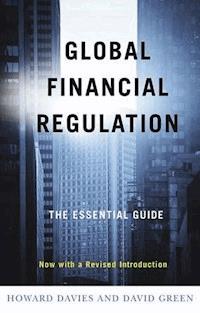
As international financial markets have become more complex, so has the regulatory system which oversees them. The Basel Committee is just one of a plethora of international bodies and groupings which now set standards for financial activity around the world, in the interests of protecting savers and investors and maintaining financial stability. These groupings, and their decisions, have a major impact on markets in developed and developing countries, and on competition between financial firms. Yet their workings are shrouded in mystery, and their legitimacy is uncertain.
Here, for the first time, two men who have worked within the system describe its origins and development in clear and accessible terms. Howard Davies was the first Chairman of the UK's Financial Services Authority, the single regulator for the whole of Britain's financial sector. David Green was Head of International Policy at the FSA, after spending thirty years in the Bank of England, and has been closely associated with the development of the current European regulatory arrangements.
Now with a revised and updated introduction, which catalogues the changes made since the credit crisis erupted, this guide to the international system will be invaluable for regulators, financial market practitioners and for students of the global financial system, wherever they are located. The book shows how the system has been challenged by new financial instruments and by new types of institutions such as hedge funds and private equity. Furthermore, the growth in importance of major developing countries, who were excluded for far too long from the key decision-making for a has led to a major overhaul.
The guide is essential reading for all those interested in the development of financial markets and the way they are regulated.
The revised version is only available in paperback.
Sie lesen das E-Book in den Legimi-Apps auf:
Seitenzahl: 365
Veröffentlichungsjahr: 2013
Ähnliche
















Global Financial Regulation
Global Financial Regulation
The essential guide
Howard Davies and David Green
polity
Copyright © Howard Davies and David Green 2008
The right of Howard Davies and David Green to be identified as Author of this Work has been asserted in accordance with the UK Copyright, Designs and Patents Act 1988.
First published in 2008 by Polity Press
Polity Press
65 Bridge Street
Cambridge CB2 1UR, UK.
Polity Press
350 Main Street
Malden, MA 02148, USA
All rights reserved. Except for the quotation of short passages for the purpose of criticism and review, no part of this publication may be reproduced, stored in a retrieval system, or transmitted, in any form or by any means, electronic, mechanical, photocopying, recording or otherwise, without the prior permission of the publisher.
ISBN-13: 978-0-7456-5588-8
A catalogue record for this book is available from the British Library.
Typeset in 11 on 14pt Sabon
by Servis Filmsetting Ltd, Stockport, Cheshire
Printed and bound in Great Britain by MPG Books Group, UK
The publisher has used its best endeavours to ensure that the URLs for external websites referred to in this book are correct and active at the time of going to press. However, the publisher has no responsibility for the websites and can make no guarantee that a site will remain live or that the content is or will remain appropriate.
Every effort has been made to trace all copyright holders, but if any have been inadvertently overlooked the publishers will be pleased to include any necessary credits in any subsequent reprint or edition.
For further information on Polity, visit our website: www.polity.co.uk
Contents
Acknowledgements
List of abbreviations
Update – September 2009
Introduction
1 The Objectives of International Financial Regulation
2 The Current International Regulatory System: Theory and Practice
3 The International Financial Institutions and their Role in Financial Regulation
4 The European Union: A Special Case
5 Regulatory Structures in Individual Countries
6 The Debate on Regulatory Structure
7 The Need for Reform
Afterword
References
Index
Acknowledgements
This modest volume is not the product of great original research but draws on the personal experience and knowledge accumulated during the time we spent as central bankers and then regulators, first within the long-established tradition of the Bank of England, and then engaged in the creation of the Financial Services Authority. The sources to which we refer are not comprehensive but those we have come across in the course of our day-to-day work and which struck us as useful and illuminating. Most of all, though, we have gained insights from the close collaboration and debate over the years with our fellow colleagues in the Bank and the FSA, some of whom agreed to review what we had written, whether in whole or in part.
We would particularly like to express our indebtedness to Paul Boyle, Alastair Clark and Paul Wright, each of whom reviewed an earlier draft in full, as well as to Ged Fitzpatrick, Piers Haben, Alan Houmann, Peter Parker and John Sloan, the last of whom devised the forerunners to the charts we provide to help unravel the spaghetti of international committees. We are also grateful to our support staff, without whose endless patience in deciphering manuscript scribbles or making and remaking amendments, this would have never been finalized. We would particularly mention Rachel Gibson, Carol Liuzzi, Clare Taylor Gold and Tamlyn Whittock.
Lastly, as is customary, but also necessary, we need to note that the views expressed here are entirely our own and not those of any of the organizations with which we have been associated.
Abbreviations
ACAM
Autorité de Contrôle des Assurances et des Mutuelles (France)
AMF
Autorité des Marchés Financiers (France)
APRA
Australian Prudential Regulatory Authority
ASIC
Australian Securities and Investments Commission
AuRC
Audit Regulatory Committee (EU)
BAC
Banking Advisory Committee (EU)
BAKred
Bundesaufsichtsamt für das Kreditwesen (Germany)
BaFin
Bundesanstalt für Finanzdienstleistungsaufsicht (Germany)
BAV
Bundesaufsichtsamt für Versicherungswesen (Germany)
BAWe
Bundesaufsichtsamt für den Wertpapierhandel (Germany)
BCCI
Bank of Credit and Commerce International
BCBS
Basel Committee on Banking Supervision
BIS
Bank for International Settlements
BOBS
Board of Banking Supervision (UK)
BOJ
Bank of Japan
BSC
Banking Supervision Committee (ECB)
BSC
Building Societies Commission (UK)
Buba
Deutsche Bundesbank
CBRC
China Banking Regulatory Commission
CCA
Commission de Contrôle des Assurances (France)
CDIC
Canada Deposit Insurance Corporation
CDO
Collateralized Debt Obligation
CEBS
Committee of European Banking Supervisors
CECEI
Comité des Établissements de Crédit et des Enterprises d’Investissement (France)
CEIOPS
Committee of European Insurance and Occupational Pensions Supervisors
CESR
Committee of European Securities Regulators
CFTC
Commodity Futures Trading Commission (US)
CIRC
China Insurance Regulatory Commission
CMF
Conseil des Marchés Financiers (France)
COB
Commission des Opérations de Bourse (France)
CONSOB
Commissione per le Società e la Borsa (Italy)
CPSS
Committee on Payment and Settlement Systems
CRD
Capital Requirements Directive
CSE
Consolidated Supervised Entity (US)
CSRC
China Securities Regulatory Commission
DBERR
Department of Business, Enterprise and Regulatory Reform
DICJ
Deposit Insurance Corporation of Japan
DTI
Department of Trade and Industry (UK)
EBC
European Banking Committee
ECB
European Central Bank
EFC
Economic and Financial Committee (EU)
EFR
European Financial Services Round Table
EFRAG
European Financial Reporting Advisory Group
EGAOB
European Group of Audit Oversight Bodies
EIOPC
European Insurance and Occupational Pensions Committee
ESC
European Securities Committee
EP
European Parliament
FASB
Financial Accounting Standards Board
FATF
Financial Action Task Force
FDIC
Federal Deposit Insurance Corporation (US)
FESCO
Forum of European Securities Commissions
FGD
Financial Groups Directive
FIBV
Fédération Internationale des Bourses de Valeurs
FRC
Financial Reporting Council (UK)
FSA
Financial Services Authority (UK)
FSA
Financial Services Agency (Japan – also JFSA)
FSAP
Financial Services Action Plan (EU)
FSAP
Financial Sector Assessment Programme (IMF)
FSC
Financial Services Committee (EU)
FSCS
Financial Services Compensation Scheme (UK)
FSF
Financial Stability Forum
FTA
Free Trade Agreement
GAAP
Generally Accepted Accounting Principles
GAO
Government Accountability Office (US)
GATS
General Agreement on Trade in Services
IAA
International Actuarial Association
IAASB
International Auditing and Assurance Standards Board
IADI
International Association of Deposit Insurers
IAIS
International Association of Insurance Supervisors
IAS
International Accounting Standards
IASC
International Accounting Standards Committee
IFAC
International Federation of Accountants
IFI
International Financial Institution
IFIAR
International Forum of Independent Audit Regulators
IFRS
International Financial Reporting Standards
IFSB
Islamic Financial Services Board
IIF
Institute of International Finance
IMF
International Monetary Fund
IMFC
International Monetary and Financial Committee
IMRO
Investment Management Regulatory Organization (UK)
IORP
Institutions for Occupational Retirement Provision (EU)
IOSCO
International Organization of Securities Commissions
IOPS
International Organization of Pension Supervisors
IPO
Initial Public Offering
ISAs
International Standards on Auditing
ISP
Insurance Supervisory Principles
ISVAP
Istituto per la Vigilanza sulle Assicurazioni Private e di Interesse Colletivo (Italy)
JFSA
Japan Financial Services Agency
LZB
Landeszentralbanken (Germany)
LIFFE
London International Financial Futures Exchange
MiFID
Markets in Financial Instruments Directive
NAIC
National Association of Insurance Commissioners (US)
NASD
National Association of Securities Dealers (US)
NGO
Non-Governmental Organization
NRSRO
Nationally Recognized Statistical Rating Organization (US)
OCC
Office of the Comptroller of the Currency (US)
OECD
Organization for Economic Co-operation and Development
OFC
Offshore Financial Centre
OPRA
Occupational Pensions Regulatory Authority (UK)
OSFI
Office of the Superintendent of Financial Institutions (Canada)
OTS
Office of Thrift Supervision (US)
PBOC
Peoples Bank of China
PCAOB
Public Company Accounting Oversight Board (US)
PIA
Personal Investment Authority (UK)
PIOB
Public Interest Oversight Board
PSD
Payment Services Directive
RFS
Registry of Friendly Societies (UK)
ROSC
Report on the Observance of Standards and Codes (IMF)
SEC
Securities and Exchange Commission (US)
SESC
Securities and Exchange Surveillance Commission (Japan)
SEPA
Single European Payments Area
SI
Systematic Internalizer
SIB
Securities and Investments Board (UK)
SRO
Self-Regulatory Organization
UCITS
Undertakings for Collective Investments in Transferable Securities (EU)
WFE
World Federation of Exchanges
WTO
World Trade Organization
UPDATE – SEPTEMBER 2009
Time seems to have speeded up in the world of financial regulation. For many years the global structure remained roughly the same, give or take a committee here and a forum there. And the countries which played the leading roles in designing the systems and agreements in place remained the same. The G7 has been the dominant grouping for twenty years or more.
Now all that has changed. It is not hard to see the reason why. The financial crisis which began in 2007, rumbled on through that year and through to the summer of 2008, exploded in the autumn at the time of the Lehman failure. It became clear that there had been a serious malfunction, and that attention was needed to all aspects of global financial regulation – the architecture of committees and institutions, the membership of those bodies and the rules themselves. At the same time, a number of countries decided to take a hard look at their own regulatory bodies, and their functioning.
The key political events were the three G20 summits of 2008–2009 in Washington, London and Pittsburgh. For the first time the G20 (with a couple of additional countries whose leaders talked their way in) met at head of government level and addressed a concrete agenda covering fiscal policy (outside the ambit of this book), the roles and resourcing of the IMF and World Bank (partly covered here) and the co-ordination and reform of the bodies which set the rules for financial markets – which is our central concern. The build-up to the London summit, in particular, was not easy. The G20 is not blessed with a functioning permanent secretariat, and the habits of co-operation between the members, a much more diverse group than the G7, are not well developed. Also, the new US administration was still not fully staffed to handle complex international negotiations.
So the outcomes, lengthy communiqués backed with extensive detail on new initiatives, surprised many. There is room for doubt about how significant the changes will turn out to be, and indeed for scepticism about the feasibility of some of what is proposed. But the world’s political leaders have, at the very least, thrown down a challenge to financial regulators to overhaul their practices, and to broaden and strengthen their international networks. At the same time they have implicitly taken on responsibility for financial regulation as a matter of global concern.
Lesen Sie weiter in der vollständigen Ausgabe!
Lesen Sie weiter in der vollständigen Ausgabe!
Lesen Sie weiter in der vollständigen Ausgabe!
Lesen Sie weiter in der vollständigen Ausgabe!
Lesen Sie weiter in der vollständigen Ausgabe!
Lesen Sie weiter in der vollständigen Ausgabe!
Lesen Sie weiter in der vollständigen Ausgabe!
Lesen Sie weiter in der vollständigen Ausgabe!
Lesen Sie weiter in der vollständigen Ausgabe!
Lesen Sie weiter in der vollständigen Ausgabe!
Lesen Sie weiter in der vollständigen Ausgabe!
Lesen Sie weiter in der vollständigen Ausgabe!
Lesen Sie weiter in der vollständigen Ausgabe!
Lesen Sie weiter in der vollständigen Ausgabe!
Lesen Sie weiter in der vollständigen Ausgabe!




