


0,99 €
Mehr erfahren.
- Herausgeber: Arcadia Press
- Kategorie: Geisteswissenschaft
- Sprache: Englisch
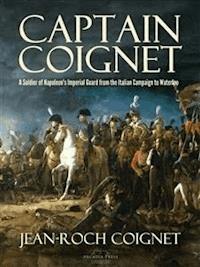
Jean-Roch Coignet (1776-1865) was a French soldier who served in the military campaigns of the Consulate and First French Empire, up through the Battle of Waterloo.He later wrote his memoirs detailing his military service, The Notebooks of Captain Coignet, which are still being reprinted.
Das E-Book können Sie in Legimi-Apps oder einer beliebigen App lesen, die das folgende Format unterstützen:
Veröffentlichungsjahr: 2017
Ähnliche



















TABLE OF CONTENTS
Jean-Roch Coignet
CAPTAIN COIGNET
A soldier of Napoleon’s imperial guard from the italian campaign to Waterloo
Edited from the original manuscript by Loredan Larchey Translated from the french by Mrs. M. Carey
Copyright © Jean-Roch Coignet
Captain Coignet
(1890)
Arcadia Press 2017
www.arcadiapress.eu
Storewww.arcadiaebookstore.eu
CAPTAIN COIGNET
PREFACE
Jean-Roch Coignet was pre-eminently what is called a thoroughgoing man. Whether as shepherd or wagoner, stable-boy or farm hand, soldier or captain, we find him always ready to do his best. Whether using a broom or drawing a sabre, he brings to bear all his mind, all his buoyancy of spirit, and all his pride. Consequently, the perusal of his life rests one as does the company of good reliable men, upon whose devotion one can always count.
It will be seen that his life was not without adventures, and that he knows how to relate them unusually well. One is not a story, teller at will. It is a natural gift, like the color-sense of the great masters, and without it a well-educated person will often find nothing to tell about a journey which an illiterate man so gifted will describe in the most eloquent manner. Our old captain was one of those who possessed this gift. He was uneducated, and he acknowledges the fact without hesitation. He did not know how to read or write until he was thirty-five years old. It was with great difficulty that, at the age of seventy-two, he traced the big schoolboy characters which cover the nine blank-books of his manuscript.
How could he, at seventy-two, remember so many minute details? The fact is less surprising than it appears: in the first place, the memory of early years becomes more vivid as age increases, and in the second place, Coignet had related his memories all his life long before writing them. Just so the bards of Homer recited his “Iliad.”
Are Coignet’s memorials valuable as a book of history? I do not go to them any more than to the “Iliad” to verify facts, as we say. I do not even stop to discuss or rectify their statements. Their interest is altogether of another kind. As is the case with all those who do the fighting, our soldier knew not how to give a detailed account of the operations of an army; but he gives us what we could never learn from the exact report of the chief of staff. From him you get the face of the combatant, the incidents of the march, the color of the battle-field, the unforeseen action, the hot work of the fight, — everything that is spirited, picturesque, or specially exciting.
We know the whole story, doubtless, but how much better we comprehend it here, when we see the decorations and the actors! We see them at Montebello when, being for the first time under fire, our hero stoops before the volley of grape-shot, and condemns his weakness immediately by answering, “I will not,” to the sergeant-major, who cries, “Don’t duck your head.” We find them at Marengo, when, thrown down and sabred, he had no chance to save his life but to cling, all bleeding as he was, to the tail of a dragoon’s horse till he could rejoin his demi-brigade, pick up a gun, and fire even better than before; in the icy bogs of Poland, where he was obliged to take hold of each leg with both hands, and pull it out of the mud in order to take a step forward; at Essling, when the Austrian cannonade made the bear-skin caps of the old guard fly about, and dashed around pieces of flesh with such force that many were knocked down by them; on the road to Witepsk, when, with only the formality of drawing lots, we see seventy marauders shot, offered up as a last sacrifice to the expiring discipline of the grand army; at Mainz, during the horrors of the typhus fever, the final scourge of the retreat, when it was necessary to bring out the cannon to force the convicts to cord-up the piles of dead bodies on foraging wagons, and afterwards dump the terrible load into one great pit. By the side of these black shadows we find bright lights, charming pictures of rural life, amusing scenes of bivouac, reflections no less amusing upon the countries traversed, and infinitely precious details of the relations of the chiefs with their soldiers. Particularly does he show what a chief may get out of our troops, when he knows how to win their esteem. The value of the office depends upon the man who fills it; and when the man is worthless, French indiscipline leaps at one bound to the greatest excess.
For this reason the officers risk their persons in every danger, keep a constant watch over their soldiers, and associate freely with them without fear of losing their respect. At Mount St. Bernard they tear up their clothing in hitching themselves to the cannon in the difficult passes. If a trooper does a brave act, they embrace him heartily, and make him drink from their cups. Courage not less than rank is the officer’s distinction. At critical moments generals are seen to take the position of sharpshooters, and to rally fugitives under fire of the enemy. Dorsenne, knocked down by the explosion of a shell in the midst of his grenadiers, immediately rises, and cries out, “Your general is not hurt. Depend upon him, he will die at his post.” Though he could not stand upright, as Dorsenne did, that colonel commanding the celebrated battery at Wagram was none the less great, who, though wounded early in the morning, had himself borne in an ambulance till evening, and remained at the head of his forces, though unable to sit up. “He commanded sitting up in bed,” says Coignet, in six words that are worth as much as a picture.
At Kowno, Coignet sees Ney snatch a gun, and face the enemy with five men. At Brienne, Prince Berthier charges four Cossacks, and retakes a cannon from them. At Montereau, Marshal Lefebvre rides at a gallop over a broken bridge, and sabres a rear-guard with no following but his staff officers. With such examples before them, it is easy to believe that the soldiers did not remain behind. Thus, at the rout of the Mincio, the sight of a single horseman remaining alone at his post as sharpshooter suffices to rally his division. The grenadiers at Essling and Wagram contend for the honor of dying as voluntary cannoneers at an untenable post. At Austerlitz a Mameluke, who had already captured two flags in a cavalry fight, dashes in a third time, and is seen no more. Nor must we forget that quartermaster who, having his leg broken on the field of Eylau, walks off alone to the ambulance with two guns for crutches, saying that with his three pairs of boots he would have enough to last a long time. We recognize this as mere facetiousness; but at the point when the gayest-hearted can laugh no longer, facetiousness becomes heroism.
Is all this really true? they ask, who do not feel within themselves either the desire or the power to do so much. I have not seen it any more than they; but I do know very well that Coignet is a storyteller of the first order; that he has the gift of style without knowing it. I have always observed that any one who possesses this merit is sure to possess two others: that of feeling intensely, and that of expressing his feelings with absolute sincerity. I have also often remarked that absolute truthfulness will crown as an author many a writer who would fall below mediocrity if asked to lie; that is, to write a work of fiction.
I do not feel that Coignet has invented anything. He was not capable of it. But did this Coignet really ever exist? I know that this question also has been asked. Certainly, it is possible to doubt even thing, and to believe that I have taken the trouble to fabricate an original manuscript. That also has been said to me. They who consider fiction more powerful than truth, not suspecting that the richest imagination will always fall short of the unforeseen reality, will continue to have eyes that see not.
Let these sceptics take the road to Auxerre. Let them go to the municipal library, and question my obliging colleague Molard, to whom I owe the chance of obtaining the autograph manuscript. Let them see the last possessor of it, M. Lorin; let them demand an interview with M. Henri Monceau, who gave me two portraits of Captain Coignet, and who also afterwards sent me an extract from his will, dated Nov. 2, 1858, and written in the office of Maitre Limosin. At Paris, I refer them to the offices of the minister of war and the chancellor of the Legion of Honor, and thence obtained duplicates of Coignet’s record of service and his commissions. Last May I saw again the Cafe Milon and that grocery at the corner of the Rue des Belles-Filles, where the captain, retired on half-pay, went on an errand to grind his pound of coffee, in order to make his offer of marriage with more delicacy. I had for my guide M. Monceaux, who knew Coignet as, indeed, he knows everybody and everything in old Auxerre. He could tell many things about him to those who doubt.
Proof is, therefore, abundant. The text of our first edition has not been changed; but it has been reduced so as to make an edition suitable for general readers.
LOREDAN LARCHEY.
Paris, August 30, 1887.
Lesen Sie weiter in der vollständigen Ausgabe!
Lesen Sie weiter in der vollständigen Ausgabe!
Lesen Sie weiter in der vollständigen Ausgabe!
Lesen Sie weiter in der vollständigen Ausgabe!
Lesen Sie weiter in der vollständigen Ausgabe!
Lesen Sie weiter in der vollständigen Ausgabe!
Lesen Sie weiter in der vollständigen Ausgabe!
Lesen Sie weiter in der vollständigen Ausgabe!




