


Erhalten Sie Zugang zu diesem und mehr als 300000 Büchern ab EUR 5,99 monatlich.
- Herausgeber: CLXBX
- Kategorie: Gesellschafts- und Liebesromane
- Sprache: Englisch
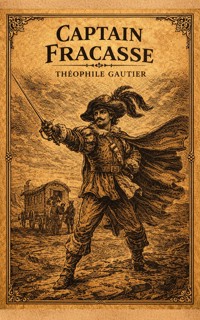
Captain Fracasse by Théophile Gautier is a dazzling adventure novel that blends romance, swashbuckling action, theatrical charm, and lyrical prose into an unforgettable tale of courage and reinvention. Set in seventeenth-century France, this vibrant story transports readers to a world of wandering performers, duels at dawn, noble intrigue, and passionate devotion. The novel follows Baron de Sigognac, a young nobleman reduced to poverty and isolation in his crumbling ancestral castle. Though born into privilege, he lives a life of quiet despair—until fate arrives in the form of a traveling troupe of actors seeking shelter from a storm. Captivated by their lively spirit and especially by the beautiful and mysterious Isabelle, Sigognac abandons his lonely estate to join their company on the road. When one of the troupe's actors dies unexpectedly, Sigognac steps into the vacant comedic role of "Captain Fracasse," adopting a flamboyant stage persona that contrasts sharply with his reserved nature. Through this transformation, he begins a journey not only across France but also toward self-discovery. As Captain Fracasse, he finds confidence, purpose, and a sense of belonging among the colorful performers who become his chosen family. Yet the road is far from peaceful. Rival suitors, jealous nobles, and dangerous swordsmen threaten both the troupe's livelihood and Isabelle's safety. Sigognac must confront his own insecurities and prove his bravery in real-life duels that echo the drama of the stage. Love, honor, and identity intertwine as he navigates a society divided by class, ambition, and power. Gautier's richly descriptive style paints vivid scenes of countryside inns, bustling towns, and theatrical performances, immersing readers in the textures and rhythms of an era long past. The novel celebrates the magic of performance and the transformative power of art, while also exploring timeless themes of loyalty, resilience, romance, and personal reinvention. Both an adventure story and a poetic tribute to the world of theater, Captain Fracasse remains a classic of French literature. With its spirited hero, sweeping romance, and elegant storytelling, it continues to captivate readers who long for tales of daring exploits and heartfelt devotion.
Sie lesen das E-Book in den Legimi-Apps auf:
Seitenzahl: 923
Veröffentlichungsjahr: 2026
Das E-Book (TTS) können Sie hören im Abo „Legimi Premium” in Legimi-Apps auf:
Ähnliche









Captain Fracasse
Théophile Gautier
Copyright © 2026 by Théophile Gautier
All rights reserved.
No part of this book may be reproduced in any form or by any electronic or mechanical means, including information storage and retrieval systems, without written permission from the author, except for the use of brief quotations in a book review.
Contents
1. THE CASTLE OF MISERY
2. THESPIS' CHARIOT
3. THE BLUE SUN INN
4. BIRDS BANDITS
5. AT THE MARQUIS'S
6. SNOW EFFECT
7. WHERE THE NOVEL JUSTIFIES ITS TITLE
8. THINGS GET COMPLICATED
9. AND OTHER ADVENTURES.
10. A HEAD IN A SKYLIGHT
11. THE NEW BRIDGE
12. THE CROWNED RADISH
13. DOUBLE ATTACK
14. THE DELICATESSENS OF LAMPOURDE
15. MALARTIC AT WORK
16. VALLOMBREUSE
17. THE AMETHYST RING
18. IN THE FAMILY
19. Century Nettles and Spiderwebs
20. CHIQUITA'S DECLARATION OF LOVE
21. HYMEN, O HYMENEA!
22. THE CASTLE OF HAPPINESS
THE CASTLE OF MISERY
On the reverse side of one of those bare hills that dot the Landes region, between Dax and Mont-de-Marsan, stood, during the reign of Louis XIII , one of those manor houses so common in Gascony, and which the villagers decorate with the name of castle.
Two round towers, topped with gabled roofs, flanked the corners of a building. On its facade, two deeply cut grooves betrayed the former existence of a drawbridge, now rendered obsolete by the leveling of the moat, and gave the manor a rather feudal appearance, with its pepperpot turrets and dovetailed weathervanes. A blanket of ivy half-wrapping one of the towers provided a welcome contrast, its dark green contrasting with the gray tone of the stone, already aged at that time.
The traveler who might have glimpsed the castle from afar Drawing its pointed ridges against the sky above the broom and heather, one might have judged it a suitable dwelling for a provincial squire; but, upon closer inspection, one's opinion would have changed. The path leading from the road to the house had been reduced, by the encroachment of moss and parasitic vegetation, to a narrow white trail resembling a faded braid on a threadbare coat. Two ruts filled with rainwater and inhabited by frogs testified that carts had once passed this way; but the amphibians' undisturbed state indicated a long period of possession and the certainty of being undisturbed. — On the strip cut through the weeds, and soaked by a recent downpour, one could see no human footprints, and the brushwood twigs, laden with glistening droplets, did not appear to have been moved for long.
Large patches of yellow leprosy marbled the browned, disordered tiles of the roofs, whose rotten rafters had given way in places; rust prevented the weathervanes from turning, each indicating a different wind; the dormer windows were blocked by shutters of warped and cracked wood. Rubble filled the barbicans of the towers; of the twelve windows on the facade, eight were boarded up; the other two had bubbled panes, trembling in their lead frames at the slightest pressure of the north wind. Between these windows, the plaster had fallen away in flakes like the scales of skin.The decaying stonework exposed dislodged bricks and crumbling rubble, weathered by the moon's pernicious influence. The doorway, framed by a stone lintel whose regular roughness suggested ancient ornamentation worn smooth by time and neglect, was surmounted by a crude coat of arms that the most skilled herald would have been powerless to decipher, its mantling fancifully twisting and turning, not without numerous breaks in continuity. The upper sections of the door panels still bore traces of oxblood paint and seemed to blush with their state of disrepair; diamond-headed nails held their cracked boards in place, forming broken symmetries here and there. A single door opened, sufficient for the passage of the castle's obviously few guests, and against the doorframe leaned a dismantled wheel, its remains scattered like a sheaf, the last vestige of a carriage that had perished during the previous reign. Swallows' nests obscured the chimney stacks and the corners of the windows, and, were it not for a thin wisp of smoke rising from a brick chimney and twisting like those drawings of houses that schoolchildren scribble in the margins of their notebooks, one might have thought the dwelling uninhabited: the cooking must have been meager, for a soldier with his pipe would have produced thicker plumes. It was the only sign of life the house gave, like those dying people whose existence is revealed only by the vapor of their breath.
Pushing open the movable door, which refused to yield without protest and turned with obvious ill humor on its rusty, squeaky hinges, one found oneself beneath a kind of pointed arch, older than the rest of the dwelling, and divided by four bands of bluish granite that met at their intersection at a projecting stone where, slightly less degraded, one could still see the coat of arms carved on the exterior: three gold storks on a blue field, or something similar, for the shadow of the arch made it difficult to distinguish them clearly. Set into the wall were sheet metal snuffers blackened by torches, and iron rings where visitors' horses were once tethered—a rare occurrence these days, judging by the dust that soiled them.
From this porch, beneath which opened two doors—one leading to the ground-floor apartments, the other to a room that may once have served as a guardroom—one emerged into a bleak, bare, and cold courtyard, surrounded by high walls streaked with long black strands by the winter rains. In the corners of the courtyard, among the rubble fallen from the chipped cornices, grew nettles, wild oats, and hemlock, and the paving stones were bordered with green grass.
At the far end, a ramp flanked by stone railings adorned with balls topped with spikes led to a garden situated below the courtyard. The broken, uneven steps shifted underfoot or were held in place only by the filaments of mosses and wallflowers; on the terrace's abutmenthouseleeks, wild radishes and wild artichokes had grown.
As for the garden itself, it was slowly returning to the state of a thicket or virgin forest. With the exception of a square where a few cabbages with veined and grey-green leaves stood, and which were starred by golden suns with black hearts, whose presence testified to a kind of cultivation, nature was reclaiming its rights over this abandoned space and erasing the traces of the work of man which it seems to like to make disappear.
The untrimmed trees sent out their greedy branches in every direction. The boxwoods, intended to define the borders and paths, had become shrubs, having gone unpruned for many years. Seeds carried by the wind had germinated haphazardly and were growing with that tenacious hardiness peculiar to weeds, in the places once occupied by pretty flowers and rare plants. Brambles, with their thorny thorns, crisscrossed the paths, snagging on you as you passed, preventing you from going further and stealing away this mystery of sadness and desolation. Solitude doesn't like to be caught undressed and scatters all sorts of obstacles around itself.
However, if one had persisted, without fearing the scratches from the undergrowth and the blows from the branches, in following to the end the ancient path, now more obstructed and overgrown than a trail in the woods, one would have arrived at a kind of rocky niche.depicting a rustic grotto. To the plants once sown between the crevices of the rocks, such as irises, gladioli, and black ivy, others had been added: persicaria, hart's-tongue ferns, and wild lamb's-tails that hung like beards and half-veiled a marble statue representing a mythological deity, Flora or Pomona, who must have been quite gallant in her time and done the craftsman proud, but who was now as grim as Death, with a broken nose. The poor goddess carried in her basket, instead of flowers, moldy and poisonous-looking mushrooms; she herself seemed to have been poisoned, for patches of brown moss streaked her once so white body. At her feet, beneath a green layer of duckweed in a stone shell, lay a brown puddle, the residue of the rains; because the lion's muzzle, which could still be discerned if necessary, no longer vomited water, not receiving any from blocked or destroyed conduits.
This grotesque cabinet, as it was then called, in its ruined state, testified to a certain vanished affluence and the taste for the arts of the castle's former owners. Properly cleaned and restored, the statue would have revealed the Florentine Renaissance style, in the manner of the Italian sculptors who came to France following Master Roux or Primaticcio—likely the period of the now-fallen family's splendor.
The cave leaned against a wall covered in green and saltpeter, where remnants of broken trellises, undoubtedly intended to conceal theThe walls, during their construction, were hidden beneath a curtain of climbing and leafy plants. This wall, barely visible through the unruly foliage of the overgrown trees, enclosed the garden on this side. Beyond stretched the heath with its bleak, low horizon, dotted with heather.
Returning towards the castle, one could see the opposite facade, more ravaged and degraded than the one just described, the last masters having tried to preserve at least the appearance, and concentrated their meager resources on this side.
In the stable, where twenty horses could have comfortably fit, a scrawny nag, its rump jutted out in bony protuberances, plucked a few wisps of straw from an empty hayrack with the tips of its yellow, loose teeth, and from time to time turned an eye, set deep in an orbit so tight that the rats of Montfaucon wouldn't have found the slightest trace of fat, towards the door. At the threshold of the kennel, a lone dog, floating in its overly loose skin where its relaxed muscles stretched into flabby lines, dozed with its muzzle resting on the sparse cushion of its paws; it seemed so accustomed to the solitude of the place that it had given up all vigilance and didn't worry, as dogs, even when asleep, usually doze, at the slightest noise.
Upon entering the house, one encountered a huge staircase with a wooden balustrade. This staircase had only two landings, thedwelling containing no more than two stories. — It was made of stone up to the first floor, and of brick and wood from there onward. On the walls, grisaille paintings, devoured by damp, seemed to have attempted to simulate the relief of a richly ornamented architecture, using the resources of chiaroscuro and perspective. One could still discern a series of Hercules figures ending in sheaths supporting a modillion cornice from which, curving upwards, sprang a canopy of foliage festooned with vine leaves, revealing a faded sky, its color altered and its geograph marked by unknown islands through the seepage of rainwater. Between the Hercules figures, in painted niches, busts of Roman emperors and other illustrious figures from history were displayed; But all of it was so vague, so faded, so destroyed, so vanished that it was more the specter of a painting than an actual painting, and one would have to speak of it with shadows of words, ordinary vocabulary being too substantial for that. The echoes of this empty cage seemed quite astonished to repeat the sound of a footstep.
A green door, its serge yellowed and held only by a few tarnished nails, led into a room that might have served as a dining room in the fabulous days when meals were eaten in this deserted dwelling. A large beam divided the ceiling into two compartments, striped with exposed joists whose gaps had once been covered with a layer of blue paint, now faded by dust and cobwebs that the wolf's head would never disturb at this height. Above the shaped fireplace In the ancient style, a ten-point stag's antlers were displayed, and along the walls, on darkened canvases, grimaced smoky portraits of armored captains, their helmets at their sides or held by a page, staring at you with profoundly black eyes, the only living thing in their lifeless faces; lords in velvet robes, their heads resting on rigid rotundas of starch like the heads of Saint John the Baptist on silver platters; dowagers in old-fashioned dress, frighteningly livid and, through the decomposition of the colors, taking on the appearance of stryges, lamias, and empouses. These paintings, done by provincial daubers, acquired a motley and formidable aspect from the very barbarity of the work. Some were unframed; others had borders of tarnished and reddened gold. All bore in their corner the family crest and the age of the person depicted; But whether the number was low or high, there was no appreciable difference between these heads with their yellowed lights, their charred shadows, smoky with varnish and sprinkled with dust; two or three of these canvases, decaying and covered with a bloom of mold, displayed the tones of a decomposing corpse, and proved, on the part of the last descendant of these men of lineage and the sword, a complete indifference to the effigies of his noble ancestors. In the evening, this silent and motionless gallery was to be transformed, by the uncertain reflections of the lamps, into a line of phantoms, terrifying and ridiculous at once. Nothing is moreIt is sad that these portraits are forgotten in these deserted rooms; half-erased reproductions of forms long since dissolved underground.
As they were, these painted ghosts were fitting guests for the desolate solitude of the dwelling. Real inhabitants would have seemed too alive for this lifeless house.
In the middle of the room stood a blackened pearwood table, its legs spiraled like Solomon's columns, riddled with thousands of holes by shipworms, undisturbed in their silent work. A thin grey layer, on which one could have traced characters, covered its surface, showing that it was not often used for dining.
Two sideboards or credenzas of the same material, adorned with a few sculptures and probably bought at the same time as the table in happier times, hung from one side of the room to the other; chipped earthenware, mismatched glassware and two or three rustic figurines by Bernard Palissy representing eels, fish, crabs and shells enameled on a background of greenery, miserably filled the empty shelves.
Five or six chairs upholstered in velvet that may once have been crimson, but which years and use had rendered a piss-red, were shedding their stuffing through tears in the fabric and limping on odd legs like scavenging worms or crippled soldiers returning home after battle. Unless he was a spirit, he would not have been prudent to sit there, and, no doubt, these seats were only used when the council of ancestors, taken out of their frames, came to take their place at the unoccupied table, and before an imaginary supper, discussed among themselves the decadence of the family during the long winter nights so favorable to the feasts of specters.
From this room, one entered another, slightly smaller. One of those Flemish tapestries called "verdure" adorned the walls. Let the word "tapestry" not conjure up any idea of undue luxury in your imagination. This one was worn, frayed, and faded; the unstitched panels formed a hundred gaps and were held together only by a few threads and the force of habit. The discolored trees were yellow on one side and blue on the other. The heron, standing on one leg amidst the reeds, had suffered considerably from moths. The Flemish farmhouse, with its well festooned with hops, was barely discernible, and of the hunter's pallid face, chasing the halbrans, only the red mouth and black eye, seemingly of a better complexion than the other shades, had retained their original color, like a waxen corpse whose mouth has been vermilioned and whose eyebrows have been revived. The air played between the wall and the slack fabric, imprinting suspicious undulations upon it. Hamlet, Prince of Denmark, had he spoken in this room, would have drawn his sword and stabbed Polonius behind the tapestry, shouting, "A rat!" A thousand little noises, imperceptible whispers of solitude, which make silence more keenly felt, disturbed the ear and the mind of thea visitor bold enough to venture this far. Mice gnawed hungrily on bits of wool on the underside of the low warp. Worms scraped the wood of the beams with a dull, file-like sound, and the death clock struck the hour on the wood paneling.
Sometimes a piece of furniture would creak unexpectedly, as if weary solitude were stretching its joints, causing you, despite yourself, a nervous shudder. A four-poster bed, closed off by brocade curtains cut at all their folds, whose green and white patterns blended into a single yellowish hue, occupied a corner of the room, and one would not have dared raise its sides for fear of finding in the shadows some crouching larva or some rigid form outlining, beneath the whiteness of the sheet, a pointed nose, bony cheekbones, clasped hands, and feet positioned like those of statues lying on tombs; so quickly do things made for man, and from which man is absent, take on a supernatural air! One might also have supposed that a young enchanted princess lay there in a centuries-long sleep like Sleeping Beauty, but the folds had a rigidity too sinister and too mysterious for that and opposed any gallant idea.
A black wooden table with its copper inlays peeling away, a cloudy, dubious mirror whose silvering had run, tired of not reflecting a human face, a petit point tapestry armchair, a work of patience and leisure brought to completion by someonegrandmother, but which no longer allowed to be discerned except a few silver threads among the silks and faded wools, completed the furnishings of this room, barely habitable for a man who would have feared neither spirits nor ghosts.
These two rooms corresponded to the two unblocked windows in the facade. A pale, greenish light filtered in through the frosted glass, which hadn't been cleaned in a hundred years and which appeared to be tinned on the outside. Large curtains, crumpled at the edges and which would have torn if one had tried to slide them along their rust-eaten rods, further diminished this twilight light and added to the melancholy of the place.
Upon opening the door at the far end of this last room, one was plunged into complete darkness, entering the void, the obscure, and the unknown. Gradually, however, the eye grew accustomed to the shadows pierced by a few livid jets filtering through the joints of the planks that boarded up the windows, and vaguely discerned a series of dilapidated rooms, with uneven parquet floors strewn with broken panes of glass, bare walls or walls half-covered with a few tattered remnants of frayed tapestry, ceilings revealing the slats and allowing rainwater to seep through—admirably arranged for the Sanhedrins of rats and the Estates General of bats. In some places, it would have been unsafe to proceed, for the floorboards undulated and flexed underfoot, but no one ever ventured into this Thebaid of shadow, dust, and canvas. of a spider. From the threshold, a musty odor, a scent of mold and abandonment, the damp, black chill peculiar to dark places, rose to your nostrils as when you lift the stone of a tomb and lean into its icy darkness. Indeed, it was the corpse of the past slowly crumbling to dust in these rooms where the present never set foot; it was the sleeping years swaying as if in hammocks in the gray canvas of the corners.
Above, in the attics, owls, barn owls, and jackdaws roosted during the day, with their feathered ears, cat-like heads, and round, phosphorescent eyes. The roof, collapsed in twenty places, allowed these amiable birds to come and go freely, as comfortable there as in the ruins of Montlhéry or Château Gaillard. Every evening, the dusty flock took flight, hooting and uttering cries that would have stirred the superstitious, to seek far and wide food that it would not have found in this tower of hunger.
The ground floor rooms contained nothing but half a dozen bales of straw, corn graters, and a few small gardening tools. In one of them was a straw mattress stuffed with dry Turkish wheat leaves, with a brown wool blanket that appeared to be the bed of the manor's only servant.
Since the reader must be weary of this stroll through solitude, misery, and abandonment, let us lead him to the only somewhat alive room in the deserted castle, to thekitchen, whose fireplace sent up to the sky that light whitish cloud mentioned in the exterior description of the castle.
A meager fire licked the hearthstone with its yellow tongues, and from time to time reached the bottom of a cast-iron pot hanging from the rack, its faint reflection striking a reddish fleck in the shadows on the rim of the two or three pans attached to the wall. The daylight, filtering through the wide chimney that rose straight to the roof, settled on the bluish ashes, making the fire appear paler, so that in the cold hearth even the flame seemed frozen. Had it not been for the lid, rain would have fallen into the pot, and the storm would have thinned the broth.
The slowly heated water had finally begun to rumble, and the kettle groaned in the silence like an asthmatic person: a few cabbage leaves, overflowing with the foam, indicated that the cultivated portion of the garden had been used for this more than spartan broth.
An old, thin black cat, its fur as bald as a worn-out muff, its lost coat revealing patches of bluish skin, sat on its haunches as close to the fire as possible without scorching its whiskers, staring intently at the pot with its green eyes, each with an I-shaped pupil. Its ears had been cropped flush with its head and its tail trimmed close to its spine, giving it the appearance of one of those Japanese chimeras.which are placed in cabinets among other curiosities, or even those fantastic animals to which witches, going to the sabbath, entrust the task of skimming the cauldron where their potions are boiling.
This cat, all alone in this kitchen, seemed to be making soup for itself, and it was probably it that had placed on the oak table a plate with green and red bouquets, a pewter goblet, polished no doubt with its claws as it was so striped, and a stoneware pot on the sides of which were roughly drawn, in blue lines, the coat of arms of the porch, the keystone and the portraits.
Who was to sit at this modest place setting brought to this manor without inhabitants? Perhaps the familiar spirit of the house, the genius loci , the Kobold faithful to the adopted home, and the black cat with the deeply mysterious eye awaited his arrival to serve him with the napkin on its paw.
The pot was still boiling, and the cat remained motionless at its post, like a sentry who had been forgotten. Finally, a footstep was heard, heavy and ponderous, that of an elderly person; a small cough beforehand echoed, the door latch creaked, and a man, half peasant, half servant, entered the kitchen.
At the arrival of the newcomer, the black cat, which seemed to have a long-standing bond with him, left the ashes of the hearth and came to rub itself amicably against his legs, arching its back, opening and closing its claws, and letting out this murmur from its throat. hoarseness, which is the highest sign of satisfaction in the feline race.
“Very well, Beelzebub,” said the old man, bending down to run his calloused hand two or three times over the cat’s bald back, so as not to be out of politeness with an animal; “I know that you love me, and we are quite alone here, my poor master and I, not to be insensitive to the caresses of a soulless beast, which nevertheless seems to understand you.”
These mutual pleasantries completed, the cat began to walk in front of the man, guiding him towards the fireplace, as if to hand over the direction of the pot which he was looking at with the most endearing look of famished longing, for Beelzebub was beginning to grow old, his ear was less sharp, his eye less piercing, his paw less nimble than before, and the resources which hunting birds and mice once offered him were diminishing considerably; so he did not take his eyes off this stew of which he hoped to have his share and which made him lick his lips in anticipation.
Pierre, that was the old servant's name, took a handful of kindling, threw it onto the half-dead fire; the twigs cracked and twisted, and soon the flame, pushing out a stream of smoke, burst forth bright and clear amidst a joyful flurry of sparks. It seemed as if the salamanders were frolicking and dancing sarabands in the flames. A poor, lung-ridden cricket, overjoyed by this warmth and clarity, he even tried to keep time with his timpani, but he could not succeed and produced only a hoarse sound.
Pierre sat under the mantelpiece of the fireplace, festooned with an old green serge valance cut with wolf's teeth and all yellowed by smoke, on a wooden stool, with Beelzebub beside him.
The firelight illuminated his face, which the years, the sun, the fresh air, and the harsh seasons had, as it were, tanned and darkened beyond that of a Caribbean Indian; a few strands of white hair, escaping from his blue beret and plastered to his temples, further accentuated the brick tones of his swarthy complexion; black eyebrows contrasted with his snow-white hair. Like people of Basque descent, he had an elongated face and a nose like a bird of prey's beak. Deep, perpendicular wrinkles, like saber cuts, furrowed his cheeks from top to bottom.
A sort of livery with faded braid, and a color a professional painter would have struggled to define, half-covered his chamois jacket, shimmering and blackened in places by the friction of his breastplate, producing on the yellow background of his skin hues like those that turn green on the belly of a gamey partridge; for Pierre had been a soldier, and some remnants of his military harness were used in his civilian attire. His half-width breeches revealed the warp and weft of a fabric as light as embroidery canvas, and it would have been impossible to tell ifThey had been made of woolen cloth, ratine, or serge. All hair had long since vanished from these bald breeches; never was a eunuch's chin more hairless. Quite visible repairs, made by a hand more accustomed to wielding a sword than a needle, reinforced the weak points and testified to the care the owner took to prolong the garment's lifespan to the very limits. Like Nestor, these ancient breeches had lived through three ages of manhood. There is a strong likelihood that they had once been red, but this important point is not definitively proven.
Rope soles tied with blue laces to a woolen stocking with the foot cut off served as Pierre's shoes, reminiscent of Spanish alpargatas. These crude cothurni had doubtless been chosen as more economical than the puffed-toe shoe or the drawbridge boot; for a strict, cold, and pristine poverty betrayed itself in the smallest details of the man's attire and even in his pose of dreary resignation. His back against the inner wall of the fireplace, he had folded his large hands, reddened with purplish hues like vine leaves in late autumn, above his knee, and stood motionless opposite the cat. Beelzebub, crouching in the ashes opposite him, with a famished and pitiful air, followed with profound attention the asthmatic bubbling of the cauldron.
"The young master is very late arriving today," murmured Pierre, seeing through the windows The smoky, yellow light from the single window that illuminated the kitchen diminished and faded, the last ray of light of sunset at the edge of a sky streaked with heavy, rain-laden clouds. What pleasure could he possibly find in wandering alone like this on the moors? It's true that this castle is so dreary that one couldn't be more bored anywhere else.
A joyfully hoarse bark was heard; the horse stamped its foot in its stable and made the chain that tied it creak on the edge of its manger; the black cat interrupted the bit of grooming it was doing by passing its paw, previously moistened with saliva, over its cheeks and above its cropped ears, and took a few steps towards the door like an affectionate and polite animal that knows its duties and complies with them.
The door opened; Pierre rose, respectfully removed his beret, and the newcomer appeared in the room, preceded by the old dog we've already mentioned, who was attempting a frolic and falling heavily, weighed down by age. Beelzebub did not show Miraut the antipathy his kind usually profess for dogs. On the contrary, he looked at him very amicably, rolling his green eyes and arching his back. It was clear they had known each other for a long time and often kept each other company in the solitude of the castle.
The Baron de Sigognac, for it was indeed the lord of this dismantled castle who had just entered the kitchen, was a young man of twenty-five or twenty-six, although at first glance he seemed older. Perhaps even more so, so grave and serious did he appear. The feeling of powerlessness that follows poverty had driven away the gaiety from his features and caused that springtime bloom that adorns young faces to fall away. Dark circles of brown already encircled his bruised eyes, and his hollow cheeks accentuated the prominence of his cheekbones; his mustache, instead of curling briskly into hooks, hung with its tips low and seemed to weep beside his sad mouth; his hair, carelessly combed, hung in black strands along his pale face with a lack of coquetry rare in a young man who might have passed for handsome, and showed an absolute renunciation of any idea of pleasing. The habit of a secret sorrow had given painful lines to a face that a little happiness would have made charming, and the natural resolve of that age seemed to yield to a misfortune fought in vain.
Although agile and of a robust rather than weak constitution, the young baron moved with an apathetic slowness, like someone who has resigned from life. His gestures were sleepy and lifeless, his countenance inert, and one could see that he was perfectly indifferent to being here or there, gone or returned.
His head was covered with an old, grayish felt hat, all dented and torn, much too wide, which came down to his eyebrows and forced him to crane his neck to see. A feather, whose sparse barbs made it resemble a fishbone, was fitted to theHis hat, seemingly designed to resemble a plume, hung limply behind him as if ashamed of itself. A collar of antique guipure lace, its wear not always the work of the craftsman and its age adding more than one crease, fell over his doublet, whose flowing folds suggested it had been tailored for a man taller and stouter than the slender baron. The sleeves of his doublet concealed his hands like the sleeves of a frock coat, and he squeezed his boots, studded with iron spurs, up to his waist. This motley collection had belonged to his late father, who had died a few years earlier, and he was now finishing off the clothes, already ripe for the rag trade at the time of their first owner's death. Thus attired in these clothes, perhaps quite fashionable at the beginning of the other reign, the young baron looked both ridiculous and touching; one might have mistaken him for his own grandfather. Although he professed a filial veneration for his father's memory, and tears often came to his eyes when donning these cherished relics, which seemed to preserve in their folds the gestures and attitudes of the deceased gentleman, it was not precisely out of inclination that young Sigognac dressed himself in his father's wardrobe. He possessed no other clothes and had been overjoyed to unearth this portion of his inheritance from the bottom of a trunk. His adolescent clothes had become too small and too tight. At least he was comfortable in his father's. The peasants, accustomed toThey venerated them on the back of the old baron, and did not find them ridiculous on that of the son, and they greeted them with the same deference; they noticed no more the tears in the doublet than the cracks in the castle. Sigognac, poor as he was, was still in their eyes the lord, and the decadence of this family did not affect them as it would have affected foreigners; and yet it was a rather grotesquely melancholy sight to see the young baron pass by in his old clothes, on his old horse, accompanied by his old dog, like that knight of Death in the engraving by Albrecht Dürer.
The Baron sat down in silence at the small table, after responding with a kind wave to Pierre's respectful greeting.
He untied the pot from the rack, poured its contents onto his pre-cut loaf of bread in a common earthenware bowl, and placed it before the Baron. It was that common soup still eaten in Gascony, known as garbure. Then he took from the cupboard a block of miasson, trembling on a napkin sprinkled with cornmeal, and brought it to the table with the small board that supported it. This local dish, along with the garbure greased by a piece of bacon—no doubt stolen from a mousetrap, judging by its small size—constituted the Baron's frugal meal. He ate distractedly between Miraut and Beelzebub, both in ecstasy, their noses in the air on either side of his chair, waiting for a few crumbs of the feast to fall upon them. From time to time, the Baron threw Miraut,who wouldn't let the piece fall to the ground, a morsel of bread to which he had pressed the slice of bacon to at least give it the aroma of meat. The rind fell to the black cat, whose satisfaction was expressed by low growls and a paw extended forward, claws outstretched, as if ready to defend its prey.
This meager meal finished, the Baron seemed to sink into painful reflections, or at least into a distraction whose subject was anything but pleasant. Miraut had rested his head on his master's knee and was fixing him with eyes veiled by age like a bluish flower, but which seemed to flicker with an almost human intelligence. It was as if he understood the Baron's thoughts and was trying to show him his sympathy. Beelzebub was spinning his wheel as loudly as Bertha the Spinner, and uttering little plaintive cries to attract the Baron's wandering attention. Peter stood some distance away, motionless like those long, rigid granite statues one sees on the portals of cathedrals, respecting his master's reverie and waiting for him to give him some order.
Meanwhile, night had fallen, and large shadows huddled in the corners of the kitchen, like bats clinging to the corners of the walls with the fingers of their membranous wings. A smoldering ember, fanned by the gust of wind rushing up the chimney, cast strange reflections on the group gathered around the table with a kind of mournful intimacy.which further highlighted the melancholy solitude of the castle. Of a once powerful and rich family, only one isolated offspring remained, wandering like a shadow in this manor populated by his ancestors; of a numerous livery, only one servant remained, a devoted servant who could not be replaced; of a pack of thirty hunting dogs, only one dog survived, almost blind and all grey with age, and a black cat served as the soul of the deserted dwelling.
The Baron signaled to Pierre that he wished to withdraw. Pierre, bending down at the hearth, lit a splinter of pine wood coated with resin, a kind of economical candle used by poor peasants, and began to precede the young lord; Miraut and Beelzebub joined the procession: the smoky glow of the torch made the faded frescoes on the walls of the staircase flicker and gave an appearance of life to the smoke-stained portraits in the dining room whose black and fixed eyes seemed to cast a look of painful pity on their descendant.
Arriving at the fantastical bedroom we described, the old servant lit a small copper lamp with a single spout, its wick curling in the oil like a tapeworm in spirits at an apothecary's watch, and withdrew, followed by Mirault. Beelzebub, who relished his grand entrances, settled himself in one of the armchairs. The Baron slumped in the other, overcome by loneliness, idleness, and boredom.
If the room resembled a haunted house during the day, it was far worse at night in the dim lamplight. The tapestry took on livid hues, and the hunter, against a backdrop of dark greenery, became, thus illuminated, an almost real being. With his arquebus at the ready, he looked like an assassin stalking his victim, and his red lips stood out even more strangely against his pale face. He looked like a vampire's mouth, crimson with blood.
The lamp, caught by the humid atmosphere, crackled and cast intermittent glimmers, the wind sighed like an organ through the corridors, and frightening and peculiar noises could be heard in the deserted rooms.
The weather had turned foul, and large raindrops, driven by the gust, tinkled against the panes of glass rattling in their lead frames. Sometimes the glass seemed about to bend and burst open, as if a weight had been placed on the outside. It was the knee of the storm pressing against the fragile obstacle. Sometimes, to add another note to the harmony, one of the owls, nesting under the roof, would utter a hooting like the cry of a slaughtered child, or, startled by the light, would come and peck at the window with a loud flapping of wings.
The lord of this gloomy manor, accustomed to these mournful symphonies, paid them no heed. Beelzebub alone, with the natural restlessness of animals of his kind, shook the roots at every sound.with its cropped ears, it stared fixedly into the dark corners, as if it had glimpsed, with its night-visioned eyes, something invisible to the human eye. This visionary cat, with its diabolical name and appearance, would have alarmed a less brave man than the Baron; for it seemed to know many things learned in its nocturnal wanderings through the garrets and uninhabited rooms of the castle; more than once it must have had encounters at the end of a corridor that would have turned a man's hair white.
Sigognac picked up a small volume from the table, its tarnished binding stamped with his family crest, and began to turn the pages with a nonchalant finger. Though his eyes followed the lines precisely, his thoughts were elsewhere, or he took only a passing interest in Ronsard's odes and love sonnets, despite their beautiful rhymes and learned inventions borrowed from the Greeks. Soon he threw down the book and began to unbutton his doublet slowly, like a man who doesn't want to sleep and finally lies down, weary of the struggle, because he doesn't know what to do and wants to try to drown his boredom in sleep. The grains of dust fall so sadly into the hourglass on a dark and rainy night in the depths of a ruined castle surrounded by an ocean of heather, without a single living being for ten leagues around!
The young Baron, the sole survivor of the Sigognac family, indeed had many reasons for melancholy. His ancestors had ruined themselves in various ways, whether through gambling, war, or the vain desire forshine, so that each generation had bequeathed to the next an increasingly diminished heritage.
The fiefs, tenant farms, farms and lands belonging to the castle had flown away piece by piece; and the last Sigognac, after incredible efforts to revive the family fortune, efforts without results because it is too late to plug the leaks of a ship when it sinks, had left his son only this cracked castle and the few acres of barren land that surrounded it; the rest had to be abandoned to the creditors and the Jews.
Poverty had cradled the young child in its thin hands, and his lips had clung to a dried-up breast. Deprived at a young age of his mother, who had died of grief in that dilapidated castle, and thinking of the misery that would later weigh upon her son and close off any future for him, he knew nothing of the gentle caresses and tender attentions that surround youth, even in the least fortunate families. His father's solicitude, which he nonetheless missed, had scarcely been expressed beyond a few kicks in the backside, or the order to whip him. At that moment, he was so bored that he would have been happy to receive one of those paternal admonitions whose memory brought tears to his eyes; for a kick from father to son is still a human connection, and for the four years that the Baron had lain sleeping beneath his tombstone in the Sigognac family vault, he had lived in profound solitude. His youthful pride loathed to appear among the nobility.from the province to the festivals and hunts without the equipment suitable for his station.
What would people have said, indeed, if they had seen the Baron de Sigognac dressed like a beggar from the Hostière or an apple picker from the Perche? This consideration had prevented him from offering his services as a servant to some prince. Consequently, many people believed the Sigognac line was extinct, and oblivion, which grows on the dead even faster than grass, erased this once important and wealthy family, and very few people knew that a single descendant of this diminished lineage still existed.
For the past few moments, Beelzebub had seemed uneasy, raising his head as if he sensed something disturbing; he stood against the window and rested his paws on the panes, trying to pierce the deep black of the night, streaked with hurried rain-soaked lines; his nose wrinkled and twitched. A prolonged howl from Miraut, rising above the silence, soon confirmed the cat's antics; something unusual was definitely happening near the castle, usually so peaceful. Miraut continued to bark with all the energy his chronic hoarseness allowed. The Baron, to be prepared for anything, buttoned up the doublet he was about to take off and stood up.
"What's wrong with Miraut, who snores like the dog of the Seven Sleepers on the straw of his kennel as soon as the sun sets, to make such a racket? Could a wolf be prowling around the walls?"said the young man, as he strapped on a heavy iron-hilted sword which he detached from the wall and fastened the belt at its last hole, for the leather band cut for the old baron's waist would have gone twice around that of the son.
Three rather violent knocks on the castle door resounded at measured intervals and made the echoes of the empty rooms groan.
Who could at this hour come to disturb the solitude of the manor and the silence of the night? What misguided traveler was knocking at this door, which had not opened for a guest for so long, not through lack of courtesy on the part of the master, but through the absence of visitors? Who was asking to be received in this inn of famine, in this plenary courtyard of Lent, in this hotel of misery and stinginess?
THESPIS' CHARIOT
Sigognac descended the stairs, protecting his lamp with his hand against the drafts that threatened to extinguish it. The reflection of the flame penetrated his slender fingers and tinted them with a diaphanous red, so that, although it was night and he walked followed by a black cat instead of preceding the sun, he deserved the epithet applied by good Homer to the fingers of Aurora.
He lowered the door bar, slightly opened the sliding door, and found himself facing a figure in whose face he shone his lamp. Illuminated by this beam, a rather grotesque figure emerged against the shadowy background: a skull the color of rancid butter gleamed in the light and rain. Gray hair plastered to the temples, a cardinal-shaped nose the color of September mash, all aglow with tiny bumps, blossoming into a bulb between two small, heterochromatic eyes covered by very thick and strangely black eyebrows, flabby cheeks, hammered with wine-red tones and streaked with red fibrils, a mouth thick with the lips of a drunkard and a satyr, a wart-covered chin where a few bristly, stiff hairs like scabby hairs were implanted, composed a whole ofA face worthy of being sculpted as a mascaron beneath the cornice of the Pont-Neuf. A certain witty affability tempered what these features might have seemed rather unappealing at first glance. The squinty corners of the eyes and the upturned corners of the lips, moreover, suggested the intention of a gracious smile. This puppet-like head, perched atop a ruff of dubious whiteness, surmounted a body draped in a black smock, bowing in a semicircle with an exaggerated affectation of politeness.
After the greetings were completed, the burlesque character, anticipating the question that was about to arise on the Baron's lips, spoke in a slightly emphatic and declamatory tone:
"Please excuse me, noble lord, if I come myself to knock at the postern gate of your fortress without being preceded by a page or a dwarf sounding a horn, and at this late hour. Necessity knows no law and forces even the most civilized people of the world into barbarisms of conduct."
"What do you want?" interrupted the Baron rather curtly, annoyed by the old fellow's verbosity.
— Hospitality for me and my companions, princes and princesses, Leanders and Isabellas, doctors and captains who travel from town to town on Thespis' chariot, which chariot, drawn by oxen in the ancient manner, is now stuck in the mud a few steps from your castle.
— If I understand correctly what you are saying, you are provincial actors on tour and you have strayed from the right path?
"My words could not be better explained," replied the actor, "and you speak of wax. May I hope that Your Lordship will grant my request?"
"Although my home is rather dilapidated and I don't have much to offer you, you'll still be a little less unhappy here than outdoors in the pouring rain."
The Pedant, for that seemed to be his role in the troupe, bowed in assent.
During this discussion, Pierre, awakened by Miraut's barking, got up and joined his master under the porch. Having been informed of what was happening, he lit a lantern, and the three of them headed towards the cart stuck in the mud.
Leander and Matamore urged on the wheel, and the King spurred the oxen with his tragic dagger. The women, wrapped in their cloaks, despaired, moaning and uttering little cries. This unexpected reinforcement, and above all Peter's experience, soon helped the heavy cart overcome the obstacle, and, guided onto firmer ground, reached the castle, passed under the pointed arch, and was parked in the courtyard.
The unharnessed oxen went to take their places in the stable next to the white pony; the actresses jumped down from the cart, billowing their crumpled skirts, and climbed, guided by Sigognac, into the hall. The dining room, the most habitable room in the house, was where Pierre found a bundle of sticks and a few armfuls of brushwood at the bottom of the woodpile. He threw them into the fireplace, and they burst into a cheerful blaze. Although it was still only the beginning of autumn, a little fire was necessary to dry the ladies' damp clothes; besides, the night was cool, and the air whistled through the loose woodwork of this uninhabited room.
The actors, although accustomed by their wandering life to the most diverse lodgings, looked with astonishment at this strange dwelling which men seemed to have long since abandoned to spirits and which involuntarily gave rise to ideas of tragic stories; yet they showed, as well-bred people, neither terror nor surprise.
"I can only offer you a place to eat," said the young Baron, "my pantry doesn't contain enough to feed a mouse. I live alone in this manor, never receiving anyone, and you see, without my saying so, that fortune does not dwell here."
“So be it,” replied the Pedant; “if, at the theater, we are served cardboard chickens and turned-wood bottles, we take care, for ordinary life, to have more substantial food. These hollow meats and imaginary drinks would not agree with our stomachs, and, as the troupe’s supplier, I always keep in reserve some Bayonne ham, some venison pâté, some loin of veal from Rivière, along with a dozen bottles of Cahors and Bordeaux wine.”
“Well said, Pedant,” exclaimed Leander; “go and fetch the provisions, and, if this lord permits and deigns to dine with us, let us set the table for the feast right here. There is enough crockery in these cupboards, and these ladies will set the place.”
At the sign of acquiescence given by the Baron, who was quite giddy with the adventure, Isabelle and Donna Serafina, both seated near the fireplace, got up and arranged the dishes on the table which had been previously wiped by Pierre and covered with an old, worn, but white tablecloth.
The Pedant soon reappeared, carrying a basket in each hand, and triumphantly placed in the center of the table a fortress of pâté with golden-blond walls, which contained within its walls a garrison of fig-eaters and partridges. He surrounded this gastronomic stronghold with six bottles, intended as supplies, which had to be taken before taking up residence. A smoked ox tongue and a slice of ham completed the symmetry.
Beelzebub, who had perched himself atop a sideboard and was curiously observing these extraordinary preparations, tried to appropriate, at least by smell, all these exquisite things displayed in abundance. His truffle-colored nose inhaled deeply the fragrant emanations; his green eyes rejoiced and sparkled, a little drool of covetousness silvered his chin. He would have liked to approach the table and take his share of this Gargantuan feast, so far removed from the eremitic sobriety.of the house; but the sight of all these new faces terrified him and his cowardice fought against his gluttony.
Finding the lamp's glow insufficient, Matamore fetched two theatrical torches from the cart, made of wood wrapped in gold paper and each fitted with several candles, an addition that produced a rather magnificent illumination. These torches, whose shape resembled the seven-branched candelabra of Scripture, were usually placed on the altar of the wedding ceremony at the denouement of plays with elaborate stage machinery, or on the banquet table, as in Mairet's Marianne and Tristan's Hérodiade .
In their light and that of the blazing bourrées, the dead room had taken on a kind of life. Faint reds colored the pale cheeks of the portraits, and if the virtuous dowagers, stiff in their collars and rigid under their farthingales, took on a pinched air at the sight of the young actresses frolicking in this solemn manor, on the other hand, the warriors and the Knights of Malta seemed to smile at them from the depths of their frames and to be happy to attend such a party, with the exception of two or three old grey moustaches sulking obstinately under their yellow varnish, and keeping, despite everything, the forbidding expressions with which the painter had endowed them.
A warmer, more invigorating air circulated in this vast hall, where one usually breathed only the musty dampness of the sepulchre. The decay offurniture and tapestries were less visible, and the pale specter of misery seemed to have abandoned the castle for a few moments.
Sigognac, initially displeased by this surprise, was now surrendering to an unfamiliar feeling of well-being. Isabelle, Donna Sérafina, and even the maid, gently stirred his imagination and struck him more as goddesses descended to earth than mere mortals. They were, indeed, very beautiful women, and would have captivated those less inexperienced than our young baron. All of this produced the effect of a dream, and he feared waking at any moment.
The Baron offered his hand to Donna Serafina, whom he seated to his right. Isabelle took her place to the left, the maid sat opposite, the duenna settled herself next to the Pedant, and Leander and the Braggart sat wherever they pleased. The young master of the castle was then able to study at his leisure the vividly lit and strikingly detailed faces of his guests. His examination focused first on the women, of whom it would not be out of place to sketch a few lines here, while the Pedant made a breach in the walls of the castle.
Serafina was a young woman of twenty-four or twenty-five, whose habit of playing the coquette had given her the air of society and as much poise as a lady of the court. Her face, a slightly elongated oval, her nose slightly aquiline, her grey eyes set high on her head, her red mouth, whose lipHer lower hair was parted with a small parting, like that of Anne of Austria, and resembled a cherry, giving her a pleasing and noble appearance, further enhanced by two cascades of chestnut hair falling in waves along her cheeks, where the heat and activity had brought out pretty pink hues. Two long locks, called moustaches and each tied with three rosettes of black ribbon, stood out capriciously from the crimps and highlighted their ethereal grace like touches of vigor that a painter adds to a picture he is finishing. Her felt hat with a rounded brim, adorned with feathers, the last of which curled into a plume over the lady's shoulders and the others gathered into ruffles, adorned the Serafina with a cavalier air; a turned-down man's collar, trimmed with Alençon stitch and tied with a black tassel, as well as the moustache, was spread out over a green velvet dress with slashed sleeves, raised with aiguillettes and frogging, and whose opening let the linen billow; a white silk scarf, placed across the shoulder, completed giving this outfit a gallant and decisive air.
Thus attired, Serafina had the air of Penthesilea and Marphisa, perfectly suited to adventures and swashbuckling comedies. No doubt it wasn't all in pristine condition; wear had dulled the velvet of the skirt in places, the Frisian linen was a little wrinkled, the lace would have appeared russet in daylight; the embroidery of the scarf, judging by its appearance...Up close, they blushed and betrayed the tinsel; several aiguillettes had lost their ferrets, and the frayed braid of the braids was coming undone in places; the unnerved feathers beat limply on the edges of the felt, the hair was a little disheveled, and a few wisps of straw, picked up from the cart, mingled rather poorly with their opulence.
These minor flaws did not prevent Donna Sérafina from having the bearing of a queen without a kingdom. Though her dress was faded, her face was fresh, and, moreover, this outfit appeared the most dazzling in the world to the young Baron de Sigognac, unaccustomed to such magnificence, who had never seen anything but peasant women dressed in a simple skirt and a calande cape . Besides, he was too preoccupied with the beautiful woman's eyes to notice the snags in her costume.
Isabella was younger than Donna Serafina, as her role as an ingénue required; nor did she push the boldness of her costume to such extremes, confining herself to an elegant, bourgeois simplicity, befitting Cassandra's daughter. She had a pretty, almost childlike face, beautiful silky chestnut hair, eyes veiled by long lashes, a small, heart-shaped mouth, and an air of virginal modesty, more natural than feigned. A bodice of gray taffeta, trimmed with black velvet and jet, flared into a point over a skirt of the same color; a slightly starched ruff stood erectBehind her pretty nape, where little curls of hair twisted and playful, a string of imitation pearls encircled her neck; although at first glance she attracted less attention than Serafina, she held it longer. If she didn't dazzle, she charmed, which has its own advantage.
The maid thoroughly deserved the epithet " morena," which the Spanish give to brunettes. Her skin was tinged with golden and tawny tones, like that of a gypsy. Her thick, frizzy hair was infernal black, and her yellowish-brown eyes sparkled with a devilish mischief. Her large, bright red mouth revealed flashes of white teeth that would have done credit to a young wolf. Moreover, she was thin and seemed consumed by ardor and wit, but with that youthful, healthy thinness that is not unpleasant to behold. Surely, she must have been as adept at receiving and returning a chicken in the city as she was on the stage; but the lady who employed such a Dariolette must have been counting on her charms! Passing through her hands, more than one declaration of love had failed to reach her, and the forgetful gallant had lingered in the antechamber. She was one of those women whom their companions find plain, but who are irresistible to men and seem molded with salt, chili pepper, and blister beetles, which doesn't prevent them from being as cold as usurers when it comes to their own interests. A whimsical blue and yellow costume with a jabot of imitation lace completed her attire.
Lady Leonarda, the noble matriarch of the troupe, was dressed all in black like a Spanish duenna. Etamine headdresses framed her plump, multi-chinned face, pale and as if worn by forty years of makeup. Tones of yellowed ivory and old wax pallided her unhealthy plumpness, a consequence of age rather than health. Her eyes, over which drooped soft eyelids, held a cunning expression and stood like two black spots in her pallid face. A few hairs were beginning to darken the corners of her lips, though she carefully plucked them with tweezers. The feminine character had almost vanished from her face, in whose wrinkles one could have found many stories, had one taken the trouble to look for them. An actress since childhood, Dame Léonarde knew a great deal about a career in which she had successively filled every role, even that of duenna, a position she accepted with great difficulty, her coquettishness still failing to convince her of the ravages of time. Léonarde had talent, and, old as she was, knew how to command applause, even among the young and pretty, all of whom were surprised to see the cheers directed at this witch.
That was the case for the female cast. The principal roles in comedy were represented, and if a character was missing, they would simply pick up some wandering actor or amateur playwright along the way, happy to take on a small part and thus get close to the Angelicas and Isabellas. The male cast consisted of the Pedant already described,and on which it is not necessary to return, of Leander, of Scapin, of the Tragic Tyrant and of the Mountain Cutter.




