


Erhalten Sie Zugang zu diesem und mehr als 300000 Büchern ab EUR 5,99 monatlich.
- Herausgeber: Batsford
- Kategorie: Geisteswissenschaft
- Sprache: Englisch
One of the attractions of painting outdoors is the challenge of capturing the spirit of a place – changing light, weather and transient conditions demand particular painting skills if they are to be interpreted effectively. Leading painter David Curtis works on location, in all weathers, observing and capturing the subtle effects of light and mood. Oil paint is as good for painting on site as it is for large-scale painting in the studio; it is remarkably responsive; can be applied in many different ways; and it allows time to assess and modify work in progress. In this fascinating book, David Curtis shows how he achieves such expressive and original results using drawings, paintings and stage-by-stage examples. He gives detailed explanations of his two main working methods – for plein-air paintings and for studio compositions – as well as plenty of helpful guidance and advice on choosing materials, exploring techniques, selecting ideas, composition, colour and tone and associated topics. Drawing skills and interpreting the qualities of light are other key issues that he deals with, while his wonderfully evocative landscapes, coastal scenes, interiors and figure compositions provide much inspiration.
Sie lesen das E-Book in den Legimi-Apps auf:
Seitenzahl: 151
Veröffentlichungsjahr: 2015
Das E-Book (TTS) können Sie hören im Abo „Legimi Premium” in Legimi-Apps auf:
Ähnliche


















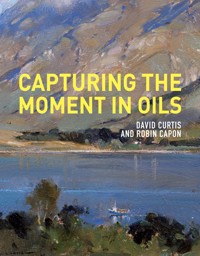
Capturing the Moment in Oils
Pembrokeshire Sea Cliffs, Port St Justinian
Oil on canvas, 61 x 76 cm (24 x 30 in)
The Dry Dock, Thorne, Yorkshire
Oil on board, 30.5 x 25.5 cm (12 x 10 in)
Capturing the Moment in Oils
David Curtis with Robin Capon
To my family, friends and painting companions
Contents
Introduction
1 Making a Start
A Versatile Medium
Essential Equipment
Developing Skills
2 Design Principles
Drawing and Observation
Viewpoints
Initial Marks
3 Capturing the Moment
Transient Effects
Light and Shade
Interpretation
4 Choosing Subjects
Features of Interest
Scale and Detail
Reference Material
Scope and Variety
5 Painting Plein Air
Practical Considerations
Speed and Confidence
Starting on Site
6 The Considered Approach
The Studio Environment
Planning and Composing
The Painting Process
Index
Acknowledgements
My special thanks to Robin Capon for his work on the text. He has shown a real empathy and understanding in conveying my thoughts and ideas, and it has been a genuine pleasure to work with him, both on this book and my previous one, Light and Mood in Watercolour.
www.djcurtis.co.uk
David Curtis is represented by Richard Hagen, Stable Lodge, Broadway, Worcestershire WR12 7DP.
Tel: 01386 853624; www.richardhagen.com
Introduction
A Pembroke Beach
Oil on canvas, 61 x 76 cm (24 x 30 in) I paint beach scenes throughout the year; they are one of my favourite types of subject matter.
Oil paint has always been the medium in which I have felt most confident. From the very first time I used it, in my early teens, I instinctively knew that it was the most suitable medium for my kind of painting – which even in those early, formative years was principally expressive, plein-air work (that is, painting outdoors). Naturally, to begin with, my colours were sometimes harsh and my attempts at handling paint rather crude and ‘lumpy’, but I instantly liked the feel of oil paint and the way that it could be moved about to shape forms and effects on a canvas or board. Without doubt that Christmas gift of an oil-painting set, when I was about 12 years old, proved to be an extremely significant present!
David Curtis in his studio
I remember quite clearly the first painting I did outside. It was a simple farmyard scene with a ginger cat in the foreground, and it still hangs in my mother’s bedroom. Guided by some very experienced local artists, notably Andy Espin-Hempsall, I soon began to appreciate the strengths of oils – both in terms of colour and technical range – for capturing the essence of a subject speedily and successfully. A quality I started to exploit, and which remains vital to the way I work today, is the fact that oils can be used in a very direct manner. If desired, a painting can be developed in a single session as a ‘one-hit’ process, with no further modifications.
Since those early days I have continued to explore the potential of oils for expressing the many different subjects and effects that inspire me to paint. I have now been painting for more than forty years, and from my experience I would certainly single out perseverance as one of the most important qualities that artists need. It takes a good deal of time and hard work to acquire the necessary skills and confidence, and even the most accomplished painters accept that there is always something new to learn.
As you will see when you study the text and illustrations in this book, I place great emphasis on observation and composition. Also, I firmly believe that figurative painters need good drawing skills. Exciting subject matter, accomplished technique and a sensitive use of colour are all very important aspects of painting, but the overall impact is invariably weakened if there are faults in the drawing or design.
Additionally I would like to make the point that while I love oil paint, I do not view it as an exclusive medium. I also paint in watercolour, and in the past I have worked in various other media, including pastel and pen-and-ink. There is great value, I think, in having the ability to switch from one medium to another. It gives you a fresh perspective, a different way of looking and understanding, and one medium can inform another. Often in the studio, and occasionally outside, I will start with an oil painting and then move on to work in watercolour, or vice versa. I find this a good way to keep my paintings lively and interesting.
This book covers every aspect of my working methods, from the materials I use to varnishing and framing the finished paintings. In all my work, whether in oils or watercolour, the transient effects of light, weather and mood are the features I am usually concerned with the most. Sometimes I paint in the studio, working from location drawings and similar reference material, but more often I paint on the spot, directly from the subject matter. In my opinion there is no substitute for this approach, and no more rewarding way of painting than to place a brushstroke in direct response to something you have just seen.
I think it is a pity that modern-day painters are less inclined to work outdoors. But if this book encourages more artists to adopt a plein-air approach, then I shall be delighted – there is no greater creative experience! Working on site is more rewarding for the artist, and similarly beneficial for the paintings, invariably giving them an inherent integrity and a real sense of connection with a certain place and time.
Brancaster Foreshore, Norfolk Coast
Oil on board, 30.5 x 40.5 cm (12 x 16 in) I like to work directly from the subject whenever I can, and I greatly enjoy the challenge of atmospheric scenes such as this.
1 Making a start
Pond and Garden, Gibdyke House
Oil on canvas, 51 x 30.5 cm (20 x 12 in)
Each painting medium – be it watercolour, oils, acrylics, tempera or gouache – has its own character, potential and limitations, and naturally it takes time, as well as a good deal of commitment and perseverance, before we can start using the medium with confidence. An interesting aspect of oil painting is its long history, and this is something that can obviously benefit the present-day artist, who can learn from many well-established procedures and techniques. Placing an emphasis on traditional skills is always a good way to begin, I think. Of course the eventual aim is to paint in a style that is distinctly your own, but the best means of achieving that is to first arm yourself with a sound understanding and knowledge of oil paint and oil-painting methods.
I know from my own experience, when I started painting in oils more than forty years ago, that progress depends on a willingness to experiment, and indeed learn from the mistakes that inevitably occur. I went out painting with much older and far more skilful artists, and I soon found that the best way to start in oils was to paint with broad areas of colour and to think in terms of simple, block-like shapes. I was advised not to use the paint too thickly to begin with; to avoid body colour (the addition of white paint in a mix) until the later stages of a painting; to set the dark tones with pure colour, while leaving the extreme whites as areas of unpainted canvas or board; and to work with bold, contrasting strokes.
In this way, I was told, I would be able to control the painting right from the start. It was good advice, and certainly advice that I, in turn, would offer others. The essential things to remember in oil painting are to work from thin to thick paint (what is known as painting ‘fat over lean’); to consider the general shapes before any detail; and always to avoid unnecessary detail.
A Versatile Medium
Oil paint has very distinctive paint-handling characteristics, and what makes it so different from other media is the richness and resonance of the colour quality that can be achieved, and the potential for very expressive marks, textures and surface effects. It is not, as many people are inclined to believe, suited only to large studio paintings. As A Kensington Side Street shows, oil paint is also an excellent medium for plein-air work, especially for capturing the fleeting effects of light, which is something that particularly interests me.
In fact, when painting outside, I would say that I usually capture a light effect better in oils than in watercolour. For me, oil paint is ideally a ‘one-hit’ medium, by which I mean the colours are applied in a quick, direct way, as more or less finished colours with no subsequent glazing or overworking, as explained in the section on alla prima. I also regard it as the prime all-weather medium. Watercolour is restricted in damp conditions, but with oils there is always the chance of at least setting down the essence of a scene – I have even painted in a snowstorm! I find the plasticity of the medium enables me to tease out the most incredible atmospheric effects, and, as you can see in Old Fishing Vessels, Peel Harbour, Isle of Man, strong darks really sing out and play their part in a composition painted in oils.
A Kensington Side Street
Oil on board, 18 x 25.5 cm (7 x 10 in) For me, oil paint is the perfect medium for small plein-air paintings that aim to capture a fleeting effect of light and mood.
Afternoon Light, Polperro Harbour, Cornwall
Oil on board, 25.5 x 35.5 cm (10 x 14 in) This was a plein-air study that I made in preparation for a larger, studio painting.
Old Fishing Vessels, Peel Harbour, Isle of Man
Oil on canvas, 51 x 51 cm (20 x 20 in) Here, for this more complex composition painted in the studio, I worked mainly from photographic reference and sketches.
Different Approaches
Many different working methods are possible in oil painting, and so with experience it is possible to select those techniques that are the most appropriate for the subject matter and effects you have in mind. The main techniques are explained here. However, whatever techniques are involved, their success and impact will depend to a large extent on the type of board or canvas surface that is chosen, and the way it is prepared.
When I paint outside I use prepared boards, as described below. But, after assessing the subject matter and the particular qualities that I want to concentrate on, as well as choosing a board of a certain colour, I decide whether I want to start with a wet surface or a dry one. Generally I like to work on a wet surface for subjects in which the dominant atmospheric or lighting effect would be best interpreted by drifting one colour into another. With a dry surface, on the other hand, I have already established an overall mid-tone against which I can place and subsequently develop strong lights and darks, as demonstrated in Sparkling Light, Staithes Beck.
Sometimes I prepare the board with an initial overall wash of colour the day before I intend to paint on site, and this gives a workable, though not slippery surface over which to create various effects of light and texture. On other occasions I apply the wash as the starting point for the painting and, while it is still wet, use a rag to remove the paint in those areas where I want highlights or extreme lights. Modifying the wet surface with different types of brushwork, or blending other colours into it, are useful techniques for suggesting a sense of distance or expressing the idea of fog, mist or other atmospheric effects. In the studio I may work on canvas, adopting similar methods for the initial ground colour and underpainting.
View from Cowbar Rise, Staithes
Oil on board, 25.5 x 30.5 cm (10 x 12 in) Whenever possible I prefer to work on site, directly from the subject. Outside, the paintings are usually small scale and painted on a prepared board.
Canal Basin, Bruges
Oil on board, 25.5 x 18 cm (10 x 7 in) I liked the drama of the contrasting tones in this low-light subject, and my aim was to capture the effect as quickly as I could, before anything changed.
Calm Waters, Loch Linnhe, Argyll
Oil on board, 30.5 x 25.5 cm (12 x 10 cm) I painted this lovely atmospheric scene from a cottage window.
Sparkling Light, Staithes Beck
Oil on board, 23 x 30.5 cm (9 x 12 in) For this study I used a board that was already prepared with a dry, mid-tone ground, which enabled me quickly to place and develop the strong lights and darks.
Light over Dark
In the studio, obviously, it is possible to work on a much larger scale, take your time and tackle more complex subjects and ideas. Paris Boulevard in the Spring is an example of one of my studio paintings, which in this case was developed from a small pochade-box oil sketch, some photographs, a number of sketchbook studies (mainly of cars and people) and of course my memory of the scene. Another approach I sometimes use is to start a painting outside and finish it later in the studio. It could be that the weather, light or some other factor prevented me finishing the painting on site. Blakow Hill, Nottinghamshire was painted in this way.
But whether I work in the studio or outside, I want the painting to have an Impressionist quality, to feel spontaneous and of the moment. At all costs I try to avoid any of the brushstrokes looking laboured. Rather, I want them to appear as though they were made instinctively and freely. This is easier to achieve outside, of course, where there is a greater sense of urgency because of the constraints of time and light. Another difference when working outside is that the approach is essentially alla prima, whereas in the studio the painting can be developed in stages and, if necessary, the paint built up in layers.
Paris Boulevard in the Spring
Oil on canvas, 51 x 66 cm (20 x 26 in) This studio painting was inspired by a small oil sketch made on the spot. Additionally I used sketchbook drawings as references for the figures and cars.
Blakow Hill, Nottinghamshire
Oil on board, 30.5 x 40.5 cm (12 x 16 in) Sometimes, as here, it is not possible to complete the painting on site due to weather conditions or any number of other factors. The finishing touches are therefore added later, in the studio.
As I have mentioned, oil paint should be applied ‘thick over thin’ – that is, thinly to start with, with thicker layers on top. Principally this is because thin paint dries quicker than thick paint. Therefore, if you work the other way round – thin over thick – the underpainting will dry slower than the rest, which most likely will lead to cracking of the paint surface. What is also interesting about oil painting is that usually the dark areas are established first, in the thinnest paint. Essentially the process is one of working lighter colours over darker ones, finishing with the highlights, whites and other pale colours, which are handled as bolder, impasto strokes. This is in direct contrast to the approach used for watercolour painting, which relies on working dark over light.
History and Tradition
Despite the wide choice of painting media available today, oil painting remains a popular technique, especially for figurative work. It was the Flemish artists of the early 15th century who first used oil paint, and thereafter the medium soon attracted attention throughout Europe. While fresco and tempera painting, which were the techniques commonly used at that time, had their own particular aesthetic qualities, they could not rival the level of realism and variety of effects that were now possible with oils.
If you research the history of oil painting you will find numerous great artists whose work will inspire and help you. The Dutch painters, such as Rembrandt and Hobbema; the Barbizon plein-air artists, including Corot and Daubigny; Constable; and of course the Impressionists, perhaps especially Sisley, Pissarro, Monet and Cézanne, are just a few of the artists and movements worth considering. As well as looking at art books, visit some of the major galleries if you can and view the actual paintings. Additionally, there are plenty of exciting oil paintings by contemporary artists that can be seen at exhibitions staged by the major societies at the Mall Galleries in London and at other venues.
On the Hard, Cadgwith Cove
Oil on board, 30.5 x 40.5 cm (12 x 16 in) Choice of viewpoint is another factor that can add drama to a painting. Here, I chose a low viewpoint to make the most of the interest and impact in the scene.
Low Tide, Mevagissey, Cornwall
Oil on board, 30.5 x 40.5 cm (12 x 16 in) This was quite an ambitious subject to attempt plein air, but fortunately I had time and conditions on my side. Some of the details were added later, in the studio.
Influences
It can be immensely rewarding to study paintings by artists whose work you admire. However, it is never a good idea, I think, to try to emulate the style of another artist. On the other hand, you may well find small aspects of technique, unusual colour mixes, a particularly striking composition, or similar points that are interesting and worth experimenting with. In this way you may decide to adapt and assimilate something you have noticed in another painting into your own range of working techniques.
I have always loved the work of the Impressionists, painters such as Monet and Pissarro, who were able to capture so convincingly the transient effects of light. Equally, I enjoy the paintings of lesser-known artists, for example Walter Langley, a Newlyn School artist who explored the technique of painting with a square-ended brush to create skilfully drawn, beautifully crisp shapes.
I admire too the garden paintings of Douglas Stannus Gray, with their joyous, Impressionistic touch and wonderful sense of dappled light; the marine and figure subjects painted by Henry Scott Tuke; the impressive, large-scale pictures of horses by Lucy Kemp Welch; and the work of Harold and Laura Knight, who painted at one of my favourite places, Staithes. These are just a few of the artists whose work I have found interesting and inspirational during my career.
Conversation on the Bridge
Oil on canvas, 40.5 x 40.5 cm (16 x 16 in) I greatly enjoy the challenge of capturing a particular quality of light, and I am always interested in seeing how other artists tackle similar subjects.




