


204,99 €
Mehr erfahren.
- Herausgeber: Thieme
- Kategorie: Fachliteratur
- Sprache: Englisch
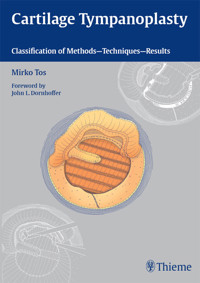
A superbly illustrated atlas of cartilage tympanoplasty methods
Written by a pioneering master in the field, Cartilage Tympanoplasty: Classification of Methods-Techniques-Results, is a comprehensive reference for all the currently used methods of cartilage tympanoplasty. In the opening chapters of the book, Mirko Tos provides a thorough overview of this class of procedures, including a classification of 23 original cartilage tympanoplasty methods. Each of the following chapters offers a detailed exposition of a different method, presenting its definition, indication, graft harvesting and shaping, surgical technique, and an analysis of the anatomical and functional results based on a review of the literature and on personal experience. In the closing chapters, the author discusses long-term outcomes and compares the results of the various cartilage tympanoplasty methods.
"Mirko Tos has written a remarkable book...The entire community of otologic surgeons will benefit from this contribution."--From the foreword by John Dornhoffer, MD, FACS
Das E-Book können Sie in Legimi-Apps oder einer beliebigen App lesen, die das folgende Format unterstützen:
Seitenzahl: 866
Veröffentlichungsjahr: 2009
Ähnliche


















Library of Congress Cataloging-in-Publication Data
Tos, Mirko
Cartilage tympanoplasty/Mirkos Tos.
p.;cm.
Includes bibliographical references.
SBN 9783131495419 (alk. paper)
1. Tympanoplasty. 2. Articular cartilage I. Title.
[DNLM: 1. Tympanoplasty-methods. 2. Ear Cartilage-surgery.
WV 225 T713c 2009]
RF126.T67 2009
617.8'059-dc22
2009012403
Illustrator: Regitze Steinbruch, Denmark
© 2009 Georg Thieme Verlag,
Rüdigerstrasse 14, 70469 Stuttgart, Germany
http://www.thieme.de
Thieme New York, 333 Seventh Avenue,
New York, NY 10001, USA
http://www.thieme.com
Cover design: Thieme Publishing Group
Typesetting by Primustype Hurler, Notzingen, Germany
Printed in India by Replika Press PV TLTD, Delhi
ISBN 9783131495419
1 2 3 4 5 6
Important note: Medicine is an ever-changing science undergoing continual development. Research and clinical experience are continually expanding our knowledge, in particular our knowledge of proper treatment and drug therapy. Insofar as this book mentions any dosage or application, readers may rest assured that the authors, editors, and publishers have made every effort to ensure that such references are in accordance with the state of knowledge at the time of production of the book.
Nevertheless, this does not involve, imply, or express any guarantee or responsibility on the part of the publishers in respect to any dosage instructions and forms of applications stated in the book. Every user is requested to examine carefully the manufacturers' leaflets accompanying each drug and to check, if necessary in consultation with a physician or specialist, whether the dosage schedules mentioned therein or the contraindications stated by the manufacturers differ from the statements made in the present book. Such examination is particularly important with drugs that are either rarely used or have been newly released on themarket. Every dosage schedule or every form of application used is entirely at the user's own risk and responsibility. The authors and publishers request every user to report to the publishers any discrepancies or inaccuracies noticed. If errors in this work are found after publication, errata will be posted at www.thieme.com on the product description page.
Some of the product names, patents, and registered designs referred to in this book are in fact registered trademarks or proprietary names even though specific reference to this fact is not always made in the text. Therefore, the appearance of a name without designation as proprietary is not to be construed as a representation by the publisher that it is in the public domain.
This book, including all parts thereof, is legally protected by copyright. Any use, exploitation, or commercialization outside the narrow limits set by copyright legislation, without the publisher's consent, is illegal and liable to prosecution. This applies in particular to photostat reproduction, copying, mimeographing, preparation of microfilms, and electronic data processing and storage.
Preface
The first and main goal of this book is to teach otologists who are in training cartilage tympanoplasty methods, using step-by-step demonstration of the surgery.
This is the first book on cartilage tympanoplasty and represents the very first collection of all known cartilage tympanoplasty methods. I hope, therefore, that experienced otosurgeons may also profit from this book.
In recent years cartilage tympanoplasties have been used more and more often in otosurgical practice and several new methods have been published, allowing me in this book to classify 23 original cartilage tympanoplasty methods. In the individual chapters each method is thoroughly defined, illustrated, and described, which is the second goal of this book.
The third goal is to analyze the anatomical and functional results of surgery, to illustrate functional differences between the various methods, and to promote clinical and basic researchin cartilage tympanoplasty.
I have used cartilage for reconstruction of the ear canal wall and obliteration of the attic, antrum, and mastoid cavity since the early 1960s. Inspired by Heermann, who also was a frequent teacher on the Bochum tympanoplasty courses, I started sporadically with cartilage palisades in the 1990s. In Volume 1 of the Manual of Middle Ear Surgery (1993) I included a chapter on cartilage tympanoplasty, with illustration of the annular graft method, posterior cartilage-perichondrium composite island graft method, micro sliced cartilage methods, and the cartilage palisade techniques of Heermann. In Volume 2 (1995) the methods of reconstruction of the ear canal wall with cartilage and the methods of obliteration of the mastoid cavity were described and illustrated. During 1995–2000 I reconstructed the eardrum in half of the children with cholesteatoma at the Gentofte Hospital with cartilage palisades and in the other half with fascia. Three years and again ten years after surgery, the anatomical and functional results were significantly better in the palisade group than in the fascia group. These results convinced me that cartilage tympanoplasty is a good method, especially for difficult cases. From 1995 to my retirement from the Gentofte Hospital in 2001 and during the following 3 years of surgery outside my hospital, I used most often the cartilage methods. In 2004 I started to write this book.
Writing such book from the age of 73 to 77 years, at home, without a secretary and with my two-finger typing, is not easy and demands enormous discipline and a strong will to finish it. At the start I did not dream that the book would end with 28 chapters, but several new methods have been published and included, resulting in 23 original methods.
With only one exception, all the illustrations were made especially for this book in the same manner as in my previous books: I sketched each illustration in pencil on parchment paper, then the artist, Regitze Steinbruch, copied it and redrew it in ink on another parchment. Regitze also made the figures for Volumes 1 and 2 and partly for Volume of 4 of Manual of Middle Ear Surgery in the same way.
I would like to thank Dr. SV Fernandes, from Newcastle, Australia, the author of the ”Triple C“ Technique (Chapter 26), for great help in reading and correcting the text of most of the chapters, and Dr. MW Yung for correcting the text of Chapter 14.
The staff of the Gentofte Hospital Library were very helpful in finding the literature I needed.
I also wish to thank many friends and authors for discussion about and help with explanation of their cartilage methods: M Bernal-Sprekelsen, AE Ferekidis, SV Fernandes, F Hitari, J Heermann, K-B Hüttenbrink, K Jahnke, J. Klacansky, H Martin, C Milewski, B Morra, and D Portmann.
Finally I would like to thank my beloved wife Nives for her help and patience during the retirement and the cartilage tympanoplasty years. I was never able to answer her constant question: Do you really need this book?
Mirko Tos
Foreword
While cartilage has been used to a limited extent in otosurgical procedures for many years, its utility in major reconstruction of the tympanic membrane has become increasingly recognized. While routine acceptance of cartilage tympanoplasty has been hampered by anticipated worsening of hearing results with the use of a thick graft, many studies comparing cartilage to more traditional grafting materials have shown no difference in hearing post-operatively. Likewise, the rigidity and stability of cartilage, especially in the hostile middle ear environment often found in the surgical ear, have made it invaluable in cases of cholesteatoma, atelectasis, and recurrent perforations.
The techniques involved in cartilage tympanoplasty do present a few nuances that must be appreciated, such as graft harvest, cartilage shaping, and placement. Likewise, the creation of an opaque ear drum must be anticipated in the post-operative period. Intubation of the tympanic membrane, if deemed necessary, can be difficult. As a result of this, several techniques have evolved with modifications in graft thickness, placement, and degree of drum reconstruction based on the clinical situation or surgeon's preference. Some represent minor variations of existing techniques while others are quite novel and intuitive.
Mirko Tos has written a remarkable book, the only comprehensive text to my knowledge, on cartilage tympanoplasty. Since reading his manuals of middle ear surgery over 15 years ago, I have appreciated Professor Tos' ability to classify, organize, and explain middle ear surgery in a clear but detailed way. This book continues in that tradition and clearly reflects his 40 years of experience in otosurgery. The book is well illustrated and is unique in the fact that the initial drawings were produced by Professor Tos. As a result, they are straightforward and easy to follow from a surgeon's perspective.
There is no question that this book will not only be valuable to the otologist in training, but also to more advanced surgeons. As a surgeon experienced and published in cartilage tympanoplasty, I was astounded by Mirko Tos' ability to provide sucha comprehensive treatise of techniques, from so many different surgeons, and explain them in a way that only an experienced ear surgeon could. I read this book from cover to cover and learned a great deal. The entire community of otologic surgeons will benefit from this contribution.
John Dornhoffer M.D., F.A.C.S
Professor of Otolaryngology
Director of Otology and Neurotology
Samuel McGill Chair in Otolaryngology Research
University of Arkansas for Medical Sciences
Little Rock, Arkansas, USA
Table of Contents
1 History of Cartilage Tympanoplasty
Introduction
Cartilage in Ossiculoplasty in Tympanoplasty Type 2 with Intact Stapes
Cartilage Slices in Tympanoplasty Type 2 with Intact Stapes
Cartilage in Ossiculoplasty in Tympanoplasty Type 3 with Missing Stapedial Arch
Myringoplasty Using Autogenous Septal Cartilage by Salen—the First Cartilage Tympanoplasty
The Heermann Cartilage Bridge from the Stapes Columella to the Inferior Annulus
The Broad Heermann Stapes–Annulus Cartilage Bridges
The Tunnelplasty
Cartilage Palisade Tympanoplasty
The Goodhill Annular Graft—the First Cartilage–Perichondrium Composite Graft
2 Classifications and Definitions
Classification of Cartilage Tympanoplasty Methods
Cartilage Grafts
Cartilage Palisades
Cartilage Strips
Cartilage Foils, Thin Plates, and Thick Plates
Cartilage–Perichondrium Composite Island Grafts
Special Cartilage–Perichondrium Composite Island Grafts
Composite Islands Grafts for Minor, Medium-sized, and Subtotal Perforations
Special Cartilage Methods in Small and Medium-Sized Perforations
Classification of Tympanoplasty
Cartilage Tympanoplasty
Classification of Tympanoplasty in Relation to Ossiculoplasty
Pictorial Key to the Drawings in this Book
Pieces of Cartilage and Cartilage Palisades
Cartilage Strips, Foils, and Plates
Composite Cartilage–Perichondrium Grafts
Soft Tissues
Bony Tissues
Other Elements
3 Approaches and Harvesting of Cartilage
Approaches
Transmeatal Approach through Fixed Ear Speculum
Endaural Approach with Intercartilaginous Incision
Retroauricular Approach
Harvesting of Cartilage
Harvesting of Tragal Cartilage
Harvesting of Cartilage from the Auricle
Harvesting of Cartilage in Endaural Approaches
Thinning the Cartilage
The Hüttenbrink Cartilage Guide
The Groningen Cartilage Cutting Device
4 Cartilage Palisades in Underlay Tympanoplasty Techniques
Definition
Indications for Surgery
Harvesting and Shaping of Palisades
Surgical Techniques
Posterior Perforation
Inferior Perforation
Total Perforation
Underlay Cartilage Palisade Technique and Ossiculoplasty
Modifications of Cartilage Palisade Technique
Ferekidis Chondrotympanoplasty
Covering Palisades with the Perichondrium
Cartilage Palisades and Fascia
Results of Surgery with Palisades in Underlay Tympanoplasty Techniques
Results in Pars Tensa Cholesteatoma in Children
Comparing Results of Cartilage Palisades with Fascia
Comparing Functional Results and Tympanometry
Comparison of Underlay Cartilage Palisades with Fascia—Recent Results
Late Results in Underlay Palisade Technique
Ten-year Results of Cartilage Palisades versus Fascia in Eardrum Reconstruction after Surgery for Sinus or Tensa Retraction Cholesteatoma in Children
Author's Comments and Proposals
Clinical Research on Cartilage Tympanoplasty Is Needed
Placement of the Palisades
Gelfoam in the Tympanic Cavity or Not?
Small On-lay Perichondrium Grafts
Why Not Perichondrium Covering on Both Sides of the Palisade?
5 Cartilage Palisades in On-lay Tympanoplasty Techniques
Definitions
Full-Thickness Palisades
Half-Thickness Palisades and Perichondrium Flaps
Harvesting and Shaping of the Palisades
Harvesting of the Palisades
Shaping of the Palisades
Curling of the Cartilage Grafts
Indications for On-lay Palisade Technique
Surgical Techniques with On-lay Placement of Palisades
Anterior Perforation
Inferior Perforation
Total Perforation
Results of On-lay Cartilage Tympanoplasty Techniques
Author's Comments on On-lay Palisade Techniques
Clinical Research in On-lay Cartilage Technique is Needed
6 Tympanoplasty with Broad Cartilage Palisades
Definition
Harvesting and Shaping of Broad Palisades
Indications for Tympanoplasty with Broad Cartilage Palisades
The Bernal-Sprekelsen Broad Palisade Techniques
Total Perforation with Intact Ossicular Chain
Total Perforation with Missing Ossicles
Total Perforation with Missing Long Process of Incus
Retracted and Adherent Malleus Handle in a Total Perforation with Defective Incus
Broad Palisades and Various Tympanomastoidectomies
Closure of an Atticotomy with Broad Cartilage Palisades
Results in Tympanoplasty with Broad Cartilage Palisades
Anatomical Results
Functional Results
Author's Comments and Recommendations
The Longest Follow-up Period
Evaluation of Hearing Results in Tympanoplasty Type 1 with Broad Cartilage Palisades Is Needed
Support of Broad Palisades by Small Pieces of Cartilage
7 Cartilage Strips in Underlay Tympanoplasty Techniques
Definition
Harvesting and Shaping of the Cartilage Strips
Cutting and Shaping of the Cartilage Strips
Indications for Cartilage Strips in Underlay Techniques
Surgical Techniques
Posterior Perforation
Inferior Perforation
Total Perforation
Tunnelplasty
Reconstruction of the Eardrum and the Attic Wall with Cartilage Strips
Covering the Cartilage Strips with Perichondrium
Results of Surgery
Comparison of Results of Underlay Cartilage Strip Technique with Fascia Grafting
Conclusion on Results of the Underlay Cartilage Strip Technique
Author's Comments and Recommendations
8 Cartilage Strips in On-lay Tympanoplasty Techniques
Definition
Harvesting and Shaping of the Cartilage Strips
Indications for Surgery
The On-lay Cartilage Strip Techniques
Anterior Perforation
Inferior Perforation
Total Perforation
On-lay Cartilage Strips in ossiculoplasty
Results of Surgery
Author's Comments and Recommendations
Need for Clinical Research
9 The Dornhoffer Cartilage Mosaic Tympanoplasty
Definition
Harvesting and Trimming of the Cartilage
Indications for Cartilage Mosaic Tympanoplasty
Surgical Techniques of Cartilage Mosaic Tympanoplasty
Posterior Perforation
Inferior Perforation
Subtotal Perforation
Total Perforation
Results of Surgery
Author's Comments and Recommendations
10 Underlay Tympanoplasty with Cartilage Foils and Thin Plates
Definition
Harvesting and Elaboration of Cartilage Foils and Thin Plates
Portmann's Tangential Cutting of Conchal Thin Plates and Lamellae
Indications for Surgery
Underlay Techniques with Foils and Thin Plates
Posterior Perforation
Inferior Perforation
Total Perforation
The Portmann Mosaic Underlay Cartilage Tympanoplasty with Foils or Thin Plates
Results after Surgery with Cartilage Foils or Thin Plates Covered with Perichondrium
Author's Comments and Recommendations
11 On-lay Tympanoplasty with Cartilage Foils and Thin Plates
Definition
Harvesting and Elaboration of Cartilage Foils and Thin Plates
Indications for On-lay Tympanoplasty with Cartilage Foils and Thin Plates
On-lay Techniques with Foils and Thin Plates
Anterior Perforation
Inferior Perforation
Total Perforation
Results after On-lay Tympanoplasty with Cartilage Foils
Author's Comments and Recommendations
12 On-lay Tympanoplasty with Thick Cartilage Plates
Definitions
Harvesting and Elaboration of the Cartilage Plates
On-lay Techniques with Thick Cartilage Plates
The Jansen Cartilage Plate On-lay Tympanoplasty
Tympanoplasty Type 2 or Type 3 and Cartilage Plates
“Cartilage Boards” On-lay Technique
Cartilage Plates in Stabilization of the Columella
Full-Thickness Cartilage Plate
Results of Surgery with Cartilage Plates
Results of the Early On-lay Techniques
Author's Comments and Recommendations
Effect of the Thickness of The Cartilage Disk on Hearing
Experimental Investigation of the Use of Cartilage in Tympanic Membrane Reconstruction
Methods
Sound Pressure Response
Clinical Research on the Thickness of Cartilage Grafts
Problems with Curling
Optimal Graft Thickness for Different Sizes of the Perforation
13 Underlay Tympanoplasty with Thick Cartilage Plates
Definitions
Harvesting and Elaboration of the Autogenous Cartilage Plates
The Underlay Tympanoplasty Techniques with Thick Cartilage Plates
Cartilage Plate Covered with Fascia
Cartilage Plate Covered with Areolar Tissue—a Cartilage Shield Tympanoplasty?
Cartilage Shield Tympanoplasty of Moore
Tympanoplasty with Cartilage Plates Only
Tympanoplasty with Crushed Autogenous Cartilage Plate
Tympanoplasty with Irradiated Homogenous Rib Cartilage Plates
Reinforcement of the Tympanic Membrane with Cartilage Plates after Removal of Congenital Cholesteatoma
Results of Surgery with Cartilage Plates
Results of Recent Underlay Techniques
Author's Comments and Proposals
Classification of Cartilage Shield Tympanoplasty
14 Superior (or Attic) Cartilage–Perichondrium Composite Island Graft Tympanoplasty
Definition
Indications for Surgery
Surgical Methods for Closure of Bony Defects of the Scutum
McCleve Technique
Fleury Technique
Adkins Technique
Black Technique
Honda Scutumplasty
Quinn Technique
Results of Surgery
Lateral Attic Reconstruction (LAR) Technique: Preventive Surgery for Epitympanic Retraction Pockets
Author's Comments and Proposals
Difficulties in Comparison of the Various Series
15 Posterior Cartilage–Perichondrium Composite Island Graft Tympanoplasty
Definition
Harvesting and Shaping of the Graft
Shaping of the Posterior Cartilage-Perichondrium Island Graft
Indications for Surgery
Surgical Techniques with Posterior Cartilage–Perichondrium Composite Island Graft
Transmeatal Technique with Posterosuperior Island Graft
Transmeatal Removal of a Posterior Retraction
Transmeatal Removal of the Sinus Cholesteatoma
Removal of a Large Sinus Cholesteatoma
Retrograde Atticoantrotomy in a Large Sinus Cholesteatoma
Posterior Ear Canal Wall Reconstruction with a Composite Cartilage Titanium Mesh Graft
Cartilage Ossiculoplasty and Myringoplasty by Lever Method
Results of Surgery with the Posterior Island Graft
Author's Comments and Recommendations
When to Operate a Posterior Retraction?
Pathogenesis of Sinus Cholesteatoma
When to Operate a Posterior Perforation?
16 Superior and Posterior Cartilage–Perichondrium Composite Island Graft Tympanoplasty
Definition
Harvesting and Shaping of the Graft
Indications
Surgical Methods
Technique of Levinson
Technique of Poe and Gadre
Two Separate Grafts of Couloigner
Results of Surgery
Levinson Series
Series of Poe and Gadre
Pediatric Series with Two Separate Cartilage–Perichondrium Composite Island Grafts
Author's Comments and Recommendations
Vibratile and Non-vibratile Island Grafts
Prevalence and Classification of Attic Retractions
Attic Precholesteatoma
Pathogenesis of Attic Cholesteatoma
The Incidence of Cholesteatoma
17 Total Pars Tensa Cartilage–Perichondrium Composite Island Graft Tympanoplasty
Definitions
The Tolsdorff and the Nitsche Grafts
Harvesting and Shaping of the Cartilage Graft
Shaping of the Tolsdorff Graft
Shaping of the Dornhoffer Graft
Klacansky Small Total Pars Tensa Composite Island Graft
Other Pars Tensa Composite Grafts
Indications for Surgery
Surgical Techniques
The Nitsche On-lay Technique
The Tolsdorff Technique
The Würzburg Clinic Techniques
The Dornhoffer Technique
Results of Surgery with the Total Tensa Composite Graft
The First Würzburg Series (1982–1987)
The Second Würzburg Series (1989–1994)
The Dornhoffer Series
Outcomes by Surgical Indication
Pediatric Series
Comparison of the Cartilage–Perichondrium Graft with the Fascia Graft
Series with Posterior and Total Pars Tensa Grafts
Author's Comments and Recommendations
18 Annular Cartilage–Perichondrium Composite Graft Tympanoplasty
Definition
Previous Applications of the Annular Graft
Harvesting and Shaping of the Annular Graft
The Klacansky Chondrotome
Circular Graft and U-Graft
Indications for Application of Annular Grafts
Surgical Techniques with Annular Grafts
Goodhill's On-lay Annular Graft Technique
Annular Graft in Tympanoplasty Type 2 with Interposition Techniques
Annular Graft in Tympanoplasty Type 3 with a Columella
The Klacansky Annular Graft Technique with Removal of Fibrous Annulus and Eardrum Remnant
Further Development of the Klacansky Annular Graft
The Borkowski Underlay Annular Graft Technique
Retracted Malleus Handle and Annular Graft
Missing Malleus Handle and Annular Graft
Circular Annular Graft in Case of Missing Entire Malleus
U-shaped Annular Graft in Large Inferior Perforation
Annular Graft in the Reconstruction of the Tympanic Cavity after a Canal Wall Down Mastoidectomy
Results of Surgery with the Annular Graft
Author's Comments and Proposals
Need for Future Research on Clinical Series with Annular Graft
19 “Crown Cork” Cartilage–Perichondrium Composite Graft Tympanoplasty
Definition
Harvesting and Construction of the “Crown Cork” Graft
Harvesting of Tragal Cartilage
Harvesting of Conchal Cartilage
Indications for “Crown Cork” Tympanoplasty
Congenital Malformations
Acquired Ear Canal Lesions
Surgical Techniques of “Crown Cork” Tympanoplasty
Schematic Illustration of Surgical Principle in Congenital Type 2a Atresia Reconstructed with Crown Cork Tympanoplasty
Surgery of Congenital Type 2b Atresia Applying Crown Cork Graft
Removal of Fibrous Tissue in Blunting Phenomena When Applying Crown Cork Tympanoplasty
Results of the “Crown Cork” Tympanoplasty
Author's Comments and Recommendations
20 Cartilage Shield T-Tube Tympanoplasty
Definition
Harvesting and Construction of the Cartilage Shield T-Tube Grafts
Construction of the Hall Cartilage Shield T-Tube Graft in Intact Eardrum
Construction of the Duckert Cartilage Shield T-Tube Graft
Construction of the Dornhoffer Cartilage Shield T-Tube Graft
The Elsheikh U-shaped Cartilage-Perichondrium T-Tube Graft
Indication for Cartilage Shield T-Tube Tympanoplasty
Surgical Techniques
The Hall Technique
The Duckert Technique
The Dornhoffer Technique
Application of the Elsheikh Graft
Postoperative Care and Problems
Accidental or Intentional Removal of the Tube
Reinsertion of the T-Tube in a Cartilage Shield Graft
Malfunction of the T-Tube due to Plugged Cerumen
Formation of Granulation Tissue at the Tube-Perichondrium Interface
Infection and Otorrhea
Medialization of the Cartilage Graft
Results of Cartilage Shield T-Tube Tympanoplasty
Hall's Series of Children
The First Series of Duckert and Co-workers
The Later Series of Duckert and Co-workers
The Series of Danner and Dornhoffer
The Randomized Prospective Study of Elsheikh and Co-workers
Author's Comments and Recommendations
Proposal of an Inferior Cartilage Shield T-Tube Graft
Comments on Tubal Function
Need for Testing of Tubal Function
Cartilage Shield T-Tube Tympanoplasty Provides Ideal Opportunities for Long-Term Research on Tubal Function
21 Underlay Tympanoplasty Techniques with Cartilage–Perichondrium Composite Island Graft
Definition
Harvesting and Shaping of the Island Graft
Indication for Application of the Underlay Island Graft
Surgical Techniques
Anterior Perforation
Inferior Perforation
Subtotal Perforation
Cartilage Graft in Type 1 Tympanoplasty—A Modification without Perichondrium Flaps
Results of Surgery with the Island Graft
Comparison with Fascia
Author's Comments and Recommendations
Drilling a Hole or a Groove into the Bony Annulus
Modifications of the Techniques
22 In-lay Underlay Tympanoplasty Techniques with Cartilage–Perichondrium Composite Island Graft
Definition
Harvesting and Shaping of the Graft
Indications for In-lay Underlay Technique
The In-lay Underlay Techniques
Anterior Perforation
Inferior Perforation
Posterior Perforation
Subtotal Perforation
Results of Surgery
Author's Comments and Recommendations
23 On-lay Tympanoplasty Techniques with Cartilage–Perichondrium Composite Island Graft
Definition
Harvesting and Elaboration of the On-lay Island Graft
Thinning, Trimming, and Shaping of On-lay Island Grafts
Indications for Surgery
Surgical Techniques of On-lay Tympanoplasty with Island Grafts
Anterior Perforation
Inferior Perforation
Total and Subtotal Perforations
Results of Surgery with On-lay Techniques
Author’s Comments and Recommendations
Research on Epithelialization of the Cartilage Grafts is Needed
24 In-lay On-lay Tympanoplasty Techniques with Cartilage–Perichondrium Composite Island Graft
Definition
Harvesting and Elaboration of the Graft
Indications for Application of the In-lay On-lay Graft
The In-lay On-lay Technique
Anterior Perforation
Posterior Perforation
Inferior Perforation
Subtotal Perforation
Total Perforation
Pediatric Interleave Tympanoplasty
Results of Surgery
Results of Pediatric Cartilage Interleave Tympanoplasty
Author's Comments and Recommendations
Minimally Invasive Surgery
Composite Island Grafts for Small and Medium-sized Perforations
25 In-lay Butterfly Cartilage Tympanoplasty
Definition
Indications
Harvesting and Shaping of the Butterfly Cartilage Graft
The In-lay Butterfly Cartilage Technique
Grafting of a Small Anterior Perforation
Grafting a Medium-Sized Inferior Perforation
Butterfly Technique in Large Perforations
Butterfly Prosthesis Placed onto the Bony Annulus
Results of the In-lay Butterfly Technique
Author's Comments and Recommendations
Problems with Epithelialization of the Graft
Elevation of the Epithelium Instead of Removal
Closure of Large Perforations and Postoperative Hearing
Future Research Needed
26 Composite Chondroperichondrial Clip Tympanoplasty: The Triple “C” Technique
Definition
Indications for the Triple “C” Techniques
Harvesting and Preparation of the Graft
Surgical Techniques
Anterior Perforation
Inferior Perforation
Posterior Perforation
Results of Triple “C” Technique
Author's Comments and Proposals
27 The Fate of Implanted Cartilage Grafts
The Nourishment of the Cartilage
Experiments on the Fate of Transplanted Cartilage
Living Cartilage Implanted into Animals
Living Cartilage Implanted into Humans
Otological Research on Cartilage Grafts
The Fate of Cartilage Columellae and Struts
The Fate of Cartilage Grafts after Myringoplasty
Author's Comments and Recommendations
The Fate of the Implanted Cartilage and Clinical Consequences
28 Clinical Research in Cartilage Tympanoplasties
Postoperative Results without Comparison with Other Series
Comparison of Functional Results within the Same Cartilage Tympanoplasty in Relation to the Preoperative Tubal Function
Comparison of Functional Results within the Same Cartilage Tympanoplasty in Relation to the Postoperative Tubal Function
Comparison of the Results in Cartilage Tympanoplasty Methods with the Results in Tympanoplasty Methods Using Fascia or Perichondrium Graft
Tympanoplasty with Total Pars Tensa Cartilage–Perichondrium Composite Island Graft Compared with Tympanoplasty with Perichondrium Graft
Underlay Tympanoplasty with Cartilage Palisades Compared with Underlay Tympanoplasty with Fascia Graft
Tympanoplasty with Total Pars Tensa Cartilage-Perichondrium Composite Island Graft Compared with Tympanoplasty with Fascia Graft
Underlay Tympanoplasty with Cartilage Strips Compared with Underlay Tympanoplasty with Fascia
Comparison of Results between Various Cartilage Tympanoplasty Methods
Proposals for the Methods of Clinical Research in Cartilage Tympanoplasty
Comparison of Results within Group A
Index
1 History of Cartilage Tympanoplasty
Introduction
In this chapter, the very first cartilage ossicular prostheses will be briefly mentioned.The first series of cartilage myringoplasty techniques published in 1963 by Salen will be described and illustrated by redrawing his diagrams.The beginning and evolution of Heermann's palisade techniques will be described in detail and illustrated by redrawing his illustrations.The very first cartilage–perichondrium composite graft—the annular graft of Goodhill (1967)—will be illustrated.The historical aspects of other cartilage methods, such as cartilage strips, cartilage foils or plates, various cartilage–perichondrium composite grafts, and some specific, recently published new methods will be described at the beginning of the respective chapters involving these methods.Cartilage in Ossiculoplasty in Tympanoplasty Type 2 with Intact Stapes
The classification of tympanoplasty used in this book is described in Chapter 2 and in Tos (2008), and also in Volume 1 of Manual of Middle Ear Surgery Tos (1993).
The first ear surgeon to apply cartilage in middle ear surgery was Utech (1959, 1960, 1961). In the latter 1950s, Utech placed a rectangular piece of tragal cartilage without perichondrium onto the stapes tendon and brought the cartilage prosthesis into contact with the eardrum (Fig.1.1a). Utech was also responsible for placing the cartilage prosthesis onto the head of the stapes and under the eardrum (Fig.1.1b). Other cartilage prostheses placed on the stapes head have been inspired by Utech (Fig.1.1c–f).
In the late 1950s, Jansen used an allogenous septal cartilage plate as a short T-prosthesis in cases of missing incus and intact stapes (Fig. 1.2a, b) (Jansen 1963). In the early 1960s, Glasscock and Shea (1967) applied a solid “horse-rider” prosthesis shaped from septal cartilage in situations where an intact stapes was present (Fig. 1.3).
During the last 40 years, various cartilage partial ossicular replacement prostheses (PORPs) have been developed and are illustrated in Tos (1993). Subsequently all PORPs made of allogenous cartilage were abandoned. PORPs made of autogenous cartilage are still in use.
Cartilage Slices in Tympanoplasty Type 2 with Intact Stapes
Waltner (1966) published a curious ossiculoplasty technique using thin and long cartilage slices placed onto the head of the stapes (Fig.1.4a–c). The tragal cartilage is cut 3mmwide and 10–12 mmlong. The pieces are then split to one-half or one-third of their thickness. The slices do not touch the promontory and are supposed to grow together with the fascial graft that will cover the eardrum perforation. The slice is either placed under the remnant of the long process of the incus (Fig.1.4a) or replaces the incus (Fig.1.4b), or two slices replace both the incus and the malleus (Fig.1.4c). The use of the thin slices was inspired by Heermann's stapes–annulus bridges (see Fig.1.7a, b).
Cartilage in Ossiculoplasty in Tympa-noplasty Type 3 with Missing Stapedial Arch
Utech (1959, 1960, 1961) was also the first surgeon to use a cartilage stapes columella in cases with a missing stapes (Fig.1.5a). Jansen (1963) applied a T-shaped allogenous septal cartilage graft in the early 1960s in similar situations (Fig.1.5b). Pfatz used tragal and conchal cartilage in 1962, mainly as a columella after stapedectomy but also in chronic otitis media cases with a missing stapedial arch (Pfatz and Piffko 1968). In the early 1960s, Goodhill used a tragal cartilage strut as a columella (Fig.1.5c) and also a tragal cartilage–perichondrial composite T-columella (Fig.1.5d) (Goodhill 1967). Glasscock and Shea (1967) applied a tragal cartilage strut columella (Fig.1.5e).
All columellae made of allogenous cartilage have been abandoned. Practically all columellae made of autogenous cartilage have also been abandoned, because the grafts became soft over a period of years (Steinbach and Pusalkar 1981).
Fig. 1.1 a–f The Utech tragal cartilage prostheses.
The Utech tragal cartilage prosthesis, shaped as a rectangular piece of tragal cartilage without perichondrium. A small groove for the stapes tendon is made and the prosthesis is placed onto the stapes tendon.The Utech tragal cartilage stapes eardrum prosthesis. A groove for the stapes head is cut and the prosthesis is placed onto the head of the stapes under the eardrum.The Utech cartilage prosthesis placed on the head of the stapes only.The Utech cartilage prosthesis placed on the head of the stapes and the prominence of the facial nerve.The Utech cartilage prosthesis placed on the head of the stapes and slightly touching the promontory.The Utech cartilage prosthesis placed on the head of the stapes and on the posterosuperior bony annulus.Fig. 1.2 a, b Jansen's short T-prosthesis of allogecaption septal cartilage.
A groove is made for the head of the stapes and the cartilage prosthesis is placed onto the head of the stapes. Posteriolateral view.Inferior view of Jansen's septal cartilage prosthesis.Myringoplasty Using Autogenous Septal Cartilage by Salen—the First Cartilage Tympanoplasty
In 1964, Salen from Sweden published good hearing results following myringoplasty on 25 patients with total and subtotal perforation using autogenous septal cartilage with nasal mucosa on one side.
The septal graft is harvested by an anteroinferior incision through the nasal mucosa and perichondrium on one side. The mucosa and perichondrium are elevated and preserved on this side. A circular excision 12 mm in diameter of cartilage, contralateral perichondrium, and mucosa is made (Fig.1.6a). This relatively thick “composite” graft is trimmed by substantial thinning of the cartilage. The thinning is more pronounced at the periphery of the graft (Fig.1.6b).
The edges of the tympanic membrane perforation are cleared of epithelium. The epithelium from the eardrum is elevated together with the ear canal skin (Fig.1.6c). The trimmed round septal cartilage–perichondrium–mucosa graft is placed onto the annulus and the epithelium and the ear canal skin are replaced (Fig.1.6d).
The graft healed in 23 ears. The average improvement of hearing was 16 dB in tympanoplasty type 1, and 20 dB in type 2 with intact stapes.
This seems to be the first report on an outcome of a cartilage tympanoplasty.
Fig. 1.3 Glasscock tragal cartilage prostheses with a groove for the stapes head, contacting the tendon of the stapes head as well as the anterior crus.
The Heermann Cartilage Bridge from the Stapes Columella to the Inferior Annulus
The beginning of the cartilage palisade techniques is presumably the Heermann cartilage plate between the cartilage columella (or the stapes) and the inferior annulus (Heermann 1962a, 1962b). In cases of missing stapedial arch, Heermann constructed a cartilage columella with a groove (Fig.1.7a). Onto this columella (or stapes head) a long and relatively thin cartilage plate is placed. The plate continues in the direction of the long process of the incus down to the inferior fibrous annulus. The lower end of the plate is placed either under the eardrum remnant and fibrous annulus or onto the eardrum remnant and fibrous annulus.
Later Heermann (1962c, 1963) applied a cartilage plate with two legs (Fig.1.7b). The purpose of the cartilage bridge was an ossiculoplasty with expected hearing improvement and which also provided a support for the fascial grafting. At that time use of fascia dominated the reconstruction of the eardrum and Heermann used it in myringoplasty as an on-lay technique and as an underlay technique (Heermann and Heermann 1967; Heermann et al. 1970).
Fig. 1.4 a–c Waltner's type 2 ossiculoplasty with 3 mm wide and 10–12 mm long cartilage slices placed onto the head of the stapes.
The superior end of the slice is placed medial to the missing long process of the incus.The slice replaces the entire incus.Two slices are placed, replacing both the malleus and incus. The slices do not touch the promontory and will be included in the fascial graft.Fig. 1.5a–e Cartilage columellae.
Utech cartilage columella. A thin cartilage columella is placed onto the footplate and under the eardrum, close to the malleus handle.Jansen's T-shaped allogenous septal cartilage columella.Goodhill's tragal cartilage strut as columella.Goodhill's tragal cartilage–perichondrium composite T-columella.Glasscock's tragal cartilage strut.Fig. 1.6a–d The Salen cartilage tympacaption using autologous septum cartilage. (Redrawn from Salen [1964].)
A round and thick cartilage–perichondrium–nasal mucosa composite graft is harvested from the nasal septum.The graft is trimmed and the cartilage is thinned, especially at the edges.The epithelium from the eardrum remnant is elevated, together with the ear canal skin.The round trimmed composite graft is placed onto the annulus and the epithelial flaps are replaced.Fig. 1.7 a, b The Heermann stapes–annulus cartilage plate in the right ear. (Redrawn from the original schematic drawing of Heermann [1962a].)
A piece of tragal cartilage, with the perichondrium, is shaped as a stapes columella and a groove for the cartilage plate is created. The columella (2) is placed onto the footplate (1). The cartilage plate (3) is placed onto the groove of the cartilage columella in the direction of the long process of the incus (5) and under the eardrum remnant (6) and under the fibrous annulus (7). The chorda tympani (4) supports and stabilizes the cartilage plate. The round window (8) and the facial nerve (9) are indicated.A two-leg stapes–annulus cartilage plate (3) is placed onto the groove of the cartilage columella (2) and onto the inferior eardrum remnant (6) and the inferior annulus (7). The plate has the same direction as the long process of the incus (5). The footplate (1) and oval window (4) are also shown.The Broad Heermann Stapes–Annulus Cartilage Bridges
With time, the cartilage plates became broader. They are used to protect the promontory and the hypotympanum and additionally they serve as a solid ossiculoplasty (Fig.1.8a). In a canal wall down mastoidectomy situation, without ossicles and eardrum, the cartilage plate is placed onto the cartilage columella and onto the inferior bony annulus. The tympanic cavity will subsequently be covered with fascia (Heermann et al. 1970).
In a similar situation, without ossicles and eardrum, a very large cartilage plate is placed onto the cartilage columella and onto the tunnelplasty (Fig.1.8b).
With an intact malleus handle and intact stapes, the posterior perforation is covered with a broad cartilage plate, placed onto the stapes head and onto deepithelialized eardrum remnant and the fibrous annulus (Fig.1.8c). Thus this is again an example of on-lay tympanoplasty (Heermann et al. 1970).
Fig. 1.8a–c Heermann broad cartilage stapes–annulus bridge.
In a situation without ossicles and without eardrum, a broad cartilage plate (2) is placed onto a stapes columella (1) and onto the inferior bony annulus (3). The chorda tympani stabilizes the cartilage plate and a fascia graft will cover the tympanic cavity. The position of the facial nerve (4) is indicated. (Redrawn from Heermann et al. [1970].)In a tympanic cavity with absent ossicles and eardrum, a very large plate (2) is placed onto the stapes collumella (1) and onto a piece of cartilage involved in the tunnelplasty (5). Inferiorly, the cartilage plate is placed onto the bony annulus and will be covered with fascia. The axis of the long process of the incus (3) and the position of the facial nerve (4) are indicated. (Redrawn from Heermann et al. [1970].)In a situation subsequent to an attico-antrostomy and a posterior eardrum perforation with an intact stapes and malleus handle, a broad cartilage plate is placed onto the intact stapes head and onto the inferior eardrum remnant and fibrous annulus. The eardrum remnant is deepithelialized. The cartilage plates reconstruct the posterior meatal wall. (Redrawn from Heermann et al. [1970].)The Tunnelplasty
To stabilize the first palisade, which was placed under the bony annulus, and to maintain open the orifice of the eustachian tube, Heermann placed a rectangular piece of tragal cartilage onto the eminence of the tensor tympani muscle (Figs. 1.9, 1.10). He called this procedure a tunnelplasty (Heermann et al. 1970; Heermann 1978).
Cartilage Palisade Tympanoplasty
After 1962, Heermann used cartilage fragments for the reconstruction of the tympanic membrane. Initially cartilage was used to stabilize the fascial graft, first with small cartilage plates and later with broad plates of cartilage. It has been shown that large pieces of cartilage may twist after some years, so again the cycle shifted to small palisades (Heermann et al. 1970; Heermann 1992).
The palisades were usually placed parallel to the malleus handle. In a total perforation the first palisade is placed under the anterior bony annulus at the entrance of the eustachian tube. The palisade is closely connected to the bone. Heermann calls this palisade the “simmering” (Fig.1.11). At the upper part of the tubal orifice this palisade rests on the “architrave,” which is a rectangular piece of cartilage placed onto the eminence of the tensor tympani muscle (see Fig.1.10). The architrave is the main cartilage in tunnelplasty. The other palisades at the promontory level and at the malleus handle are placed onto the bony annulus and under the fibrous annulus (Fig.1.11).
Fig. 1.9 Tunnelplasty. A rectangular piece of cartilage (2) is placed onto the eminence of the tensor tympani muscle (TTM) close to the entrance of the eustachian tube (ET). The first palisade (1) is placed under the bony annulus and onto the rectangular piece of cartilage (2). The third cartilage plate (3) is placed over the bony annulus in the posterior hypotympanum, and under the bony annulus in the anterior hypotympanum. The oval window (OW), round window (RW), facial nerve (FN), and tensor tympani tendon (TTM) are indicated. The diagram is adapted to the right ear and is redrawn from Heermann and Heermann (1967).
Fig. 1.10 Tunnelplasty with a large cartilage plate in a canal wall down situation without ossicles and eardrum (Heermann 1977). A rectangular piece of tragal cartilage (1), termed the “architrave”, is placed onto the eminence of the tensor tympani muscle (TTM). A large cartilage plate is positioned onto a cartilage stapes columella (2) and onto the “architrave” (1). (Redrawn from Heermann [1978].)
Fig. 1.11 The cartilage palisade tympanoplasty in the presence of the malleus. The most anterior cartilage plate, termed by Heer-mann the simmering, is placed medial to the bony annulus and on the “architrave” and the second palisade is placed under the bony annulus. The two following palisades at the malleus handle are cut funnel-shaped, and are placed onto the bony annulus. The posterior palisades are placed onto the bony annulus but under the fibrous annulus. (Redrawn from Heermann [1992].)
The Goodhill Annular Graft—the First Cartilage–Perichondrium Composite Graft
Goodhill 1962) introduced perichondrium harvested from the tragal dome to cover the oval window niche after stapedectomy and later to reconstruct the eardrum in tympanoplasty (Goodhill et al 1964). In 1967 Goodhill published his “circumferential cartilage batten still attached to one surface of a total perichondrial autograft” (Fig.1.12) (Goodhill 1967). This cartilage aids in maintaining a lateral position of the central perichondrium graft, which covers only the stapedial capitulum and does not contact any other surface (Fig.1.13).
Fig. 1.12 The Goodhill annular graft: the composite cartilage–perichondrium graft. In a total perforation, Goodhill placed the cartilage ring onto the denuded remnant of the eardrum. The central perichondrium acts as the new eardrum. The peripheral perichondrium is placed onto the bone of the ear canal and suspends the annular graft.
Fig. 1.13 Sagittal cross-section of the tympanic cavity, attic, and antrum with the implanted Goodhill annular composite cartilage–perichondrium graft in a situation with total perforation and an intact stapes as the only ossicle. The ear canal skin and the epithelium from the eardrum were elevated and the annular graft was placed onto the fibrous annulus and covered with the epithelium. The perichondrium is in contact with the head of the stapes as a myringostapediopexy. Superiorly, at the pars flaccida region there is no cartilage.
References
Glasscock ME, Shea MC. Tragal cartilage as an ossicular substitute. Arch Otolaryngol 1967;86:308–317.
Goodhill V. Surgical correction of deafness. Annu Rev Med 1962;13:447–470.
Goodhill V. Tragal perichondrium and cartilage in tympanoplasty. Arch Otolaryngol 1967;85:480–491.
Goodhill V, Harris I, Brockman SJ. Tympanoplasty with perichondral graft. Arch Otolaryngol 1964;79:131–137.
Heermann J. [Experiences with free transplantation of facia-connective tissue of the temporalis muscle in tympanoplasty and reduction of the size of the radical cavity. Cartilage bridge from the stapes to the lower border of the tympanic membrane.] Z Laryngol Rhinol Otol 1962a;41:141–155.
Heermann J. [Tympanoplasty with enlargement of the tympanum into the auditory canal for the prevention of adhesions in poor mucosal relations or moderate tubal function.] Z Laryngol Rhinol Otol 1962b;41:235–241.
Heermann J. Trichterförmige Faszienplastik des Trommelfells aus mehreren StÜcken mit Knorpelbrücke zum Stapes nach Radikaloperation des Ohres und das Gehör bei dickeren Trommelfell. Arch Ohren Nasen Kehlkopfheilkd 1962c; 180:556–562.
Heermann J. [Syndesmosis in tympanic sclerosis. Lining atrophic scars and small perforations with inclusion of a cartilage bridge without scalping the ear drum. Leveling of the radical cavity.] Acta Otolaryngol 1963;56:1–10.
Heermann J. [Development from skin- to fascia- and to cartilage tympanoplasty (epitympanon-antrum-mastoidplasty) (author's transl.)] Laryngol Rhinol Otol (Stuttg) 1977;56:267–270.
Heermann J. Auricular cartilage palisade tympano-, epitympano-, antrum- and mastoid- plasties. Clin Otolaryngol Allied Sci 1978;3:443–446.
Heermann J. Autograft tragal and conchal palisade cartilage and Perichondrium in tympanomastoid reconstruction. Ear Nose ThroatJ 1992;71:344–349.
Heermann J, Heermann H. [Seven years of fascia-cartilage-tegmen tympanoplasty and antrum-mastoidoplasty] Z Laryngol Rhinol Otol 1967;46:370–382.
Heermann J, Heermann H, Kopfstein E. Fascia and cartilage palisade tympanoplasty. Nine years' experience. Arch Otolaryngol 1970; 91:228–241.
Jansen C. Cartilage tympanoplasty. Laryngoscope 1963;73: 1288–1302.
Pfatz CR, Piffko P. Substitution of the stapedial arch by free cartilage grafts. Arch Otolaryngol 1968;87:29–33.
Steinbach E, Pusalkar A. Long- term histological fate in ossicular reconstruction. J Laryngol Otol 1981;95:1031–1039.
Salen B. Myringoplasty using septum cartilage. Acta Otolaryngol 1964;(Suppl188):82–93.
Tos M. Manual of Middle Ear Surgery. Vol.1. Approaches, Myringoplasty, Ossiculoplasty, Tympanoplasty. New York: Thieme; 1993:245–382.
Tos M. Cartilage tympanoplasty methods: proposal of a classification. Otolaryngol Head Neck Surg 2008;139:747–58.
Utech H. [Tympanotomy in disorders of sound conduction; its diagnostic & therapeutic possibilities.] Z Laryngol Rhinol Otol 1959;38:212–221.
Utech H. [Improved final hearing results in tympanoplasty by changes in the operation technic] Z Laryngol Rhinol Otol 1960;39:367–371.
Utech H. Über die Verwendung von Knorpelgewebe bei der Tympanoplastik und Stapeschirurgie. [Abstract] HNO 1961;9:232–233.
Waltner JG. Cartilage tympanoplasty. A new technique in ossicular problems. Ann Otol Rhinol Laryngol 1966;75:1117–1123.
2 Classifications and Definitions
Classification of Cartilage Tympanoplasty Methods
An exact classification of cartilage tympanoplasty methods is very important when presenting and elaborating new techniques. Furthermore, the methods should be widely known, discussed, and used in daily surgical practice. To initiate a discussion, I have made a classification of all the known cartilage tympanoplasty methods (Tos 2008). The various methods are divided into several main groups:
Group A: Cartilage tympanoplasty with palisades, strips, and slices
Cartilage palisades in underlay tympanoplasty techniques (Chapter 4).Cartilage palisades in on-lay tympanoplasty techniques (Chapter 5).Tympanoplasty with broad cartilage palisades (Chapter 6).Cartilage strips in underlay tympanoplasty techniques (Chapter 7).Cartilage strips in on-lay tympanoplasty techniques (Chapter 8).The Dornhoffer underlay cartilage slice mosaic tympanoplasty (Chapter 9).Group B: Cartilage tympanoplasty with foils, thin plates, and thick plates
Underlay tympanoplasty with cartilage foils and thin plates (Chapter 10).On-lay tympanoplasty with cartilage foils and thin plates (Chapter 11).On-lay tympanoplasty with thick cartilage plates (Chapter 12).Underlay tympanoplasty with thick cartilage plates (Chapter 13).Group C: Tympanoplasty with cartilage–perichondrium composite island grafts
Superior (attic) cartilage–perichondrium island graft tympanoplasty (Chapter 14).Posterior cartilage–perichondrium composite island graft tympanoplasty (Chapter 15).Superior and posterior cartilage–perichondrium composite island graft tympanoplasty (Chapter 16).Total pars tensa cartilage–perichondrium composite island graft tympanoplasty (Chapter 17).Group D: Tympanoplasty with special total pars tensa cartilage–perichondrium composite grafts
Annular cartilage–perichondrium composite graft tympanoplasty (Chapter 18).“Crown cork” cartilage–perichondrium composite graft tympanoplasty (Chapter 19).Cartilage shield T-tube tympanoplasty (Chapter 20).Group E: cartilage–perichondrium composite island graft tympanoplasty for anterior, inferior, and subtotal perforations
Underlay tympanoplasty techniques with cartilage–perichondrium composite island graft (Chapter 21).In-lay underlay tympanoplasty techniques with cartilage–perichondrium composite island graft (Chapter 22).On-lay tympanoplasty techniques with cartilage–perichondrium composite island graft (Chapter 23).In-lay on-lay tympanoplasty techniques with cartilage–perichondrium composite island graft (Chapter 24).Group F: Special cartilage tympanoplasty methods
In-lay butterfly cartilage tympanoplasty (Chapter 25).Composite chondroperichondrial clip tympanoplasty: The triple “C” technique (Chapter 26).For the oldest method, the cartilage palisade underlay tympanoplasty, some important modifications are described in Chapter 4, such as Ferekidis chondroplasty (Ferekidis et al. 2003), where the palisades are always placed under the bony annulus. In a further modification in which the palisades are covered by fascia or by perichondrium. Wiegand (1978) used palisades covered by perichondrium on both sides.
Cartilage Grafts
In contrast to the fascia and perichondrium grafts, cartilage grafts have many variations in their construction, thickness, and shape. Placement of the graft in relation to the eardrum remnant, fibrous annulus, and bony annulus may also vary. Here only a short overview of variations and definitions will be presented; the details will be presented in the respective chapters as noted above. It is very important that all methods of cartilage tympanoplasty are clearly defined and classified so that they can be collated in the appropriate groups.
Fig. 2.1 Underlay palisade grafting of a total perforation with a relatively large distance between two palisades at two sites. The anterior site is closed spontaneously by the epithelium but represents a weak spot for later retraction (thin arrow). The posterior place has been closed immediately with a very small palisade (thick arrow).
Fig. 2.2 Underlay palisade grafting of a large inferior perforation with oblique placement of the palisades centered on the umbo. Gelfoam balls support the palisades, especially around the umbo.
Cartilage Palisades
The 0.5–3mm broad palisades of Heermann are placed close to each other, but there will always be a small distance between neighboring palisades. They are cut from a piece of tragal or conchal cartilage, covered on the concave side with the perichondrium. When placed into the tympanic cavity, the perichondrium is on the ear canal side only, promoting fibrous connection between the two parallel palisades and faster epithelialization. Such fibrous connections between the palisades are mostly very stable, but when the distance is 1 mm (Fig. 2.1) the fibrous connection may be only a thin membrane, with the attendant risk of a later retraction. Immediate closure of the defect between two palisades with a small palisade prevents retraction.
The length of the palisades depends on the size of the perforation.
Usually the palisades are placed in superoinferior direction but they can be placed in posteroanterior direction or oblique direction as well and can be connected to the umbo (Fig. 2.2). Some surgeons use Gelfoam balls placed in the tympanic cavity to support the palisades, others do not use Gelfoam. Some palisades will need support to stay in the proper position.
Small palisades of 0.5-3 mm can be applied to cover small bony defects around the tympanic cavity, such as a posterosuperior bony defect caused by drilling, or spontaneous defects of the scutum. Additionally, small palisades can bridge the defects from the annulus to the interposed ossicle in tympanoplasty type 2 or to the columella in tympanoplasty type 3 (see Chapters 4 and 5). Small defects between palisades or along their borders to the bone can be additionally covered with small palisades at any place.
Broad palisades of full cartilage thickness covered on the ear canal side with the perichondrium measure 3.5–5mm in width (Bernal-Sprekelsen and Barberan 1997; Bernal-Sprekelsen et al. 1997, 2003). For reconstruction of the eardrum in a total perforation, only two or three palisades are used as underlay grafts (see Chapter 6).
Underlay Palisade Technique
Most surgeons used underlay grafting of the eardrum (Heermann and Heermann 1967; Heermann et al. 1970; Heermann 1977, 1978; Wiegand 1978; Amedee et al. 1989; Pere 1989; Heermann 1992; Milewski 1993; Helms 1995; Hildmann et al. 1996; Andersen et al. 2002, 2004; Uzun et al 2003; Neumann and Jahnke 2005; Tos et al. 2005). The anterior palisades are placed under the bony annulus (Fig. 2.1) and are supported by architrave (see Chapter 4) or Gelfoam. The posterior palisades are placed onto the bony annulus, but under the fibrous annulus and do not need a support. It is my own experience that the palisades in posterior perforation do not need to be placed onto the inferior bony annulus. Support with Gelfoam was sufficient, and all palisades adhered to the under surface of the eardrum (Tos et al. 2005).
Fig. 2.3 On-lay palisade technique in a large inferior perforation. The epithelium is mostly elevated around the perforation and partly removed. A very small belt of the denuded eardrum is needed for placement of the palisades as on-lay grafts.
On-lay Palisade Technique
The on-lay technique seems to be a reliable technique (see Chapter 5) without risk of dislocation of the palisades into the tympanic cavity because, after elevation of the epithelium, the palisades are placed onto the denuded eardrum remnant or fibrous annulus (Fig. 2.3). The palisades can be thinned at the ends or even along the entire length depending on the size of the perforation. Some curling may be expected after thinning of the palisades. There is no need for support of the palisades in the tympanic cavity. My experience with on-lay cartilage palisade technique has been positive.
Cartilage Strips
Cartilage strips (or slices) differ from the cartilage palisades in several ways:
The grafts, harvested from the tragus, concha, or cymba, are cut in an oblique manner, resulting in cartilage strips that are wider than the thickness of the original graft (Fig. 2.4).The strips are thinner than the palisades and can be wide.Successive strips are positioned on the edge of the previous strip, slightly overlapping like roof tiles (Fig. 2.5) (Neumann 1999).The belt of perichondrium covering each cartilage strip on the ear canal side is considerably smaller than the perichondrium of the palisades, but the perichondrium is important for the epithelialization and nutrition of the cartilage.Fig. 2.4 Cartilage strips cut in an oblique manner. Using oblique cutting it is possible to cut thin and wide strips.
Fig. 2.5 Cartilage strips positioned in the manner of roof tiles.
Because of these differences, in particular the difference in positioning the strips by the “roof tiles method” and of the palisades according to the “close to each other method,” these methods are dealt with in separate chapters. Even today there are very few papers on cartilage strips, but they will hopefully appear in the future and allow comparison of the results of these two distinct methods. The palisade technique is blamed for causing the thin membranes between the palisades to retract and may lead to cholesteatoma, but such a membrane should not exist in the cartilage strips method.
Fig. 2.6 Side view of the underlay cartilage strip method. The most anterior strip is placed under the bony annulus. The most posterior strip is placed under the eardrum remnant. The strips around the malleus can be placed under or at the level of the malleus handle.
Cartilage Strips in Underlay Technique
The positioning of the most anterior strip is under the bony annulus; the following strips are placed onto the bony annulus but under the fibrous annulus (Fig. 2.6) (see Chapter 7). Cartilage strips as underlay grafts were first used by Neumann 1999 and only a few reports on results have been published in recent years (Neumann et al. 2002, 2003; Kazikdas et al. 2007).
Cartilage Strips in On-lay Technique
Similarly to palisades, cartilage strips can also be applied in on-lay technique. The cartilage strips are placed onto the denuded lamina propria of the eardrum remnant(Fig. 2.7). The epithelium of the eardrum remnant is either removed or elevated. There are no publications on the on-lay cartilage strip method, but I have used the on-lay technique with cartilage strips relatively often during the last 4 years. The method used in various pathologies will be described and illustrated in Chapter 8.
Underlay Cartilage Slice Mosaic Tympanoplasty Techniques
The full-thickness slices (or pieces) of cartilage, covered on the ear canal side with the perichondrium, are pieced together, like the pieces of a jigsaw puzzle (Chapter 9), to reconstruct a total perforation. In contrast to the strict Heermann technique, the Dornhoffer mosaic technique is more “liberal,” allowing slices of various shapes and sizes (Dornhoffer 1997, 2000, Danner and Dornhoffer 2001).
The Dornhoffer mosaic cartilage tympanoplasty can be applied as an on-lay method as well, by placing the cartilage slices onto the denuded lamina propria of the eardrum remnant, but apparently no-one has yet tried this method.
Fig. 2.7 The on-lay cartilage strip method. The posterior and anterior palisades are placed onto the lamina propria of the cleaned eardrum remnant. The epithelium of the eardrum remnant can be either elevated or removed.
Cartilage Foils, Thin Plates, and Thick Plates
Cartilage foils are thin plates of cartilage without perichondrium of thickness 0.2–0.3 mm. They may be of various shapes and various sizes. Some are elongated, like lamellae; some have a size of a quarter of the eardrum; the largest may measure 1 cm × 1cm. The thickness of the normal eardrum is 0.1mm; thus the eardrum reconstructed with foils of the indicated thickness will still be thicker than a normal eardrum but it will have the acoustic quality of a normal eardrum. Thin cartilage plates may have a thickness of 0.4 mm and may be applied in similar way to the method for strips, i. e. overlapping (Figs. 2.8a, b, 2.9).
The foils and thin plates are usually cut with the Kurz Precise Cartilage Knife (Kurz Medical, Dusslingen, Germany). The placement of the foils is similar to placement of a dried fascia graft. They can be placed as underlay or as on-lay grafts (see Chapters 10 and 11). One may expect papers giving methods and results to appear in the literature in the future. The foils were introduced and used by K. B. Hüttenbrink (personal communication, 2001) in Dresden and by his co-workers (Mürbe et al. 2002). Experimentally, the Dresden group has shown that in poor tubal function an overlapping placement of thin cartilage foils, like the leaves of a tulip, can provide good stabilization of the reconstructed eardrum (Mürbe et al. 2002).
Half-thickness plates of 0.5 mm, three-quarter-thickness plates of 0.6–0.8 mm, and full-thickness plates are not covered with the perichondrium. They are applied in a similar way as composite grafts. The methods using thick cartilage plates are illustrated in Chapter 22.
Underlay Technique with Cartilage Foils and Thin Plates
As in underlay techniques with fascia or perichondrium, the tympanomeatal flap with the eardrum remnant has to be elevated and the foils adapted to the undersurface of the eardrum remnant, which with large foils may be more difficult than with large fascia. Accordingly, several small foils may be placed to cover a total perforation (Fig.2.8). Using three foils, for example, the second foil is partly placed under the first foil and the third foil is partly placed under the second foil so that the foils are “underlapping” each other (Chapter 10).
Fig. 2.8 a, b Underlay technique with cartilage foils in a total perforation and intact ossicular chain. Removal of the edges of the perforation and scarification of the mucosa of the medial surface of the eardrum remnant provides a better attachment of the naked cartilage (without perichondrium) foils as expected, but Gelfoam balls can be placed into the tympanic cavity for support. The ante-rosuperior foil (1) is placed first and is supported by Gelfoam. The posteroinferior foil (2) is placed partly under the first and partly over the third foil (3). The posterior foil partly overlaps the posteroinferior foil.
On-lay Technique with Cartilage Foils and Thin Plates
The cartilage foils are placed onto the denuded eardrum remnant (Fig. 2.9). The foils can be cut exactly in relation to the size of the perforation and the overlapping of the foils can easily be performed. No support of the foils is needed. In fascia tympanoplasty of anterior, inferior, subtotal, and total perforations, I prefer transcanal on-lay techniques, mainly because such methods are minimally invasive and need no support. Cartilage foils seem to be a good material for on-lay closure of any perforation, regardless of size (Chapter 11)
Fig. 2.9 On-lay technique with cartilage foils in an inferior perforation. The epithelium is elevated as flaps all the way around the perforation. The anterior foil covers the anterior half of the perforation. The posterior foil partly overlaps the anterior foil. The epithelial flaps are replaced.
On-lay Tympanoplasty with Thick Cartilage Plates
“Cartilage plate” denotes a cartilage disk of a thickness between 0.4 and 1.1mm (Fig. 2.10), but without attached perichondrium. The thickness of a plate may vary at different locations on the plate, depending on the cuts made with the scalpel. The on-lay tympanoplasty with cartilage plates had already been used since the early 1960s (Jansen 1963, 1968; Kleinsasser and Glanschneider 1969; Kleinfeldt et al. 1975). The cartilage plates are placed onto the denuded edge of the lamina propria.
Cartilage plates differ considerably from the cartilage composite island grafts suspended by perichondrium flaps. Also, at the end of the tympanoplasty the cartilage plates are covered with fascia or with free perichondrium (Chapter 12).
Underlay Technique with Thick Plates
In the underlay technique, the cartilage plates are of the same thickness as in the on-lay technique. Martin (1979) applied cartilage plates in the reinforcement of the eardrum. Puls (2003), in 161 patients, presented good results with reconstruction of the eardrum with cartilage plates without perichondrium (see Chapter 13). The cartilage plates are placed as an underlay graft and covered with perichondrium or fascia.
2.10 Cartilage plate of half to full thickness, most often without perichondrium, cut usually with a scalpel or with the Kurz Precise Cartilage Knife (Kurz Medical, Dusslingen, Germany).
Fig. 2.11 a–d The four methods of application of the various composite cartilage–perichondriumflaps.
Underlay island graft with relatively large perichondrium flaps.In-lay underlay graft. The cartilage disk is positioned in the perforation and is covered with perichondrium on both sides. The perichondrium flaps are under the eardrum.On-lay island graft placed onto the edges of the perforation. The perichondrium flap is placed onto the denuded eardrum remnant.




