


80,99 €
Mehr erfahren.
- Herausgeber: John Wiley & Sons
- Kategorie: Fachliteratur
- Sprache: Englisch
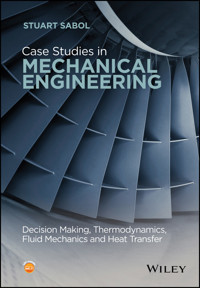
Using a case study approach, this reference tests the reader’s ability to apply engineering fundamentals to real-world examples and receive constructive feedback
Case Studies in Mechanical Engineering provides real life examples of the application of engineering fundamentals. They relate to real equipment, real people and real decisions. They influence careers, projects, companies, and governments. The cases serve as supplements to fundamental courses in thermodynamics, fluid mechanics, heat transfer, instrumentation, economics, and statistics. The author explains equipment and concepts to solve the problems and suggests relevant assignments to augment the cases.
Graduate engineers seeking to refresh their career, or acquire continuing education will find the studies challenging and rewarding. Each case is designed to be accomplished in one week, earning up to 15 hours of continuing education credit. Each case study provides methods to present an argument, work with clients, recommend action and develop new business.
Key features:
- Highlights the economic consequences of engineering designs and decisions.
- Encourages problem solving skills.
- Application of fundamentals to life experiences.
- Ability to practice with real life examples.
Case Studies in Mechanical Engineering is a valuable reference for mechanical engineering practitioners working in thermodynamics, fluid mechanics, heat transfer and related areas.
Sie lesen das E-Book in den Legimi-Apps auf:
Seitenzahl: 404
Veröffentlichungsjahr: 2016
Ähnliche

















Table of Contents
Cover
Title Page
Foreword
Preface
Introduction
Case 1: Steam Turbine Performance Degradation
1.1 Steam Turbine Types
1.2 Refresher
1.3 Case Study Details
1.4 Case Study Findings
1.5 Decision Making and Actions
1.6 Closure
1.7 Symbols and Abbreviations
1.8 Answer Key
References
Case 2: Risk / Reward Evaluation
2.1 Case Study
2.2 Background
2.3 Gas Turbine Operating Risks
2.4 Case Study Evaluations
2.5 Case Study Results
2.6 Closure
2.7 Answer Key
Reference
Case 3: Gas Turbine Compressor Fouling
3.1 Background
3.2 Case Study Details
3.3 Case Study Results / Closure
3.4 Symbols and Abbreviations
3.5 Answer Key
References
Case 4: Flow Instrument Degradation, Use and Placement
4.1 Background
4.2 Case Study Details
4.3 Exercises
4.4 Closure
4.5 Symbols and Abbreviations
4.6 Answer Key
Further Reading
References
Case 5: Two-Phase Hydraulics
5.1 Background
5.2 Case Study Details
5.3 Exercises
5.4 Closure
5.5 Symbols and Abbreviations
5.6 Answer Key
References
Case 6: Reliability and Availability
6.1 Background
6.2 Case Study Details
Exercise
6.3 Closure
6.4 Symbols and Abbreviations
6.5 Answer Key
Reference
Case 7: Efficiency and Air Emissions
7.1 Background
7.2 Case Study Details
7.3 Refresher
7.4 Objective
7.5 Exercises
7.6 Closure
7.7 Symbols and Abbreviations
7.8 Answer Key
References
Case 8: Low-Carbon Power Production
8.1 Background
8.2 Refresher
8.3 Case Study Details
8.4 Closure
8.5 Answer Key
References
Case 9: Heat Exchangers and Drain Line Sizing
9.1 Background
9.2 Reading
9.3 Case Study Details
9.4 Closure
9.5 Symbols and Abbreviations
9.6 Answer Key
Further Reading
References
Case 10: Optimized Maintenance
10.1 Background
10.2 Refresher
10.3 Presentation Techniques
10.4 Reading
10.5 Case Study Details
10.6 Closure
10.7 Symbols and Abbreviations
10.8 Answer Key
Further Reading
References
Case 11: Project Engineering
11.1 Opening
11.2 Background
11.3 Project Planning and Definition
11.4 Executing the Project
11.5 Closure
11.6 Answer Key
Reference
Case 12: In the Woodshop
12.1 Background
12.2 Case Study Details
12.3 Closure
12.4 Glossary
12.5 Solutions
Further Reading
References
Appendix
Glossary
Index
End User License Agreement
List of Tables
Chapter 01
Table 1.1 Turbine performance data – Part 1.
Table 1.2 Turbine performance data – Part 2.
Table 1.3 Turbine flow function results.
Chapter 02
Table 2.1 Example data for tornado diagram.
Table 2.2 Answer – section 2.4.5, sensitivities.
Chapter 04
Table 4.1 Flow equation units of measure.
Table 4.2 Constants for linear thermal expansion factor for temperature in (°C).
Table 4.3 Flow measurements and instrumentation.
Table 4.4 Answer, section 4.3, number 4.
Table 4.5 Answer, section 4.3, number 4.
Chapter 05
Table 5.1 Resistance coefficients.
Table 5.2 Suction specific speed – typical ranges.
Table 5.3 Depropanizer reboiler parameters.
Chapter 06
Table 6.1 CHP/LNG terminal integration.
Chapter 07
Table 7.1 Fuel emissions rates and weighting factors.
Table 7.2 Service territory average generation mix.
Table 7.3 Fuel gas composition and heating values.
Table 7.4 Gas turbine performance data at 59 °F.
Table 7.5 Ambient air composition.
Table 7.6 Gas mixture molecular weight.
Chapter 08
Table 8.1 Availability factors.
Table 8.2 Development periods.
Table 8.3 Powder River basis coal and petroleum composition.
Table 8.4 System generation mix.
Table 8.5 LCOE calculation inputs.
Table 8.6 System LCOE calculation.
Chapter 09
Table 9.1 Condenser data sheet.
Table 9.2 Feedwater heater datasheet.
Chapter 10
Table 10.1 Example of waterfall chart values.
Table 10.2 Example waterfall chart calculations.
Table 10.3 High-pressure turbine efficiency test results.
Table 10.4 Economic data.
Table 10.5 Repair cycle optimization.
Table 10.6 Ninety-day wash cycle and capital improvements.
Chapter 11
Table 11.1 Selected properties of HD.
Table 11.2 HD neutralization rates.
Table 11.3 Ton container data and cleanout requirements.
Table 11.4 Biodegradation parameters.
Table 11.5 Material balance results.
List of Illustrations
Chapter 01
Figure 1.1 Alstom steam turbine.
Figure 1.2 Typical axial flow exhaust steam turbine.
Figure 1.3 700 MW ST Hekinan Unit 3, Chubu Electric Power Co.
Figure 1.4 An LP section of a large nuclear steam turbine.
Figure 1.5 Blade tip-seals (US Patent 6926495 Ihor S. Diakunchak).
Figure 1.6 Shaft seal leakage.
Figure 1.7 Tandem Compound steam turbine with extractions.
Figure 1.8 Solid particle erosion.
Figure 1.9 Example: HP expansion.
Figure 1.10 Answer Assignment 2, number 1.
Figure 1.11 Answer: Assignment 3, number 1.
Chapter 02
Figure 2.1 Example ERCOT contour map – real time market.
Figure 2.2 1 × 1 CHP.
Figure 2.3 Rendering of HRSG.
Figure 2.4 A photograph of an installed HRSG.
Figure 2.5 1 × 1 × 1 combined cycle generating plant.
Figure 2.6 Gas turbine cut away.
Source
: Reproduced by permission of General Electric.
Figure 2.7 Compressor consequential blade damage.
Figure 2.8 Failed turbine wheel and consequential damage.
Figure 2.9 Possible decision tree.
Figure 2.10 Example tornado diagram.
Figure 2.11 Answer to section 2.4.4, number 1.
Figure 2.12 Answer – section 2.4.5, tornado diagram.
Chapter 03
Figure 3.1 A Mitsubishi-Hitachi M701J on the factory floor.
Figure 3.2 Gas turbine inlet filtration.
Figure 3.3 Filtration efficiency.
Figure 3.4 Typical atmospheric dust distribution.
Figure 3.5 Ambient temperature correction.
Figure 3.6 Ambient pressure correction.
Figure 3.7 Relative humidity correction.
Figure 3.8 Linear programming solution.
Figure 3.9 Example topic breakdown structure.
Figure 3.10 Answer: section 3.2.2, number 2.
Figure 3.11 Net present value spreadsheet excerpt.
Chapter 04
Figure 4.1 BWR configuration.
Figure 4.2 PWR configuration.
Figure 4.3 ASME flow nozzle.
Figure 4.4 SGU schematic.
Chapter 05
Figure 5.1 Tower setting elevation.
Figure 5.2 Horizontal two-phase flow.
Figure 5.3 Project organization example.
Figure 5.4 Depropanizer tower.
Figure 5.5 Reboiler isometric sketch.
Chapter 06
Figure 6.1 Series reliability model.
Figure 6.3 Parallel system:
x
of
n
required.
Figure 6.2 Parallel process reliability model.
Figure 6.4 System with parallel and series processes.
Figure 6.5 Parallel system with two outputs (“P” power, “H” heat).
Figure 6.6 Initial CHP block flow diagram with power (P) and heat (H) outputs.
Figure 6.7 Modified CHP block flow diagram.
Chapter 07
Figure 7.1 Schematic of gas turbine powered cogeneration.
Figure 7.2 Proposed CHP plant.
Figure 7.3 Existing boiler and feedwater system.
Chapter 08
Figure 8.1 US wind resources.
Figure 8.2 Stacked bar chart of LCOE results.
Chapter 09
Figure 9.1 Condenser LMTD definitions.
Figure 9.2 Steam surface condenser.
Source
: Reproduced by permission of Alstom.
Figure 9.3 Steam condensate flowing to the higher pressure section through a difference in static head.
Figure 9.4 Power plant with an air-cooled condenser.
Figure 9.5 Alstom feedwater heater.
Source
: Reproduced by permission of Alstom.
Figure 9.6 Low-pressure feedwater heater with cascaded and pumped ahead feedwater heater drains
Figure 9.7 Pouring with Froude number greater than 0.3.
Figure 9.8 Condenser, feedwater system.
Figure 9.9 Drain line configuration.
Figure 9.10 Answer: section 9.3.3, number 5.
Chapter 10
Figure 10.1 Maintenance practices.
Figure 10.2 Life cycle maintenance costs.
Figure 10.3 Waterfall chart.
Figure 10.4 Aircraft tire on glass runway, 28 to 88 knots.
Figure 10.5 Efficiency curve fit option.
Figure 10.6 High-pressure turbine efficiency model.
Figure 10.7 Example Visual Basic cost integration program.
Figure 10.8 Graphic results of repair cycles.
Figure 10.9 Waterfall – heat rate.
Figure 10.10 Waterfall – output.
Chapter 11
Figure 11.1 HD composition and structure.
Figure 11.2 Example of a block flow diagram.
Figure 11.3 Example work breakdown structure.
Chapter 12
Figure 12.1 Philadelphia low boy.
Figure 12.2 Floor mounted band saw.
Figure 12.3 Floor model table saw.
Figure 12.4 Plunge router with guide bearing on bit.
Figure 12.5 Band saw setup.
Figure 12.6 Table saw cove setup.
Figure 12.7 Setup, plan and elevation.
Figure 12.8 Asymmetric cove on the table saw.
Figure 12.9 Pennsylvania secretary.
Figure 12.10 Secretary gallery.
Figure 12.11 Scaling cove dimensions.
Appendix
Figure A.1 Adding Developer menu item.
Figure A.2 Visual Basic modules.
Glossary
Figure G.1 Developer tab, insert menu.
Figure G.2 LMTD definitions: counter flow.
Guide
Cover
Table of Contents
Begin Reading
Pages
iii
iv
v
xiv
xv
xvi
xvii
1
2
3
4
5
6
7
8
9
10
11
12
13
14
15
16
17
18
19
20
21
22
23
24
25
26
27
28
29
30
31
32
33
34
35
36
37
38
39
40
41
42
43
44
45
46
47
48
49
50
51
52
53
54
55
56
57
58
59
60
61
62
63
64
65
66
67
68
69
70
71
72
73
74
75
76
77
78
79
80
81
82
83
84
85
86
87
88
89
90
91
92
93
94
95
96
97
98
99
100
101
102
103
104
105
106
107
108
109
110
111
112
113
114
115
116
117
118
119
120
121
122
123
124
125
126
127
128
129
130
131
132
133
134
135
136
137
138
139
140
141
142
143
144
145
146
147
148
149
150
151
152
153
154
155
156
157
158
159
160
161
162
163
164
165
166
167
168
169
170
171
172
173
174
175
176
177
178
179
180
181
182
183
184
185
186
187
188
189
190
191
192
193
194
195
196
197
198
199
200
201
202
203
204
205
206
207
208
209
210
211
212
213
214
215
216
217
218
219
220
221
222
223
224
225
226
227
228
229
230
231
232
233
234
235
236
237
238
CASE STUDIES IN MECHANICAL ENGINEERING
DECISION MAKING, THERMODYNAMICS, FLUID MECHANICS AND HEAT TRANSFER
Stuart Sabol
This edition first published 2016© 2016 John Wiley & Sons, Ltd.
Registered OfficeJohn Wiley & Sons, Ltd, The Atrium, Southern Gate, Chichester, West Sussex, PO19 8SQ, United Kingdom
For details of our global editorial offices, for customer services and for information about how to apply for permission to reuse the copyright material in this book please see our website at www.wiley.com.
The right of the author to be identified as the author of this work has been asserted in accordance with the Copyright, Designs and Patents Act 1988.
All rights reserved. No part of this publication may be reproduced, stored in a retrieval system, or transmitted, in any form or by any means, electronic, mechanical, photocopying, recording or otherwise, except as permitted by the UK Copyright, Designs and Patents Act 1988, without the prior permission of the publisher.
Wiley also publishes its books in a variety of electronic formats. Some content that appears in print may not be available in electronic books.
Designations used by companies to distinguish their products are often claimed as trademarks. All brand names and product names used in this book are trade names, service marks, trademarks or registered trademarks of their respective owners. The publisher is not associated with any product or vendor mentioned in this book.
Limit of Liability/Disclaimer of Warranty: While the publisher and author have used their best efforts in preparing this book, they make no representations or warranties with respect to the accuracy or completeness of the contents of this book and specifically disclaim any implied warranties of merchantability or fitness for a particular purpose. It is sold on the understanding that the publisher is not engaged in rendering professional services and neither the publisher nor the author shall be liable for damages arising herefrom. If professional advice or other expert assistance is required, the services of a competent professional should be sought.
Library of Congress Cataloging-in-Publication data applied for.
ISBN: 9781119119746
A catalogue record for this book is available from the British Library.
Cover image: GettyImages-157641784 – 77studio
This book is dedicated to my wife. She is my companion, my support, greatest believer, and my best friend.
Foreword
Professors teaching engineering and corporate managers teaching entry level engineers will find this book an invaluable resource not found in any university curriculum. The author, Mr. Stuart Sabol, has drawn from his many years in engineering in industry and has enthusiastically written this book in an attempt to complement the engineering knowledge gained from a university curriculum with real complex system engineering problems that were actually encountered in the real world and that impacted both his career and the bottom line of the companies involved.
Stuart Sabol is an engineering expert who was not only intimately involved in but was pivotal to the solutions of some of the most critical and complex problems in large-scale system engineering. In most university engineering courses students are given the problems to solve with only the data required to solve them. This unrealistically hints at the correct solution. In the real world, however, an abundance of information is available or can be determined and thus good engineering judgement is required to determine what information is crucial. The author presents, through his many industry case studies, an abundance of information for each in terms of data, background, photos, and drawings from which a student may draw to determine the best course of action. Mr. Sabol has organized the case studies with a number of special exercises for students or for student teams to perform. The actual resolution for each practical case study is also given for discussion.
I think that the author can be confident that there will be many grateful professors, students and engineering managers who will have gained a broader necessary perspective of real world engineering and the associated multidiscipline approach required to solve the large scale problems frequently encountered in industry.
Dr. William C. Schneider1Endowed Professor of EngineeringTexas A&M University and (retired) Senior Engineer, NASA Johnson Space Center
Note
1
Dr. William C. Schneider is presently an Endowed Professor of Engineering, teaching courses in engineering mechanics and engineering design to graduate and undergraduate students at Texas A& M University. He has a wealth of practical experience gained from 38 years performing critical analysis and design at the NASA Johnson Space Center. Some of his spacecraft components are still on the moon; he has 14 US patents and numerous NASA medals for his achievements. He had sign-off authority for the US space-shuttle flights.
Preface
Being an engineer, husband and father rank highly among my endeavors. I have had great mentors throughout my professional and personal life; and have tried to be a good mentor to those I worked with, and to those close to me. This book is perhaps a completion of that attempt to mentor others to become better engineers.
When I ask someone, “How do you solve a problem?” they look at me and ask anything ranging from “Don’t you know?” to “What problem?” I don’t know the answer either. What I do know is that the more problems I solve the better I am at solving problems. Thus, experience is a valuable teacher. The trouble is, experience takes time.
Reducing the time to gain experience in real-world problem solving is therefore a goal of this work. I have taken from my career the most memorable projects. They are memorable because they were difficult. Memorable because I learned something from each one. Although they may seem difficult, there are paths through the data and seemingly unconnected points that reside in our engineering education. My hope is that these scenarios open doors to problem solving and life beyond the university that will pay dividends in the reader’s career as a mechanical engineer.
The cases in this book are experiences, altered to avoid identification with any owner. Names are excluded. Locations are not mentioned and in many cases transposed across oceans to disguise the original project. It is not my intent to identify anyone but to present a situation that provides a learning opportunity. I anticipate that each chapter, including the problems and outside readings, can be completed in one week as part of a supplement to course studies.
There are people and institutions that have made this book possible, and I would like to acknowledge a few of them. To the contributors of artwork, Mitsubishi-Hitachi Power Systems Americas, EPRI, Doosan, ERCOT, ThermoFlow, Fram, Nooter / Eriksen, Atco, General Electric, Siemens, ASME, Crane, DeWalt, Dresser, Alstom, Triad Instruments, and owners that permitted the use of photographs, I am deeply grateful. Being able to show size, scale, and details of equipment characteristics is a valuable contribution. Thank you.
My engineering and professional mentors are too numerous to recall; however, a few deserve a mention. Charles, it was great to work with you and create a first of its kind. Keith, you directed a mentor / mentee relationship that changed the company, and protected it in a unique project that resulted in a considerable new opportunity. Who says Fortran is dead? Reid, “you can have only one first priority,” “everyone has a contribution to make,” and “there are only two decisions you make in your life” are valuable life lessons that will stay with me. Mike taught me how to appreciate everyone’s opinion, to seek them out, and incorporate everyone’s knowledge. George helped me understand that there is no greater joy than to enjoy what you do. Jo showed me how to progress the work and how to motivate people.
A special thanks to Steve Turns at Penn State. Your feedback was a breakthrough for this book. Also a special thanks to my publisher. Paul, thanks for believing in the book as much as I did, and in my ability to create it.
Stuart Sabol PE, PMP
Introduction
This volume of Case Studies in Mechanical Engineering strives to bring real-life experiences to students, recent graduates, and those seeking to continue their education either formally or on their own. These particular cases depart from traditional engineering case studies in that they are not evaluations of failures, and do not try to explore the field of engineering ethics. Instead, the author has drawn from his years of engineering to present those cases that affected his career and brought about new understandings in the field and practice of mechanical engineering. All deal with engineering’s impact on a company’s earnings and profit.
Lesen Sie weiter in der vollständigen Ausgabe!
Lesen Sie weiter in der vollständigen Ausgabe!
Lesen Sie weiter in der vollständigen Ausgabe!
Lesen Sie weiter in der vollständigen Ausgabe!
Lesen Sie weiter in der vollständigen Ausgabe!
Lesen Sie weiter in der vollständigen Ausgabe!
Lesen Sie weiter in der vollständigen Ausgabe!
Lesen Sie weiter in der vollständigen Ausgabe!
Lesen Sie weiter in der vollständigen Ausgabe!
Lesen Sie weiter in der vollständigen Ausgabe!
Lesen Sie weiter in der vollständigen Ausgabe!
Lesen Sie weiter in der vollständigen Ausgabe!
Lesen Sie weiter in der vollständigen Ausgabe!
Lesen Sie weiter in der vollständigen Ausgabe!
Lesen Sie weiter in der vollständigen Ausgabe!
Lesen Sie weiter in der vollständigen Ausgabe!




