


15,99 €
Mehr erfahren.
- Herausgeber: Parkstone International
- Kategorie: Geisteswissenschaft
- Sprache: Englisch
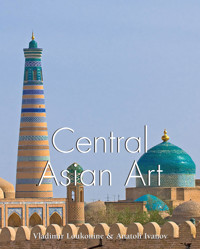
The strict prohibition on the representation of the human form has channeled artistic creation into architecture and architectural decoration. This book is a magical tour through Central Asia - Khirgizia, Tadjikistan, Turkmenia, and Uzbekistan - a cradle of Ancient civilisations and are pository of the Oriental arts inspired by Buddhism and Islam. There are magnificent, full-colour photographs of the abandoned cities of Mervand Urgench, Khiva, the capital of the Kharezm, with its mausoleum of Sheikh Seid Allahuddin,and, the Golden Road to Samarkand, the Blue City, a center of civilisation for 2,500 years.
Das E-Book können Sie in Legimi-Apps oder einer beliebigen App lesen, die das folgende Format unterstützen:
Seitenzahl: 121
Veröffentlichungsjahr: 2015
Ähnliche















Author:
Vladimir Lukonin and Anatoli Ivanov
Layout:
Baseline Co. Ltd
61A-63A Vo Van Tan Street
4th Floor
District 3, Ho Chi Minh City
Vietnam
© Confidential Concepts, worldwide, USA
© Parkstone Press International, New York, USA
Image-Barwww.image-bar.com
All rights reserved.
No part of this publication may be reproduced or adapted without the permission of the copyright holder, throughout the world. Unless otherwise specified, copyright on the works reproduced lies with the respective photographers, artists, heirs or estates. Despite intensive research, it has not always been possible to establish copyright ownership. Where this is the case, we would appreciate notification.
Vladimir Lukonin and Anatoli Ivanov
Central
Kazi Zade Rumi Mausoleum.
Contents
A Brief Glance at History
Architecture
Triumph of Islam
The art of decoration
Predominance of religious art
The golden age of the builders
Tradition and modernity
Sculpture
Statuary
Hellenistic contributions
Buddhist influence
Khwarezm sculptures
Sogdian sculptures
Bactrian sculptures
The early Middle Ages
Buddhist art
Mythological art
Megalithic art
Figurines
Ossuaries
The revival of independant art
Monumental Painting and Illumination
Monumental painting
Palace frescos
Illumination
Styles
The schools
The modern miniaturists and their successors
The Decorative Arts
Ceramics
Antiquity
The Middle Ages
Modern times
Metals
The Middle Ages
The art of engraving of Tokharistan
The art of engraving of Kharezm
The art of engraving of Sogdian
The art of engraving of the north-east
Post-Mongolian times
The contemporary period
The Goldsmith’s trade
Antiquity and the Middle Ages
Modern times
Schools of the goldsmith’s trade
Women’s jewellery
The Craft industry
Glass
Ivory work
Woodcarving and painted wood
Felt-working
Carpet weaving
Printed cloth
Embroidery
Leatherwork
A general picture of popular crafts
Three Pearls on the Silk Road
Samarkand
The Blue City
Bukhara
The Citadel of the Arch
Khiva
Cultural Capital of Kharezm
Map of Central Asia
Index
Fresco, Abdul Aziz Madrasa.
A Brief Glance at History
Central Asia, ancient territory where nature offers contrasts different from any other area of the world, traditionally regroups four republics of the community of Independent States: Kyrgyzstan, Tajikistan, Turkmenistan, and Uzbekistan, extending from the Caspian Sea to the Chinese border. Broad deserts and flourishing orchards and vineyards, snow-covered mountains and green valleys, old abandoned cities, traditional villages and modern towns proud of their past – often several thousand years old, and with famous monuments – may be found here. Centre of successive civilisations and multiple cultures, this vast area claims an exceptional architectural, artistic, and handicraft heritage.
Ever since the Bronze Age and the beginning of the Iron Age, Central Asia has rivalled with classical Eastern Asia (which extended from Mesopotamia to India) in the abilities and skills of its peoples. In the 6thcentury BCE it was largely conquered by the powerful Achaemenian Dynasty and in the 4thcentury BCE by Alexander the Great’s army which gave it considerable artistic impetus. The period between the 3rdcentury BCE and the 3rdcentury CE marked the area with the appearance of powerful Kingdoms: the Parthians of the Arsacid dynasty (south of Turkmenistan, in Persia, and in part of Mesopotamia), the Greco-Bactrians, the Kushans (which included Bactria and the territory beyond Amu-Daria as far as the Indus and the Ganges), the Kangas (that united the Kharezm, the Sogdian, and the northern territories) whose social and cultural development founded an entirely new cultural impulse throughout the territory they controlled.
If the development of the arts in Central Asia was closely linked with their neighbours, this period was nevertheless marked by a conjunction of influences, Hellenistic, Indo-Buddhist, and South Persian, whereas in the North-East, the central territories, the Sakas, and the Scythians, left the imprint of their own traditions. But the local artists didn’t satisfy themselves with copying shapes and designs alien to them, but modified, according to their sensibility, the forms and the content of foreign cultures. They worked with their own ancestral techniques and according to their aesthetic sense and ideology, thus giving birth to a new art profoundly original at the threshold of the 4thcentury BCE.
The Ark, fortress walls. Bukhara, Uzbekistan.
The fall of the ancient empires of Central Asia and the invasions of the 4thand 5thcenturies by wandering tribes from the North predetermined the establishment of a new social order, an intensive feudal system, and the constitution of a great number of semi-independent principalities. It was a period of domination by rich landowners who lived in innumerable fortresses scattered in the plains and mountains. One of the most remarkable characteristics of this renewed social system was the formation of a particular type of medieval culture in the towns, then few in number, and the development of many crafts in different artistic areas.
The political dismemberment encouraged the conquest of the region by the Arabs and its submission to the caliphate power from the 7thcentury. It was at this time that all the countries between the Amu Darya and Zhetysu (previously known as Semirechyez, the Seven Rivers region) was named Mavera-un-Nahr. The south of today’s Turkmenistan became a part of the Khorasan region. From this time, only Khwarezm retained its former name.
A part of the patrimony, including mural paintings, sculptures, and representative figures opposed to the Arab laws about ornament, was destroyed during that period, but at the same time, many aspects of artistic life were influenced by Muslim culture.
During the 10ththrough 12thcenturies, art was once again faced with many sudden changes. Ancient traditions were abandoned, the development of monumental paintings and sculptures ceased, and the ornamental, decorative style common to all Islamic countries in architecture and the applied arts became the main source of creation. On political grounds, the local noblemen, even if they were nominally subjects of the caliphate, began to conduct their states with total independence from the 9thand 10thcenturies.
At last, at the beginning of the 11thcentury, following the numerous Turkmen invasions, the Turkmen dynasties established themselves in this region. This period favoured the development of urban culture and the growth of towns, among which Merv – today abandoned – Samarkand, Khiva, and Bukhara remained representative of the essential spirit.
Around 1150, the architecture of Central Asia was monochrome, but in the middle of the 12thcentury blue brick began to be used and considerable progress was made in the art of building and decorative ornamentation.But the Turco-Mongol invasions at the beginning of the following century put a stop to all artistic development for almost a hundred years.
Tilya-Kori Madrasah.
The Ark, fortress.
Gur-e Amir Mausoleum. Samarkand, Uzbekistan.
It was only at the end of a slow revival that a renewal began to appear in the 15thcentury, under the reign of Tamerlane and the Timurids, today considered the most sumptuous of the artistic patrimony of Central Asia. The edifices from that time are characterised by their decorative aspects and the richness of colour of the glazed ornaments.
The palette of the ceramic surfaces became more and more varied, with a predominance for turquoise blue. Under Timur, in the 1470’s, Samarkand experienced a great development in architecture, which is a testimony to the power of the self-namedEmir, or commander.
The edifices of this time are remarkable for their monumental conception intended to strike people’s eyes and hearts. The variety of decorative techniques, glazed bricks, majolica tiles, and sculptured baked clay are proof of a great artistic mastery. With similar ideas concerning the edifices meant for worship, buildings for different purposes were also erected for the comfort of the population: takis and tims or copula galleries for trading caravanserai; public baths, bridges, and sardobas or water-cisterns. The latter were of more modest proportions and surfaces.
These traditions continued for two centuries, under the Uzbeks of the Cheibanid Khanate and the Ashtarkhanid dynasties. But the weakening of the economic and political links outside Central Asia, victim of feudal internal wars, led to a great social crisis at the end of the 18thcentury.
The effect was deeply felt on cultural activities in every region except in khanate of Khiva where the economic and political conditions remained favourable. It was only during the following century under the Emirate of Bukhara, the khanates of Khiva and of Kokand that culture knew its new Golden Age. It was at the same time, as these two khanates were integrated to the Russian Empire, that the territories of Central Asia took the names of Turkestan and Transcaspian Province.
Following Central Asia’s historic destiny, its creative activities knew another sumptuous rise which was followed by a decline.
Sher-Dor Madrasah, 1619-1639.
Reconstructed yurt for the 1000th anniversary of Manas, a poem about a mythical national hero of the Kyrgyz.
However, despite the period, it was through architecture, craftsmanship and illuminated design of manuscripts that the Uzbek, Turkman, Tajik, and Kyrgyz artists gave the best of themselves. After the October Revolution, Central Asia was integrated into the autonomous Soviet Socialist Republic of Turkestan, which was later, conforming to the principle of national Leninist politics, was divided into four Independent Soviet Republics, until the dismemberment of the empires and their integration in the Central European Initiative (CEI).
New forms of art appeared at this time, such as easel painting, graphic arts, and theatre decoration as well as monumental paintings and sculpture, abandoned years and years before, now enjoying an encouraging renewal. A powerful impulse was also given to the development of traditional applied arts, where modernity combined with the heritage of a faraway past, which was always present.
Summer emcampment on the road
Dome of a mosque with Oriental decoration. Samarkand, Uzbekistan.
Portal and Kalta Minor,
View of Khiva with Kalta Minor.
Architecture
The architectural heritage of Central Asia offers great diversity. The oldest period is characterised by the vestiges of mighty castles, houses, workshops, palaces, and temples decorated with mural paintings and sculptures. Of these edifices nothing remains today except pieces of walls, bases, and fragments of columns or capitals on which can be seen elements of old western or Hellenistic architecture. During the Middle Ages (6th-8thcenturies) particular attention was given to the building of edifices dedicated to worship, palaces, and fortresses. The decoration of palaces and houses with paintings and sculptures was ample and so was sculpture on wood or on stucco, primary elements in architectural ornamentation that was to blossom during the following centuries. The medieval castles constituted one of the most characteristic forms of architecture in Central Asia. Their forms were simple and severe: over a vast terrace of beaten earth, bind walls were raised and sometimes decorated with engaged columns.
Triumph of Islam
Most of the monuments preserved until today, however, have come from a more recent period that coincides with the triumph of Islam. From this epoch until now, we have seen an increase in the construction of secular buildings (private houses, palaces, caravanserais, covered markets) as well as edifices dedicated to the cult (mosques, minarets, madrasahs, hospices for the dervishes) and some that have an intermediary place between civil and religious architecture (mausoleums). This general construction gave the medieval towns of Central Asia their peculiar aspect that we also find in Bukhara, Samarkand, and Khiva, where the mosques’ cupolas, the rectangular portals, the vertical lines, and minarets rise above the lower part of the town, with low-roofed houses and winding alleys. In the monumental architecture, kiln bricks began to be used: not only were they going to assure longer life to the construction, but they were going to play an important part as decorative material. The oldest brick monument is the Ismail Samanid Mausoleum in Bukhara, built between the 9thand 10thcenturies. Its composition is extremely simple: a cube covered by a semi-spherical dome adorned with little corner cupolas.
All the side façades are identical. The base, the central arches, the corner columns, and the arcade are striking. The same clearness is to be found in the inner arrangement: simple lines of the walls with arches above, in an octagonal tambour supporting the central dome. Inside and outside the mausoleum is decorated with an ornamental masonry of bricks. The decoration resulting from the varied disposition of fine square bricks, disks, and rosettes give importance to the principal architectural forms.
Almshouse, Khanqah Faizabad, 16th century.
Ceiling decoration, saodat tea house, 1984.
Main iwan vault, Mir-i Arab Madrasah, 17th century. Bukhara, Uzbekistan.
The art of decoration
The Arab-Ata Mausoleum at Tim (Uzbekistan), dated 977, is the first type of funerary monument with portal and cupola. Its façade is emphasied by a monumental portal topped by a gracious blind arch. The principal ornamentation – brick masonry or sculpted stucco – is concentrated on the portal. Geometrical ornaments (ghirikh) begin to appear as well as the first epigraphic decorations, like the one on the façade. Central Asian people are particularly fond of ornaments. Geometrical and vegetal designs, abstract or epigraphic, cover practically everything – from the portals of the palaces to snuff-boxes. During the 10ththrough the 12thcenturies, geometrical ornaments acquired a theoretical foundation, due to an astonishing impetus given in the East by mathematics and particularly by applied geometry.
From the time Central Asia was drawn into the Muslim orbit, epigraphic ornament acquired an entirely new character. The inscriptions in Arabic – of religious moral inspiration – had a definite goal. Their aesthetic effect contributed to the expansion of the Islamic dogma. But in many cases (as in the Arab-Ata Mausoleum), these inscriptions also contain historical information (dates, names, sometimes the names of the builders). The calligraphers must have written the texts with great exactitude and care for the beauty of the Arabic writing, proportions, harmony, and rhythm. During the 10thcentury the architectural decoration adopted a severe style, with Kufic lettering, and during the 11thand 12thcenturies a more pleasant and complex lettering began to appear as well as other calligraphy with more fluid lines, the naskhi.
Vault, Abdul Aziz Madrasa, 17th century. Bukhara, Uzbekistan. (left)
Pahlavan Mahmud Mausoleum (detail), 19th century. Khiva, Uzbekistan. (right)




