


Erhalten Sie Zugang zu diesem und mehr als 300000 Büchern ab EUR 5,99 monatlich.
- Herausgeber: The History Press
- Kategorie: Lebensstil
- Sprache: Englisch
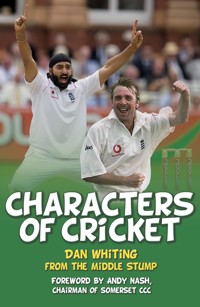
Cricket is a game that has always attracted mavericks and characters. Cantankerous batsmen, lethal bowlers, criminal wicket keepers and philandering fielders feature as The Middle Stump looks at the good, the bad and the potentially dangerous of the cricket world. Dan has interviewed some of the biggest names in the game and those sitting on the knolls in the sun, and has spoken to everyone who is anyone in the cricket world. Now, based on years of cricket fandom and limited ability, he has collected the portraits of the most interesting players from recent years. Written in the same tongue-in-cheek and honest style that we have all come to love from The Middle Stump, this is a great read for all cricket fans.
Sie lesen das E-Book in den Legimi-Apps auf:
Seitenzahl: 233
Veröffentlichungsjahr: 2015
Das E-Book (TTS) können Sie hören im Abo „Legimi Premium” in Legimi-Apps auf:
Ähnliche


















I am really pleased to be writing a few more words for the author of Cricket Banter and Characters of Cricket. The second title is very appropriate as there are some lovely characters in the world of cricket, a lot of whom have been very kind to Melanoma UK in the last few years.
If the second book is half as good as the first, I am looking forward to plenty of anecdotal evidence that will make me smile.
We are grateful to Dan and The Middle Stump team for the continued support of Melanoma UK. Melanoma continues to be a very serious issue in the UK, and through the game of cricket, we have been able to educate many people on the need for a careful approach during hot and sunny weather.
Gill Nuttall, 2015
Melanoma UK
ACKNOWLEDGEMENTS
I would like to thank the following for their help in the making of Characters of Cricket:
My kids, who are my raison d’être – Rebecca, Hannah, Ben and Beth. To John Thorp, for his article on ‘oppo speak’ and being an all-round good bloke for the last thirty years; Andy Nash, the Chairman of Somerset County Cricket Club, who so kindly wrote the foreword for this book; to Liam Kenna, my old partner in crime at The Middle Stump; John Cosgrove, Reckless, Pinstripe Pete, Jamie Parker, Jeff Searle, Paul Ruffhead and Neil Manvell and all the boys in Barnet; to the boys and girls of Southgate Adelaide CC in north London (if Carlsberg did cricket clubs …); Danish, Eros, Sparrow, Worthy, Greg Mackett and many more; Anthony Morris and Adam Whiting; Brian ‘Oz’ Cohen; John Simpson and Gareth Berg at Middlesex CCC; to Graeme ‘Foxy’ Fowler; Matt Maynard for his kind words; the Shantry brothers – Adam and Jack – for their wonderful stories; the legend Steve Kirby at Somerset CCC; the ‘Headband Warrior’ at Yorkshire CCC, Jack Brooks; Ryan Sidebottom, a splendid ambassador for Melanoma UK; Steve Gale and Scott Ruskin at Hertford; Paul Nixon for his general bonhomie; Amy; George Berry, Gena and Ruth; Richard Whiting in Cardiff; Fred Boycott; Paul Mokler; Susan Usher; Nik Myles in Nottinghamshire, and all who have helped us via Twitter; George Dobell for his words of encouragement when starting out; Nigel Walker, Nigel Henderson and the chaps at Guerilla Cricket; John Etheridge of the Sun; all at The History Press; Steve James and Hugh Bateson at the Telegraph for correcting my spelling, grammar and entering into debates with us; Marcus Charman and the Cricket Family; Langwith CC; anyone and everyone who has helped promote us and for their support over the years; and all those who have bought a copy of this book.
Finally to my mum, who gave me the support and encouragement to play this wonderful game when I was a kid: without that, I wouldn’t have written this book.
Gill Nuttall at Melanoma UK and all those suffering from this cruel disease – this one goes out to you.
I tend to think that cricket is the greatest thing that God ever created on earth – certainly greater than sex, although sex isn’t too bad either.
Harold Pinter
CONTENTS
Title
Dedication
Acknowledgements
Foreword
Introduction
Poshest Cricket XI
The Bearded XI
Bad Boys XI
The Beautiful Ones
Cricketing Criminals
Copyright
FOREWORD
One of the most likeable and beguiling aspects of cricket is its characters. C.L.R. James wrote:
What do they know of cricket who only cricket know?
The cast of cricketers here don’t fall foul of James’ concern, as becomes clear pretty quickly. Here we read numerous stories that demonstrate the versatility and breadth of many cricketers’ interests and experiences.
It’s often said that this game is a metaphor for life, and this is reflected many times in the tales of the people who’ve woven the tapestry of the game so many of us love. This book also examines the work of art that is the contemporary product in England and Wales. The recollections of the men and women who adorn our national summer game are rich with humour and camaraderie. Many accounts stir the soul; I found the ‘Prince of Wales’ (Matt Maynard) account did just that for me. In playing with my feelings it did four things: I chuckled, it made me relive an experience, forced me to Google and to reread a eulogy, and the emotions it stirred stung my eyes. It did exactly what a good book should.
Cricket, as we followers know only too well, regularly confounds its fans and pundits. Consider this typical prose from one of Yorkshire’s finest:
The Aussies have spent so much time basking in the glory of the last generation that they have forgotten to plan for this one. It’s just like the West Indies again; once their great names from the 1970s and 80s retired, the whole thing fell apart. The way things are going, the next Ashes series cannot come too quickly for England. What a shame that we have to wait until 2013 to play this lot again.
Geoffrey Boycott
If you take yourself too seriously, the game has the knack of returning you to earth, and often none too elegantly.
However, I am sure that Geoffrey is now aware that since his quote, the Australian team well and truly returned the English lads to earth, and with a bang!
The author, Dan Whiting, is a passionate cricket fan and finds time to chair the redoubtable Southgate Adelaide Cricket Club in Greater London, as well as trying to meet his grocery bills and match fees as a recruitment specialist in the legal profession. Dan has set out to provide a fresh and rather irreverent angle on cricket and the numbers of followers of his site, The Middle Stump, and its social media offspring, are testimony to the niche it’s managed to carve out. It’s also of note that followers and contributors include many past and present cricketers and other notable sportsmen from near and far. These include Graeme Fowler, Matt Maynard, Jason Gillespie, Alan Mullally, Mike Gatting, Paul Nixon and many more who have all contributed to the laughs and jokes included on his web page.
This compendium of characters is a fine addition to the game’s history. It will bring considerable pleasure, and enhance the knowledge of all those who choose to dip into it.
I hope that you enjoy it as much as I do.
Andy Nash, Chairman of Somerset County Cricket Club
2015
character
[kar–ik–ter]
noun
1 the aggregate of features and traits that form the individual nature of some person or thing.
2 one such feature or trait; characteristic.
3 moral or ethical quality: a man of fine, honourable character.
4 qualities of honesty, courage, or the like; integrity.
5 reputation: a stain on one’s character.
INTRODUCTION
Cricket is a game that attracts many characters. From the village green to the professional game – whether it is that maverick amateur from your fourth eleven who always has too much to drink on a Saturday night in the clubhouse, or the bloke who the tabloid press won’t leave alone – there are many throughout this wonderful sport.
It is why I wanted to write this book. For me, cricket is about these people and as much about having a few beers at the end of play as it is watching it on your television. Everyone who has made it into this book has enhanced the game and has put bums on seats: whether they are the good guys, the bad guys or even the ugly, they are the reason why people pay good money to go and watch the sport. Yes, of course there is something of great beauty about a David Gower cover drive, but to me, cricket is so much more than just what is played out on the pitch, and to watch the guys you will shortly read about joke, laugh, snarl, or in other cases, get up to far worse, is why we love cricket.
Many I have grown up with, during an era where the game was less professional and the foibles of your average sportsman were laid bare for the public to see. The idiosyncratic ways of players of yesteryear often make far better material than today’s media savvy, monotone interviewees, but still the odd person from the modern era takes their place in the book.
Many of the stories in this book and my first, Cricket Banter, have been part of my childhood in Hertfordshire and north London club cricket. The days of sides playing it hard but fair on the pitch and having four or five pints together are dying out, and many local club cricketing characters, in turn, are also departing the grass roots scene. I look to write about these anecdotes, and the characters that have influenced my formative years and enhanced my love for the game.
So, what actually defines character? Character is about showing honourable qualities, courage, integrity or moral fibre, or standing out from the crowd. I would suggest that everyone in this book has those qualities. Anyone who has faced a quick bowler or played sport at a decent level will understand what I am talking about. As Theodore Roosevelt famously once said:
The credit belongs to the man who is actually in the arena, whose face is marred by dust and sweat and blood; who strives valiantly; who errs, who comes short again and again, because there is no effort without error and shortcoming; but who does actually strive to do the deeds; who knows great enthusiasms, the great devotions; who spends himself in a worthy cause; who at the best knows in the end the triumph of high achievement, and who at the worst, if he fails, at least fails while daring greatly, so that his place shall never be with those cold and timid souls who neither know victory nor defeat.
Saying that, hats off to the No. 11 who has potted it out for a draw too! Many of those who regularly bat at this number make it into this book, funnily enough. However, the quality that all of the people you are about to read about have is the ability to distinguish themselves from others who have played the game. They are people you remember, the ones that stick out from your childhood, the ones who made you laugh, the ones who you feel a sense of affinity with, and the ones you want to see do well, sometimes even though they are playing for the opposition. To use a modern and vulgar term, they have the ‘X factor’.
From Shane Warne and Ian Botham to Leslie Hylton, the only cricketer to be hanged; or the obscure county professionals from the early 1980s: the mad, like Derek Randall; the bad, such as the match fixers; or the downright ugly (too numerous to name!), these are the people who define the game for me, and are an integral part of why I love this wonderful sport. Whether it is the grace of Gower, the joviality of Phil Tufnell, the sledging of Shane Warne, or Mark Vermeulen with a box of Swan Vestas in his hand, these people were all individuals and stood out from the crowd.
And for that, I adore them.
Dan Whiting
April 2014
I feel when somebody has
been playing cricket for
a long time, he creates a
separate identity for himself.
S.R. Tendulkar
MY HERO
David Ivon Gower was my hero. Whilst not being one of the major characters of the game, he was the man who did it for me as a kid. (I had posters up on my wall.) This is my book so he is going to come first – so there.
I loved Gower, to the extent that I even had a cat called Gower. I first noticed him, David that is and not my cat, during a John Player League game in 1977, one that was affected by rain. All of a sudden BBC2 went from showing the cricket to classical music with a pair of wicketkeeping gloves, and this bored kid had nothing to do. Classical music also is what they would play on Radio 3, back in the day, when the cricket was washed out, and I have had an inbuilt hatred of that bastard Beethoven ever since.
Gower came to prominence in 1978, when England were decimated due to Packer call-ups. The likes of Clive Radley and David were picked to play against Pakistan and, having received a short ball from the trundling Liaqat Ali, he pulled it for 4. Not a bad way to play your first ball in Test cricket now is it? He finished with 58, and had a good season, culminating in a splendid hundred against the New Zealanders later in the summer at the Oval.
Gower was amazing to watch. As someone said, ‘He made it look so easy until he made a mistake. Sometimes the mistake was put off for long enough for him to play an innings of individual brilliance’. His cover drives were a thing of beauty – the lazy flick off his legs, the swivel pull – the whole thing was majestic, almost effortless, and he still remains for me, the most beautiful batsman of all time.
Azharuddin, Mark Waugh, Stephen Fleming all come close, but Gower was my god. Yes, he would nick off to the slips, yes, he would do something stupid, yes, he would throw it away, but in this child’s eyes, he was the main man. Almost to the point where you would be willing Brearley to get out, just so you could watch him bat. I even wished I was left-handed at times.
Gower then had a sparkling 1979, apt for a man who enjoyed the odd glass of champers. A hundred against the Aussies in Perth, facing a fired-up Rodney Hogg was followed up in England by a double hundred against India.
Unfortunately, 1980 was a tough year, and he was dropped having been worked over by the touring West Indians. Despite being picked to tour the Windies, and scoring a magical 154 at Sabina Park in a tour marred by the death of Kenny Barrington, he didn’t score many in the 1981 Home Series against Australia, and was eventually dropped for Paul Parker for the final Test.
It was during this time that Gower was even parodied for the classic TV series Not the Nine O’Clock News, when he dropped an infamous skier during a game. The sketch showed Griff Rhys Jones pushing very hard to defecate in an aeroplane toilet before releasing his stool of gargantuan proportions, then the clip shifted to David dropping the aforementioned ‘bum Havana’.
The 1982 series saw Gower perform well, and in 1983 he scored an amazing hundred in the World Cup. He also took over the England captaincy, firstly as understudy to the injured Bob Willis, before getting the gig in 1984. Unfortunately it was against the West Indies, and England were ‘blackwashed’, losing the series 5–0. Gower even set them 300 once, in less than a day at Lord’s, but Gordon Greenidge saw to that with the most unbelievable double hundred in two sessions.
He managed to keep the captaincy for the tour of India, and led the side extremely well during what can only be described as the most difficult tour ever. The assassination of Mrs Gandhi led to rioting and mass murder across the country. They even went to a party at British High Commissioner Percy Norris’ house, only to wake up and find that he had been murdered the following day. Despite this, they continued and Gower became only the second Englishman after Douglas Jardine to win in India.
The 1985 season can only be described as Gower’s ‘glorious summer’. Skippering a side to beat the Aussies is what every English schoolboy dreams of, and his hundred in the Texaco Series, before the Tests kicked off, was merely the hors d’oeuvres before he tucked into the main course. His 166 at Trent Bridge was my favourite ever Gower knock and has been watched countless times on YouTube. Madonna may have been No. 1 with ‘Into the Groove’ that summer but Gower was seriously in the groove with a double hundred at Edgbaston, his 215 being his highest Test score, before the coup de grâce of 157 at the Oval. To watch Gooch smashing it with his cudgel, and Gower delightfully wafting his wand, caressing it around south London, was to watch the antithesis of batting as they put on 300.
It was after this that it started to go a bit wrong for Gower, although he did lead his side to domestic success in the Benson & Hedges Trophy. Another ‘blackwash’ in the West Indies, and the knives were out amongst the press pack. Mike Gatting soon got the job and, Gower being Gower, famously passed him a t-shirt with ‘I’m in charge’ written on it.
The summer of 1988 was infamous for being the summer of four England captains, including Chris Cowdrey, and English cricket was a complete shambles. Gower continued to churn out the runs, and in 1989 he was reinstated as England captain for the visit of the Aussies, despite the TCCB having promised Gatt the job. Again the press got on his back, so at one point during a press conference he announced that he had tickets to the theatre and promptly walked out. Can you imagine an England captain doing that now? It was another horrific summer, blighted by stories of rebel tours to South Africa and a good Australian team. He lost his job at the end of that year, and it was the beginning of the end for him.
Graham Gooch took over, and his fitness regime never really fitted in with David’s ethos. The famous ‘Tiger Moth’ incident, where he hired a plane from a local airfield before dive-bombing his mate Robin Smith, went down really badly, but not as badly with Gooch as getting out a couple of balls before lunch flicking down the leg side, caught at long leg. When Gower was good, he was marvellous. When he was bad, he was really bad.
Despite getting runs against Waqar and Wasim in 1992, a series blighted by ball-tampering rows, Gower was dropped and, despite some MCC members calling for an emergency General Meeting trying to reinstate him, that was that. Sadly, my cat Gower died shortly afterwards too, and went to the grave with a bit of my childhood. His life mirrored Gower’s Test career, lithesome as a youngster but becoming frail and elderly-looking towards the end. He even started to lose his fur!
Achieving 117 Tests and 8,231 Test runs, with 3,000 in One Day cricket, meant Gower was a legend of English cricket. His fielding was brilliant at times, whether in the covers as a young man before a shoulder injury curtailed his athleticism, and his bravery close to the bat, especially to Edmonds or Emburey, should also not be forgotten. His off-spin, however, can be consigned to the dustbin, although he did manage one Test wicket. He was famous for his declaration bowling in a game for Leicestershire, in which Steve O’Shaughnessy hit the fastest hundred. Gower’s figures were 9–0–102–0!
He finished his career at Hampshire, and he is now the anchor of Sky Sports cricket coverage. I will remember him for his panache, his grace and his wonderful cover drives. Gower was truly my hero as a child, and for that he is first in my book.
A STAR IS WARNE
Shane Keith Warne was born on 13 September 1969 in Melbourne, and revolutionised the game of cricket. Leg spinners were a dying breed up until the 1990s when he exploded on to the scene, and he was certainly the finest bowler that I have ever witnessed. The previous twenty or so years before his arrival within the Test arena were all about pace, with the West Indian battery of quicks, followed by the toe-crushing pace of Waqar Younis and Wasim Akram. Shane Warne changed all that. The beach-blonde young Australian had arrived on the scene, looking as if he had arrived straight off a surfboard, or the cast of Home and Away, and kids went from trying to bowl quickly to flipping it out of the back of their wrist.
Leg spinners were supposed to be dying out, the modern day pitches not conducive to their art, and I had only seen a few in my time. The Australians, Richie Benaud and Terry Jenner, were before my time and Bob Holland was barely good enough, save one performance against England at Lord’s. Abdul Qadir was probably the best that I had seen, although I had listened to the radio as Laxman Sivaramakrishnan span us out in India in 1984. All of the above could be brilliant on their day, but leg spinners were deemed a luxury due to being expensive, and One Day cricket had killed them off. Again, Shane Warne changed that.
A budding Aussie rules footballer, he was let go before arriving in Bristol to play club cricket in 1989. It was here that he first came to light in England, before going back to Australia a few months later, and a few stone heavier having tasted the local cider once too often over that long, hot summer.
It was after his arrival at the Australian Academy that the first of his many indiscretions arose. Once, sitting around the pool in Darwin, three young Asian girls were flashed by members of the team that Warne was playing in. Terry Jenner described it in typical Australian fashion as ‘dropping yer keks and brown eyeing them’, but there were serious implications, and one cannot help thinking that if authority figures had been harder on Shane, would some of his later problems in life have come to the fore?
Jenner himself was what the Aussies describe as a ‘larrikin’, or ‘a bit of a chap’, as we say here in England. He had just come out of prison for a fraud to fund his gambling habit, yet he was Warne’s mentor and guru.
Warne’s career is littered with indiscretions. Some of his sledging has been disgraceful over the years. As a young player, the committed Christian, South African Andrew Hudson, was shocked as, having been dismissed, Warne yelled, ‘fuck off, fuck off, Hudson. Just fuck off!’ He was even more surprised when Shane threw the ball back once to keeper Ian Healy, and the ball was intercepted by Hudson’s wrist, fracturing it and keeping him out for two matches.
Michael Slater was supposedly a good friend and teammate, proud to wear the ‘Baggy Green’ with Warne, but having battled nervous and mental health problems, Slater was astounded to hear Warne and Victorian wicketkeeper Darren Berry sledging him with ‘tick tock’, implying that he was a walking time bomb. This was allegedly from his mate.
Matthew Sinclair, the New Zealander, was another who arrived at the crease in a Test match once to be greeted by Warne screaming, ‘Fuck off, you buck-toothed fuck!’. Chatting with friends afterwards the perplexed Sinclair questioned, ‘what was all that about? I know my teeth stick out a bit but I hardly know the bloke.’
Graeme Smith famously said in 2002, ‘Warnie? He just stands there and calls you a c*** all day.’
Matthew Maynard was told to ‘take that fucking shot back to Wales’, whilst Darryl Cullinan had to visit a sports psychologist, much to the delight of the blond Victorian leg spinner. Then there was the mocking, either of an injured Chris Cairns, or the ability of No. 11 Paul Adams with the bat. Even in later years in England, when at Hampshire, Chris Adams complained that Warne had deliberately set out to humiliate one of his Sussex players in retaliation for a bit of earlier chat. Nothing was sacred to Warnie once you crossed the white line. Even his career finished with him getting fined for almost having a punch-up with Marlon Samuels in the Big Bash League.
Apart from the sledging there were the scandals. Taking money from a bookie in India, with teammate Mark Waugh, would certainly merit a much harsher sentence in this day and age from the Anti-Corruption Unit of the ICC than the slap on the wrists that they received. The two Aussies had claimed it was just for giving the bookies weather reports. Again, the story given in court that the bookie was only known to the two of them as ‘John’ as they received $5,000 and $4,000 each would be looked into far more deeply these days. The Australian Cricket Board were also heavily criticised about their handling of the case, when other boards around the world were being more transparent in their findings. This made Warne deeply unpopular back in his home country for a while, with banners at Adelaide saying ‘I don’t need money to know how hot it is today’, and the Barmy Army getting involved with songs about him.
The English fans had progressed from a fiscal sledge towards him with their witty, ‘He’s fat, he’s round, there’s three dollars to the pound, Shanie Warne, Shanie Warne’, to the tune of ‘My Old Man’s a Dustman’ with:
Mark Waugh is an Aussie, He wears a baggy green hat,
And when he saw the bookie’s cash, he said I’m having that.
He shared it out with Warnie, they went and had some beers,
And when the ACB found out, they covered it up for years.
Another scandal arose from a time when he was supposed to have given up smoking. Having received money for endorsing a ‘non-smoking product’ which helps a smoker to give up nicotine, Warne was then photographed by two schoolboys in New Zealand with a fag hanging out of his mouth. He tried to wrestle the camera from them, using threatening words towards them such as ‘cockhead’ and ‘fuckface’, so the boys claimed, and security and the police were called in yet another sensational drama.
A ban for taking illegal substances was another in a long line of misdemeanours, when he was caught taking a diuretic. A diuretic is something that is generally taken to mask the traces of another drug, perhaps taken to enhance performance. Rather than come clean to the authorities, Warne concocted some story that his mother had given it to him for weight loss, and he had just taken the tablet on a one-off basis. He claimed it was to reduce fluid, as his mother had noticed that he had a double chin in a press conference. He received a one-year ban for his troubles. Weight had often been an issue for the man whose diet consisted of toasted cheese sandwiches, pizzas, tinned spaghetti and twenty cigarettes a day.
Then there was his marriage. Simone Callaghan was a pretty promotions girl when she met Shane in the early 1990s. They married and had three children. Unfortunately, like many other cricketers, Shane struggled with his fidelity and marriage vows, and a string of women have come forward suggesting that Shane had come on to them. His media of choice seems to be the text message, and voicemails and texts sent from him to a nurse in Leicester, implying that he was on the point of orgasm, found their way into the British tabloid press.
Other stories were rife, and there were plenty of women who would be prepared to kiss and tell on the blonde Victorian. One photo, of an overweight Warne in his ‘budgie smugglers’ (as they say in Australia) with a couple of girls, found its way on to the Internet.
On another occasion he shared a night with two young ladies in a hotel in Kensington before heading back down to Hampshire to take seven Middlesex wickets in a resounding victory. Having patched up his marriage to Simone, he then sent a text to her which was meant for another woman and that was the final straw. The man who was a magician with a cricket ball in his hand was a complete fool with a mobile phone.
A relationship with the English model Liz Hurley followed, but even that finished towards the end of 2013 (or the beginning of 2014).
Yet Warne was an absolute genius on a cricket pitch, with a great sense of theatre. No wonder he had the nickname ‘Hollywood’. He generally saved the best for England as well.




